chasing forever-ness

POSTCARD # 481: Singapore: Compassion for those caught in the conundrum of chasing forever-ness – pushing their luggage trolleys, carrying their children, headed for Departures. We are all caught up in the flow, part of the great exodus, on-the-run from what we don’t want, towards what we do want, but never quite getting there, and moving on to somewhere else, then somewhere else. An urgency of thought, searching for an understanding of the way things are, finds that something is not quite right… what is it? Even trying to define it is not satisfactory. This is how it gets triggered – the Buddha’s First Noble Truth from two thousand five hundred years ago, arrives in the here and now of present time: “There is suffering.” It’s a universal reality… not just little old me, fretting over this and that.

Going through the airport security portals; laptop out of the bag, and take off your watch. Remove your shoes put them in the tray then on to the moving belt, shoes get X-rayed. ‘Excuse me sir, show me what you have in your shirt pocket.’ It’s a sheet of capsules, my medicine for the headaches, the tinfoil sets off the metal detector. Jumping through the hoops, getting dressed again and down the narrower and narrower tunnels leading to the seats. Where are we? Look at my number (aisle seat is less claustrophobic). Sit down, seat belt fastened, experience the elongated flying bus with wings. Look out the window as far as I can see, at the small patch of blue sky.

[1st Noble T.] There is Suffering (Dhukka), in the most general sense, encompassing all kinds of slightly distressed states and [2nd Noble T.] it is caused by craving (Tanha); wanting things to be better than they are or different than what they are, or more beautiful, more comfortable, more bearable, less painful, less irritating, less disturbing and a whole range of undesired, unhappy conditions of the mind. But in simply knowing there is a reason for it, a cause, [3rd Noble T.] we find there is a solution to the problem. (Nirodha) This is the key to the locked door… for an instant the suffering is gone! The door is thrust open, sunlight enters the darkness of where I’ve been. So now I know how it works! [4th Noble T.] If I tackle the cause, I can put an end to suffering, by way of the Eightfold Path (Magga).

But today there’s another form of transitional suffering hanging around, a sense of something suspended, isolated, uneasy – why should it be like this? And I start to think it’s the fact that I don’t know why it’s like this, that’s causing the uneasiness. ‘A riddle, wrapped up in an enigma’ [Winston Churchill]. Uncertainty, impermanence, the Ajahn Chah teaching, ‘Not sure’ [mai nae]; poised on the edge of something – a kind of alertness?

This mass of suffering is to do with the upcoming trip to Scotland in about a month from now… and here we are high up in the clouds, on the way to Singapore for a holiday, Jiab and I and our niece M who is now 18. It reminds me that my own departure date to UK is getting nearer and nearer. This brings up a whole range of feelings I haven’t thought about in a long time. Revisiting memories of my less-than-perfect functioning in a dysfunctional family, growing up without a father, a very young mom, more like an older sister than mother, and sharing life with a younger sister, the other chick in the nest.

Living in a household of women and feminine things, the adolescent male falls out of the nest, discovers it can fly and leaves that place there and then. I’ve been away from the North since that time, never went back to stay. I’ve been here and there in the South of England and in Thailand for 38 years – where did the time go?Living in someone else’s country, a permanent foreigner. Now there’s a feeling that it’s been so long since I was in the place where I was born, my ‘home,’ I’ve become a foreigner there too. The loss of my Northern heritage was all my own doing of course, and there’s the regret, remorse and guilt, a burden of suffering I’ve learned to live with all these years. Perhaps visiting it this last time (?) will bring it to a close.

Arriving in Singapore at night, coloured flashing lights, buildings are huge architectural sculptures and everything looks like a celebration. It’s a young person’s city, parties, happy times. Meanwhile I’m engaged with remembered instability, insecurity, vulnerability and there’s this ‘mai nae’ (not sure) out there, neither this nor that.

We sit in a cafe the next day, next to the window and have a scone with butter and jam – oh no, it’s so British! It starts raining, then the sun comes out, then it’s raining again and the AC is so cold… this feels like British weather! I start to realise I’m attached to the historical Thai time-warp, remote from internationalism. I don’t know how I will cope with the cold reality of Scotland. The urgency of thought seeks the safest place to be, the midway point and holding the balance; a place of equanimity in the midst of uncertainty, find a calm abiding there. Allow the suffering to be here – there’s nowhere else for it to go. Let it in. It’s the willingness to allow it a place of its own, that leads to an immediate sense of release, inside and outside… understanding the way things are.

But there’s now the feeling that the Scotland scenario remains an unfinished story. There is the death of ‘self,’ of course, and I can say the self that was lived in Scotland came to its end a long time ago – if it’s an unfinished story, it’s because I’m still holding on to it… time to let the ghosts of that go. The self that I am now, is transparent in the Buddhist sense. Mostly it’s not there at all. Everything that is associated with this body will have its death however, at the end of my allotted time. Other than that, there is the actuality of ‘forever-ness,’ (the unconditioned) things (chittas) evolve, they reform, (annican), become other things in the vast oneness, and there is no ending.

“For many lives I have wandered
looking for, but not finding,
the house-builder
who caused my suffering.
But now you are seen and
you shall build no more.
Your rafters are dislodged and
the ridge-pole is broken.

All craving is ended;
my heart is as one with the unmade.

[DHP. Verse 153 – 154, A Dhammapada For Contemplation]

Photo: Jiab’s pic of the Financial District, Singapore, taken from the Tourist Cruise Boat
multiplicity and diversity 

POSTCARD # 480: Bangkok: The world is functioning everywhere at the same moment. The here-and-now taking place in all other locations at the same time as it is for me right now, in this place… population of the world, 7.753 Billion (2020). Overwhelmed by the immensity of it in terms of ‘Self,’ “the vast myriad of things seen as independent entities” [Buddhadasa Bhikkhu]. “When the mind contains unknowing (avidyā) it inevitably experiences all things as being ‘self.’ It’s not that we make a deliberate effort to consciously establish a self. The ‘self’ is merely a condition that arises when there is grasping and clinging in the mind.” Attempting to grasp an impossibility, and it just gets more and more impossible.

Characteristic proliferation of mind when confronted with an immutable truth; when I understood that the Macular Degeneration AMD in my right eye is a permanent condition and I’d have to have the injections in the eye once a month for the rest of my life, I was reminded of a comment by blogger Jude: “… the mind is creative no matter what the stimuli. Imagination, let loose like a racehorse, goes careering off then is yanked back unwillingly and all kinds of fearful things arise, created by the struggle.”

How to have mindfulness so I can catch that creative awareness before I get hijacked by how bad it seems? But this is the classic “End Of Days” scenario (not the movie starring Arnold Schwarzenegger, no not that one,). It’s the bit where mindfulness steps in and I stop having the injections in the eye, because there are more important things to be considered before the arrival of death itself.

Birth and death, I remember seeing a TV programme about a woman giving birth – it was the first in a BBC series on the human body, about 20 years ago, I remember it was so vivid, I suddenly felt this immediacy of it happening to me: the blinding light, echoing sounds; the coldness, the impact of air entering the breathing passages, inflating lungs? Revisiting the birth experience… emerging into the world,  the first consciousness of where we are now sweeps through, and the body/mind organism is removed from its inner world.

Seventy-five years go by, and even though the mind clouds it over with improvised explanations, and received knowledge, the body sense knows I don’t breathe the air, the air breathes me. I am not looking out through my eyes at the world, the world is looking in through my eyes and enters my inner being. As the Buddha has said, all sensory objects enter the physiological organism through the sense gates āyatana, and sounds are heard, food is tasted, words are spoken, things are done but there is no doer doing the deed – no Self in charge (anatta). The process itself selects the sound, or the sound selects the process, same with mind actions, the words, the thought, the concept appearing in the six external sense bases bāhirāni āyatanāni. That TV film left me quite transformed… awareness is aware of itself, “consciousness is outside the thinking mind, the uncreated.” (Ajahn Sumedho)

I’m saying there is no self but there is the small sense of self associated with a craving for ‘things’ that enter the physiological organism. This is the self that arises in the sensory world, driven by desire and bound by suffering. When I stop thinking about it, it disappears. Not so for most people I see. Everywhere I look the surroundings are populated by people with bowed heads, unable to face the world without their devices, their small window on the inner self. Stuck in the basic functions of interacting with the world of sensory stimuli. The deluded, not-knowing state, attachment to sensory events, caught in the vast myriad of things, beset with random karma…a tangled skein of thread, a woven nest of birds, a thicket of bamboo and reeds. “It is by their not being able to comprehend the dependent origination, that people are entangled like a ball of cotton, and not being able to see the Truth, are always afflicted by sorrow – born often into conditions that are dismal and dreary, where confusion and prolonged suffering prevail. And, they do not know how to disentangle themselves to get out.” [The Buddha’s words on Dependent Origination]

Time is in the mind, space is in the mind. The law of cause and effect is also a way of thinking. In reality all is here and now and all is one. Multiplicity and diversity are in the mind only.

Nisargadatta Maharaj

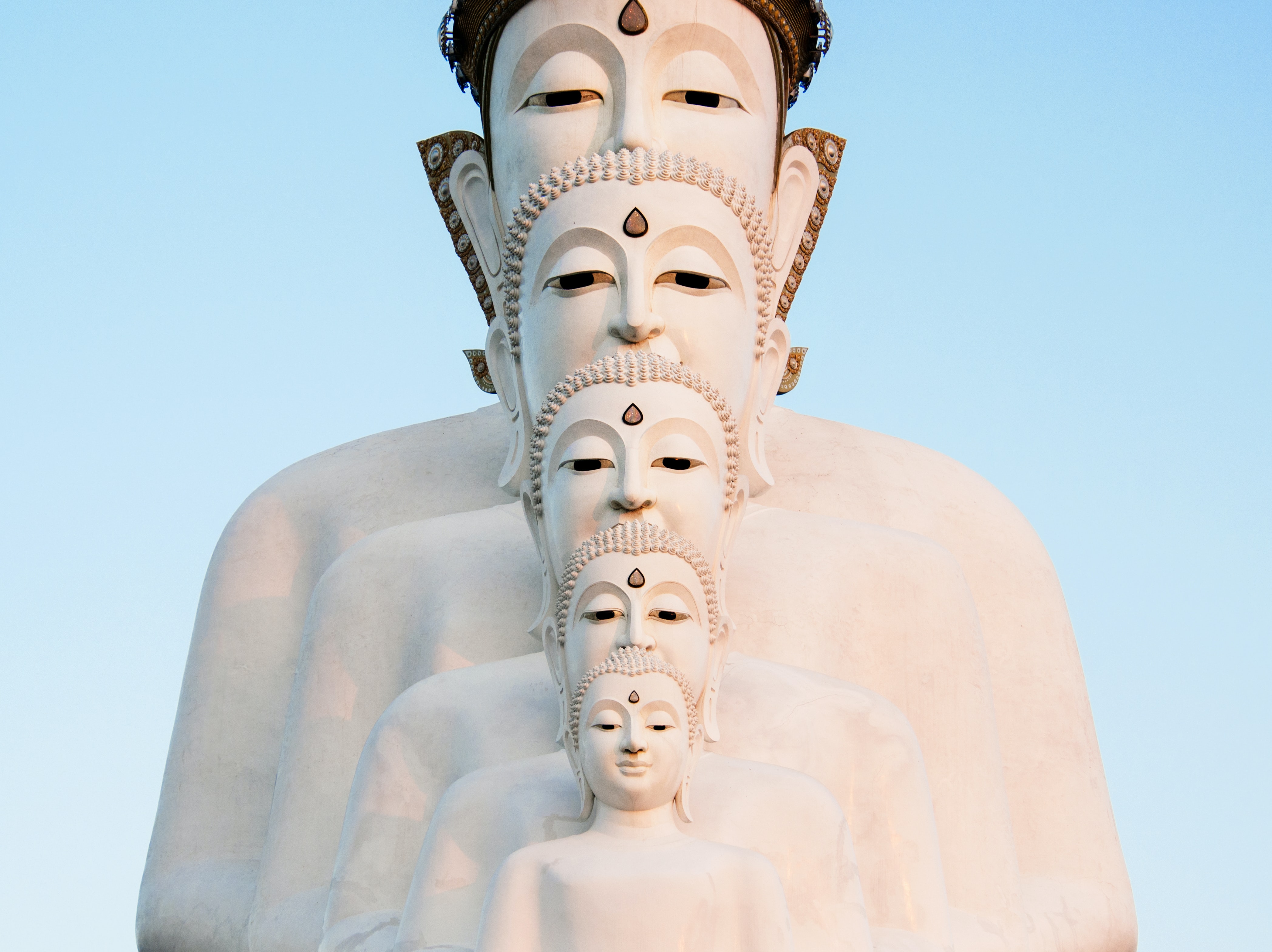
Image Details: Five forms of the Buddha, in Wat Phra Soon Kaew, Phetchaburi, Thailand

there is no ‘there,’ there

POSTCARD #478 Suddenly I’m not thinking about this and that anymore, just sitting quietly here, aware of the in-breath/out-breath. It’s that wait-and-see thing… and when there’s an opportunity, look for a place in the middle ground. Find equanimity in the midst of uncertainty, the balance, the midway point, neither yearning for this nor not yearning for this… find a temporary abiding there.

There’s a plan taking shape; I go back to Scotland for a visit, long enough to see what remains of family. Now that the threat of Covid is over and over, and under and through, we are free to go where we will.

Almost nothing of my UK ‘self’ remains. I have a sister, the other chick in the nest. And a cousin who tries to keep the strands of family together. The others… all gone in the passing years. I remember mother, warm skin-to-skin palms in that cold air-conditioned room, where she came to her end.

Present time is more connected with the past, where we arrived from, than with the future where we are going to; a place of unconfirmed likelihoods, stumbled-upon in following the here-and-now to the there-and-then – a past tense form used to refer to future time.

This returning is likely to reveal some old faces. Always and forever, (the collective ‘we’) are in recovery from to overwhelm, our dwellings lost in the floods of ancient times – the timeless metaphor of Mind overcome in a tide of worries, fears, and things left undone. Sorrow, lamentation and despair; swept along by unrelenting events, surfacing and going under. But it’s an adherence that appears more difficult to unstick from than it is.

Remembering my life as it was then, extending in the mind’s eye, from that existence stretching into the future. Now here in the future foretold, where there is no ‘there’, there. It’s ‘here, and now (always), nothing remains of the past, only the conceptual wreckage of it revisited.

Access the power that immediately releases the tenacity of grip, the jaw clench, tongue adhered to roof of mouth…. unlock, unfasten, undo; the process of having to reassemble the parts of who I am in every new circumstance – inventing a self that’s satisfied at times, happy and sad, dissatisfied other times.

Arriving ‘home’ after 30 years or more, in the tradition of long distance train drivers, itinerant peoples, travelling salesmen, nomadic Bedouin, and outsourced peripatetic teachers of music in rural schools, there’s an immediate opening to the incidental, innovative, event. Start again on a new page.

Rather than seeing it as it is, I’m looking for the ‘story’ that might be there, comparing it with other stories and understanding it all in stories that are composed of other stories. We create a working structure that we believe is nature rather than seeing Nature itself, in the same way as a ‘story’ is understood by a child.

As silence is not silence, but a limit of hearing.
As some strings, untouched, sound when no one is speaking.
So it was when love slipped inside us.
As this life is not a gate, but the horse plunging through it.
The heart’s actions
are neither the sentence nor its reprieve.
Salt hay and thistles, above the cold granite.
One bird singing back to another because it can’t not
[Jane Hirshfield, Come, Thief]

self is not an entity in itself

POSTCARD #477 ‘It was as if lightning coursed within my chest. The impact lasted for a while, and for the next few weeks whenever I saw people, they seemed like a magician’s illusions in that they appeared to inherently exist but I knew that they actually did not.’ [‘How to Practice: The Way to a Meaningful Life’].

The Dalai Lama, in the sixties, reflecting on the Rope Seen As Snake metaphor, phenomena being dependent on conceptuality and his discovery that the “I” exists conceptually, dependent on mind and body; not an entity in itself.

The Buddha identified no-self, [anatta], nobody at home, no self anywhere, anywhen, nowhere, now-here. The world is a construct, look, see, glimpse the nothingness situated at the centre of everything [śūnyatā]. Most people flinch at the thought, because in the West we are taught that the self is real. We are to hold the Self in high regard, a mutual propping-up of the illusion. Everywhere we look, our self-concept looks back at us like a mirror reflection. Our whole environment supports the fictional self, made to measure, tailored to fit, we live in a bespoke world. The Self we know as the body and mind is thought to be not something we ‘are’ so much as something we ‘possess’, I am ‘me’ and this is ‘mine – the opposite of what we are talking about here.

About the Rope Seen As Snake metaphor, there was a time, some years ago, I was alone in the Nontaburi house and I wrote a Post about the illusion: “The house is surrounded by trees, leaves filter a green light all around. There are birds, squirrels, lizards all kinds of critters. I see something move out on the path… is it a bird, dropped down from a branch to peck at something? There, it moves again – just a hop and it’s a few feet further on. I sit very still, don’t want to frighten it away. I see it now, sitting still, not moving. 

After a long time waiting for it to change position, I decide to slowly get up and see what happens when I do that. But it’s still not moving… maybe it’s injured. I come closer… the bird is not a bird, it’s a large brown leaf curled into a shape, and blown by the wind across the surface of the path.  

Step back and look at it again. It looks exactly like a bird, and just then a short gust of wind blows the leaf. The animation of it is absolutely convincing, but I see it now as a leaf, not a bird. How disconcerting, believing that something is there, then having to accept that it’s not.” In the same way, the mind is going around as if it were a bird, but it’s only a leaf in the wind. And we have the idea then that the “I” is a concept, not real. Compassion for those caught in the predicament of believing in the self, I was similarly held, looking for Truth in a battleground of untruths.The assumption is that if ‘I’ am my body, I am my feelings, I am my consciousness – then everything else is out ‘there, and if I’m in ‘here’, disconnected from everything out ‘there’. I’m isolated, alone, anxious – projecting a perceived self that I know, somehow, is not real. I need to resolve this issue of fearful uncertainty so I have a very busy life, work 5 days a week and spend time with friends at weekends. Together we go out and around looking everywhere for indications that align with that ‘Self’ held in high regard, visiting public parks and places of interest, taking ‘selfies’ with a nice background. ’Is everybody in the picture?’ Smile please… click! Everyone comes to see the image on the screen; let’s take another one… click! We all seem to be happy doing this, but there’s still that dissatisfied feeling, seeking a way to have whatever it takes to confirm the identity of that Self (held in high regard). This introspective state of mind allows another kind of ‘self’ to enter the picture, seeing the ‘self’ that is seeking. The seeking ‘self’ turns its attention to the seeing ‘self’ and is, at once, seen.

The self we self-create exists in a distorted reality, each of us as selves at the centre of our own universe. We act in our own self-interest, or as groups of like-minded ‘selves.’ It results in a conflict of interest between those whose lives and interests are, in fact, interdependent. Those of us who have let go of our selfish-selves, are part of a larger network of others, whose pains and pleasures and interests we share.

In a wider context there are scholars and spiritual leaders who say the awakened state is the state of no self. No self is the aspect that pervades all of reality. We are in a totality of consciousness, you can say we are part of God, therefore there is no individual self. When our soul merges with God there is no self – one drop in the ocean.
I am inspired by these speakers and professors and shall continue to listen to their words. In the meantime I’ll go on with the Buddha’s teaching and the ’nuts-and-bolts’ of how the process works, develops, evolves.

‘The deconstruction and reconstruction of the sense of self is necessary to become aware of the most deceptive of meta-narratives: the one we normally do not perceive because it is our ordinary, everyday reality – the ‘real world’ we take for granted but in fact is constructed.’ [David Loy: ’The Great Awakening’(4) 

This post contains sections from two earlier posts:

Rope Seen As Snake

Thoughts Like Clouds.

Also excerpts from a talk by Ishwar Ji Puri

And a paper by Jay L Garfield “Why No Self”

*the space where it hasn’t happened yet

POSTCARD#476: I wake in the morning, fuzzy headedness, the sound of the leaves in the trees rustling and whispering together… blustery winds. Dark sky out there, it’s going to rain. Small birds dash around searching for the place where small birds take shelter. The rain will be heavy, lasting for hours/days. It’s the season of green leaves sprouting in trees, hedges fill out and enlarge, and it’s a novelty for me even though I’ve lived here for many years. I come from the North of Scotland where weather events are not so overwhelmingly generous in such an abundance of plant growth.

Into the shower and pressurized water massages the *headache I live with  – lulled into a relaxed state, mesmerized by the sensation. I am a sensitive being these days, sharp penetrating light frequencies and high pitched squealing sounds activate the headache and it can take some time to recover. Usually I have to take extra meds which cushion the pain but shift me out there… living on the edge.

Step out of the shower and I’m deafened by the downpour on the roof. Sensory mechanisms function without my involvement. There’s just an alertness, waiting for things to arrive in consciousness. Seeing, hearing, smelling, tasting, touching and cognitive functioning held by this immense sound. An all-inclusive experience of awareness itself.

I’ve learned how to see pain in the context of the 4 Noble Truths and focus on ‘The Cause’ of it which I cannot control, but can stay in neutrality; in that small space that’s neither here nor there. Knowing this brings it all to a standstill for a moment, and this is how it is, the awareness of it, simply that.

Stories of past and future arise and the narrative requires me to ‘believe’ in the story before it begins. I’m hovering on the brink of what it could be, still contained inside that little space that’s neither here nor there… do I want to get swept away by an engaging story when I’m quite comfortable being here? It’s telling me I have to get into it, become it, *bhāva,

No thanks, I’m ok here in the space where it hasn’t happened yet, looking into that place in the mind where unfinished stories usually reside, and find instead a curious stretched-out present moment. The strangeness of it, wary and watchful… a trembling awakenedness of an immensity, just this.

Mindfulness of non-becoming. See how that feels here under the roof, with the deafening sound of rain, the distractedness of it, the here-and-now of it… like a nonstop, fierce applause, forever and always in present time, ‘the uncreated consciousness’. I’m merging with the sound, headache hiding in that place where headaches take shelter.

Stormy gusts intrude through doors and windows passing through downstairs rooms and corridors leading to other rooms and through the open doors and windows of neighbors’ houses, I can hear their voices, hear a door slam, see somebody rushing to take in the last of the laundry hanging on the line. Tall trees bending, branches dancing in the wind.

*title inspired by a discussion with Steve T.

*headache: Post Herpetic Neuralgia, Right Occipital Nerve. Seven years now and it’s not as bad as it was, maybe I’m used to it, higher threshold/tolerance *bhāva:  In Thai Buddhism, bhava is interpreted as the habitual or emotional tendencies which leads to the arising of the sense of self, as a mental phenomenon.

wordless and indefinable 

POSTCARD#475: Fragments of a thought pieced together from associated thoughts, memories of a past time brought into present time, together with things thought about in future time. Words can snatch at things, pin them down and try to get them to say what they are (What is this?), in the context of other things already identified in the mind. Any ‘new’ experience is assimilated and the actuality of it is filtered, obscured, cloaked. As Tommy G said, ‘words seem to give the mind a sense of knowing but in awareness knowing is before the word.’ Conscious experience is perceived in an instant, then framed in language and it becomes something else.

Pause for a moment and everything stops, just the circumstance itself – there is only one moment – only one, all the time. I wake up to it every now and then, there and then, here and now in this place and time, but it is always now, the present now, the forever ‘now.’

“Time is in the mind, space is in the mind. The law of cause and effect Is also a way of thinking. In reality, all is here and now and all is one. Multiplicity and diversity are in the mind only.” [Nisargadatta]

I write it in my notebook, and that holds it in time, meanwhile thinking seems to have jumped from the thing I’m thinking about to the next, and there’s only that instant to decide what this new thing is before it becomes something else. In the interval the mind is engaged in ‘thinking it’, everything moves on and I can never seem to catch up. Language is an overlay placed on reality, gives everything an identity, duality, ‘me’ and ‘you.’ Language tells the story, creates a fiction I get lost in. Nothing is what I think it is.

The present moment feels like it’s an immediate event occurring ‘now’, but there’s also a feeling that it comes from somewhere else. Time is a measurement I apply – applied time. Maybe this is something that has not happened yet… it happens later, gets reflected upon and what I think is ‘now’ is actually a moment of hindsight situated in future time.

How can I be sure things are what I think they are when I’ve only just started feeling my way through something not experienced yet? The vast present time – the continuing ‘now’ phenomenon enfolding and unfolding, transforming from the future into past in one continuous surging-through movement that cannot be explained. What a strange mystery it is; future time slides into present time, tomorrow becomes today, ‘now’ falls back into yesterday… something ‘remembered.’

Mind creates a structure to explain time, otherwise how could we understand the enigma of how the past is ‘gone’ and the future has not arrived yet? Hovering on the brink of the smallest pause before it gets there, the empty space of not-knowing what it is, and held like this for an instant…

‘… (the) still point is not in the mind, it’s not in the body; this is where it’s incapable of being expressed in words, ineffable. The still point isn’t a point within the brain. Yet you’re realising that universal silence, stillness, oneness where all the rest is a reflection and seen in perspective…. personality, kamma, the differences, the varieties … are no longer deluding us because we’re no longer grasping at them.’ [‘The Way It Is’, Ajahn Sumedho, page 123]

unsupported consciousness

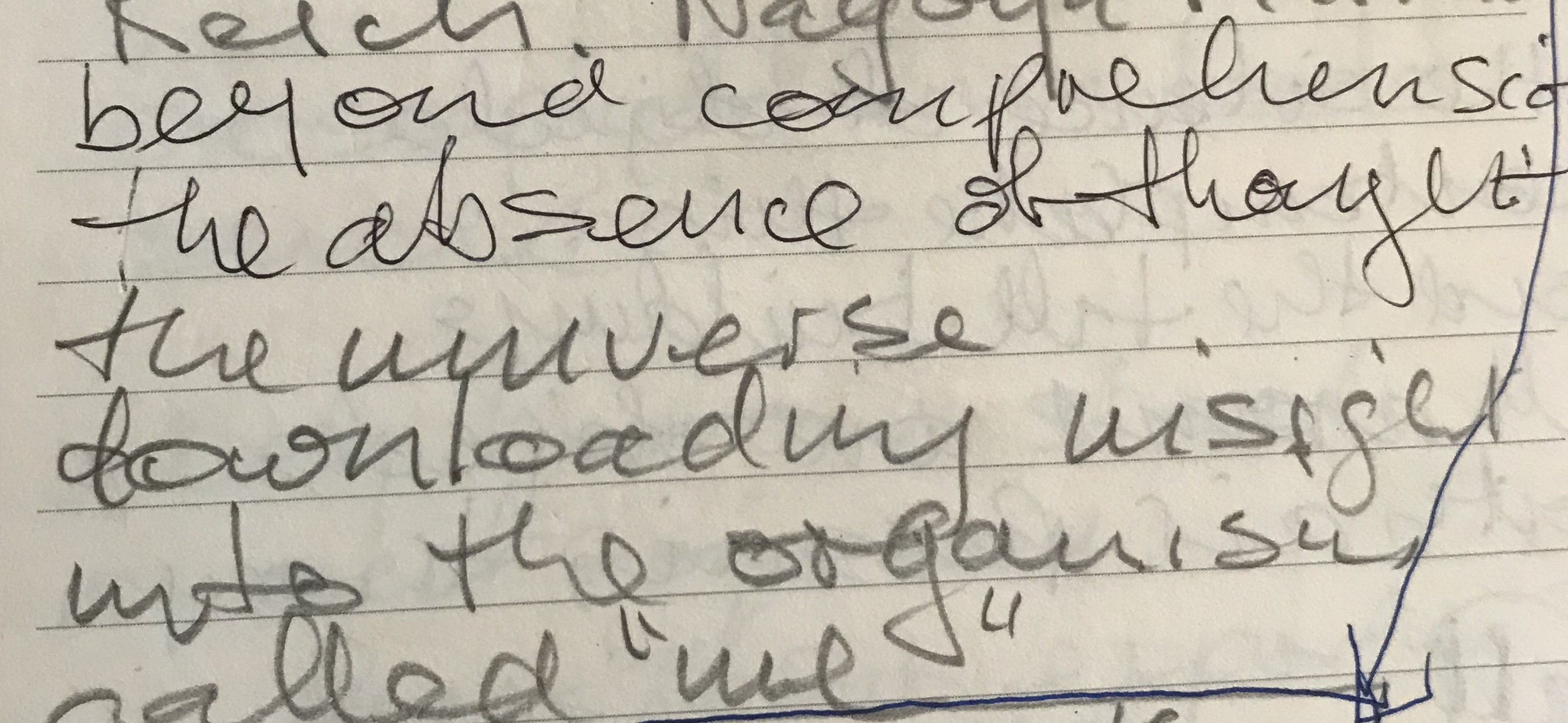
POSTCARD#474: I’ve been looking through my old notebooks, hard-to-read handwriting, scribbled in urgency many years ago – the stream of consciousness, where everything seemed to carry meaning. Not enough space to outline the vast wholeness. This was before our days of phone cameras and scanners. No internet, only books in the library, photocopies for a charge per page. It was all heavy and slow but this was normal for us, we didn’t know anything different. No email, no text-messaging, etc. Only letters folded into an envelope, lick-stick-on stamp… thump, and post in the mail box, then wait for days for a reply…

I left the West in 1982 and that’s how things were then, very different from the East. I used to like to select a postcard to send, a picture on one side; blue sky, a beach, palm trees and on the other side; space for the address, exotic stamps, and not much room left to write. Minimalist choice of words to express what you want to say to the other person, to read and reflect on the present moment and how it is there and then, compared with how it is here and now, in this different place and time. Then stamp… thump, post in the mail box, and there was no reply, usually. The postcard message is a statement… this is how things are. The present moment stretching out into the future and back into the past.

A prevailing sense of Self, of course, running through every part of the configuration – leading to unwholesome attachment to all kinds of unhappy mental states. That’s how it was in Northern Europe, the belief in the self was encouraged. We were not taught about meditation, and structuring the mind in order to see the ‘self’ is a fiction the mind creates. Instead we just muddled along and I could see something was not quite right, but most of the time I was living in a dream; the deluded not-knowing state and random karma: ‘a tangled skein of thread, a woven nest of birds, a thicket of bamboo and reeds…’ The thinking thing gets a hold, loves it, hates it; tries to control it, tries to figure it out.

But I found the way out, I was lucky enough to have a friend and got a few books that helped me understand. Also, meditation where the self is seen for what it is; it appears sometimes, holding on to Mind and Body and if  you don’t let it get attached, then it’s gone: “… the ‘I’ exists conceptually, dependent on mind and body, not an entity in itself (Dalai Lama).  So the Buddha, the Dalai Lama and other enlightened beings are saying, there is no self. That’s how it is if you’ve reached “… the remainderless fading & cessation, renunciation, relinquishment, release, & letting go of that very craving. (the noble truth of the cessation of dukkha) “— SN 56.11 (dukkha nirodho ariya sacca).

For the rest of us still engaged in unhelpful attachment, it’s hard to let go of our years of conditioning. My difficulty with practising ‘no-self’ had been extricating myself from the Judeo-Christian conditioning that assumes the existence of an eternal soul. It still haunts me some nights but I’m okay about that now. I understand everything that arises, ceases. “All dharmas (phenomena) arise in dependence upon other dharmas: ‘if this exists, that exists; if this ceases to exist, that also ceases to exist.’” In other words; if you can accurately remove the cause, then the suffering falls away.

Often it takes place in an unexpected way, the problem is gone and in its place an empty space – the strangeness of it, a luminosity and awareness of immensity. Sometimes it happens if I’m in a dangerous situation say, fast moving traffic behaving in a wild sort of way, I look into the mind and there is this stretched-out present moment! I’m excited and watchful. A trembling awakenedness, it’s like that place,” the zone,” that athletes refer to – not always reachable but I’ve been there, and understand better now, the meaning of the word, ‘śūnyatā,’ when the little sense of ‘me’ is gone and there is only consciousness.

There are different ways of understanding the word ‘consciousness’ and  describing the experience, Ajahn Sumedho calls it ‘unsupported consciousness, an awareness that’s different from the basic functions of consciousness,’ when you are interacting with the world; distant from the usual state of simply being aware of what’s going on in the body/mind.

And beyond all of that is the unsupported consciousness. It’s there that my curiosity is drawn. The thinking mind disappears, no boundaries, a non-conceptual experience… an omnipresent consciousness all through the centuries of present ‘moment-ness’ and there’s so much more to be said about this.

end of the book study, and looking back

Dear Readers. I propose bringing our study of “Mindfulness, Bliss, and Beyond,” to a close now. The text from here on, in my opinion, is intended for those who have a functioning knowledge of the Jhānas. I’m thinking of senior monks who have been practicing for a few decades, or more – those to whom I show respect including, of course, the author of the book, Ajahn Brahm.

So what has been going on here these last few months? We are working on the book versions of the posts, some of them soon to be published, in time for our 10th Anniversary: 2012/ 2022!

There was one ground-breaking post in December 2011 and the actual starting date was January 2012. Special thanks to WordPress for hosting the site and to all our readers, those who have looked, liked and made a comment – those too, who engaged in lengthy dialogue on this humble platform. I’m very grateful.

To celebrate our 10th year, I think we have to re-publish a few posts from that year, beginning with “Jesus and Advaita Vedānta,” posted on July 1 2012

Jesus and Advaita Vedānta

POSTCARD#473: I didn’t know about Advaita Vedānta when I was a child and only recently discovered there were people like Alan Watts (and others) writing about non-duality in the Christian context, Now I’m convinced it is important to focus on the fact that there is something at the heart of Christianity. The uncomfortable feeling that’s followed me all these years – that somehow I missed the point of the Jesus Teaching – all this has gone when I think of the Advaitist aspect of the teaching. It’s the missing piece of the puzzle I just stumbled upon, coming from an Asian perspective, an inductive knowing and that’s how it works.

The reason I didn’t see it before is because the Western concept of God, having human attributes (similar to the Advaitist idea of Ishvara), contradicts the rational scientific view. Accepting something that’s scientifically impossible, just because it’s written down in the Bible, doesn’t make sense. It’s like a myth and that’s why Christianity never had any reality in the West. What’s needed is to take it all a bit further.

“… when human beings think of Brahman, the Supreme Cosmic Spirit is projected upon the limited, finite human mind and appears as Ishvara. Therefore, the mind projects human attributes, such as personality, motherhood, and fatherhood on the Supreme Being. God (as in Brahman) is not thought to have such attributes in the true sense.”

In Western countries, people are wandering around without a map. There’s the shopping mall and that’s all. How to let go of the individual ‘self’ if everything in the system is aimed at getting you to hold on? Looking for the way out by browsing possibilities will take a lifetime. The distractions built-in to window shopping behaviour are designed to keep you ‘shopping’ and prevent you from finding the way out too easily. By the time you get there you’ll have forgotten what it was you were looking for.

“The Advaita Teachings are pointers, offered at the level of the audience, so to some people Jesus would talk about “a mansion with many rooms” and to other people he would say: “(heaven) is within.” (And) without understanding Advaita and the way pointers are adjusted depending on the audience, (most) Christians haven’t a clue what Jesus was talking about ….” 

Those who didn’t fall into the shopping mall trap just took the belief ‘thing’ to pieces to see what it was made of. That’s how it was seen that there was/is no substantial “self” in the centre of consciousness. It’s an operating system that keeps all working parts in the state of  ‘oneness’. “We are, right at this moment, God itself, and we can rejoice in that – if we can break out of our individual identity…” If someone had been able to explain it to me like this when I was a child, the challenge to find out what it could mean would have been enough motivation for a lifetime.

——————————–

Note: I’m including the Jesus Teaching in a oneness of spiritual teaching centred in that geographical region where the three Abrahamic religions arose: Christianity, Judaism, Islam and the connection with Brahmanic religions, Buddhism and Jainism. That region, from North India through to Israel and the Mediterranean, a distance of about 3000 miles, say from New York to San Francisco? I see it like a highway of knowledge, wisdom and information. All of it coming and going along the route many centuries before Jesus was born and many centuries after. All the world’s religions arose here.

The Fourth Jhāna

POSTCARD#472: As the stillness of the knower calms that which is known, the bliss that was the central feature of the first three jhānas changes again when one enters the fourth jhāna. Only this time it changes more radically. Sukha completely disappears. What remains is an absolute still knower, seeing absolute stillness.

From the perspective of the fourth jhāna, the bliss of the previous jhāna as a residual movement of the mental object, and an affliction obscuring something much greater. When the bliss subsides, all that is left is the profound peace that is the hallmark of the fourth jhāna. Nothing moves in here, nothing glows. Nothing experiences happiness or discomfort. One feels perfect balance in the very center of the mind. As in the center of a cyclone, nothing stirs in the center of the mind’s eye. There is a sense of perfection here, a perfection of stillness and of awareness. The Buddha described it as the purification of mindfulness, just looking on (upekkhā sati pārisuddhi) (DN 9,13).

The peace of the fourth jhāna is like no other peace to be found in the world. It can only be known having passed though the experience of the previous three jhānas. That passage is the only way of later confirming that the unmoving peace that one felt was indeed that of fourth jhāna. Furthermore, the state of fourth jhāna is so very still that one remains on its plateau for many hours. It seems impossible that one could experience the fourth jhāna for any less time.

Though pīti and sukha have both ceased in the fourth jhāna and all that is left is the perfection of peace, such an experience is later recognized, upon reviewing, as supremely delightful. The perfect peace of the fourth jhāna is seen as the best bliss so far. It is the bliss of no more bliss! This is not playing with words, trying to sound clever and mystical. This is how it is.

Summary of the Fourth Jhāna

Thus the fourth jhāna has the following features:

1. The disappearance of sukha;

2. An extremely long-lasting, and unchanging, perception of the perfection of peace, reached only through the lower three jhānas;

3. The same absolute rocklike stillness, and absence of a doer, as in the second and third jhāna;

4. The complete inaccessibility from the world of the five senses and one’s body.

The Buddha’s Similes for the Four Jhānas

The Buddha would often describe the experience within the four jhanas by evocative similes (e.g.; MN 39,15-18;77, 25-28). Before explaining these similes, it is helpful to pause and clarify the meaning of kāya, a key Pāli word used in all the similes. Kāya has the same range of meanings as the English word “body.” Just as “body” can mean things other than the body of a person, such as a “body of evidence,” for example, so too kāya can mean things other than a physical body, such as a body of mental factors, nāma-kāya (DN 15,20). In the jhānas the five senses do not operate, which means that there is no experience of a physical body. The body has been transcended. Therefore, when the Buddha states in these four similes, “so that there is no part of his whole kāya unpervaded (by bliss and so on),” this can be taken to mean “so that there is no part of his whole mental body of experience unpervaded” (MN 39,16). This point is frequently misunderstood.

The Buddha’s simile for the first jhāna is a ball of clay (used as soap) with just the right amount of moisture, neither too dry nor too wet. The ball of clay stands for the unified mind, wherein mindfulness has been restricted to the very small area created by the “wobble.” The moisture stands for the bliss caused by total seclusion from the world of the five senses. The moisture that completely pervades the clay ball indicates the bliss that thoroughly pervades the space and duration of the mental experience. This

is later recognized as bliss followed by bliss, and then more bliss, without interruption. That the moisture is not in excess, and so does not leak out, describes how the bliss is always contained in the space generated by the wobble, never leaking out of this area of mind-space into the world of the five senses, as long as the jhāna persists.

The second jhāna is likened to a lake with no external entry for water but with an internal spring that replenishes it with cool water. The lake represents the mind. The complete absence of any way that water from outside can enter the lake describes the inaccessibility of the mind by any influence from outside. Not even the doer can enter such a mind in this jhāna. Such hermetic inaccessibility is the cause of the rocklike stillness of the second jhāna. The internal spring that supplies the cool water represents ajjhattam sampasādanam, the internal confidence in the bliss of second jhāna. This internal confidence causes complete letting go, cooling the mind into stillness and freeing it from all movement. The coolness stands for the bliss itself, born of samādhi or stillness, which pervades the whole mental experience, unchanging throughout the duration of the jhāna.

The third jhāna is described by the metaphor of a lotus flower that thrives immersed in the cool water of a lake. The lotus represents the mind in the third jhāna. Water can cool the petals and leaves of a lotus but can never penetrate the lotus, since all water rolls off. The coolness stands for sukha, and the wetness stands for pīti. So like the lotus immersed in water, the

mind in the third jhāna is cooled by sukha but is not penetrated by pīti. The mind in the third jhāna experiences only sukha. In the third jhāna, the mind continues to experience a rocklike stillness, never moving outside, just as the lotus in the simile always remains immersed within the water. Just as the cool water causes the lotus to thrive, so the bliss of the third jhāna sustains the mind therein. Once again, just as the cool waters in the simile pervade the lotus with coolness from its roots to its tips, so the unique bliss of the third jhāna pervades the whole mental experience from beginning to end.

The fourth jhāna is likened to a man draped from head to toe in a clean white cloth. The man represents the mind, while the cloth represents the perfect purity of equanimity and mindfulness that is the hallmark of the fourth jhāna. The mind in the fourth jhāna is stainless, spotless as a clean cloth, perfectly still and just looking on, purely and simply. This absolute purity of peacefulness pervades the whole body of mental experience, from the start to the end, just as the white cloth completely covers the man’s body from head to toe.

Such is the meaning of the four similes for jhāna, as I (the author) understands them.

Truthful Words to Pacify the Fear of War

Editor’s Note: I’m here with Jiab and M on holiday in Phuket. Some rain and sunshine, Thinking of those less fortunate than I, and the terrible situation in Ukraine. Just this morning I found a beautiful, apt Dharma message from The Great Middle Way blog, and re-blogged it here:

Truthful Words to Pacify the Fear of War

oṃ maṇi peme hum

POSTCARD#471: Victorious Maitreya, sublime and noble Chenrezi, ferocious king Hayagrīva, Jetsün Tārā, and all Holy Buddhas, the mere sound of whose names dispels all fear —compassionate sources of refuge, please hear my prayer!

In this time when individuals experience an oceanic surge of negative karma and jealousy –the age of fivefold decadence and strife– as intense suffering, fighting and quarrelling oppress us, please burn it all in the fires of your compassionate wisdom.

Shower the nectar of love upon those who fan the flames of hatred. Bless them to recognize one another as parents, and thereby usher in auspiciousness and happiness.

May the mischievous unwholesome thoughts that enter the minds of beings and instantaneously transform their hosts into warring demons never hold sway again.

May all who have died in battles, combat, conflicts, and wars immediately give up their indulgence in destructive action, cause and effect, and, having taken birth in the pure realm of Dewachen, lead all to that same Buddha realm.

May all beings have long and healthy lives, be free of quarrels and strife, practice the ten virtues, experience timely rains and bountiful harvests, and may the auspiciousness of the environment and beings increase exponentially.

May these pure, vast prayers be accomplished through the compassion of the Lama, Yidam, and Three Rare and Sublime Ones, Suchness, which by its very nature is utterly pure, and the appearance of things, the undeceiving nature of cause and effect.

—Thangtong Gyalpo