
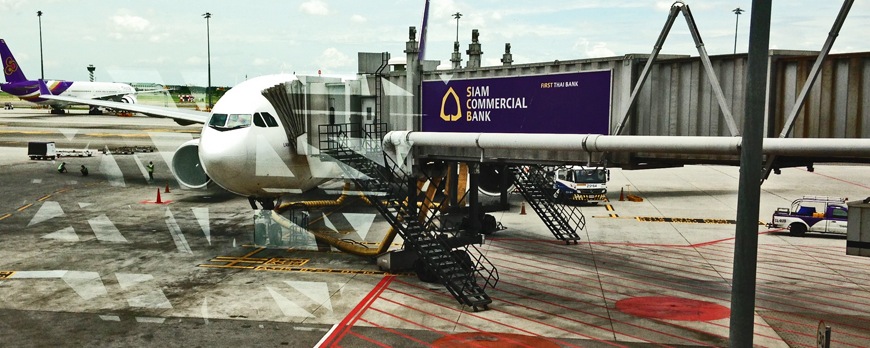
 POSTCARD #118: Chiang Mai/Bangkok flight: Early morning and we have a flight to catch. Some urgency in getting M organized, her bag with tinkling-bell/woolly-teddy-bear appendages and putting on these brightly coloured shoes. Then down in the elevator, along the corridor and all the doors that open different ways… obstacle course. Is it a pull or a push? M says it’s a plush. I simply assume they should all be the same but Western standards don’t apply here (not necessarily a bad thing). There’s a tug, an unyielding shove but we get most of them right, out in the street and the taxi is waiting.
No time, bags flung in and we’re careering through the quiet streets at a surprising speed. Fortunately no rush-hour traffic, it’s a public holiday, Thai New Year (Songkran) and we’re at the airport; suddenly there… it feels like some kind of space/time anomaly has taken place. X-ray machines, no queue at check in, boarding pass issued, more X-ray machines and we’re in Departures with more than an hour to spare.
There’s an old 80s song: ‘…and you may ask yourself, well… how did I get here?’ (Talking Heads). I’m as bewildered as anyone would be at this time in the morning, whatever it is that brought me here. In a larger sense, karma, causality – even though time cannot be excluded, in a manner of speaking. The flight is called, and the announcement that elderly passengers and families with small children are invited to board first. M says: Toong Ting? We can go now, it’s our little joke, because M and I qualify on both counts… so hand in hand we line up behind the wheelchairs. It’s as if I’m being led by M, not the other way round, and in a moment we’re walking down the ramp, on to an empty plane. Enough time to get the bags stowed away and into our seats before the great sea of passengers pours in.
Flight leaves on time, uneventful journey, I ask M if she’s okay, it must be really boring for kids, not being able to see above the high passenger seats. I look down at her small face, and don’t see M, I see her grandmother who died three years ago. M says she’s okay and I get up from the seat; go along the aisle to the tiny toilet at the very end of the plane, a kind of perspective shaped endspace inside the tailpiece of the fuselage. Curious experience, everything is tailored to fit; we live in a bespoke world. Just enough room to turn around see myself in the mirror, believing in this mirror reflection of myself that takes the place of that which is aware. Who am I? No answer required, no seeking, no wanting or needing. Just being with the question.
Back to the seats and M is still there of course. In no time at all we’re landed, bags picked up from the belt, on to the trolley out of the airport, into the car and the family take over from there. I can relax when we get to the house, M is busy changing clothes and getting ready to join the thousands of people out in the streets for the water throwing games. Just before she leaves, M comes to my room with a small bottle of auspicious scented fluid mixed with water and pours a little on my arm and rubs it in, Happy Songkran Toong Ting, runs out the door.

‘There is no memory. There is only the act of remembering.’[Nyanaponika Thera]
————————-



 dhamma footsteps
You must be logged in to post a comment.