
 POSTCARD#50: Delhi: It’s cold here, fingertips touch the keys tentatively, unwilling to make contact. Feeling chilled all the time and can’t seem to get comfortable with this February weather. I just arrived from Thailand, my bag, still unpacked, contains the blue sky and sunshine of white shorts, sunglasses, T-shirts and rubber slippers. Wow it was hot there; I’m reluctant to let go of that nice feeling.
It’s like the world extends only as far as the immediate surroundings of where I’m currently situated and it takes a little time to reassemble things if I move 2000 miles to somewhere else. There’s the tendency to hold on to nice things and I’m particularly reluctant to let go of it this time because the visit to Delhi is only for a couple of weeks, then I go back to Thailand again. So I’m in transit, not really ‘here’, and that’s why I’m making the excuse that it’s not necessary to unpack my bag.
My bag is an extension of ‘me’, it’s my identity, part of the self-construct I’ve created, the same as everyone else’s sense of ‘self’. I feel a fondness for my bag, a familiarity and a connection with that small volume of folded clothing, flattened garments, papers, books and various computer cables, that’ll be zipped up tight, X-rayed and pushed back into its space in the aircraft baggage section along with all the other bags, and away we go back to the sunshine. But that hasn’t happened yet, and I’m stuck here in the cold for a number of days.
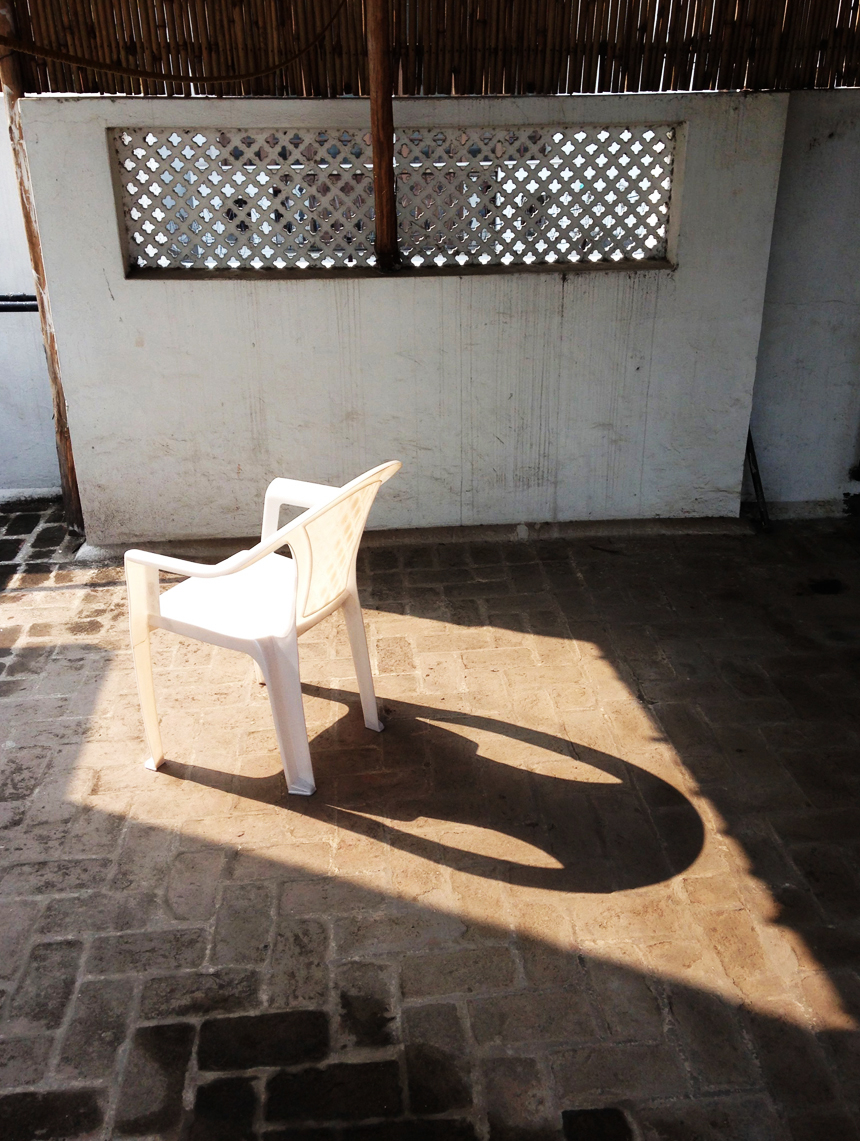
When it’s warm enough I go up on to the roof terrace, to the place where the sun shines through between the buildings and there’s a patch of sunlight where I can sit on my chair. The chair is in the same place it was two months ago and for a moment there’s a kind of presence about that empty chair… déjà vu; the ‘self’ that was there at that time is gone completely, no familiarity with it – yet I remember being here quite clearly. Now I’m sitting in the warm sunshine, recreating a ‘self’ that suits this time and place, for this duration, knowing that soon it’ll be gone too. Phenomena are as they are for a short time and disappear; it’s as if the appearance of everything has the quality of a pencil sketch, a pleasant unfinishedness.
I look at things, and they’re gone – it’s the time needed to process the thought. Objects are experienced not in present time but just as they’re slipping into the past; everything is always seen in hindsight. Conclusions arrived at after the event. Nothing remains. The day I die will be an ordinary day. The moment after I’m gone will be no different from any other. It’ll be like a pause in the middle of a sentence… the focus on the object slips away, the next moment will just be the next moment and things will go on as if nothing happened. The fragility of the world held for an instant then it’s gone, only the space where everything used to be and the silence left behind…
‘Usually when we hear the teaching on not-self, we think that it’s an answer to questions like these: “Do I have a self? What am I? Do I exist? Do I not exist?” However, the Buddha listed all of these as unskillful questions. Once, when he was asked point-blank, “Is there a self? Is there no self?” he refused to answer. He said that these questions would get in the way of finding true happiness. So obviously the teaching on not-self was not meant to answer these questions. To understand it, we have to find out which questions it was meant to answer.’ [Thanissaro Bhikkhu: ‘Selves & Not-self: The Buddhist Teaching on Anatta’]
————————-



 dhamma footsteps
You must be logged in to post a comment.