unforeseen

IMG_0126aPOSTCARD #14: Rutnin Eye Hospital, Bangkok: I just had eye surgery for cataracts and there’s a protective eye shield with cotton wadding taped over my right eye, but I don’t remember anything about it. I remember lying on a gurney in the operating room, and recall chatting with the anesthetist as he’s putting the needle in my arm – then suddenly I’m back in my hospital room with the eye shield taped over the eye and no memory of it at all. I feel normal, the only difference is I know that a newer version of part of the eye mechanism has just been installed; I’ve had an upgrade. But the eye has to stay covered today, so I can’t see anything, except when the nurses take off the shield every hour and I get a brief glimpse; they give me eye-drops then it’s covered again. A great flood of liquid in the eye, slight taste in the mouth as it drains through the tear duct into the back of the throat; swallowing my tears, gulp, gulp…

They take the eye shield off next morning. I get dressed, go downstairs to the outpatients department and through to the exit. The décor in the waiting area is in shades of lime green and ice blue, colours are amazing. Unexpected. There’s a completely clear perception of distance for the first time in many years. Fascinating. I’m distracted by colour and movement at the edge of vision, face turns in that direction, curiosity – an involuntary response. Head spinning like a child or a small animal, noticing all kinds of things. Sense organs filter incoming information. In my case, visual data enters through implanted intraocular lenses (IOLs). I see the world and assume it exists exactly as I perceive it, but I know the lens implant has, to some extent, created my version of the world; perception is subjective, reality is a construct in the mind. I can see a wide range of colours where insects see ultraviolet, reptiles see infrared, and cats and dogs see the world in only two colours. Viewed in this way, the world is suddenly endowed with great mystery; ask the question: ‘what is reality?’ and it takes you to a different place entirely.

Out of the exit, wait for a taxi, on to the highway system and step into a world that looks like it’s been Photo-shopped, high resolution, multi-pixel display. If there comes a time in the future when I’m no longer able to see it in this way because the novelty of it has gone and consciousness doesn’t regard it as special anymore, then I can return here, read this post and remember how wonderful it was…

‘Normally we human beings assume the world ‘out there’ exists just as we perceive it (by way of eye, ear, nose, tongue and physical contact) but if we consider these sense organs, it must become apparent to us that the world ‘out there’ is really dependent on our particular modes of perception. For instance, the human eye limits conditions, by its very structure, the objects we see. It is well known that a bee can see, as a colour, ultraviolet but we have no idea what such a colour looks like nor, of course, can we find any words to describe it. It follows therefore that our sense organs being differently constructed from that of a bee (or any other non-human being), our world “out there” is not necessarily the world as it really is.’ [Phra Khantipalo, ‘Buddhism Explained’ 1965]

————————-

Note: Claude Monet had treatment for cataracts that left him with poor vision. He agreed at age 82 to have the lens of his left eye completely removed. Light could now stream through the opening unimpeded and he began to see – and to paint – in ultraviolet (Water Lilies series). [Link]

uncertainty (mai nae)

IMG_0141POSTCARD #13: Bangkok: Raining heavily at the airport, poor visibility on the highway into town. Traffic moving steadily through the downpour, a large spray of water hits the windscreen, sploosh – like driving through a car wash. Reminds me of Scotland, wild, wet and windy; weather is unpredictable. You expect it to be one thing but it’s something else instead; uncompromising in its insistence that it is what it is – and not what you think it is. Thai language/cognition is like this, so different from the West; making assumptions based on the Western model doesn’t always get you where you want to be.

I explain to the taxi driver where I want to go, saying there are two ways to get there: he can go on the tollway but better to take the turn that gets us on to vipawadi. We come to the place to make the turn, but the driver doesn’t go that way; we pass it…. It takes a moment for me to see what went wrong: he’s thinking the vipawadi turning is the way I don’t want to go, not the way I want to go. All it takes is one small slip in the logical sequence of the language and I get the opposite of what I intended. Ah yes, well, sometimes it’s like that. No holding on unduly to things you expect to be ‘right’ when they prove to be otherwise. After two decades in Thailand, I suppose I’m used to it; a familiarity with not quite knowing what to expect. ‘…many problems are the result of us expecting that there should be a solution.’ [Ajahn Tiradhammo]

Thai semantics are a bit elusive, the language doesn’t stretch the way you’d expect it to. Anticipating reactions to a request, statement or question – not the best way to go. A structure created by words to explain a concept and the assumption is that the listener understands what I’m saying in the way I mean it to be understood, but it doesn’t work like that. Words are just reference points; they’re sort of out there, ready to be shared with everyone. People interpret them in the way they understand it best. Usually it’s the meaning I’m hoping for, but not always. I try to be minimalist, the complexity of it reduced as far as it’ll go. Allow the selected words to carry the meaning and if it’s misunderstood, try to find an indirect way to approach the problem by letting go of the idea that it’s somehow ‘wrong’. This is ‘the land of smiles’, a cultural  tendency to not confront the issue – we become so focused on the ‘should’ we forget the ‘maybe’. The journey takes the time it takes, through the floods and downpour, but we reach the house okay, of course. The sky clears. Rainbows, green leaves in the trees drip crystal drops… soon after that the rain stops.

‘We can easily get caught up in thinking that life should conform to some definite plan. But by keeping a close connection with the truth of uncertainty we can soften the resulting frustration and negativity when the plan doesn’t unfold the way we think it should. We may even gain a clearer understanding of the real nature of plans: mere concepts about possibilities, rather than concrete programmes of actualities. Then whenever we find ourselves having to make plans we do it in pencil with an eraser in hand, and with the clear understanding that many other possibilities are available as well.’ [Ajahn Tiradhammo]

————————-
‘mai nae’, in the Thai language, means ‘uncertain’ – the living expression of the fundamental Buddhist teaching of anicca, or impermanence [Ajahn Tiradhammo]

limitations

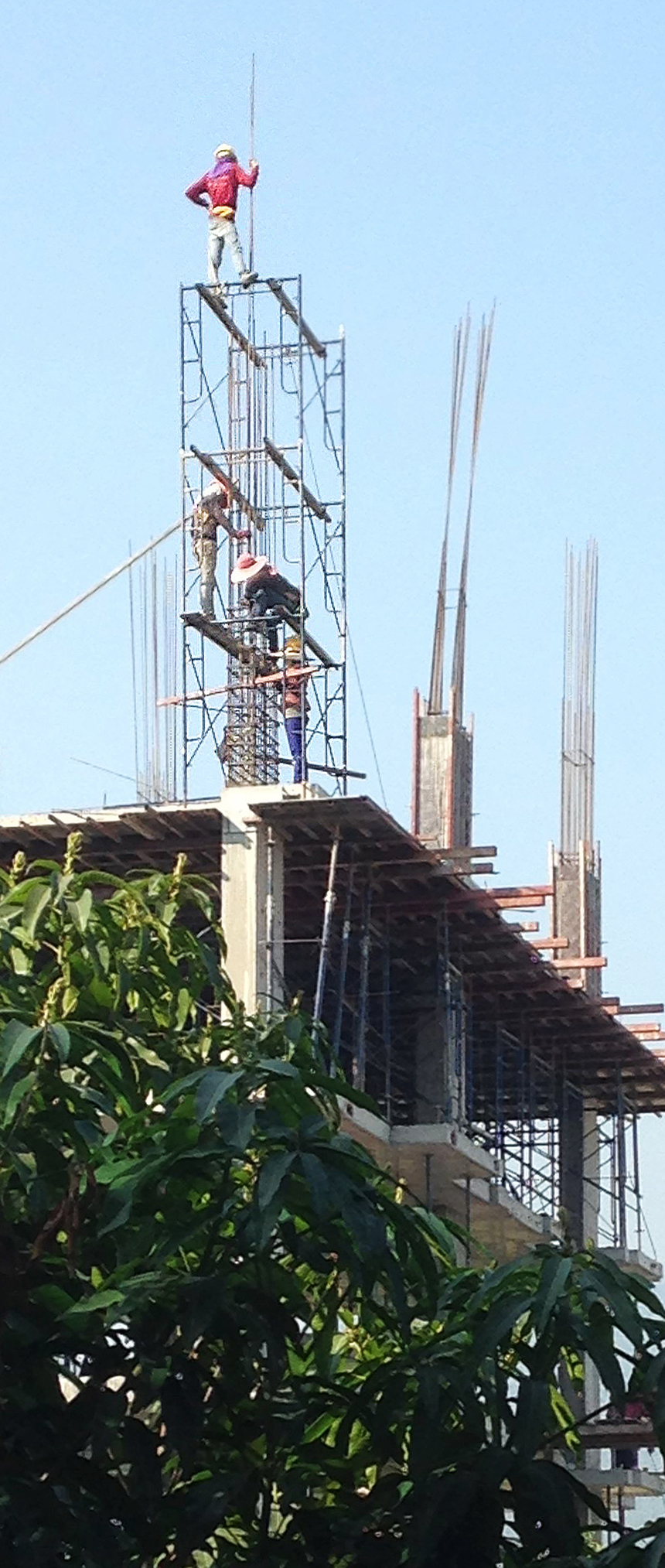
290620131919POSTCARD #12: Delhi Airport Departures: Time to go, I have to finish my coffee… hold cup to lip, tilt head back to drink the last drop, eyes sweep upwards with the movement, and there’s a man standing in the roof structure. He’s cleaning the window glass or doing something. I didn’t notice he was there. Nothing special, it’s just that if we were in Europe, there’d be warning signs, black and yellow tape, fluorescent high-vis vests everywhere, a restricted area below, we apologise for any inconvenience caused, and more staff with their hi-vis vests and hard hats asking the public to keep back. All the necessary precautions to comply with health and safety standards. Over here, the man just climbs up into the roof structure, holding on with his hands, dressed in navy-blue overalls and he does have a hard hat but no more than that. And nobody feels there’s any danger. People are sitting in the coffee shop below and it works okay, relax no problem.

Fine with me too, I like the pragmatic way things are done, intelligent, improvised solutions; repair and maintenance developed to the level of aesthetics, extraordinary to the point of being innovative. It’s a relief to not have the same old limitations imposed on us that we live with in the West: security procedures, systems that back-up systems to protect against liability. What’s left unsaid is that the systems, designed to protect us, create the perceived threat in the mind. Precautions against a hypothetical danger lead to what is thought to be a real danger in present time. A created anxiety, unintended folks, but there you are, we’re really living on the edge here. No need to WORRY… thanks to professional security systems installed at your request, it’s all being taken care of.

Things are not what they seem. The world is an illusion, maya, look in the mirror: consciousness embodied in human form but what I see, more than anything else, is a face, an identity – can this really be me? Wow, a fascination with the concept of self, everybody looking at each other as mirrors of themselves. A lifetime spent chasing elusive sensory yearnings; nothing seen beyond the basic mechanisms of being human. Getting free of it for a moment is enough to understand how it works: mind gets caught up in identifying with the activity. The magician is not tricked by his own magic. Take away all the associated systems, the action is carried out, the maintenance man does his job and what’s so surprising about that?

I take a photo of him just before leaving for the flight departure gate. He has a narrow leather belt, I didn’t notice before, and secures this around his waist and round the roof supports as he climbs up or down to the next section. Then he unclips the belt and works freely. He’s obviously skilled. I can’t imagine there’d be on-the-job training for this kind of profession. More likely it’s an inherited thing; he’s descended from a lineage of South Indian toddy palm climbers, elevated in palm tree branches high above the ground considering questions of a philosophical nature. Time to get on the plane and prepare for the long climb up to 37,000 feet. Strangely comforting to know that when I’m 2700 miles over the horizon, and descending at Bangkok, the maintenance man will still be clambering around in the roof structure at Delhi, simply doing his job.

800px-Palm_tree_climber————————-

‘Thus the illusioned soul identifies with the temporary body and everything connected to it, such as race, gender, family, nation, bank balance, and sectarian religion. Under this sense of false-ego (false-identity) the soul aspires to control and enjoy matter. However, in so doing he continuously serves lust, greed, and anger. In frustration he often redoubles his efforts and, compounding mistake upon mistake, only falls deeper into illusion.’ [The Heart of Hinduism, Maya; illusion]

Lower photo from Wikipedia Commons

non-aversion

IMG_0106POSTCARD11: Delhi: There’s a wasps’ nest in the bathroom at the end of the corridor. I’ve been away for two months, didn’t know it was there and didn’t notice it at first, in the half darkness of 5.30am, walking along to this bathroom we don’t normally use. And wearing glasses because I’ve always worn glasses but since the eye operation it’s all a blur. I forget, put them on and in the darkness, can’t see any difference. Switch on the light in the bathroom, look in the mirror; is this really ‘me’? An awareness of a low humming sound; a multi-frequency buzzzzzz, just on the edge of hearing. Something crawling on the window, what’s that? I have to take my glasses off to see, a strange reverse action I’m not used to, then wait for a moment until vision gets in focus… wow, a wasps’ nest in the bathroom, not good. Back out of there fast, close the door and get as far away as possible from it – closing all doors between me and it. Seeing imagined wasps in faulty vision.

It’s full daylight in an hour and I go back for another look… some kind of large-bodied heavy duty, Indian-wasp-like species; googled it later: ropalidia marginata. The nest is not actually in the bathroom, it’s built on the underside of the top part of the bathroom window, outside… thankful for that, but still kinda scary, even though there’s mosquito mesh on all doors and windows and they can’t get inside the house. I go outside to take a photo but nervous about all the activity so the pic is not clear. The wasps are transparent orange, the nest is grey, a truly colourless grey; remarkable because of its absence of colour. Kind of supernatural, like dust, or ash.

Ropalidia_marginata_2A species so distant from where we are, there’s a reluctance to look at this, yet a fascination with it; more like science fiction than real. The Queen wasp and attendants, baby wasps, larvae, that will emerge from all these small hexagonal openings. Yeh, well… somehow it’s difficult to think of them being cute. Wiki says the females contend with each other for the position of queen. They’ve evolved through aggression and hostility. How to understand this? I don’t know, but keeping a safe distance from it, and mindful of that action – not pushing away. The contemplation of aggressive aversion and the tendency to create a category for things I hate; enemies, difficult people, personality issues at the office – all kinds of other situations worse than that. Social conditioning has made me critical; looking for the fault in people, where to lay blame. Living in circumstances I don’t always feel comfortable with. Seeing what’s wrong, not able to see what’s right. Metta, loving kindness, isn’t a case of: “I love this person, but I don’t love that one.” Metta is non-discriminatory love, all beings have conscious awareness, a shared subjectivity….

Metta is unconditioned love; you don’t have more metta for the nice things and not as much for the bad things, it is evenly distributed: our beloved friends and our detested enemies. The action of metta is unconditioned, it is patience and non-aversion. We accept the pain, disappointment, failure, blame, persecution, abuse and all the experiences we can have in a lifetime. We begin with: ‘May I abide in well-being,’ starting with yourself. It’s an attitude of acceptance and patience with the way it is; accepting the anger, resentment, aversion, or the little petty things.’ [Ajahn Sumedho]

————————-

Lower photo from the Wiki page

intuitive design

110920131975POSTCARD10: Delhi: Going to visit my neighbour who says she can help me with a new sim card for the iPhone5. I got the phone in the UK, and need a Nano SIM for India, the tiny one, rather than the standard size for the Nokia I had before. When I was in London, I had to wait 24 hours for this new NanoSIM(4FF) to be activated – why? I don’t know. Difficult to be without your contacts for that long. But that’s how it is there, no flexibility – in other countries there’s less control. In Bangkok, for example, I needed a Thai NanoSIM for the local network and was thinking it would be the 24 hour waiting thing again but they looked at the screen, clicked a couple of times, went in the back of the shop and came out with the new NanoSIM(4FF). Removed it from the backing card and put it in… working!

Now in Delhi, I need a local SIM and I heard that if you take it to the phone shop and pay Rs.100/- (US$ 1.55) they have a special cutter and it’s done immediately, snip… you’re connected. My neighbour says you can just cut the old SIM with a knife, save the Rs.100/- and it’s better than going downtown in the heat and traffic. I’m hesitating, decide to Google it first. You’re supposed to do a bit of measuring and create a paper template to cut around carefully and then finish off with a piece of sandpaper. Well, my neighbour has a blade, saying, it’s not very sharp but let’s see; I think it’ll do.

I watch as she starts to cut the sim; doing it by eye, no measuring, she has to hack at it a bit with the blunt cutter and finishes off with the kitchen scissors – cut off the little corner bit. Yes! Looks like the real thing. So try that… but it doesn’t fit into the slot in the phone! Why? Because she was thinking it was the MicroSIM(3FF) for the iPhone4 – that’s what she has and thought it’s what I had. But the NanoSIM(4FF) for the iPhone5 is smaller than that… oh-no, what to do now? Worry-worry. But no problem just cut off a bit more to get it to fit. It’s like you offer someone a piece of cake and they say, oh that’s a bit too much for me, can you make it a bit smaller please? No science required. I’m amazed that it’s possible to do this. How come I didn’t know about it? There’s a feeling that I’ve been making life unnecessarily difficult when, in fact, things are quite simple.

Walking back to my place, and nobody pays any attention to me, except the gardeners and ordinary folk who stop and look at me as I pass; an anomaly in their world. It’s a direct gaze, gentle, curious: there goes one of these foreigners, look!… children laugh and run away. White adult male, a colourless being, transparent eyes – comes from a different planet. So far away from the actuality of the human experience, dependent on the employment contract that enables all the support mechanisms. Not much of an idea how to do anything except the job and outside of that, wash the car on Sunday, cut the grass, watch TV. I’m dependent on others who have the basic skills I don’t seem to have. Meanwhile, somewhere inside, there’s this feeling that all it needs is the intuitive leap… and I don’t know how it happens or why it’s like that, the solution just comes to me – like seeing the whole picture all of a sudden, and knowing what it is.

‘Intuition is the supra-logic that cuts out all the routine processes of thought and leaps straight from the problem to the answer.’ [Robert Graves]

————————-

Photo: the finished home-made NanoSim(4FF)

a kind of analogy

IMG_0114POSTCARD09: Delhi: The flight from Bangkok arrives at Delhi mid-morning. I’m identified, processed and out in the crowd. Shym is waiting with the car, bags inside and we’re in the huddle of traffic. Not so much give-and-take, more like push-and-shove. They’re opportunists; mindfulness is a necessity. Same old thing. Looking around, what’s different? An unusual brightness, it’s the lens implant, the operation on the left eye in Bangkok. I have to put up with this one-eyed vision only for a little longer. Next week I go back for the second op. All these flights are possible, fortunately, due to some free airmiles we have to use before the end of the year. And coming back to Delhi means I’m noticing the difference in vision here. So nice, much clearer now through the left eye, it looks… clean? What I thought was urban pollution, may have been obscured vision – or what I’m seeing now is an enhancement, a brightened-up version of everything. Close the left eye and look through the right; that’s how Delhi used to be, a dull, indistinct, old, yellowed photograph. Close the right eye and look through the left again and it’s like the Nat Geo channel, as clear as the iPhone5 retina display, 326 pixels per inch; using the techno-device metaphor to describe reality.

The world is a kind of analogy, a figure of speech, the conceptual metaphor. In my case the lens in one eye is plastic, not God-given – the same as having an artifical leg or a dental crown. Nothing special about it except that you walk around with an artificial leg, you chew with a dental crown but I’m seeing the world through this artificial lens. There’s a difference. The world is coming in, ‘seen’ through the plastic. The lens is a functioning part of the cognitive process.

Light passes through the lens, images appear, mind figures it out based on received experience of similar images, and says, there you go, what you see is like this. It resembles something I know, so I accept it, and that’s what it becomes. The metaphor pushes the whole thing over the edge; one thing becomes another. There’s that thing out there and ‘me’ in here, looking at it; so ‘I’ must be on the receiving end, somehow…. the link creates the metaphorical self; conscious experience ‘is’ individual identity: ‘I think, therefore I am.’

The assumption is that everything coming through the senses is real; sight, sound, smell, taste, touch, cognition – and it’s all coming to (((me))). That’s reality, that’s the point of the exercise. I like it, I want it, I want more of it, and so closing the door on other ways of seeing things. Saying this is how it is, means I get all the joy and pain, the good with the bad, love and hate, heaven and hell – thus I have to spend a major part of my life (maybe many lifetimes) trying to control this craving and desire [tanha] that I accidentally created, thinking I was doing the right thing.

“… craving the ensnarer that has flowed along, spread out, and caught hold, with which this world is smothered & enveloped like a tangled skein, a knotted ball of string, like matted rushes and reeds, and does not go beyond transmigration, beyond the planes of deprivation, woe, & bad destinations.” [Tanha Sutta]

What to do? How to not be a slave to it? Just the intention to be mindful is enough, the tipping point, sufficient to disengage from the automatic reaction. Not caught up in the experience of it, far enough back, one step removed, just knowing it’s there; that’s all. Knowing it takes the place of not knowing it. Step by step, learning how to do it….

————————–

‘… look upon the events occurring in your mind-and-body with the very same impartiality that you would look upon clouds floating through the sky, water rushing in a stream, rain cascading on a roof, or any other objects in your field of awareness.’ [Ken Wilbur, No Boundaries’]

Gratitude to Roger at One Garden for The Ken Wilbur quote above

9/11: a buddhist reflection

680px-911_Tribute_(wiki)The root cause for such an inhuman act is a fundamental lack of wisdom and understanding of the human condition. All human beings are companions in birth, in old age, in sickness and in death. Buddhists may train themselves to cope with that type of situation through stillness, wisdom and reflection.

[Excerpt from A Buddhist Reflection on the Tragedy of September 11’  by Ajahn Jayasaro, 2001]

Buddhism considers the quest for a direct experiential understanding of the human condition as the heart of spiritual life. It employs a vast array of skillful means and ways of reflecting on life, which people of other religious traditions or indeed people of no religious tradition, might benefit. The more profound our understanding of our existence as human beings is, the more we are protected from blind identification with narrow categories, whether they be social, ethnic or religious. We all as human beings have the capacity to reflect on experience, to learn from it. Whatever religion we profess, we can for instance, look at the effect on our mind of the strong attachment to ideas of us and them. Theists, atheists, polytheists are equally capable of observing how the idea of us and them affects how and what information we absorb from our surroundings, how we interpret that information, and how we express ourselves in our actions and words. We can begin to notice our tendency to believe in the labels we attach to things, and what strong negative emotions are conditioned by those beliefs.

As Buddhists, we devote ourselves to learning how to maintain clarity of mind, fundamental compassion and intelligence, as a constant inner refuge. It is not so difficult to be clear about issues which don’t personally affect us, or those which provoke no strong feelings. The real challenge is to be awake even in the midst of a hurricane of emotions — when we are hurt and betrayed, angry and afraid. Clarity of mind means that when things get rough we can still receive the blessings of the principles we uphold. Inner clarity is thus the ground in which the dignity and meaning of life can grow.

An inner refuge does not come easily. It can only be brought about by a thoroughgoing commitment to this life education, a training of the way we live internally and externally. Buddhist teachings are seen then, in summary, not as dogmas to be believed in (or rejected), but tools to be made use of. We use the teachings to understand ourselves and our experiences in life, to understand other people and the world we live in. Then basing ourselves on that understanding, we seek to create as much authentic happiness and benefit for ourselves and others as we can.

It is very easy to brand people who do terrible things as being evil, and perhaps almost as easy to assume that because we find evil acts repugnant, that therefore we are good. But when we look more closely, we see that our bogeymen, the so-called “evil people” sometimes act well and “good people” may, on occasion, act cruelly.

There is no fixed entity, “the evil person”, who is evil 24 hours a day, 365 days of the year. Similarly, (apart from fully enlightened beings), there is no unchangeably good person. That being the case, the most constructive response to the suffering that human beings inflict on each other is surely to seek to understand and affect the factors conditioning the arising and cessation of good and evil in the human mind.

Armed with this knowledge we may then look at ways of reducing the power of evil wherever it arises, no matter whether it be in the group of people that we consider as them, or within the group of people that we consider as us. At the same time, we must be constantly looking to develop and support those qualities – both within that group we consider them and that group we consider us – which are good, wise and compassionate. Our most pressing task though, because nobody else can do this for us, is to look within our own hearts. [For another excerpt from Ajahn Jayasaro’s talk, click on this link: 9/11 (2012)]

————————-

the look of eyes (2)

flightPOSTCARD08: Bangkok/Delhi flight: Large men standing in the aisles of the passenger area look along the length of the plane in one direction, turn the head around and look in the other direction. Hold that for a moment, then look to the left, to the right, and back to the central position: ok, so here we are on this plane… Sensory receptors positioned around the face and the cranium spins around, up/down on its axis, moving in response to received vision, sound, smell. The mind coordinates, thinks about things… ‘60,000 thoughts per day by each and every human being on the planet.’ [Deepak Chopra]. No wonder it’s such a novelty to discover a space where there’s no thought, no stories unfolding in the mind.

Maybe it’s something cultural; the male authority figure standing there like a tall pillar and everyone else is seated. I’m reminded of Meerkats, these cute creatures who stand up on their hind legs and look at everything in a kind of philosophical way. See and be seen. I catch the look, and glance away… a brief encounter, not held; no dialogue: hi how are you today? No, no need for that; no language required to interpret events and engage the mind. Just the look of eyes, and our shared space up here in thin air; a passenger jet travelling at 600 miles per hour, 10 kilometres above the curvature of the Earth.

Bundles of conditioned reflexes squeezed into the volume of a body, the experience of being a human ‘being’ – only this. Seeing the events without the story, like screenshots in a sequence; a few gestures, the meaning is not quite there. It creates a pause, taking a moment to receive that data before mind gains control and ‘self’ gets a hold; before ‘I’ perceive what it is, or what it could be; pleasant, unpleasant, neutral – how should I feel about that? Maybe no feeling at all… It’s as if there’s a small seed of wisdom buried deep in the layers of unknowing; lying there, dormant, waiting for things to evolve and the right conditions to be there, in order to wake up. But it hasn’t happened yet… contemplating the noble truth of waking up in some future lifetime.

I can’t read text, cross-eyed vision after an operation on the left eye. It’ll be okay after the operation on the right eye. Mildly deafened by the white noise of air pressure systems and the velocity of the plane displacing the air. And there’s a stewardess announcement: the plane is now making its descent, this concludes our inflight service, thank you…. [Link to: the look of eyes (1)]

————————-

“And what is the origination of the world? Dependent on the eye & forms there arises eye-consciousness. The meeting of the three is contact. From contact as a requisite condition comes feeling. From feeling as a requisite condition comes craving. From craving as a requisite condition comes clinging/sustenance. From clinging/sustenance as a requisite condition comes becoming. From becoming as a requisite condition comes birth. From birth as a requisite condition, then aging & death, sorrow, lamentation, pain, distress, & despair come into play. This is the origination of the world. [Loka Sutta: The World” (SN 12.44), translated from the Pali by Thanissaro Bhikkhu. Access to Insight, 17 June 2010]

lonesome highway

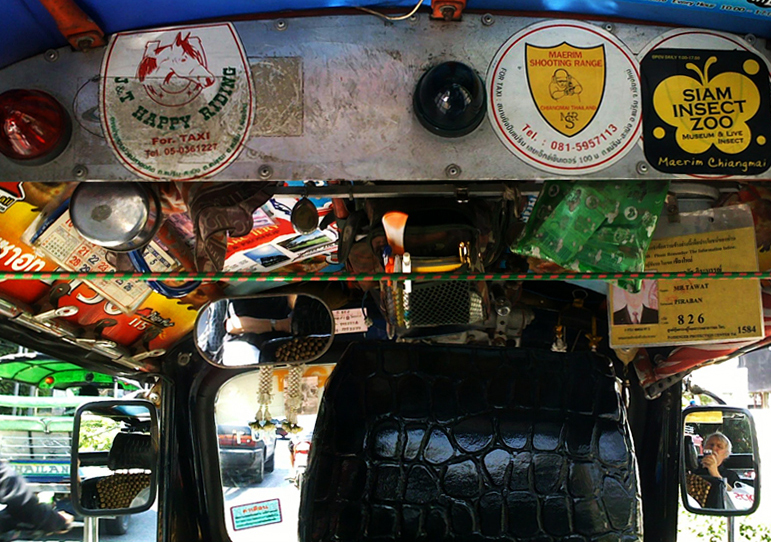
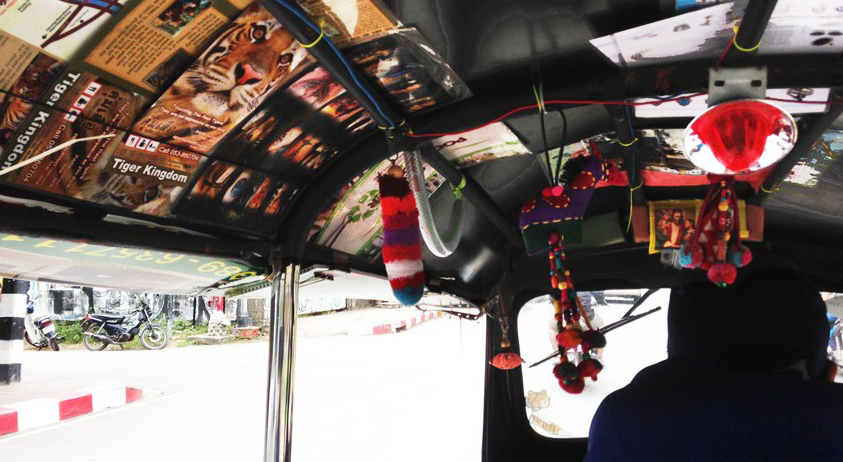
IMG_0063POSTCARD07: Bangkok: Travelling along the highway to the airport in a taxi that has past its best – seen better days. It’s veering off to the left, trembles for a moment then corrects itself. There’s another problem, the driver has it revved-up because the engine stalls when we slow down, so the sound is a bit alarming. We stop at the tollway to pay the fee, engine stalls, driver gets out to push. Fortunately there’s a little slope at the tollbooth and the car moves forward easily. Driver jumps in, ignition on, and the engine comes to life. Big sigh of relief, driver apologizes to me: koh tod khrap, polite. A nice guy, just trying to earn a living with a rented vehicle that’s barely roadworthy. The Thai compassion for this kind of predicament means it’s tolerated more than it would be in other Asian countries.

In a moment we’re accelerating down the road again with this huge noise and there’s still about 20 km to go. I’m thinking that if the engine fails, we’ll have to stop at the edge of this long and lonesome elevated highway with nothing around except sky up above… this really is the middle of nowhere. I drop into a state of alertness; being mindful is exhilarating, the inclination to be awake, watchful. All senses switched on, an awareness that sees also, at the edge of this, some anxiety – the Buddhist term: samvega/pasada describes it – a sense of urgency. There’s clarity too, even though things are not looking good at all.

It’s like a death, just stopping at some place on the road, anywhere’ll do and that’s it, engine conks out. Nothing extraordinary about death; we die and come to life again from one moment to the next. Physical death comes along and instead of coming to life in another moment, we find ourselves in another lifetime. This is how it is, according to what I’ve read, and it could be time’s up for our taxi, it’ll die anytime now. Worst case scenario is waiting in the heat of the tarmac with no air-con running because there’s no engine and hoping another taxi will come along – unlikely… empty taxis don’t normally go out to the airport. What to do? Ah well, miss the flight, I suppose, go tomorrow – yes, but I’m getting ahead of myself here, it hasn’t happened yet.

In the end, the taxi holds on to life and we arrive at the airport okay. Get the bags out of the car with engine still racing and the last I see is the driver heading off in the direction of Arrivals; hoping he’ll pick up another passenger and make it back to the city again. I wheel my luggage into the cool airport and go look for the check-in row. Doorstep to the world. Goodbye Thailand, next stop Delhi…

BKKairport‘The universe I’s (using the word ‘I’ as a verb) in the same way that a tree ‘apples’ or a star shines, and the center of the ‘appling’ is the tree and the center of the shining is the star, and so the basic center of self of the I’ing is the eternal universe or eternal thing that has existed for ten thousand million years and will probably go on for at least that much more.’ [The Essence of Alan Watts, Vol. 4: “Death”]

————————-

Upper photo: approaching BKK tollway. Lower photo: BKK airport departure gate area

constructed reality

sun image2POSTCARD06: Bangkok: Standing outside the house in the shade of a large tree, waiting for the taxi to the airport. The brightness of the sun is tremendous, colours are vivid, the world is a high resolution Photoshop enhancement. After the eye surgery I feel like a nocturnal creature, squinting in the daylight, a quiet presence behind sunglasses. I have an attachment to darkness, I’d like it to be dark, dull and rainy today but instead it feels like I’m in a television studio. The light penetrates everything. There are no real seasons in Thailand, no markers in the calendar to say where we are in the annual cycle. The weather is the same every day. Night comes at 6pm, instant darkness, then at 6am, instant daylight and each day is pretty much like the one before. The days become weeks, weeks become months, months become years. The whole thing is just one very long, continuous day, and night is the blink of an eye.

Time disappears, people are startled to discover they have aged… wake up one day to discover they’re old – life has gone. Rip Van Winkle fell asleep and woke up with a very long beard. The story is based on an Orkney folktale about an inebriated fiddler, late one night on his way home, hears some wonderful music and discovers a group of magical beings dancing in a circle. He plays his fiddle with them for a while and continues on his way home. When he arrives he discovers fifty years have passed; people have died, his daughter is middle-aged, her children are grown up. We don’t see the true nature of the world. Reality is thought to be what is out ‘there’, perceptions based on received sensory data input: what we see, hear, touch, taste, smell – and what we ‘think’ it is. What we recognize as a particular colour, is seen by an insect as ultra-violet, by a snake as infra-red. Who are we to say our view of the world is exactly what it is? The ground appears to be solid, terra firma even though the planet is spinning around, hurtling through outer space at thousands of miles an hour. Things are not what they seem to be.

A bright pink and white taxi approaches the house, enters the driveway and fills my vision. Bags inside, door slam, reverse out and we’re gone.

————————-

‘… there are no colors in the real world… there are no textures in the real world. There are no fragrances in the real world. There is no beauty; there is no ugliness… Out there is a chaos of energy soup and energy fields. Literally. We take that and somewhere inside ourselves we create a world. Somewhere inside ourselves it all happens.’ [Sir John Eckles, Nobel Prize winner in physiology and medicine 1963]