nothing in itself

A village near Hat Yai: Silence all around in the heat of the afternoon, save for the sudden ‘crack’ of roof tiles expanding in the high temperature. Birds and insects for the most part quiet, an isolated single syllable: ‘chirp’ sound, then quiet again. I look up, anorexic chicken is standing in my open doorway because it sees me sitting inside. It’s thinking maybe some food will get flung out of the door because this is what usually happens. The cranium darts forward in an inquiring sort of a way and it watches me with one eye then maneuvering around in stages to watch me with the other eye and I used to think this was funny and cute but now I realise, sadly, that no matter how much loving-kindness I could extend to that creature transfixed in its observation of me, it is motivated by food, only; there’s just the process driving itself and not much further on in evolutionary terms than its dinosaur ancestor. So I make the single sound: ‘SH!’ that I learned from Jiab’s mum and it’s gone.

I’ve got the fan positioned just right in the room, seated on the cushion, body getting grounded – all internal processes and organs settled, gravity helps. It takes about five minutes. Thought movements start to get slower and it’s possible to monitor the situation and bring attention to the breath. Then it drifts off and I have to bring it back again to the breathing pattern and focus on that for a while.

And there are times when it seems like there is only this continuing present moment, kind of surging through from the past and into the future in one constant movement – like standing at the bow of a small ship plunging through the waves, rising and falling; moving forwards but no landmarks in the sea to say you are going anywhere.

When I look around for the landmarks to gauge my progress, and try to picture it in my mind, that sensation of standing at the bow of a small ship fades away and that’s how I learn not to push aside the experience and put in a constructed ‘self’ in its place, with the thought that ‘I’ am doing this. ‘… impossible to be aware of an experiencer because it is always the experience itself that momentarily occupies that space.’ [Alan Watts, ‘The Wisdom of Insecurity’] So the sensation of being on the ship returns and around it there is periodically the experience of moments of nothing – and that’s not ‘nothing’ as in ‘not much happening’, but ‘nothing’ in itself. It seems like a worthwhile thing to focus on this for the time being.

‘Nothing is after all just nothing. It cannot be a place that resembles an idea of nothingness. A place involves area, or extension. It is defined by coordinates and boundaries. It is not nothing. It is room. Nothing has no room, nor can anything be located within nothing. Nothing cannot have an inside or an outside. It cannot destroy, swallow, or terminate. As nothing, it can have no energy or effect. As nothing, it cannot be a thing, a realm, a state, or anything. It is absolutely nothing to fear. It is nothing to hope for.’ [Robert Thurman]

The focus finds a comfortable place and I just let it sit there for a while then, as the afternoon dwindles away, squirrels get argumentative, great hosts of squabbles and a periodic shrill chattering fills the air.

If A Tree Falls …

A village near Hat Yai: Exotic red Hibiscus flowers and butterflies as big as birds. A zizzle of insects in the night and numerous coconut palm trees just standing around contemplating the situation: if a tree falls in the forest …. Does the world continue to exist when I close my eyes? Was this world here before I was born? Hard to believe it was, everything just going on as it is now, probably, farmyard animals, birds in the trees and all the other random events taking place as they are now, experienced from here on the top floor of the house where the treetops are level with the roof terrace and higher.

There was a time when I wasn’t here – not born yet. I can understand that, so it means I can understand what the world is without that person called ‘me’ going around, being myself, and there’s an anonymity about this observation that’s quite liberating. I am in it, that’s all – no more, no less – and undeniably, the present moment is all around the place, spread over the surfaces of the things I see, as soon as I look at them. It was there when the dogs got tangled up in the leash a short while ago – it can be inexplicable! Not always, but I keep bumping into it, the present moment is all there is. And it is as it is whether I am aware of it in its as-it-is-ness or not.

Sometimes it gets stuck, like a failed internet connection. The internet room at Hat Yai Airport was closed when I was there, all the computers covered with dustsheets and a sign written in felt tip pen explaining the reason why. And in the center of this Thai message were the words, in English: “could not make a connection” copied from the message on the browser – okay, everybody can go home now. Is this what Death is like? The unexpected occurs  – it does that sometimes, fatal error – quit all programs and try restart. It doesn’t work; just another aspect of the ‘as-it-is-ness’, probably yes, whatever.

Systematically eliminating the idle chatter of the mind as it arises leads to a state of mind free of all the tugs and pulls. Everything that comes to conscious mind can be thought of as recognition of the object; bare attention, continued awareness applied to everything in the environment and the various happenings of the day.

It’s really nice to be in this pleasant rural remoteness and So What if I’ve been trying to get a connection all day? I’m an optimist, hoping for the best, without clinging to the idea there’s a problem about that. Meanwhile, the world and everything is just going on, the original state, always there. Death arrives one day and it’s that letting-go thing again.

“… how much more harmoniously the days are passing compared with those when we gave in to the slightest stimulus for interfering in the world by deed, word, emotion or thought. As if protected by an invisible armour against the banalities and importunities of the outer world, one will walk through (the) days serenely and content, with an exhilarating feeling of ease and freedom. It is as if, from the unpleasant closeness of a hustling and noisy crowd, one has escaped to the silence and seclusion of a hill top, and with a sigh of relief, is looking down on the noise and bustle below. It is the peace and happiness of detachment which will be thus experienced.” [“The Heart of Buddhist Meditation” Nyanaponika Thera]

Loving-Kindness to Animals 1

flying gull

I was on a cliff path by the sea, in the North of Scotland, cold and windy, and there were all these nesting gulls making a terrific high-pitched screaming sound. Suddenly this large gull flew past my head, so close I could see its eye looking at me as it passed. I felt its body heat, was aware of the complexity of its massed intestinal organs, lungs, heartbeat and all this in just that ‘gull’ moment caught zooming through the air. Some piece of it’s time zone made an impact on me – an unexpected contact with a living creature in nature that you don’t normally have. It was protecting its nest, I was the predator, a wild animal on two legs; an egg thief coming to steal away its offspring.

I hurried on out of the nesting area, chased away by the gull, and spent some time in thought about the carnivorous relationship I have with the animal world. A friend told me about these two girls, twins in fact, who had their 15th birthday and their parents asked them what they would like to have as a birthday gift. After some discussion – twins always have to agree on birthday gifts – they decided they would like to ‘liberate’ a lobster. I saw on a webpage  that scientists believe lobsters can live to 100 years but the normal life span is about 15 years. I’d not heard of the Lobster Liberation Front before. Mum and Dad said OK to the plan and they went around all the storage areas where lobsters are kept for consumption in sea food restaurants, chose a lobster, bought it, put it in a bucket went out to sea in a boat and set it free.

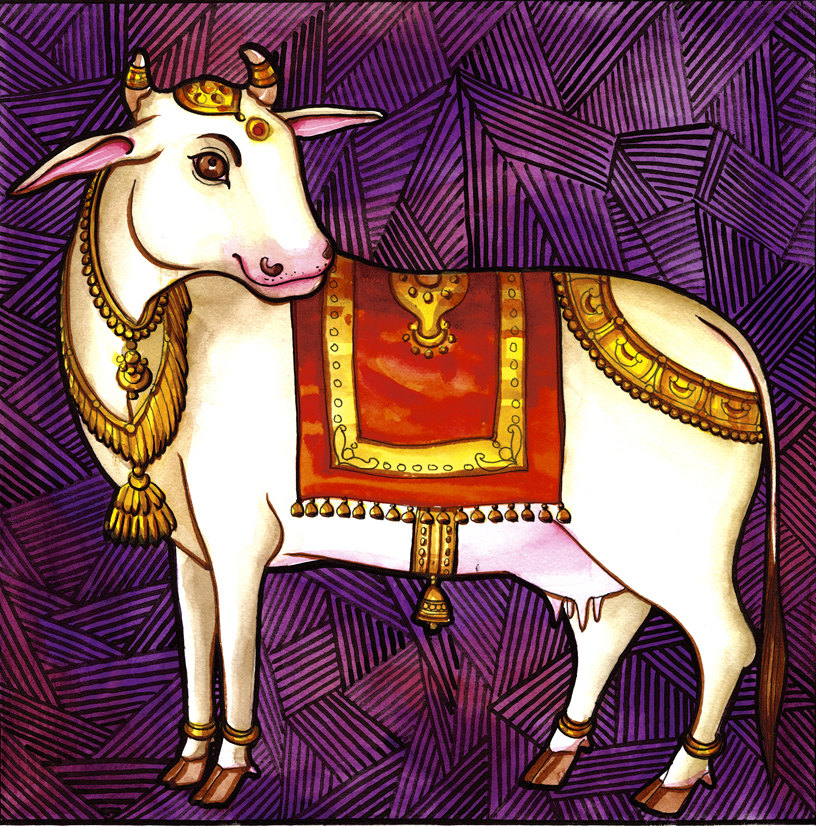
I am a vegetarian, mostly, it’s a sensitive area. The fact that I sometimes eat animal products is not something I like to think about. There was one time in rural Thailand I was walking with Jiab in the fields around her home, and she takes me to see the little cow they have there. It has a bamboo bell around its neck: takata-takata. We stop and look at the cow, and it looks at us. A miniature creature, it comes towards me with cautious movements and swinging head in motion with the way it walks, raises it’s head and points a snuffling, sniffing wet snout in my direction; large snorts, extends long tongue and sticks it in it’s nostril (how do they do that?), comes a bit closer and quite a bit of sniffing of the air around me – not in Jiab’s direction. This cute little cow is curious about me due to a certain familiar milky smell coming through the pores of my skin? Thais don’t drink much milk so I was thinking, wow! here is proof that the (Western) body releases a noticeable odour of milk. I know this little cow has never been near to a Western person before in its life. The smell was familiar; a naïve recognition of an upright, standing-on-it’s-hind-legs member of the species – a cow person?

But we are carnivores. And there’s this unpleasant conceit about being at the top end of the food chain bothering me now while eating a breakfast of grains, nuts, fruit and cow’s milk. Jaws move in a slightly circular motion; down up, down, up, down, grind, grind, and swallow. I’m an animal too. I consume the environment, whether it’s other animals, fish, vegetables, eggs, milk – we are the cow’s babies (there’s a thought!). And cutting up vegetables is a bit of a sacrifice really; every time I start to cook food there is the opportunity for this kind of contemplation. Vegetables and fruit may not have the obvious characteristics of sentient beings but we may eat their reproductive organs along with everything else [link to: Buddhism and Beef].

There’s a couple of lines of text somewhere in an essay by Tan Ajahn Buddhadassa, that I cannot find at the moment; it’s about consciousness of all the things we eat, bits of animals, poultry and fish and how all their ghosts will come back to haunt us in the end. Pretty scary, nowhere to run, everything we are: mental, physiological, flesh, blood, and bones is a composite of what we have eaten, internalized. And it extends back through the generations to the beginning of time. The cellular substance of what we are is a genetic composite of all kinds of animal fats and enzymes and there’s just no getting away from it.

So, it has to be about being aware of the reality of it all. Contemplating the eating of meat helps me to see the true extent of my voracious appetite for all consumables. Things I feel drawn to consume surround me – and I mean, here, non-food items: ‘mind’ hungers for mind object. Consciousness is dominated by habitual ‘mind’. Remove habitual ‘mind’ and there may be something like a deluge of reality comes along and with it comes a deluge of understanding. Somewhere in there is an explanation for the fact that people eat animals.

When Acharn Mun was at the end of his life, weak and lying in a village in NE Thailand, a very large number of his followers began to assemble. He asked the bhikkhus to take him away from the village because the villagers would have to kill many animals to feed those people. They took him to a nearby town where there were market places and various kinds of prepared food could be easily obtained. Shortly after that Ajahn Mun passed away.

‘From the day of my ordination I have never thought of harming (animals), let alone killing them. I have always extended my loving-kindness to them, never neglecting to share with them all the fruits of my merit. It would be ironic if my death were to be the cause of their deaths (‘The Venerable Phra Acharn Mun Bhuridatta Thera, Meditation Master’, page 201 – 202).

[link to: Ajahn Mun Bhuridatta Thera, Wiki]

[link to: Image source]

Listening 1

palmtree sunset

South India: Birdsong. A small wave of tiny notes. Sitting on the cushion under a thatched structure built on the roof. Focus on breathing, soft warm air, it’s the end of the night. Dawn light coming up. The birds near to me are surprisingly loud, so much energy from such a small body, such a tiny breathing system. There are these silent intervals, to take a bird-size breath of air, I think, then a long musical ‘verse’, and another silent interval for breath; the ‘song’ moves on to the next verse and so on. The regular pace of these silent intervals contributes to the pattern of the verses. Birdsong is a ballad, a story about something that goes on and on; more than enough; an abundance. It blows away the scarcity of my small mindedness. I can see why they call it ‘The Dawn Chorus.’ Sky is full of sound, a huge chord played on an instrument with a great number of strings

Listening consciousness and sound object are one and the same thing, there’s an affinity with birdsong. Maybe it’s about acoustic resonances of the bird cranium being all of a oneness as far as we other living creatures in the world are able to perceive it. And, part of it too, are the echoes in the spaces between things: reflective surfaces, tree trunks, branches, walls, the air, clouds. Sympathetic resonances create multiple frequencies like the echo it makes on the underside of my thatched roof. And now it’s gradually diminishing; no grande finale, just a musical occurrence that takes place every day and gets forgotten about as soon as the sun rises in the dramatic way it does, expanding into our lives and everything becomes secondary to that main event.

Other sounds become heard; ordinary household noises, miscellaneous gentle ‘clatter’ from houses through open windows. Dishes clink, aluminium pots make that dull ‘ding’ sound. A shout, partial sound of a goat. child cries, cock crows, dog barks, a bicycle bell, street trader’s call, a car horn honks. Something clinks, and it goes on, individual recognisable sounds all appear in consciousness exactly as they occur, no end to it. Each has its own space, situated in its place in a clear sequence, one after the other.

I’m thinking there’s something about it that suggests a composer could create an orchestral symphony out of this? But it doesn’t work that way, I realise. It’s not the ‘actual’ sound I’m listening to, it’s the ear consciousness function that is set to rationalise the flow into an orderly pattern of ‘virtual’ sound. Each unit of sound has a place, according to how the consciousness function selected it, unknown partial sounds are replaced by known sounds, ear consciousness triggers a process so the object is placed according to the ‘closest match’ that can be found in the filing system.

The actual sound space I’m surrounded by may well be a tremendous complexity of pieces of things; an ocean of permutations. There’s some insight into what this amounts to but I know I’m not even taking on anything resembling the scale of it. I seek stability from this chaos: the ‘self’ shapes the randomness of the universe into a manageable chunk and I can settle with that thought.

‘In the normal way, attention shifts from one thing to another. Surprising events grab the attention: other chains of thought wait to be finished as soon as there is a gap. So there is never any peace. This is efficient in using all available processing capacity, but what does it feel like to be … in such a system? I suppose it feels like most of us do feel – pretty confusing. The only thing that gives it any stability is the constant presence of a stable self model. No wonder we cling to it.’ Dr. Susan Blackmore [link to: Science tackles the self ]

[Link to: Listening 2]

rope seen as snake

OLD NOTEBOOKS: Nontaburi, Thailand: Alone in a house surrounded by trees. Leaves filter a lovely green light all around; birds, lizards, squirrels, I see something move out on the patio… is it a bird, dropped down from a branch to peck at something? There, it moves again – just a hop and it’s a few feet further on. I sit very still, don’t want to frighten it away. I see it now, in the same position, not moving. After a long time waiting for it to change position, I decide to slowly get up and see what happens when I do that. It’s still not moving – maybe it’s injured. I go out on the patio and walk up to it. Ahhh… the bird is not a bird, it’s a large brown leaf, blown by the wind across the patio surface.

Go back inside and look at it again. It looks exactly like a bird, and just then a gust of wind blows the leaf. The animation of it is absolutely convincing, but I see it now as a leaf, not a bird. How strange, believing that something is there, then having to accept that it’s not. The teaching about the rope and the snake; a piece of rope lying on the ground is thought to be a snake. It’s an analogy of ‘self’ seen in consciousness + name-and-form: I recognize that the rope is a rope, not a snake, and can see how the illusion occurs. Or I may not see it and be convinced it’s a snake… maybe for a long time – a whole lifetime preoccupied with a ‘self’ that isn’t there.

This small epiphany occurs after another curiously similar event took place in this quiet house. I’m alone here except for D who is a grad student, working part-time, and he also takes care of the place. I don’t see D much, he works night shift sometimes, sleeping in the middle of the day. The house is large and I’m never absolutely sure if he’s here or not. Usually he stays in his room so I’m used to not seeing him around. I just quietly go about the house, day after day, not making too much noise in case he’s sleeping and quite often forget about him completely.

Then, just the other day, I start to wonder what happened to him. I look in the car park and his car is not there. When did I last see his car? Two days ago, or longer than that? I go to look at his laundry – could be the same laundry that’s been there for a while… clothes without a person inside them – remembering the movie: The Time Traveller’s Wife. I have to stop for a moment and think, when did I see him last? Go up to his room, door is open, nobody there. Hard to believe, I assumed D was in the house but I’ve been alone the whole time. The leaf-seen-as-bird metaphor. Something I thought was there, wasn’t… thinking it’s one thing, then it’s not. The usual sense of ‘me’ suddenly gone… then it returns again. Everything feels light and transparent.

‘It was as if lightning coursed within my chest. The impact lasted for a while, and for the next few weeks whenever I saw people, they seemed like a magician’s illusions in that they appeared to inherently exist but I knew that they actually did not.’ [‘How to Practice: The Way to a Meaningful Life’. The Dalai Lama, in the sixties reflecting on the Rope Seen As Snake metaphor, phenomena being dependent on conceptuality and his discovery that the “I” exists conceptually, dependent on mind and body; not an entity in itself] Source: Emptiness and Existence:

————————-

This post reblogged from July 12, 2012 

Jesus and Advaita Vedanta

 I didn’t know about Advaita Vedānta when I was a child and only recently discovered there were people like Alan Watts (and others) writing about non-duality in the Christian context, [link to part of the Alan Watts’ essay: This Is It].  Now I’m convinced it is important to focus on the fact that there is something at the heart of Christianity. The uncomfortable feeling that’s followed me all these years – that somehow I missed the point of the Jesus Teaching – all this has gone when I think of the Advaitist aspect of the teaching. It’s the missing piece of the puzzle I just stumbled upon, coming from an Asian perspective, an inductive knowing and that’s how it works.

The reason I didn’t see it before is because the Western concept of God, having human attributes (similar to the Advaitist idea of Ishvara), contradicts the rational scientific view. Accepting something that’s scientifically impossible, just because it’s written down in the Bible, doesn’t make sense. It’s like a myth and that’s why Christianity never had any reality in the West. What’s needed is to take it all a bit further.

‘… when human beings think of Brahman, the Supreme Cosmic Spirit is projected upon the limited, finite human mind and appears as Ishvara. Therefore, the mind projects human attributes, such as personality, motherhood, and fatherhood on the Supreme Being. God (as in Brahman) is not thought to have such attributes in the true sense.’

In Western countries, people are wandering around without a map. There’s the shopping mall and that’s all. How to let go of the individual ‘self’ if everything in the system is aimed at getting you to hold on? Looking for the way out by browsing possibilities will take a lifetime. The distractions built-in to window shopping behaviour are designed to keep you ‘shopping’ and prevent you from finding the way out too easily. By the time you get there you’ll have forgotten what it was you were looking for.

‘The Advaita Teachings are pointers, offered at the level of the audience, so to some people Jesus would talk about “a mansion with many rooms” and to other people he would say: “(heaven) is within.” (And) without understanding Advaita and the way pointers are adjusted depending on the audience, (most) Christians haven’t a clue what Jesus was talking about ….’ [link to Advaita Vedanta page]

Those who didn’t fall into the shopping mall trap just took the belief ‘thing’ to pieces to see what it was made of. That’s how it was seen that there was/is no substantial “self” in the centre of consciousness. It’s an operating system that keeps all working parts in the state of  ‘oneness’. ‘We are, right at this moment, God itself, and we can rejoice in that – if we can break out of our individual identity….’ If someone had been able to explain it to me like this when I was a child, the challenge to find out what it could mean would have been enough motivation for a lifetime.

‘When you fully understand that which you are and cannot not be, there is nothing to do to be what you are.’ [Jac O’Keeffe]

………………..

I wrote another post about this: ‘Jesus and Churchianity‘.

Note (i): There are two references in the Upanishads: aham brahmasmi (Brhadaranyaka Upanishad 1,4,10), and tattvamasi (Chandogya Upanishad 6,8,7), the instruction of Svetakatu by his father – very much earlier than the Jesus teachings. The 8th Century development by Adi Shankara is something for a later post. [link to ‘Christian Consciousness and Advaita Experience‘] 


Acting the Part

1st Century theatrical maskI was in New York some years ago, in the car with WGM, stuck in traffic. A hot day in July, car windows open, air-con wasn’t working; exhaust fumes, hazy visibility. WGM was practising for his singing lesson and had a few song sheets with him in the car. He showed me an old one: the Julie Andrews classic, ‘The Sound of Music’. and all of a sudden, sang the first part of it, there in the car: ‘The hi-ills are alive, with the sound of music…” stage performance, vibrato, full voice, and the volume was amazing! It blew me away. Heads turned, people leaned out of their car windows and the great river of jostling pedestrians paused for a moment on the sidewalk. It was WGM’s 15 minutes of fame.

But he did that kind of thing all the time, an ability to find the paradoxical circumstance and play the part. WGM was an actor I’d met in Europe the year before and staying with him in a cramped apartment near Broadway with other actors, performers and ‘people’. Different from other shared habitations because they were all hustling for parts in videos, TV ads, movies, music, anything. Life is ‘theatre’. They were opportunists. Every step of the way was an opportunity to perform – life itself is the audition. The ‘self’ we create is the performance; we are acting a part, all the time.

In the apartment the phone was ringing constantly, theatrical agencies calling up to return a call from somebody in the apartment, “Can you get that?” and “Sorry, he’s not here, can I take a message?” The thing about this that made it different from other shared-apartment situations was that the phone link was really important to everyone there; the world of opportunity. And the phone calls from the agencies made it somehow part of the ‘public’ world out there. It felt like the whole world was calling this number all day and most of the night – the outside world coming in to the inside world. Another thing about it, the process of answering the phone was an opportunity for these multi-personality specialists to try out a different persona every time.

So when the phone rings whoever is sitting next to it answers, switching to a subtly different ‘voice’, with a different accent, quite believable and acceptable to the caller but interestingly ‘changed’ to those of us in the room. It was baffling to me at first because I couldn’t figure it out and partly because there’s a strange logic to this: the unknown caller at the other end of the line is ‘somebody else’, a person with his/her own identity – hence the created personality, character (game) seems like, well, appropriate? It made sense because, on a certain level, it’s all about ‘self’, anyway, and who you are at that moment is subject to change because who you’re talking with determines who you are. I can appear to be somebody in one situation, then ‘be’ somebody else in a different situation. The self illusion has flexibility. The whole thing is about acting the part.

The phone gets put down and immediately rings again. The same person answers it in another ‘voice’ – an identity that’s so different from the one he just used it’s hard to believe; hilarious, bordering on the schizoid. Since that time I’ve been aware of the ‘act’ of being alive. It contributed to the discovery of the Buddhist anatta (no ‘self’) and the habitual ‘self’ construct, projecting ‘my’ character, ‘my’ personality at a particular point in time and in specific circumstances changes all the time. It just happens naturally.

The skilled actor plays the part so well, the spectator thinks he is the person, not the actor. A layer of paradox: the actor being himself and simultaneously not himself reveals the ‘self’ construct. Or it could be that the ‘act’ is revealed completely to the spectator; a self-reflexive act that does not distinguish between the ‘self’ construct and acting the part, it’s just there; a total act, an actor/spectator encounter in metaphysical terms and, for the most part, it’s accepted as ‘theatre’, illusion, samsara and we’re immersed in the story of it all.

………………………….

[image link]

Birds on the Balcony 2

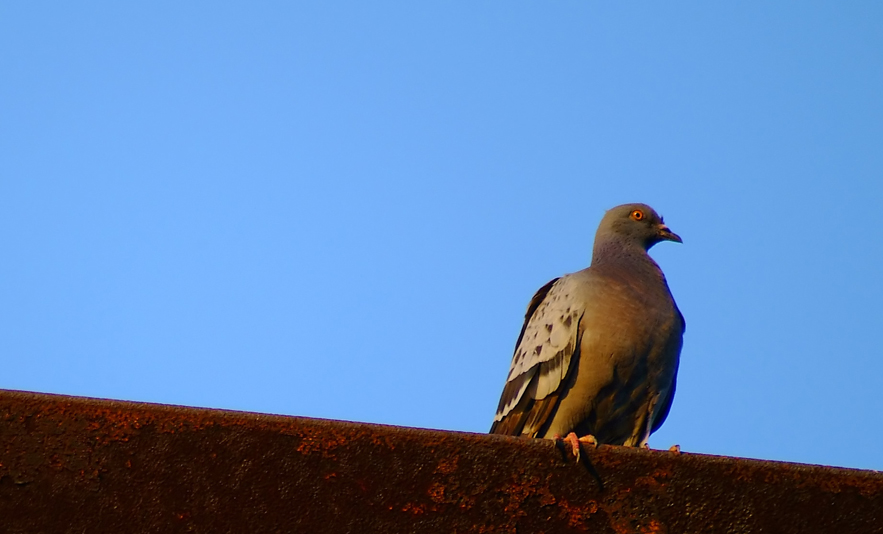
Switzerland, June: I wrote in another post [Birds on the Balcony 1] about pigeons nesting on my balcony up here on the 7th floor. The nest is in an old Christmas tree bucket with some of the bells and everything still dangling from the branches. The faded Christmas paper now getting dusty and sad, Christmas is long past but it is amazing, really, that the bird just went ahead and built a nest there. After that there was not just one egg in the nest but two and, to cut a long story short, the two eggs became two living beings with wings. I saw the whole thing; their development, their getting fed from the beak of the parent bird and the flapping of little downy wings. The birds on the balcony were the main focus of my attention for a long time. I feel I know such a lot about rearing birds, I’m sort of associated with the species.

At the time of writing this post, Jiab is away for a few days so I’m on my own. I’ve arranged my chair and table to be near to the window without getting too close to the parent bird sitting in the half filled bucket of earth, babies underneath. And if I’m moving around too much, it watches me with one eye then twists its neck completely round in a totally impossible way and looks at me with the other eye. How do they do that? So I sit quite still and watch.

I’m a part of the security system here – less danger from things like the crow population and the parent bird probably feels safe here, recognizes the right degree of proximity to humans because humans chase away crows and don’t chase away pigeons? So, it looks like I’m taking care of this little family situation and me and the bird are ok together.

More than that, in fact, I’m the great patron and benefactor, in this case, the saviour and I’ll tell you why. There was one day, I was sitting in my chair next to the pigeon nest with the two cute little baby birds all huddled up in there, parent bird off to get food and I’m in charge, just gazing out at the clouds. All is well in the natural world of animals, birds and baby pigeons safe and secure. But something was about to happen in the very next moment ….

I become aware of a black shape in the centre of my vision. Vision consciousness takes a certain amount of time to send the message and it doesn’t immediately click in my brain that it’s a large crow and looking so black and mysterious I cannot see it’s features, like a photographic negative, glinting a kind of deep purple and blue. Just arrived on the balcony rail, folding away it’s wings, here on the seventh floor where crows don’t usually go; just materialised out of the deathly world of nowhere. And I’m kinda, speechless; hypnotized by it’s presence.

It slants it’s head in the direction of the baby birds and makes a hop in their direction. And there’s a sort of slow-motion thing going in my mind; that’s a crow, yes …. ok, that’s it, then. Can’t get there quick enough to stop the inevitable, it’s nature. The birds are going to get eaten, swallowed up, can’t be helped. Fatalistic. Crow takes a few hops closer to the nest, and I’m transfixed – it’s all happened already, crow makes a few lunges and flies away with a beakfull of baby pigeons…

I suddenly ‘wake up’ and fall out of my chairs knocking over a few things in the scramble to get to the balcony door; hurt my knee in the collisions with the furniture: ‘No-oh!’ then a primal roar: ‘OAAAAAHHH!’ and by the time I get up off the floor and fling open the sliding glass door, arms flying around in desperation, the crow has gone. And the little birds are where they were, all happy and safe, barely aware of the interruption.

A relief, to say the least, but the shock of it remained for a while after. And, even though my relationship with the birds became more bonded since the visit of the crow and I felt like we’d been through stuff together, I started to notice I was getting off on things like: am I getting too attached to these cute little birds, I mean they’re just food for the predators? And was developing a kind of morbid view of the whole thing.

I tried to explain it to Jiab when she got back from Peru but it didn’t seem to have any impact. Instead, she said something about all creatures in the world, good or bad, being just as they are. That led me to read, again, the talk by Ajahn Amaro on ‘Forgiveness’ [link to: Forest Sangha publications, ‘Seeing the Way’ vol. two – 2011]

‘The act of wishing well to even those who do us harm is a recognition of our common humanity, our common nature as living beings. It is a recognition that carrying around resentment only creates greater division, greater disharmony, and greater discord and sows the seeds of greater suffering in the future.

“Those who are friendly, indifferent or hostile; may all beings receive the blessings of my life, may they soon attain the threefold bliss and realize the Deathless.”

[“Reflections on Sharing Blessings”, page 26 of the Chanting Book]

Fragrant Illusion

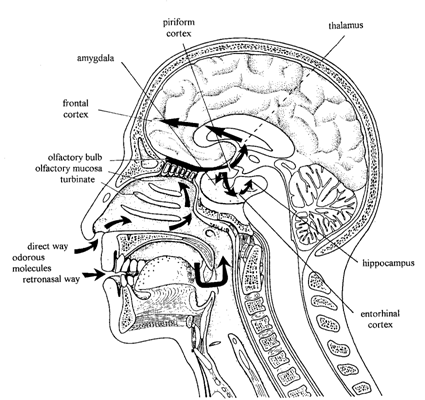
I’M WAITING AT THE BUS STOP in the zone industrielle and there’s that slightly odd fragrant smell in the air again. I asked somebody about it and they told me there’s a laboratory here that creates different kinds of commercial smells: odorants, aromas; the air is full of fragrance. It’s the smell of fruit jam today. Another day, it’ll be a different smell, maybe a more subtle thing that you can’t identify easily, an essential component of a popular smell – not unpleasant, just odd. Interesting that the fragrance of fruit jam that strikes the nose when I open the jar is not as fruity as I thought. It’s a ‘replacement aroma’ created under laboratory conditions by chemists. How weird.

The manufactured smell is a chemical compound designed to trigger an olfactory experience. My smell process is activated and even though this is completely artificial, I’ll react in the same way. I’m just as likely to respond to the aroma and go into the ‘wanting’ mode, whether it’s been created in the laboratory or it’s the real thing – I can’t tell the difference. The chain reaction of consciousness is saying this is real, go for it, and that’s all it takes.

I’m thinking about the wonderful aromatic fragrance of bread and bakery items that wafts towards me from the bakery near the station. I’m drawn to it because of the aroma. And I realise now the bakery cannot produce that smell as a result of baking – I doubt if it even has a baker’s oven on the premises. But I respond to the smell as if it were real.

In the paticcasamuppada the smell of fresh bread starts a sequence that looks like this: The aroma of fresh bread is at Sense Gates salayatana. In itself, it’s not anything, then it makes Contact phassa and shortly after that there’s the beginnings of recognition, which leads to Feeling vedana and I’m taking out my wallet. There’s Craving tanha and after that I’m caught. The purchase is about to be made but before we close the deal: ‘…autre chose, monsieur?’  (anything else, sir?)

I experience Grasping, upadana and it seems like a good idea maybe to get a couple of other things as well. Then Becoming bhava happens, I’ve made the purchase – it’s mine! There’s a brief moment of joy: Birth jati and I get outside and look in the nicely wrapped carton of donuts, pain aux chocolate, almond croissants…. What did I get all these for?

At some point, it may be now; it may be later, I experience Sorrow, lamentation. pain, grief and despair soka, parideva, dukkha, domanassa upayasa (Note: the actual ps cycle includes: old age, death, jara, marana) and the lingering smell means I might, later, try to revisit the baker’s shop to see if I can do it again but somehow manage to avoid the suffering this time?

Not only food, there’s the smell of leather upholstery in a new car, for example. That distinctive odor, created by chemical processes, may tip the balance and … sold! The smell of a new carpet; it may not be an attractive odor but it does trigger something; there’s a familiarity about it – ok, proceed to checkout! The company that manufactures and promotes the aroma is engaged in the commercial exploitation of smell – and we are caught by the nose.

I used to travel regularly on a small jet, a short flight and the steward would come along the aisle of this tiny plane to serve a coffee and a rather sad-looking sandwich. But before that, before it was served, the cabin would be filled with a wonderful, exotic aroma mix of French cognac, a hint of cigar smoke, ground coffee, crème caramel, port, liqueur. The snack is served, it’s a terrible let-down.

Do they really think we might not suspect it’s something entirely manufactured, a puff of a spray that releases the odorant in the air? But I realise that it doesn’t matter. The steward who serves the snack and everyone in the plane know it’s an illusion. There’s a basic acceptance of illusion; it might even appeal to a competitive cleverness that ‘I’ can see through this illusion: “… isn’t it interesting how they can create artificial smells?”

It’s saying this is acceptable, it’s okay to do this, there’s illusionary stuff everywhere; TV, videos, and mind states are just the same; the ‘self’ we have created from the five khandas. And there’s a familiarity with the ‘trick’; a recognition of the whole panorama of illusion that we have created in our world. So what if it’s artificial? The whole ‘thing’ is artificial. We like it like that!

That’s the way to go if you think you like endless proliferation, but it does need to be maintained and the novelty wears off. The seeing of it dispels ignorance: Phenomena are sustained only so long as their sustaining factors remain.’ Take out the sustaining factors and the whole thing comes to pieces.

The bus arrives and we all get on. It rumbles off down the road and the smell of fruity jam is almost gone, I can still smell slight traces, then I get distracted and forget to smell for a moment. When I remember, the smell is gone completely. Soon after that I’ve forgotten all about it.

‘When this exists, that comes to be. With the arising of this, that arises. When this does not exist, that does not come to be. With the cessation of this, that ceases.’ [Samyutta Nikaya 12.6]

…………………………………

 (For the whole analysis of the paticcasamuppada, click on this link: Buddha’s Teaching on Causality, Dependent Origination paticcasamuppada.)

[link to more info on artificial aromas]

[image source link]


Too Much is Never Enough

Tanha

“If this sticky, uncouth craving overcomes you in the world, your sorrows grow like wild grass after rain.” (Dhammapada 335)

Tanha perpetuates ‘the fever of unsatisfied longing’; the opposite of bien être (sense of well-being). Tanha is not a happy bunny. It attempts to feed the hunger of ‘wanting’ but the action of feeding it only sharpens the edge of appetite; there’s never enough. Tanha is a deep craving for ‘self’. It is astonishing to think that the ‘self’ we have constructed to fill the void of ‘no self’ is the direct result of tanha. I am ‘me’, here in this world, because of tanha.

Tanha is the cause of Suffering, the 2nd Noble Truth, the 7th step in the Paticcasamuppada. Tanha is the reason for rebirth. In the story of King Assaka and Queen Upari, Queen Upari died and became a cow dung beetle in the next life. But she felt quite at home in her lowly existence as a cow dung beetle and this is due to tanhã (craving) which finds delight everywhere. Tanhã gives pleasure, delighting in whatever sense object presents itself – tanhã has the tendency to delight wherever it finds rebirth. Reborn as a dog, it takes delight in a dog’s existence; reborn as a pig, as a fowl, there is always delight in each existence.

It explains very well the reason why some people you meet are absolutely committed to ‘wrong view’ with an intensity that takes your breath away. They believe they’re right and the rest of the world is wrong. No matter what anybody says, they continue to do it the wrong way. Life is pretty difficult for somebody like that. I’m reminded of a song from the 60s: ‘The original discriminating buffalo man. He’ll do what’s wrong as long as he can.’ (Lyrics: The Minotaur’s Song’ by Incredible String Band [link])

Tanha is step 7/8 in the paticcasamuppada causality sequence. Interrupt the sequence there and bring the whole thing to an end. I first came across it in Walpole Rahula’s ‘What the Buddha Taught’, then later in Ajahn Buddhadasa [link] The way to deal with tanha is to cut off the conditions that lead to its arising. The entry point here is the step before it: 7. Vedana. At the vedana stage, there are three possibilities: the arising of pleasure, or pain or neutral feelings. If feelings of pleasure or pain arise, then craving or aversion will follow and tanha will be the result.

‘… if, by an act of will, only the neutral feeling was allowed to arise from contact with the object… the seventh link would be neutralized, de-activated. That being so, tanha could not arise, and the next link (upadana) would fail to arise and so on …” Eric Cheetham, “Fundamentals of Mainstream Buddhism”, p214-215

For me, the discovery that interrupting the sequence at Vedana changed the momentum of everything was awesome, to say the least. This is how I quit the tobacco habit (and other things). By allowing the neutral response (at Vedana) to be present for a moment, I noticed an easing in the craving, a cessation – just enough to trigger my curiosity… what is going on here? The first time this happened, the cessation took place just as my recognition of it clicked as (possibly) ‘the way out’, and I knew then I’d cracked it. Now I see it’s about staying a little distant from it, and allowing the craving to start the process of cessation by itself. Trying to confront/defeat the craving will not work because willed action only causes it to arise again.

Time went on and the craving would arise but there was always cessation. By my continuing to recognize that it’s in the nature of Tanha (as with everything else) to be transient like this, it was seen as something that comes and goes – bye-bye craving. The neutral feeling didn’t register as anything (that’s the thing about neutral feeling) and there was a space, a gap that wasn’t there before. Curiosity about this new space, just discovered, led to extra motivation. I could see that I was changed. Situations that used to completely overwhelm and demolish me seemed more distant; I’d found a way of looking at them as if they were something quite separate.

Other habitual behaviour began to fall away. I began to notice the wonderful emptiness or the wholeness or … (whatever word you use isn’t quite it), a great peace in the space of the mind that comes about when you understand that there is a way out of Suffering. I figured out that I am not dependent on the ‘dependent’ mind state tanha. I can walk away from it; everything that arises, ceases.

[link to image source]