why?

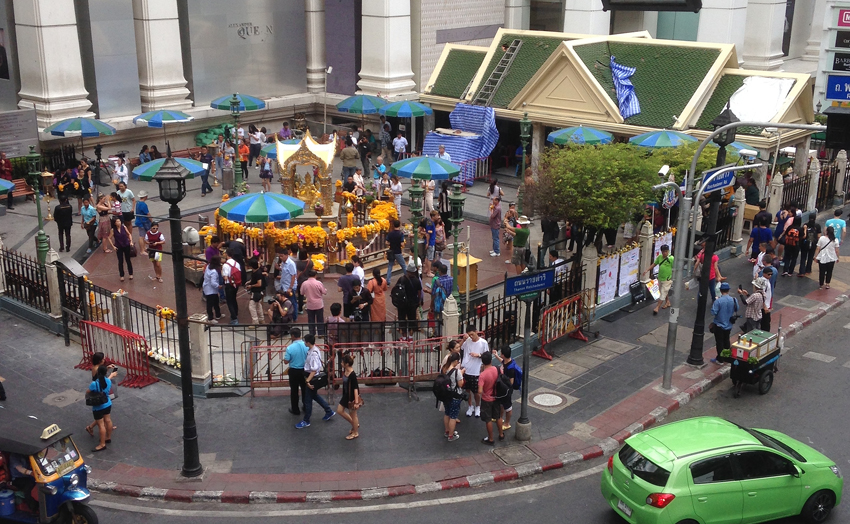
matichon.cov1827POSTCARD 145: Bangkok: The front cover of the Matichon newspaper weekly supplement shows pictures of the Erawan Shrine with the headline: ‘why’, ทำไม (tham mai). Whoever is responsible for the bomb would have been aware of the damage to relationships with China, and aware of the damage to the Thai government for failing to protect the public. Seems strange to me that even though it’s a four-headed Hindu, Brahmin shrine, worshippers are mostly Chinese Thais and it’s popular with Chinese tourists from Hong Kong, Singapore, and the new wealth of mainland China, group-tours of families and young people mostly. Maybe it’s not political, an act of madness – the shrine has a curious history. Inevitable, though, that everyone assumes it’s political; the small cartoon character in the lower right appears in every edition of the Matichon weekly. In this one the character wears a black armband and is saying: “So now we have finally come to this!” A provocative statement – a comment about anti-government groups, trying to harm the Thai economy.

IMG_2291It’s a mystery. I visited the shrine yesterday, most of the barriers are moved away now, some repairs still to be done to the roof where the explosion blew off roof tiles. The pedestrian bridge is cordoned off with tape to stop people leaning over to take photos. The same great cloud of incence hangs in the air above a continuing throng of hundreds of people visiting throughout the day and night with their offerings and countless bowings of head and hands, burning incence sticks held in hands, and palms together as if in prayer (anjali). I’m amazed by the passion of the ritual, there’s always been some intensity of thought here – not an open free mind, it’s not meditative… it’s something ‘willed’. There’s an undercurrent of some sort of unknown energy, people cling to the idea of it, the deity can save us if we believe in Him; we worship somebody else ‘doing it’ on our behalf – we are subject to that.

Strange to see this, because Thailand is a Buddhist country and Buddhism is about not engaging with the ‘story’, it’s about understanding the constructed nature of what has been handed down to us and stepping outside of that to see the non-duality between ourselves and the world. Like the original Jesus Teachings, you simply ‘see’ the Truth of it; the reality that surrounds us all the time; like the Hindu Brahman, the Oneness, the God-state that’s here and now.

The people who visit here every day must be sincerely involved in mindfully finding their way through the busyness of their lives. Others may visit when they have an extreme situation they’re worrying about, they come for help; a desperate prayer for what ‘I’ want, what I think I need. I can’t imagine what they receive from this, only more of a focus on situations that are absent of that thing that is desired. Why? What can I learn from this? Is there a Teaching here? Or maybe there’s something wrong with the question. It could be superstition, misguided intentions, living in illusion; ‘the futile pursuit of happiness’ it’s always disatisying because it doesn’t do enough, I want more of it – the fleeting happiness found in consumerism doesn’t hit the spot.

Traffic noise echoes off the concrete structures all around. Heat and incence smoke rising…
IMG_2281

‘The ego’s attachment to power of any kind is linked inextricably to the fear of losing that power and thus becomes a source of suffering.” (Ramdas)

————————–

History: In 1956, an astrologer advised building the The Erawan Shrine to counter negative influences and the bad karma believed caused by laying the foundations of the Erawan Hotel on the wrong date. Furthermore, the Ratchaprasong Intersection had once been used to put criminals on public display. The hotel’s construction was delayed by a series of mishaps, including cost overruns, injuries to laborers, and the loss of a shipload of Italian marble intended for the building. In 2006, the shrine was vandalised by a Thai man believed to be mentally ill. After smashing the statue with a hammer, he was himself beaten to death by angry bystanders.

maya & christmas

IMG_0220POSTCARD #36: Chiang Mai: Going around town in a tuk-tuk, seeing all these new shopping areas getting built and a huge shopping mall opens here soon called MAYA – a Sanskrit word meaning illusion. In Thailand the word maya is applied to the lifestyle of movie stars who have everything money can buy and their lives are thought to be unreal. In an intelligent way, everybody knows what maya is and what ‘reality’ is. But in the shopping mall context maya is presented as an attractive idea; it’s appealing, even though it’s an illusion, we’re partly agreeing with it; complicit in its being there. We might say well, okay it’s an illusion, but what’s wrong with that? Nobody wants to see it as calculated corporate planning to create a market for consumer goods… that would destroy the pretty illusion. Nobody wants to know that the local population, sons and daughters of rural/urban migrants, and naïve hill-tribe folk are likely to be swept away in the wave of purchasing choices. Unseen, built-in strategies contained in an imported Western model that doesn’t suit this culture… and we’re not willing to say there’s anything wrong with it because we’re all in some way compromised.

A kind of tacit approval of consumerist schemes embedded in our lives that has resulted in our losing so much of our inherited cultural traditions. The Christmas festival is layered over with the maya of santaclausisms and the Jesus Teachings are nearly lost in it. It’s as if the essential part of our spiritual Truth got forgotten along the way and consumerism came along in its place. It’s a mystery really, why it should be like this, but for some reason the early Church disapproved of the gnosis (knowledge) part of the teaching. Out went the pragmatic instructions on seeing the constructed nature of appearances and the stepping-through to discover the non-duality between ourselves and God. ‘His disciples said to him, “When will the kingdom come?” 
<Jesus said,> “It will not come by waiting for it. It will not be a matter of saying ‘here it is’ or ‘there it is.’ Rather, the kingdom of the father is spread out upon the earth, and men do not see it (113).”’[Nag Hammadi Manuscripts].

After an extended period of study and contemplation, one simply ‘wakes up’ to the Truth of it; the reality that surrounds us all the time; Brahman, the Oneness, the God state that’s here and now. You’ll notice I’m presenting the Jesus teachings as an instance of the Advaita experience, sourced in the Upanishads [I wrote another post about this, link to: Jesus and Advaita Vedanta]. I’m also including the Jesus Teaching in a oneness of spiritual teaching centred in that geographical region where the three Abrahamic religions arose: Christianity, Judaism, Islam and the connection with Brahmanic religions and Advaita Vedanta. Others related to this include Buddhism and Jainism. That region, from North India through to Israel and the Mediterranean, a distance of about 3000 miles, say from New York to San Francisco? I see it like a highway of knowledge, wisdom and information. All of it coming and going along the route many centuries before Jesus was born and many centuries after. All the world’s religions arose here.

Somewhere in this context lies the actuality of our Jesus experience; only traces of it remain – enough to know there is this huge feeling of goodwill towards all beings in the world and the universe.

Merry Christmas friends and fellow bloggers ~ Christmas 2013

————————-

Excerpts from: meta-narratives

the beholder

ploenchitBKK3

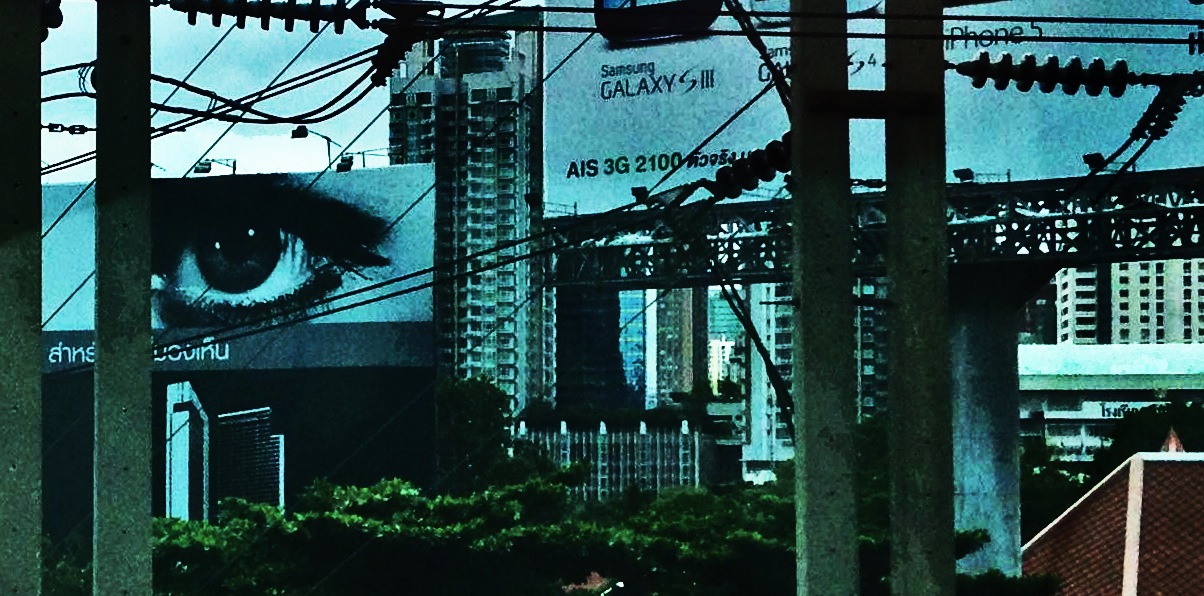
Bangkok: The world seems different, everything suddenly seen in clear three-dimensionality. Reflected light, rich, deep colours and a strange familiarity, objects in the environment become somehow known. I’ve seen these things so often before but now seeing them with an expanded awareness. It sounds visionary, you could say revelatory but it’s the result of eye surgery, rather than insight… nonetheless quite astonishing. I have this clarity in one eye only, vision in the other eye is like an old yellowed photo, dull and indistinct. The operation on that eye will be in October, back to the Rutnin Eye Hospital in Bangkok. The surgeon makes a hole in the eye and puts in a tool that uses ultrasound to emulsify the lens. The lens becomes liquid and is sucked away, then a plastic foldable lens is inserted in the place where the natural lens used to be. That’s it, done. Local anaesthetic is enough, or general if you feel claustrophobic about the covers over the face. After the op there are different kinds of eye-drops that go on for about three weeks and it feels a bit itchy but that’s all.

I’m amazed that it’s possible to do this; the plasticity of the human body, parts can be taken out, replaced; systems are deconstructed, reconstructed, subject to change. It all supports the idea of anatta: no abiding self. There’s an underlying flexibility about the mind/body organism namarupa. One example of this is that I have a very refined piece of plastic in my eye instead of a natural lens. And, looking at the world, I find an affinity with clear-wrap, cling-film, transparent plastic food packaging – the way the plastic surface refracts the light. In this strong sunlight in Thailand, I notice the reflections on chrome and glass – the clarity is sparkling and beautiful. Also these enhanced colours, reds mostly, and an overall bright clear blueness in the white areas. It has the quality of an iPad screen, retina display, high density pixels merge into one – an extraordinary brightness.

Faces of friends and family are seen as if for the first time. I notice small expressions now I didn’t know were there, maybe because everybody is looking at my new eye, intense Thai faces examine my new eye, and I’m looking back at them looking at me, seeing subtleties in their features that I’ve never seen before. It’s all quite new, a curious reality.

So, I’ll be going around for the next few weeks, looking at my surroundings and considering the phenomenon that I am experiencing this. Can it really be so? ‘Beauty is in the eye of the beholder’ (Margaret Wolfe Hungerford). The expression always seemed a bit mean and divisive to me, ‘I’ think it’s beautiful but ‘you’ might think it’s not; beauty becomes a matter of opinion… In Buddhism, the ‘beholder’ sees the world and identifies the self, ‘me’. If ‘I’ am inside the body, in ‘here’, I must be separate from everything else out ‘there’, isolated, alone, anxious – wrong view a fundamental error. The attachment to a perceived self and craving for it to become real, creates suffering. Language has a naming function, creating an apparent identity. Anything that is stated is always missing the point because of these characteristics of language. Better to think of it in terms of what it is not, rather than what it is: ‘… the remainderless fading & cessation, renunciation, relinquishment, release, & letting go of that very craving. (the noble truth of the cessation of dukkha)’ [SN 56.11 (dukkha nirodho ariya sacca)]

————————-

Photo image: Skyline at Ploenchit Bangkok.

30 minutes

Bangkok, Suvarnabhumi: Awake very early and in the car before daylight, through the empty streets and strange yellow sodium street lights on the elevated tollway over the rooftops of the town and out to the airport to meet the Air France flight, ETA: 06.15 hrs. As it turned out, the flight was delayed by one hour, so there was time to sit in the seats at the tour group end of Arrivals, near Gate 10 and open the laptop to write this.

Gate 10 is where the tour groups gather, bleary-eyed and sleepless, having just got off the plane from some distant part of the world. The people around me are speaking Russian and I see from the Arrivals board it must be the flight from Novobirisk (Wikipedia says it’s a large industrial city in Asian Russia). They assemble at Gate 10 and have their names ticked off a list by the Thai representatives of the tour. There’s 30 minutes allowed to have a cup of coffee; children run around, go to the toilets and everyone is ready to get on the coach. When they’re all accounted for, the tour leader gathers them together and they all leave. The mass exodus of the group is dynamic, all following the leader in front who’s holding a coloured flag high in the air so they can see it. Off they go, through the wide passageways and shuffling along with their luggage and running children and moving as one great lake of beings in the direction of the coaches somewhere in another part of the airport. In a short time all the seats at Gate 10 are suddenly empty. Bye-bye the group from Novobirisk.

But before that happens, the Russian tourists spend the time intensely absorbing everything around them; talking with the tour guides and taking pictures of everything; roof structure, walls, illuminated adverts, airport signage, and each other posing in front of vases of purple orchids, dressed up in their best summer frocks and smiling for the camera. It’s as if they’d stepped out of the 1950s, remote from anything I know of and yet there’s a familiarity; it’s possible they could be people I knew in my childhood in the North of Scotland. There are so many photos being taken, it’s like a small press event; digital camera lights flashing like strobe lights in a disco. I’m dazzled by it, blinded for a moment and have to look at the floor to allow normal vision to recover. Look up again and they’re leaving, the whole place captured in pixels and taken away back to Novobirsk, at the end of the holiday, where all the views of it are reassembled to form one composite image of the waiting area at Gate 10. ‘… and here is Aleksandra and Nikolai at Bangkok airport don’t zay looks zo bright and lively?

The seating area is empty for a while, strangely quiet, light slowly coming up and then it’s completely daylight, people again start to assemble in the seating area. It’s another group from Beijing, same thing as last time but the conversations I hear this time are in Chinese.

————————-

‘… it seemed to him that these people were his brothers. Their vanities, appetites and absurd traits had lost their absurdity for him. These traits had become comprehensible, lovable; he even experienced them as worthy of respect. The blind love of a mother for her child, the ignorant pride of a father over his son, the raw hunger of vain young women for jewellry and the admiring looks of men – all these impulses, all these childish qualities, all these simple and foolish but incredibly powerful, incredibly vivid, forcefully dominant impulses and cravings were no longer childishness for Siddhartha. He saw that people live for them, achieve an endless amount for them, travel, wage war, suffer and persevere unendingly for them. And he could love them for that. He saw life, that which is living, the indestructible essence, Brahman, in all of their passions in each of their deeds.’ [Herman Hesse, ‘Siddhartha’ p128]

Photo Image: Peter Henderson

non-becoming

OLD NOTEBOOKS: East Anglia: Dreamy half-formed images swim before the eye without identity, no recognizable or known parts of the image. I’m trying to see it this way: no identity, otherwise ‘self’ intervenes and it ‘becomes’ something [bhava]. I’m falling asleep again; still early morning, comfortably dark and sitting on the cushion on a futon on the floor in the upstairs room. One advantage of sleeping on the futon is that you can roll over and up into the sitting position on the cushion quite easily – a smooth transition from sleep to wakefulness. The disadvantage is that it’s difficult to stay awake.

The process of waking up in the morning means the mind is in the process of getting shaped into a form, a ‘self’, and it all gets locked down then; ‘becoming’. So what I’m trying to do here is not let that happen. Without the habitual inclination towards ‘self’, conscious attention gently searches out another way, one that is identity-free, no ID card. The problem is, of course, ‘self’ tries to take over, as usual and if the identity-free state is present, ‘self’ understands it to be sleep. So I start to drift off to sleep again. I see it happening and think: Hey! Why should the ‘self’ impose itself like this? But the ‘self’ goes around imposing ‘itself’ and making assumptions about everything all the time and if I were to just let it go on doing that, I’d not see that things are actually quite different from how they appear to be.

Continue the meditation by following the breath, and a curious feeling that I’m sitting at an angle, or the weight of the body is over on the right side and on the left side there’s something like an empty space… what’s happening? Next thing is, I’m thrust into another dreamlike scenario and some sort of memory sequence. Here we go, I’m falling asleep again and losing it all in the dreamy half-formed images of the sleep I just emerged from. Mindfulness cuts in when I remember to let it all go. Hold on and let go… I need to hold on to the intention to let go. Everywhere I look there’s a ‘self’ searching for an opportunity to create an identity, (sakkayaditthi) ‘personality view’. It’s what holds beings in the cycle of rebirth. Breaking out of the cycle is arrived at by non-becoming – allowing it to ‘become’ without becoming.

————————-

It does not appear or disappear.
It is not born and does not die.
It is neither constructed nor raised up,
Neither made nor produced.
It is neither sitting nor lying,
Neither walking nor standing still,
Neither moving nor turning over,
Neither at rest nor idle.
It does not advance or retreat,
Knows not safety or danger,
Neither right nor wrong.
It is neither virtuous nor improper.
It is neither this nor that,
Neither going nor coming.
[Lotus Sutra]

Photo: Louk Vreeswijk

something else

London: I’m in a narrow rush-hour train, standing in an integrated mass of human bodies all supporting each other. I’ve got something to hold on to above my head which is fortunate because the train is shaking about on uneven tracks, noisy and exhilarating. This really is the whole experience of train travel…. Then it settles down to a smoother pace and I’m focused on the closeness with other people; fragrance of wet raincoats and a forest of arms reaching up to hold on to roof bars, blocking the view. Somewhere nearby, a voice suddenly shouts out: ‘I’M ON THE TRAIN’ – a man speaking on his phone…

‘I think, therefore I am’ [cogito ergo sum] The Buddha noted the inherent problems in this kind of thinking: “I am the thinker’ lies at the root of all the categories and labels of conceptual proliferation, the type of thinking that can turn and attack the person employing it… “Do I exist?” – It depends on what you mean by “exist.” “Do I have a self?” – It depends on what you mean by “self.” Thinking driven by definitions like these often falls prey to the hidden motives or agendas behind the definitions, which means that it’s unreliable.’[Thanissaro Bhikkhu]

The man on the phone continues with his loud conversation, surrounded by people with grim faces who don’t speak. He disregards us completely, asserting himself in this space that everybody is squeezed together in, caught in the dis-ease of ‘deadly tedium’. We are struggling over this intrusion of the man and his phone but holding our composure with patient endurance. Folded newspaper in front of the face to avoid eye contact, we are managing to ignore each other completely. Turn the page of the newspaper, fold it back skillfully without untoward touching and have a casual glance all around, as I’m doing it, just in case there’s anything that needs to be noticed, looked at or ‘seen’. No, everything is as it should be; newspaper held like demure fan that masks the face, and doing the crossword: 7 across: Four letters, ‘It may follow something  _ _ S_. Meanwhile the man talking on his phone is saying the line is breaking up because we are going through a tunnel.

I am committed to a world of consumption of goods and services. I want to have more of what I like and less of what I don’t like. I’m not interested in things that are neutral, they are meaningless (it’s a pity really, because the neutrality of feeling is the Way To Go). I am therefore in a chronic state of dissatisfaction because I never get what I really want. Okay, but as long as we’re mindful, it can be manageable? Well, it’s allright for some, you might say, for those of us who have recently returned from somewhere colourful and bright, light and cheerful, sun shines all the time; smiling Thai faces and their polite behaviour. But isn’t it just that they have a more cheerful kind of dukkha over there?

There’s a passenger announcement: ‘…delays at Croydon and Blackfriars due to congestion’. Then entering Liverpool Street: ‘… this train will not stop at Liverpool Street because of “flooding” at the Eastbound station (flooding?) and will continue on to Aldgate where passengers can take the train back and enter from the Westbound station which is unaffected and we apologize for any inconvenience.’ I have to ask other passengers what the announcement was about and surprised to discover everyone is friendly; the shared burden of these times of hardship and emergency – something conditioned by World War II?

I get there finally, near the end of a long list of Anglo-Saxon place names, and walking along with the South coast tourists in the pleasant harbour area of a town near the sea at Eastbourne. I’m looking for the office of an agent I have to visit and the phone in my pocket is ringing, who can this be… Hello? Jiab, she’s in Peru; hard to believe. She wants to know, can I get some of these wipes that are good for doing polished wood, and get a few packs, please? I have to take them with me when I come to Thailand. I hold up the phone high in the air so she can hear the Eastbourne seagulls all the way over there in Peru; a great swirl and echo of Northern seabirds singing in the wind, like cats mewing in the air.

————————-

 ‘It’s because of not understanding and not penetrating this Dhamma that this generation is like a tangled skein, a knotted ball of string, like matted rushes and reeds, and does not go beyond transmigration, beyond the planes of deprivation, woe, and bad destination.’ [DN 15 PTS: D ii 55 Maha-nidana Sutta: The Great Causes Discourse]

bird in the mall

THE NUMBER 9 BUS drops me in town and I find a place with tables and umbrellas in a shopping mall. Order something and open my bookmarked page: ‘Satisfaction is a moment of relief from the pressure of wanting.’ [‘Who Dies’ by Stephen and Ondrea Levine] That small moment of relief from the pressure of wanting comes with an increasing thirst for more.

Just then, a little bird appears at the table; hops over, quite close to me, where there are crumbs scattered, looks at me with a flick of the head, picks up a crumb and flies away, whrrrt. Mall sparrows are incredible, living in a totally artificial environment, high ceilings, glass roof, enclosed – this place doesn’t really look like what it’s trying to be; obviously artificial green foliage descending from stylized pillars made from polystyrene, surfaced with a resin that makes it look like marble.

I go on reading and the bird comes back, picks up another big crumb and flies off, whrrrt. I can see it going up to the top of a pillar and now perched on the plastic leaves, then disappears in the foliage. Hmmm… a nest constructed from woven drinking straws, paper serviettes, fragments of cash till receipts, hidden in the simulated foliage up there. Generations of sparrows and other creatures have lived inside these places for years, urban wild life, that has long since lost the way back to the ‘real’ world. The birds wouldn’t survive out there, they’ve adapted to conditions in here; proximity to table crumbs.

The small sparrow comes back to my table, takes another crumb, flies off again, whrrrt. The speed of the action… snatch, fly, eat. Feed the offspring and that’s how it evolved. The dukkha of endless searching is not an issue for this bold little bird. It has everything it needs maybe. Time for me to go. Across the road and the tram I need arrives at the stop, traffic lights change and I cross over and jump on. Light and easy, moving from one thing to the next. Not driven by wanting things to be how I’d like them to be. It’s got to do with the way you see it; the tram speeds up and glides along on smooth rails.

————————-

‘When desire does not shape the mind and limit it to thought, consciousness becomes translucent. Entering into the spaciousness of the original mind, we become the vastness itself. Inseparable from all else, at one with all that is.’ [Stephen and Ondrea Levine, ‘Who Dies’, chapter 4: ‘The Thirsty Mind’]

‘more like this’

exit

Bruxelles Arrivals: Out of the aircraft and into the airport hallways, pulling the wheels behind, following signs pointing to immigration /douane. Overnight flight from Delhi, weary and dull. Dukkha is basically the sense that everything feels like it’s not as good as it could be and choosing, thus, to search for and be engaged in activities that will take the mind away from the discomfort (into the ‘happy’ zone) only perpetuates suffering. Endless searching is all there is: the human condition. Click the ‘search’ button, for no good reason, and receive millions of possible answers, filling up all the available space, replacing possible answers that were already there. And when it comes down to it, there is really only one possible answer: craving and attachment is what you’re searching for; samsara … ‘more like this’.

It’s difficult to see it in any other way right now, faced with great rivers of people pouring down long corridors on moving walkways. The whole world is in transit. I can see all the people, but they’re somehow not there. There’s only the information about them: itineraries, Arrivals point A – Departures point B, Gate numbers, passport numbers, visa details, security cameras, facial recognition software, vast amounts of figures and the support services that keep it all going – data on its own

Walking along the moving walkway at high speed; a foot keeps appearing out in front, down there on the floor: one at a time, left foot then right foot… pulling the wheels behind, heading for immigration /douane. Just moving along, mindful of body movements and associated events, let everything else go and there’s only the walking – other than that, try to focus on empty space.

Then mindfulness goes off, unnoticed; I’m distracted, wide-eyed and sleepless like a small nocturnal creature placed in TV studio lighting. Something occurs, and I enter into that seen event, a short scenario about something that happened before I got here. The mind considers that; why and what could that be? But there’s no reason for it; just one part of a great network of beginnings, middles and ends one has access to at any point in time, in any direction and it’s always leading back to the same thing; ‘me,’ just being me like this; ‘me,’ just being me like that ….

Then mindfulness cuts in, where’ve I been? and I’m back again, watching feet step out below me, walking down the moving walkway, pulling the wheels behind, pleased with the sense of movement and surprised to discover that without the wandering thoughts, there is just silence. There’s just a kind of physical awareness of body movements. And reminded of Ajahn Munindo’s talk  (Selling Samsara); about when he was here in Brussels airport some years ago, between flights and walking through the shopping area; mobile phones, handbags, perfume; just walking up and down to pass the time:

‘I’d done a few laps of the area when a lady, dressed in a blood red costume, comes out of a perfume shop and over to where I am, asks me what I’m doing. I tell her I’m a Buddhist monk just walking up and down and, ‘What are you doing?’ And she said, ‘Well, I’m selling Samsara, it’s a perfume.’ I say, ‘well, that’s interesting, do you know what Samsara means?’ She says, ‘No, tell me.’ I say ‘Samsara means: the endless cycle of deluded existence.’ ‘Oh, that’s wonderful!’ she says, and rushes inside the perfume shop. After a moment, she comes out with all the other ladies dressed in blood red costumes. ‘Tell them, tell them’, she says to me.’

Immigration, luggage belt and out of the airport into a taxi. I give the address, it’s a downtown area where Jiab’s younger brother, Nong T, has a shared aparment in a student area. Taxi glides out of the airport network, on to elevated highways and along wide roads, glass buildings, large yellow trams. Into the old town, narrow streets, North African eating places, bright colours, people everywhere, parked cars and look for the house number. Get out, ring the bell at the top of a small column of doorbells covered in paint and with names written in ballpoint pen held on with ancient scotchtape.

After a long time I can hear footsteps coming down. An image appears in the frosted glass panel of the door, it opens and Nong T is there. Hi, how was the flight and come on in. We start up the staircase which is so steep it’s like a stepladder where it spirals around at the corners and all the way up to the top. Lifting the luggage in front, step by step up and into a large studio type attic room with sloped roof ceiling and stove chimney pipe winding up to the top. Roof windows; quiet here, above the traffic noise.

Collapse on the sofa. The London Olympics on TV, last day. What else is on? I find a movie I think I’ve seen before, not sure, Dutch and French subtitles. I remember seeing the end of this. So I watch that for a while and when the adverts come on I switch to another channel to see if there’s something interesting there. Then switch back to where I was before, but find I’m somewhere else instead – how did that happen? So I return to where I was a moment ago and try to get orientated from there. But that seems different too, everything has moved on on time? Maybe I clicked the wrong thing. Go back, then forget completely how this started.

Then I’m wandering through animal programs, other movies, curious discussions in strange languages, news headlines with the same footage of Olympic events unfolding and, after that, the same thing backwards. Open the laptop, internet connection, go to google, key in ‘homelessness’, find an interesting post on the the homeless nature of thought [Link to: Thought is Homeless]. ‘… we, and our thoughts, are homeless because we are searching for a home that doesn’t exist…. when we let go of the mind that is constantly seeking to form attachments, when thought is comfortable in its homelessness, we can abide in the home of no-home.’ It expresses something very well that I’d not been able to focus on properly before. There’s all this constant restlessness that’s just going on. Let it go. No need to try to get it to stop, it’s just there, flowing like the river. There’s something comforting about this. Soon after that I take a shower and fall into deep sleep.

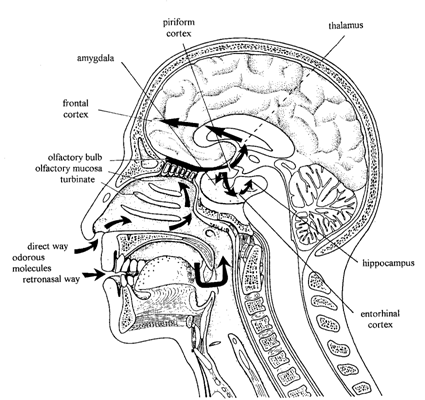
Fragrant Illusion

I’M WAITING AT THE BUS STOP in the zone industrielle and there’s that slightly odd fragrant smell in the air again. I asked somebody about it and they told me there’s a laboratory here that creates different kinds of commercial smells: odorants, aromas; the air is full of fragrance. It’s the smell of fruit jam today. Another day, it’ll be a different smell, maybe a more subtle thing that you can’t identify easily, an essential component of a popular smell – not unpleasant, just odd. Interesting that the fragrance of fruit jam that strikes the nose when I open the jar is not as fruity as I thought. It’s a ‘replacement aroma’ created under laboratory conditions by chemists. How weird.

The manufactured smell is a chemical compound designed to trigger an olfactory experience. My smell process is activated and even though this is completely artificial, I’ll react in the same way. I’m just as likely to respond to the aroma and go into the ‘wanting’ mode, whether it’s been created in the laboratory or it’s the real thing – I can’t tell the difference. The chain reaction of consciousness is saying this is real, go for it, and that’s all it takes.

I’m thinking about the wonderful aromatic fragrance of bread and bakery items that wafts towards me from the bakery near the station. I’m drawn to it because of the aroma. And I realise now the bakery cannot produce that smell as a result of baking – I doubt if it even has a baker’s oven on the premises. But I respond to the smell as if it were real.

In the paticcasamuppada the smell of fresh bread starts a sequence that looks like this: The aroma of fresh bread is at Sense Gates salayatana. In itself, it’s not anything, then it makes Contact phassa and shortly after that there’s the beginnings of recognition, which leads to Feeling vedana and I’m taking out my wallet. There’s Craving tanha and after that I’m caught. The purchase is about to be made but before we close the deal: ‘…autre chose, monsieur?’  (anything else, sir?)

I experience Grasping, upadana and it seems like a good idea maybe to get a couple of other things as well. Then Becoming bhava happens, I’ve made the purchase – it’s mine! There’s a brief moment of joy: Birth jati and I get outside and look in the nicely wrapped carton of donuts, pain aux chocolate, almond croissants…. What did I get all these for?

At some point, it may be now; it may be later, I experience Sorrow, lamentation. pain, grief and despair soka, parideva, dukkha, domanassa upayasa (Note: the actual ps cycle includes: old age, death, jara, marana) and the lingering smell means I might, later, try to revisit the baker’s shop to see if I can do it again but somehow manage to avoid the suffering this time?

Not only food, there’s the smell of leather upholstery in a new car, for example. That distinctive odor, created by chemical processes, may tip the balance and … sold! The smell of a new carpet; it may not be an attractive odor but it does trigger something; there’s a familiarity about it – ok, proceed to checkout! The company that manufactures and promotes the aroma is engaged in the commercial exploitation of smell – and we are caught by the nose.

I used to travel regularly on a small jet, a short flight and the steward would come along the aisle of this tiny plane to serve a coffee and a rather sad-looking sandwich. But before that, before it was served, the cabin would be filled with a wonderful, exotic aroma mix of French cognac, a hint of cigar smoke, ground coffee, crème caramel, port, liqueur. The snack is served, it’s a terrible let-down.

Do they really think we might not suspect it’s something entirely manufactured, a puff of a spray that releases the odorant in the air? But I realise that it doesn’t matter. The steward who serves the snack and everyone in the plane know it’s an illusion. There’s a basic acceptance of illusion; it might even appeal to a competitive cleverness that ‘I’ can see through this illusion: “… isn’t it interesting how they can create artificial smells?”

It’s saying this is acceptable, it’s okay to do this, there’s illusionary stuff everywhere; TV, videos, and mind states are just the same; the ‘self’ we have created from the five khandas. And there’s a familiarity with the ‘trick’; a recognition of the whole panorama of illusion that we have created in our world. So what if it’s artificial? The whole ‘thing’ is artificial. We like it like that!

That’s the way to go if you think you like endless proliferation, but it does need to be maintained and the novelty wears off. The seeing of it dispels ignorance: Phenomena are sustained only so long as their sustaining factors remain.’ Take out the sustaining factors and the whole thing comes to pieces.

The bus arrives and we all get on. It rumbles off down the road and the smell of fruity jam is almost gone, I can still smell slight traces, then I get distracted and forget to smell for a moment. When I remember, the smell is gone completely. Soon after that I’ve forgotten all about it.

‘When this exists, that comes to be. With the arising of this, that arises. When this does not exist, that does not come to be. With the cessation of this, that ceases.’ [Samyutta Nikaya 12.6]

…………………………………

 (For the whole analysis of the paticcasamuppada, click on this link: Buddha’s Teaching on Causality, Dependent Origination paticcasamuppada.)

[link to more info on artificial aromas]

[image source link]