everything is a metaphor

IMG_2142bPOSTCARD #122: Chiang Mai: Jiab suggested we hire a car with driver and  go to Doi Ang Khang, the mountain, for some fresh air and hill walking – beneficial for health for someone in my condition. Do I want to do this? Ask a question, and the answer comes with it – as if it were part of the question. The answer is in the asking. So off we went. M sitting beside me in the car and I had my passport in my jeans pocket. She felt the hard square shape: What’s this Toong Ting? I said it was my passport. M knocked on it with the knuckle of her finger:
Knock, knock!
Who’s there?
Hank…
Hank who?
You’re welcome.
It’s playing with the idea that Thais cannot pronounce properly the ‘th’ sound in ‘Thank You’. Then another one:
What kind of dessert do ghosts like?
I don’t know.
Ice cream (I scream).
That led to the pronunciation, and difference in meaning between ‘dessert’ and ‘desert’. For example, the whole central part of Australia is mostly a vast area that consists of nothing but custard and bananas and blobs of ice cream, fruit and currants.

It was a four-hour journey, pretty scary steep incline of roads and sharp bends kept us alert. Also gulping of air to get rid of the ear pops until we finally got to the top, into the hotel room and M runs through all the space, jumps on the three beds and into the bathroom. Mirror takes up the whole wall. I see her looking at herself – not satisfied. Ah well, we don’t usually fall in love with our reflected image, there’s always something judgmental – things that are always not as good as they could be (the Buddha’s teaching on Suffering Dukkha). The antidote is alert watchfulness, mindfulness, sati; mindful of being mindful, remembering to remember to remember. Learning how to learn.

Lunch came and before we could start to eat, M had to take a photo of it and send to her friends. It’s an amazing thing that we use the wonders of technology to send an image of somebody’s lunch over the Internet; a created postcard sent and instantly received. Then the actual lunch is eaten and gone forever. Except that M wouldn’t eat enough, and Jiab said something about she was too thin. I could feel the hopelessness in M, like… please don’t tell me this again! So I said I thought M looked nice, thin, elegant: What does elegant mean Toong Ting? I said she looked like a movie star, beautiful… then after that I kinda regretted saying it because she started acting strangely. We got back to the room and she’d hardly look at me and at the same time cuddle up against me. But it was soon forgotten when we got out and started the walk up the mountain.

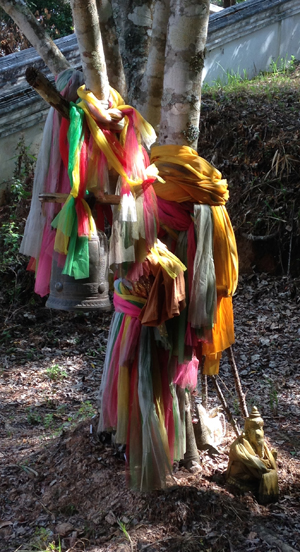
The first stop was the pagoda, one hundred and ninety steps up and down. I couldn’t quite figure out why it was there, except that everything is a metaphor. Trees wrapped in coloured cloth, auspicious meanings I understand only because I’m expected to understand (to be continued)

“our world and the beings in it in all their diversities are but the illusive manifestations of mind. While the illusion is taking place, it is “real”, but its essence is unreal like a dream. Therefore regard all phenomena as insignificant, similar to a dream, and rest your mind in this perspective in the moment.”[ The Seven Points of Mind Training of Atisha]

————————–
The Atisha quote comes from a comment by Ben Naga in a recent post
~ G R A T I T U D E ~

the kamma of not seeing it

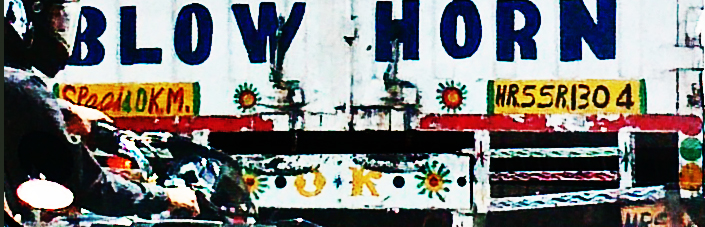
blowhorn2

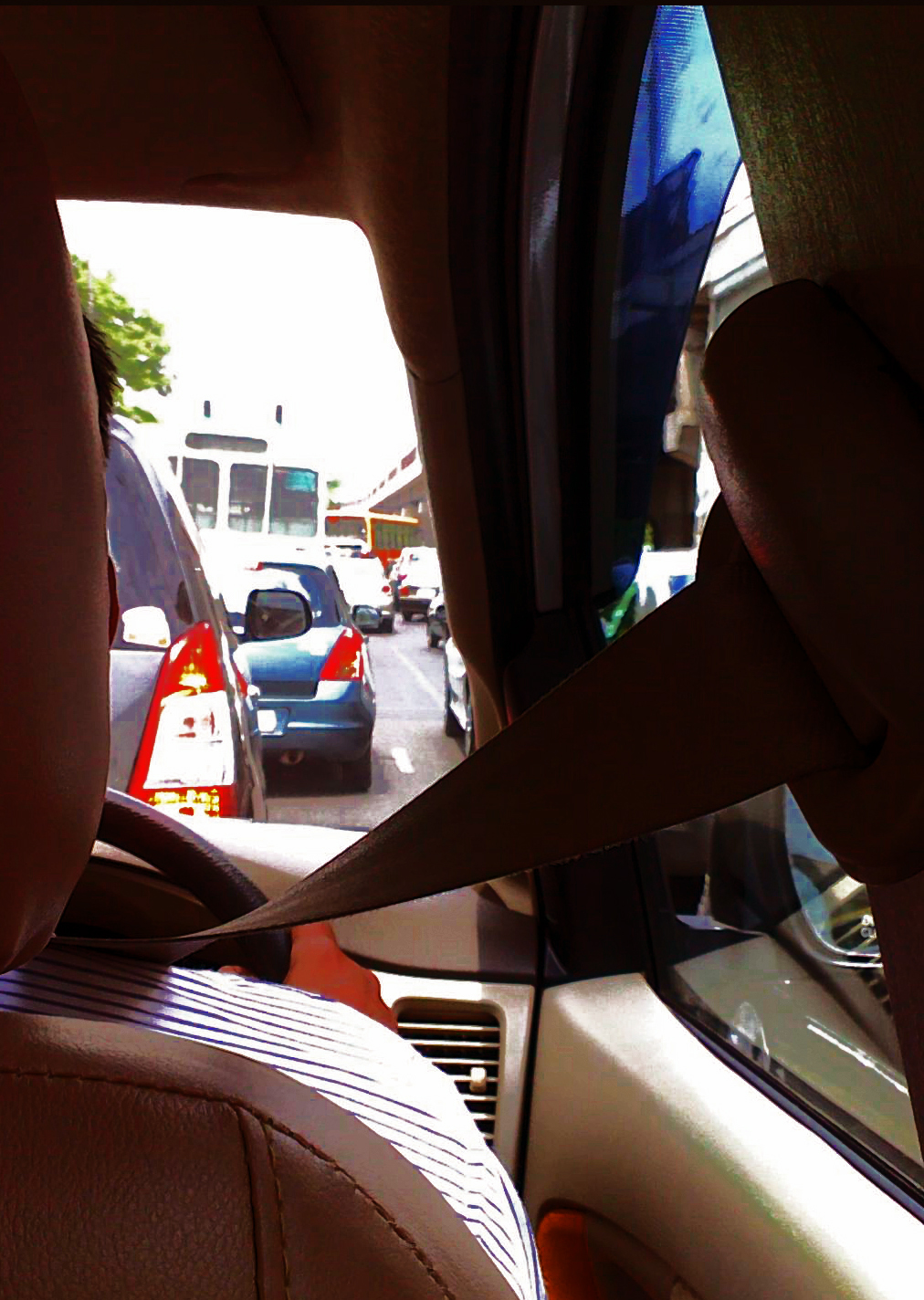
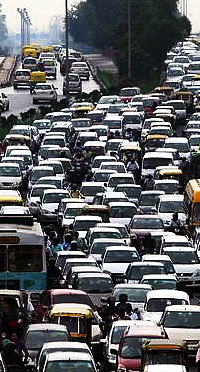
POSTCARD #84: Delhi: Eight thirty in the morning, coming into town from the airport, great rivers of traffic and car horns hooting and tooting like flocks of geese in a poultry market. Shym is driving, I’m in the back… an opportunity for me to consider how difficult all this could be. Confrontations up-front and in-close brinkmanship… give-and-take becomes push-and-shove, not enough space, no room to move. Scarred and scratched vehicles, smashed rear lights, dented bumpers. Trumpets blare, somebody blocking the lane – get out of the way! Insist on it thru the sheer force of horn blasts: plaaaaah, PEEEE, pap-pap-pap! Everybody gets into it, scenarios of outrage, high octave shouting in a language I don’t understand. Then Shym starts singing in Hindi, a voice with trembling vibrato. Maybe I should ask what’s that nice song he’s singing and we can have some light conversation? But I see his hands gripping the steering wheel, white-knuckling it, a sense of the radiant nuclear fury of the sun. This is how it must have been in the Wild West – except they had guns. The ever-present sound and odour of gunfire, young cowboys wearing holstered revolvers and composure like stainless steel. Somebody loses their cool, chairs fly away and everybody dives for cover under the tables.

Things being as they are it takes longer to get to the house than planned, driving with extra caution through these hair-trigger hazards in Delhi traffic, and me with these whispered voices I try not to listen to, voices telling me, it shouldn’t be like this, and seeking calm, steadiness in the intention to be mindful. Remembering to disengage the automatic irritation response. Just notice it – yep, that’s it, and leave it alone. Let sleeping dogs lie. Lessons learned from a lifetime of kamma-vipaka, cause/effect – this is the result of something that happened in the past. Whatever that was, caused this. And what caused that cause? There must have been another cause and this is the effect of that effect, then… and before that cause? Another cause, same thing. My presence here, ‘me’, is the result of a very long cause/effect sequence stretching all the way back through the ages to the Big Bang (The Original Cause, or was there something that caused that?). I am here as a result of generations of those who came before ‘me’, believing it was an inevitability, destiny tattooed on one’s forehead. Going about their lives and managing likes, dislikes; the desire to have, want and get-away-from. The kamma of not seeing it – not seeing that there’s an end to kamma.

So, everything is holding together reasonably well and we reach home in the end. Out of the car, hi everyone, I’m okay yes, thanks, just been sitting in an aircraft economy class seat all night. Into the house, drop bags where I stand and collapse on the sofa. It’s been three weeks but feels longer; three Buddhist monasteries, a funeral and a wedding – and the 4000-year-old stone circle in NE Scotland. I came back to India to take a rest from all that… watch the breathing, heartbeat all a flutter, lying here in the horizontal position. There’s a trembling vibration running through my body, is it the sofa, the floor? Raise my head, is it an earthquake? Look around, no indications of it, nothing falls off the shelves – not an earthquake, just life itself….

“… in its fullest sense, liberation from kamma is liberation from cause and effect in the mind. It’s a process of mentally, emotionally, stepping back from any state and seeing it just as a state, without reactions and attitudes. This simple skill, which most of us can do from time to time, is what we develop in Buddhist practice.” [Ajahn Sucitto, Kamma and the End of Kamma]

————————- 

gone is gone

Nepalese Buddhists monks pray outside thPOSTCARD #20: Delhi: Suddenly awake at midnight, the mind is busy with something… seeking gratification in the realization that I don’t have to search for anything anymore – thus lost in the seeking for it. Trying to remember the dream from the parts of the jigsaw that are remaining. Maybe, as I’m looking for the lost pieces, I’ll see what the story was about – the logic of the dream… In every new circumstance, reassembling the parts of who I am, and nothing seems to fit; searching for a ‘self’ to be satisfied with what’s going on – or dissatisfied with how things are; or upset, or angry, confused, depressed, gloomy or sad

How did I get to be here? Arrived yesterday morning – flight from Chiang Mai to Bangkok, then another flight to Delhi; a cabin-pressured, air-conditioned day at 37,000 feet, cruising speed 600 mph; up and down again – twice. I’d been awake since 4am Thai time, fell asleep at 7.30pm in Delhi then woke again at midnight – the predicament of the dream, staring wide-eyed in the half-gloom of city night, deep purplish-black night-vision. Halloween season, all doors and windows shut to keep the ghosts out, enclosed in the concrete and steel of the present moment. Quiet, except for the refrigerator noise; hmmmmmmm… masking out frequencies. When it stops, I become deaf in the silence. Small random sounds… the bark of a dog:

Death is drawn to sound
like a slipper without a foot, a suit without its wearer,
comes to knock with a ring, stoneless and fingerless,
comes to shout without a mouth, a tongue, without a throat.
Nevertheless its footsteps sound and its clothes echo, hushed like a tree. [Death Alone by Pablo Neruda]

Listening to the whisperings of stealth; a small lizard is investigating the kitchen, the tiny clink of something against a plate, rustling in the small trash bin on the counter… I switch on a few lights and it’s gone. Start up the laptop, feel more comfortable with nocturnality, more at peace with the electric light of night, shadows and darkness. Draw all the curtains closed just before dawn, hermetically sealed. The day is an exhausting awakeness. I shall stay with the night, be a vampire; halloween and ghoulishness..

Deathlessness and the buddhist undead; mind hovering in a memory; the context of an event, somewhere between remembering what happened and wondering what could have happened after that – how it might have been and how the story unfolded from there. The thought exists in the mind, then it’s gone. Curiosity, where did it go? Carefully take everything apart to find out where that thought went… everything irredeemably dismantled. It’s gone. Gone is gone; when I’m gone, I’m gone and everything else will be going on. Just the same. Comforting, somehow, to shift the focus away from the confines of ‘me’ and out into the surroundings.

‘… we are only dust. Our days on earth are like grass; like wildflowers, we bloom and die. The wind blows, and we are gone – as though we had never been here.’ [Psalm 103, 14-16]

————————-

Reference to Psalm 103, 14-16: TheWannabeSaint.com  – G  R  A  T  I  T  U  D  E –
Upper image: remembering this time last year when we went on the tour of Buddhist holy sites [Photo Link]
This post inspired by a website I recently discovered: Buddhism for Vampires

recognition

HarnhamLakePOSTCARD ♯05: Harnham Monastery, Northumberland: The monastery is situated on top of a small hill; guest accommodation is down the road a bit. I walk up to the main building for the one meal of the day; sunshine, a cloudless sky, and I meet one of the monks at the door. How long has it been, more than two years? He looks different. Faded brown/tangerine robe, shaved head, exposed face, features looking at me. The whole presence of a person, eyes in the centre of a field of vision – it seems like an immense identity just living here quietly… my perception of how things are, looking back at me. Recognition is a selective thing, matching moments of experience with what’s in the files inside the folder marked: THE MEMORY OF OTHER THINGS SIMILAR TO THIS – select/match, the mind-body organism default. It’s not what it is, it’s only what it appears to be.

Chanting, food, wash dishes and walk back down to the guest accommodation again. Huge daisies on the edge of path, everything is swelling up in blossom on top of this solitary hill and the panorama of Northumberland landscape all around. Unknowingly, I’m manipulating my perception of things to see the world as I want to see it without any real understanding of why I’m attracted – a huge habit of indulgence that I think is simply normal. I don’t understand desire, I just respond to the experience of it. Now on top of this hill, looking at a lifetime of seeking after what I want and rejecting what I don’t want without really knowing why. There’s this experience of dissatisfaction at the base of it all… normally I’m pretending it’s not there. It’s a hunger – a hunger for what? Caused by what? Is there a way of ending this hunger? There’s a name for it. It can be identified. Dukkha, (suffering), the First Noble Truth. Knowledge enters and ignorance is pushed out. I couldn’t see it before; too much thinking about how much I dislike the idea of suffering, an obstacle is created by my aversion to it; the desire for it to not be there. Strategies of avoidance, and lost in experience, agreeable/disagreeable. Caught in the momentum of seeking gratification or holding on to unhappy states of mind believing that this is my reality. The deluded self, ‘me’ and ‘mine’. This is the obstacle – the only reason it’s there is that I linger with the idea of it….

KHouse daisiesReturning again and again to the same starting point means these unhappy states of mind are reinforced more and more. Recognition is not informed by ‘clear knowing’, it’s seen through the clouded prism of unawareness, avidyā not-knowing (ignorance). What’s required is mindfulness, applied recognition, Right View, and the undoing of all the little knots tied in memory, habitual reactions over many lifetimes. Bit by bit, letting it all go…

View_harnham_hill————————-

‘If we have faith in the Buddha’s teaching and are inspired by the great teachers, we can direct our interest into not just avoiding suffering, something we have spent a long time doing, but finding a skilful way of directing our attention towards recognising it, here and now. What is this ‘self’? How is this ‘me’ and ‘mine’ manifesting itself here and now?’ [Ajahn Munindo, Entering the Monastery, 22 July 2013]

– G  R  A  T  I  T  U  D  E –

conflict & release

121120121567“Metta is non-discriminatory. It doesn’t mean liking one thing rather than another, it isn’t a question of singling out: “I love this person, I don’t love that one.” [Ajahn Sumedho, “Universal Loving Kindness” From Forest Sangha Newsletter, October 1997]

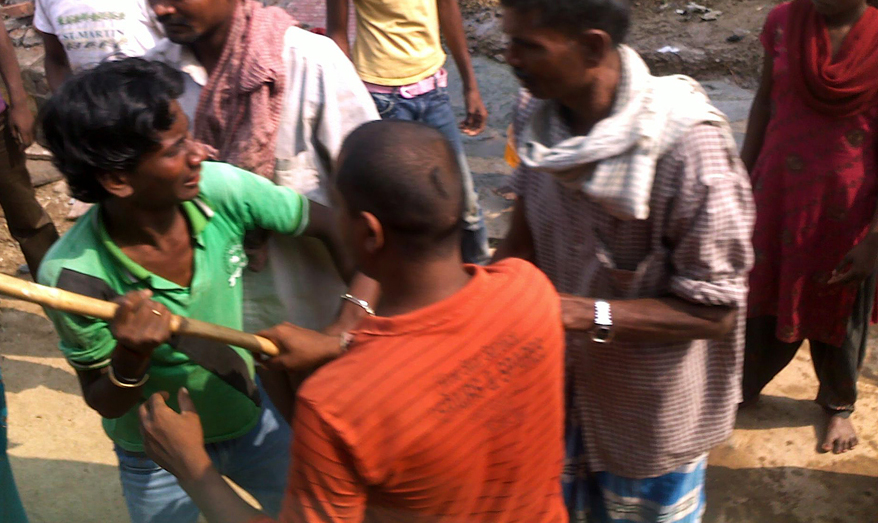
North India: The image here shows some kind of serious argument happening among a group of men, viewed from the window of a moving bus. I couldn’t actually see what was happening because other passengers were in the way, but I got the camera into a space near the window of the bus and took the picture, guesswork, thinking it’ll not come out clearly but it did – perfectly positioned in the centre of the frame. The man in the green shirt is trying to do something with that pole and the other guys are struggling with him violently. The bus pushed itself on through the crowd and the people made space for it. When we got up close, all I could see was the top of their heads and I took the photo without seeing where to point the camera…

The bus moved on and we were gone in a moment, accelerating along empty streets. I was amazed to see the photo after we’d moved away from the area. What to do with it? The tremendous intensity coming from the green-shirted man is scary – murderous feelings in the air. There’s another emotion too, he looks tearful, as if he might start to cry. It was an event I didn’t see, all I have is this picture of it. I could hear the explosions of angry voices, and the memory of it is still a bit scary, but it didn’t happen to me. If it hadn’t been for the camera lens, I’d not have seen it. As long as no effort is there to keep it going, conflict falls away. But we fuel the fires to keep the conflict going; our wars and war-mongering, allowing everyone the means to build up the tension, justified outrage, creating stories in the mind. We could just as easily allow it to fall away, but we’re drawn in, and it gets to a point when conflict is inevitable; this is always how it is.

Then Ajahn Vajiro was in town the other day and somebody asked him about what to do when you have to put up with some unreasonable, insensitive person giving you a hard time and you have to see this person on a daily basis. Ajahn spoke about the Brahma Viharas and later Suffering, the First Noble Truth and how the Buddha didn’t say he could eliminate suffering – he gave us the tools to escape the suffering. It led me to see that conflict is resolved if we can focus on the subjective nature of it, see our own anger, and see the anger the ‘bad guy’ has to cope with, and recognise it as exactly the same thing – what’s the difference?

The practice of meditation is the solution. Ajahn talked about getting to know the inner world; start from there, explore the universe from the inside. It’s not just about feelings of bliss and peace, that’s there too but it’s about the real world. Long term goals. Following this path, you get to know about suffering; you notice your own suffering, you have compassion and act towards others with compassion when you notice the suffering in your opponent. Apply wisdom – especially if your opponent is swinging a long pole, aimed at your head. See the angry person as someone who doesn’t understand his/her own suffering and recognise their difficulty – then get out of the way of the swinging pole!

It’s about the difference between ‘knowing’ and ignorance. Ignorance is the result of unskilful action. Non-ignorance (knowing) is about accepting limitations and doubt. It’s not a sure thing but it doesn’t have to be a serious drawback; having to cope with being not sure, uncertainty. Ajahn V described it as being at the edge of the known; doubt is nearly knowing what it is…. In a different context, uncertainty is what’s in the wrapped gift you’ve been given. You don’t know what’s inside until you open it….

————————-

“The metta – kindness – engendered in us encourages us to accept ourselves and others, and so to understand ourselves and others. Understanding implies wisdom. And this wisdom is that which allows us to find the way, to grow beyond, or let go of, that which limits and binds the heart. The kindness expressed to others allows them to accept themselves and others. This is an emotional, gut or heart acceptance that allows the acts of body, speech and mind that are a response to that which is perceived as `other’ to be kind; not motivated by not-liking, not motivated by aversion or fear. The effect is unlimited Metta is radiant and attractive, warming to those that are cold, cooling to those that are hot.” [Venerable Ajahn Vajiro – “Mature Emotions ” from the Forest Sangha Newsletter]

nothing cannot be anything

hand image3Delhi: There’s a needle in my arm. Strange how the body accepts this intrusive object and the antibiotic fluid coming through it that enters the blood stream. Veins have a plasticity like something synthetic we recognize from the world of manufactured polymer substances. But human tissue is better; you can make a hole in it and it repairs itself. You can cut it, stitch it up, remove parts of it and replace these with other parts that fit. The human body is a miracle. The pain of this needle, though, has a directness, increasing, then easing off, over and over, dukkha, there’s no getting away from it.

I don’t want it to be there, vibhava-tanha, I want to disconnect it from the plastic tube leading to the upside-down bottle suspended from the hook above my head. It feels unnatural; it shouldn’t be like this…. Lying here on the bed looking up and counting the drips that fall into the receptor that fills the tube; one drop every 4 seconds and that’s the rate of the fluid flowing down the tube into my pierced blood vessel. It’s a full bottle, and there are others I have to take after this one… treatment for an intestinal infection – nothing really extraordinary in a country like India, in the hot season, when all kinds of bacteria thrive. Caused by drinking water from a filtered system that didn’t filter. Organisms survive the filtering system; bugs everywhere in this intensity of 43°C.

I need to find a way of getting through this period of invalid status and prolonged boredom of a plain room with hospital fittings, plugs and sockets in the walls, hospital furniture and a TV screen I’m not interested in. Dissatisfaction with things; clicking the buttons that control the position of the hospital bed; down/up and up/down. Lying here with eyes closed, listening to the metal trash bin; it makes a satisfying percussive sound when the cleaner presses the pedal with his foot, lid springs open and strikes the wall next to it Clang! He releases the pedal and the lid closes: Flumpf an airtight trash bin with plastic bag liner. Crash! Flumpf! again and it’s joyful and funny.

I need some joy here, there are men in dark navy uniforms in the room; cleaners with large grey floor mops that look like they’re soaked in muddy water swabbing the tiles; smell of Dettol stings the eyes. Muddy grey mops and dark navy uniforms seem out of place in an environment of lemon yellow, soft pink walls; pastel shades and shiny chromium fittings. The muddy grey mops are a bit scary also, because I’m sensitive to things that appear dirty, having fallen into this sickness as a result of drinking water from a filter machine installed at home that allows dirty water to come through.

‘We’re not in Kansas anymore Toto…’ The doctor said always drink boiled water in the hot season, organisms are present in the water, filter or no filter. I feel some frustration with the company that sold me the water filter: ‘it shouldn’t be like this’but we don’t live in a world of ‘should’ and ‘shouldn’t – western theory applied in an Indian context. We expect it to work, and it doesn’t. Western systems are deductive and life is inductive. Organic growth has no beginning no end. How to understand that, what to do? Don’t make it into a structure. Let it be nothing.

So I can lie here on the bed with my eyes closed and the cleaners expect me to be like this because I’m a hospital patient. And in this curious public place, enter meditative contemplation, watching the breath, the rising and falling of the chest. Allow the thoughts that arise to fall away and be replaced by others that I allow to fall away and allow everything to fall away and cease, as far as possible – just the effort of trying to do this leads to a quietness in the mind; spaces of no thought. There’s some peace to be found in this activity. And from here consider nothingness, just nothing, no thought. It’s not an idea of nothingness, that’s a concept. Nothing cannot be  anything. Nothing cannot be located anywhere in time or space; no before, no after. If it is truly nothing, it can have no cause or effect. I can’t work towards some mind state in future time when I’ll see what ‘nothing’ really is, it has to be now, it’s always ‘now’. Nothing cuts through, penetrates, and dissolves everything. It’s just nothing.

————————-

‘One must have a mind of winter… (to behold) the nothing that is not there and the nothing that is.’ [ Wallace Stevens, The Snow Man]

Photo image: http://www.jeffzinn.com/wp-content/uploads/2011/12/poor.jpg

girl at the traffic lights

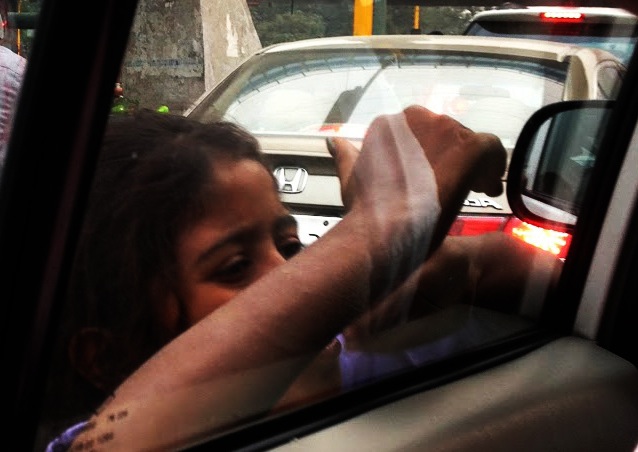
090420131781New Delhi: Sitting in the car, Shym driving, and I’m in the back seat looking out through tinted windows, incognito. Slow down and stop at the traffic lights. Street people and traders walking up and down between the vehicles, selling kiddy’s toys, books, and all kinds of stuff. Children with bunches of wilted  roses knocking on windows, and discussing with passengers in auto rickshaws. One of them presses her face against my window, hands and arms cupped around her head so she can see inside through the tinted glass film. A shadowy head and face spin around looking for where I’m situated in the dark interior. Finds me, then some kind of eye contact, and: tap-tap-tap-tap on the glass with a small coin…. tap-tap. Doing it just to see what’ll happen. Shym puts the car in gear and drives forward a little bit, trying to discourage her but she remains stuck to the glass like glue, walking sideways, legs slightly back out of the way of the turning wheels.

IMG_9171I slide down the window and give her a folded 10-rupee note. Hot street air enters the cool interior of the car like a blast from a huge hair dryer, and I see a dark girl about 9, with hair a light reddish-brown colour, dusty with the street atmosphere. The entrepreneur. How does it look to her? A foreigner gives her money, somebody with colourless eyes, pale, half invisible; like a creature that lives at the bottom of the sea, no sunlight. Her dark eyes hold my attention, intense, penetrating; there’s only ‘the look’. I slide up the window again. Giving her a few rupees is encouraging this kind of livelihood – that’s not really what I want to happen… but what to do? The lights change and we’re off, accelerating through the traffic, overtaking on the left, or the right, wherever there’s a space.

lights1

There’s a small smear on the glass where she was looking in. How does the world seem, seen through her eyes? Must be a no-choice situation; hardship at a level I can’t comprehend – we’re not watching the same movie. But it reminds me of something in the early times in Scotland. In those days I was pretty much caught between polarities. A rocky road. I went down South to England and I’d look at other people’s lives there; unbelievable to me, how their reality seemed to be so… bland? Where I was living you’d open the door of your house to go out and the wind would blow you back in. Extremes of climate, extraordinary confrontations; the rough and tumble. At that time, I didn’t know about the Buddhist perspective on suffering dukkha, all I had was the experience of it. The cloud of unknowing… life was held by random karma. Consciousness was a kind of unconsciousness. Awake but unclear, living in a dream… dum-di-dum. Subject to all the whims and fancies; tugs and pulls. Like/unlike – and for long periods, quite lost in samsaric realms. I thought I could just carry on like that, hoping to muddle on through…

Carefree, at times, and reckless, not happy, no sense of an applied mindfulness other than, okay, so… what’s going on here? Sometimes I was nearly right, other times terribly wrong. I’d weather the storm and somehow things stayed okay. The mistake was (although there are no mistakes) I’d be trying to get ‘it’ to do something or be something or become something (or not become something), without realizing that I didn’t have to do anything with it, or make a ‘thing’ out of it, or have it become anything. Just letting it be there in the background, or the foreground or seeing it in the middle distance, not focusing on it unduly – whatever. So the ‘it’ became not so important; less and less of an identity found in the ‘object’, more like a larger subjectivity. It’s the same for everyone but at the time I thought it was just happening to ‘me’.

AVN_TRAFFICDELI_282719eIt’s not about guarding that little self-construct called ‘me’. The Buddha’s Noble Truth of Suffering is about receiving the suffering as it is, conscious experience. Open wide and let it in so then there’ll not be a self for it to attach to. If I can allow the Suffering to enter, I’m not confused by it or perplexed by the fact that I don’t know why I don’t know what it is. I ‘know’ what it is: maintaining a ‘self’ that isn’t there. So I can let all of that go. It’s about relinquishment, giving it all away – a shared experience. A kind of generosity, like giving money to the girl at the traffic lights; she was there to enable my simple act of generosity (raison d’être for panhandlers). Who knows, maybe she has the wisdom I’ve been looking for all these years. I’ve been caught in delusion, a dull puzzleheadedness, caused by the influence of the painted consumer god, the psychiatric witch-doctors – is it so very different from her world? Failing to see that if my life is never nourished by anything greater than what I need and want, I become cynical and negative. There are some people like that; holding on to ‘self’ with such tenacity, they get old and bitter with disappointment. Offering something to somebody else makes me feel good, brings gladness into my life… ‘The Buddha-Dhamma spreads out from here to all sentient beings throughout the universe. Mettā, loving–kindness and goodwill is generated for the welfare and development of all beings everywhere: seen, unseen, born, not born yet, animals, devils and angels. The whole cosmology of possible sentient beings is included in the practice of mettā bhāvanā…’ [Ajahn Sumedho]

————————-

– G  R  A  T  I  T  U  D  E –
Ajahn Sucitto, for the use of the word: ‘puzzleheadedness’ also edenriley.com and thehindu.com

remains of the dream

tuk18March

Chiang Mai: 05.00 hrs, phone alarm goes off, ascending ring tones of celestial music and the small window of digital light illuminates the dark room. Too bright, it’s difficut to see how to switch it off. OK, I got it…

Peace and quiet, it’s a Chiang Mai morning. Difficult to wake up because I just arrived from Delhi and there’s a time difference of 1½ hours – neither one thing nor the other and the remains of the dream scattered around. Fragments of a story and the urge to try to put the pieces together and recreate the dream. There’s this built-in curious ‘wanting’ tanha. Maybe I’ll find out what the story is about in the process of looking for the pieces that are lost?

Impossible. The predicament of the dream, the tendency to be wanting something… anything, it doesn’t matter; something to attain, obtain, procure, secure – a mood, a good feeling – the language of consumerism – wanting something, but I can never seem to narrow down the options sufficiently to actually get what I want, and all that’s left is the ‘wanting’ itself. Ungratified desire, just the wanting, hungry and dissatisfied, I feel like I want to get rid of the ‘wanting’ but wanting the ‘wanting’ to stop doesn’t make it stop. It only increases the level of ‘wanting’ and this is my suffering, dukkha….

Slowly moving up through the layers into a more wakeful consciousness, here. Difficult. All the pain meds for backache coming to an end now, very nearly pain-free for the first time in 10 days. Wonderful. So, I think I’m nearly able to pull the body into a meditational posture. Try it and see. Carefully adjusting the pillows and cushions on the bed to get myself sitting upright with folded legs. Aching knees because it’s been a while but it comes allright, settles down, and everything just falls into place again.

Mindfulness. The presence of the body, just quietly sitting here, and the mind slowly moving from sleep to wakefulness. The in-breath and the out-breath seem like incremental steps going higher and higher up a narrow winding stone staircase until it doesn’t go any higher and when I let go of that, the mind eases off into this state of peace. ‘… meditation is not an activity; it’s the cessation of an activity’ [Rupert Spira]. It’s about consciously not doing anything.

Peacefulness and fragments of the dream remain, pieces of a jigsaw puzzle. I’m drawn towards it, still, and inclined to try to put the pieces together again. The peaceful state becomes blissful, nice – if I merge with it, I’ll fall asleep and there’s a reluctance to do that. I’m holding on to it again, I see I’m trying to make it do what I want it to do, even though the blissful state is incidental, subject to change, annican, and I’ll never succeed with it.

It’s the ‘wanting’ thing again. I could ‘modify’ this and get it to be what I want? It would be nice if it were blissful all the time but I recognize something; the bliss can become irritation and sometimes it’s a hell realm and I have to get out of it quick… Heaven/hell, there’s no way of knowing which way it’s going to go, so I need to remove the function that tries to manipulate the pleasant state through greed and wanting.

This helps me to detach from it; let go of the bliss, bye bye… but it’s still there; just feels like it’s happening to someone else; generosity, share it with the world. Can’t find words to express. Leave it at that. I’m really a minimalist, anatta. No God, no ‘self’, no I, you, he, she, it, we, you, they – and the sentence often makes no sense because there’s no subject, no object. No problem, the feeling is too large, no words for it…

————————

“As far as the suns and moons extend their courses and the regions of the sky shine in splendour, there is a thousandfold world system. In each single one of these there are a thousand suns, moons, Meru Mountains, four times a thousand continents and oceans, a thousand heavens of all stages of the realm of sense pleasure, a thousand Brahma worlds. As far as a thousandfold world system reaches in other words [the universe], the Great God is the highest being. But even the Great God is subject to coming-to-be and ceasing-to-be.”[Anguttara-Nikaya X 29]

dimensions of pain

DSC00134 Lake Wanaka - near Diamond LakeI WAKE UP FROM THE DREAM to find I’m shipwrecked on the sofa, notes and papers strewn around, a cold cup of coffee – how long have I been asleep? Turn to look at the clock, then the pain; lower back pain, oh… aaah! Yes, I remember now, I’ve been disabled for a few days and situated on the sofa mostly: pain is bad – I must have done something ‘bad’ to deserve this… the tendency to criticize oneself for having the pain, perpetuating the kamma of causes and conditions. I need to correct this frequently. Another thing is that I’ve had the pain often enough to know there’s a difference between the pain itself and the act of resisting it; also the attachment to wanting it to go away: I-don’t-want-it-to-be-there…. Profoundly desiring it to not-exist, vibhava-tanha, but I’ll not find any peace in attempting to gratify that need – although I may persist in trying. What to do? There’s nothing I can DO about it, except try to get comfortable and see how that goes. It’s a no-choice situation and, strangely enough, things start to improve as soon as I stop trying to do something about it…

Some years ago I had abdominal surgery (abominable abdominal surgery – no joke) two operations, 6 months apart. Just enough time to recover from the first before getting ready for the second. More difficult the second time around, because I knew what was coming. The first time it was unplanned, an emergency, severe abdominal pain, straight into the emergency room in a Bangkok hospital and admitted right away; something sinister and twisted in the large intestine. So I sign the no-liability form and get operated on the next day. The surgeon tells me after I come round, he’s removed two tumors together with a length of intestine – doesn’t tell me how much, I didn’t ask, and he also says he’s my closest friend; nobody else has ever left their handprints on my intestines!

Colonic cancer, I was lucky. In both operations the post-surgery period was dramatic. After the anesthetic had worn off, the pain arrived suddenly, right there in the centre of my physical being – absolutely no getting-away from it. The immensity of it occupying all the space and I’m backed into a corner. No escape, the only way I can go is forward, step into it. No choice, but dropping the resistance to the pain caused a moment of ease to arise, just before being swept away in the pain… wow, how did that happen? Clutching at straws: an insight, a tiny one, but it made a huge difference. There was desperation all around but just enough of an easing in the pain to tell me that whatever it was I’d done was good so how to do that again?

This back pain is the same kind of thing, but less intense, not erratic and scary. So I can allow it to be there. In contemplation of it, I see there are the other systems of the body all around the pain, normal stuff, just quietly ticking over. There’s sufficient space to distance myself from all the immediate responses to this pain; the obsessions and fears, mostly a conjured-up conceptualizing where, in different circumstances, like intense joy, it would lead to everything being compellingly interesting. And, in the same way, when I have intense pain I’m subject to fear and wild imaginings: ‘your joy is your sorrow unmasked. And the selfsame well from which your laughter rises was oftentimes filled with your tears.’ [On Joy and Sorrow by Kahlil Gibran]

Conceptualizing is an automatic default that returns always to that same starting point: the ‘self’. Unless something propels it right out of there (like what happened to me in surgery) there’s nothing beyond this, no real insight into finding the way out of pain. But what the Ajahns told me about the Buddhist teaching is that the mind is not self. Mind is the sixth sense – everything I see, hear, smell, taste, touch, feel and think. The mind sense usually leads to a consciousness of how everything is coming in from the outer world through sensory experience and that default to the sense of self: hey, this must be happening to ‘me’. With insight, the mind sense can bypass that, and then the pain is not happening to anyone – there’s no ‘me’ engaging with these thoughts. Instead there’s an awareness of the thinking process with no attachment, mostly abiding in a state of mindfulness and careful receptivity, sati-sampajañña; just looking to see what it might be. There’s a kind of alertness about the sensory function, and the simple curiosity: what is it? Just being open to what this could be, is enough to understand how it works…

————————-

Photo image by Louk Vreeswijk, New Zealand Collection

hold on and let go

2013-04-01 15.24.34New Delhi: Arrived late morning on a flight from Thailand and Shym picks me up at the airport. It’s that feeling of bewilderment; having been scanned by X-ray machines, identified, processed, held in aircraft cabin pressure for 4 hours and transported. Now I’m here, nearly two thousand miles away from where I was, placed on the ground and having to reassemble the parts of who I am in this new context.

Where are we now? Eyes looking out, bright sunlight but not fiercely hot like Bangkok; more like a Mediterranean climate, feels okay. Heavy traffic, drivers with attention-seeking behaviour; the ‘BLOW HORN’ message on the back of trucks says everything. It’s a kind of open invitation to press your horn to say you’re here. Get out of the way! I am coming; it’s me! ‘Self’ is something real, something eternal, according to the Vedas and Upanishads – something that is. Completely different from the Thai Buddhist culture that I’m used to, which says that what we cling to as ‘self’ is really only impermanent phenomena subject to arising, changing, and passing away – nothing of substance.

India is not a Buddhist country, it used to be but the Teaching is more or less unknown today, and the only reason I make the comparison is that I’m often going between these two places, Thailand and India. It’s culture shock, really, happens every time. And now, stuck in this traffic jam, some drivers try to get relief by blowing their horn while we’re all at a standstill. I hear the sound and find I’m vibrating like a bell that has been struck… it’s the argumentative, provoking nature of it: I feel his anger. I forget about this when I’m away – an unavoidable reaction.

Mindfulness, focus on the breath, let it just be there – everything that arises ceases aniccan. In a moment the impact has gone, nothing special. I just need to be careful I’m not indirectly fanning the flames and causing it to blaze up again. I don’t want it to be like this but saying this doesn’t help because ‘not wanting’ (vibhavana) is as much a desire, as ‘wanting it’ is. If I continue to ‘hate’ it like this, I become even more attached to the anger of not-wanting it and cannot easily disengage from that. So, looking for the place that’s somewhere in the middle ground where I can find a temporary abiding.

It’s inevitable that North India looks confrontational when the Thai way is to keep your temper, whatever the situation; the chai yen concept (keep a cool heart). Thais very rarely show their anger. If there’s a problem, Thai people keep it inside… that particular intensity of unexpressed anger, like a pressure cooker that explodes suddenly – it can be dangerous. In 2001 a German motorcyclist, frustrated by the traffic situation, made an obscene gesture to a van driver and was shot dead. The van driver lost his cool. It’s what happens when you don’t manage to hold it anymore, the release is really explosive. In this kind of emotional holding, it can be pretty scary because everybody knows the consequence of a lifetime of intense holding; clinging with tenacity to the refusal to let go, and no safety valve. But not necessarily, Thai children learn about this Buddhist teaching at an early age, and in the right circumstances, most people see it for what it is and allow it to come to an end.

Then some hours later, I’m at the house, and somebody I don’t know is shouting in anger outside my front gate. I go to the window and a man is standing out there under the tree in the shade, talking on his phone in Hindi and waving his free arm. Shym told me the man was expecting to receive some money, seemingly, but didn’t get it and this was his reaction. The fury in his voice was like something Biblical, the wrath of God, I’m immediately intimidated, and the vibration of anger starts up again, it’s like a contagious disease. You just can’t pretend it’s not there – that compelling sense of ‘me.’ After a short while it’s gone, and I’m thankful there’s no ‘eternity’ in my mind: no heaven, no hell. There’s liberation from suffering: the way out, the Third Noble Truth, nirodha, and cessation, no holding. In the emptiness of the moment there is no self, only the stillness of the mind and everything comes to an end…

120420131785