the kamma of not seeing it

blowhorn2

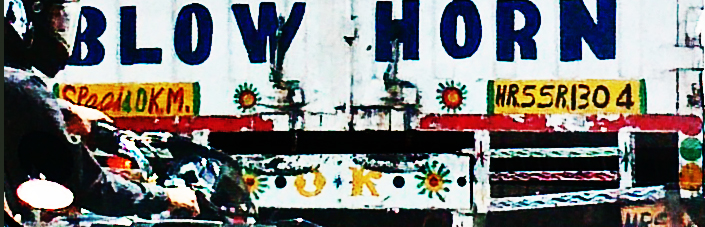
POSTCARD #84: Delhi: Eight thirty in the morning, coming into town from the airport, great rivers of traffic and car horns hooting and tooting like flocks of geese in a poultry market. Shym is driving, I’m in the back… an opportunity for me to consider how difficult all this could be. Confrontations up-front and in-close brinkmanship… give-and-take becomes push-and-shove, not enough space, no room to move. Scarred and scratched vehicles, smashed rear lights, dented bumpers. Trumpets blare, somebody blocking the lane – get out of the way! Insist on it thru the sheer force of horn blasts: plaaaaah, PEEEE, pap-pap-pap! Everybody gets into it, scenarios of outrage, high octave shouting in a language I don’t understand. Then Shym starts singing in Hindi, a voice with trembling vibrato. Maybe I should ask what’s that nice song he’s singing and we can have some light conversation? But I see his hands gripping the steering wheel, white-knuckling it, a sense of the radiant nuclear fury of the sun. This is how it must have been in the Wild West – except they had guns. The ever-present sound and odour of gunfire, young cowboys wearing holstered revolvers and composure like stainless steel. Somebody loses their cool, chairs fly away and everybody dives for cover under the tables.

Things being as they are it takes longer to get to the house than planned, driving with extra caution through these hair-trigger hazards in Delhi traffic, and me with these whispered voices I try not to listen to, voices telling me, it shouldn’t be like this, and seeking calm, steadiness in the intention to be mindful. Remembering to disengage the automatic irritation response. Just notice it – yep, that’s it, and leave it alone. Let sleeping dogs lie. Lessons learned from a lifetime of kamma-vipaka, cause/effect – this is the result of something that happened in the past. Whatever that was, caused this. And what caused that cause? There must have been another cause and this is the effect of that effect, then… and before that cause? Another cause, same thing. My presence here, ‘me’, is the result of a very long cause/effect sequence stretching all the way back through the ages to the Big Bang (The Original Cause, or was there something that caused that?). I am here as a result of generations of those who came before ‘me’, believing it was an inevitability, destiny tattooed on one’s forehead. Going about their lives and managing likes, dislikes; the desire to have, want and get-away-from. The kamma of not seeing it – not seeing that there’s an end to kamma.

So, everything is holding together reasonably well and we reach home in the end. Out of the car, hi everyone, I’m okay yes, thanks, just been sitting in an aircraft economy class seat all night. Into the house, drop bags where I stand and collapse on the sofa. It’s been three weeks but feels longer; three Buddhist monasteries, a funeral and a wedding – and the 4000-year-old stone circle in NE Scotland. I came back to India to take a rest from all that… watch the breathing, heartbeat all a flutter, lying here in the horizontal position. There’s a trembling vibration running through my body, is it the sofa, the floor? Raise my head, is it an earthquake? Look around, no indications of it, nothing falls off the shelves – not an earthquake, just life itself….

“… in its fullest sense, liberation from kamma is liberation from cause and effect in the mind. It’s a process of mentally, emotionally, stepping back from any state and seeing it just as a state, without reactions and attitudes. This simple skill, which most of us can do from time to time, is what we develop in Buddhist practice.” [Ajahn Sucitto, Kamma and the End of Kamma]

————————- 
round-and-round

IMG_0998POSTCARD#66: Phuket: It was nearly the end of M’s school holiday and she hadn’t had much experience of the ‘beash’ (beach: her mispronunciation of the ch/sh sound). So the three of us decided to take her to the seaside, got on a flight to Phuket, 1 hour 50 minutes from Chiang Mai and some of that time spent speaking in English and making jokes about the ch/sh sound: washing TV (watching TV). I asked her when she’s ‘washing’ TV does she uses BREEZE detergent, is that a good one? Hahaha, etc. No, Toong-Ting, I wash TV with MAGICLEAN because it’s anti-bacterial… (there’s a kind of one-upmanship developing, now she’s past her 10th birthday). Arrived in the early afternoon, lumpy chunks of land rising from the sea, seen from the plane window. Busy airport, flights from all parts of the world arrive and depart, waves roll in from the ocean and drift back out. There’s an Aeroflot jumbo jet arriving at the gate next to ours, direct flight from Moscow, and signs in Russian everywhere in the airport. In the town too, also Russian travel agents, Russian car rentals, Russian laundries, Russian restaurants, and guided tours for Russian tourists with Russian guides – they’re more noticeable than other Caucasians; large human beings who don’t smile at all.

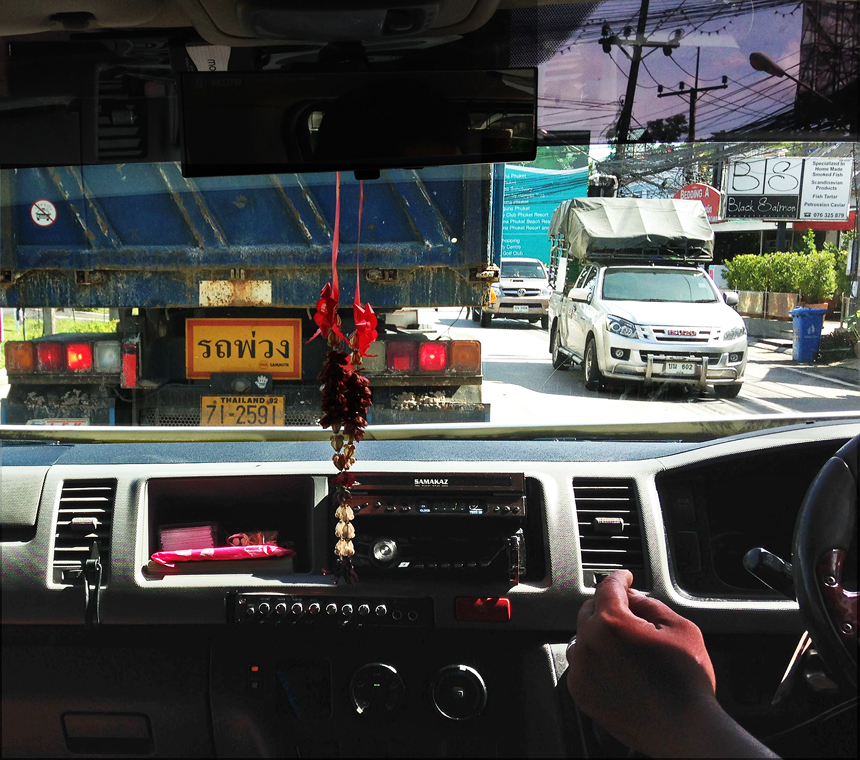
Coming in by bus from the airport to the Centara Hotel at Karon beach (a hotel catering for families with children), M sitting with me in the front seat behind the driver, and she seems unusually quiet – busy with the iPad. I ask her if she’s okay… mm-hmm, (like I’m doing something quite complex, don’t bother me right now). We’re going round and round on these circular roads; signs for the airport keep coming up. The bus driver chatting with Jiab and M’s mum, saying it’s because it’s an island, the GPS brings you around in a circle and all the roads lead back to the point of origin. Nowhere else to go, limited land space, commercial potential of everything examined, evaluated, exploited to within an inch of its life. All to create another crescent shaped beach, same palm trees, same everything.

It was then I noticed there was this slightly dizzy feeling; a lot of up-and-down and around on cliff roads to get nowhere in particular because everywhere in Phuket looks exactly like the place you’ve just arrived from and the same as the place you’re going. And M turns to her mum, says something that mum can’t hear, has to repeat it; I hear it as cha-ooap (cha is a future indicator, ooap means to be sick). The recognition of it comes slowly; I see the driver’s eyes in the rear-view mirror looking at us with alarm… M shouts out cha-ooap! She’s going to be sick – there’s a rush and fumbling among the passengers on the bus to find a plastic bag… shouted instructions on how to hold the bag and how to lean forward. But she wasn’t sick, soon we were in the hotel and everything got back to something resembling familiarity.

tsunamiNow it all looks pretty exotic here. A lot of Russians and if I look away from the grim expressions, I can really get to appreciate the lovely deep resonant tones of the language. The tsunami of December 26, 2004 was a visiting catastrophe, came and went and the memory of it now is like biblical karma. We don’t like to think of it… gone is gone. Could be we are the only Thai group in the hotel – I’m not Thai but identify more with them than Westerners here, and really amazed at the long story of what has led to this, dependent arising, and the karma that’s brought me into this situation ~ [to be continued]

For the early Buddhists, karma was non-linear and complex… karma acts in multiple feedback loops, with the present moment being shaped both by past and by present actions; present actions shape not only the future but also the present. Furthermore, present actions need not be determined by past actions. In other words, there is free will, although its range is somewhat dictated by the past. The nature of this freedom is symbolized in an image used by the early Buddhists: flowing water. Sometimes the flow from the past is so strong that little can be done except to stand fast, but there are also times when the flow is gentle enough to be diverted in almost any direction. [Thanissaro Bhikkhu]

————————-

Upper photo image, view from the van that took us from the airport
Lower photo image source

Responsibility

Bangkok: We arrived at the Golden Palace in a taxi but at the wrong entrance, unfortunately, and the man there said this is not the entrance, you have to go down that way and he pointed down the road – but, the thing is, and didn’t we know, the Golden Palace is closed in the morning today? So we hesitate and he says, yes there’s some kind of ceremony taking place, so it’s closed to the public but why don’t you go round to some other temples and palaces for an hour or two then come back in the afternoon and it’ll be open at 1pm? So we’re thinking about that and he takes us over to the the tuktuk guys and starts to sell us a deal for going around the area on a tuktuk. That’s when we figure it’s a scam, say to the guy, thank you very much and walk around for a bit to decide what to do, then down to the main entrance where everything is open as usual with a sign saying: ‘Open Every Day’.

It comes as a bit of a shock and makes you wonder, what is it with that guy? How can a Thai have such blatant wrong intention; absolutely contrary to normal cultural behaviour and doing this on the doorstep of one of the most cultularly significant sites in Thailand. Its a bit like someone working a scam on tourists entering the Vatican. He must know he’s creating very bad karma and why would he do that? I asked Jiab afterwards and she didn’t have a lot to say except that the guy was probably in such dire straits he must be in a living hell realm already so let’s not talk about that okay?

I’m not sure how this works, it’s one of those things that everybody just puts up with, so it has space to continue as it is; nothing really comes along to stop it, or give it proper direction. You take responsibility for your own actions here because, up to a point, you can do anything you want in Thailand, except that if it’s wrong action, you have to know that it’ll eventually bring bad results to the wrongdoer and every Thai knows this, fears this and is in awe of this. Why, then, do we have people doing things that’ll create bad karma? Because they are already trapped in pre-existing karma; due to avidyā, a fundamental misunderstanding of the nature of reality and over time have become inseparable from bad actions and have obligations to other unfortunate characters equally lost in the cycle of bad karma. So they have to take on things like this to earn a living – for the guy at the tuktuk stand, it’s not much maybe, but he has to go on creating unpleasant situations for other people as he’s slowly working his way out of his unfortunate karmic situation. He’s just trying to survive and will ask for blessings from the monks, the same as everyone else. If it looks like he’s genuinely trying to do something about his predicament, society tolerates his behaviour – up to a point.

And what, then, if you have some seriously bad guy like a gang boss in the underworld who has such large accummulated wrong action and the bad karma that goes with it? Let’s say he’s at the end of his life, a Buddhist, and clear in the knowledge that he can’t put off having to face the consequences of his actions one day quite soon. What can he do? Assuming he’s not already lost in the cycle of deluded and obscure karmic forces, he may offer to the temple, very large amounts of the money he took from others, in his lifetime or he may even offer to finance the building of a new temple or a monument of religious significance. Whatever; he’ll try to do something to put right the wrong things in his life. Although it will bring benefit to many, it won’t work for the gang boss because he left it too late and is now in the situation of being old and weak and having to face the knowledge of his wrongdoings on the threshold of death; a crash course in learning what remorse is and coping with a fearful mind rapidly moving in the direction towards: ‘the downfall, the woeful way, the sorrowful state, the cycle of birth-and-death.’ There’s just no getting away from it. It’s about samsara and, depending on the particular circumstances, could be unfortunate. We can’t take anything in this life on to the next life; only karma. There’s every reason to feel compassion for the guy standing outside the Golden Palace and hope that eventually he finds the way out.

————————-

‘Like a seed waiting for rain, our karma shadows us, waiting for the opportunity to grow and ripen. Our intentional actions will produce a result at some time. People in their present lives, are experiencing the effects of their past actions or karma.… it is possible to alter or reduce the effects of these past actions through present actions. These will also have effect on future lives. Understanding the law of Karma helps us realise that we are, whatever we make ourselves to be. We are entirely responsible for our own destiny.’ [Hwa Tsang Buddhist Monastery]

Photo Image: Elaine Henderson