how it is

POSTCARD#326: Bangkok airport: Arriving from Chiang Mai, all trains into town are seriously crowded and no taxis available anywhere at the airport. Therefore I become the Crowd, one of a very large number of individuals caught in the rush on a Friday evening. Somebody later said it’s because all the international schools start again on Monday. Whatever, go with the crowd, it’s decided for me, I accept. I am subject to the public transport System, I am being ‘taken’, it’s about the process, rather than any particular person controlling the process. For different reasons, I could create a Controller in my imagination, like the bosses, the management and blame it all on them/him/her/it, but it’s about the way it works, and there’s no ‘self’ in the equation – the deed is done but there is no doer, using the Passive Voice language function to express the Buddhist Truth of no-self (anatta).

Sounds are heard, food is tasted, and the chill wind of September is felt upon the skin. And the ‘self’ is absent; there’s nobody there that feels it, unless I consciously put together an identity composite, in which case I feel the chill wind of September (Active Voice). Language tells a story, creates a fiction that I can get lost in; only partially aware that it’s a constructed thing and most of the time I’m clinging to a concept of selfhood, an assumed identity. Thankfully, in the Passive Voice, there is no doer, things are done; the cognitive process is about ‘how it is’ rather than ‘what it is’.

The world is seen – I had an eye operation recently and what I didn’t expect was that it turned out to be an opportunity to contemplate this phenomenon of the experiencer. There’s the experience of visual stimuli entering the eye through a lens created by an industrial process and somehow the ‘me’ part of it is not in the place where it used to be. It’s all very new and quite interesting – maybe because I still have the ‘old vision’ in the untreated eye, something to compare it with.

I can see the world through the old eye as well as the new eye. It’s like the linguistic ‘voice’ can be both passive and active and I’ve understood it mostly in the active form; the process of ‘selfing’ is grasped at as an entity and identified with – a controlling thing. In the West it’s a ‘belief’. My difficulty with anatta has been extricating myself from the Judeo-Christian conditioning that assumes the existence of an eternal soul. I notice that Thais, happily, don’t have this problem. Even after 30 years in the East, I still struggle with my Western conditioning; an everlasting identity, the idea of it still lingers; a shadow of ‘self’.

Train moves along and Thai passengers behave with courtesy. I’m suddenly aware how it is in a crowded train in the West and the confusion of ‘self’ that’s going on there. Here it’s about being quietly patient, soon it’s my stop. Night, car headlights reflected in puddles, I’m standing in the rain, feet are soaked and D comes to get me in the car. The thought arises, the car is driven but there is no driver….

‘Where water, earth, fire, & wind have no footing; there the stars don’t shine, the sun isn’t visible. There the moon doesn’t appear. There darkness is not found. And when a sage, a Brahman through sagacity, has realized [this] for himself, then from form & formless, from bliss & pain, he is freed.’ [Bāhiya Sutta]

Reflections on an earlier post, ‘passive voice’

that which is seen

POSTCARD#325: Bangkok: After the operation on the right eye, and the world seems different, everything suddenly seen in clear three-dimensionality. Reflected light, rich, deep colors and a strange familiarity of objects, things become somehow known. I’ve seen these things so often before but now seeing them with an expanded awareness. It sounds visionary, you could say revelatory but it’s the result of eye surgery, rather than insight… nonetheless quite astonishing. I have this clarity in one eye only; vision in the other eye is like an old yellowed photo, dull and indistinct.

The operation on that eye will be in October, back to the Rutnin Eye Hospital in Bangkok. The surgeon makes a hole in the eye and puts in a tool that uses ultrasound to emulsify the lens. The lens becomes liquid and is sucked away, then a plastic foldable lens is inserted in the place where the natural lens used to be. That’s it, done. Local anesthetic is enough, or general if you feel claustrophobic about the covers over the face as the procedure is going on. After the op there are different kinds of eye-drops that go on for about three weeks and it feels a bit itchy but that’s all.

I’m amazed that it’s possible to do this; the plasticity of the human body, parts can be taken out, replaced; systems are deconstructed, reconstructed, subject to change. It all supports the idea of anatta: no abiding self. There’s an underlying flexibility about the mind/body organism (namarupa). One example of this is that I have a very refined piece of plastic in my eye instead of a natural lens. And, looking through this at the world, I find there’s an affinity with clear-wrap, cling-film, transparent plastic food packaging – the way the plastic surface refracts the light. In this strong sunlight in Thailand, I notice the reflections on chrome and glass – the clarity is sparkling and beautiful. Also these enhanced colors, reds mostly, and an overall bright clear blueness in the white areas. All this has the quality of an iPad screen, retina display; high-density pixels merge into one – an extraordinary brightness.

At home, curious Thai faces examine my new eye, and I’m looking back at them looking at me, seeing subtleties in their features that I’ve never seen before. It’s all quite new, an extended reality. So, I’ll be going around for the next few weeks, looking at my surroundings and considering the phenomenon that I am experiencing this and the mystery of that which is seen.

‘… the remainderless fading & cessation, renunciation, relinquishment, release, & letting go of that very craving. (the noble truth of the cessation of dukkha)’ [SN 56.11 (dukkha nirodho ariya sacca)]


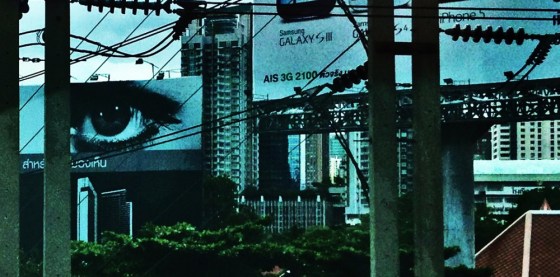
Photo image: Skyline at Ploenchit Bangkok. Reflections on an earlier post The Beholder

samsara of stories from a small island

POSTCARD#323: Today is 27 July, the Buddhist Asalha Puja. The day when the Buddha gave his first Dhamma teaching/discussion. So much has changed for me since I first discovered the Buddha in my heart. It was visiting the UK in 2013 that really brought it home, how so much has changed.

London, Covent Garden 2013: Arrival point from Heathrow airport on a flight from Thailand, where I’ve been for more than 30 years – living in someone else’s country, a permanent foreigner. Now finding that it’s been so long since I was in the UK, where I was born, I’ve become a foreigner here too. Separateness, island mentality, a tentative belief in ‘self’ but I’m seeing only the lack of it, and lifetimes used up with searching for completeness. Most people I knew when I was young are gone now… I’m a homeless person, staying in Buddhist monasteries on the way – washing dishes and sitting meditation. Staying in hotels, staying with people I’ve met in Buddhist groups, friends, of friends, kalyanamitra.

All these hotels and other temporary places of residence where nearly everyone I meet is a ‘foreigner’. So many different languages: Italian, Japanese, French, Spanish, Portuguese, and others – this is England but where are the English people? It’s the holiday season, they must be in someone else’s country, being foreigners there too?

It’s true; all the staff in hotels, restaurants and shops are East Europeans. Visitors come here and what they see is a system run by other visitors to England. A picture of England, a picture of reality – when was it not ever like this? Grand statues of eminent Victorians, in South Kensington, a solitary man standing alone, up there on a plinth, pigeons sit on his head.

Splendid isolation, tourists take pictures of each other standing next to the man’s name carved in the stone of the base of the statue’s plinth and up above, there he is, looking over the rooftops at other statues, who are looking back at him – depending on which way they have been placed.

I should know who this eminent Victorian statue man is – I’m British, but have never heard of him. All I see here is a monument to ‘self’, and the grandeur of it escapes me. But it was important to the people of that time; statues, ornate buildings, the opulence and wealth of the Empire (stolen from other countries?) recorded in history by way of these statues. Such a great achievement, such a small country – is it so important? Can’t help thinking it’s all a fiction created by the storytellers of the day about a reality somewhere else, somewhere far away – samsara of stories from a small island.

‘The thought of a self is an error and all existences are as empty as whirling water bubbles, as hollow as the plantain tree. There’s a blowing of the air but no wind that does the blowing. There is no self, there is no transmigration of a self; there are deeds and the continued effect of deeds…’ [Ramesh S. Balsekar, ‘Advaita, the Buddha and the Unbroken Whole’]


The image: Huffington post

a world of our own creation

POSTCARD#322: Chiang Mai Airport: Waiting in departures for the delayed flight to Bangkok. Very crowded and all seats near the gate are taken. Young Americans, Australians, in ‘Hang Out’ mode, sprawled around in the seats, on the floor, wearing nearly nothing at all; long legs, pointed elbows sticking out – a sea of brightly coloured T-shirts, shorts, rubber slippers. In the coffee bar, a forest of exposed limbs, tattooed legs, bosoms, identity obscured behind peaked caps worn down over the eyes, mirror reflecting sunglasses, headphones, iTunes and hunched over their devices, sucking up drinks through a plastic straw, the tubular proboscis of insectoids. Sensory-experience junkies, have to have that input by way of the sense gates.

They do know, though, that the ego of the West is a self-sustaining concept running out of battery and most likely to fizzle out quite soon, impermanence, everything changes. There’s no substance to it, same with all things. This is the Christian God of the West, the one-and-only-God that doesn’t include two thirds of the world’s population because they’re not Christian. It’s like a right wing supremacist movement, same as Muslim extremist groups; there’s a war and both sides pray to God to win. God gets confused, so there’s another war, and another…. Everyone is dying or dead and among the survivors there is one who can see they they’re not talking about God, the Ultimate Reality, what they’re talking about is one of the gods of the conditioned realm. The logic of this is inescapable – how could God be something that one religion has and another doesn’t have? Yes, inescapable but there’s a kind of nobody-at-home look on the faces of my Christian friends when it seems like I’m going to want to try to discuss this point further.

Some people wake up, but some just don’t wake up at all. It gets too complicated and that’s why the Buddha was saying life is difficult enough as it is so let’s not get engaged with the God concept, okay? Attachment to the idea of it becomes a desire in itself and that’s what’s causing the problem. Ultimate reality is so fragile and subtle you can never be absolutely sure you’re not still setting it up so you’re seeing it the way you want it to be, still in the conditioned realm and far from the Truth. The best thing to do is not call it anything, cultivate mindfulness, clear comprehension, discerning awareness and take care; see how that goes…

“… the illusory world is through attachment. We think we all live in the same world as personalities, but every one of us lives in a world of our own creation. We have certain things in common but so much of our life is personal and unique to ourselves. That world we create is not the objective world we believe we’re living in; we’re living in a world of our own creation. That’s why it’s so difficult relating to each other, isn’t it? We’re coming from different worlds – you feel, sometimes, you’re living with a bunch of aliens!” [Ajahn Sumedho, ‘In Awareness There is No Dukkha’]


Photo: Louk Vreeswijk

a twinkling diamond light

POSTCARD#321: Bangkok: Remembering North India, Bodh Gaya: 04.00 hours: This is where the Buddha’s enlightenment took place. I’m in a hotel not far from where it happened, the window is open, sitting on a cushion and comfortably watching the breath. There’s a sense of being near the epicentre, ground zero – the sparkling, twinkling diamond light. From here, it spread through everyone who were able to listen, then, in the course of time, reaching out to all parts of the East. Hundreds of thousands of visitors from Tibet, China, Japan, Korea, South East Asia and other places eventually came here to see for themselves, the places where the Buddha walked.

Something I’d really like to do before running to catch the last bus, is to visit all the Buddhist countries in the world. I’ve been to Bodh Gaya, Śrāvastī, and the other sites in North India, where that sparkling diamond light can be seen. All those centuries ago, the presence of the Buddha, – although typically, we have to line up with hundreds of other visitors and shuffle through these neatly restored monuments with a fence all around and guards at the gate to keep out the beggars.

Better just to find a place in the grass comfortably situated in the shade of these huge Pipal trees. How much of this is as it was, 2,600 years ago? I’m seated on the earth, with the others in my group. I am distinctly aware that the Buddha walked near to here when it was called Jeta’s Grove – Thus Have I Heard. The wind gently moves across my face, becomes tangled in the hair on my head. The sensation of the breath gently touching the inner nasal passages, and the consciousness that arises with that feeling – look around, the same blue sky, brown earth, green foliage, even though the objects I see may not be the same as they were then, the process of seeing is the same, received in the ever-present conscious experience – a manifestation of consciousness experiencing itself in that twinkling diamond light.

“Where there is the mind, where there are mental phenomena, mind-consciousness, things to be cognized by mind-consciousness, there a being exists or the description of a being. Where there is no mind, no mental phenomena, no mind-consciousness, there a being does not exist nor any description of a being.” [SN 1.65]


Reflections on an earlier post titled Now As It Was Then

only the world ends

POSTCARD#320: Chiang Mai. It’s my birthday 6 July, tomorrow, or today if you’re over the date line, somewhere over the rainbow. Laughed at this video going viral on Thai networks (my first attempt at uploading an MP4 file, apologies if the download is a problem). For me, the vid shows us how people in that part of India are not phased at all by what we would call difficult situations. I often return to this simple fact that these people sliding down the pole are more able, resourceful, than most Western populations. They would beat us hands down if there was even the slightest support system removed from our world. In Delhi, power cuts happened every day at all hours. I never managed to get my mind focused with the darkness, except maybe for the following post from 5 years ago.

New Delhi: February 23, 2013: Power cut and everything in the house goes totally black; street lights are out too, the whole thing…. I use my phone as an island of light to help me with the fumbling for matches striking one and a candle placed in a porcelain plate, exactly for this eventuality… immediately drawing comfort in the small light and scented flame. Okay, so how long is it going to be? Listening to all the generators out there like a fleet of helicopters has landed in the street, rotor blades whipping round – time passes, yep! it’s going to be a long one. fumble my way through to bedroom, get into bed with clothes on because it’s cold, heating is out too.

Unexpected, unplanned situation. The warmth of bedding, face on pillow; no other input from the outer environment except sounds coming from the freezer in the kitchen: creak, crack, creak – ice is starting to melt. Listening in the silence between the creaks, no other sounds, only this; the listening action, and that small space before the thinking process is engaged. What is it that is aware of this? Consciousness removed from the sensory experience of everything I see, hear, smell, taste, touch, feel and think; outside of the elements: earth, water, fire, air – and not held by time.

Unsupported consciousness, an awareness that’s different from the basic functions of interacting with the world; distant from the usual state of simply being aware of what’s going on in the body/mind organism and that’s enough – living in a dream; the deluded not-knowing state and random karma: ‘a tangled skein of thread, a woven nest of birds, a thicket of bamboo and reeds…’ The thinking thing gets a hold, loves it, hates it; tries to control it, tries to figure it out. And beyond all of that is the unsupported consciousness. It’s there that my curiosity is drawn.

Nibbana, the unconditioned consciousness, non-temporal. Further than that leads to the idea of a soul and the god/creator thing outside the system and we’re familiar with this from church conditioning… for me, that’s not the way to go. Maybe I’ll get there by a different route. All the Teachings were intended to be tools to assist in our awakening. We don’t attach to them, develop a clear mind, let go and see for ourselves.

Blinding light, suddenly, all the lights in the house start up at the same time. Generators outside shut down, fridge begins to hum, water heater starts to hiss and bubble. The world as I know it returns. I go through and figure out where I was at the computer, and see how that goes.

“The word, ‘loka’ in Sanskrit, is the world. The world as we experience it: sight, sound, smell, taste, touch, thought, emotion and feeling – my world, your world. ‘Loka’ is not the abstracted, geographical planet, universe-type world. It’s the direct experience of the planet, the people and the cosmos. Here is the origin of the world, the cessation of the world and the way leading to the cessation of the world.” [‘Consciousness: Invisible, Radiant, Limitless’, Ajahn Amaro, Buddhadharma, December 1st 2003]


Reflections on an older post with the same title

the look of eyes (1)

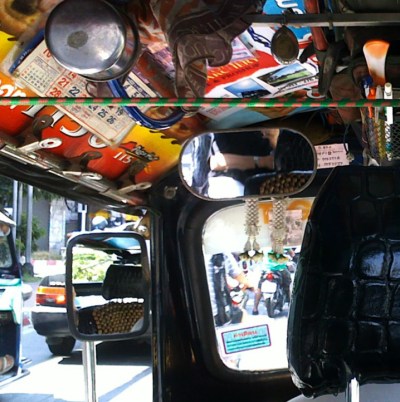
POSTCARD#319: Chiang Mai: Moving through the main road traffic in a tuktuk, going at an unforgivable speed, just amazed by the noise of it. Lying back on the seat in the slouched position, holding on to everything, and the body kind of adhered to the seat. We make a fast turn into a soi (narrow road), lurch to the right in this flimsy three wheeled vehicle, lightweight structure with a wide seat, shiny chrome poles support a canvas hood overhead and nothing to separate outside from inside.

We’re now in a residential area, careering down a narrow path; the engine noise is louder here. Pedestrians turn and look as the tuktuk approaches and step back out of the way. There’s just enough time to see the person’s head turning in my direction, I glance and have eye contact, wish them well in my mind, and I’m gone. Turn another corner and somebody else looks up from what they’re doing. It happens again and again, an old woman, a child, and a man just sitting on the wall. He hears the sound of the approaching tuktuk, head rises, shoulders turn and face comes round to where I am, looks at me sitting in the back seat, I smile and he does too. We’re in a moment, a shavingth of time and it’s gone. Again and again it all takes place in a couple of seconds – not unusual, quite ordinary… a fragment of a shared moment.

Heads move in my direction: who is that in the tuktuk? The human reaction eyes and ears; vision and hearing, and mouth is there to speak or call out if necessary. All these sensory receptors are positioned together in or about the face and the flat plane of it moves round like a small parabolic TV satellite dish reaching out for a signal, ready to respond. Sometimes it’s too fast and the thinking process doesn’t engage. I see the beginning of recognition, mind takes over and ‘self’ locks in, then released and the tuktuk is gone in that same instant. A brief glimpse; an excerpt from a sentence; a few words that don’t have a context.

Each person I see is ready to respond, smile, say hello when we have eye contact. It’s my responsibility to smile and wave because the place where I am at, is moving too fast and they see first I’m not anybody they know, white face, pale eyes, kind of invisible. Sorry, have to rush, bye! It’s a brief encounter then zoom round the corner and there’s somebody else. Face turns, eyes look and mind engages gear… she looks at me sees the prepared smile, smiles in recognition of my polite intrusion in her space and that is somehow hugely reassuring for me. The face turns away, and ‘I’ am not here, I never was here really, it just seemed like that for a moment; the look of eyes, and our shared world, the air takes the volume of a space where there’s always enough room for it, and the water in the lake is for fish to find somewhere to swim around in….


Photo: Chiang Mai Tuktuk

Right Speech & Donald Trump

POSTCARD#318: Bangkok: Trump making mileage (one way or another) from outrageous actions that take place every few days. Maybe we need to take 5 minutes to look at Right Speech and Buddhist ethics. Trump becomes transparent then, because we are not held by his harmful performance . It is obvious, everything is intended to induce dismay, after that it’s like the weasel and the rabbit; hypnotic, chaotic speech, a wild stab in the dark, perplexing and puzzling manoeuvring of events.

As a rule, Right Speech is not something politicians are good at, but Trump pushes it to the extreme; wrong speech, the intention is to create disorder and our reality becomes an an illusion. Showmanship… probably not very different from how things were 2600 years ago when the Buddha encountered leaders like Trump. There have always been politicians manipulating the truth for all the usual reasons.

And that’s why we have the Teaching on Right Speech. It’s called ‘right’ speech because language doesn’t stretch far enough to accurately express all the subtleties of how people normally communicate. The important thing is to get it right and Trump is an example of someone getting it wrong, deliberately.

‘The importance of speech in the context of Buddhist ethics is obvious: words can break or save lives, make enemies or friends, start war or create peace. The Buddha explained right speech as follows:

  1. to abstain from false speech, especially not to tell deliberate lies and not to speak deceitfully,
  2. to abstain from slanderous speech and not to use words maliciously against others,
  3. to abstain from harsh words that offend or hurt others, and
  4. to abstain from idle chatter that lacks purpose or depth.’

‘Abandoning divisive speech… What he has heard here he does not tell there, to break those people apart from these people here…Thus reconciling those who have broken apart or cementing those who are united, he loves concord, delights in concord, enjoys concord, speaks things that create concord…

Abandoning abusive speech… He speaks words that are soothing to the ear, that are affectionate, that go to the heart, that are polite, appealing and pleasing to people at large…

Abandoning idle chatter… He speaks in season, speaks what is factual, what is in accordance with the goal, the Dhamma, and the Vinaya. He speaks words worth treasuring, seasonable, reasonable, circumscribed, connected with the goal… [The Samaññaphala Sutta, Kevatta Sutta and Cunda Kammaraputta Sutta]

‘In the case of words that the Tathagata knows to be factual, true, beneficial, and endearing and agreeable to others, he has a sense of the proper time for saying them. Why is that? Because the Tathagata has sympathy for living beings.’ [Abhaya Sutta]


image: Yak, dynamic presence of a strange being at the entrance to the Golden temple in Bangkok. note, an older post refreshed

mindful attention

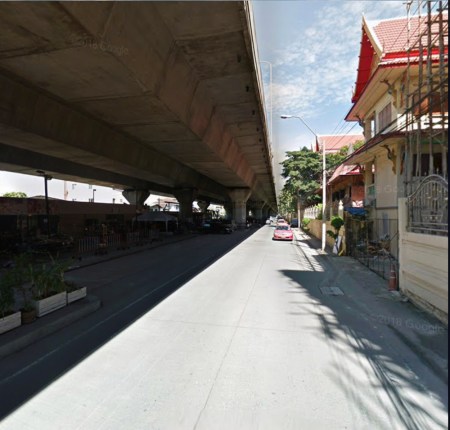
POSTCARD#317: Bangkok: I’ve been here long enough to remember what some districts looked like without the huge shadow of the elevated highway and overhead Skytrain. Congestion underneath; traffic jams, and not much room. Small markets, street food, but the population were okay with it – maybe forced out because a massive concrete pillar had to be situated right in the middle of where they used to be. But mostly they found another location, moved back a bit, shared the space among themselves giving way to the changing infrastructure.

The photo above shows the North/South Highway at Nontaburi that meets the city network of raised highways. On the right stands the Buddhist Wat Bua Kwan temple – buildings coloured red and cream. I don’t know if they lost a bit of land in the intrusion of the highway, they probably did. One thing the monks and laypeople who lived there lost, was the relative silence of how things used to be before the highway came. The noise level now must be incredible.

Then the road was finished and we’d pass by above the temple often, seeing only the exotic peak of the roof at first. After some time the roof was taken down and scaffolding appeared instead, then an upper floor was built. When the floor was completed, an enormous Buddha statue was placed in the centre facing East and the sunrise over the rooftops below. Then the walls and roof were built up around it.

It sounds like all this happened very quickly but it took special artisans 5 to 6 years, working  slowly and carefully, and allowing time for blessings and ceremonies to take place. Each part of the upper floor and walls were done in the same way and the special curved roof was completed with the whole extent of mindful observances.

Now it’s finished and we pass the building on the left side (lower photo) as we go into town (Thailand drives on the left). Coming back at night the whole thing is lit up and… it just blows me away.

Also the sense of the monks there, and in meditation morning and evening, otherwise occupied with household tasks, teaching in that beautiful place – but surrounded by this colossal sound of traffic 24/7. It says something about patient endurance, the way one can tolerate external things mindfully and allowing internal narrative to be in balance. The monks living there are sending a clear sign to car drivers and passengers passing by that it is possible to calmly persevere with mindful attention, sometimes in difficult circumstances. Remembering too that all things arise and pass away.


Ajahn Chah was in London, staying at the Hampstead Vihara. The monks were troubled by the noise that was coming from the pub across the road. Ajahn Chah told them that the cause of suffering was their sending attention out to trouble the sound. Sound itself is just so. Suffering only arises when we ‘go out’ and add something extra. Seeing our part in creating problems, a shift in the way we view struggles takes place. Instead of blaming, we simply ‘see’ what we are doing, in the moment. Let’s not get into a fight with hatred; exercising careful restraint and with Ajahn Chah’s reflection, we let it ‘fall away’

Initially we see this only after we have reacted and created suffering. With practice we catch it sooner. One day, we will catch ourselves just as we are about to create the problem. (Ajahn Munindo)

generosity

POSTCARD#316: Chiang Mai:  Click on ‘generosity’, then click on synonyms for that word, and you get loving-kindness, compassion, empathy, well-being, freedom. You find gratitude, grace, honor, motivation, encouragement.

Generosity is everything. Its nature is to share, recycle, circulate; it can only be given, never taken. With generosity we can accept, we can share, we can forgive. Generosity leads to wisdom – the truth is without bias. There is an understanding of things as they really are.

There is ‘generosity of spirit’, a quality we all possess. Generosity, as a mental, emotional letting go, means releasing the tenacity of holding on to things. All that heavy stuff we burden ourselves with is removed in one single act of generosity.

What’s wrong with being generous, cultivating an inward disposition to give? A glad willingness to share what we have with others – why not? We have more than enough. Give it away. Ease the discomfort of being driven to fulfill that urge to ‘have’, a hunger created by always wanting more. All of it is gone when you’re generous.

Generosity is seen as a way to counteract greed. It’s a way of helping others and a means of lessening the economic disparities in society. Generosity is part of the Buddha’s ‘Right View’. The dhamma of generosity is a gift for all of society as we struggle for meaning in a world of Trump, criminality and so on. The dhamma of giving is a disinfectant, a gunk dissolver, and an antidote for all the greed, hatred and delusion.

“Curiosity endows the people who have it with a generosity in argument and a serenity in their own mode of life which springs from their cheerful willingness to let life take the form it will.” [Alistair Cooke]


Photo of the deva at the entrance to Dhammapala Buddhist Monastery, Switzerland, DHP Archives. Reflections on an earlier Post: More Than Enough