Right Speech & Donald Trump

POSTCARD#318: Bangkok: Trump making mileage (one way or another) from outrageous actions that take place every few days. Maybe we need to take 5 minutes to look at Right Speech and Buddhist ethics. Trump becomes transparent then, because we are not held by his harmful performance . It is obvious, everything is intended to induce dismay, after that it’s like the weasel and the rabbit; hypnotic, chaotic speech, a wild stab in the dark, perplexing and puzzling manoeuvring of events.

As a rule, Right Speech is not something politicians are good at, but Trump pushes it to the extreme; wrong speech, the intention is to create disorder and our reality becomes an an illusion. Showmanship… probably not very different from how things were 2600 years ago when the Buddha encountered leaders like Trump. There have always been politicians manipulating the truth for all the usual reasons.

And that’s why we have the Teaching on Right Speech. It’s called ‘right’ speech because language doesn’t stretch far enough to accurately express all the subtleties of how people normally communicate. The important thing is to get it right and Trump is an example of someone getting it wrong, deliberately.

‘The importance of speech in the context of Buddhist ethics is obvious: words can break or save lives, make enemies or friends, start war or create peace. The Buddha explained right speech as follows:

  1. to abstain from false speech, especially not to tell deliberate lies and not to speak deceitfully,
  2. to abstain from slanderous speech and not to use words maliciously against others,
  3. to abstain from harsh words that offend or hurt others, and
  4. to abstain from idle chatter that lacks purpose or depth.’

‘Abandoning divisive speech… What he has heard here he does not tell there, to break those people apart from these people here…Thus reconciling those who have broken apart or cementing those who are united, he loves concord, delights in concord, enjoys concord, speaks things that create concord…

Abandoning abusive speech… He speaks words that are soothing to the ear, that are affectionate, that go to the heart, that are polite, appealing and pleasing to people at large…

Abandoning idle chatter… He speaks in season, speaks what is factual, what is in accordance with the goal, the Dhamma, and the Vinaya. He speaks words worth treasuring, seasonable, reasonable, circumscribed, connected with the goal… [The Samaññaphala Sutta, Kevatta Sutta and Cunda Kammaraputta Sutta]

‘In the case of words that the Tathagata knows to be factual, true, beneficial, and endearing and agreeable to others, he has a sense of the proper time for saying them. Why is that? Because the Tathagata has sympathy for living beings.’ [Abhaya Sutta]
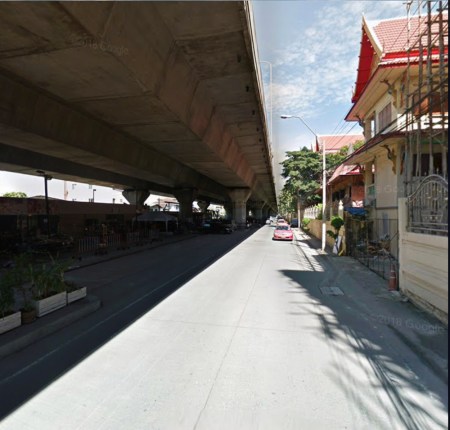

image: Yak, dynamic presence of a strange being at the entrance to the Golden temple in Bangkok. note, an older post refreshed

mindful attention

POSTCARD#317: Bangkok: I’ve been here long enough to remember what some districts looked like without the huge shadow of the elevated highway and overhead Skytrain. Congestion underneath; traffic jams, and not much room. Small markets, street food, but the population were okay with it – maybe forced out because a massive concrete pillar had to be situated right in the middle of where they used to be. But mostly they found another location, moved back a bit, shared the space among themselves giving way to the changing infrastructure.

The photo above shows the North/South Highway at Nontaburi that meets the city network of raised highways. On the right stands the Buddhist Wat Bua Kwan temple – buildings coloured red and cream. I don’t know if they lost a bit of land in the intrusion of the highway, they probably did. One thing the monks and laypeople who lived there lost, was the relative silence of how things used to be before the highway came. The noise level now must be incredible.

Then the road was finished and we’d pass by above the temple often, seeing only the exotic peak of the roof at first. After some time the roof was taken down and scaffolding appeared instead, then an upper floor was built. When the floor was completed, an enormous Buddha statue was placed in the centre facing East and the sunrise over the rooftops below. Then the walls and roof were built up around it.

It sounds like all this happened very quickly but it took special artisans 5 to 6 years, working  slowly and carefully, and allowing time for blessings and ceremonies to take place. Each part of the upper floor and walls were done in the same way and the special curved roof was completed with the whole extent of mindful observances.

Now it’s finished and we pass the building on the left side (lower photo) as we go into town (Thailand drives on the left). Coming back at night the whole thing is lit up and… it just blows me away.

Also the sense of the monks there, and in meditation morning and evening, otherwise occupied with household tasks, teaching in that beautiful place – but surrounded by this colossal sound of traffic 24/7. It says something about patient endurance, the way one can tolerate external things mindfully and allowing internal narrative to be in balance. The monks living there are sending a clear sign to car drivers and passengers passing by that it is possible to calmly persevere with mindful attention, sometimes in difficult circumstances. Remembering too that all things arise and pass away.


Ajahn Chah was in London, staying at the Hampstead Vihara. The monks were troubled by the noise that was coming from the pub across the road. Ajahn Chah told them that the cause of suffering was their sending attention out to trouble the sound. Sound itself is just so. Suffering only arises when we ‘go out’ and add something extra. Seeing our part in creating problems, a shift in the way we view struggles takes place. Instead of blaming, we simply ‘see’ what we are doing, in the moment. Let’s not get into a fight with hatred; exercising careful restraint and with Ajahn Chah’s reflection, we let it ‘fall away’

Initially we see this only after we have reacted and created suffering. With practice we catch it sooner. One day, we will catch ourselves just as we are about to create the problem. (Ajahn Munindo)

generosity

POSTCARD#316: Chiang Mai:  Click on ‘generosity’, then click on synonyms for that word, and you get loving-kindness, compassion, empathy, well-being, freedom. You find gratitude, grace, honor, motivation, encouragement.

Generosity is everything. Its nature is to share, recycle, circulate; it can only be given, never taken. With generosity we can accept, we can share, we can forgive. Generosity leads to wisdom – the truth is without bias. There is an understanding of things as they really are.

There is ‘generosity of spirit’, a quality we all possess. Generosity, as a mental, emotional letting go, means releasing the tenacity of holding on to things. All that heavy stuff we burden ourselves with is removed in one single act of generosity.

What’s wrong with being generous, cultivating an inward disposition to give? A glad willingness to share what we have with others – why not? We have more than enough. Give it away. Ease the discomfort of being driven to fulfill that urge to ‘have’, a hunger created by always wanting more. All of it is gone when you’re generous.

Generosity is seen as a way to counteract greed. It’s a way of helping others and a means of lessening the economic disparities in society. Generosity is part of the Buddha’s ‘Right View’. The dhamma of generosity is a gift for all of society as we struggle for meaning in a world of Trump, criminality and so on. The dhamma of giving is a disinfectant, a gunk dissolver, and an antidote for all the greed, hatred and delusion.

“Curiosity endows the people who have it with a generosity in argument and a serenity in their own mode of life which springs from their cheerful willingness to let life take the form it will.” [Alistair Cooke]


Photo of the deva at the entrance to Dhammapala Buddhist Monastery, Switzerland, DHP Archives. Reflections on an earlier Post: More Than Enough

ko-el

POSTCARD#315: Chiang Mai: The silence of the morning is interrupted by a koel bird on a branch of the huge tree near us: ko-el, ko-el, ko-el – two syllables getting louder and louder, reaching its peak and the bird stops for a moment. It starts again quietly then working up to the same high volume, the ko-el sound echoes with the quality of hard surfaces of branches and the layers of foliage. All around inside the room: ko-el, ko-el. The end of the sound –el collides with the beginning of the next sound in the sequence: ko- and for a moment it becomes more like: el-ko-el-ko-el-ko, smoothly presented in a form the bird insists on, so well and I’m just discovering it.

The perception of the sound shifts back to ko-el, ko-el, contained in this space – and in the space contained in all the other rooms in this building. Also the corridors and passageways, in the elevator shaft, the front lobby as I go down to street level to get something from 7/11. The ko-el sound can be heard everywhere in the building. I know, of course, it just seems like the ko-el sound is in the building, in fact the ko-el sound and the whole building are contained in awareness, which holds all, no boundaries, no beginning, no end. The ko-el sound can be heard all along the street too.

Back upstairs again and I am in this space, the space is in me. I can say ‘I’ am here, meaning the ‘self’ arising from the mechanisms that filter conscious experience through the senses. And the ko-el sound reaching my ear convinces me that if there is sound, there must be somebody in here hearing it – and that’s ‘me.’

The belief in self is backed up by sensory data input through ear, eye, nose, mouth, the sense of touch, and mind. I can let go of this belief that I am ‘me’ because there’s really nobody here – it’s a figure of speech. The emphasis on it being the same as the object of comparison pushes the whole thing over the edge and the metaphor ‘becomes’ both subject and object.

Thoughts think themselves, dependent on conditions, that are dependent on other conditions; peeling back the layers of onion to discover there’s nothing in the center. The what-ever-ness, ‘self’ is not contained in me, ‘I’ am contained in ‘self’.

The ko-el sound shifts to some other location, the bird has flown to a different tree. Later in the day, I hear it again coming from some distant place, and after a while I don’t hear it any more.


Reflections on an earlier post, the ‘I’ metaphor. Note, “whateverness” sourced in Joakim (Sweden)’s blog: seeingwhatis

have metta for the fear

POSTCARD#313: Bangkok: Getting into town from the airport is okay to start with, gliding along the elevated highway in a huge open landscape, and all the good-looking 21st Century buildings pointing up into the evening sky like some futuristic sci-fi heaven realm. Then, as we get near the exit, the traffic slowly starts to fuse together in a mass of end-to-end steel/chrome-plated metal units, creaking along like the glacier I visited a long time ago in Switzerland moving so slowly, the end of its 133 kilometer length is four hundred years older than its beginning.

Struggling with the thought that the reason I’m here is that I have to have eye surgery on both eyes for cataracts. I don’t want it to be like this, causes and conditions, waiting for the traffic is like the changes in nature, the ocean, the weather.

Reminded of the Ajahn Chah image of leaves in the trees blowing in the wind in a rising and falling motion for as long as the winds last. It’s just the mind blowing like the wind that can cause the restless, uneasy feeling. In its original state, the mind is still and calm.

‘To be mindful means to have metta towards the fear in your mind, or the anger, or the jealousy. Metta means not creating problems around existing conditions, allowing them to fade away, to cease. For example, when fear comes up in your mind, you can have metta for the fear — meaning that you don’t build up aversion to it, you can just accept its presence and allow it to cease. You can also minimize the fear by recognizing that it is the same kind of fear that everyone has, that animals have. It’s not my fear, it’s not a person’s, it’s an impersonal fear.’ [“Mindfulness: The Path to Deathlessness: The Meditation Teaching of  Venerable Ajahn Sumedho.”]


Reflections on an earlier post titled: “necessity of mindfulness”

blessings fill the room

POSTCARD#312: Chiang Mai: 07.00 hours: The alarm rings…. and it takes a moment to recognize I’m in Chiang Mai, arrived last night. Heavy curtains over the window; a darkness I’m not used to. It’s quiet here, the sound of monks chanting anumodana on the edge of hearing. A motorbike whizzes by in the distance, nothing else. Senses are alert, listening, feeling, searching for a way to ‘become’ something that will establish ‘me’ in this place and time but I can’t, I’m distracted by these new surroundings and keep returning to the narrative associated with interesting objects.

Too many, too much, I go to the window, feet on cool tiles, flip flop, flip flop, a sense of empty rooms, as yet uninhabited; space/time occupied with the moving of its integral parts – chapters from a book about furniture being moved into a new apartment, the ending hasn’t been written yet and the beginning is a continuation of what happened before that.

Future time slides into present time, tomorrow becomes today, and ‘now’ becomes yesterday – here we are in the awareness of this moment, the means by which we arrive at this point in time remains a mystery.

Slide open the curtains of all the windows. A blaze of colour, monks in varying shades of orange, faded tangerine robes and a group of kneeling Thai tourists from the hotel opposite. (Note: the original post refers to Christmas Day 2012, and here in a Buddhist country it is just an ordinary day).

Jesus and all the other great teachers in history were really saying the same thing. In the peace and quiet emptiness of the moment there is no hungry ‘self’, no driving ‘urge’ and from this place in awareness, it’s possible to see that I am continually re-born in tiny slices of time, minutes, seconds, into this self-perpetuating loop due to the habituality of trying to get what I want or to get rid of what I don’t want. Thinking that yes, so life is about trying to get it right, but caught in attachment upadana; even this, the desired state, belongs to ‘me,’ the act of possessing it requires that there has to be a ‘me.’

Everything I have, everything I want, all of this is ‘mine.’ Even that which I consider to be ‘my’ enemy, is also ‘mine.’ Thus creating a self that is incomplete, unfulfilled, searching for the truth in all this and failing to see that it’s the searching that maintains the state of being lost. Layers of associated narrative obscure the issue. People say they are so busy with ordinary tasks; earning enough money to support the family and no time to think of anything else.

In the same way, belief in an external creator creates attachment and unthinking devotion to this returns me to the same point of entry, again and again. It’s not so much about taking refuge in the Jesus or Buddha of the mind. It’s about here-and-now behaviors: sila, samadhi, pannya (virtue/ mindfulness of present time/ and the applied intelligence that goes with it). The blessings of the monks fills the room; slowly waking up to an awareness of this reality….

‘If those who lead you say to you, “See, the kingdom is in the sky,” then the birds of the sky will precede you. If they say to you, “It is in the sea,” then the fish will precede you. Rather, the kingdom is inside of you, and it is outside of you. When you come to know yourselves, then you will become known, and you will realize that it is you who are the sons of the living father. But if you will not know yourselves, you dwell in poverty and it is you who are that poverty.’ [Selected Sayings of Jesus from Gospel of Thomas, Nag Hammadi manuscripts]


Reflections on an earlier post titled habituality of former lives

limitlessness

POSTCARD#311: Bangkok: 5.30 am. In the quietness of where we are, deep in the narrow lanes of the city where there’s only mature trees heavy with foliage, inhabited by exotic birds, and the first solitary songbird interrupts the silence. It sings its song as if it were a voice saying something in a language I can’t understand, and comes to the end like an unanswered question…

A picture seen in an instant then it’s gone, I lost the word; the memory of an event is displaced by the next moment of remembering. Body moving through the choreography of early morning routine in a background of dawn chorus, huge melodies played on an instrument with a great number of strings… then an awareness of the headache – something that’s bothered me for a long time… it bothers me that it bothers me.

I can see from these explorations into mind-states, that the reason for things being the way they are comes out of nowhere. It just happens by itself, a narrative appears that seems to explain why we are here. Conscious awareness has to penetrate these stories through the layers of belief that Mind is the centre of it all. Mindfulness of it is not enough, it’s more like I have to consciously take the step in order for things to develop of their own accord – and all of a sudden, that thing that bothers me is gone. A little door opens in the mind… “Ping” I can feel it open. I can enter that space, and there it is; the thing that all this is only a small part of – a clear, sharp, vivid, state of clarity – a there-and-then, here-and-now understanding of the limitlessness and vast regions of how things are.

……….

Some time after that, suddenly a shrill squeal from the baby’s room downstairs, a group of aunties laugh and encourage the child to do it again. Silence then another joyous squeal, diphthong two-tone quality of what sounds like a group of words. So this is how we learn…

“Be an island to oneself be your own refuge, having no other; let the Dhamma be an island and a refuge to you, having no other. Those who are islands unto themselves… should investigate to the very heart of things: ‘What is the source of sorrow, lamentation, pain, grief and despair? How do they arise?’ [What is their origin?]” [Attadiipaa Sutta: An Island to Oneself]


Photo shows our sculpture of Thalia Goddess of comedy, placed safely on a cushion while we get our house in order after the shipment of furniture arrives from India

its as-it-is-ness

POSTCARD#310: A village near Hat Yai: Exotic red Hibiscus flowers and butterflies as big as birds. A zizzle of insects in the night and numerous coconut palm trees just standing around contemplating the situation – if a tree falls in the forest… does the world continue to exist when I close my eyes? Was this world here before I was born? Hard to believe it was, everything just going on as it is now, probably, farmyard animals, birds in the trees and all the other random events taking place as they are now, experienced from here on the top floor of the house where the treetops are level with the roof terrace and higher.

There was a time when I wasn’t here – not born yet. I can understand that, so it means I can understand what the world is without that person called ‘me’ in it. There’s an anonymity about this that’s quite liberating, and undeniably, the present moment is all around the place, taking the form of objects, I see (as soon as they are ‘seen’), becoming the surfaces of things I touch (as soon as they are ‘held’). I keep bumping into it, the present moment is all there is, and it is as it is, whether I am aware of it in its as-it-is-ness or not.

Sometimes it gets stuck, like a failed Internet connection. The internet room at Hat Yai Airport was closed when I was there, all the computers covered with their old covers and a sign written in English: “could not make a connection” – okay, everybody can go home now. Is this what Death is like? It could happen any time – it does that sometimes, the ‘fatal error’ – quit all programs and try restart. If that doesn’t work, ah well, it’s just the ‘as-it-is-ness’, probably, yes, whatever.

Happy enough with the present mind state that’s free of all the tugs and pulls. Maybe it’s the meds, the all-inclusiveness of my condition; continued awareness applied to everything in the environment and engaged in the various happenings of the day. It’s really interesting to be in this pleasant rural remoteness, and So What if I’ve been trying to get a connection all day? I’m just hoping for the best, without clinging to the idea there’s a problem about that. Meanwhile, the world and everything is going along, death arrives one day…  that letting-go thing again. Falling asleep like a dark veil falls over my eyes; the transparency of a transitional state, the forgetfulness of holding on to things; an easing away somewhere…

“… How much more harmoniously the days are passing compared with those when we gave in to the slightest stimulus for interfering in the world by deed, word, emotion or thought. As if protected by invisible armour against the banalities and importunities of the outer world, one will walk through (the) days serenely and content, with an exhilarating feeling of ease and freedom. It is as if, from the unpleasant closeness of a hustling and noisy crowd, one has escaped to the silence and seclusion of a hilltop, and with a sigh of relief, is looking down on the noise and bustle below. It is the peace and happiness of detachment which will be thus experienced.” [“The Heart of Buddhist Meditation” Nyanaponika Thera]


Adapted from an older post, July 21 2012, If A Tree Falls

samsara of advertising

POSTCARD#307: Bangkok: Everywhere in shopping malls, magazines, TV channels, images exerting the ‘pull’ 24/7 so that we can easily, unknowingly enter into a world of choices – the idea that ‘I’ can have a personal preference, thus am I caught in ‘self’. The Western model, reshaped by East Asian style and adapted to fit Thai cultural behaviour. Stories acted out by adults who look like children; cute faces, attractive personalities, charm. Products presented as if it were a game, makes it all seem quite real and acceptable; the high-voltage sales strategy is unseen, cloaked in naivety – preparing for a whole new generation of consumers, a new Thai society – the corporate entity engaged in long term planning.

I can get caught by it, drawn towards the TV screen, something I see in the advert triggers it, and the who-I-am thing arises, and a voice inside me says: I LIKE THIS and it all gets to be really important, relevant, vivid and intense. I feel suddenly energized, compelled and, I WANT TO HAVE IT, ready to start discussing with sales staff at the retail point and proceed with the purchase; the plastic in my wallet getting hot, I’m being swept away by the samsara of advertising. Too bad because I can apply the brakes at this point, as it is in the patticcasamupada, remembering the way to stop craving (tanhã) arising, is to cut off the conditions that lead to its beginning; interrupt the sequence before craving happens, and bring the whole thing to an end. I know it will cease of its own accord if I can allow it to become nothing, and fortunately it’s all in a language I can switch off from so it all fizzles out…

To become the owner of a purchased product, I have to believe in it – I have to consciously engage with it. To become me, I have to think ‘me’. The ‘me’ that I believe in depends on me thinking it. I am conditioned to be attached to my opinions, my emotionality, and the sense of self in all kinds of ways. I can manipulate the conditioned world so that, from this perspective of thinking, I see (my) self situated favorably – or it could be unfavorably if I’m caught in being the victim (but there is always a way out). Everything arises due to causes and conditions, then thinking about it, excessively and often enough to have it appear to be embedded in the fabric of this self construct I recognize as ‘me,’ subject to its perceived whims and waywardness, as some kind of fictional character.

But there is a way out; everything that arises falls away. Let it go and it’s gone. The simple truth is don’t mess with it, don’t think it into being, and it won’t arise. Maintain a proximity-to but distance-from position: the Middle Way. There is viññāṇa, conscious awareness, self-sustaining; I don’t create it. There’s the body, moving through the population, minding its own business, other than that, no personal essence given to me by (some external force); nothing added, nothing extra. The simplicity of this seems to immediately throw everything to do with ‘self’ into disarray; enough to cause it all to come tumbling down; a house of cards. Knowing this, we can rebuild the concept with an awareness of its parts. Leading to a more enhanced sense of ‘self’ if that’s what seems preferable… nothing wrong with personality, it’s the attachment to it that’s the problem…


Excerpts from my earlier post: March 28, 2013. Photo image: Coke ad Ploenchit

somewhere in the city

POSTCARD#306: Bangkok: Alarm goes off at 04.00, hand-reach and it’s silenced in a quiet darkness. My footsteps going downstairs seem to me to be too loud for the baby sleeping. Thankfully, I reach the ground floor without waking the boy. I make coffee and half a toasted bagel for Jiab who is going to a meditation centre near Pak Chong – a three hour journey. We speak quietly, the car comes, filling the gated entrance with headlights, a soft door-slam and she’s gone

Jiab’s elder sister Pi Sao comes downstairs, she is the smiling grandmother of the child, visiting here from down South, an overnight journey by train. Pi Sao gets up early to offer food to the three monks who come into our part of the city, just after daylight.

She goes into the kitchen for the three small bags of food she prepared last night. They are placed on a tray and she brings them into the room. I’m watching her from the computer table as she goes out and kneels at the entrance to the house with the tray raised to a point that’s level with her forehead. She stays in that position for a longish time, could be a minute. Suddenly I’m aware of an extraordinary easeful peace. The monks appear in a blaze of colour, pale tangerine robes, and accept the food placed into their metal bowls. They chant blessings anumodana, on receiving the food and they’re on their way.

I allow the blessings to fall over me and come inside me, and for a moment it becomes me. I’m overwhelmed with boundless bliss, then it’s gone. There’s so much I don’t know, I want to say to her, thank you and how much this small moment of samadhi means to me. Yes, but my baby-babble of the Thai language is not enough to express these uncommon things. Besides I’m pretty sure Pi Sao doesn’t want to talk about anything thought to be near to the mystical experience, for fear of stepping into the realm of ghosts, and supernatural beings.

All these years and all that I have are these tentative steps into learned processes of cultural behaviour, requiring an alert watchfulness I discovered long before hearing the word ‘mindfulness’. Remembering over and over again that the focus is on the intention to stay mindful always, and somehow this got deeply embedded. It has been more than two decades after all, and now this attention has become a built-in wake-up bell that rings every time mindfulness wanders: ting-ting-ting-aling-ting-aling

And these days, now the headache is with me, I’m watching the breath go in and go out much more than I used to. Depending on the wake-up bell, ting-aling-ting-aling. It’s the alertness of samadhi and great peace and bliss that goes with it, but more often than not, it’s the on-going narrative and I’m engaged in deconstructing familiar patterns of habit where I criticize myself for having the pain: pain is bad – I must have done something ‘bad’ to deserve this.

Strong angry emotions, and the wake-up bell rings, ting-aling-ting-aling…. return to watching the breath, in-breath, out-breath – heart beat – the utter functioning of being alive, and the alertness of choosing not to get locked into the ways and means of endurance, tolerating the suffering allows an attachment to it and an associated habitual response forms over the years.

The effort is in separating the pain into two parts; there’s the pain itself, and the pain of resisting the pain; I-don’t-want-it-to-be-there… desiring it to not-exist, vibhava-tanha – wanting it to go away. The alertness is directed towards the pain of resisting the pain and allowing that to withdraw.

It’s about finding the Middle Way, the truth of suffering and the path leading to the extinction of that suffering is the most pressing need, the only true and worthy purpose in life – for the sake of well-being, peace-of-mind and all things considered are considered….

“Peace is not a destination, but a starting point. Find that peace that rests behind anything and anybody and bring it into your world”. [Shakti Caterina Maggi]


Excerpts from an older post, also some notes I made and can’t remember the original source.