responsibility & mindfulness

IMG_0993POSTCARD#67: Phuket: Hotel room on the third floor, level with the treetops, slide open the patio window and step out on the balcony. Birdsong in the early-dawn light. I sit in one of the outdoor chairs, settle down, and focus on the in-breath/out-breath. Check that there’s a balance in the body, symmetrical position of limbs, feet flat, back straight… and a curious peace in the air; an atmosphere that’s suddenly different from the North – the kind of thing you notice when you come by air, are dropped on the ground and have to figure out a whole set of new feelings, like where am I now and the quality of the air; all kinds of new things. Five minutes of watching the breath with mindfulness, the sun rises and a great flood of things to think about swells up. I’m washed away by it for a while; thought sequences and memories become apparent when they reach the point of “being”. Before that they’re in the uncreated state – arbitrary, disassociated. Things that don’t exist at all, until I observe them. For the first time I’m thinking of the Observer Effect in quantum physics, the experiment showing that when one is observing the movement of electrons it changes their behavior. In Buddhist thought, the ‘observer’ is the self-construct that forms as a result of responses to sensory input via the Five Khandas. Received data is formed according to the mechanisms of the human sensory process – including cognition, a sense like all the others. I see the need, the responsibility of mindfulness…

Sit for a bit more, to see what’s happening and on-going indications that’ll eventually lead to my assessment of what could be the ‘reality’ for the day. There’s a clear recognition that I’ll be able to see ‘it’ in this way, so then there must be all kinds of very powerful entities present who choose to ‘be’ in this World in order to manipulate our perceived reality to fit with their own advantage – to have control. (Then after I’d written this part of the post, the news came that there’s a military coup in Thailand as from 16.30 May 22, 2014.

What now… ah well, there’ll be enforced peace and that’ll allow everyone to investigate the feeling – the unknowing energy of Thaksin followers who might think differently about the consequences of their action in other circumstances. And maybe those who have the influence will have the space they need to see what needs to be done to get it all to work – whatever. The heart of the Thai people is with the King who is at the end of his life… when it happens they will wear black and mourn for a year, un-fillable vacuum… that’s what this is about.)

Light becomes an irreversible fact, sky is unquestionably blue and there on the hill is the Big Buddha of Phuket, พระพุทธมิ่งมงคลเอกเนาคคีรี sitting up there at the highest place on the island. From where I am, it’s seen from the back, looking in the same direction I’m looking – I have to search in Google images to find a good one seen from the front (see below). Limited by what the human sensory mechanisms can do, this is the means at our disposal, you could say, and all the stumbling pitfalls that are part of it… sensory receptors are on the face, the front of the head, no rear-view mirror. All incoming data is received that way, from the front and the ears on the sides – mouth and nose on the front too. Strange how it’s like that, we miss everything that going on behind, unseen. There’s a tendency to turn around, always, to see what’s going on… anybody there? The limitations of being human, see it and switch off the ‘search’ function. Allow things to happen in the way they’re supposed to. It’s what the software does… a prayer would help.

“…not a single particle out “there” exists with real properties until it’s observed… reality is a process that involves consciousness [Robert Lanza]

————————-

the-big-buddha_2

Top photo, Bodhi tree at the viewing area in the south of the island. Bottom photo, the Big Buddha of Phuket. Link to  source
Note: The Robert Lanza quote is from hipmonkey

getting attention

traff.1POSTCARD#52: Delhi: There was a time when I wasn’t here – not born yet. The world just going on as it does without having anything to do with that person called ‘me’. I didn’t exist then. There’s an anonymity about this that’s quite liberating. Thinking about it here in the car, looking at the world going by, same world that was out there before I was born. I’m on the way to pick up my Thai visa for the Bangkok trip this weekend – heavy traffic and stuck behind a truck. I take a photo of it simply because of the way all the words and colours insist I look at it, shouting out at me, trying to get my attention. Is it this kind of attachment to ‘self’ that causes ego-rebirth? A whole truck is suddenly reborn in front of me, identity smeared over every part of it, saying: ‘I’ am here; this is ‘my’ place! It has to be allowed for; make space for it in all the honking, hooting/tooting and scenarios of outrage where everybody really wants to be somebody. Press your horn to announce your presence. Do it loudly, you think a lot of yourself.

Mindfulness of conflict, resentment and holding a grudge; loving-kindness, compassion, metta-karuna. I’m a long-term outsider, now more than 30 years of living in other people’s countries. It means there’s a distance between ‘me’ and how things are done. As far as possible, the ‘I’ is understated, indirect, a release of the tenacity of ‘grip’ on how I (personally) think things should be. Thus I discover these days, local people look at me and I become invisible. They can’t get me to fit into their social scale, eyes glaze over. I unexist for them. I understand it to be that easing off from holding on to identity, almost to the point of letting go completely – the Buddha’s teaching on anatta, no-self. Extraordinary in my case because the I-am-not-here thing happens twice, two cultural settings: India and Thailand. I’m invisible in both countries, just my name on the lists of foreign residents, photo attached; ‘me’ in dress shirt, formal expression, hair combed, ‘smile please!’ I take out the ID I carry with me here and look at the photo, stamped, authorized, signed, registered, watermarked. It’s my identity, but is it ‘me’?

I’m not convinced. Is it proof that I exist? …em, it’s a picture of a man who looks like me, having his picture taken. All I have by way of proof that I exist is the subjective experience of it and the present moment that is undeniably everywhere, in the unlikeliest of places. The ubiquitous presence of now, I keep bumping into it, oh… what’s this? The present moment seen in a cloud of unknowing. Or I’m thinking it’s something it isn’t. Or I accept the present moment is as it is, whether I am aware of it in its as-it-is-ness’ or not.

Other times it’s seen as if standing at the bow of a small ship plunging through the waves, rising and falling, just on the point of leaving the past and surging into the future, but not there yet – never reaching that point. All the surrounding clutter and stuff of the mind is pushed away by the waves and the movement of the ship passing through. Long intervals between things… why this pause? How come there’s nothing to think about? What happens when the thinking thing stops – what happens after that? But the question just leads to more thinking. No answer, no question, stillness – a state of mind that’s free of all the tugs and pulls. Slow down, stop. Contemplate the body and mind; breathe in/breathe out, there is heartbeat, consciousness of the mystery: out there/in here…

‘…looking for the first time at homemade movies taken a few weeks before his birth. He saw a world that was practically unchanged—the same house, the same people—and then realized that he did not exist there at all and that nobody mourned his absence… But what particularly frightened him was the sight of a brand-new baby carriage standing there on the porch, with the smug, encroaching air of a coffin; even that was empty, as if, in the reverse course of events, his very bones had disintegrated.’ [The autobiography of Vladimir Nabokov: “Speak, Memory”, page 1]

————————-

valentine palindrome: 14/02/2014

IMG_0532bPOSTCARD#48: Bangkok Airport: Man wearing a bright red shirt leans backwards with hands behind his head just as I take the photo and it looks like a heart shape. Sitting in a coffee shop at Concourse B waiting for the 8.40 pm flight to New Delhi, decided to take the photo of the interesting curved shaped roof structure and didn’t see the heart-shape till I arrived in Delhi. A happy coincidence… and Valentines Day is special this year because of the palindromic sequence of date, month and year: 14/02/2014. Coming into Delhi from the airport, in the midst of pretty fierce traffic, I thought how nice to have this kind of numerical valentine and a day of love in a city that’s normally bristling with displays of proud male plumage and all things unloved. Then, looking through the image gallery in my camera phone, I discovered the photo – a gift, there in all the noisy traffic, a reminder to see beyond the tightly controlled mind state experienced in the driver’s seat.

The contemplation on loving-kindness, metta, begins with a focus on myself, my own well-being, and using that as a point of reference, I can extend it to others: “Just as I wish to be happy and free from suffering, so may all beings be happy and free from suffering!” Then I extend the thought of loving-kindness to a person for whom I have love and respect; and to those who are close to me. Extending then to those who are indifferent and to those disliked. It’s about the necessity of cultivating feelings of kind consideration to others; a conscious act of generosity rather than abiding with the unconscious default holding and keeping things to myself.

Arrived at the house, good to be back after two months away. Unpacked and found the Buddha’s Words on loving-kindness: the Karaniya Metta Sutta.

This is what should be done
By one who is skilled in goodness,
And who knows the path of peace:
Let them be able and upright,
Straightforward and gentle in speech,
Humble and not conceited,
Contented and easily satisfied,
Unburdened with duties and frugal in their ways.
Peaceful and calm and wise and skillful,
Not proud or demanding in nature.
Let them not do the slightest thing
That the wise would later reprove.
Wishing: In gladness and in safety,
May all beings be at ease.
 Whatever living beings there may be;
Whether they are weak or strong, omitting none,
The great or the mighty, medium, short or small,
The seen and the unseen,
Those living near and far away,
Those born and to-be-born
May all beings be at ease!
Let none deceive another,
Or despise any being in any state.
Let none through anger or ill-will
Wish harm upon another.
Even as a mother protects with her life
Her child, her only child,
So with a boundless heart
Should one cherish all living beings;
Radiating kindness over the entire world:
Spreading upwards to the skies,
And downwards to the depths;
Outwards and unbounded,
Freed from hatred and ill-will.
Whether standing or walking, seated or lying down
Free from drowsiness,
One should sustain this recollection.
This is said to be the sublime abiding.
By not holding to fixed views,
The pure-hearted one, having clarity of vision,
Being freed from all sense desires,
Is not born again into this world.

[Karaniya Metta Sutta: The Buddha’s Words on Loving-Kindness (Sn 1.8), translated from the Pali by The Amaravati Sangha]

————————-

[See also the Buddhist teaching on The Four Sublime States: Contemplations on Love, metta, Compassion, karuna, Sympathetic Joy, mudita, and Equanimity, upekkha, by Nyanaponika Thera]


‘now’

BkkTaxi3POSTCARD#47: Bangkok: So profoundly stuck in this traffic jam it feels like time has stopped. It’s not today; it’s yesterday – same taxi, same traffic jam. I raise my head from the book I’m reading and look out at the world. No sense of having moved further on, the back ends of vehicles and bits of buildings. This is a continuation of the same day and the interval that happened in between, dinner, 8 hours sleep; it was a daydream. Look at my watch, same time, same place I was in yesterday. The same people (probably) all headed in the direction they go in every day. Look down at my book again, eyes scan the text… where was I? Remembering my place by association with events taking place around me. The sounds of the gear stick shifting through its worn engagings and the accelerator pedal, the brake, then the gear stick again… parts of the story seem related to parts of the journey. The words I’m reading are flickering around the interior of this cab. Parts of sentences and interesting phrases get wrapped around the objects in this small space.

It feels good in here, inside this metal shell that’s holding me cushioned in a womb-like environment, bent over the book in my lap and looking outside from time to time. The experience of the ‘now’ moment is the same ‘now’ moment everybody else is experiencing… a hesitant, preoccupied ‘now’, maybe, for many of us; teetering on the brink of wanting things to be different from what they are. The traffic is hard to believe. Skillful avoidance of the tendency to hold on to the thought it ‘shouldn’t be like this.’ Look around the interior of the taxi, devotional flowers hanging up front in the windscreen and up above I see the painted marks of a holy person’s blessing on the underside of the roof. Grey/blue seating, a public space, registration numbers for the driver and the vehicle. A photo of the driver with his name in English.

We don’t have a conversation. I say: rod tid… (bad traffic eh?). And he says: yeu! (too much). We’re comfortable with the silence after that. For him, it’s a pointless journey to nowhere in particular – no problem; it’s often like this. Pause for a moment and watch the in-breath, the out-breath; mindfulness. A moment’s reflection and meditative contemplation in a Bangkok taxi… this is how it is for him. After I get out, somebody else will get in and off to the next place. When he gets there it’s the same as the place he just left. Where are we now? There’s a huge map in his head. City traffic is like a river, it gets into all the corners and any place where there’s space for it, finding its own level and passing through the hundreds of miles of its landscapes as it makes its way to the sea.

Like a boat on the river going with the current, the ‘now’ feels like it’s not moving. Only when the trees on the riverbank are seen is there a sense of movement, of moving through time. The ‘now’ is experienced in this present time as it has been for millions of years. I can imagine a time in what I would call the ancient past, but a moment experienced then happened in present time; it was ‘now’. A prehistoric being may have been sitting on a rock or a branch, exactly where I’m sitting, inside this cab… looking around – just as I’m doing now – and the ‘now’ experienced then would have been no different from the ‘now’ experienced at this moment.

‘The river is everywhere at the same time, at the source and at the mouth…in the ocean and in the mountains, everywhere, and the present only exists for it, not the shadow of the past, nor the shadow of the future… Nothing was, nothing will be, everything has reality and presence.’ [Hermann Hesse: ‘Siddhartha’, Chapter 9]

————————-

gridlock

Bkktaxi4POSTCARD#45: Bangkok: The traffic is incredible – beyond credible, the French word incroyable comes to mind. I get in the taxi, tell the driver where I want to go and he sets off in exactly the opposite direction to where I’m going. Disconcerting… it’s like when you ignore the GPS and its voice keeps on telling you to: ‘please take the next U-turn where possible’. But doing a ‘u-ey’ (yooee, Aussie slang for U-turn) is no good when the whole city is one huge U-turn, interconnected with diversions and u-turns within u-turns. Diversion signs posted everywhere; alternative routes because this is the ‘Bangkok Shutdown.’ All roads leading to Thai Government Ministries are blocked by demonstrators… a protest campaign to force the government out of office before the February 2nd elections. A bit scary but no signs of violence here… I feel secure enough. Strange how the Thai population is able to accommodate these dangerous protests and life goes on pretty much as usual.

The taxi is now going along at walking speed through a crowded area. It’s the lunch hour, people rush out from offices and factories to get something to eat from the local traders. But there’s hardly any room, cars are occupying every space and there’s nowhere for pedestrians to walk. They filter through the flow of slow moving vehicles like water trickles through the stones and boulders in a stream. I try to get a good photo of it but it doesn’t make visual sense, everything is too close, I’d like to try making a cut-paper collage and paste pieces of images of traffic in a kind of jigsaw effect. Maybe it’s something I’ll do after this – at the moment I’m in this collage. I’m part of it, looking through the windscreen, past the passenger head-rest in front and seeing in between a building and a pedestrian footbridge overhead. Out there, there’s a small patch of blue sky, maybe 30 miles away and I can see a passenger jet ascending into the air.

I don’t know to what extent the government is really affected by these demonstrations; it’s the ordinary people who have to take the immediate pressure. But I’m a foreigner here and there’s all kinds of stuff I don’t understand. One thing I don’t understand is how everyone is able to keep their cool, no sounds of car horns at all; drivers maintain an outward calm. The Thai othon (khanti patient endurance), a Buddhist control of anger through the cultivation of mind, based on compassion for all living beings. But how does that sit with the fact that authority figures may be taking advantage of this willingness to comply. This putting-up-with-it thing is allowing all the political skullduggery to go on unchecked…

Bangkok celebrates Chinese New Year from 31st January (10% of the Thai population are of Chinese descent); a 15-day holiday period is coming up when people take time off to go around the city and upcountry visiting family members. How will the traffic be, I wonder. How about the Thai capacity to stay calm in difficult circumstances? Will the political leaders go on pushing until it explodes?

There’s a distinct feeling that, for the time being, everyone is just waiting quietly to see what will happen

‘In daily life we experience suffering more often than pleasure. If we are patient, in the sense of taking suffering voluntarily upon ourselves, even if we are not capable of doing this physically, then we will not lose our capacity for judgment. We should remember that if a situation cannot be changed, there is no point in worrying about it. If it can be changed, then there is no need to worry about it either, we should simply go about changing it.’ [The Dalai Lama]

————————-

evenness of 2014

IMG_0382POSTCARD #38: A village near Hat Yai: Here in a house surrounded by trees above window height on the ground floor and in the daytime everything is seen in a translucent green light. It’s an old rubber plantation, with some palms and huge banana trees. Now it’s night and I’m pretty well seeing double having been staring at words all day. Struggling a bit to stay awake to see the coming of New Year – thinking the number 14 is somehow nicer than 13 and also the number 2014 has a pleasant evenness about it? But maybe I’ll go to sleep, it doesn’t seem right to be awake when all the small creatures in the forest are either asleep or being strangely nocturnal and kinda scary in their stealth. I feel a bit obvious here with all the lights on in the house.

IMG_0380Cannot see well, the spellchecker rejects all the Thai and Pali words and onomatopoeias and my spelling innovations; and when it doesn’t know a word I’ve been clicking the ‘Add’ option so much it’ll render the spellchecker obsolete eventually. It’s getting difficult too because small insects attracted by luminosity of screen are walking around in my vision seemingly dotting the letter ‘i’ and crossing the ‘t’ or making an ending to a word that isn’t there. Cannot understand how they get through the mosquito mesh on the windows. I notice that the larger insects stop flying around when you put the lights out because they bump into things, it takes them a few moments to stop where they are, anywhere’ll do and just immediately go to sleep.  I’ll do that too, have to call it a day and shall set this Post so it’ll go out at midnight, and it’ll be the New Year then, Thai time: +7hrs GMT. So, all that remains is for me to say thank you friends and fellow bloggers for visiting me here in the year 2013, and best wishes for 2014. Metta, Loving Kindness, may your year be one of Mindfulness and Letting Go

– HAPPY NEW YEAR TO ONE AND ALL –

IMG_0367

generosity is letting go

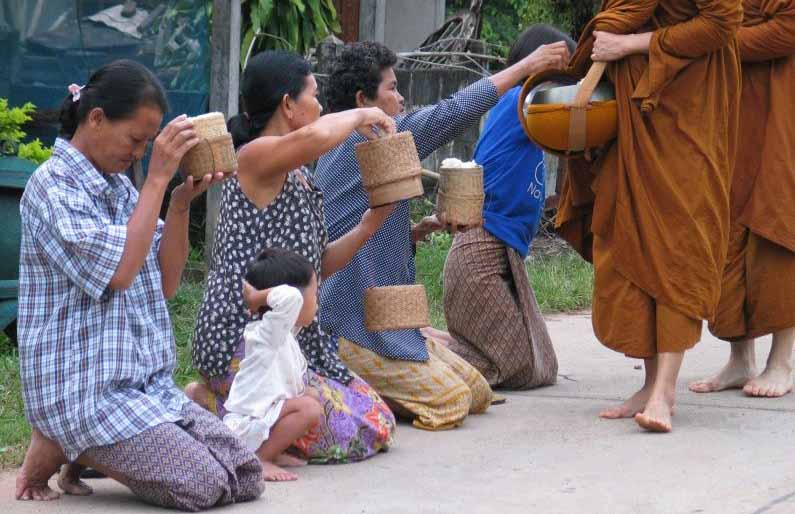
Pindabat 5POSTCARD #31: In Buddhist countries, babies are taught when they are about six months old to put food into the monk’s alms-bowl. The whole family applauds as the sticky rice drops from that little hand into the monk’s bowl. The kid gets the idea early on: when stuff leaves your hand, you get this happy feeling. It feels good to give.

Everything the Buddhist monk receives is a gift, an offering; the monk is a mendicant, and lives entirely on the generosity of others: ‘Our bodies are fueled by the food that is offered to us. In fact, scientists say that all the cells of the body are replaced every seven years, so any (monk) who has been ordained for that long has a body that is completely donated. If it were not for the accumulated kindnesses, efforts, and good will of countless hundreds and thousands of people, this body would not be able to sustain itself. Kindness is the actual physical fabric of what we think of as ‘me.” [Ajahn Amaro, ‘Generosity in the Land of the Individualist’]

Generosity is cultivating an inward disposition to give, a glad willingness to share what we have with others. Give it away, we have more than enough. Ease the discomfort of being driven to fulfill that urge to ‘have’, to ‘possess’, a hunger created by always wanting more. All of it is gone when you’re generous. Brainstorm the word ‘generosity’ and you come up with loving-kindness, compassion, empathy, well-being, freedom. You find gratitude, grace, honour, motivation, encouragement. Generosity is everything. It’s nature is to share, recycle, circulate; it can only be given, never taken.

Generosity, is a mental, emotional letting go; releasing the tenacity of holding on to things; all that baggage we burden ourselves with is removed in one single act of generosity. Generosity means not holding to the self-concept, the separateness applied to things that are really ‘in context’. Seeing it all as process, ever-changing; a connectedness with the outer world. Generosity leads to wisdom – the truth is without bias. The cultivation of generosity directly debilitates greed and hate, and facilitates the kind of mind that allows for the eradication of delusion.

‘There was a seeker and a wise man. The wise man had a most incredible jewel and the seeker was absolutely amazed by the jewel. He asks the wise man if he would give him the jewel. And the wise man gives it to him. The seeker is very excited and afraid that the old wise man is going to change his mind, so he hastily says goodbye and goes off. A short while after that he comes back, approaches the wise man with great humility and respect, lays the jewel down in front of him on the ground and says he’d like to make a trade. He’d like to exchange this jewel. And the wise man asks him what he wants to exchange it for. The seeker says he would like to exchange the jewel for knowledge of how to gain the sort of mind that could give up a jewel like that without a second thought.’ [This story appears in Khanti – Patient Endurance]

————————-

Sources include: Dana: The Practice of Giving
Excerpts from an earlier post: More Than Enough
Upper image is from the Wat Pahnanachat collection

non-aversion

IMG_0106POSTCARD11: Delhi: There’s a wasps’ nest in the bathroom at the end of the corridor. I’ve been away for two months, didn’t know it was there and didn’t notice it at first, in the half darkness of 5.30am, walking along to this bathroom we don’t normally use. And wearing glasses because I’ve always worn glasses but since the eye operation it’s all a blur. I forget, put them on and in the darkness, can’t see any difference. Switch on the light in the bathroom, look in the mirror; is this really ‘me’? An awareness of a low humming sound; a multi-frequency buzzzzzz, just on the edge of hearing. Something crawling on the window, what’s that? I have to take my glasses off to see, a strange reverse action I’m not used to, then wait for a moment until vision gets in focus… wow, a wasps’ nest in the bathroom, not good. Back out of there fast, close the door and get as far away as possible from it – closing all doors between me and it. Seeing imagined wasps in faulty vision.

It’s full daylight in an hour and I go back for another look… some kind of large-bodied heavy duty, Indian-wasp-like species; googled it later: ropalidia marginata. The nest is not actually in the bathroom, it’s built on the underside of the top part of the bathroom window, outside… thankful for that, but still kinda scary, even though there’s mosquito mesh on all doors and windows and they can’t get inside the house. I go outside to take a photo but nervous about all the activity so the pic is not clear. The wasps are transparent orange, the nest is grey, a truly colourless grey; remarkable because of its absence of colour. Kind of supernatural, like dust, or ash.

Ropalidia_marginata_2A species so distant from where we are, there’s a reluctance to look at this, yet a fascination with it; more like science fiction than real. The Queen wasp and attendants, baby wasps, larvae, that will emerge from all these small hexagonal openings. Yeh, well… somehow it’s difficult to think of them being cute. Wiki says the females contend with each other for the position of queen. They’ve evolved through aggression and hostility. How to understand this? I don’t know, but keeping a safe distance from it, and mindful of that action – not pushing away. The contemplation of aggressive aversion and the tendency to create a category for things I hate; enemies, difficult people, personality issues at the office – all kinds of other situations worse than that. Social conditioning has made me critical; looking for the fault in people, where to lay blame. Living in circumstances I don’t always feel comfortable with. Seeing what’s wrong, not able to see what’s right. Metta, loving kindness, isn’t a case of: “I love this person, but I don’t love that one.” Metta is non-discriminatory love, all beings have conscious awareness, a shared subjectivity….

Metta is unconditioned love; you don’t have more metta for the nice things and not as much for the bad things, it is evenly distributed: our beloved friends and our detested enemies. The action of metta is unconditioned, it is patience and non-aversion. We accept the pain, disappointment, failure, blame, persecution, abuse and all the experiences we can have in a lifetime. We begin with: ‘May I abide in well-being,’ starting with yourself. It’s an attitude of acceptance and patience with the way it is; accepting the anger, resentment, aversion, or the little petty things.’ [Ajahn Sumedho]

————————-

Lower photo from the Wiki page

conflict & release

121120121567“Metta is non-discriminatory. It doesn’t mean liking one thing rather than another, it isn’t a question of singling out: “I love this person, I don’t love that one.” [Ajahn Sumedho, “Universal Loving Kindness” From Forest Sangha Newsletter, October 1997]

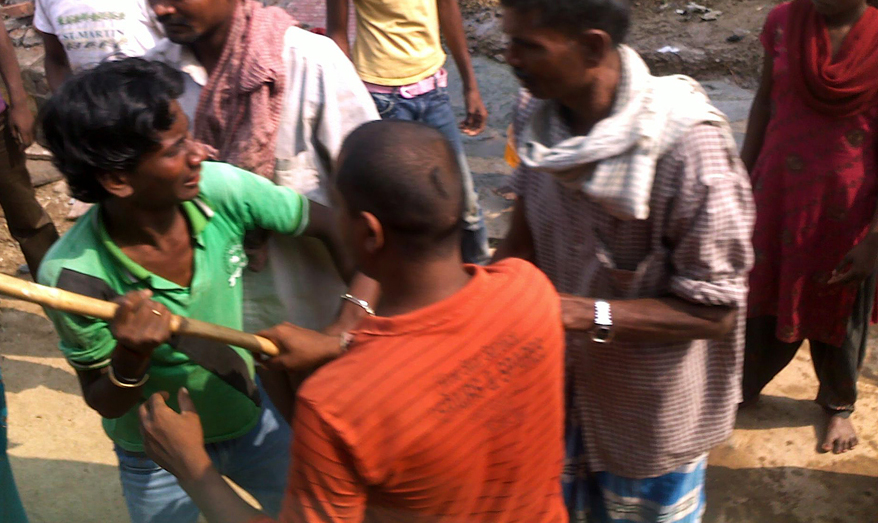
North India: The image here shows some kind of serious argument happening among a group of men, viewed from the window of a moving bus. I couldn’t actually see what was happening because other passengers were in the way, but I got the camera into a space near the window of the bus and took the picture, guesswork, thinking it’ll not come out clearly but it did – perfectly positioned in the centre of the frame. The man in the green shirt is trying to do something with that pole and the other guys are struggling with him violently. The bus pushed itself on through the crowd and the people made space for it. When we got up close, all I could see was the top of their heads and I took the photo without seeing where to point the camera…

The bus moved on and we were gone in a moment, accelerating along empty streets. I was amazed to see the photo after we’d moved away from the area. What to do with it? The tremendous intensity coming from the green-shirted man is scary – murderous feelings in the air. There’s another emotion too, he looks tearful, as if he might start to cry. It was an event I didn’t see, all I have is this picture of it. I could hear the explosions of angry voices, and the memory of it is still a bit scary, but it didn’t happen to me. If it hadn’t been for the camera lens, I’d not have seen it. As long as no effort is there to keep it going, conflict falls away. But we fuel the fires to keep the conflict going; our wars and war-mongering, allowing everyone the means to build up the tension, justified outrage, creating stories in the mind. We could just as easily allow it to fall away, but we’re drawn in, and it gets to a point when conflict is inevitable; this is always how it is.

Then Ajahn Vajiro was in town the other day and somebody asked him about what to do when you have to put up with some unreasonable, insensitive person giving you a hard time and you have to see this person on a daily basis. Ajahn spoke about the Brahma Viharas and later Suffering, the First Noble Truth and how the Buddha didn’t say he could eliminate suffering – he gave us the tools to escape the suffering. It led me to see that conflict is resolved if we can focus on the subjective nature of it, see our own anger, and see the anger the ‘bad guy’ has to cope with, and recognise it as exactly the same thing – what’s the difference?

The practice of meditation is the solution. Ajahn talked about getting to know the inner world; start from there, explore the universe from the inside. It’s not just about feelings of bliss and peace, that’s there too but it’s about the real world. Long term goals. Following this path, you get to know about suffering; you notice your own suffering, you have compassion and act towards others with compassion when you notice the suffering in your opponent. Apply wisdom – especially if your opponent is swinging a long pole, aimed at your head. See the angry person as someone who doesn’t understand his/her own suffering and recognise their difficulty – then get out of the way of the swinging pole!

It’s about the difference between ‘knowing’ and ignorance. Ignorance is the result of unskilful action. Non-ignorance (knowing) is about accepting limitations and doubt. It’s not a sure thing but it doesn’t have to be a serious drawback; having to cope with being not sure, uncertainty. Ajahn V described it as being at the edge of the known; doubt is nearly knowing what it is…. In a different context, uncertainty is what’s in the wrapped gift you’ve been given. You don’t know what’s inside until you open it….

————————-

“The metta – kindness – engendered in us encourages us to accept ourselves and others, and so to understand ourselves and others. Understanding implies wisdom. And this wisdom is that which allows us to find the way, to grow beyond, or let go of, that which limits and binds the heart. The kindness expressed to others allows them to accept themselves and others. This is an emotional, gut or heart acceptance that allows the acts of body, speech and mind that are a response to that which is perceived as `other’ to be kind; not motivated by not-liking, not motivated by aversion or fear. The effect is unlimited Metta is radiant and attractive, warming to those that are cold, cooling to those that are hot.” [Venerable Ajahn Vajiro – “Mature Emotions ” from the Forest Sangha Newsletter]

loving-kindness to animals 2

cows2A village near Hat Yai:  Going to see the cows with M and we meet the first one. I ask M about pulling on the rope tied through it’s nose and if she thinks that would be painful? M tells me it’s like pulling your hand and she pulls me along by holding on to my finger: ‘Like this Toong-Ting’ – laughing, Toong-Ting as a reluctant cow… I can hear the voice of (her auntie) Pa K, who lives here, a down-to-earth farming person; and I guess M must have asked Pa K the same question and she’d shown her, as M shows me now. I’m also aware that M sees me a bit like a grown-up child, because I’m a foreigner and have such naïve views about things. For us Westerners, the simplicity of rural life is attractive, but we’re not able to see it in the long term, or accept the hard work that’s necessary to be able to live like that. Also having to accept basic truths like killing animals for food and all that… yes, well, I don’t discuss this with M. We just go on through all the wet ground towards the other cows in the distance.

There was another time I came here to visit the cows, and met the little cow with the bamboo bell around its neck: clacka-clacka sound when it’s eating grass – strange grass-eating rhythms. We stop and look at it, and it looks at us. Such a miniature creature, it looks like a calf, and comes towards me with cautious movements, swinging head in motion with the way it walks. It raises it’s head and points a snuffling, sniffing wet snout in my direction; bits of grass and green stained mouth. Large snorts. Then it extends a long tongue and sticks it in it’s nostril (how do they do that?), comes a bit closer and there’s quite a bit of sniffing of the air around me. This cute little cow is curious about me due to a certain familiar milky smell coming through the pores of my skin? It’s not smelling the others who are with me like this… Thais don’t drink much milk so I’m thinking, hmmm, here’s proof that the Western body releases a noticeable odour of milk. I know this little cow has never been near to a Western person before in its life. The recognition of this milky smell, a familiarity: I am an upright, standing-on-it’s-hind-legs member of the species – a cow person? A bit disturbing… I’m conscious, all of a sudden, that humans are carnivores and there’s this unpleasant conceit about being at the top of the food chain that’s bothering me right now.

Scan-130523-Cow1

Later, reflecting on this while eating a breakfast of grains, nuts, fruit and cow’s milk – jaws move in a slightly circular motion, down up, down, up, down, grind, grind, and swallow. I’m an animal too. I consume the environment, whether it’s other animals, fish, vegetables, eggs, milk and – we are the cow’s babies! I notice cutting up vegetables is a bit of a sacrifice too; every time I start to cook food there is the opportunity for this kind of contemplation. Vegetables and fruit may not have the obvious characteristics of sentient beings but we may eat their reproductive organs along with everything else and that’s kinda weird…

There’s a couple of lines of text somewhere in an essay by Tan Ajahn Buddhadassa, that I cannot find at the moment; it’s about consciousness of all the things we eat, bits of animals, poultry and fish and how all their ghosts will come back to haunt us in the end. Pretty scary, nowhere to run, everything we are: mental, physiological, flesh, blood, and bones is a composite of what we have eaten, internalized. And it extends back through the generations to the beginning of time. The cellular substance of what we are is a genetic composite of all kinds of animal fats and enzymes and there’s just no getting away from it.

Contemplating the eating of meat helps me to see the true extent of my delusion driven by a voracious appetite for all consumables. Things I feel drawn to consume surround me – non-food items; ideas, concepts, ‘mind’ hungers for mind object. Consciousness is clouded over by habitual ‘mind’. Remove habitual ‘mind’ and there may be something like a deluge of reality comes in and with it comes a satisfactory understanding of the mystery that people eat animals.

Scan-130523-cows3

When Acharn Mun was at the end of his life, weak and lying in a village in NE Thailand, a very large number of his followers began to assemble. He asked the bhikkhus to take him away from the village because the villagers would have to kill many animals to feed those people. They took him to a nearby town where there were market places and various kinds of prepared food could be easily obtained. Shortly after that Ajahn Mun passed away.

‘From the day of my ordination I have never thought of harming (animals), let alone killing them. I have always extended my loving-kindness to them, never neglecting to share with them all the fruits of my merit. It would be ironic if my death were to be the cause of their deaths (‘The Venerable Phra Acharn Mun Bhuridatta Thera, Meditation Master’, page 201 – 202).

————————-

Sections originally posted in loving-kindness to animals 1 and re-posted here.