cruel pillows [part one]

7427ea210acc16b3b0130f (1)OLD NOTEBOOKS: DELHI: I just remembered this expression: “a bull with a headache.” It comes from Scotland, where large Men drink whisky all night, then one staggers through to the breakfast room in the morning and is demonstrably angry with everything, then one goes off to work in the wild, wet, wooly Northern landscapes of my distant memory.

Now I live in Asia which is really nice, gentle and warm and I’m a Buddhist and all is well in my world, except I’ve got a headache – all the time. A Buddhist with a headache? What to do, I have wondered many times. For me it’s an opportunity to be conscious and aware of what I’m doing all the time, because the headache is likely to get bad at any time. And I’ve thought too about what we’re doing here in the blogging world… our consciousness/awareness of our ‘world’, in a sense, is what we’re writing about, really, one way or another. Even if a lot of space may be taken up with trying to express how we get to that point. Even so, it’s an all-inclusive thing, isn’t it? And sometimes what we write is not as important as the spaces left where there’s nothing written. No point in asking why the ‘world’ should be (or shouldn’t be) like this. Or even try to identify it and analyze it – as you’ll see if you keep reading this – I’m just trying to make friends with my headache, in a round-about way, not too direct… see how that goes. I’m not expecting it ‘to be’ anything, at times I try to anticipate what it’s likely to do next, wondering how it’s getting on.

The headache arrived last September as a result of shingles on the right side of the head, here’s the link: PHN, but it might give you a headache reading about that, so why don’t I just introduce you to the headache itself? Think of a motorbike helmet that holds your head tightly, a snug fit … that’s it. Now there’s this cloud of intense feeling that, as yet, doesn’t have a name, it’s just energy. As long as it remains anonymous, things are okay – reasonably okay, the only thing is that what you have is this hair-trigger-sawn-off-shotgun-crash-helmet of a headache, minding its own business and nobody’d even know it was there.

So, the lesson is, be careful about what you think! Now, in some foolish un-mindful moment, I might say to myself: Do I have a headache? I can’t feel it now… and BOOM it demolishes my head. So naturally I get to know not to do that, not to ‘name’ it, identify it, or try to make it into something. And, important, I have to learn about this mechanism that can be held in the default STOP position. It’s the: please-don’t-go-there thought; that split-second, small, even tiny, space before the thinking process is engaged and what was really, absolutely, going to happen, by some miracle, doesn’t.

It cannot be stopped sometimes, of course, and you find that the forewarned intuitive snap feeling it’s about to happen means it just happens anyway and there’s devastation all around as you reach for the meds that are opiates anyway so you’re kinda hovering on the edge of a Edgar Allan Poe nightmare most of the time when you overdose on them.

This is how it is, predictably unpredictable so you have to be ready for it to happen any time. If it takes place at night, probably the best way of explaining the feeling of it, when dosed up to the eyeballs with sleeping pills, but still the headache remains and you’re awake for hours, it’s this: pillows appear cruel – have you ever thought of pillows being cruel? Probably not, well I know everything there is to know about pillows, in my research since this headache came to stay with me last September. Really, what I don’t know about pillows is just not worth knowing.

But that’s a whole different story…. [See: part two]

————————-

Screen Shot 2016-02-04 at 17.12.04About this picture: This is the missing head, a screenshot taken from a YouTube video, which shows the head briefly at the end of the clip: https://youtu.be/MjRf-b8Ezis

The whole story is, it’s an ancient Buddhist sculpture, which at the time of the top photo, was at the Beijing World Art Museum and being made ready to be sent to Kaohsiung in Taiwan where it will be reunited with its head.

Its head was stolen in 1996 from the Youju Temple in Hebei Province. The sculpture, made of white marble, is around 1,400 years old. The body is 1.59 meters tall. The head was obtained and offered by a private collector in 2014. Repairs will be made before it is put on public display in 2016. Twenty years after it was removed. The museum has selected another 77 relics for the exhibition in Taiwan.

The Taiwan Affairs Office of the State Council approved the body be sent to Kaohsiung for a three-month Buddhist Cultural Relic Exhibition jointly held by the administration and the Fo Guang Shan Buddha Memorial Hall, before the complete statue is sent back to Hebei. It symbolizes the possible reunification of Taiwan with China.
————————-

nothing

buddha

OLD NOTEBOOKS: DELHI: Sitting quietly on the meditation cushion, together with this headache that’s moved in recently, and I’m wondering if it’ll quieten down too – sometimes it does. At first it’s like there’s this energy of time and space moving through me from the past into future in continuously transforming evolving forms – but it’s more than that; internal processes happening by themselves – there’s no ‘me’ involved here, because I’m engaged with this swirling mass of headache and also just on the edge of understanding it’s like that when the whole thing becomes transparent – there is no beginning/no end… and it all slips into what you’d call the bigger picture.

So the meditation becomes more of a: let’s see now where are we at? (the headache and me). The outside world is not outside it’s inside too, every time I look/watch/see an object, it’s internalized. The brain creates a customized picture of it for me – and we all agree – who says the sky is blue, it could be a fantastic different color?

The pressure points on the cushion and floor where my legs are folded, and right knee supported, also parts of the body that are in contact with the surfaces of mat, form sensory data which reach the mind and give me balance, and I slip into this physical position like a hand fits the glove.

But then later as I’m walking through the rooms, the thought that I am as much inside as outside is a bit unexpected. The music I listen to becomes me, it is who I am, the alto saxophone sounds of Paul Desmond enter the hearing mechanism and I’m immediately on a 4D wave of melody floating out the window, I just take it for granted.

Then I smell lunch, go through, and eat the outside world. It enters my body. It goes to create flesh, blood and bones. Fingernails and hair grow. It’s quite an experience. The headache is a long swirling blue veil unravelled all around and caught in gentle aircurrents, of the saxaphone music – you could say it’s not getting the attention it deserves. Then all this becomes momentary, the headache disappears again and there’s the curious awareness of nothing. An experience of ‘open moments’, nothing in itself – but how did that happen? Where did the subject go? Suddenly there’s nothing in ‘here’ where the ‘me’ ought to be.

Virtue and the mind itself shows the way to go; the Buddha’s Noble Eightfold Path. Everything else in this great mass of no-thingness is an intuitive part of the whole, while functioning as form which is what we are on one level, everything else is too, and here we can study and learn so much from each other, while all of the world is comprised of particles that become increasingly smaller until their structure is formless space.

The knower and the known are one. Simple people imagine that they should see God, as if He stood there and they here. This is not so. God and I, we are one in knowledge. [Meister Eckhart]

————————-

Source for Header Image
Note “open moments” comes from a post in the blog:A Buddhist Year titled, ‘Time
Music I was listening to: ‘Polka Dots and Moonbeams’ by Paul Desmond:

becoming

1024px-Siddharta_Gautama_BorobudurOLD NOTEBOOKS: DELHI: I have this headache that lives with me now; wake up in the morning and it’s there… dreamy half-formed images like wings of birds fluttering around in front of the headache then I see it’s becoming something and try to correct it so there’s no ‘becoming’. As soon as I do that, there’s no headache – wonderful except, I fall asleep again; the mind assumes, since there’s no becoming, no subject is focused upon, no actual thing (nothing) happening, this must mean sleep; okay, goodnight. Zzzzz….

Wake up again, and stumble out of bed, the whirr and buzz of the mechanism of headache that still hasn’t managed to become anything yet is taken into the hot shower. Then dressed in scarf and warm clothing because it’s cold here in North India this time of year. Downstairs from the third floor holding on to the hand-rail in an almost spiral staircase makes you dizzy to look at it and balancing the head as best as possible in a stable position because now the headache has become a snooker ball rolling around and crashing into the walls inside a sphere at the top of the vertebral column.

Stone steps with shiny-soled slippers that slip. Spinning around, everywhere in the mind thoughts arise; there’s always a subject searching for an opportunity to ‘become’ something. Is this what holds beings in the cycles of rebirth? Curious idea; a possibility… so it must be to do with non-becoming – allowing it all to ‘become’ without anyone ‘becoming’ it. Let’s see, how does that work? Stop here for a moment and think about this.

Am I down yet? Which floor am I on now? Having to be careful about not slipping, how many landings are there? I’m losing my sense of direction. But this idea gets my attention: active thought arises from somewhere in the midst of a great cloud of inactive thought. I can decide to not-become a thought just allow it to ‘become’ by itself.

So it’s possible to be focused on two parts of a thought at the same time… there’s a kind of transparency about it, a ‘becoming’ but no one who ‘becomes’. There’s no become-ee; a headache but no ‘headache-ee’ – it doesn’t belong to ‘me’. There’s awareness of the headache, but no awareness of to whom it is happening, there must be a larger awareness that includes this – an awareness of one thought that includes awareness of another. There’s something that allows me to consider this; I’m seeing it from somewhere else.

Yes this must be it, I’m at the ground floor now, and these stairs are difficult I get lost in them every time – don’t know if I’m going up or down. The mind searches for this awareness in some place completely unknown. Where is it? The space that’s unattached: the space-in-between. This takes me to another awareness that’s quite distant from the headache. It’s like it’s happening somewhere far away.

The mind is the canvas on which our thoughts are projected and is part of consciousness. Our body is a holographic projection of our consciousness. [B. M. Hegde, cardiologist and former Vice-Chancellor Manipal University]
—————————-

Source for header picture. Note: this was developed from an earlier past titled ‘non-becoming‘. the structure of it is almost exactly the same, only difference is I had no headache in those days. So I was inspired to apply the same strategy in dealing with the headache I have now and it’s been quite succesful.

the buddha today

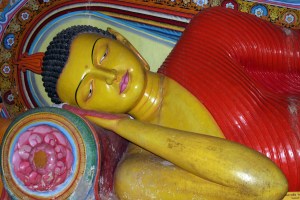
100-reclining-buddha-in-isurumuniya-vihara-anuradhapuraOLD NOTEBOOKS: The images of Gautama the Buddha we have today portray him as a person from the educated class, someone we might recognize as not unlike many of us who have the ability to see ordinary life at a distance, without any immediate financial concern about things in general because we live in a society that takes care of itself (as it was for Gautama before he left the palace). Or maybe we’re desperadoes, adventurers with a special genius and exceptional skill and energy that creates equanimity in times of brinkmanship and it’s the sheer confidence in our ability that allows us to see this truth; the suffering of the ordinary worldling is caused by wanting things to be different from (other than) what they are, and never managing to reach the desired state.

There is another a form of Buddhism that reaches the ordinary people of India through the Ambedkar conversion from the socially oppressed Dalit caste to Buddhist, in the hope of a better life. This has become a political issue and some would say the Buddha was an activist attempting to create social change – I think most would agree that, sadly the politics of the situation has confused the Buddha’s original teaching. The Ambedkar Buddhists are the fifth largest religion in India. The Dalit Buddhists I have met, those with  university degrees at doctorate level, are actively searching for a way of integrating those parts of the Buddha’s original teaching.

In the West, people have to structure their lives around employment. Their innate ability to be happy is exploited by commercial strategies and a fleeting, temporary happiness has come to be built-in to the system. People can’t escape from that unless they step out of the social momentum they’re in and this means there’s the risk of losing everything. So they’re trapped in the system.

As Pankaj Mishra says: “Buddhism has always attracted the elite of whatever society it has traveled to, partly because you need to have traveled through a certain experience of materialism in order to arrive at the sense that there is something problematic about desire and longing, how they don’t lead to happiness, and more often than not lead to unhappiness. If you are still struggling to fulfill your fantasies of wealth, power, status, Buddhism is less likely to appeal to you.” [‘An End to Suffering’ Pankaj Mishra‘]

Maybe we are seeing some similarities here reading this while stretched out on the sofa with an iPad at this very moment, giving some thought to the situation of Gautama leaving his comfortable home and stepping into the unknown, in search of a spiritual life. In Thailand there’s the option of living in the monastery for a period of time in order to follow the spiritual path. In fact you can spend your whole life there. This kind of choice is held in high regard by Thai society. In the West we are in one way or another committed to our earning capacity. There is virtually no spiritual option of this kind in the system – other than self-study and the support from nearby Buddhist monasteries. A Google search for Theravada monasteries in USA and other parts of the world will explain that anyone is welcome to share in the one meal of the day, free of charge, the activities, Dhamma talks in the monastery and accommodation can be arranged.

“You should live as islands unto yourselves, being your own refuge, seeking no other refuge; with the dharma as an island, with the dharma as your refuge, seeking no other refuge.” [selected from the Buddha’s final words]

————————-

Note: some parts of an earlier post included here: https://dhammafootsteps.wordpress.com/2012/08/22/the-way-out/

remembering

Dazu-Sleeping-BuddhaOLD NOTEBOOKS: In the midst of my contemplation of this Chinese Buddha, along comes an image that becomes a memory; it’s all these objects of reverence and holy things that seem to clutter this central object of focus, the continous chanting by Buddhists from all countries and dressed in different kinds of costumes with bells and accessories, and accouterments… and my own sense of reverence.

When I was a young guy I stayed with an Anglican priest in a Victorian vicarage until I could find my own place. It was my first job, supply teacher in a rough high school in East London, just before Christmas and I hadn’t really thought about it, coming from the far North East, a heritage of strong whisky, fishing boats in the North Sea and gales. Christmas wasn’t meaningful there.

By comparison, everything in London seemed soft and gentle, small wrapped gifts from everyone and I was opening them in my room, when the Church bells suddenly start ringing, it was a collosal din coming from above my room. Did they have bell-pullers? I didn’t see anything to indicate that, and the Father came in dressed in a black cassock, wide-eyed and important and apologised for not telling me about it but it was a cassette tape player and could I come and see – shouting the instructions above the huge noise, and could I please check on these cables reaching up through the ceiling to the huge speakers in the bell tower, carefully placing the cassette player on the small carved clerical table and the wound copper cables stretching dangerously upwards. And I understood I was to watch them for a while to see they didn’t come loose then come downstairs to the service and he’d indicate with a nod when to run up and switch off the cassettte player.

Everyone who came to see the Father just assumed I was a trainee priest and smiling all the time, I felt inspired about being a ‘believer’, but what in? Didn’t seem to matter it was just a sort of space I was occupying at the time; really nice (compared with the storms and savage battle history I’d recently escaped from, best kept quiet about). Aspiring towards the state of being goodhearted, without knowing what exactly I was doing and hadn’t yet discovered what the question was, Looking but not ever finding the opportunity to discuss this kind of thing with the very tall young curate who was always in a hurry; dashing around washing the dishes in this Victorian kitchen with huge taps; abundant generosity with his smiles although kinda narrow in his views.

I happened to show him a leaflet the Hare Krishna guys gave me , dancing in the street with a drum. And the curate said: Oh dear, God on a bad day , and gave it back to me. So I thought about that answer for a long time and it really sounded not bad considering it was not exactly accompanied with any kind of intelligent question. But it did inspire the thought; what might God be like on a good day? So that must have been the question I really wanted to ask this curate, I thought later up in my room, the shape of a large cross that used to hang there where my bed was, and had left the original pattern of the beautiful old Victorian wallpaper in the faded room… it was shortly after that I left for Asia.

“There are only two ways to live your life. One is as though nothing is a miracle. The other is as though everything is a miracle”. [Albert Einstein]

————————-

a sense of sky

bodhgaya2OLD NOTEBOOKS: There’s a sense of sky, thoughts like clouds drifting through the vast space in the head… but I really don’t want to call it anything; giving things names gives them an identity and what happens next is, I become the ‘happy’ feeling. Feeling “happy” creates a ‘self’ where there wasn’t one before – “I” want to be happy, and don’t want to be ‘sad’, or unhappy. So maybe everything was okay before that ‘happy’ word arrived.

Something deeply understood by every human being in the world is the thought: ‘I am the only one that’s ‘me’, somehow ignoring the overwhelming fact that 7 billion people feel the same way. These days I’m returning to my old notebooks written when I was first discovering Buddhism, it’s this sudden PHN physical condition that’s throwing things all over the place and I need to remember how it all began. It really feels like the best thing to do is return the focus to that sense of sky, nothingness, no-thingness, and anatta, ‘no-self’, nobody at home…

How does it work? For me now, ‘no-self’ describes it well; it’s all just an operating system, same as Windows 10, Mac OS X El Capitain, and a determined and purposeful search to find out exactly where and how this ‘no-self’ exists will yield nothing, because “non self” doesn’t substantially exist – there isn’t any ‘thingness’ about non-self. No substance to it. In fact, ‘no-self’ is just another way of saying nothing substantially exists anywhere. There’s a wonderful fragility, a transparency about the world.

So the Buddha discovered this by way of his own research, 2500 years before Quantum physicists started to come up with empirical evidence that nothing substantially exists. Same thing in so many words. I started to investigate this further, because the question is, if there is no “self”, who or what “sees” there is no “self”? It’s an interesting direction the Dhamma takes that seems to hold my attention. I asked a monk about it in Thailand: ‘If everything without exception is “non self” including the “I” that’s investigating this, then who or what is there to see it’s non self… where does it all lead to? Without hesitation the monk just looked at me calmly and said “enlightenment.” That kinda stopped the conversation for a while …

The process of conceptualising is just a process – no person there doing it. just a process of how one thing is naturally linked to the next thing it’s most likely to link with, and that in turn linked to the next and it goes around like a wheel turning; the extreme point is suffering and unknowing (ignorance: the act of ignoring) and continues on from there following links that the Buddha showed us how to see. It can happen in a millisecond or in a slightly longer extended time… and that’s when we see it. There is a way out, of course, and that happens around steps 6,7 & 8 in the 12 step cycle. I’m not going to talk about that specifically here, check out the link below. So the main thing is all of these cycles, all these other behaviours that go on in life, have no ‘self’ in the background somehow pulling the strings. I find that remembering this helps me in dealing with pain; the pain is not happening to ‘me’ – there is no ‘me’ it’s happening to… just a series of processes. I allow it to pass, in the same way as ‘it’ is raining, wait for it to end… all things do.

“When Hanshan got up from his seat and walked around, he did not see things in motion. When he opened the window blind, suddenly a wind blew the trees in the yard, and the leaves flew all over the sky. However, he did not see any signs of motion. He understood what the text spoke of as, “Streams and rivers run into the ocean and yet there is no flowing.” [Han-shan Te-Ching (1546 – 1623)]

————————-

Note: The source of the Han-Shan Te-Ching quote is the Mindfulbalance blog, post titled: Present in the midst of change. I’m grateful to the researcher for finding this wonderful group of words.
For the cycles of causality follow this link to t
he Buddha’s teaching on Dependent Origination (Paticcsammupada)

high altitude pain

259982750POSTCARD #187: Bangkok/Delhi flight: The journey is by way of a series of crowded corridors connected like tubes in a telescope, one inside the other, becoming smaller and smaller, reduced to squeeze us into the self construct; the way we are and the lifetimes lived with it. The ‘me’ in the body, the voice in my head, the narrator telling the story. This is how it is… and already there’s a sense of distance from the world (‘this’ was). Keep moving, we pass through security as if it were the eyepiece of the telescope, examined through a lens; cameras watch us standing in line. We are subject to causes and conditions… shoes off, gentlemen remove belt, anything in your pockets Sir? Take off watch please. Enter the X-ray cubicle, stand with legs apart, arms extended, wind blows clothes aside and hair ruffled. I’m suddenly aware the viewer behind the lens can see everything underneath clothing. Shoes on, thread belt through loops, pick up watch and things. Collect computer from tray put it back inside bag and get organised. Step out of there, aware, balanced, easy breathing and it’s okay right now (except piercing high frequency air-conditioning sound, waiting for pain to arrive but it doesn’t come), sensory mechanisms function without my involvement. Continue with the slow foot shuffle (high pitched voices, mysterious kerfuffle), but we’re all moving along here. I’m like an antenna receiving data; seeing, hearing, smelling, tasting, touching and cognitive functioning receptor, waiting for things to happen.

Hand passport to officer, look at the camera, facial recognition, the self I inhabit… this is who I ‘am’ (the same as everyone else ‘is’). The officer stamps twice, thump… thump (the sound of it), walk through and out to the duty-free extravaganza (piercing light enters neural pathways), suddenly blinded for a moment in the reflected glow of gold watches, jewelry, the made-up lips and eyes in vivid, max-pixel pictures, videos of popular celebrities, cosmetic dentistry, facial alterations, images in unflawed focus and good-looking lighting; commonplace works of art, masterpieces of trivialities. I could use the television analogy; I’m watching this channel and all the other people are watching their channels – and if there were separate channels for every single being in the world, that would be the correct analogy.

We’re in another tunnel sloping downwards, becoming smaller at the end where painted ladies wait, show me where I have to go; turn right into an even smaller tube with seats on either side of a corridor, and I’m in my numbered seat. It’s made to measure, low ceiling, knees touch the seat in front, elbows touching the guy next to me, hairy arms. It’s like being on a bus at night, except less space. No view from the window, can see only the blank video screen at eye level, 18 inches in front of me… everything is too near and a feeling of blackness. Try to read my book on the Kindle but the words appear strange, three-dimensional, as if embossed on the screen, the lines of text are not straight; flowing in a gentle curve. Then I feel the pain behind my right eye like a sharp steel knife entering my head, and pushed right up to the hilt. Gasp! The painted ladies bring me a plastic glass of water. Searching in my pockets for the meds…the huge pain has reached its max, the steel blade withdraws; a devastation of everything, catastrophic, frantic looking for something to hold on to, or let go of, and it all tips over like a building falls on its face in slow motion, desolation, wreckage and some relief as I see it’s not happening to ‘me’ – it’s not ‘my’ pain, too big for that, much too big. It’s the force of pain on its own, like the huge wind blows, the vast rain falls, a storm at sea. Swallow two capsules, lie back, close my eyes and the curve I was seeing earlier becomes the curve of a thick dark smoke rising up from my head, swirling up through the paper-thin structure of the plane, the sky above and space all around.

Relaxed with the seat back, pain gone and all that remains is the sound of the engines at 600 mph and altitude 38,000 feet. The mind makes a ‘story’ out of it, a stretched sense of reality that includes the video I’m watching in the darkness. Memory allows all kinds of out-of-context events to be there and acceptably part of it.

Landing, bump… bump, long lumpy runway to get to the airport buildings, then the clamber and struggle for overhead baggage, push, shove. Intrude, squeeze as they do here, full body contact with total strangers, and out into a tunnel again, more tunnels becoming wider, wider then a corridor and out onto the miles of ochre coloured carpet with patterns of planets and stars. High speed moving walkways and we’re in India.

“God is a mythical word, a mumbo-jumbo word that is the invention of the priesthood. Actually, to ask whether God exists is absurd. God is existence, the very isness. When we say God exists we create something out of the word God, then God becomes a thing. But God is not a thing, nor is God a person, he is pure existence. The word is misleading because the word personifies. It is better to use the word existence. The totality of existence is God.” [Osho]

————————

Photo: Free internet image
Quote: Source, God is Existence itself – Osho

obviously unexpected

IMG_2566 (1)POSTCARD #186: Bangkok: Easily said in hindsight, but there’s a sense of helplessness, as I take leave of the birds nesting in the ceiling fan; now it depends entirely on their strength and vigor – anything could happen to these small creatures … and it’ll all take place without me being here because I’m leaving. Bag is packed on my way to the airport, flight to Delhi and swept away in the wave of circumstances. It was that kind of unexpected situation that obviously decided everything finally when we had the birds on the balcony the last time, in Switzerland.

Things came to a head. Events occurred, a change, suddenly this U-turn showed up and we had to follow it around. I was lying on the sofa in the front room, one day, head propped up on a large cushion, staring at my feet down there and the vague space beyond, when suddenly I became aware of something moving in the room, a shadow reflected in the shiny floor surface. A bird with folded wings striding boldly across the floor… quite far into the room – HEY get out of here! Strange to have a wild bird suddenly fly across the room, bird-wing-flap disturbing the air, the acoustics – a very odd thing. It shot out through the open door, into the outside world, straight over the balcony rail and immediately gone in a direct line further and further away in the vast sky until it vanished as a tiny dot.

I stood on the balcony and watched it for a moment then dismantled the perch I’d built and removed the artist’s easel; scraped off all the bird mess and washed down the whole floor. It’s that farmyard thing; dung and downy feathers blowing around inside the apartment because we have to have the balcony doors open in the hot weather, and even if I vacuum up all the feathers, one or two still seem to be fluttering through the rooms of the apartment. My wife Jiab continues to be nice about it but doesn’t actually answer the question when I ask how she feels about the birds. So it’s that awkward silence…

When the birds came back in the evening, there was tremendous confusion: where’s our perch gone? Flapping of wings, feathers flying and hovering in the air where the easel used to be. Then one of them figured it was a good idea to perch on the door stop bracket at the top of the door – never noticed it before – it sticks out about 5 cm with a rubber stopper on the end. An ideal perch. Also the top of the door, which had to be open in the warm evening. So much flapping of wings to see who had the right to be where, the doorstop perch seemed to be top in the hierarchy. That night I put out the easel again (for the last time) and things quietened down, back the way they were.

The following day, after the birds left, I cleaned up again and took the easel inside, locked the door and we were off for a week’s holiday. Mixed feelings, we left them to look after themselves, letting go of attachments. It’s always like this, uneasy feeling, leaving the place where you were. Gratitude for everything received here, loving kindness, anjali, blessings, time to move on…

Our skills and abilities all come from the kindness of others; we had to be taught how to eat, how to walk, how to talk, and how to read and write. Even the language we speak is not our own invention but the product of many generations. Without it we could not communicate with others nor share their ideas. We could not read this book, learn Dharma, nor even think clearly. [Excerpt from: “Eight Steps to Happiness” by Geshe Kelsang Gyatso]

 ————————-

camouflage

IMG_2555POSTCARD #185: Bangkok: It might look like a small heap of dirt stuck in a ceiling fan, but it’s a bird’s nest and the tiny bird, hatched out, is just sitting there, not moving… camouflaged, trying to look like a small heap of dirt stuck in a ceiling fan.

Almost impossible to see, but there’s a shape of a head there, and a small body. I can see it sometimes when it appears from under the wing of the parent bird but whenever I lift the camera, parent bird glares at me with this slightly fierce stare.

As soon as the parent bird leaves the nest, the other one gets in… unless I’m standing on top of a chair wobbling around with a phone camera and not getting anywhere. So I’m looking for an opportunity to get a better pic but that’s the best I can do without disturbing things too much.

Yep, some familiarity with this kind of situation because this is the second time around. We used to have doves on the balcony in an apartment on the seventh floor, 70-80 feet up, well above street level, above the treetops, just clouds and sky. I was surprised the birds would fly as high as seven floors. They’d come in the evening, stay the night and fly away each day at dawn – I should say they flew down each day because there really wasn’t any up. Following is a section of notes made at that time:

old notebooks: The birds have decided to roost on that big old artist’s easel on the balcony we have no room for in the apartment; somehow sculptural, artistic in a puzzling conceptual way, birds perched on the cross-piece and silhouetted against the evening sky. I’ll have to try to get them not to roost there; the smears of paint on the easel are becoming more of an ochre/white/grey smearing and dropping off onto the floor.

I spent the whole day today building a structure of bird perches made from bamboo canes bound with string, glue, duct tape and screwed to the wall. Then I waited until evening when the birds came back… but they didn’t seem to notice it at all and continued to perch on the artist’s easel. It must be about having your own place and your own identity, ‘self’, this is ‘my’ territory; this is me, myself, and this is where I am. None of the birds moved from where they were, and my elaborate new perch remains unoccupied.

Two days later: new birds have arrived and assembled on it, checking out the situation with this nearly 360 degrees sweep of vision they have, and thinking, well, it looks like this fine perch must be for us! But the old birds on the easel don’t like the new ones on the perch. There’s some upset-wing-flap and the deliberate pushy invasion of each other’s space with puffed-out, chest and assertive walk thus forcing the unwanted bird off its perch. Gained some understanding of the term: “the pecking order”.

About 15 birds now on the balcony, too much noise every night, small feathers blowing around and coming into the house. My wife Jiab really doesn’t like the idea of it and has spoken wise words about how it is getting quite crowded out there and how this is getting to be a problem. So I have to persuade the birds, I invited to stay, to go away… that’s a whole story in itself and I’ll write about it later.

LATE NEWS: I managed to get a very blurred pic of the nest and I think there are two hatchlings, not one.

IMG_2568

————————-

ceiling-fan-nest, 1 egg

IMG_2544POSTCARD #184: Bangkok: The ceiling fan is situated in the open air of the balcony and hasn’t been used in years – the on/off switch sealed with Scotch tape now the birds have claimed the space. When the nesting bird left this morning, I took the photo, standing on a chair with arms stretched up, hands holding the phone-camera at a slight angle pointing downwards at where I thought the nest would be: click… a few tries and I got the picture showing the egg in a fragile little nest, then got down and quickly put the chair away. A very small nest, temporary structure made from stalks of grass individually placed. There’s lightness, like the wind and the air about it.

IMG_2548Shortly after that, the parent bird comes back, sees me watching (it knew I had been up there), looks around with an almost 180° sweep of vision that brings the cranium all the way round as far as it’ll go, then back the other way to where it started and there’s just that little bit of vision obscured by the back of the head. Also some movement on the vertical plane looking up and down with eyes on each side so, somehow choosing which eye to focus with. The head appears to spin around over the top in and in absolutely any direction… it makes me quite dizzy to watch. Bird gets back on nest by sliding through the upper bar of the ceiling fan guard and shuffling in.

Now I’m pacing around the room wondering if this is what it feels like to be expecting a child? The womb is placed outside the body; parent bird feels pecks from a small beak. Tiny beings find there is a way out of their enclosed shell. They learn how to fly quickly and abandon the nest to the monsoon winds, which will demolish it immediately.

Our own life is the instrument with which we experiment with truth. [Thich Nhat Hanh]

————————-