Finding Dipa Ma

DipaMaSwitzerland: Somehow I’ve been thinking about Dipa Ma lately; the Bengali meditation teacher who had such a large influence on IMS teachers like Sharon Salzberg, Joseph Goldstein, Jack Kornfield and others who believe she was an enlightened being. Just looking at her face on the cover of the book, such a welcoming presence. There are accounts of people who never met Dipa Ma having seen/felt Dipa Ma’s grace, her loving kindness – not in a strange or exceptional way, quite ordinary. Whenever there’s a moment that requires special compassion, the presence of Dipa Ma is there.

That’s how it is for me now; it’s like she’s here by my side. It’s as if she is saying to me that this present moment is absolutely right as it is, no need for anything else. Gone are all stray and wandering thoughts that tend to cling; they just disappear. How can it be possible to have the feeling you are close to someone you’ve never met and all you know is what you’ve read about her? I think, it’s because that’s just how she was; always approachable, she welcomed everyone. Dipa Ma was asked once about loving-kindness and mindfulness: ‘From my own experience, there is no difference between mindfulness and loving kindness.’ For her, love and awareness were one…. When you are fully loving, aren’t you also mindful? When you are mindful, is this not also the essence of love?’[Amy Schmidt]

These days I often think about her, whenever I’m in a difficult situation I find Dipa Ma is here too, deep breaths, and everything is ok.

————————-

‘Saintly beings, whether they are the Dalai Lama, Mother Theresa, Dipa Ma, or one thousand unknown saintly beings living amongst us, share the same fundamental characteristic of selflessness, great compassion, and peace. Each one of us can carry Dipa Ma’s legacy in terms of having that much peace and love. It takes its own time, yet it’s possible for anyone. In the end the point is not to be like Dipa Ma or some other great yogi or saint you might read about. The point is something much more difficult: to be yourself and to discover that all you seek is to be found, here and now, in your own heart.’ [Jack Kornfield]

In-Between-Thing

THE BUS IS ON IT’S WAY to a place on the edge of town. There’s an English class I agreed to do for a teacher who’s on holiday, so I’ve not been down this way before; just highway and the lake all along the left side, mile after mile of flat water. It’ll take 20 minutes; not many stops on this route, no interruptions so I can try to slow down everything in ‘mind’ and see how that goes. Focus on the breath, getting comfortable, sounds and movements all around and some memory suddenly presents itself, related to something I was thinking about earlier. It must have been one of those ‘in-between’ things – how did that happen? The mind finds the space between moments?

Then back to the rumble and noise of the bus and busy with the confused flow of thoughts, moving from one scenario to another, trying to get everything to quieten down. No good saying: I don’t want to have these thoughts, because the mind state of ‘not wanting’ causes me to become even more attached to the confusion and I cannot easily disengage from the activity. So, leave that be and look for that space between thoughts – find refuge in that quiet space – it’s the only way. And there it is, the space that’s absent of thought: the space-in-between.

So, the way out is to be found by looking for the space in between. It’s prepositional? Reminded of a line from Ajahn Munindo’s commentary on Dhammapada Verse 380: ‘… carefully feeling our way into, around, over and under, the many moments of obstruction, life teaches us how to let go….’ [NEW MOON – Wednesday 18th July 2012] On either side and all around is the ‘busy-ness’ of thought and outside is the bus speeding along. Depending on what’s going on, the focus can move through these items of thought like a bird flutters through a tree – and still I’m in the space-in-between.

The bus engine is in top gear and accelerating. There’s an irregular swaying and I can focus on that and see the inner landscape at the same time. Focus on one item of thought and at the same time there is sufficient focus on another item of thought to be able to see it’s possible to be focused on both at the same time. It moves and changes and there’s a bit more focus on one than the other but I am able to see awareness can be in two or more places at the same time or it’s an awareness of one item of thought that includes awareness of another.

There’s a curiosity about this because it helps in getting relief from pain. I can momentarily ease back from the thought of a painful, aching back muscle for example, thinking, if there’s awareness of the painful back muscle, there’s another awareness that knows this – what is this ‘other’ awareness? There’s that small in-between space again that allows me to consider this; I’m seeing it from somewhere else. The reaction to the pain may have caused me to stumble upon this secret; this space-in-between. I just didn’t know how to get to it before.

It means I can be engaged in some kind of attachment and at the same time be aware that it is happening. I have another location from which I can be focused and the thinking process surrounding that clinging scenario can be observed from that ‘other’ location. If it’s seen, the attachment is less demanding (or not demanding at all) and without anything to which it can adhere, it ceases to be – gradually it’s just not there anymore. This awareness can be applied to everything. It is possible to contemplate the state of the body and it is possible to contemplate the mind contemplating this. Given time and the right circumstances, the various characteristics of the constructed ‘self’ can be seen. And, beyond that, everything that led to this….

In the meantime, if it all gets swept away in the confused traffic of thought again, it’s reasonable to say, OK, time to be absent now and the space-in-between is always there. Bus is approaching my stop, I gather my things and get ready to get off.

————————-

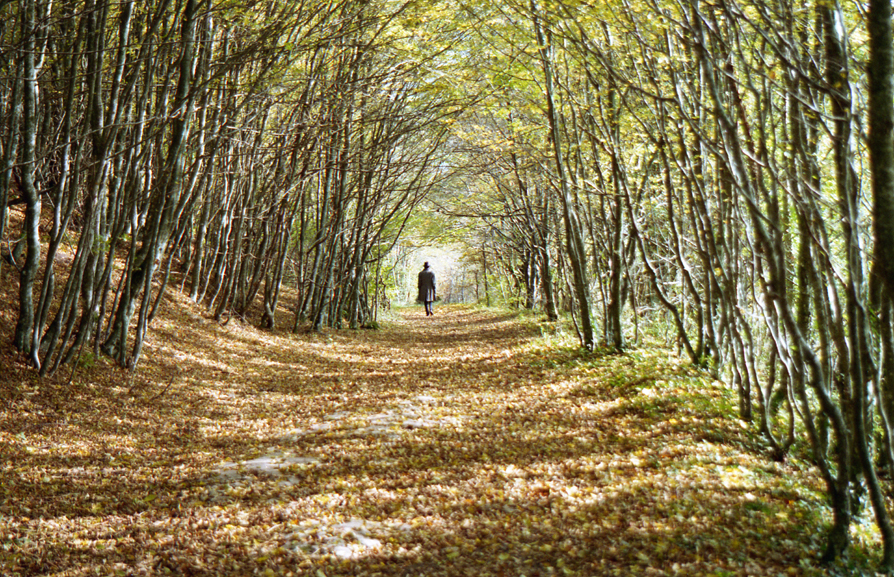
[Image: detail from a photo by Louk Vreeswijk]

mindfulness of irritation

New Delhi: Around midnight, the neighbour’s dog starts barking. It’s done this before. I know where it is; standing out there on the second floor balcony, facing the tall trees in the park, where birds, squirrels, and small creatures are trying to sleep. Other dogs must be thinking: really! what’s all the fuss about? The dog barks (sounds more like a shouted ‘woof’) in multiples of 7 woofs: woof, woof – woof, woof – woof, woof – woof! Then it stops for a breath and starts on the next round of woofs: woof, woof – woof, etc. The only voice in the silence of the night. It’s a guard dog; it barks for a living, just doing its job. The problem is, it’s left alone most of the time in a house owned by people who don’t live there. They go away and the dog shouts out: I am here, I am here….

An irritating situation, ‘mind’ racing around in a panic, bordering on anger and outrage and I’m very conscious there’s nothing I can do about Dog; mindfulness is all there is. I need to try to be mindful, then doubt comes along: I’m trying to be mindful, but still feeling the irritation, so maybe I’m not doing it correctly? Why isn’t the mindfulness easing the suffering? Fortunately I find a short video of Ajahn Viradhammo talking on this subject. Ajahn V is saying that mindfulness is the capacity to know what irritation is. That’s different from being irritated. Being irritated means, ah, now you’ve got this barking dog, okay, so that’s bad, very bad; it shouldn’t be like this, no, etc. That’s not being mindful, that’s being irritated.

So, gratitude to Ajahn V, I managed to see the difference between ‘irritation’ and ‘mindfulness of irritation’. With mindfulness, I can make a choice: get irritated about Dog? or watch my breathing. I can choose to mindfully listen to the voice of the dog and use aspects of the experience to calm my mind

Dog usually goes on barking for about 20 minutes and then has a rest. Well, I suppose all that energetic barking must be quite tiring… yeh, well after it’s had its rest, it comes back to the balcony and gets into its next round of multiples of 7 woofs for another 20 minutes or until it chooses to stop and the night can drag on like this…. So, eventually I realise I have to get to know this dog voice; make friends with it. The ‘woofs’ are dog-shouts – I am over here now – large, breath-sized, full-lung-capacity, plosive, gusts of dog breath forced at velocity through vibrating vocal cords – a kind of dog song.

The woof  sound has a deep, rich bass quality, an acoustic resonance that suggests to the listener a spacious hollow chest cavity; definitely indicates size, a large creature. I’ve seen it up there on the balcony, a black Alsatian, but when it sees me, it goes into accelerated barking mode. Unfortunately, it seems to take a long time for Dog to wind down from this excited state of dog-shouts to the ordinary pace so I don’t allow that to occur. I don’t have eye contact with it.

As the night goes on, it becomes heavy and laboured; barking requires energy,  and there’s a noticeable tiredness or monotony about it – the dog is not spirited and happy, rather, it’s like it’s bored; why am I doing this? What’s the point? Motivation for barking at its best is beginning to slip. That’s when I’m inclined to start thinking it’s going to stop any minute but I’ve been caught in that wishful thinking state before and discover Dog has sufficient energy to go on for very much longer: woof, woof – woof, woof – woof, woof – woof!

So, necessity determines the right action, and that is mindfulness. Ajahn says there is the irritation, I feel it, but I don’t become the irritation. I now have some space around this thing called irritation; I see there is a choice. I’m not that irritation; I’m bigger than it. Mindfulness is bigger than that, I’ve met it, I know it, and I can make a choice because I’m not caught up into it. I’m not caught so I’m able to let go at last and fall into profound sleep, where I’m happily unaware if Dog is barking or not. Wake up next day and I’ve forgotten all about it.

……………………………….

‘The choices I make with thought, with intention with action with speech, they have a consequence. So if I just (tolerate the situation) in a state of frustration then that means a certain amount of stress is going to carry on into the next five minutes. And if I’m not mindful of that sort of stress and not able to say, well this is the way it is now, I will feel rotten or negative or unhappy and I never really awaken to the moment then each next moment is just driven by habit and I’m like a leaf in the wind…. The craft of the heart. Pottery, carpentry, knitting. A craft requires skill. We, as human beings can do skillful things, do our craft, get better at it. It’s the same with our minds. Our minds are not just hard-wired to be a certain way, they are flexible’ Ajahn Viradhammo [Link to video]


Power Failure

New Delhi: Power failure across 21 States of the North, East and North-East regions of India on Tuesday for about 10 hours. Trains came to a standstill, commuters squeezing onto overloaded buses (see photo). Newspapers say 300 million people were affected, half the country of India; it means something like the whole of Central Europe without electricity.

I didn’t know the full scale of this power failure until the next day. As far as I was concerned, I was the only one; it was just ‘me’ that was suffering; padding around in the house, barefoot, like a wet frog in T shirt and shorts, dripping little puddles of sweat on the floor. The AC went out straight away, that was at 2.30 am and there’s a back-up system in the house but it lasted only a few hours then the fans stopped, one by one. The last fan stopped spinning mid-morning and that was it, no alternative. Hot like this for an indefinite period.

So I open up to it and take stock of the situation: 30°C, not too bad, skin feels like the sticky side of scotch tape, could be worse. Struggling with the need to be mindful. When something like this happens, there’s a tendency to feel that it’s ‘wrong’, so wrong you can get caught up in a kind of imagined, collective guilt – that’s how seriously ‘wrong’ it feels. There’s a Pema Chodron quote about this: ‘People get into a heavy-duty sin and guilt trip, feeling that if things are going wrong, that means that they did something bad and they are being punished. That’s not the idea at all.’  The heat is bad enough but ‘mind’ makes it worse with all this, it’s ‘my’ fault, stuff.

‘Fault’ is a loaded word: it leads to ‘blame’ and this tenacity of the mind-lock around ‘my fault’ is so fierce it takes continuing mindfulness to keep mad thoughts from spiralling way out of control, problems proliferate and body discomfort equals ‘mind’ discomfort. Thinking, it shouldn’t be like this; ruminating over why the power outage occurred in the first place, and who’s to ‘blame’ and why and what’s really going on?

It’s not getting me anywhere, so there’s only one thing to do, open all doors and windows to maximum, get on to the cushion and try to settle the body/mind. Shirt sticking to back, takes some wriggling around to get it to unstick, then it’s better. There is the immediate advantage in that sitting absolutely still, even though you’re hot, doesn’t involve energy and doesn’t create body heat. The body just takes up the position; it’s getting the mind to settle that’s the problem.

Sweat dribbles down the face and at first it seems like there’s no air; the outside temperature feels like it’s the same as the temperature inside the body? Then there’s an awareness of tiny movements of air across the forehead and everything inclines towards this source of relief. The effect of deep breathing comes with the first conscious long inhalation, and it’s like there’s a great space opened up inside: all the distress is gone. For a moment, there’s awareness that the heat has dispersed. So, if it can just disappear like that, then I need to look at the conditions that caused it to happen. I’m naturally inclined to investigate this.

Ajahn Buddhadasa talks about learning from the experience of suffering: ‘If I see things in terms of suffering, I come to know the truth. It’s a natural process. The whole purpose of life is to find out what’s going on, to gain knowledge attained through clear insight….The simple fact that we exist means we are working with mind/body every day; what we learn about ‘self’ comes from the direct experience of being alive. To do this, there needs to be sufficient mindfulness to carry out a detailed investigation every time suffering arises in nama-rupa.’

There’s a distinct sense of ‘body’, just sitting there, patiently waiting for instructions, quite still and at ease. It’s an awareness of the mass of the physical body; the totality and volume/weight of all the internal systems – it feels kind of heavy or something like inert, comfortable just to be in that one position. Body acts as a measure, against which the hectic thought flow can be stabilized; the nama-rupa relationship.

After some time sitting, I realise it’s not a problem anymore. As soon as it becomes possible to ‘know’ ignorance, well-being follows and the knowledge that such a thing is possible motivates me to identify the cause of suffering. ‘Craving is completely destroyed because ignorance cannot be in that same moment when knowledge arises.’ [Link to: Ajahn Buddhadasa text]

The power came back on after about 10 hours and the house seemed like a different place, bathed in all the comfort of cool airflow from ACs.

————————-

[image link]