expecting the unexpected

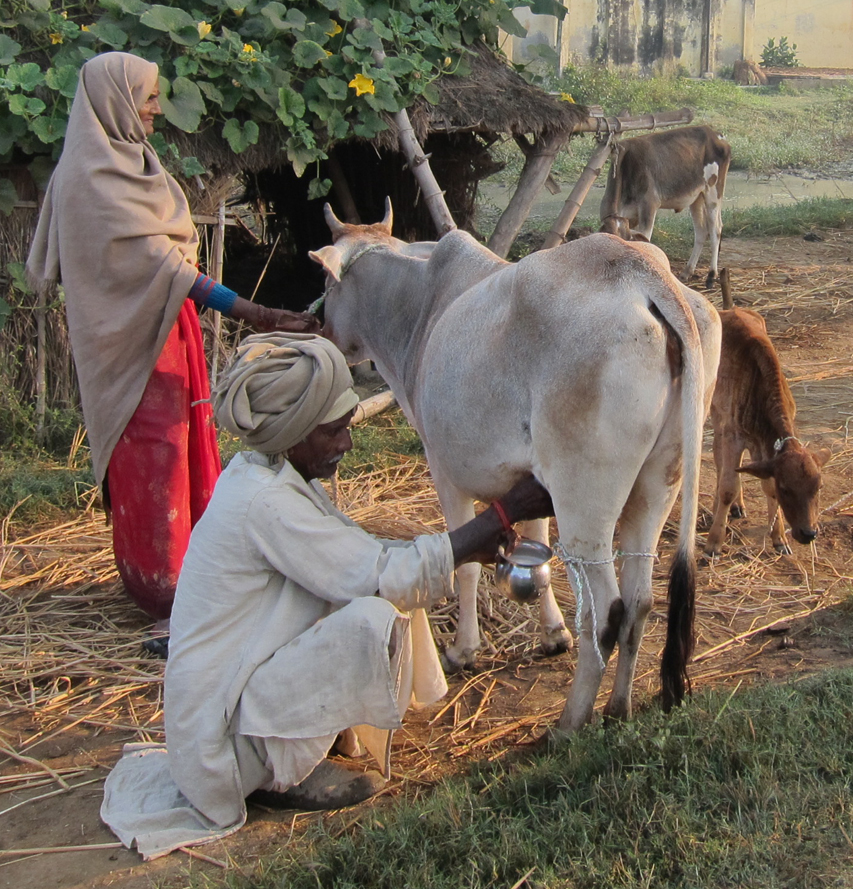
IMG_3972Gorakhpur station: 21.00 hours, just got off the bus and we’re waiting for everyone to assemble and walk together to the train. There are security guards here with short lathi sticks as if expecting a small riot. Darkness, shadowy figures flitting around and trying to see what’s going on, I’m confused by something that seems to be heaped on the road beside some parked cars. It’s a shapeless mass I cannot identify; looks like a pile of brownish-grey sacks filled with something – no, wait, it’s alive. I saw it move! What is it? And for a moment there’s uncertainty… something I cannot recognize, no matter how hard the brain fathoms it. Eventually I see it’s a cow sleeping on the road. I forgot, of course, that they have to lie down and sleep at night. I’ve seen plenty cows standing about, but somehow I assumed they’d be rounded up at night and put in cow sheds. Of course not; they just sleep on the streets; as if the whole environment were fields and meadows. Surprising really, a cow sleeping in a car park is the last thing I’d have expected, but you can expect events and occurrences to be unexpected here. It’s that thing again, difficult to understand, a consciousness of a sense object that’s unknown and the subsequent search for something that’s not in the data bank inevitably causes the mind to invent an explanation that will fill the empty space.

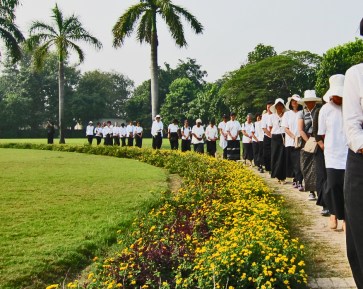
Tour guide blows his whistle, raises his little flag. We have to follow him. So we set off walking through the station in a long line, headed for the train. It attracts attention; we are the Buddhist pilgrims, dressed in white and black costumes and flanked by uniformed guards who raise their sticks and shout at the local people to get out of the way. Seems to me people here are used to the idea of privilege, hierarchy and the sons and daughters of the Buddhist feudal lords in some distant country are passing through, so get out of the way. It’s not a good feeling but that’s how it is here. On to the train and into our little carriage – just Jiab and me in this cosy place, quite nice. Preparing now for an overnight journey to Gonda then Sravasti.

IMG_3901After some time the train sets off, speed increases and the track is rough and bumpy, we have to get used to being thrown around. Along to the little bathroom to brush my teeth and holding on to every handhold available along the corridor; mindfulness of rock-and-roll. Inside, there’s a tiny sink in the corner with a shelf above it and I have to bend down, lower the head under the shelf and brush my teeth quite close to the sink. The movement of brushing teeth: updownup downupdown updownup is in sync with the rhythm of the train for a while then there’s a sudden lurch of the carriage, down and up. I hit my head upwards on the underside of the shelf and whack my elbow sideways on the wall, simultaneously.

Getting shoved around and bullied by the train causes irritation to flare up, it shouldn’t be like this, then it falls away – easier to see that letting-go thing when you’re in an unstable situation like this on a moving train and all the rough and tumble. There’s an underlying awareness that I’m rattling along at about 70 mph, everything is moving past me, sorry can’t stay, got to go, bye!… and I’m in a long tube, penetrating stable realty. Back along the corridor jiggidy-jig jiggidy-jig, nursing slightly painful elbow and into the carriage. Jiab is in the top bunk, and I’m down below. It’s all very different from normal environmental conditions, where there’s stability and a tendency to sink deeper and deeper in the slow mud of thinking-about-things.

I’m asleep straight away then four hours later something wakes me; back in the world of bump, rattle, bang – rattle, bang, bump. How to get back to sleep? I try watching the inbreath, the outbreath, lying flat on my back and the extremely bumpy track becomes the object of attention. It helps to see the bumps on the line not as bumps but as downward movements; small steps going steadily downwards, some steps are lower than others and it’s all going down bit by bit; sometimes there’s a little upwards return but mostly it’s small incremental steps getting lower and lower. Then it seems to land on a much lower step and down into a place where consciousness seems to remain steady, smooth and restful. It stays like that. A space stretches out from here that seems to encompass all the small steps that have occurred so far and all the steps yet to come. It’s in this space I’m able to settle. Sleep returns and the train goes on through the night in a straight line across the moonlit landscape, jiggidy-jig jiggidy-jig jiggidy-jig….

————————-

Photos from the Witit Rachatatanun Collection

Buddhist tourists

Angulimala stupa, Śrāvastī: The Buddha is gone from here, it’s like languages that become extinct; if the language is not used, refreshed and evolving continuously, it disappears in history. And there are no signs of Buddhism beyond the gates of these historical places, no characteristics of mindfulness, compassion, there’s not even an understanding of it. It can so easily fragment and we can’t hold on to these historical times, annica, impermanence; what’s left are the teachings and sati sampajañña (mindfulness and clear comprehension); a deep and thorough understanding of impermanence. This teaching helps me to understand impermanence in a way that suggests some other kind of temporality. It’s enough to know such a thing is possible and this helps me accept the fact that things are so completely changed now, in the places where the Buddha used to be.

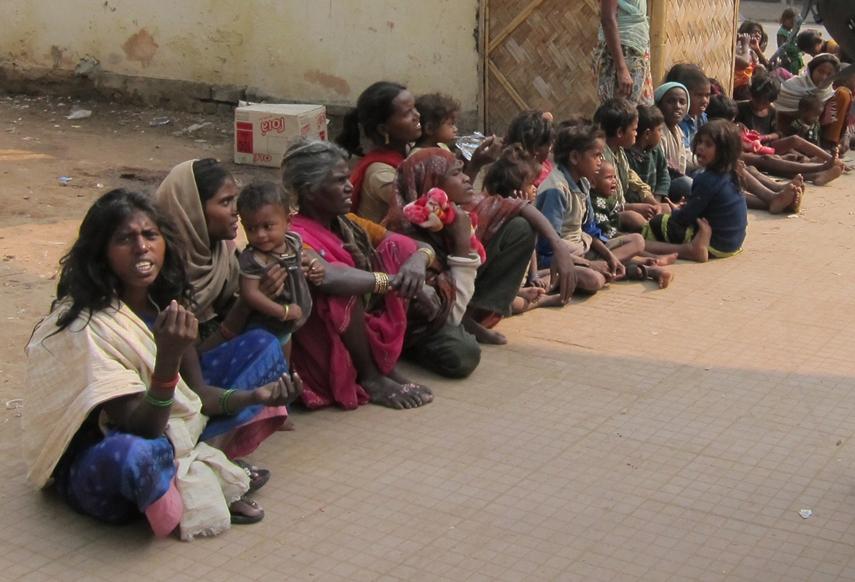
Begging children gather outside the gates and as we are leaving, the tour guide gives us packets of sweets to give to them – intended as a gesture we can make, reflecting on the generosity of Anathapindika (“feeder of the orphans or helpless”), all those centuries ago. But when we start to distribute these small packets, there’s such a fierce clawing and snatching that most of us have to drop the gifts and make a dash for the bus, chased by beggars. Last thing I see is a scuffle amongst them fighting for the ’gifts’. It was a feeling so completely different from the generosity of the historical figure who covered Jeta’s grove with gold coins in order to buy it from Prince Jeta. The Prince was so impressed with the generosity of Anathapindika, he gave the rest of it to him for free and joined with Anathapindika in offering the whole grove as a gift to the Buddha.

Is it possible that the presence of Buddhist tourists has created a generation of beggars at the gates? Anyway, this kind of thing seems to be unavoidable in India; there are beggars in other tourist places also. But the giving of money and gifts is a bit of a shambles and it would be better for everybody if this could be properly organized. What I did see that seemed more positive was a couple of people giving money to the beggars with an honest generosity, joyfully sharing; they were very good at doing it. I learned from this, it seemed to me to have a quality of dignity and mindful generosity and I tried to do it that way afterwards.

So, I wasn’t expecting the presence of beggars to have such an impact during this visit to the Buddhist holy places. Maybe it seems so dominant because what else is there here to see? Only ancient mounds and reconstructed low walls that show the location. I doubt if the bricks are original. There are very old Bodhi trees decorated with prayer flags but not of an age that could be anywhere near to the Buddha’s time. Otherwise there’s the earth and the sky; the air, nothing more than that. What is present is a special kind of sensitivity; visitors are all Buddhists or persons that way inclined, respectful and sincere and what we’re all considering is something that is unseen. If you can focus on being in these places where the Buddha used to be, and allow space for mindful contemplation, just being here becomes part of conscious experience; there’s a reality of that ancient time that comes through, such a fragile thing, barely noticed. It triggers something about these events that happened here all these centuries ago – just knowing it’s possible is enough.

The light and warmth; coolness in shadows in the afternoon, sense impressions, the laughter of a child in the trees and I’m thinking, yes, there would have been this also. I can allow it to be present for a moment and I’m in the 5th Century BC. It’s a simple feeling of just being here. I know how it must be for all other beings to experience this feeling; just like this. Subjectivity; we’re linked like this. The feeling stays for as long as I’m aware of it then it falls away.

————————-

Photos – Upper: Bodhi tree with prayer flags.  Middle: Beggars at the gate [Witit Rachatatanun Collection]

now as it was then

Bodh Gaya: 04.00 hours, this is where the enlightenment took place. I’m in a hotel not far from where it happened, early morning and the window is open, sitting on a cushion with mindfulness, watching the breath. There’s a sense of, it’s just over there, out the window and over to the right a bit; yes, it was there that the event took place. I’m near to the epicenter, ground zero. From here, it spread outwards to the people close by and dispersed among everyone who had a mind to listen. Then, in the course of time, reaching out to all parts of the world, so that visitors from Tibet, China, Japan, Korea, South East Asia and other places eventually came here to see for themselves. Ordinary lay people came, conversions from Hindu castes, bearded sannyasis with matted hair and white marks smeared across the forehead, and monastics came from all over Asia, robes in shades of ochre, maroon and grey; chanting … namo tassa bhagavato arahato samma sambuddhassa … various intonations and melodic rhythms altogether in a pleasant discord.

How much of this is the same now as it was then, 2,600 years ago? The sensation of the breath is the same. The air gently touching the inner surfaces of nasal passages and throat and the consciousness that arises with that feeling. Through my own humanness and in a subjective sense, I can recognize the humanness of the bodhisattva. As well as the same blue sky, brown earth; green foliage, and even though the outer objects I can see may not be the same, changed over the centuries, the process of seeing is the same. The consciousness that recognizes this is the same for me as it was/is for everyone, and the ‘me’ and ‘mine’ I experience is not in any way different from anyone else’s ‘me’ and ‘mine’ who lived at that time, or now, or will live any time in the future.

You could say it’s just a sense of history that’s present whenever you enter a historical site, or a building or museum. It’s possible to know how the people, who lived then, felt and understood the world; the things they looked at and what they heard, smelt, tasted, touched and their mind responses; all of that is the same for me now, here in this place where the bodhisattva walked 2,600 years ago. I’m connected with the outer world by consciousness, in the same way the people at that time were; the conscious experience of what is seen is the same for me as it was for the bodhisattva – simply that function. And the environment I’m in, the outer world, may be different from how it was at that time, but the body/mind organism that receives the experience is universal. All beings are caught in this conscious experience. There’s no need to add anything else. The sense of ‘now’ that’s the same today as it was then could be the sounds I hear, the feeling of sunlight and the gentle wind blowing in my face; an awareness of the ever-present sensory data telling me outer and inner are the same and I’m an inseparable part of it all.

————————-

Where there is the mind, where there are mental phenomena, mind-consciousness, things to be cognized by mind-consciousness, there a being exists or the description of a being. Where there is no mind, no mental phenomena, no mind-consciousness, there a being does not exist nor any description of a being. [SN 1.65]

Photo: prayer flags, Sravasti

Buddhists and Christians

Chiang Mai: A very nice short flight here from Bangkok yesterday, 1 hour 10 minutes. They serve a small meal; it was like going upstairs to have lunch in the clouds, then it’s time to come down again. During the flight I was able to have a discussion with somebody I met there about Christianity and Buddhism – is there ‘something’ there (God) or is there not anything? And ‘not anything’ implies something that cannot be verbalised.

It is a bit like tight-rope walking for me as a Western Buddhist and now 30 years in Asia but still subject to the conditioning of the Church and childhood memories of it in the West. With my Christian companion here, there is agreement on many things. The main thing we agree about is that human beings may experience a certain kind of realization that there is no ‘self’, no identity, nothing there; nothing in the mind/body organism, it’s a construct. There’s a feeling of ‘lack’, and the shock that comes with this discovery causes dismay, distress, etc. Christians say the realization of emptiness is the absence of God, and this knowledge facilitates the entry of God, the creator of everything. This is what fills the emptiness; a significant turning point for all Christians.

Buddhists encounter this feeling of ‘lack’ in the same way but will not ‘fill’ it with anything, rather, they contemplate the emptiness of it in depth; examine the associated emotional reactions with mindfulness and come to see that, this is how it is. Śūnyatā, the emptiness, the lack of ‘self’ is everywhere and in all things. The understanding that everything is without ‘self’ helps Buddhists to contemplate the constructed nature of the mind. It’s possible to see the whole picture; how everything works and where we go from here. It’s an open-ended, investigative approach that may lead to an understanding of the non-duality of the observed world and the observer of it, together as a oneness. What the Christians call God must be inside this, because it is all-inclusive. There cannot be anything outside of it.

Christians will depend on the attachment to a belief in God for guidance and that’s how they see the world; they might say that ‘emptiness’ for the Buddhist is the Buddhist sense of God? And Buddhists could consider it this way, but the Buddha didn’t see any point in going further with that because the important thing is to make sure you are seeing reality correctly; anything else is getting caught in wishful thinking. Necessary because working only with belief and faith and no pragmatic teachings means there are all kinds of things that can go wrong with it. Christians are focused on the experiential aspect; Buddhists say conceptualizing a God leads to attachment, tanha; the desire for, and attachment to, ideas and ideals, views, opinions, theories, conceptions and beliefs. [Dhamma-taṇhā, Walpole Rahula].

If I say the word ‘God’ to myself, something comes into my mind, the word ‘God’ has an immediate emotive effect. Certain assumptions arise and the mind is already closed around it; it’s a ‘special’ thing. When Christians talk about God, what they’re referring to (I think) is the God they are creating in their own minds – their loving devotion to a personal god: a deity who can be related to as a person, but God is beyond everything that is conceived or thought about. There is no adequate analogy, words cannot describe it. It cannot even be imagined because it is beyond space and time. Buddhists stay separate from the God concept because to become involved with it means making assumptions about a kind of consciousness that is totally different from ordinary mind states. This is not to say there is no God, for me, at this time, it is impossible to express in words what God could be.

Then there’s a stewardess announcement, the plane is starting its descent, please put your fold-away table up, arm rest down, and chair forward. I get lost in the directions for a moment; a small clutter of prepositions, then were on firm ground again.

————————-

‘Both Jesus and the Buddha were pointing to something that could not be found in the context of ordinary ‘mind’, the Buddha’s goal was to strive to realise the unconditioned, the unoriginated, the deathless, that which is free from mortality. So did the Buddha find God? Was it this that he called Nibbana? God is not Nibanna, because when we speak about ‘God’ we start getting ideas in our head about what God is and that is very far from the unborn, the unconditioned, the uncreated, the unoriginated, the deathless. All these words tell you nothing. What comes into your mind? Nothing. Anything you might say or try to put into words to describe God is an image in the mind. There are no words for it.’ [Ajahn Jagaro]

‘God is God only in relation to man. God appears in the material world like the reflection of the moon in a pool of water, as part of the illusion that is the context of man searching for God with his mind. What man sees becomes “God” (gender neutral; “He” only for explanatory purposes). He is Omniscient, Omnipresent, Creator of the world. He is both immanent and transcedent, full of love and justice. He may be even regarded to have a personality. He is the subject of worship.’ [Wikipedia Brahman page]

Image: Peter Henderson

30 minutes

Bangkok, Suvarnabhumi: Awake very early and in the car before daylight, through the empty streets and strange yellow sodium street lights on the elevated tollway over the rooftops of the town and out to the airport to meet the Air France flight, ETA: 06.15 hrs. As it turned out, the flight was delayed by one hour, so there was time to sit in the seats at the tour group end of Arrivals, near Gate 10 and open the laptop to write this.

Gate 10 is where the tour groups gather, bleary-eyed and sleepless, having just got off the plane from some distant part of the world. The people around me are speaking Russian and I see from the Arrivals board it must be the flight from Novobirisk (Wikipedia says it’s a large industrial city in Asian Russia). They assemble at Gate 10 and have their names ticked off a list by the Thai representatives of the tour. There’s 30 minutes allowed to have a cup of coffee; children run around, go to the toilets and everyone is ready to get on the coach. When they’re all accounted for, the tour leader gathers them together and they all leave. The mass exodus of the group is dynamic, all following the leader in front who’s holding a coloured flag high in the air so they can see it. Off they go, through the wide passageways and shuffling along with their luggage and running children and moving as one great lake of beings in the direction of the coaches somewhere in another part of the airport. In a short time all the seats at Gate 10 are suddenly empty. Bye-bye the group from Novobirisk.

But before that happens, the Russian tourists spend the time intensely absorbing everything around them; talking with the tour guides and taking pictures of everything; roof structure, walls, illuminated adverts, airport signage, and each other posing in front of vases of purple orchids, dressed up in their best summer frocks and smiling for the camera. It’s as if they’d stepped out of the 1950s, remote from anything I know of and yet there’s a familiarity; it’s possible they could be people I knew in my childhood in the North of Scotland. There are so many photos being taken, it’s like a small press event; digital camera lights flashing like strobe lights in a disco. I’m dazzled by it, blinded for a moment and have to look at the floor to allow normal vision to recover. Look up again and they’re leaving, the whole place captured in pixels and taken away back to Novobirsk, at the end of the holiday, where all the views of it are reassembled to form one composite image of the waiting area at Gate 10. ‘… and here is Aleksandra and Nikolai at Bangkok airport don’t zay looks zo bright and lively?

The seating area is empty for a while, strangely quiet, light slowly coming up and then it’s completely daylight, people again start to assemble in the seating area. It’s another group from Beijing, same thing as last time but the conversations I hear this time are in Chinese.

————————-

‘… it seemed to him that these people were his brothers. Their vanities, appetites and absurd traits had lost their absurdity for him. These traits had become comprehensible, lovable; he even experienced them as worthy of respect. The blind love of a mother for her child, the ignorant pride of a father over his son, the raw hunger of vain young women for jewellry and the admiring looks of men – all these impulses, all these childish qualities, all these simple and foolish but incredibly powerful, incredibly vivid, forcefully dominant impulses and cravings were no longer childishness for Siddhartha. He saw that people live for them, achieve an endless amount for them, travel, wage war, suffer and persevere unendingly for them. And he could love them for that. He saw life, that which is living, the indestructible essence, Brahman, in all of their passions in each of their deeds.’ [Herman Hesse, ‘Siddhartha’ p128]

Photo Image: Peter Henderson

the doorway

London-Bangkok flight: What a strange way to spend the afternoon… brilliant clear light enters the window as if we were in a room high up in an apartment building. Purple carpet with yellow stars, walls are grey, the fittings are of brushed steel, but I’m somewhere in the air, and thousands of miles away from where I was 8 hours ago. The little old house in East Anglia is empty now, I packed up and left it behind.

Last thing was to bless the room; a blessing and a ‘thank you’ for providing shelter, and doing this also helps me to be alert, mindful and ready for the next thing. Hands held in anjali, and walking through all the rooms in that small dwelling saying in my mind: ‘May all beings live in safety, be happy, be healthy, live with ease. May all persons who come here after me find the same feeling of security and stability I found in this place.’ Then step outside, close the door, double lock it and into the taxi. It helps give a sense of closure, or something, at the end of an event. I recommend it. Recently I came across something very similar about blessings that I liked [Link]

After that, walking through the airport halls and passageways and all these people just moving along with their bags; as you pass them there’s a hint of something familiar – it’s that transitory ‘thing’. Airports and stations are an extraordinary example of it, in fact it’s always there – there at the corner of one’s vision. We’re all having the same kind of experience; we’re all going ‘away’; we’re all in transit; this is the time after we left and before we arrive. This is aniccan the ‘in-between’; the moment of transforming.

Change is there all the time – might seem like a contradiction. There’s a Nagarjuna quote: ‘All things are impermanent, which means there is neither permanence nor impermanence…’  could be a koan; the constant sweeping along of aniccan and waves of change. But immediately it says to me, first I need to lighten up and there’s always something new, gently nudging at the elbow and that’s what makes it possible to ease away from attachment.

If I’m free from ‘holding’, I can easily pass through the layers and corridors of the travel experience, part of the great river of human beings, all of us on the way to ‘somewhere’, surrounded by advertising images of well-off, good-looking people smiling all the time; Julia Roberts doing a Gucci advert? Celebrities I know but can’t remember their names, just posing as ‘themselves’ wearing a watch the cost of a small car. I look closely, trying to remember who it is, and fall into the dream.

They look secure, confident, happy and everything is going allright for them. They don’t seem to suffer from that great chasm of nothingness situated in the centre of everything; the ‘me’ I live with. What is it they have that I don’t? If I could have whatever it is they have, I could be happy, like them…? I’m drawn towards ‘the purchase’ by scenarios and strategies created by commercial psychologist witchdoctors who can manipulate my conscious experience.

Mindfulness means I stay free of the hunger and the urge. Here on this plane I can see  a small piece of  sky out there. It’s sufficient to remind me that if I get pulled into consumerist samsara too much, there’s a doorway in the mind which leads to freedom from sufferingthe remainderless fading & cessation, renunciation, relinquishment, release, & letting go of that very craving. Just knowing this is enough.

‘Within that cycle [the wheel of birth and death (samsara)], there is one doorway through which we can step out, namely, between feeling[Vedana] and craving[Upadana]. All the other steps of dependent arising are automatic causes and effects. Unless we learn to live with unpleasant and pleasant feelings without wanting to get rid of the one or keeping and renewing the other, we don’t have access to that doorway.’ [Aaya Khema, When the Iron Eagle Flies, Transcendental Dependent Arising p55]

something else

London: I’m in a narrow rush-hour train, standing in an integrated mass of human bodies all supporting each other. I’ve got something to hold on to above my head which is fortunate because the train is shaking about on uneven tracks, noisy and exhilarating. This really is the whole experience of train travel…. Then it settles down to a smoother pace and I’m focused on the closeness with other people; fragrance of wet raincoats and a forest of arms reaching up to hold on to roof bars, blocking the view. Somewhere nearby, a voice suddenly shouts out: ‘I’M ON THE TRAIN’ – a man speaking on his phone…

‘I think, therefore I am’ [cogito ergo sum] The Buddha noted the inherent problems in this kind of thinking: “I am the thinker’ lies at the root of all the categories and labels of conceptual proliferation, the type of thinking that can turn and attack the person employing it… “Do I exist?” – It depends on what you mean by “exist.” “Do I have a self?” – It depends on what you mean by “self.” Thinking driven by definitions like these often falls prey to the hidden motives or agendas behind the definitions, which means that it’s unreliable.’[Thanissaro Bhikkhu]

The man on the phone continues with his loud conversation, surrounded by people with grim faces who don’t speak. He disregards us completely, asserting himself in this space that everybody is squeezed together in, caught in the dis-ease of ‘deadly tedium’. We are struggling over this intrusion of the man and his phone but holding our composure with patient endurance. Folded newspaper in front of the face to avoid eye contact, we are managing to ignore each other completely. Turn the page of the newspaper, fold it back skillfully without untoward touching and have a casual glance all around, as I’m doing it, just in case there’s anything that needs to be noticed, looked at or ‘seen’. No, everything is as it should be; newspaper held like demure fan that masks the face, and doing the crossword: 7 across: Four letters, ‘It may follow something  _ _ S_. Meanwhile the man talking on his phone is saying the line is breaking up because we are going through a tunnel.

I am committed to a world of consumption of goods and services. I want to have more of what I like and less of what I don’t like. I’m not interested in things that are neutral, they are meaningless (it’s a pity really, because the neutrality of feeling is the Way To Go). I am therefore in a chronic state of dissatisfaction because I never get what I really want. Okay, but as long as we’re mindful, it can be manageable? Well, it’s allright for some, you might say, for those of us who have recently returned from somewhere colourful and bright, light and cheerful, sun shines all the time; smiling Thai faces and their polite behaviour. But isn’t it just that they have a more cheerful kind of dukkha over there?

There’s a passenger announcement: ‘…delays at Croydon and Blackfriars due to congestion’. Then entering Liverpool Street: ‘… this train will not stop at Liverpool Street because of “flooding” at the Eastbound station (flooding?) and will continue on to Aldgate where passengers can take the train back and enter from the Westbound station which is unaffected and we apologize for any inconvenience.’ I have to ask other passengers what the announcement was about and surprised to discover everyone is friendly; the shared burden of these times of hardship and emergency – something conditioned by World War II?

I get there finally, near the end of a long list of Anglo-Saxon place names, and walking along with the South coast tourists in the pleasant harbour area of a town near the sea at Eastbourne. I’m looking for the office of an agent I have to visit and the phone in my pocket is ringing, who can this be… Hello? Jiab, she’s in Peru; hard to believe. She wants to know, can I get some of these wipes that are good for doing polished wood, and get a few packs, please? I have to take them with me when I come to Thailand. I hold up the phone high in the air so she can hear the Eastbourne seagulls all the way over there in Peru; a great swirl and echo of Northern seabirds singing in the wind, like cats mewing in the air.

————————-

 ‘It’s because of not understanding and not penetrating this Dhamma that this generation is like a tangled skein, a knotted ball of string, like matted rushes and reeds, and does not go beyond transmigration, beyond the planes of deprivation, woe, and bad destination.’ [DN 15 PTS: D ii 55 Maha-nidana Sutta: The Great Causes Discourse]

More Than Enough

Mitt Romney’s 47% remark drew a lot of attention, perhaps revealing an uncharitable, grudging attitude but it does inevitably bring us around to seeing a quality we all possess: generosity of spirit. Generosity, as a mental, emotional letting go, means releasing the tenacity of holding on to things. Baggage, all that heavy stuff we burden ourselves with, is removed in one single act of generosity. What’s wrong with being generous; cultivating an inward disposition to give? A glad willingness to share what we have with others – why not? We have more than enough. Give it away. Ease the discomfort of being driven to fulfill that urge to ‘have’, a hunger created by always wanting more. All of it is gone when you’re generous.

Brainstorm the word ‘generosity’ and you come up with loving-kindness, compassion, empathy, well being, freedom. You find gratitude, grace, honour, motivation, encouragement. Generosity is everything. It’s nature is to share, recycle, circulate; it can only be given, never taken. With generosity we can accept, we can share, we can forgive. Generosity leads to wisdom – the truth is without bias. There is an understanding of things as they really are.

In Buddhism, generosity is seen as a way to counteract greed. It’s a way of helping others and a means of lessening the economic disparities in society. Generosity is part of Right View. The dhamma of generosity is a gift for all of society as we struggle for meaning in a world of dollars, logos, oil and military spectacle. The dhamma of giving is a disinfectant, a gunk dissolver, an antidiote for the monetary values, brand names that clutch at our hearts.

‘The complex American culture of healthy (that is, democratic) and unhealthy (worship of profit) elements…. Even middle-class Americans, rich by the standards of most of the worlds people, spend much of their money on indulgences, entertainment and addictions.’ [Practising Generosity in a Consumer World]

The cultivation of generosity directly debilitates greed and hate, while facilitating that pliancy of mind that allows for the eradication of delusion. In Buddhist countries, babies are taught when they are about six months old to put food into the monk’s alms-bowl. The whole family applauds as the sticky rice drops from that little hand into the monk’s bowl. The kid gets the idea early on: when stuff leaves your hand, you feel happy. It feels good to give. Everything the Buddhist monk receives is a gift, an offering. Ajahn Amaro describes it in this way: ‘Our bodies are fueled by the food that is offered to us. In fact, scientists say that all the cells of the body are replaced every seven years, so any of us who has been ordained for that long now has a body that is completely donated. If it were not for the accumulated kindnesses, efforts, and good will of countless hundreds and thousands of people, this body would not be able to sustain itself. Kindness is the actual physical fabric of what we think of as ‘me.” [Generosity in the Land of the Individualist]

There’s the story about a seeker and a wise man talking together and the wise person has a most incredible jewel. The seeker is absolutely dazzled by the jewel and asks the wise man if he would give him the jewel. And the wise man gives it to him. The seeker is very excited and afraid that the old wise man is going to change his mind, so he hastily says goodbye and goes off. A short while after that he reappears, approaches the wise man with great humility and respect, lays the jewel down in front of him on the ground and says he’d like to make a trade. He’d like to exchange this jewel. And the wise man asks him what he wants to exchange it for. The seeker says he would like to exchange the jewel for knowledge of how to gain the sort of mind that could give up a jewel like that without a second thought. [This story appears in Khanti – Patient Endurance]

————————-

The gift of Dhamma excels all gifts. The flavour of Dhamma surpasses all flavours. The delight of Dhamma transcends all delights. Freedom from craving is the end of all suffering. Dhammapada 354

This post was created from the following references: Bhikkhu Bodhi: ‘Dana: The practice of Giving’. Ajahn Amaro: ‘Generosity in the Land of the Individualist’. Ajahn Jayasaro: ‘2. Khanti – Patient Endurance’ from ‘The Real Practice’ (Three Talks to the Monastic Community of Wat Pah Nanachat). Bhante Shravasti Dhammika – Link to source for: ‘Dāna, the development of its concept and practice’, Toshiichi Endo. Santikaro: ‘Practicing Generosity in a Consumer World’ from ‘Hooked’ (Buddhist Writings on Greed, Desire, and the Urge to Consume) page 198

Photos: Kathina at Wat Pahnanachat 2010 by PB

Aloneness

Switzerland: No news from Jiab in Cambodia. People call me up looking for her and I tell them: Sorry, Jiab is not here right now, she’s coming back in a few days. I’m like a recorded message. This is how it is with us; Jiab is the star of the show, I’m the supporting act. Tried calling her one night last week – 6.45am in Phnom Penh, Hotel Intercontinental, room 710: ‘Just one moment please…’ and the receptionist connects me to her room; I can hear the phone ringing. Then a very sleepy voice says, quite loudly, ‘Thank you!’ and puts the phone down! Disconnected and I’m 6000 miles away again. Try again; key in this very long number and wait. Explain to the receptionist, she connects me, and same thing happens: ’Thank you!’ and puts the phone down. This time the receptionist put me on hold and, I imagine, explains that this isn’t a wake-up call, it’s an overseas call. Eventually I get through and Jiab is so totally and profoundly asleep, the conversation had to be abandoned. I guess I called too early.

Truth is, I’m in a state of aloneness here. The Worldly Winds are blowing hard and strong. In the post office sits a lady behind the glass window with her painted smile of resignation because obviously the answer is ‘no’ even though the question hasn’t been asked yet. And even when I manage to engage her in a dialogue, there’s that clear signal that if we’re going to talk, let it be known she is somebody who doesn’t listen to people – asks me a question and eyes glaze over as I give her the answer; not listening because she’s busy with the next question. Maybe she was just having a bad day.

After I get back to the apartment it feels like I’ve been wounded in battle; discomfort likely to break out into fully fledged distress any minute. I manage to do a sidestep before it locks into place. I wrote a post about this: Skillful Avoidance; if you can sidestep the clinging tendency, the ’velcro’ of self cannot attach and in its place there’s a feeling of relief, wow! how good is that! This feeling moves it all forward in a wholesome direction. These small successes are necessary here in a non-Buddhist country where people are careless about what they say at the best of times.

I’ve lived in Thailand for more than 20 years and I’m used to being in a Buddhist society where, on a very ordinary level, people are generally courteous; they smile, they’re pleasant and try to be helpful. You can see monks everywhere and there’s the atmosphere of mindfulness. When I’m in Europe, I have to take extra care in relating to others and it does get to be difficult. But that’s the way it is, and I have the opportunity to watch my reactions here whereas in Thailand I don’t have to do that. But anyway, when Jiab is with me I can get things more in perspective – and she’s not here….

I’m part of it but not ‘in’ it and can see what’s going on; insulated against the fierceness of it. I get into the apartment at the end of the day, door is closed and it’s all gone. My files, books and notes about the Buddha’s teaching are here. All my friends in the world seen through the window of computer screen are practicing Buddhists and I have a small correspondence with Buddhist monks. If the doorbell rings, I take a deep breath because it’s not impossible the flames of unrest will come leaping into my quiet space and what I’ve noticed is that it’s an all-inclusive situation; my reactions, my aversion to it, all become part of the ‘me’ thing.

The fact that I dislike it exacerbates the problem – then I heard Ajahn A. saying something wise about it’s the energy we use in being averse that creates the obstacle, not the ‘obstacle’ itself. The energy accumulates and the tendency is for it to come into ‘being’. All the usual suspects are there; the same old familiar stories unfolding. I can see the accumulated energy; simply that and nothing more. I don’t need to love it, don’t need to hate it, don’t need to hold on to it: ‘Sabbe dhamma nalam abhinivesaya’. Nothing whatsoever should be clung to. There’s a separation from all ‘likes’ and dislikes’; a pleasant feeling of aloneness and wishing people well.

————————-

The Eight Worldly Winds, Ratanagiri Newsletter [Link to: Hilltop]

Photo: Louk Vreeswijk

Paper Day

Switzerland: Woke up this morning and it was a paper day, according to Jiab – meaning the day the garbage truck comes to collect cardboard and paper for recycling: ‘jeter les papiers’. The garbage guys are fast so I have to go down to the basement immediately, get all the newspapers, then up one floor to ground level and put everything out by the entrance. Waiting for the elevator to arrive, check the phone is in my pocket because the basement is 8 floors down, below ground level and there’s only one key. The key fits in a keyhole inside the elevator that takes you down to this strangely claustrophobic space. I wouldn’t want to get stuck in the basement. Unless I meet any other tenant, it’s a solitary experience. I come down here and it feels like entering the death state.

“… death is as near to him as drying up is to rivulets in the summer heat, as falling is to the fruits of the trees when the sap reaches their attachments in the morning, as breaking is to clay pots tapped by a mallet, as vanishing is to dewdrops touched by the sun’s rays …” [Visuddhimagga, Mindfullness of Death]

Elevator drops all the way down and stops, solidly at the bottom. Door opens, I’m inside a large mysterious network of small rooms, white walls, grey doors. It’s a reinforced concrete nuclear fall-out shelter built for the occupants of the apartment building. This is the law in Switzerland. A lingering sense of paranoia all around here; strangely thick doors on huge hinges held open with large iron stays. Lighting system is permanently on, they just replace the bulbs. Years from now, it’ll be exactly like this; and maybe even generations into the future, a vast supply of continually replenished light bulb stock keeps this space illuminated.

I find our concrete room, number painted on the door, another key on the ring opens the lock and I step into this familiar place. Discarded old things, vestiges of a former life. Papers in stacks, carboard cartons flattened into sections and bundled up. What a curious space. I suppose this is where we’d sleep, in the event of a nuclear catastrophe up above. ‘All that is mine beloved and pleasing will become otherwise, will become separated from me.’ The simple fact of being alive seems to take on a whole different meaning when you’re aware of the nearness of death. There’s some old furniture here, a broken chair. I can squeeze around, back against the wall, and there’s just enough space to ease the body down on the old chair and sit. What does this feel like?

Rupa kandha, a distinct sense of ‘body’ just sitting there, patiently waiting for instructions, quite still and at ease, inert. I am ‘contained’; internal organs in a sack of skin. Meditation in a subterranean room; reinforced walls to create the space I’m in. The grave. This is how it’ll be when I’m dead? Focus on the breath, after a moment, it’s calm. Strange acoustics. The silence is exceptional. There’s the solidity of the body, the totality and weight of all the internal systems, the earth, fluids, heat and breathing; just being comfortable in the taking up of the space it’s occupying.

Mind flow drops down a notch, thought patterns and changing images, flitting around, have no identity; darting all over the place like little flashes of energy. Body acts as a conductor, through which the sparkling electric current flow of small thoughts can be earthed. It’s like a fireworks display. Strange how, in contemplating death, it ends up that you’re contemplating life.

Phone rings. An extremely loud ringtone. It’s Jiab: what are you doing down there? Breakfast is ready! Okay, coming now. Pick up the paper bundles, lock up the room. Into the elevator and up one floor. Out of the door into the daylight, drop the papers and there’s the fresh mountain air. Into the elevator and up again to the 7th floor. Large, spacious interior, picture windows, landscape below, white clouds above; clear open sky. It feels like nothing really matters. It’s a paper day.

‘As contemplation deepens, the contents of the mind become increasingly rarefied. Irrelevant flights of thought, imagination, and emotion subside, mindfulness becomes clearer, the mind remains intently aware, watching its own process of becoming. At times there might appear to be a persisting observer behind the process, but with continued practice even this apparent observer disappears. The mind itself — the seemingly solid, stable mind — dissolves into a stream of cittas flashing in and out of being moment by moment, coming from nowhere and going nowhere, yet continuing in sequence without pause.’ [The Noble Eightfold Path, Bhikkhu Bodhi, page 82 – 83, Contemplation of the State of Mind (cittanupassana)]