a patch of sunlight

IMG_0540POSTCARD#50: Delhi: It’s cold here, fingertips touch the keys tentatively, unwilling to make contact. Feeling chilled all the time and can’t seem to get comfortable with this February weather. I just arrived from Thailand, my bag, still unpacked, contains the blue sky and sunshine of white shorts, sunglasses, T-shirts and rubber slippers. Wow it was hot there; I’m reluctant to let go of that nice feeling.

It’s like the world extends only as far as the immediate surroundings of where I’m currently situated and it takes a little time to reassemble things if I move 2000 miles to somewhere else. There’s the tendency to hold on to nice things and I’m particularly reluctant to let go of it this time because the visit to Delhi is only for a couple of weeks, then I go back to Thailand again. So I’m in transit, not really ‘here’, and that’s why I’m making the excuse that it’s not necessary to unpack my bag.

My bag is an extension of ‘me’, it’s my identity, part of the self-construct I’ve created, the same as everyone else’s sense of ‘self’. I feel a fondness for my bag, a familiarity and a connection with that small volume of folded clothing, flattened garments, papers, books and various computer cables, that’ll be zipped up tight, X-rayed and pushed back into its space in the aircraft baggage section along with all the other bags, and away we go back to the sunshine. But that hasn’t happened yet, and I’m stuck here in the cold for a number of days.

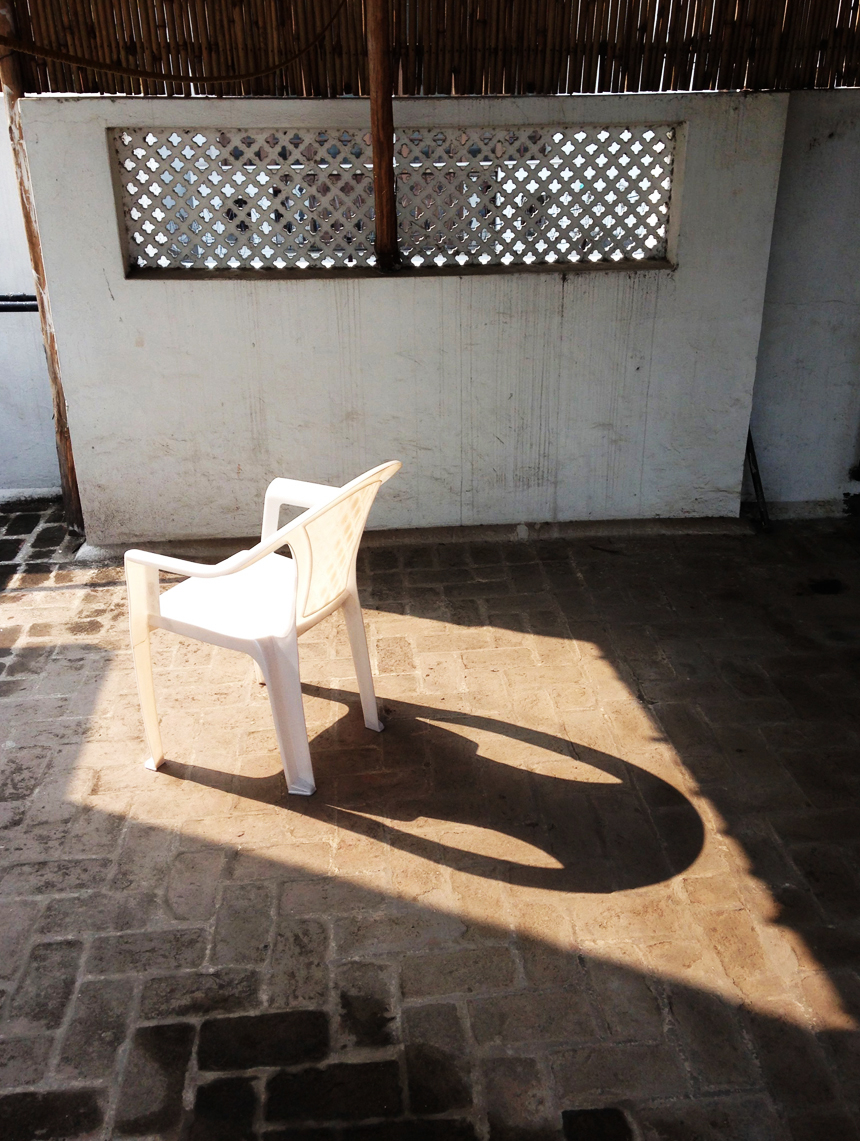
When it’s warm enough I go up on to the roof terrace, to the place where the sun shines through between the buildings and there’s a patch of sunlight where I can sit  on my chair. The chair is in the same place it was two months ago and for a moment there’s a kind of presence about that empty chair… déjà vu; the ‘self’ that was there at that time is gone completely, no familiarity with it – yet I remember being here quite clearly. Now I’m sitting in the warm sunshine, recreating a ‘self’ that suits this time and place, for this duration, knowing that soon it’ll be gone too. Phenomena are as they are for a short time and disappear; it’s as if the appearance of everything has the quality of a pencil sketch, a pleasant unfinishedness.

I look at things, and they’re gone – it’s the time needed to process the thought. Objects are experienced not in present time but just as they’re slipping into the past; everything is always seen in hindsight. Conclusions arrived at after the event. Nothing remains. The day I die will be an ordinary day. The moment after I’m gone will be no different from any other. It’ll be like a pause in the middle of a sentence… the focus on the object slips away, the next moment will just be the next moment and things will go on as if nothing happened. The fragility of the world held for an instant then it’s gone, only the space where everything used to be and the silence left behind…

‘Usually when we hear the teaching on not-self, we think that it’s an answer to questions like these: “Do I have a self? What am I? Do I exist? Do I not exist?” However, the Buddha listed all of these as unskillful questions. Once, when he was asked point-blank, “Is there a self? Is there no self?” he refused to answer. He said that these questions would get in the way of finding true happiness. So obviously the teaching on not-self was not meant to answer these questions. To understand it, we have to find out which questions it was meant to answer.’ [Thanissaro Bhikkhu:Selves & Not-self: The Buddhist Teaching on Anatta’]

————————-

connectedness

DurakitPOSTCARD#46: Bangkok: Sitting in a taxi that’s stuck in traffic and I see these buildings through the window, take the photo thinking, wow! I can write a post about that. The floating staircases look like they were put in as an afterthought. Somebody came up with the idea and sketched it out on the back of a beer mat. Creativity. Things are linked in the mind – the symbol of a bridge, everything is connected. It all fits. Taxi still stuck and I’m searching around in the memory for something, through the staircases and corridors of no-words-to-describe-it, looking for a starting point. How to begin? A small insight comes along; it’s the karma of circumstances.

That’s why, who, where, what, which, when and how I came to be here in Bangkok, strange as it may seem, having started off in such a far-away place over the mountains, over the sea… the Northern part of the world, near to the Arctic region. Up there, the polarities of shady darkness and never-ending light inspire one thing above all: the desire to get on a plane to a sunny place in the Southern Seas and never come back. So that’s what I did.

When I came back I discovered thirty years had passed, the Rip Van Winkle effect – look in the mirror, hair gone white. Most of the people I knew are dead. It had been so long I’d forgotten the ‘me’ that used to be there. I gave some thought to the ‘me’ left behind in the sunny place in the Southern Seas, went back over to check on that but it wasn’t there either. All these hours and days over the years, looking out the windows of an airplane and the world coming in through these eyes but seeing it like it’s not ‘me’ personally that it’s happening to, more like it’s an extension of what’s out there.

There’s a connectedness. No ‘me’. The temporary self-construct that used to be ‘in here’, a tentative sort of half-existence, has gone. Gone is gone. No ‘self’, anatta, nobody at home. Elvis has left the building. I am a metaphor of ‘me’ looking out of the window of a moving vehicle going away to, or coming back from a place called ‘home’ in Bangkok at the present time but next week I’ll be in Delhi again and looking at ‘home’ from that location. I know that three weeks from now I’ll be in Chiang Mai in that place there called ‘home’, hang out for a while, contemplate the space I’m in, then after that, no plans…

Is there anything I can call a real home? (hold that thought)… there’s a memory of something being ‘home’ when I was a kid. I remember long nights and short days, aunties and grannies wearing comfortable wooly cardigans, porridge in a cracked bowl, coal and wood fires, a black-and-white sheepdog – and incidentally, the rural/urban thing about Asian cities, cows sitting on the pavement, goats nibbling and chickens pecking around, the sound of a cockerel in the distance; all this reminds me of the farmyard scene where I was brought up. There’s a familiarity about it

Fond memories, pictures in the gallery of the mind, and yes I’d like there to be a real home, but for a very long time now there’s been only a series of temporary homes – all good, I share my life with Jiab and we’ve gotten used to the way things are. In each place I have my favourite chair, books, and all the things I need. It works okay except sometimes I might spend a long time searching the bookshelves for a book I’m sure is there then realise it’s not in these bookshelves, it’s the other bookshelves, about 2000 miles away. So I have to let that one go, although I can see it there in the mind’s eye…

I feel dispersed, an okay sort of feeling. It suits me well to follow the Buddha’s Teachings: homelessness, non-attachment, no-self. Whether there is a ‘self’, yes/no, is best not thought about too much because saying ‘yes’ or ‘no’ to it is, in itself, identifying ‘self’’. Words identify things, language has a default mechanism that allows me to select what ‘I’ want it to be (also what I don’t want it to be) and the resulting attachment to all that I love and hate. I see it happening, stay mindful about where the exit is located, and open the heart/mind citta to the world as wide as possible.

————————

‘I place the word “Jesus” into my heart, and in a magical instant all those wordless, intangible sensations I have come to recognize as His Presence fill the room, as if that word was a seed dropped into the planter of my heart, which took root, and produced an entire orchard.’ [Excerpt from the post: Trending Towards Holiness]

–   G   R   A   T   I   T   U   D   E   –

passive voice

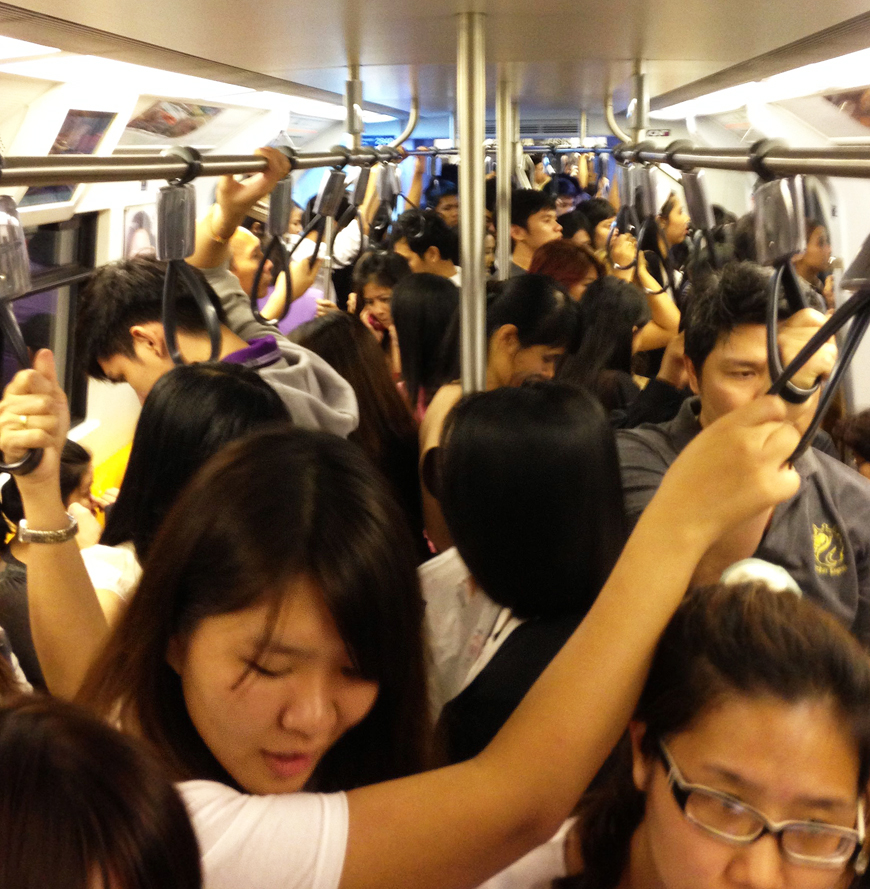
IMG_0083aBangkok: No taxis available at the airport, and all trains into town are seriously crowded. I am one of a very large number of individuals caught in the rush on a Friday evening. Somebody said later it’s because all the international schools start again on Monday. No other way, it’s decided for me, okay, I accept, I am subject to the system, the public transport system and I have no control over it. I am being ‘taken’, it’s about the process, rather than any particular person controlling the process. I could create a Controller in my imagination like the bosses, the management and blame it all on them/him/her/it, but it’s better to not do that…. There’s not a ‘self’ in the equation – the deed is done but there is no doer, using the Passive Voice language function to express the Buddhist Truth of no-self (anatta), and I came across an interesting post about this the other day [Link to: Just A Little Dust].

The ‘self’ is absent. Sounds are heard, food is tasted, the chill wind of September is felt upon the skin. And there’s nobody there that feels it, unless I consciously put together an identity composite, in which case I feel the chill (Active Voice). Language tells a story, creates a fiction that I can get lost in; only partially aware that it’s a constructed thing and most of the time I’m clinging to a concept of selfhood, an assumed identity. Thankfully, in the Passive Voice, there is no doer, things are done; the cognitive process is about ‘how it works’ rather than ‘what it is’.

The world is seen – I had an eye operation recently and what I didn’t expect was that it turned out to be an opportunity to contemplate this phenomenon of the experiencer. There’s the experience of visual stimuli entering the eye through a lens created by means of an industrial process and somehow the ‘me’ part of it is not there like it used to be. The lens inside my left eye is made of plastic, there’s a particular clarity in the colours, the quality of light and a fascination with the way plastic surfaces refract the light; plastic food wrapping, mineral water bottles, car windscreens. It’s all very new and quite interesting – maybe because I still have the ‘old vision’ in the untreated eye, something to compare it with.

I can see the world through the old eye as well as the new eye. It’s like the linguistic ‘voice’ can be both passive and active and I’ve understood it mostly in the active form; the process of selfing is grasped at as an entity and identified with – a controlling thing. In the West it’s a ‘belief’. My difficulty with anatta has been extricating myself from the Judeo-Christian conditioning that assumes the existence of an eternal soul. I notice Thais don’t have this problem. Even after 30 years in the East, I still struggle with my Western conditioning; an everlasting identity, the idea of it still lingers; a shadow of reality. A couple of hours and I’m at Morchit BTS near Chatuchak standing in the rain and D comes to get me in the car. The thought arises, the car is driven but there is no driver….

————————-

 ‘Where water, earth, fire, & wind have no footing; there the stars don’t shine, the sun isn’t visible. There the moon doesn’t appear. There darkness is not found. And when a sage, a brahman through sagacity, has realized [this] for himself, then from form & formless, from bliss & pain, he is freed.’ [Bāhiya Sutta]


Constructedness

Chiang Mai: I met somebody in a coffee shop the other day and he was saying, it’s all just words, isn’t it? We were talking about the difference between the Advaita Self and the Theravada Buddhist no-self. I was saying no-self is a deconstructed form of Self. The man in the coffee shop wouldn’t say yes or no to that (it’s all just words). Theravadin Buddhism is about seeing through the constructedness of the ordinary self we all experience as who we are. Take that to pieces through meditational investigation and wise reflection, follow the Path and you end up with the state of final deliverance, the unborn, ageless, and deathless; Nibbana.

Advaita doesn’t need to get into that because the state of non-duality is pre-existing. You can’t break it down into its parts because it’s already there. You just need to ‘see’ it. Speculative conjectures, say the Theravadins. The quest to know the Self in Brahman is simply the mind’s natural yearning for a comprehensive unity; trying to reach ‘Nibbana’ by intellectual means. What we need to do is remain grounded in actuality and by humble, sustained spiritual practice, work to liberate ourselves from the dualities contained within human experience. This living experience of things as they really are, is the starting point and framework. Buddhism attempts to diagnose the central problem at the core of human existence, dhukka and to offer a way to its solution. ‘This is suffering, this is the origin of suffering, this is the cessation of suffering, this is the way leading to the cessation of suffering.’ The Buddha didn’t say exactly what happens after that.

In Advaita there’s a kind of built-in narrative that seems to be associated somehow, more literalist than what I’m used to in the Theravadin Buddhist way. This is where I return to at the end of the day. Maybe it’s because that’s how I started out on the Path. I learned how to take things apart carefully to see how it all works; how it can be reconstructed or deconstructed and it looks like there’s no final state, the ‘world’ remains as transformation; it’s all about phenomena that are dependent on other phenomena, and nothing in the world has a true independent reality.

This is different from the Advaitist ‘absolute reality’, the single homogenous and continuous structure of Brahman, the ‘Oneness’. The question is, what’s the difference between ‘absolute reality’ and ‘no independent reality’? An intuitive sense tells me both ‘absolute reality’ and ‘no independent reality’ are relevant to the Path – I don’t see why there should be an impossible difference between them because the ‘Oneness’ includes everything. Like my friend in the coffee shop says, it’s all just words, isn’t it? Take the words away and and there’s nothing left – only conscious experience.

————————

‘Early Buddhism conflates subject into object. Consciousness is something conditioned, arising only when certain conditions exist. The self is merely an illusion created by the interaction of the five aggregates. The self shrinks to nothing and there is only a void; but the Void is not a thing — it expresses the fact that there is absolutely nothing, no-thing at all, which can be identified as the self.

Advaita Vedanta conflates object into subject. There is nothing external to Brahman, the One without a second. Since Brahman is a non-dual, self-luminous consciousness, consciousness expands to encompass the entire universe, which is but the appearance of Brahman; everything is the Self.’ [Enlightenment in Buddhism and Advaita Vedanta: 
Are Nirvana and Moksha the Same? David Loy]

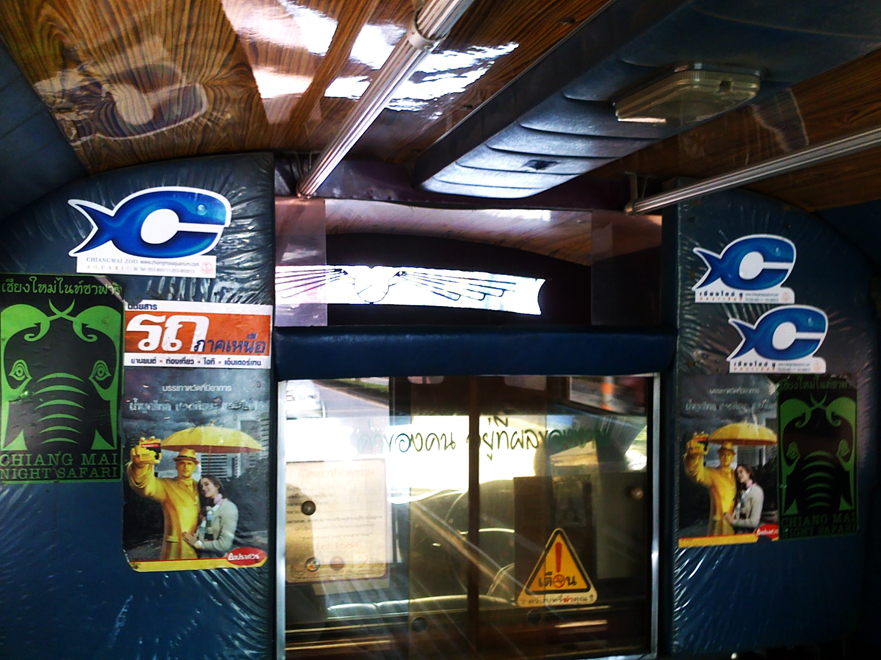
Photo: People Carrier (Songtaew) Chiang Mai

rope seen as snake

OLD NOTEBOOKS: Nontaburi, Thailand: Alone in a house surrounded by trees. Leaves filter a lovely green light all around; birds, lizards, squirrels, I see something move out on the patio… is it a bird, dropped down from a branch to peck at something? There, it moves again – just a hop and it’s a few feet further on. I sit very still, don’t want to frighten it away. I see it now, in the same position, not moving. After a long time waiting for it to change position, I decide to slowly get up and see what happens when I do that. It’s still not moving – maybe it’s injured. I go out on the patio and walk up to it. Ahhh… the bird is not a bird, it’s a large brown leaf, blown by the wind across the patio surface.

Go back inside and look at it again. It looks exactly like a bird, and just then a gust of wind blows the leaf. The animation of it is absolutely convincing, but I see it now as a leaf, not a bird. How strange, believing that something is there, then having to accept that it’s not. The teaching about the rope and the snake; a piece of rope lying on the ground is thought to be a snake. It’s an analogy of ‘self’ seen in consciousness + name-and-form: I recognize that the rope is a rope, not a snake, and can see how the illusion occurs. Or I may not see it and be convinced it’s a snake… maybe for a long time – a whole lifetime preoccupied with a ‘self’ that isn’t there.

This small epiphany occurs after another curiously similar event took place in this quiet house. I’m alone here except for D who is a grad student, working part-time, and he also takes care of the place. I don’t see D much, he works night shift sometimes, sleeping in the middle of the day. The house is large and I’m never absolutely sure if he’s here or not. Usually he stays in his room so I’m used to not seeing him around. I just quietly go about the house, day after day, not making too much noise in case he’s sleeping and quite often forget about him completely.

Then, just the other day, I start to wonder what happened to him. I look in the car park and his car is not there. When did I last see his car? Two days ago, or longer than that? I go to look at his laundry – could be the same laundry that’s been there for a while… clothes without a person inside them – remembering the movie: The Time Traveller’s Wife. I have to stop for a moment and think, when did I see him last? Go up to his room, door is open, nobody there. Hard to believe, I assumed D was in the house but I’ve been alone the whole time. The leaf-seen-as-bird metaphor. Something I thought was there, wasn’t… thinking it’s one thing, then it’s not. The usual sense of ‘me’ suddenly gone… then it returns again. Everything feels light and transparent.

‘It was as if lightning coursed within my chest. The impact lasted for a while, and for the next few weeks whenever I saw people, they seemed like a magician’s illusions in that they appeared to inherently exist but I knew that they actually did not.’ [‘How to Practice: The Way to a Meaningful Life’. The Dalai Lama, in the sixties reflecting on the Rope Seen As Snake metaphor, phenomena being dependent on conceptuality and his discovery that the “I” exists conceptually, dependent on mind and body; not an entity in itself] Source: Emptiness and Existence:

————————-

This post reblogged from July 12, 2012