castles made of sand

2013-01-13 09.40.12

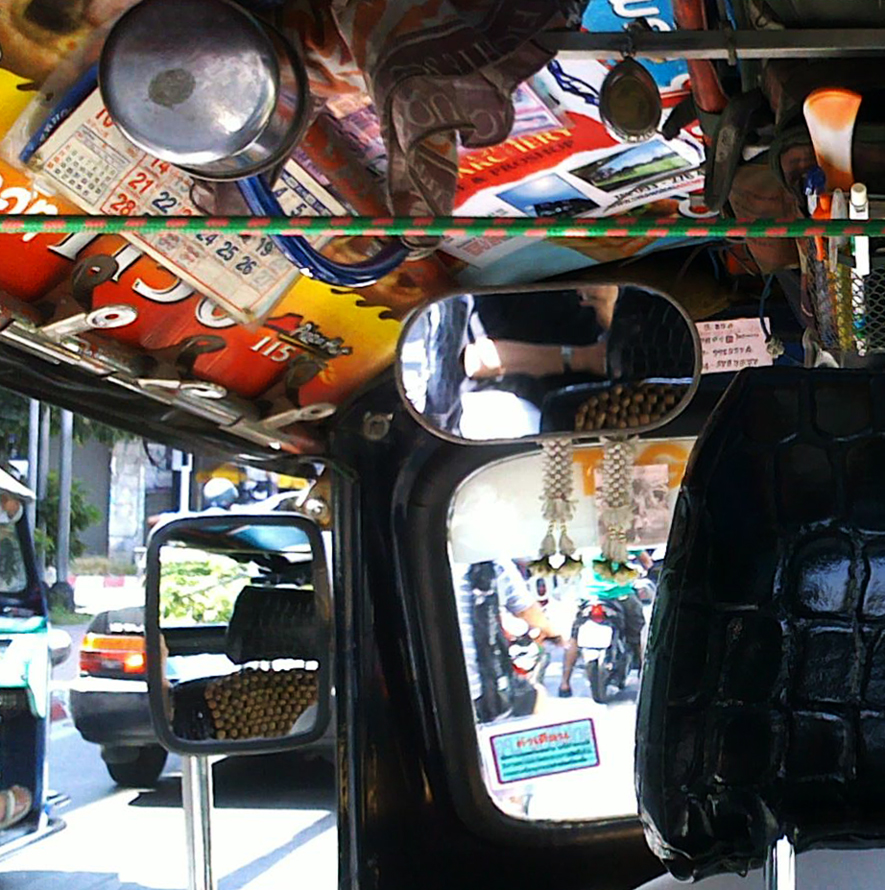
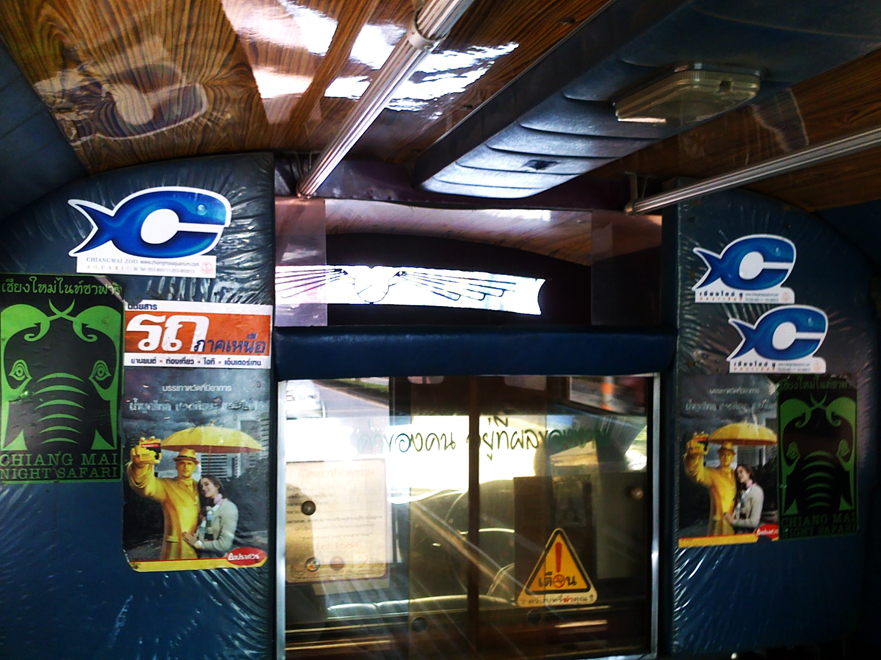
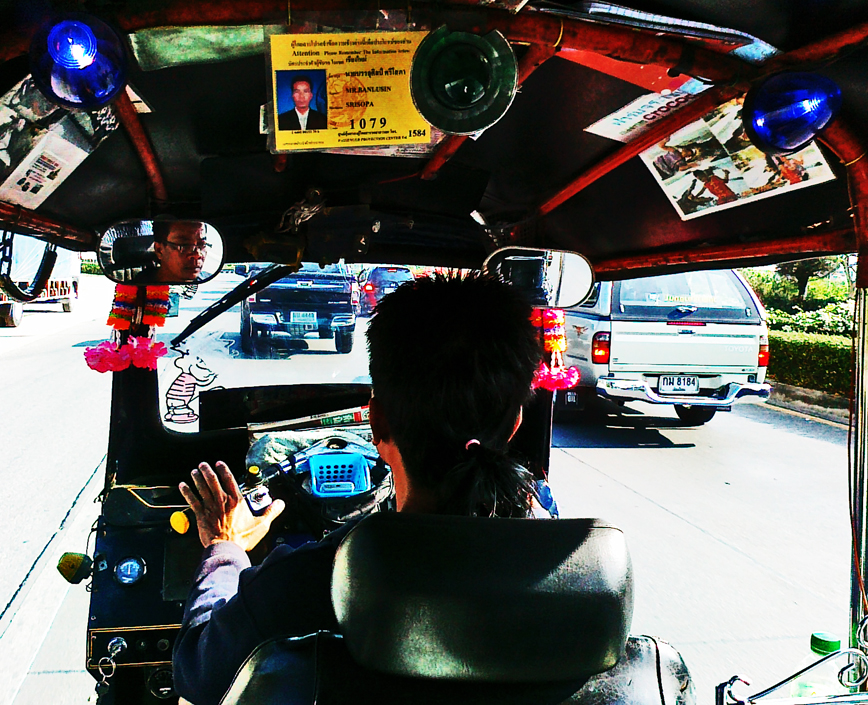
Chiang Mai: Traffic congestion at the intersection and everything comes to a standstill. The tuktuk driver makes some remark, I ask him what he’s saying and out comes a whole string of words I think I can’t understand. Then I start to recognise a few familiar vocabulary items and can reply with the same kind of observation. He laughs and says this thing I’ve never heard before: jai yen-yen (heart stay cool) jai ron mai dai (heart hot – not okay). So what now? He looks around to see if we can do a U-turn; not possible, we have to wait and see, and he switches off the engine. Sit back, relax, silence, it’s strange to be suddenly quiet after the large sound of the 2-stroke engine stops with the flick of a switch. Seems like another world; sitting on a sofa in someone’s living room, decorative chromium bars – an old-fashioned ice-cream parlor on wheels? The driver has photos of his family stuck above the windscreen, and decorative flower garlands swaying in this slight wind. No walls, a canvas roof and the outside world enters my space, like it’s always been here; the inside merged with the outside. Birds could fly through… it’s odd, just metallic creaks and the sound of other engines turning over. The smell of fuel, tarmac; this is somewhere in some part of town. Ah well,  I’m glad it’s not too hot, we might be here for a while.

I could send someone a text message …reach for my phone – then resist the urge. Okay, so, what’s the plan? All things are now directed here: the Plan; an habitual thing from long ago, frequent updates, always in line with current changes. It’s a comfortable space I create in the mind and that’s okay but sometimes I feel compelled to have a plan about the Plan. Then a plan about the plan about the Plan. The Plan is an end in itself, detached from its location in some future time, it’s now placed in present time – more like a plan for the present moment. We’re always only part the way through anything, anywhere, anyway and never at the end – we just don’t know what happens after that. Nobody ever came back from What Happens After That to say what it was like… we just don’t know.

Nothing is permanent, anicca, but the intervals between change may be immense; it doesn’t change for a very, very long time – then it does. I have a vision of it coming to an end one day… there goes the world, collapsing like a dead star, all matter reduced to an atom… all gone in a flash. Or maybe it’ll be slower; bits start to fall off and you hardly notice. And there’ll come a time when the System and all who sail in her will begin to fall in on itself like great empires do that have spanned the centuries; in the end, become too unreal and like castles made of sand and all things subject to collapse, tumble to the sea – nothing is permanently permanent – eventually. But it depends how you choose to see it, of course. In a different kind of temporality, it would just arise again and pick up where it left off; a continuous unfolding transformation and that’s how it is, even as we speak.

Something happening up front, cars beginning to move, the driver switches on the engine and it starts up immediately, a few turns of the throttle and we’re suddenly not there anymore, away in an exhilaration of speed and noise….

————————-

‘For many lives I have wandered, looking for, but not finding the house-builder who caused my suffering. But now you are seen and you shall build no more. Your rafters are dislodged and the ridge-pole is broken. All craving is ended; my heart is as one with the unmade’ [Dhammapada v.153-154]

the ‘I’ metaphor

2013-01-19 09.18.12Chiang Mai: Contemplating birdsong here in this place, next to a wooded area and a very large tree in the early morning and there’s a male Koel bird on a branch somewhere repeating its call: ko-el, ko-el, ko-el! a two-syllable utterance, at measured intervals, getting louder and louder each time, reaching its peak and the bird stops for a breath. It starts again from low volume working up to high volume, The sound, ko-el echoes around in the spaces between the hard branches and trunks, the layers of foliage and around in the air into my space here in the room: ko-el, ko-el. The end of the sound –el collides with the beginning of the next sound in the sequence: ko- and for a moment it becomes more like: el-ko-el-ko-el-ko, smoothly presented in a unity the bird knows so well and I’m just discovering it.

The preception of the sound shifts back to ko-el, ko-el, contained in this space. And in the space contained in all the other rooms in this building, the corridors and passageways, as I go down to street level; the elevator and front lobby. The ko-el sound can be heard everywhere in the building. I know, of course, it just seems like the ko-el sound is contained in the building, it’s an illusion. In fact the ko-el sound and the whole building are contained in space; space holds all, there are no boundaries, no beginning, no end. The ko-el sound can be heard all along the street too.

Back upstairs again and I am in this space, the space is in me. I can say ‘I’ am here, meaning the fictional ‘self’arising from the five khandhas, the mechanisms that filter conscious experience received through the senses. And the ko-el sound reaching my ear convinces me that if there is sound, there must be somebody in here hearing it – and that’s ‘me.’ The belief in self is backed up by sensory data input through ear, eye, nose, mouth, feeling sensations and mind. I can hold on tight to this belief that I am ‘me’ but there’s really nobody there. I can let go of it. It’s a metaphor; it’s saying conscious experience ‘is’ individual identity – a figure of speech, a kind of analogy. Not real. The emphasis on it being the same as the object of comparison pushes the whole thing over the edge and it ‘becomes’ the object. In fact the conceptual metaphor is a tricky business….

My Western conditioning still struggles with the anatta teaching, and the misleading statement: ‘I think, therefore I am.’ [René Descartes] isn’t helpful. It’s like the opposite of what Buddhists know to be true. If Descartes had been a Buddhist, he might have said: ‘I think, therefore I am a thought construct’ …but it doesn’t quite have the same ring to it, does it? What I think I am is not what I am. Thoughts think themselves, dependent on conditions arising from other conditions which are dependent on other conditions; peeling back the layers of onion, like this, to discover there’s nothing in the center; just empty space (again). It’s the ‘I’ metaphor; a structure created by words to explain a concept. In the mind’s eye we can leave the body behind, soar up into the sky and leap up into the heavens. It’s a figure of speech. The self is not contained in me, ‘I’ am contained in ‘self’ – the universe – everything, no subject/no object.

The ko-el sound shifts to some other location and it must be because the2013-01-19 09.17.09 bird has flown to a different tree, further away. Later in the day I hear it again, coming from some distant place and after a while I don’t hear it anymore….

————————-

‘…the anatta teaching is not a doctrine of no-self, but a not-self strategy for shedding suffering by letting go of its cause, leading to the highest, undying happiness. At that point, questions of self, no-self, and not-self fall aside. Once there’s the experience of such total freedom, where would there be any concern about what’s experiencing it, or whether or not it’s a self?’ [“No-self or Not-self?”, by Thanissaro Bhikkhu. Access to Insight, 8 March 2011]

the non-personal self

2013-01-09crop

Chiang Mai: Death is a failed internet connection. Three o’clock in the morning, unable to sleep so I get up, stumble through in the darkness and start up the computer. The brightness of the screen is blinding. But no internet, and no matter how much I think there should be a connection, it’s just not there. Consciousness operates in terms of subject and object; to be conscious I have to be a separate entity, a subjective being situated here. And the object, the internet – my friend, is part of this assumed ‘self-ness’ I’ve been accustomed to see in everything, still held by the conditioning of my childhood. But my friend is not there, and it is a death in that sense.

Stubborn and resentful, I go back to bed, and for quite a long time, mind continues rummaging through the disarray of its files and references; I see, with mindfulness, there’s a sense of it being a bit put-out; can’t sleep, the dream-state is set in the context of my being awake. It’s been like this, for as long as I can remember – there’s a created ‘self’ everywhere, it has it’s own momentum blindly searching for situations that offer pleasurable gratification (or gratification in displeasure), and not much more than that. I can see what this is about, but lose sight of what’s beyond ‘self’ in the attempt to grasp an understanding of it.

Same old thing. There’s something about this that’s so clear and obvious yet, again and again, when I look for it, it’s not there – the direction to take is unknown; the means by which I get there, as yet, uninvented; I study it as an object, and it’s the created self again. Up till quite recently I’ve been thinking in terms of anatta (no-self), an undefined nothingness, and now starting to think there’s also a desire to ‘not-exist’ involved here – the way I’m doing it. So if the ‘I’ construct isn’t what this is about, what is it, then? I can change the pronoun from ‘me’ to ‘it’ and that gives me distance, somehow there’s an ‘it’ there that recognizes ‘itself’ everywhere….

Head leans back and enter into a huge yawn, yaaaaawn… so deep and large, …aaaawn… and reaching optimum yawn capacity, coming to an end, and there’s a distinct ‘click’ noise in the ear. The hinge of the lower jaw – is it supposed to do that? This holds my attention for a moment, wetness around the eyes, nasal passages blocked up and fuzziness. There’s the beginning of a thought related to something I was puzzling over and a little picture of it is somehow revealed, a solution to the problem… I have to get up and find a reference in my notebook, mark it with a bookmark, come back, collapse on the pillow and drop off into deep sleep completely.

Some hours later I wake up for the second time. Senses switched on, eyes open, sounds enter, taste in the mouth, feet on floor, arms push upper body into sitting position. And there’s the notebook with the bookmark lying where I left it: ‘What had been realised in that moment was that self isn’t personal, it’s non-personal. And not only that, the realisation wasn’t personal. The realisation was simply something else appearing in what had been assumed to be my consciousness, and was realised to be the Self: absolute, timeless, radiant being.’ [Roger Linden, ‘The Elusive Obvious’, Conscious TV, July 17th 2008]

————————-

wisdom in unknowing

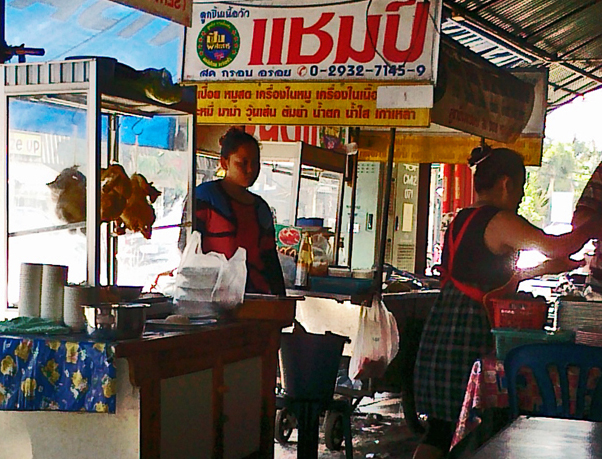
ChmaiNshopChiang Mai:  Street-side, noodle shop, low headroom under wide umbrellas placed at an angle to create shade. I duck my head and squeeze through into this place, aware of obstructions and watching for uneven surfaces at ground level I could trip on; feet in rubber slippers appear below me, first left then right, then left… ask the noodle shop man if he has what I want, find an empty place, sit down and look around. Thai language like birdsong and traffic sounds, a bell rings, cooking pots collide, somebody’s ring tone… ‘hello?’ All kinds of noises, smells and the fragrance of jasmine with faint odour of a sewer nearby – not unpleasant. The mind has to discern which is which according to likes and dislikes. And the high-activity level of it all more or less insists on mindfulness. Head spinning around to register environmental activity; this curious reality of receiving sensory input by means of sense organs situated mostly around the head and face, has that effect of the whole head seeming to enter into an ‘outside’ world.

Attention moves from one thing to the next. Loud sounds take priority over quieter sounds, the whole sequence adjusts to allow for it, then continues as it was before. In the same way, a chain of thought waits to be completed as soon as there is a gap in the flow of other thoughts. It’s the traffic of thinking about things; the mechanism engaged in its functionality, never any peace. I find some stability in the constructed self and hold on to that – that’s what it’s there for.

Focus on a particular sound, or sensory object and logic says if that’s out ‘there’, then I must be in ‘here’ – subject-object link activated by default. The world enters through eye, ear, nose, mouth, body feeling, mind, and creates consciousness: ‘I’ am born and the ‘world’ is out there. Being a ‘self’ is a little trick I learned when I was a child, it’s not real. It only appears to be a personal experience, because if there’s a sound that’s not demanding my attention, there’s only a neutral awareness, no reaction, nobody at home; the sound is there but there’s just the receiving of it and our shared world. Sensory input enters and there’s no ‘self’ to really notice it’s there, so I imagine it just buffets around for a while like the wind from the fan above my head disturbs the papers on my table and then it’s quiet again.

Conscious awareness is the sixth sense. It knows the other five senses, and knows itself as a ‘self’ then attachment to that dissolves away; the ‘self’ aspect is gone – seeing the events without the story. Deconstruct everything, carefully disassemble it to see how it all fits together, like a mechanic breaks down a car engine into its parts. And this is such a phenomenal thing to do, putting it  back together again doesn’t seem worthwhile.

‘Self-realisation can know itself within complete ignorance, so self-realisation is possible for someone who’s had no education and it can also be possible for a king. There are no preconditions to self-realisation. Self-realisation isn’t just for those who’ve undergone years of spiritual practice….’ [David Bingham, Conscious TV]

Can’t be ‘complete ignorance’, let’s call it ‘unknowing’. Just another mind state. I can look into my own ‘unknowing’ and it’s as if there’s a small seed of wisdom in there, buried deep in the layers of unknowing, that’s saying, come on, wake up! I could call it the Noble Truth of Waking Up (numbered 2a and it comes between Tanha and Nirodha). This is how it looks to me now; there’s the focus on Anatta and freedom from suffering and the Non-Duality ‘no-thing-ness’ takes on a whole different meaning.

————————-

a movement in time

P1030990Chiang Mai: Walking back from the market carrying bags of vegetables through groups of slow-moving people in brightly coloured clothing; noise, heat, bright sunshine, large, coloured umbrellas and dense dark shadow. All kinds of obstacles on the pavement, sidewalk – more like walking on the edge of the road, sharing the space with the traffic, things being as they are, in this densely populated place where the sidewalk is often needed for other civic requirements. Maybe a phone box takes up the whole area. Or there’s a tree in the way, uneven paving stones due to ongoing repairs, or a raised concrete lid over a drain, fallen in, and one corner sticks up at an angle so you step down to street level because it’s easier. Then there’s a parked car in the way and you have to get around that; mindfulness of moving traffic coming in all directions. There’s an alertness that just automatically locks in place, obstructions and dangers above and below and on all sides like this, the infrastructure intrudes, but always there’s just enough room, squeezing through a sort of tunnel of directional force that extends in front, takes me along out from the space I’m in here now, along the way through this urban clutter and busy-ness of objects.

Then something happens that’s completely unexpected. There’s a green cloth sheet that obscures a construction site on my left side; three or four floors up, scaffolding, ropes and there’s a tied-up bundle of concrete blocks being lowered down above my head – it’s coming too quickly, I can see it in the corner of my vision. This lowering bundle strikes a sticking-out platform on the way down and a large board catapaults out, spins in the air and lands just behind me CRASH! There it is, a long heavy scaffolding board held by the green cloth sheet, now ripped, and the board caught there in a small cloud of dusty air. If it had been one second earlier…. People stop and look up, call to the workers in the building. They lean over, wide-brimmed straw hats, observe the scene. There’s some shouting and I don’t want to get involved in this; continue down the path to the apartment, nearly there. Open the door and the air conditioning hits me, up in the elevator, unlock door and into my quiet rooms.

I’m trembling, – there’s an elation too, can’t decide if I’m happy or scared out of my wits. Can’t get over how near I was to being injured by that falling board. The important thing is that it missed me and maybe that’s the way to go with this – no matter how near it was, it didn’t happen. Something is telling me I need to let go of the holding-on thing here; just calm down and watch the breath for a bit. Open the laptop, start-up, find the page I was looking at yesterday, Sangeeta’s ‘Serene Reflection’ and her Inner Landscapes page:

http://serenereflection.wordpress.com/2011/09/30/inner-landscapes/

‘I meander along the babbling brook – all the while realizing that its song comes from the obstructions it surmounts.’ It all fits together. There may be obstructions in the babbling brook but the water passes through them all anyway. We hear the sound of it: a river of small collisions. The near accident is telling me the World is all of this and more; the obstacles and that which encounters the obstacles. Sometimes I can look for an understanding of it everywhere and not find anything because I am part of what I’m looking for; that which is looking for itself, not finding it and seeing that this is what is taking place. This is what it is really but I can’t see it. Or you can say there’s nothing to find anyway because, always, it’s the World revealing itself, and ‘my’ seeking it isn’t actually doing anything. It’s simply a movement in time. This thought is enough to see the event as part of a very much larger all-inclusive whole…. And I can abide in that restful awareness.

P1040085

————————-

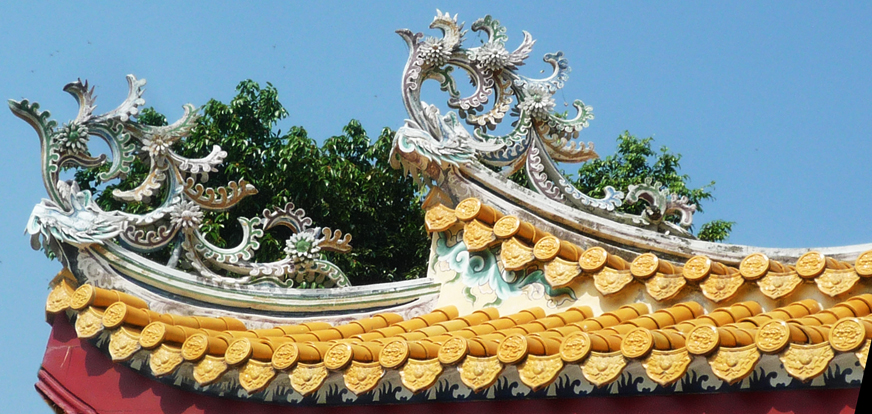
Photos: Bang Pah In (upper) & Khaosan Road (lower) by Peter and Elaine Henderson

how it looks from here

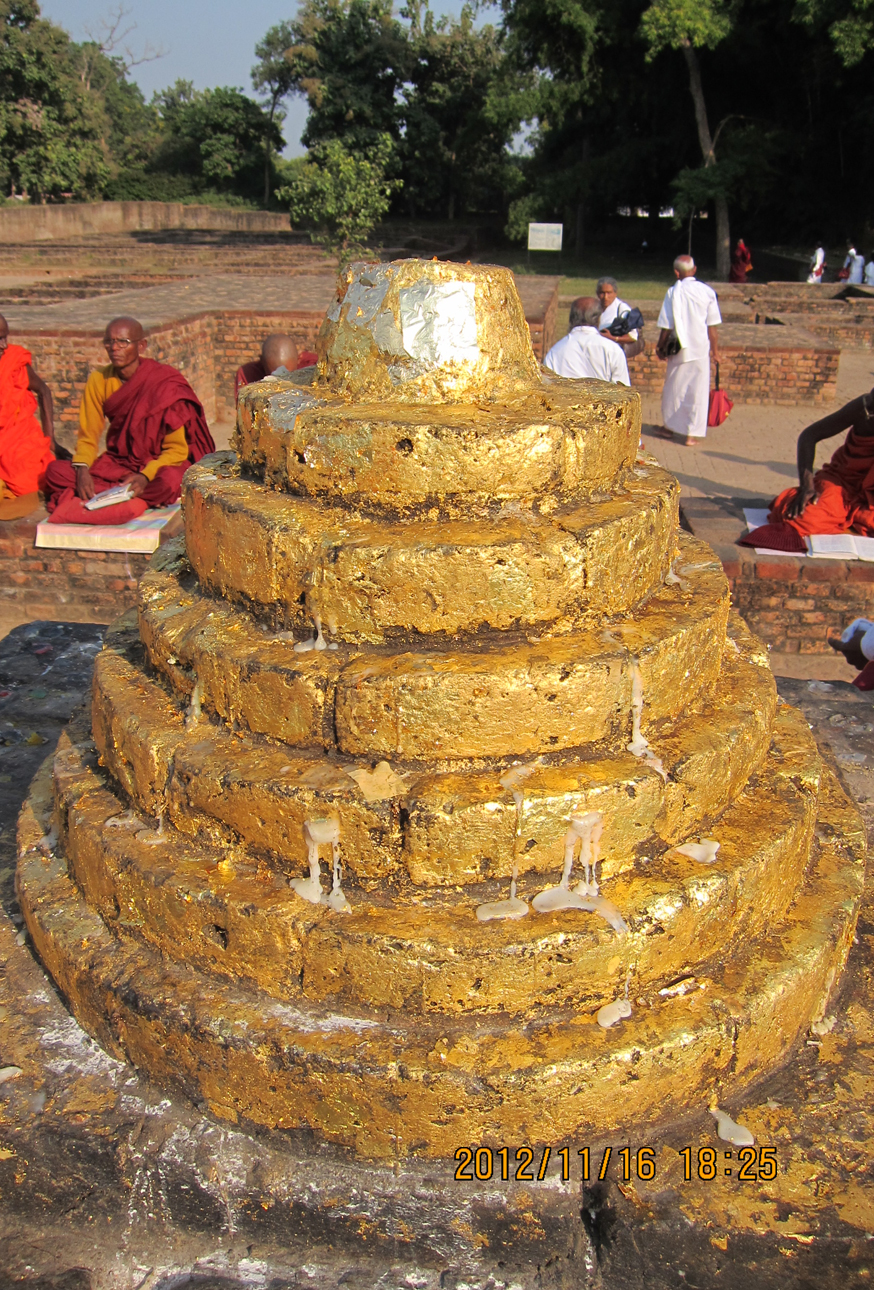
Sravasti: These shrines and monuments stay the same, perhaps sunk deeper into the landscape than they were in ancient times; there’s a presence. The seasons revolve around them, rainfall, heat, sand storms and the centuries come and go. People from all over the world come to visit, pray, bow, apply goldleaf, string garlands, light incense, show reverence and take pictures of their friends standing next to them. A great shower of digital flashes lights up the environment like a fireworks display; camera phones, iPads held up like a tray, with an image as large as a small television, ‘and here is the place where the Buddha was enlightened:’ flash, click! Thus, a small piece of the outer world is captured; perhaps a small landscape showing the shrine, prayer flags strung across branches of a huge Bodhi tree and my friends standing below smiling for the camera. Everybody hurries to look at the picture just taken; camera device held by finger tips, the image never quite hits the spot. So we reach into the outer world and ‘take’ another one, a nicer one maybe, have a look, but it doesn’t hit the spot either.

Taking a picture is a reflex action, a simple curiosity; I want to ‘take’ a picture of it and there are hundreds of images in this camera memory we have to load somewhere else to make room for more. All of them are simply showing the passage of time: people get older. But it’s meaningful to us, a metaphor we’re deeply familiar with; consciousness of outer object meeting inner sense base and we respond to it in much the same way as sensory input, by way of eye/ ear/ nose/ tongue/ skin/ mind, is the means by which the outer world enters the inner being.

Receiving data from the outer world through sense organs situated around the face and head has the odd effect, somehow, of pushing the whole head into the bubble of the outer world and I can understand what Douglas Harding was saying when he spoke about ‘having no head’, and the rest of the body, seemingly connected. That’s how it looks from here. I can see all these other beings walking around too. Some of them seem to know what’s going on and some don’t know at all because they’re preocccupied with taking a photo of the event, or maybe they’re watching the video they made of it. Some believe it’s God’s world and contemplate experiential responses to outer stimuli, thinking God created this, so it must be okay. The idea that God also gave us the gift of insight to see for ourselves is not something they feel they need to take into consideration and just leave it at that. Others are walking around just browsing the options, hoping to stumble upon something soon. It could take eons for them to find it, stuck in the samasara of Search Mode. Other beings are in a historical time period but otherwise the same as what we have today and I am here thinking about the possibility that the Buddha was standing in the same place where I’m standing now.

————————-

‘At Savatthi. Then the Venerable Kaccanagotta approached the Blessed One, paid homage to him… : “In what way, venerable sir, is there right view?”

“This world, Kaccana, for the most part depends upon a duality—upon the notion of existence and the notion of nonexistence. But for one who sees the origin of the world as it really is with correct wisdom, there is no notion of nonexistence in regard to the world. And for one who sees the cessation of the world as it really is with correct wisdom, there is no notion of existence in regard to the world.

“This world, Kaccana, is for the most part shackled by engagement, clinging, and adherence. But this one [with right view] does not become engaged and cling through that engagement and clinging, mental standpoint, adherence, underlying tendency; he does not take a stand about ‘my self.’ He has no perplexity or doubt that what arises is only suffering arising, what ceases is only suffering ceasing. His knowledge about this is independent of others. It is in this way, Kaccana, that there is right view.

“‘All exists’: Kaccana, this is one extreme. “All does not exist’: this is the second extreme. Without veering towards either of these extremes, the Tathagata teaches the Dhamma by the middle: ‘With ignorance as condition, volitional formations [come to be]; with volitional formations as condition, consciousness…. Such is the origin of this whole mass of suffering. But with the remainderless fading away and cessation of ignorance comes cessation of volitional formations; with the cessation of volitional formations, cessation of consciousness…. Such is the cessation of this whole mass of suffering.”’[SN 12.15(5)]

Photos from the Witit Rachatatanun Collection

Buddhists and Christians

Chiang Mai: A very nice short flight here from Bangkok yesterday, 1 hour 10 minutes. They serve a small meal; it was like going upstairs to have lunch in the clouds, then it’s time to come down again. During the flight I was able to have a discussion with somebody I met there about Christianity and Buddhism – is there ‘something’ there (God) or is there not anything? And ‘not anything’ implies something that cannot be verbalised.

It is a bit like tight-rope walking for me as a Western Buddhist and now 30 years in Asia but still subject to the conditioning of the Church and childhood memories of it in the West. With my Christian companion here, there is agreement on many things. The main thing we agree about is that human beings may experience a certain kind of realization that there is no ‘self’, no identity, nothing there; nothing in the mind/body organism, it’s a construct. There’s a feeling of ‘lack’, and the shock that comes with this discovery causes dismay, distress, etc. Christians say the realization of emptiness is the absence of God, and this knowledge facilitates the entry of God, the creator of everything. This is what fills the emptiness; a significant turning point for all Christians.

Buddhists encounter this feeling of ‘lack’ in the same way but will not ‘fill’ it with anything, rather, they contemplate the emptiness of it in depth; examine the associated emotional reactions with mindfulness and come to see that, this is how it is. Śūnyatā, the emptiness, the lack of ‘self’ is everywhere and in all things. The understanding that everything is without ‘self’ helps Buddhists to contemplate the constructed nature of the mind. It’s possible to see the whole picture; how everything works and where we go from here. It’s an open-ended, investigative approach that may lead to an understanding of the non-duality of the observed world and the observer of it, together as a oneness. What the Christians call God must be inside this, because it is all-inclusive. There cannot be anything outside of it.

Christians will depend on the attachment to a belief in God for guidance and that’s how they see the world; they might say that ‘emptiness’ for the Buddhist is the Buddhist sense of God? And Buddhists could consider it this way, but the Buddha didn’t see any point in going further with that because the important thing is to make sure you are seeing reality correctly; anything else is getting caught in wishful thinking. Necessary because working only with belief and faith and no pragmatic teachings means there are all kinds of things that can go wrong with it. Christians are focused on the experiential aspect; Buddhists say conceptualizing a God leads to attachment, tanha; the desire for, and attachment to, ideas and ideals, views, opinions, theories, conceptions and beliefs. [Dhamma-taṇhā, Walpole Rahula].

If I say the word ‘God’ to myself, something comes into my mind, the word ‘God’ has an immediate emotive effect. Certain assumptions arise and the mind is already closed around it; it’s a ‘special’ thing. When Christians talk about God, what they’re referring to (I think) is the God they are creating in their own minds – their loving devotion to a personal god: a deity who can be related to as a person, but God is beyond everything that is conceived or thought about. There is no adequate analogy, words cannot describe it. It cannot even be imagined because it is beyond space and time. Buddhists stay separate from the God concept because to become involved with it means making assumptions about a kind of consciousness that is totally different from ordinary mind states. This is not to say there is no God, for me, at this time, it is impossible to express in words what God could be.

Then there’s a stewardess announcement, the plane is starting its descent, please put your fold-away table up, arm rest down, and chair forward. I get lost in the directions for a moment; a small clutter of prepositions, then were on firm ground again.

————————-

‘Both Jesus and the Buddha were pointing to something that could not be found in the context of ordinary ‘mind’, the Buddha’s goal was to strive to realise the unconditioned, the unoriginated, the deathless, that which is free from mortality. So did the Buddha find God? Was it this that he called Nibbana? God is not Nibanna, because when we speak about ‘God’ we start getting ideas in our head about what God is and that is very far from the unborn, the unconditioned, the uncreated, the unoriginated, the deathless. All these words tell you nothing. What comes into your mind? Nothing. Anything you might say or try to put into words to describe God is an image in the mind. There are no words for it.’ [Ajahn Jagaro]

‘God is God only in relation to man. God appears in the material world like the reflection of the moon in a pool of water, as part of the illusion that is the context of man searching for God with his mind. What man sees becomes “God” (gender neutral; “He” only for explanatory purposes). He is Omniscient, Omnipresent, Creator of the world. He is both immanent and transcedent, full of love and justice. He may be even regarded to have a personality. He is the subject of worship.’ [Wikipedia Brahman page]

Image: Peter Henderson

world as thought-construct

Chiang Mai: 06.00hrs. Sitting on the cushion before the day actually begins and there’s that colourless light of dawn filling the room, a greyish-green glow. After what seems to be quite a long time, the day gets it’s total act together and the sun rises; things take shape in my vision and colour enters the visual world. The show has started. Sky is blue, sun is yellow, plants and trees are green. That’s how it is here at, 18°47’N, 098°59’E. I notice it because of having only recently returned to this place from the Northern Hemisphere where there are these same colourless dawns; but they’re followed by colourless days – often and unforeseen; the changeability of everything. For the local people there’s no experience of continuity.

I do find it curious here that every day is pretty much the same, some small seasonal differences but not much. For the people in this location it’s always been like this, of course. It’s how it was when they were born; it’s how it was when all known persons in their lineage were born and future generations will go on like this. There’s never any experience of anything being different from this. And for me too; all my sunny days in Asia in the last 30 years could be said to be simply one very long day – the period of night time is a blink of the eye; one huge flow of days, like moments moving along in their sameness, never ending.

In this context it’s easier to get a handle on the teachings of Ādi Śaṅkarācārya, in South India, in the 8th Century (the days were exactly the same then as they are today) and the Advaita truth of timelessness where the endless day, that I am experiencing now, stretches all the way back into the past and out into the future, in one continuous ‘now’ time happening everywhere. There’s no end to it and no beginning. Time and space phenomena are delusions, add-ons. There are, therefore, no causal relationships; cause-leading-to-effect is a temporal process – thought-constructed, and not what I take it to be because the entire objective world is a thought-construct, created by desire-motivated ways of thinking and acting. ‘…Time is generated by the mind’s restlessness, its stretching out to the future, its projects, and its negation of ‘the present state.'[6]’

Knowing this, from the Advaitist perspective, is the whole Truth. Nothing needs to be attained or done; one simply wakes up to the truth of Ātman/Brahman, and anything other than this is māyā, delusion. Where does māyā fit in? No explanation; it cannot be inside or outside Brahman; one doesn’t know where that could be (māyā truly is a delusion). Buddhist practice or any spiritual practice is not a solution to the problem, just another version of the problem itself. Any practice leading to an enlightenment experience maintains the dualism that it strives to escape; projecting a thought-constructed goal like this into the future loses the ‘now’, the place of liberation.

‘… there is absolutely nothing to attain, which is not to deny that that is something to be realized clearly. The difference between attainment and such realization is that only now can I realize I am that which I seek. Since it is always now, the possibility is always there, but that possibility becomes realized only when causal, time-bound, goal-directed ways of thinking and acting evaporate, to expose what I have always been: a formless, qualityless mind which is immutable because it is “nothing,” which is free because it is not going anywhere, and which does not need to go anywhere because it does not lack anything.’ [David Loy]

The colourless dawns, followed by colourless days in the N. Hemisphere did not bring me to this experience of continuity. I stumbled upon it in Asia and found traces of it in this location: ‘Everything – subject, object and the perceiving thereof – is inseparable from this experience-ing-aware-ing-ness … and who can escape this immanence?’ The Buddhist experience tells me there has to be a middle way in here somewhere. I’m looking for some route that allows Sankara’s truth of Ātman/Brahman to be combined with the Buddha’s no-self truth in nibbana. The Buddhists will say I’ll not find anything, the Advaitists will say there’s only One thing to be found: “all of the above”. But there has to be a middle way in here somewhere. The investigating process itself is the Path: ‘the nature of the self and causes and conditions.’ Beyond that is speculation.…

————————-

This post created with excerpts from: ‘The Path of No-path: Śaṅkara and Dogen on the Paradox of Practice’ by David Loy

Quote from: miriam louisa

Quote from: undividedexperience

– g  r  a  t  i  t  u  d  e – 

Photo image: Ch’mai TukTuk

Constructedness

Chiang Mai: I met somebody in a coffee shop the other day and he was saying, it’s all just words, isn’t it? We were talking about the difference between the Advaita Self and the Theravada Buddhist no-self. I was saying no-self is a deconstructed form of Self. The man in the coffee shop wouldn’t say yes or no to that (it’s all just words). Theravadin Buddhism is about seeing through the constructedness of the ordinary self we all experience as who we are. Take that to pieces through meditational investigation and wise reflection, follow the Path and you end up with the state of final deliverance, the unborn, ageless, and deathless; Nibbana.

Advaita doesn’t need to get into that because the state of non-duality is pre-existing. You can’t break it down into its parts because it’s already there. You just need to ‘see’ it. Speculative conjectures, say the Theravadins. The quest to know the Self in Brahman is simply the mind’s natural yearning for a comprehensive unity; trying to reach ‘Nibbana’ by intellectual means. What we need to do is remain grounded in actuality and by humble, sustained spiritual practice, work to liberate ourselves from the dualities contained within human experience. This living experience of things as they really are, is the starting point and framework. Buddhism attempts to diagnose the central problem at the core of human existence, dhukka and to offer a way to its solution. ‘This is suffering, this is the origin of suffering, this is the cessation of suffering, this is the way leading to the cessation of suffering.’ The Buddha didn’t say exactly what happens after that.

In Advaita there’s a kind of built-in narrative that seems to be associated somehow, more literalist than what I’m used to in the Theravadin Buddhist way. This is where I return to at the end of the day. Maybe it’s because that’s how I started out on the Path. I learned how to take things apart carefully to see how it all works; how it can be reconstructed or deconstructed and it looks like there’s no final state, the ‘world’ remains as transformation; it’s all about phenomena that are dependent on other phenomena, and nothing in the world has a true independent reality.

This is different from the Advaitist ‘absolute reality’, the single homogenous and continuous structure of Brahman, the ‘Oneness’. The question is, what’s the difference between ‘absolute reality’ and ‘no independent reality’? An intuitive sense tells me both ‘absolute reality’ and ‘no independent reality’ are relevant to the Path – I don’t see why there should be an impossible difference between them because the ‘Oneness’ includes everything. Like my friend in the coffee shop says, it’s all just words, isn’t it? Take the words away and and there’s nothing left – only conscious experience.

————————

‘Early Buddhism conflates subject into object. Consciousness is something conditioned, arising only when certain conditions exist. The self is merely an illusion created by the interaction of the five aggregates. The self shrinks to nothing and there is only a void; but the Void is not a thing — it expresses the fact that there is absolutely nothing, no-thing at all, which can be identified as the self.

Advaita Vedanta conflates object into subject. There is nothing external to Brahman, the One without a second. Since Brahman is a non-dual, self-luminous consciousness, consciousness expands to encompass the entire universe, which is but the appearance of Brahman; everything is the Self.’ [Enlightenment in Buddhism and Advaita Vedanta: 
Are Nirvana and Moksha the Same? David Loy]

Photo: People Carrier (Songtaew) Chiang Mai

Birds on the Balcony 4

Switzerland, September: It’s a really windy day up here on the 7th floor. The birds on the balcony [Link to: Birds on the Balcony 3], huddled and sheltering on perches made from bamboo canes bound with string and held with duct tape. These pigeons are getting tugged at by the wind, pushed from side to side but claws are anchored firmly to the perch. This strange high wind comes at you from any direction, very gusty, buffets the birds around because of feathers designed to catch the slightest up-draught of air and a weightless skeletal structure. It’s a problem sitting on the perch on a day like this, but they do have these extremely long toenails to hold on with. The wind can’t snatch them away.

This is how it is. If you’re a pigeon, a life form evolved from the causes and conditions of air and wind currents, there’s the danger of getting whisked away in the wind at any moment. Necessary to quickly find shelter and, for young birds, sometimes it does go wrong. Yesterday I was downtown waiting at the bus stop; it was windy like this and suddenly a bird drops straight down from above and soft-lands on the street, feathers sticking out at all angles showing white undersides. People waiting at the bus stop go: wooooo! in unison. It was a young pigeon. The bird corrects itself and walks around in circles, dazed, a car swerves to avoid it. The young bird walks in a zigzag fashion across the road jumps up on the pavement; wide-eyed with its sense of danger and takes refuge in a doorway behind the bus stop.

The dukkha of a windy day. It’s the mistral coming from the Mediterranean and North Africa; sudden gusts of wind come at you in a kind of anarchy of directions, very intense for a day or two then it’s gone. The pigeons are so actively engaged with the mechanism of flight, it’s as if the movements of their wings and the movement of the air are one and the same thing. I see them caught in hectic flight movement; a stationary moment in the air, suspended in time and space, then the audible flap of wingtip and fluttering away – adjusting wing positions in response to complex changes in wind direction.

Each air current has a quality that results in the corresponding wing tilt and flip, extend and hold. If you’re a bird, ground level is not the reference point; ‘up’ is not necessarily up and neither is down. Bird flight is an expression of the air movement itself, sudden and unpredictable; birds in flight and the sky – the space where the flying takes place; it’s about non-duality: ‘self and other, subject and object, organism and environment are the poles of a single process1‘ The flying and the air are not different, there’s no separation, no division between them.

‘… an ever-present no-boundary awareness wherein the subject and the object, the seer and the seen, the experiencer and the experienced form a single continuum.2

A wind like this is energy to the birds; it’s a dance. All their skills and everything they are is in readiness, alert. They have the ability to do all of it. Flying and the wind are in unison. But they need to find a place to shelter and these birds come into the balcony space here, grab on to a perch, clamp down on the landing gear, and claws lock into place. Held like this until the wind has gone. Eyes glaze over; they’re in a state of partial sleep, head sunk into the body, feathers fluffed out. They’re just not concerned at all about the wind buffeting them around – or me, looking at them through the glass, or what goes on inside this terrestrial place, 7 floors up from ground level. It could be anywhere, just a place, like the branch of a tree, elevated as it is, to be a convenient stopover for birds of the air.

————————-

‘I am infinite like space, and the natural world is like a jar/ I am like the ocean, and the multiplicity of objects is comparable to a wave/ I am like the mother of pearl, and the imagined world is like the silver/ Alternatively, I am in all beings, and all beings are in me. To know this is knowledge, and then there is neither renunciation, acceptance, or cessation of it.’ [Ashtavakra Gita 6.1 – 6.4]

[Image source: detail from: pigeon_flock_large_0410094946. I am grateful for the use of this image]

1Alan Watts, The Book on the Taboo Against Knowing Who You Are  

2The Essential Ken Wilbur, page 21: The Real Self