the ten parami

POSTCARD#405: Bangkok: Peace. It is necessary to give some thought to what peace feels like in these times of vengeful obstructionism, and a Presidential Election where the loser goes into denial and does some crazy things. Leave these thoughts behind and consider the ten perfections. We started this last week, this is part two in a series.

Generosity (dana) is the first of the ten parami, or qualities of character, that we practice as followers of the Buddha. This kind of generosity is much more than offering gifts at Christmas and birthdays. The Buddha’s encouragement is to develop generosity on a daily basis. There are all kinds of Generosity – a small favor, a kind thought, a meal, or funds to help sustain a meditation teacher. Generosity lifts the mind out of its isolation and establishes goodwill.

We are not just an isolated point that is only relevant for the moment. We are in a field of present awareness that absorbs and carries the consequences of what we’ve done in our life or had happen to us. Giving a friendly gesture or a helping hand, offering service, or giving attention are offerings that may in some situations be more important than giving material things. It’s the act of  letting-go, giving it all away, relinquishment.

Virtue (sila) is the second of the ten parami. With Virtue, the fundamental principle is: I don’t do to you what I wouldn’t want you to do to me. I don’t steal things and I don’t lie to you, because I know I wouldn’t want those things to happen to me. Sīla also involves wisdom. Its ethical sensitivity asks us to consider more carefully what is harmful, and to exercise discrimination. Is it better to steal an advantage over someone else, or to live with a mind that is free from manipulativeness and mistrust?

The third Parami, Renunciation we discussed last week but an important feature of it is craving (Taṇhā). Craving is the enemy of Renunciation. Craving is about something we don’t have. We can’t crave something we have, so the fact of not having it sets up a target for unresolved passion. Therefore it isn’t the object (food, drink) that starts up craving, it’s the sense of ‘not having.’ There’s nothing wrong with sight and sound, taste, smell, touch and the sensory world; it’s the fantasy that craving makes of them.

Knowing the flood of sensuality for what it is, takes the whole thing to pieces. Quietening the craving is not just about removing sense objects, but investigating the mind and resolving passion. In its ‘not having’ state the mind can conceive of many desirables, and of course, the great powers of the consumer industry are very aware of how susceptible the mind is to impressions of comfort, excitement, attractiveness, being popular and all the rest of the things that buying an ice cream, a gadget or an item of clothing promises you. So to go through a shopping mall bearing in mind what you really need is a very relevant practice of renunciation!

Wisdom, paññā, the fourth Parami is a discriminative faculty that operates through discernment or clarity, rather than a learned store of knowledge. ‘wisdom is the faculty that makes distinctions — between pain and pleasure, safe and threatening, black and white. For the lower forms of animal life, this faculty is programmed solely around sense contact. For humans the possible development of wisdom is to be clear about the mind. Wherever there is consciousness there is wisdom, but for humans the job is for ‘wisdom to be developed, and consciousness is to be fully understood’’ (M. 43.6).

The human mind is a mixed blessing. We can witness our instincts and responses and discern what is good/appropriate/skillful from its opposite; but we can also get so lost in the viewpoints that we’ve adopted to measure our responses, that we get confused and stressed. Thus we are thrown around by what we think we should be and what we fear we might be, as well as the ways we wish other people would be, and so we lose the balance of clarity. So it is imperative to develop the wisdom faculty in the right way. This entails balancing the need for ideas, aims and procedures with the understanding of how all this mental stuff affects us.

Without balance we get top-heavy and contrived. So it’s essential to develop the wisdom that oversees mind consciousness with its dogmatic biases, its compassion and depression. This transcending wisdom, or deep clarity, is the perfection that accompanies every other pāramī and is brought to full development, use and effect by them.  (to be continued)

Excerpts from: ‘Parami, Ways to Cross Life’s Floods’ by Ajahn Sucitto


the painted face

POSTCARD#404: Bangkok: The days of Biden are here at last. I’m happy but wounded in the battles of Trump. Speaking figuratively, I’m not one to go to war. Many of us suffered when the painted face came on television and we’d have to brace against his silent malice and spite. It hurt deep in the centre of my being. Not able to recover properly, the mind was in overwhelm because the hurt was an accumulation of all the other times he induced the hurt.

He had a knack for it, thus able in an evil sort of way I suppose to swing things to his advantage; the heritage of an old woman born in the Outer Hebrides; the lady who was his mother. I say this because I’m from Scotland and had friends in Skye where I spent my summers for seven years in the 60s. I can’t say I ever met someone like Mary Anne MacLeod of Tong, Isle-of-Lewis, Scotland, but I recognise the Western Isle’s ways of persuasion.

“The likes of which the world has never seen.” He said it too many times – sorry Mr. Trump, the world has seen most of what you said and it doesn’t amount to much. Always and forever, (the collective) ‘we’ are in recovery from the overwhelm, our dwellings lost in the floods of ancient times. The timeless metaphor of a mind overcome in a tide of worries, fears, and things left undone. Sorrow, lamentation and despair; swept along by relenting events, surfacing and going under. These are the perennial ‘floods’, and crossing them is about coming through all that to find some firm ground. The Buddha throws a lifeline to the isolated, overwhelmed beings that we all recognize in ourselves from time to time. If we hold it firmly, it will guide us back home to solid ground and a renewed sense of community.

Suddenly I’m not thinking about the “why” of things anymore, just sitting quietly here, watching the in-breath/out-breath. Intelligent control over the energy of thought… and when there’s an opportunity, seek a place in the high ground. Find equanimity in the midst of uncertainty, the balance, the midway point. Find a temporary abiding there, return to the inward disposition to give, to have compassion for; generosity, virtue, kindness, gladness.

Thus the Buddha’s damage-repair comes into play; that natural ability to relinquish – we may not be skilled in the act of surrender but can access the power that immediately releases the tenacity of grip, the jaw clench, tongue adhered to roof of mouth…. unlock, unfasten, undo. Watchful too of the mindless repetition: I don’t-want-it-to-be-like-this, and so finding it difficult to disengage from making a bad situation worse.

Quietly watching the in-breath and the out-breath, renunciation (nekkhamma) is the ability to let go of the pull towards a sense object. Renunciation is the third of ten perfections (pāramī) that Buddhists cultivate in the mind in the Theravada tradition to this day.

The first two are Generosity (dana) and Virtue, morality or ethical sensitivity (sila). In the aftermath of the inelegant storm that was Trump, I thought it was timely and a good idea to consider these pāramī. (continued Jan 29)

Excerpts from: ‘Parami, Ways to Cross Life’s Floods’ by Ajahn Sucitto

surviving the lockdown

POSTCARD#403: Bangkok: Young people are among those most socially impacted by the COVID-19 pandemic, but also the most prepared to cope with the quick shift towards virtual environments that the pandemic triggered. Our 16 year-old niece M is one of those surviving the lockdown. She was fortunate to find some good friends towards the end of her time at school and now classes are online they are able to help each other by way of their own networks. There’s also a quality that M and her friends seem to have; it’s the ability to improvise and to confront the  problem, find solutions and move on.

She was always like that, even as a child; there was the direct flow of intention to get something done that needed to be done. Then on to the next thing. I’m looking through some old posts and see this characteristic everywhere.

APRIL 25, 2014 : Going home in a tuk-tuk with M aged 9, sitting beside me, small body-mass pressed against my side. The urgency of speed, kinda scary, canvas roof, no walls and immense sound of 2-stroke engine fills our space. Impossible to hear properly what she’s saying, M indicates that she wants to borrow my phone. I pull it out of my pocket, thinking, is it okay to play with a slippery glass-like instrument like this in a speeding tuk-tuk? 

I press it into her small hands. Hot, prehensile fingers grab, grasp and clasp the phone. Go to settings, clear away unwanted windows with the swipe of a tiny finger and launch multiplayer Minecraft. So fast! I’m surprised she’s managing to get Internet, 3G signal reaching us here in a tuk-tuk racing through the streets of Chiang Mai.

My arm is placed around the slight presence of M, taking up such a small amount of the space on the seat, legs don’t reach the floor. In the little window of the phone in her hands Minecraft’s digitally created landscapes of mountains and seascapes appear. She’s now in player-hosted servers with visiting players from all countries in the world.

“How do you say this Toong-Ting?” She spells out: G-A-V-I-N. I tell her it’s a boy’s name, ‘Gavin’, probably English. I see name labels moving around the landscapes, Japanese and Italian names; Spanish, German, Norwegian – players I assume are about the same age as M? I see boy’s names and girl’s names, all here at this very moment – and, where is ‘here’? Good question: now here and nowhere, depends on the context… space and time are not separate – this is (always) where we are at.

“Remember this number Toong-Ting: 19122,” she says. I consciously remember the number, repeating it to myself… In a moment she asks me what the number was. I tell her, 19122 and ask what it was for? She doesn’t answer… I realize later she must be creating a new ID or registering a username. Sad really, there’s not the dialogue there used to be, ‘I’ am held in a suspended state, waiting for the next question.

“What’s this mean, Toong-Ting?” M spells out: B-R-O-S and I tell her it’s short for brothers. It must be a boy, he’s African American probably. She doesn’t ask me anything else so I think she knew the word ’bro’ already. Obviously interested in this and next thing she’s in with the BROS, their mountains and volcanic lava, burning fires.

Then there’s a little wail – she gets disconnected. It feels to me like a catastrophe, but for M it’s not a problem, she changes to a different player-hosted server with new players – or maybe some of them are they same ones who just got here from the same sites we were all in earlier.

In a sense M is directing everything, I simply facilitate. Maybe because I was always looking for communicative indications in English when she would dialogue with me as an infant. There’s a wonderful book ‘Words For A Deaf Daughter’ by Paul West, that’s become the idea behind writing these posts about M. The author writes the book for his daughter who is deaf and has no understanding of language, but the author is aware of innate language skills and knows that when she becomes an adult she will be able to read and understand all the feelings he had for her as a child that couldn’t be expressed at that time…

“As wave is driven by wave
And each, pursued, pursues the wave ahead,
So time flies on and follows, flies, and follows,
Always, for ever and new. What was before
Is left behind; what never was is now;
And every passing moment is renewed.”
[Ovid, Metamorphoses]


the unbroken whole

POSTCARD#402: Bangkok: I see the world by way of a built-in filter process which selects the sensory data that’s compatible with my operating system. Everything I receive from the ‘outside’ world fits with the default state of mind. The problem is the operating system is set to delete anything that doesn’t agree with the world I have come to know, and I lose things of value every day. There is only this ever-present stream of mental chatter that fills up every empty space and vacant place. Every day I say I need to fix these glitches, in the meantime, make do with things as they are.

How I perceive the world is dependent on causes and conditions arriving here in present time as soon as the inclination, intention or volition arises. I can’t be separate from my kamma, according to preferences and likes/dislikes… it’s part of the software. I think I’m an independent being unaffected by anything or not affecting or influencing anything else. But I can’t be sure. I can’t see that all this is being monitored and directed by the ongoing needs and requirements of an entity; a ‘self’ that has no inherent solidity or existence of its own. I’m dismayed, of course, when it all gets swept away in randomness and returns later, subject to the kamma outcome (vipaka) from some other time.

The outer world just rolls along, as it does, in all its diversity, and wholly neutral. Whether there’s a belief in this or that, makes no difference; it’ll only always, ever be, just how it seems. The devastating emptiness of it all means the population is driven to go out, get and do. Attain and protect and defend – it can be a battlefield. To avoid and deny, to have fear and anxiety and be controlled by authority and feel threatened with the flimsy nature of existence, although the absolute timelessness of the world (anicca), is the beauty of it.

I’m aware the population are not able to see it like that; holding on to beliefs, clutching at straws, and quite unaware that they are maintained in this unknowingness of the world like penned animals are by the farmer, well intentioned though he may be, in order to cultivate a special kind of hunger, clinging and craving (upadana tanha) for consumer goods – the economy depends on this. The greater the craving, the faster the turnover of stock and the Western style of God together with governments and the corporations are simply involved in farming the population.

Workers structure their lives around employment and this fleeting, temporary happiness found in consumerism. They can’t escape from it unless they step out of the earning momentum they’re stuck in, and risk losing everything.

‘There is a path to walk on, walking is being done but there is no traveller. There are deeds but there is no doer. There is no self. The thought of a self is an error and all existences are as empty as whirling water bubbles, as hollow as the plantain tree. There’s a blowing of the air but no wind that does the blowing. There is no self, there is no transmigration of a self; there are deeds and the continued effect of deeds…’ [Ramesh S. Balsekar, ‘Advaita, the Buddha and the Unbroken Whole]


Photo: A dramatic explosion is caught on camera outside of the Capitol building amid pro-Trump riots / REUTERS

2021 looking forward

POSTCARD#401: Bangkok: Happy New Year to all blogging friends everywhere in the world! The year 2021 has potential for being a much better year than 2020. Hopefully by this time next year Covid infections in the world will have peaked and the vaccines are successful in creating optimum herd immunity… hopefully.

Christmas day was an ordinary day for us, no reason for Santa to fly in on his reindeer sleigh, because Thailand is a Buddhist country. People go to work, schools are open, it’s a day like any other day. Except that our 16 year-old Thai niece we call M, had her hair colour changed to a subtle shade of white-blond and wore a red dress to attend her SAT class in central Bangkok.

Otherwise we had a quiet time contemplating these ‘tidings of comfort and joy,’ without all the ho-ho-ho! Happy to have M, she of the white-blonde hair, who comes from Chiang Mai but now with us in Bangkok since July. Not able to go back to her home for visits because of Covid. She is here to improve on her GED and SAT scores. Also looking carefully at University entrance requirements.

It has been a fairly peaceful year for us, mostly in lockdown, unlike the frequent-flying thing that was going on before Covid. I’d be travelling between Delhi and Chiang Mai to visit M so that she’d not forget me! I remember when she was 12, on a particular day that I recall clearly, M runs out the door to spend the day with her friends, then comes back quickly and over to where I’m sitting: Toong Ting? I am going now. Bye-bye! And she runs out again. I sit there for a while being Toong Ting, her pet name for me, part of her baby talk that remains because it’s thought to be cute when applied in a grandfatherly way.

Then I went away to Delhi and came back again, the same year, and she was definitely taller; longer and elongating like a plant in the darkness searching for the light, sprawled on the back seat of the car in an adolescent bundle of legs and arms, wearing a diver’s watch, colorful T-shirt. Long black hair that forms a curtain revealing a small oriental face sometimes seen when adjusting the thread of earphones cable then disappears again – sorry, she’s not available at the moment, plugged into two phones, watching youtube videos while checking for messages at the same time… our questions addressed to her remain unanswered.

She is still quietly being her own self but surprisingly communicative at times – becoming a person. The whole thing dependent on the time needed to grow, of course. When we are in the Nontaburi house, she sleeps until noon then phones a food delivery from her room and appears downstairs to get it from the motorbike guy, goes back to her room to eat it there… some of us might think this is a bit, well, antisocial? But here in Thailand, nobody gets upset… it’s the Buddhist way, if you’re a kid?

M seems to be happy, at ease and does everything she’s good at, really well; her school work, socializing with new friends and not coming home too late, passing exams with good scores… all of it is done properly, commendable and very suitable for a teenage daughter/niece.

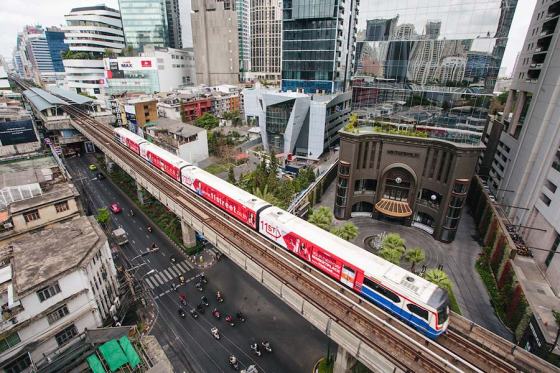
Jiab is noticeably engaged in taking care of M and goes to great lengths to accommodate her needs, cooks the food, does the laundry, drives her to school or, when we are in the apartment downtown, to the BTS station (Bangkok Transport System). It’s an elevated rail track over the streets and rooftops, called the Skytrain and her stop: Phaya Thai Station is only 5 minutes from Ari Station, where we are – get off at the third stop.

That location is linked to the airport route and near the popular shopping center of Bangkok where it’s all young people, and being looked at is the primary concern, while looking at others who look nice, can be a discussion point. M does stand out in the crowd, of course, with her hair colour when almost everyone else has Asian black hair She is extraordinary in that regard, has a pretty face like a child and is slim. Always in good-looking clothes, and so on, also politically aware, asks intelligent questions, remembers things and reminds me about the names of things when I forget.

So we have been very fortunate having M with us, and I’m going to write some more about her soon.

2021 Looking forward.


Smaller than a grain of rice, smaller than a grain of barley, smaller than a mustard seed, smaller than a grain of millet, smaller even than the kernel of a grain of millet is the Self. This is the Self-dwelling in my heart, greater than the earth, greater than the sky, greater than all the worlds. [Chandogya Upanishad 14.3, 8th-10th century BCE]