girl at the traffic lights

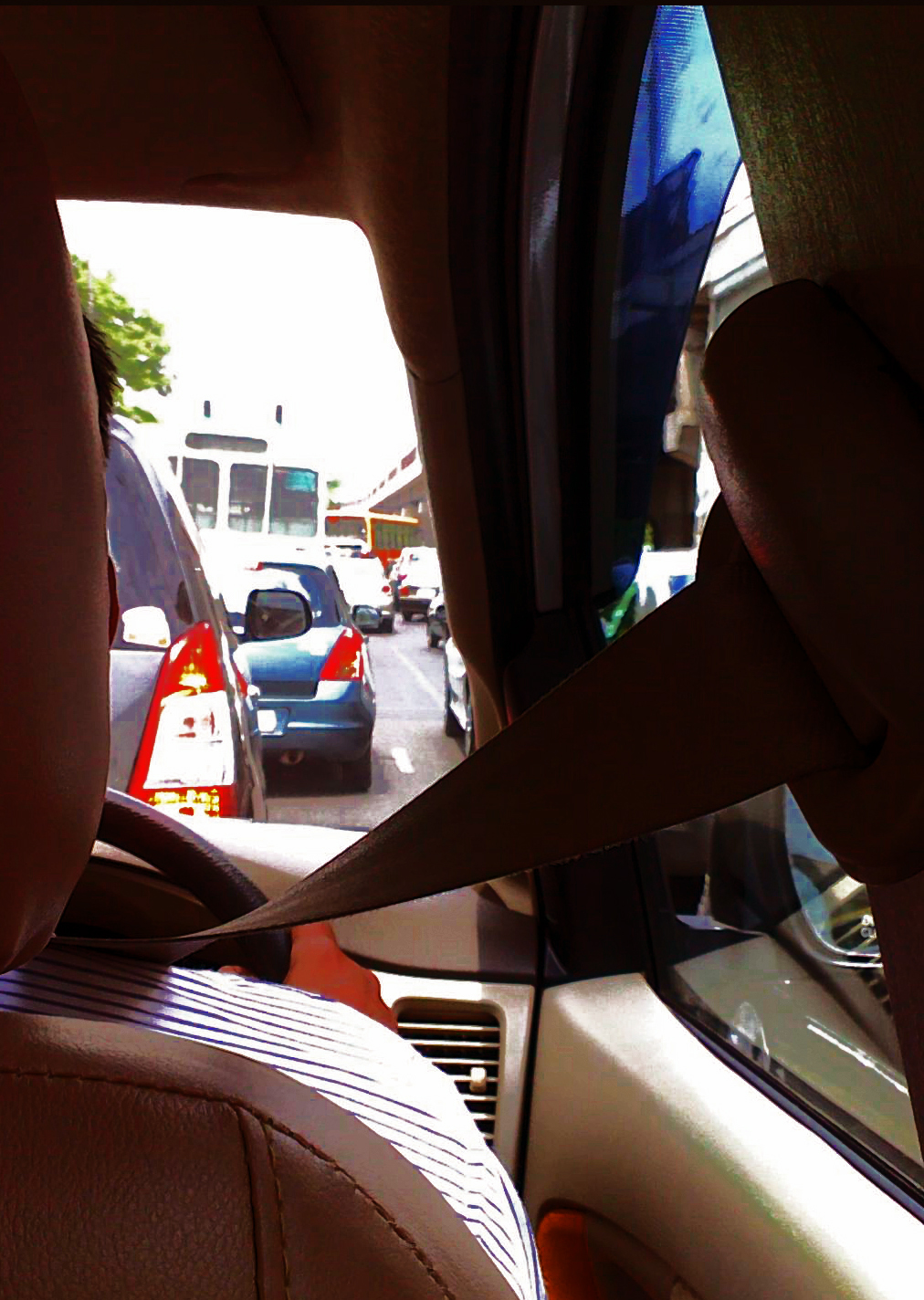
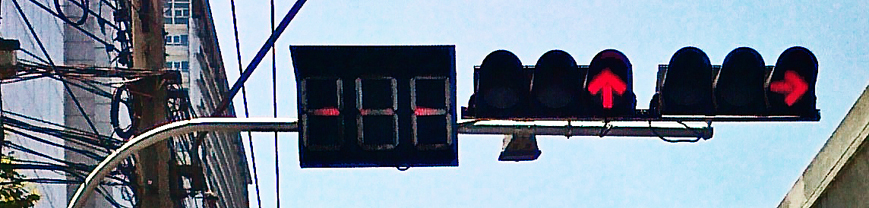
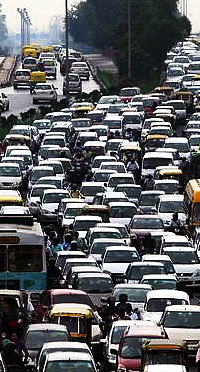
090420131781New Delhi: Sitting in the car, Shym driving, and I’m in the back seat looking out through tinted windows, incognito. Slow down and stop at the traffic lights. Street people and traders walking up and down between the vehicles, selling kiddy’s toys, books, and all kinds of stuff. Children with bunches of wilted  roses knocking on windows, and discussing with passengers in auto rickshaws. One of them presses her face against my window, hands and arms cupped around her head so she can see inside through the tinted glass film. A shadowy head and face spin around looking for where I’m situated in the dark interior. Finds me, then some kind of eye contact, and: tap-tap-tap-tap on the glass with a small coin…. tap-tap. Doing it just to see what’ll happen. Shym puts the car in gear and drives forward a little bit, trying to discourage her but she remains stuck to the glass like glue, walking sideways, legs slightly back out of the way of the turning wheels.
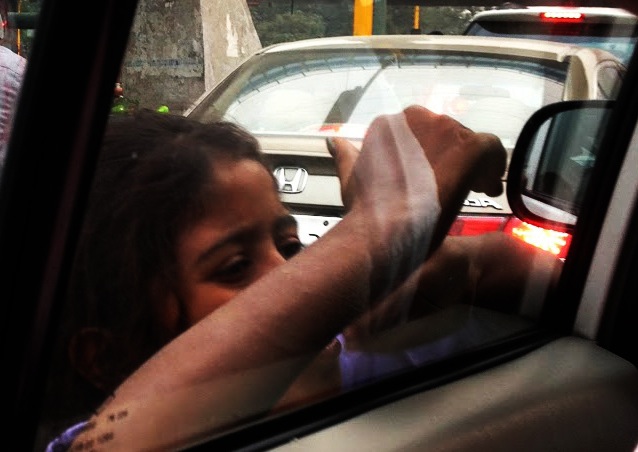
IMG_9171I slide down the window and give her a folded 10-rupee note. Hot street air enters the cool interior of the car like a blast from a huge hair dryer, and I see a dark girl about 9, with hair a light reddish-brown colour, dusty with the street atmosphere. The entrepreneur. How does it look to her? A foreigner gives her money, somebody with colourless eyes, pale, half invisible; like a creature that lives at the bottom of the sea, no sunlight. Her dark eyes hold my attention, intense, penetrating; there’s only ‘the look’. I slide up the window again. Giving her a few rupees is encouraging this kind of livelihood – that’s not really what I want to happen… but what to do? The lights change and we’re off, accelerating through the traffic, overtaking on the left, or the right, wherever there’s a space.
lights1

There’s a small smear on the glass where she was looking in. How does the world seem, seen through her eyes? Must be a no-choice situation; hardship at a level I can’t comprehend – we’re not watching the same movie. But it reminds me of something in the early times in Scotland. In those days I was pretty much caught between polarities. A rocky road. I went down South to England and I’d look at other people’s lives there; unbelievable to me, how their reality seemed to be so… bland? Where I was living you’d open the door of your house to go out and the wind would blow you back in. Extremes of climate, extraordinary confrontations; the rough and tumble. At that time, I didn’t know about the Buddhist perspective on suffering dukkha, all I had was the experience of it. The cloud of unknowing… life was held by random karma. Consciousness was a kind of unconsciousness. Awake but unclear, living in a dream… dum-di-dum. Subject to all the whims and fancies; tugs and pulls. Like/unlike – and for long periods, quite lost in samsaric realms. I thought I could just carry on like that, hoping to muddle on through…

Carefree, at times, and reckless, not happy, no sense of an applied mindfulness other than, okay, so… what’s going on here? Sometimes I was nearly right, other times terribly wrong. I’d weather the storm and somehow things stayed okay. The mistake was (although there are no mistakes) I’d be trying to get ‘it’ to do something or be something or become something (or not become something), without realizing that I didn’t have to do anything with it, or make a ‘thing’ out of it, or have it become anything. Just letting it be there in the background, or the foreground or seeing it in the middle distance, not focusing on it unduly – whatever. So the ‘it’ became not so important; less and less of an identity found in the ‘object’, more like a larger subjectivity. It’s the same for everyone but at the time I thought it was just happening to ‘me’.
AVN_TRAFFICDELI_282719eIt’s not about guarding that little self-construct called ‘me’. The Buddha’s Noble Truth of Suffering is about receiving the suffering as it is, conscious experience. Open wide and let it in so then there’ll not be a self for it to attach to. If I can allow the Suffering to enter, I’m not confused by it or perplexed by the fact that I don’t know why I don’t know what it is. I ‘know’ what it is: maintaining a ‘self’ that isn’t there. So I can let all of that go. It’s about relinquishment, giving it all away – a shared experience. A kind of generosity, like giving money to the girl at the traffic lights; she was there to enable my simple act of generosity (raison d’être for panhandlers). Who knows, maybe she has the wisdom I’ve been looking for all these years. I’ve been caught in delusion, a dull puzzleheadedness, caused by the influence of the painted consumer god, the psychiatric witch-doctors – is it so very different from her world? Failing to see that if my life is never nourished by anything greater than what I need and want, I become cynical and negative. There are some people like that; holding on to ‘self’ with such tenacity, they get old and bitter with disappointment. Offering something to somebody else makes me feel good, brings gladness into my life… ‘The Buddha-Dhamma spreads out from here to all sentient beings throughout the universe. Mettā, loving–kindness and goodwill is generated for the welfare and development of all beings everywhere: seen, unseen, born, not born yet, animals, devils and angels. The whole cosmology of possible sentient beings is included in the practice of mettā bhāvanā…’ [Ajahn Sumedho]

————————-

– G  R  A  T  I  T  U  D  E –
Ajahn Sucitto, for the use of the word: ‘puzzleheadedness’ also edenriley.com and thehindu.com

halfway through the hot season

roofsala2New Delhi: I wake up sometime deep in the afternoon. No need to look at the clock, the haze of light tells me it’s not yet 4pm, the time when it turns towards late afternoon and the cooler evening. So I continue lying there on the sofa, for a while, letting it sink in that I need to go upstairs to the roof terrace and get my laundry off the line – left for too long, the clothes get crisp and semi-baked. In a few minutes I’m upstairs, open the door at the top landing and step out into +40° centigrade, a blaze of mature, afternoon sunlight reflected off the concrete floor and walls. The air is a tangible thing, heavy like liquid, consistency of thick translucent soup. It has weight; there’s a sense of displacing the quantity of it that equals the mass of your body as you walk through – it squelches around the back and over your head and occupies the place where you were a moment ago. The presence of this extraordinary heat causes the mind to create reasons for it. Difficult to see clearly, most of the time I am involved with it (or I am it), depending on perceptions and understanding of the circumstances:

lnvestigating the mind… requires the use of the very thing we want to study. The mind functions as both the subject and object in this case. ln a conventional sense, this limits us to a superficial understanding, possibly coupled with a glimpse of some deeper aspects in the mind (or qualities of mind) that we recognize only through intuition. The superficiality is locked in by our descriptive language that attaches labels to the surface of things, preventing a meaningful exploration of either subject or object. Meditation is the entering into this process. It allows us to penetrate the barrier of chaotic language, taking us beyond rationality and placing the mind’s eye beyond the influence of the intellect.’ [Ajahn Sumano, ‘Meeting the Monkey Halfway’]

I go over to look at the tap where the monkeys come to drink and when they’ve finished, leave the water running and the tank goes dry. Then we have to start up the pump more often than usual. But no sign of any activity here, no puddles, no monkeying around. There’s a large basin full to the brim sitting below the tap. Jiab suggested we put it there, instead of the monkeys allowing the tap to run like that, and they can drink and fool around with the water – generosity. The neighbours would probably not approve of us providing facilities for the monkeys, even though we’re just allowing them to do what they do and be what they are – monkeys. For me it’s a novelty; they’re our near cousins, there’s a mutuality, we have some understanding of how we each see the world.

I was in a taxi one day, passing a garbage recycling area at the side of a road; workers sifting through the trash with long rakes and forks and the whole thing watched by a large troop of silent monkeys sitting in the branches of an overhanging tree. Suddenly this big monkey tumbled out of the tree, so fast I didn’t see how it was done, rolled across the ground and with very long outstretched arm, pointed fingers, grabbed an orange that nobody had noticed lying there in the trash. And in a moment was back up in the branches again, unpeeling it and guarding against covetous looks from other monkeys. I noticed the workers smiled and laughed at this amazing skill. Then the taxi moved on…

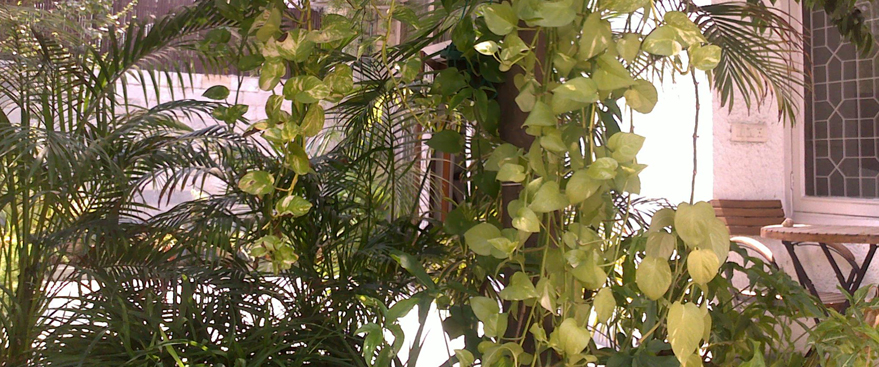
I get my laundry off the line quickly. Held in the fold of an arm, the clothes are hot and burning. Open the door, scald fingers on door handle, step into the stairwell, close the door behind me to stop the furnace heat from getting in. Down the stairs, drop the laundry in the basket and into the L-shaped room; two air-conditioners running, three ceiling fans, and my desk is in there, in the coolest corner of it. Smooth tiled floor where I walk barefoot and all curtains drawn closed to keep out the glare, except for one that offers a shaded view through the foliage of the large leafy tree outside in the garden and the various tints of transluscent green leaves through which sunlight filters. I see in the newspaper today the southwest monsoon arrived in Kerala, South India. Here in Delhi, we’re maybe only halfway through the hot season…

garden1

————————-

‘… the impact of the innumerable impressions crowding in upon man from the world of outer and inner multiplicity, papanca.’ [The Heart of Buddhist Meditation Nyanaponika (Thera)]

Note: The monkey and the orange story developed from a discussion with Lisa A. McCrohan

sustaining factors

monkey-tap-india_1626153iNew Delhi: Monkeys swing through the trees, jump down on to the roof terrace and turn on the tap to have a drink of water. I don’t mind; except that they don’t turn it off when they’re finished, just leave it running – water trickling down the drain from up above – that’s how I know they’ve been there. The neighbours have the same problem. I see somebody climbing up a ladder to the water tank up there at the highest point… what’s he doing? hmmm, replacing the tank lid; the monkeys have pulled it off to get in and drink, and have a little freshen up. Yes, well, it’s hot here, Jiab said around 45°C. Not worth it, being precise about temperatures above 40°, just waves of hotter air wafting around in slightly less hot air, something like being in a swimming pool of hot water. It’s so hot, I feel like a pancake on a hot plate. I don’t want to eat a pancake, I feel I am a pancake… cooked and kept warm. No problem, really, we have a room in the house with air-con, and I’m in there. All I need to consider are these long power cuts, but nothing more than 10 minutes. Longer than that is uncommon. But it did happen once [Link: Power Failure], what can you do? If it happens, it happens – the uncertainty element. Causes and conditions, no more than that. Phenomena are sustained only as long as their sustaining factors remain:

‘When this exists, that comes to be. With the arising of this, that arises. When this does not exist, that does not come to be. With the cessation of this, that ceases.’ Samyutta Nikaya 12.6

I can’t say I’m as detached as that when it comes to coping with stifling heat but knowing that this is how it is helps me to ease off and away from the proliferating stories in the head I don’t know are there because I’m seeing through them [Link to: The World is Made of Stories]. If there happen to be long periods with no air-con, it’s best to go outside, find a shady spot to sit and say hello to the neighbours, who’re all outside for exactly the same reason. Outside is better than in; the heat is trapped in these brick and concrete oven-like buildings. But, so far-so good, most of the time I’m sitting in this cool room.

It’s still early morning but I better get on and cook the food for the day because the kitchen will be like a furnace by noon. I open the door to go in there and enter an atmosphere that could be the planet Mars, images of volcanic slopes and bubbling lava… I have to boil water in the electric kettle, a curious old thing made of metal and if you forget to empty out any remaining water at night, when it has cooled down, tiny ants climb up the side and sit there enjoying the coolness of this small reservoir. Then, for some reason I find them drowned in the water the next morning. I think they must drift off in a dream state and fall in. I suggested to Jiab we just spoon out the ants, then boil the water but this is not well received: I do not want tea made with water that has been swam in by ants! So I’ve learned to empty out leftover water in a bucket to give to the plants.

Kettle boils, add the hot water to the steamer, put in the vegetables and switch on the gas. I can sympathize with the ants, there’s a ceiling fan spinning around, swooshing and splooshing the hot air in gusts and not doing much to lower the temperature. I have to switch it off, even so, when using the gas cooker because the gas flames get blown out and I’d asphyxiate in gas-flavored hot air (limp bizkit, chocolate starfish and the hot dog flavored water – no, no, not that, please…). Switch on the extractor fan, maybe that’ll help. The stove heats up the atmosphere by another 10 degrees and now it must be about 50°C. Strangely, it seems okay because there’s an object in awareness; the heat is coming from that; the gas stove. I don’t notice it’s hot, just standing waiting for the food to heat up, then it’s done and I can return to my cool room…

All there is is sitting in the coolness with this mindful alertness: the possibility that the power may go out any moment. There are more attention-grabbing existential phenomena but this’ll do me… listening for the monkeys and M’s little rhyme she taught me in Thailand comes to mind…

Five little monkeys jumping on the bed, one fell off and bumped his head. Mama called the doctor and the doctor said: “No more monkeys jumping on the bed.” Four little monkeys…

280520131847

————————-

Upper Photo: monkey-tap-India_16761531 GIRISH KUMAR : Message : Animals in News. Lower Photo: Cassia fistula, golden shower tree (the tree the monkeys use to access my roof).

redefining the question

800px-Asoka_KaartNew Delhi: 04.00 hours. Awake at some time of darkness that’s neither night nor morning, getting some coffee and toast ready for Jiab going to the airport for the Gujarat flight at 06.00. Car comes, she gets in, bye… door-slam and she’s gone. Stars shining in the dark sky, then I come inside and look at a Google map of India with Gujarat there on the coast of the Arabian Sea – so that’s where it is… really not that far from Europe. Then take a look at the wiki map (shown above) of the Buddhist routes going out in all directions from North India in the time of Emperor Aśoka the Great, 273 BCE to 232 BCE. It looks like an explosion of consciousness that took place in North India, and spreading out from there; North, South, East, West, along the Old Silk Road directions. It goes West as far as the South-East Mediterranean countries; arriving there in pre-Christian times. Not impossible that the Buddha’s Dhamma had an influence on the Jesus Teachings. Maybe that’s why I had this strange recognition of it, déjà vu, when I first went to Wat Pah Nanchat. Studying Buddhism revealed fragments of an innate knowledge.

Text comes in, Jiab: ‘boarding soon’. It’s a two-hour flight, Delhi to Gujarat. Looking at the map again, I notice wiki uses the word, ‘proselytism’, but it can’t have been like that. There’s no doctrine of God-worship in Buddhism, ‘I believe (I believe) in God (there’s no real Teaching other than belief for me to study). In Buddhism (and Advaita Vedanta and the Tao), the separate ‘self’ is an illusion, ‘a cluster of memories, thoughts, habits and conditioning’, maintained due to this basic human tendency to hold on to stuff. It’s not about that, it’s not about our origin, our Creator or what we are made of, it’s about how the whole thing works. It’s a 2600 year-old teaching about learning how to see what our hang-ups are, and easing the burden. It’s not about living for our(selves): seeking, acquiring and hoarding, it’s about generosity, relinquishment and giving it all away*. It’s about mindfulness and the way things exist, rather than what exists. It’s about realities that fit into our world today, exactly as it was in ancient times. The Buddha anticipated modern physics: all matter is energy; beings exist as “bundles of energies” (five khandhas). It’s not about ‘self’, it’s no-self, anatta, it’s about consciousness, viññāna, and the big question: what is consciousness?

Central_Asian_Buddhist_MonksI go through to the bedroom to lie down for an hour or so; still not yet dawn. Watch the breath, conscious of the sound of the ceiling fan above me in the shadows, constant spinning cycle that somehow says something about the weight of the rotary blades. It looks like how it sounds: a spinning propeller of an old fashioned aircraft – consciousness of the visual image. Always there’s consciousness of something: consciousness of the smell of coffee and a crust of toast in the kitchen, the taste of it; consciousness of the soft bedding I’m lying in. There’s consciousness of thought and then there’s consciousness of no-thought – including my perception of it. Consciousness without an object, the still mind, unsupported consciousness – unconditioned? The non-dual perspective is that it’s like this anyway…. So it’s without an object in the sense that it is different from the basic functions of interacting with the world through sensory organs: eye, ear, nose, skin, mouth and mind; different from the state of being conscious of what’s going on in the body/mind organism, phassa, as a result of responses to the world outside. Not consciousness of… just consciousness itself – what is that? No answer… is this the kind of consciousness that’s needed to find the answer to the question or to redefine the question, maybe, or whatever… is it the true self?

If so, it’s not what I thought it was: ‘…this true self is also the fundamental source of all attachment to being and becoming… attachment to the allure of this primordial radiance of mind that causes living beings to wander indefinitely through the world of becoming and ceasing.’ [Luangta Maha Boowa]

If it’s not that, then it goes beyond words: ‘When all phenomena are done away with, all means of speaking are done away with as well.’ [Upasiva’s Questions (Sn 5.6)]

It all needs a larger context. Some time later, another text comes in, Jiab: ‘having breakfast in the hotel’. It’s 08.30 and she’s nearly 600 miles away….

‘Consciousness cannot be known by mind. The mind is an object. It doesn’t know anything. It is itself known by Consciousness.’ [Rupert Spira – Link to: Spiritual Artwork]

————————-

“If a monk abandons passion for the property of consciousness, then owing to the abandonment of passion, the support is cut off, and there is no base for consciousness. Consciousness, thus unestablished, not proliferating, not performing any function, is released. Owing to its release, it stands still. Owing to its stillness, it is contented. Owing to its contentment, it is not agitated. Not agitated, he (the monk) is totally unbound right within. He discerns that ‘Birth is ended, the holy life fulfilled, the task done. There is nothing further for this world.’ [Bija Sutta: Means of Propagation” (SN 22.54)]

*This post contains excerpts from: ‘Beyond The Dream, Tao Te Ching7: Selfless
Lower photo image: Central Asian monk teaching East Asian monk, 9th century fresco

hold on and let go

2013-04-01 15.24.34New Delhi: Arrived late morning on a flight from Thailand and Shym picks me up at the airport. It’s that feeling of bewilderment; having been scanned by X-ray machines, identified, processed, held in aircraft cabin pressure for 4 hours and transported. Now I’m here, nearly two thousand miles away from where I was, placed on the ground and having to reassemble the parts of who I am in this new context.

Where are we now? Eyes looking out, bright sunlight but not fiercely hot like Bangkok; more like a Mediterranean climate, feels okay. Heavy traffic, drivers with attention-seeking behaviour; the ‘BLOW HORN’ message on the back of trucks says everything. It’s a kind of open invitation to press your horn to say you’re here. Get out of the way! I am coming; it’s me! ‘Self’ is something real, something eternal, according to the Vedas and Upanishads – something that is. Completely different from the Thai Buddhist culture that I’m used to, which says that what we cling to as ‘self’ is really only impermanent phenomena subject to arising, changing, and passing away – nothing of substance.

India is not a Buddhist country, it used to be but the Teaching is more or less unknown today, and the only reason I make the comparison is that I’m often going between these two places, Thailand and India. It’s culture shock, really, happens every time. And now, stuck in this traffic jam, some drivers try to get relief by blowing their horn while we’re all at a standstill. I hear the sound and find I’m vibrating like a bell that has been struck… it’s the argumentative, provoking nature of it: I feel his anger. I forget about this when I’m away – an unavoidable reaction.

Mindfulness, focus on the breath, let it just be there – everything that arises ceases aniccan. In a moment the impact has gone, nothing special. I just need to be careful I’m not indirectly fanning the flames and causing it to blaze up again. I don’t want it to be like this but saying this doesn’t help because ‘not wanting’ (vibhavana) is as much a desire, as ‘wanting it’ is. If I continue to ‘hate’ it like this, I become even more attached to the anger of not-wanting it and cannot easily disengage from that. So, looking for the place that’s somewhere in the middle ground where I can find a temporary abiding.

It’s inevitable that North India looks confrontational when the Thai way is to keep your temper, whatever the situation; the chai yen concept (keep a cool heart). Thais very rarely show their anger. If there’s a problem, Thai people keep it inside… that particular intensity of unexpressed anger, like a pressure cooker that explodes suddenly – it can be dangerous. In 2001 a German motorcyclist, frustrated by the traffic situation, made an obscene gesture to a van driver and was shot dead. The van driver lost his cool. It’s what happens when you don’t manage to hold it anymore, the release is really explosive. In this kind of emotional holding, it can be pretty scary because everybody knows the consequence of a lifetime of intense holding; clinging with tenacity to the refusal to let go, and no safety valve. But not necessarily, Thai children learn about this Buddhist teaching at an early age, and in the right circumstances, most people see it for what it is and allow it to come to an end.

Then some hours later, I’m at the house, and somebody I don’t know is shouting in anger outside my front gate. I go to the window and a man is standing out there under the tree in the shade, talking on his phone in Hindi and waving his free arm. Shym told me the man was expecting to receive some money, seemingly, but didn’t get it and this was his reaction. The fury in his voice was like something Biblical, the wrath of God, I’m immediately intimidated, and the vibration of anger starts up again, it’s like a contagious disease. You just can’t pretend it’s not there – that compelling sense of ‘me.’ After a short while it’s gone, and I’m thankful there’s no ‘eternity’ in my mind: no heaven, no hell. There’s liberation from suffering: the way out, the Third Noble Truth, nirodha, and cessation, no holding. In the emptiness of the moment there is no self, only the stillness of the mind and everything comes to an end…

120420131785

memories and the wind

stonefootCropNew Delhi: Gusty warm winds blow through the trees in the park, rustling the leaves and swishing the branches like the sound of waves breaking on the shore. The pigeons are exhilarated by it, flying over at tremendous speeds past me here sitting on the roof terrace, watching them now swoop up above my head – so actively engaged with the mechanism of flight, it’s as if the movements of their wings and the movement of the air are one and the same thing. A wind like this is energy to the birds; it’s a dance. Flight is an expression of the air displacement itself – flying and the wind – ground level is not the reference point; ‘up’ is not necessarily up and neither is down. I see them caught in rapid flight; a stationary moment in the air, suspended in time and space, then an audible flap of wingtip and change in direction.

This wind buffeting me around, hair whiplash on the forehead and the pages of my notebook suddenly leap and turn over on the spiral binding, fluttering through all my various handwritten notes over the last month. In this way, the wind blows through ‘mind’, stirring memories and things from the past, held for years, and released, they come flooding into present time. Each memory stays as long as it takes to examine, and the fullest extent remembered, like meeting an old friend. Time disappears for how long it takes to tell the story and, towards the end of the memory stream, the space behind is seen shining through, the images become transparent and vanish.

The next memory arrives after a moment, I examine that and it disappears like the others. It goes on like this, a collection of things from long ago and far away. Allowing thoughts to go by, unheld, uncaught – the opposite of catching fish; consciously unhooking fish-thoughts caught in the mind at some earlier time; letting them go free and they swim away. Memory stream moves from one moment to the next and I can’t actually see these moments… is this it? Is this the next moment? Is this it, now? Can’t be measured like that; just the circumstance itself; the situations and occurrences follow one another – not a sequence in time, it’s dependent on the nature of the events, there’s a linking that groups them together like coloured beads strung on a necklace.

Going back to Thailand tomorrow where it’ll be hotter than a locked laundromat dryer. Ah well, better go pack my bag now and… has the next moment arrived yet? The mental images and fragments have reformed themselves in the endless stream of things? Can we say, possibly, yes, this is, actually  the next moment? If so, I must have missed it, everything seems like it’s in the past again…

————————-

[Includes excerpts from: Birds on the Balcony 4]

‘Unhooking fish’ taken from an original idea by TJH
Photo image: dreamstime

space and thoughts

white buddha dreamstime

New Delhi: It’s that Sunday morning feeling again; so silent, the neighbour’s dog feels uneasy about barking too loudly – maybe there’s nothing to bark at. Sadly, it walks to its place on the balcony and looks out… nope, still nothing happening out there. No intruders on the property, no people anywhere to be seen. The world is asleep… the zzz, zzz ZZZZZs, slow breathing of sleep; the no-work-today comfort zone. No need to get up until early afternoon. Sleeping off the excesses of the night before; dinner started at 10pm and the party went on until sometime after two o’clock in the morning.

I didn’t get to sleep until late but it wasn’t because of partying, it was the neighbour (not the ‘dog’ neighbour, the other one). These people decided to have a medium/large social event last night – verging on the mildly-obstreperous. The noise and kerfuffle became kinda abstract to me, drifting in a coma of half-sleep, sounding not like people having a party, more like a party among the animals at the zoo; two or three hippopotamuses (hippopotami?) trying to get comfortable in a room too small for them – getting up and sitting down again and disturbing each other in the process, smashing small breakable things, reversing into corners and making squelchy sounds along the side of the wall with their great weight squidging around awkwardly. Slightly frenzied but not ‘losing it.’ A bit farmyardish too, with yelps and howls, crowing chickens and meowing cats and geese and ducks; somebody with hiccups. On the other side, the dog barking on the balcony – dogs of the mind bark – and the whole thing reached a kind of pandemonium of people talking over each other in a flowing jibberish of words, scraps of music mindlessly playing in two different places, punctuated with the odd crash, squeak and shout. Other percussive noises, the smell of beer floating out into the air and a cloud of cigarette smoke from men standing outside the house, speaking on the phone, lengthy shouted monologues in a language I don’t understand.

It’s really noticeable that the mind grabs at something immediately; velcro fastening, unpleasant rip as it comes apart, so you leave it attached: Yep, I could get really angry about this… There is nothing pleasant about this feeling at all, no reason for it to be there other than simply the desire it has to adhere-to, and ‘be’ something. It’s ‘birth’ in the Buddhist sense. No matter how mindful I am, there’s that driven brooding thing, the scenarios of outrage. I concentrate on letting the mind untangle itself from the problem; just letting it get on with it; it goes away for a while. Then it comes back again and eventually I move through to the front room, wrap myself in a blanket, sit on the cushion, and get ready to remain there until it’s over – watch the breath…

See where the mind leads, where it goes how it reacts to ‘me’ trying to hold it, how it is able to concentrate and how it does that. A bit like getting to know it as if it were a stranger, rather than thinking it’s ‘me’ and I can control it. It really is undeniably noisy next door, it needs attention and I give it what it needs and what’s left over gets focussed on the struggle to be in a state of peace – not a placid thing, mostly it’s like swimming in dangerous waters, but knowing that as long as mindfulness is maintained, there’s no threat at all from the carnivorous species of the deep. Just letting them be there. Anger/distress is a passing mental state, same as everything else, nothing special.

There is the body, the heat, the cold, the hard, the soft, and the thinking mind starts to drift. Let it go where it wants; a sense of travelling behind it, follow it, be curious about where it goes. Disengage from the attachment, just enough to feel safe from the slings and arrows of outrageous fortune, flying around dangerously and ricocheting off the walls and ceiling.

There is Rupert Spira’s example [Link below] about a room filled with people. ‘I’  am the space in the room, the people are my thoughts and images, bodily sensations and world perceptions. All kinds of people in the room, large, small, kind, unkind, intelligent, unintelligent, loud, quiet, friendly, unfriendly, etc…, each doing their own thing. But what they do or say has no effect on ‘I’, the space of the room. The space is there now and it will be there when the people go home. The space, is/was there before the building was constructed and will be present after it is demolished, it’s always present.

Now it’s later, the morning after. Am I the only one awake? So quiet, the electric hiss of the computer seems loud. It may have been on a morning like this, in those historical times, that Siddhartha Gotama, the prince who became the Buddha, woke up in the rooms in the palace, where the  endless parties had taken place, surveyed the devastation of spilt drinks and furniture tumbled over, and seen the true reality of the event… he just knew, this is not where it’s at. Left the palace, gave away everything he possessed and set off across the landscape…

————————-

‘Our objective experience consists of thoughts and images, which we call the mind; sensations, which we call the body; and sense perceptions, which we call the world. In fact we do not experience a mind, a body or a world as such. We experience thinking, sensing and perceiving. In fact all that we perceive are our perceptions. We have no evidence that a world exists outside our perception of it. We do not perceive a world ‘out there.’ We perceive our perception of the world and all perception takes places in Consciousness.’ [‘The Transparency of Things’, Rupert Spira]

only the world ends

five_dhayani_buddhas2

‘The world, ‘loka’, is the world as we experience it: sight, sound, smell, taste, touch, thought, emotion and feeling – my world, your world. It’s not the abstracted, geographical planet, universe-type world. It’s the direct experience of the planet, the people and the cosmos. Here is the origin of the world, the cessation of the world and the way leading to the cessation of the world.’ [‘Consciousness: Invisible, Radiant, Limitless’, Ajahn Amaro, Buddhadharma, December 1st 2003]

New Delhi: Power cut and everything in the house goes totally black; streetlights are out too, the whole thing…. Use my phone as a torch, an island of light and fumbling for matches. A candle placed exactly for this eventuality; strike a match, some comfort in the small light and scented flame. Okay, so how long is it going to be? Listening to all the generators out there like a fleet of helicopters has landed in the street, rotor blades whipping round – time passes, yep! it’s going to be a long one. Go through to bedroom, get into bed with clothes on because it’s cold, heating is out too.

Unexpected, unplanned situation. The warmth of bedding, face on pillow cover; no other input from the outer environment except sounds coming from the freezer in the kitchen: creak, crack, creak – ice is starting to melt. Listening in the silence between the creaks, no other sounds, only this; the listening action, and that small space before the thinking process is engaged. What is it that is aware of this? Consciousness removed from the sensory experience of everything I see, hear, smell, taste, touch, feel and think; outside of the elements: earth, water, fire, air – and not held by time.

Unsupported consciousness, an awareness that’s different from the basic functions of interacting with the world; distant from the usual state of simply being aware of what’s going on in the body/mind organism and that’s enough – living in a dream; the deluded not-knowing state and random karma: ‘a tangled skein of thread, a woven nest of birds, a thicket of bamboo and reeds…’ The thinking thing gets a hold, loves it, hates it; tries to control it, tries to figure it out. And beyond all of that is the unsupported consciousness. It’s there that my curiosity is drawn.

Some controversy over viññanam anidassanam, a synonym for Nibbana, the unconditioned consciousness, non-temporal, the consciousness that is outside of everything and includes it all. Theravadin extremists argue that this leads to the idea of a soul and the god/creator thing we’re familiar with from church conditioning. I’m reminded that all the Teachings were intended to be tools to assist in our awakening. We don’t attach to them, develop a clear mind, let go and see for ourselves.

Blinding light, suddenly, all the lights in the house start up at the same time. Generators outside shut down, fridge begins to hum, water heater starts to hiss and bubble. I go through and start the computer, find the page about Unsupported Consciousness by Ajahn Amaro: ‘In describing unsupported consciousness, the Buddha taught: “Wherever there is something that is intended, something that is acted upon or something that lies dormant, then that becomes the basis for consciousness to land. And where consciousness lands, that then is the cause for confusion, attachment, becoming and rebirth, and so on. But if there is nothing intended, acted upon or lying latent, then consciousness has no basis to land upon. And having no basis to land, consciousness is released. One recognizes, ‘Consciousness, thus unestablished, is released.’ Owing to its staying firm, the heart is contented. Owing to its contentment, it is not agitated. Not agitated, such a one realizes complete, perfect nibbana within themselves.” (Samyutta Nikaya 12.38 and 22.53)’

————————-

 ‘… the Buddha asked his disciples, “If there was a house with a wall that faced out towards the east and in that wall there was a window, when the sun came up in the morning, where would the shaft of sunlight fall?” One of his monks replied, “On the western wall.” The Buddha then asked, “And if there’s no western wall, where would the sunlight land?” The monk answered, “On the ground.” Then the Buddha responded, “And if there’s no ground, where will it land?” The monk replied, “On the water.” The Buddha pushed it a bit further and asked, “And if there’s no water, where will it land?” The monk answered correctly when he said, “If there is no water, then it will not land.” The Buddha ended the exchange by saying, “Exactly so. When the heart is released from clinging to what are called the four nutriments—physical food, sense contact (sight, sound, smell, taste, touch), intention and consciousness—then consciousness does not land anywhere. That state, I tell you, is without sorrow, affliction or despair” (Samyutta Nikaya 12.64).’ [Excerpt from Ajahn Amaro, ‘Attending to the Deathless, Buddhadharma, December 1st 2003]

Note: ‘Only the World Ends’ is the title of the autobiography of Ajahn Tate, translated by Jayasaro Bhikkhu.
Gratitude to Fierce buddhist  for the image used in this post header

quicker than thinking

140220131706

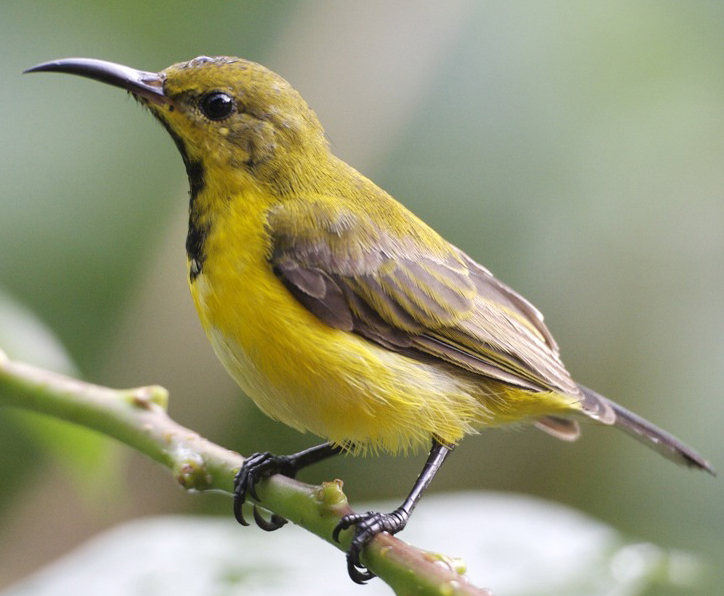
New Delhi: Sitting under the thatched shelter built on the roof terrace here, watching a small bird about the size of a large bee, so tiny! Is it a relative of the humming bird? Wikipedia says it’s a Purple Sunbird, less than 10 cms, the male is a kind of black-purple. This one, I see from the photo, must be the female, a more sedate olive green. Yep, this is the lady Sunbird, so small, it’s like it’s almost not there at all; takes my breath away. How can such a thing exist? A delicate speck of life, fragile and light; there’s birth and there’s death and there’s the bit in between. That’s where the Sunbird is, so brief… I suppose these tiny birds have just evolved like that because predators can’t catch them – always one step ahead of everything. Its movements are immediate, now here, now there; the quality of sunlight – elusive, a flicker of pure reality. Not like a bird, more like the shifting of my line of vision as I try to follow where its gone, then my conscious seeing of it in another place happens at the same time as the actual presence of the small creature itself, perched on a twig and ready to dart off somewhere….

olive-backed-sunbird-878cd193cd11f74dfc50b102c567baa7The alertness of the Sunbird is having an effect on me, how to identify this? It’s as if there’s a space between the things we take for granted and ponder over; a small gap, there in the absence of the object that has not yet arrived. The Sunbird gets to that place before we can even think of it being there. Faster than thought. I’ve noticed a few references to this space before something happens and after it’s finished; recently found it in the context of the short emptiness just before giving way to an emotion [Kadampa Life calls it ‘an inch of space’. Follow this link: Being realistic]. There’s room to move before giving way to an automatic thought response. There’s a moment before cognition locks in; a gap in time, quicker than thinking that allows the mind to see it all as it is – a small window opens and we see the whole thing passing by, sorry, can’t stay, got to rush, bye! Off it goes in a continuation of its itinerary, if it comes around here again, everything will be completely different; we may not remember it was this…

My eye follows the little brown bird as it flits and hovers from flower to flower and doesn’t seem to mind me being here quietly watching. Then it flies over the parapet of the roof terrace, hesitates there in the air, buzzing wings, makes a decision to go left and down, veers off in that direction and it’s gone…

————————-

‘This awakened consciousness, as pointed out by the Buddha, is not conditioned as with the six kinds of consciousness (the six sense-doors: eyes, ears, nose, mouth, body or mind), neither being part of the natural world (earth, water, fire, and wind), nor having size, being neither long nor short; it is without texture, being neither fine nor coarse; it is without moral quality either, being neither pure nor impure; neither is it psychological in nature (nama) nor physical (rupa). It is invisible, limitless, and radiant.’ [Ajahn Sumedho, ‘Awakened Consciousness’]

being here

131120121589

New Delhi: This is the 100th post! I feel like I should celebrate, I’m a blogger centenarian! But still a youngster, I think. Many bloggers are much older than me. So, what’s going on here? This blog is about the Buddha’s teachings, Advaita Vedanta, non-duality. I went public on July 6th, 2012 and I’ve been putting up new posts every three days, mostly, since that time. Now it’s ‘The One Hundredth’, and I was going to use that title for this post but it’s been used already – the 100th in the TV series: ‘Friends.’ The dhammafootsteps blog is, of course, about reaching out to friends, but the discussion is about just being ‘here.’ We’re all here in our various states of being, in different parts of the world; in different time zones and we’re all individually contemplating our own experience of being ‘here.’ Blogging is a good medium for this kind of thing because, just being ‘here’ is what everybody is talking about or describing, one way or another – isn’t it?

Here’s something from: Beyond The Dream: ‘…the awareness that looked out of our eyes as a five year old is the awareness that’s looking out of our eyes now.’ When I read that sentence it had a curious effect; there was an instant understanding of what being ‘here’ means. Then the next thought was, what is ‘the awareness’? And it’s a good question, that one, you can just go on asking it…. It’s like trying to understand sati-sampajañña, clear comprehension; what does that mean? And maybe I’m off somewhere searching for the meaning of clear comprehension, overlooking the fact that all the confusion is still there in my head. So, I’ll never find clear comprehension that way, because every time I think I’ve found it, the confusion just jumps up in its place. Eventually I realize clear comprehension means understanding the confusion. It has to be that way; clear comprehension of the confusion, and not some kind of desired state of clarity that doesn’t exist. The confusion is, I can’t see reality because I’m too engaged with the idea of it.

In the West we suffer from the creator-god condition; God made the world so the world and God are two separate things. I see the world from some impossible place outside of it; I’m on shaky ground here, in control mode, there’s the paranoia of thinking I can’t let it go and the fear of having to hold on indefinitely. All the clutter and stuff and mental goings-on and stumbling over all the indistinct, half-seen, misunderstood truths – believing that this is what life is about. Not able to see that it just doesn’t matter what kind of story is showing on the screen, it’s all fiction, created by the mind, arising and ceasing, dependent on causes and conditions and the karmic outcome of past events.

The mind doesn’t create awareness, mind is contained in the awareness. It’s something like, awareness is there, I just think I can’t see it. Thinking I can’t see it, is another mind moment that exists temporarily in the awareness. Being here is about getting to know everything there is to know about what that means….

————————-