before the story begins

270420131799Delhi/Bangkok flight: People don’t normally go to Thailand for their holiday in the middle of the hot season – highs of 40°C –  mad dogs and Englishmen… No passengers, plane is nearly empty, fortunate for me with this back pain I’ve had for more than a week now. I set off on this journey knowing that really the last thing I’d want to be doing is getting into the overcrowded economy class section with no room to move. But the good kamma of plenty room today, I can position myself in the chair so there’s no discomfort and able to quietly contemplate the clouds in the sky. Everything seems so still, not really comprehending the phenomenon of travelling at 500 mph – 1 mile in seven seconds? I count to seven: 1-2-3-4-5-6-7 and one mile further on. Hmmm, it feels like everything is stable and down-to-earth; stewardess smiles sweetly: something to drink sir?… I feel I’m a bunch of time-stretched-out spaghetti strings, going most of the way back to the point of departure.

Consciously watch the breathing and the mind settles. Soon there’s the quiet space of no thinking. Watch the breath for a while but then, after a moment, something triggers thought again. A story starts up and I remember Lisa’s post, Doing Nothing Out of Anger: ‘…we have to get the story of it going in our head’. Without the story, it doesn’t happen. Usually you fall into it and it’s more to do with convincing yourself it’s like this, rather than it actually really being ‘this’. But there’s the small space just before it locks in and I can see that this is the last opportunity to consciously let go of the story-building, and be aware of the unchecked habituality that’s there for no good reason.

I read something about this in Rory’s blog/Tao Te Ching 12: The Inner World: ‘It’s been estimated that we think around 60,000 thoughts each day… probably over 90% of them are simply recycled from yesterday and the day before…’ Thoughts about absolutely everything – most of the world is inside your head. No wonder the space of no-thought is such a novelty to discover, no stories unfolding. Training the mind to consciously monitor the randomness, yoniso manasikara, contemplate the act of thinking with focus and concentration.

Mind settles again in the space of no thought, no end, no beginning, everything is always in present time, no past, no future… then, in the mind’s eye, I’m with my mother in the Care Home, holding her hand and she stops breathing, I see the moment she dies and it’s like her last teaching to me: this is how you die son, just watch me… and I see her move from the present into the past – forever.

A long time spent coming to terms with the fact that all of that is now irretrievably in the past; there are memories but if I don’t start the thinking process, there’s nothing there. Sometimes finding myself cast away on a small island of thought with stories like this, then the peace returns, sound of the aircraft. No thought, not trying to find it, not engaging with the story of it. We’re all just seeing ‘the seeing of it’. There’s something about the human reaction to the world, sensory organs mostly positioned around the face, so the head moves in response to functions of eye, ear, nose, tongue, skin and mind – the mind and stories, the ubiquity of the story.

The story is everywhere and it’s necessary to see the input clearly and the habituality. As far as possible let there be no reason for Mind to step in and take control, create the story of ‘me’; someone at the receiving end and the whole subject/object duality starts up. Without that there’s just the sensory receptors and our shared world. There isn’t anything else to be done; only to ‘see’ the reality – seeing the seeing; awareness of the awareness; knowing the knowing. ‘I’ am not creating it. Awareness has somehow sidestepped that. Seeing the events without the story.

On a journey like this, you somehow think that, at the destination, that’ll be the end – no more stories. But you arrive and there’s just another set of stories going on and we’re always only part the way through whatever story it is – same as what’s going on with everyone, everywhere else in the world, all at the same time.

Landing at Bangkok, yawn and swivel the lower jaw to release trapped air in the cranial passages; ears go ‘pop’ and a whole new 3D sound enters…. didn’t realize how cotton-wooly it was before. Ah well, so which gate are we coming in at? There’s a long walk to the domestic terminal and the next flight to Ch’mai…

————————-
dimensions of pain

DSC00134 Lake Wanaka - near Diamond LakeI WAKE UP FROM THE DREAM to find I’m shipwrecked on the sofa, notes and papers strewn around, a cold cup of coffee – how long have I been asleep? Turn to look at the clock, then the pain; lower back pain, oh… aaah! Yes, I remember now, I’ve been disabled for a few days and situated on the sofa mostly: pain is bad – I must have done something ‘bad’ to deserve this… the tendency to criticize oneself for having the pain, perpetuating the kamma of causes and conditions. I need to correct this frequently. Another thing is that I’ve had the pain often enough to know there’s a difference between the pain itself and the act of resisting it; also the attachment to wanting it to go away: I-don’t-want-it-to-be-there…. Profoundly desiring it to not-exist, vibhava-tanha, but I’ll not find any peace in attempting to gratify that need – although I may persist in trying. What to do? There’s nothing I can DO about it, except try to get comfortable and see how that goes. It’s a no-choice situation and, strangely enough, things start to improve as soon as I stop trying to do something about it…

Some years ago I had abdominal surgery (abominable abdominal surgery – no joke) two operations, 6 months apart. Just enough time to recover from the first before getting ready for the second. More difficult the second time around, because I knew what was coming. The first time it was unplanned, an emergency, severe abdominal pain, straight into the emergency room in a Bangkok hospital and admitted right away; something sinister and twisted in the large intestine. So I sign the no-liability form and get operated on the next day. The surgeon tells me after I come round, he’s removed two tumors together with a length of intestine – doesn’t tell me how much, I didn’t ask, and he also says he’s my closest friend; nobody else has ever left their handprints on my intestines!

Colonic cancer, I was lucky. In both operations the post-surgery period was dramatic. After the anesthetic had worn off, the pain arrived suddenly, right there in the centre of my physical being – absolutely no getting-away from it. The immensity of it occupying all the space and I’m backed into a corner. No escape, the only way I can go is forward, step into it. No choice, but dropping the resistance to the pain caused a moment of ease to arise, just before being swept away in the pain… wow, how did that happen? Clutching at straws: an insight, a tiny one, but it made a huge difference. There was desperation all around but just enough of an easing in the pain to tell me that whatever it was I’d done was good so how to do that again?

This back pain is the same kind of thing, but less intense, not erratic and scary. So I can allow it to be there. In contemplation of it, I see there are the other systems of the body all around the pain, normal stuff, just quietly ticking over. There’s sufficient space to distance myself from all the immediate responses to this pain; the obsessions and fears, mostly a conjured-up conceptualizing where, in different circumstances, like intense joy, it would lead to everything being compellingly interesting. And, in the same way, when I have intense pain I’m subject to fear and wild imaginings: ‘your joy is your sorrow unmasked. And the selfsame well from which your laughter rises was oftentimes filled with your tears.’ [On Joy and Sorrow by Kahlil Gibran]

Conceptualizing is an automatic default that returns always to that same starting point: the ‘self’. Unless something propels it right out of there (like what happened to me in surgery) there’s nothing beyond this, no real insight into finding the way out of pain. But what the Ajahns told me about the Buddhist teaching is that the mind is not self. Mind is the sixth sense – everything I see, hear, smell, taste, touch, feel and think. The mind sense usually leads to a consciousness of how everything is coming in from the outer world through sensory experience and that default to the sense of self: hey, this must be happening to ‘me’. With insight, the mind sense can bypass that, and then the pain is not happening to anyone – there’s no ‘me’ engaging with these thoughts. Instead there’s an awareness of the thinking process with no attachment, mostly abiding in a state of mindfulness and careful receptivity, sati-sampajañña; just looking to see what it might be. There’s a kind of alertness about the sensory function, and the simple curiosity: what is it? Just being open to what this could be, is enough to understand how it works…

————————-

Photo image by Louk Vreeswijk, New Zealand Collection

strange familiarity 1.

DSC00234 Wairakei Geothermal Power

‘…(it) is not an effort to achieve something. It is a state of effortlessness. It is a state of no-action. It is a state of tremendous passivity, receptivity. You are not doing anything, you are not thinking anything, you are not planning for anything, you are not doing yoga exercises, and you are not doing any technique, any method — you are simply existing, just existing. And in that very moment… the sudden realization that all is as it should be…’ Osho

————————-

New Delhi: Emerging from these long dark tunnels of constructed thought, blinking in the bright light of the present moment – it’s always the present moment, no matter what you call it; today, yesterday, tomorrow – it’s just knowing it is, that’s all. And even if you’re living in a dream where it’s always tomorrow, the present moment catches up with it and becomes now again – then it’s gone: ‘…now we are in the concept of now’ [Moojie]. Thinking about ‘now’ in the darkness of 05.00 hours at my desk; laptop feels hot and it’s a slow internet connection… just this large white open space where the page should be. In the tab it says, untitled and in the toolbar it says, about:blank, unstated presence. I have to wait for it, balanced on the edge… anticipation of it filling my vision with colour…. unfulfilled. Yet there’s something that I actually like about this, an emptiness that triggers the letting-go thing. I used to get caught up in that stressed feeling but today there’s a great easefulness spreading through the neck, shoulders and facial muscles. If I’m not feeling totally tensed up, waiting for something that I feel ‘should be’ loading faster than it is, there’s just this sense of letting things be as they are. It’s like a deep inbreath, filling the chest cavity from top to bottom, and the long outbreath becoming a ribbon of road in a landscape, reaching out there to a vanishing point on the horizon.

Some time after that, the page loads but I don’t notice it because I’ve wandered through to the kitchen and standing there considering the cavities and space above and all around and this strange familiarity (?) of the body/mind conscious state present here, in itself, since birth. Jiab comes through, says quietly: what you doing in here? And we talk for a bit about this thing called existence, connectedness with everything and all living beings… sharing it with others – like sharing a meal with guests, a basic sense we all have, just the feel of the air and the experience itself…. Jiab says: let’s make the breakfast then, shall we? And it changes to something else, another episode, and a different story… cessation, THE END, no layers or filters. Just trying to understand what that sort of thing might possibly be, is enough to begin to know it; to know that all that’s left are events and situations immediately associated with mind states as they arise – the result of kamma created in earlier times. The mindfulness (and whatever it takes) to allow it all to unfold, to be here and to pass away, annican, no holding….

————————

‘Thus everything lingers only for a moment, and hurries on to death. The plant and the insect die at the end of the summer, the animal and man after a few years; death reaps unweariedly. But despite all this, in fact as if this were not the case at all, everything is always there and in its place, just as if everything were imperishable. The plant always flourishes and blooms, the insect hums, animal and man are there in evergreen youth, and every summer we again have before us the cherries that have already been a thousand times enjoyed. Nations also exist as immortal individuals, though sometimes they change their names. Even their actions, what they do and suffer, are always the same, though history always pretends to relate something different; for it is like the kaleidoscope, that shows us a new configuration at every turn, whereas really we always have the same thing before our eyes.’ [The World as Will and Representation, Arthur Schopenhauer]

Photo: Steam clouds at a Power Plant in NZ, by  Louk Vreeswijk
This post is inspired by: LIFE AS IMPROV.COM what is meant by now and the Moojie video at the end. Also: AWAKE AND FINDING PURPOSE.WORDPRESS.COM The spiritual path. And the fisherman and the businessman.

inevitability of circumstances

the-fool-300A LONG TIME AGO I had the idea to write a book. It was 1983, I’d just started travelling around Asia and all this colourful, exotic stuff around me, I’d never seen before. So I started making notes. That was okay but I got stuck with it; no story-line, no plot and, for a while, I thought the story could be a kind of unfolding of events as they went along… but this was too wide, I needed to narrow things down a bit. Too complex, it’d give me a headache. I kept on making notes, anyway, believing that a story would reveal itself in the course of time, but it never did and I never figured it out. Years went by and I just carried on with more and more notes. Now I’ve got five A4-sized ring folders of typed notes I managed to print out from an old hard drive just before it finally crashed about 10 years ago, and I’m scanning these back into text files bit by bit. Also there are all these little old notebooks full of scribbles I have difficulty deciphering today – it’s like they were written by somebody else. I’m telling you this because this is how the blog came into being. The posts are developed from these old notes; you could say, altogether, this is the book I never wrote.

The difference is there’s a distance now that wasn’t there then. There’s no obvious author, thoughts without a thinker, it’s very much more indirect than it was. There are these faded old notes written by the younger me, on yellowing paper, etched into the surface with a dried-out ball-point pen and I don’t remember half of it. Now they seem to be a bit reckless, stepping into that magical world of heightened feelings that generates a kind of gripping intensity: the experience itself… what’s this? what’s that? Things had to be written down quickly before they’d disappear and I’d not be able to remember, suddenly –  wow! gone, they’d vanish and all I’d have were the fragments of their being there.

Of course, it was stress all the way; trying to hold on when holding-on wasn’t needed. The urgency of it going past too fast, whole scenarios flashing by like buildings seen through the windows of a moving vehicle and you see this shadowy reflection of yourself in glazed shop windows, looking out from a taxi or bus or car and always in the same position: the point of reference… Then I started to slow down, one thought-moment, then another thought-moment – we can’t have two thoughts at the same time – thinking is the linking thing. And eventually I arrived at an understanding that this is what the process is; a mindful effort to experience consciousness of the real live situation as it’s going along. Haphazard things that before just seemed to fit in as happy coincidences, came to be more like a recognition that all things are related anyway; similarities that link parts of the story together in a kind of inevitability of circumstances.

Jean_Dodal_Tarot_trump_Fool

So there’s now this quiet familiarity, and it’s more relaxed. Being free of the great rush that lasted all these years, I reckon I’ve arrived… yes, that’s it, the purpose in life has been achieved. I can see, though, there’s also something here that tells me it could be that I’m just experiencing normality. Isn’t this just ordinary reality? Isn’t this, in fact, the place where ‘normal’ people abide all their days, and what’s been happening is I’ve been practising brinkmanship, acting slightly mad all these years and have only returned to ordinariness? Ah well, whatever… I’m pleased because how could you not be? How much better and more mindful it is now compared to how it was then. And, okay, the transformation from that to this maybe makes it seem like something more than it is. Well, ho hum, it could be that the release from that samsara is all that can be achieved in one lifetime and just being happy with small miracles is all there is – nothing else needs to be done. So I go on here in this quiet place with the pleasantness of simple things and every day seems quite wonderful.

————————-

Upper Tarot image of the Fool: http://tarot-lovers.com/the-fool-detail.shtml
Lower Tarot image of the Fool: http://en.wikipedia.org/wiki/File:Jean_Dodal_Tarot_trump_Fool.jpg

seemingly continuous

BtnBuddha2Chiang Mai: 05.00 hours. Darkness of early morning. I can hear a motorbike some way off, coming nearer, and voices talking loudly. They’re shouting to be heard over the sound of the engine. The motorbike passes below my balcony on the third floor, sound fills the room, and I realize it’s the driver with a friend on the back having a converstation as they are going along. Curious acoustics here in this narrow street; concrete and glass buildings face each other. The sound of the two voices disappears quickly past my windows and moves on further down the street, contained in the little capsule of their moving world. I hear it again, faintly now, and fading into the distance.

Strange dream-like event; receiving pieces of an animated conversation moving past me at 30 mph. Then it’s gone from my auditory awareness and (I assume) is being heard by other people further along the street. There’s something here about consciousness creating a sense of continuity; like how you string beads on a necklace and it appears to be one whole piece. A continuous stream of individual events taking place and, in the context of the body, it appears to be one, on-going connected reality – an illusion. When I wake up in the morning, it takes a moment, and everything is a development of the night before.

It must have been the motorbike that woke me up; windows wide open all night in the hot air, with just the mosquito mesh separating me from the world outside. Only 20 miles to go, straight up in the sky, before you reach outer space; no gravity, the universe (where did I read that?). Wow! outer space is so near, half an hour’s drive to get there, if there’s no traffic problem. So, what does that feel like? I suppose it feels pretty… precarious, balanced on the end of a flagpole fixed on top of a monument – the absolute verticality of it… quite scary. The only thing that gives me any sense of stability is the ‘self’ I’m inclined to depend on sometimes? No wonder there’s this tremendous attachment to it; can’t let it go, irretrievably lost in thought; I am contained in this body, stumbling around in this small area I inhabit, on the surface of the planet. I am a bit uncomfortable with the reality of what exists only 20 miles above my head. And go through life assuming that all there ever is, or all there ever can be, is ‘me’; the experience of a created self.

I hear a sound, and think: if that sound is out ‘there’ then I must be hearing it in ‘here’: the subject/object duality: ‘I’ am my body, I am my feelings, I am my consciousness and everything else (that’s not ‘me’) is out ‘there.’ In here, I’m me, I have a personality, it’s myself. And Bert0001 refers to it as: the ‘my’ in ‘myself.’ A distinct feeling of focus that disincludes other evidence – it’s all about me. Fortunately, I can understand and know that the idea of a self just seems to be there, seemingly continuous – a kind of mirage. Delete the ‘my’ from ‘myself’ and I’m free of all the tugs and pulls of likes and dislikes, emotions are not ‘my’ emotions, they’re just emotions; things that happen – liberated from the papañca, proliferating concepts, and concocted thought trying to make something real that’s just not real at all.

I’m glad to be awake early, leaving this place tomorrow and I’ll have to pack bags and get ready. Why can’t I just walk on to the plane not check in any bags at all, only passport, ticket and the contents of my pockets? Why bother with luggage? Ah… if only life were so simple.

Some time after this I hear the Tuk-kae lizard chuckling in a corner somewhere: tuk-kae-tuk-kae tuk-kae. And the Coucal, (whoop-whoop bird) (centropus sinensis) clambering around in the branches; whoop-whoop-whoop-whoop-whoop…

————————-

‘Just as a monkey moving through the forest or the woods holds on to a branch, lets it go and holds on to another; in the same way what we call viññāṇa (consciousness) arises as one thing and ceases as another, by day and by night.’ [SN.II.95]

References in this post: Sue Hamilton: ‘Identity and Experience’
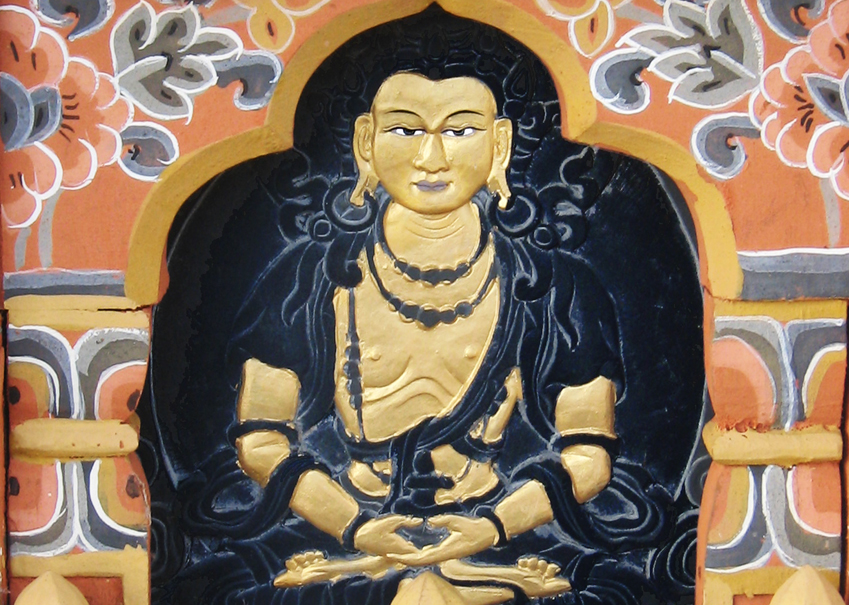
Photo: Buddhist shrine in Bhutan, collection Khun Pornchai

deductive inductive

P1040044Chiang Mai: Small figure of M sitting at the breakfast table on a chair too low for her. The plate with her toast too high and elbows sticking out, takes a large scoop of grape jelly from the jar, carefully carries it, at eye-level, on the flat of her knife, wobbling-wobbling over to her toast, decends and lands on toast without spilling a drop. I’m kinda transfixed by this manoeuvre. We were playing a game where you have to say as many words as you can, beginning with a given initial letter. So it’s my turn; I watch her spreading the jelly over the toast and ask her to give me a word beginning with ‘S’ and immediately she says, ‘SpongeBob’, then continues spreading jelly on the toast. SpongeBob? I ask… and she says, yes (like, is there something wrong with that?) Pretty good, considering she’s only 8 and English is a second language.

Also that M is Thai and coming from a cognitive place that’s different from the rigid Western, logical, clearly-stated position, that-which-is-known. You could say the Thai way is remote from this. But M is a child, like any child, learning as she goes along. There’s the impact of SpongeBob to be included, same as it is with Western children but she’s got the advantage of having an inherited understanding that’s more intuitive, Eastern (inductive); feeling the way through and let’s not bother with objectives, goals and all that stuff, okay?

Westerners find it difficult coping without a given structure. It’s not LOGICAL. In the Western (deductive) behaviour, we almost always express things having a plan in mind; the idea of what we’re saying is right there at the beginning, clearly seen, and all the backup related to that follows after. Then there’s a conclusion at the end.

The Thais are sometimes shocked by the bluntness of this kind of thinking. Their way of expressing things is like the inverse of that, no real indication where it begins, plenty of general examples and there’s a conclusion in there somewhere but it’s difficult for us Westerners to find it because we didn’t understand how it started … it seems vague.

Hotel staff, tour guides, any situation where you’re asking for information at random: Excuse me, do you happen to know where I can …? This kind of question is an invitation for the Thai to lay out a tapestry of possibilities, together with additional info you might like to know.

Western visitors are baffled. The idea is that the solution to the problem is already there, an understanding of this is induced; the conclusion is inferred, arrived at: Yes! I see what you mean… the aha moment. There’s a skill in asking the question, of course, mindfulness, and that’s on-going for me, no expectations (that helps) and there’s a skill in the ability to be patient, appear interested while looking around for someone else who might know.

The West, separates God and the world. We are not Him, we are created by Him; a subject/object duality. The Eastern inductive reasoning understands the function of things through recurring patterns, a ‘puzzle made of its parts’. If there’s a God it must be ‘inside’ this, cannot be separate, it’s integrated. Not easy for me, letting go of the seeking for logical patterns of cause and effect that aren’t there. And I’m suddenly interrupted by M, who asks me if she can use the computer; she opens google, and finds a YouTube video of the Chipmunks singing Gangnam Style in cute squeaky voices: Op op op op, oppan Gangnam Style, Gangnam Style. Op op op op, oppan Gangnam Style…

————————-

Photo: Carved doorway Wat Phra Kaew, Elaine H collection

how it seems (2)

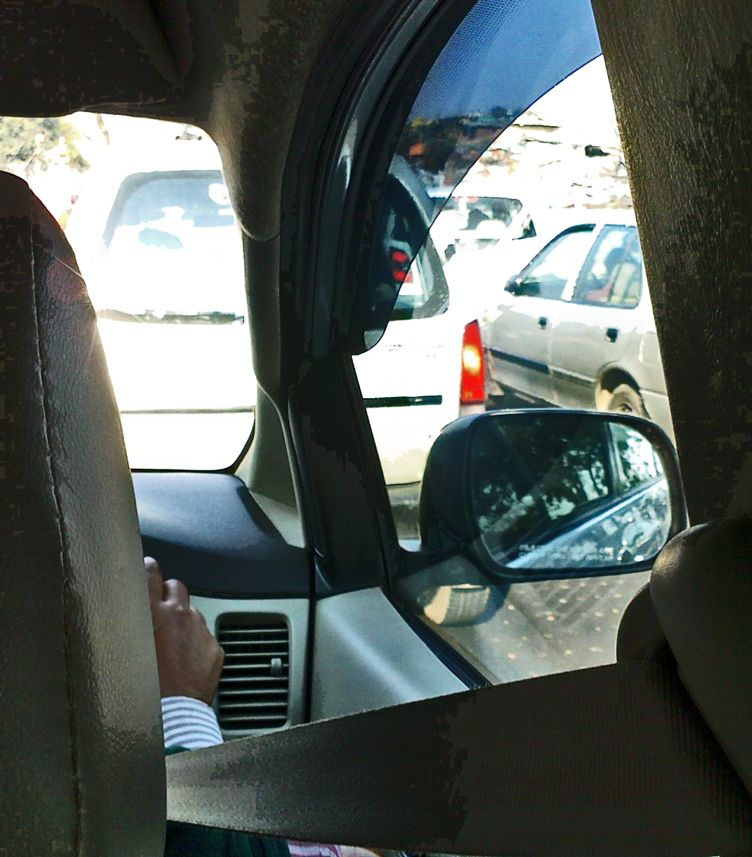
080220131699New Delhi: Travelling across town, Shym is driving. He drives slowly and carefully, surrounded by vehicles honking their horns, cutting in on the nearside; they don’t like it that he’s driving slowly. But Shym remains calm – much ado about nothing – he’s an older man. Out there, fierce displays of male feathers in a ritual display resemble pure outrage, shouts and gestures through wound-down windows. If looks could kill… eyes sparkling with diamonds of malice, giving him ‘the daggers’…. Shym stays solidly as he is. Ah well, people, you can’t always get what you want. Sometimes you’re just stuck with it, you know? It’s how you respond to that unhappy state of ungratified wanting that determines the future for you; cause/effect – if you react with anger, it’ll lead to more anger. But these drivers seem to have gone way past that stage: up-to-their-eyes in the world of anger. Without their anger there’s no purpose in life. They thrive on the struggle; mythical realms of the Titans, and the Asuras, declaring a state of war that lasts an eternity. All this doesn’t phase Shym, at the correct time he slides the steering wheel slowly through his fingertips, indicators flashing clicka-clicka-clicka, telling the world, I am now turning right, and the car sweeps around like a large boat in a wide arc. The surrounding traffic forced to move out of the way. The response is plosive, to say the least. But, well that’s just how it is.

I’m sitting in the back, looking out through tinted windows, incognito, people can’t see me in here – a car wearing dark glasses. Nobody knows I’m inside, the voyeur, the invisible man, looking out at the world all around. I feel like I’m not here. Everything passing by outside the windows of the car; events come and go, arrive and leave. Things occur in random order and drift away without leaving anything behind, video images recorded on security cameras from various places in the 360 degree coverage, showing the car entering the car park, that I’ll never see. I say something to Shym and I hear my own voice in the acoustics of the car; the sound of it causes me to pause for a moment. Everything stops… it takes an effort to get started again. Before it happens, just this silent space. The body feels light and I’m seeing through it.

We turn into the car park. Parking attendant looks like ex-military, sharp uniform, whistle held in his teeth, a piercing blast, signals for us to go left but Shym indicates right. Outrage, more whistle blasts, and he comes up to the car, peers in through the tinted glass, hand cupping the space around his eyes to shade from the sun, I see a large bristly moustache and yellow teeth, the glass fogs up slightly and there are small bits of spittle from his hot breath and shouted words. But Shym gently points with an inclination of the body and politely insists that he’d prefer to go right, not left. More displays of warlike behaviour but I can see this is an act, it’s only how it seems to be. So we are allowed to go right, there’s no problem.

I’m amazed how this system works. All my assumptions are wrong. Attachment due to causes and conditions, that’s all. It’s like everything is a continuation of how things have been; inherited from some former time, or former life, the outcome of actions still hanging around due to tanha, attachments… velcro fastenings, super glue, magnets, welded bridge structures and all the mind stuff about wanting things to be like this or like that or wanting things to be different from what they are. The created ‘self,’ seeing the world according to likes, dislikes and preferences, obscures cessation; doesn’t see that things stay as they are only for as long as it takes. Then it all dissolves in a myriad of changes, disintegrates, crumbles away. We can’t hold on to anything. It all comes to an end.

[Link to: how it seems (1)]

————————-

‘…when attention is drawn to the presence of the Knower, to that which knows and experiences, whatever that is, it immediately becomes obvious that there is something present that is conscious of the body, the mind and the world. As we do this, whatever it is that knows seems suddenly to become more present. It shines. In fact it is simply discovered to have been always present, but apparently eclipsed by our exclusive focus on the known.’ [Rupert Spira, ‘The Transparency of Things’]

wake up

Tibet,Lhasa96(5)cropThere’s a book by Jack Kerouac titled ‘Wake Up’, the story of the Buddha in the style of the ‘beat’ way. I used to have it on my bookshelf in the house in East Anglia and one day the electrician came to the house to fix some circuits and his young assistant picked up the book; a young guy, long hair sticking out, wearing shorts and running shoes, tattooed legs, said he’d heard of the Buddha and also Kerouac and that was pretty cool. So we had a little discussion about this. Later on I noticed the tattoo on his leg, there was something familiar about the flowing calligraphic style and then I remembered: Oṃ maṇi padme hūṃ in Tibetan script. I asked him about it and he was pleased that I’d noticed it; said he got it recently, didn’t know much about what it was, really, just looked good. And I told him, it was nice, and we looked at it for a while; him spinning his leg around so I could read it all, leg hairs and the indigo coloured inks. I said that I’d read somewhere this six syllable statement contains the essence of the entire teaching of the Buddha, according to Tibetan tradition. ‘Cool,’ he says. There it was, the innate consciousness in nature, activated by mysterious Sanskrit sound frequencies in harmonic resonance, tattooed on the leg of an electrician’s assistant in East Anglia.

500px-OM_MANI_PADME_HUM_HRIKerouac begins with the statement: ‘Buddha means the awakened one.’ Buddhism is the wake-up call; it’s built-in – comes with the software. There’s the quality of being aware; receptive to the whole thing. The sensation of sunlight on my skin, of how the body senses the outer world, and everything I see, hear, smell, taste, touch, feel and think. The mental faculty senses the larger consciousness, looking to see what that might be. It’s not the thoughts, the thinking process, or the identity of ‘me’ engaging with this. It’s anatta, what’s outside of all of that; an awareness that includes everything. And I can find it coming out through all the layers created by the mind. Just trying to understand what it takes to see what that sort of thing could be.

This holds my attention in a particular kind of way. It’s a kind of alertness, an ongoing investigation into the present moment and everything about the sensory function and the cognition of it is there too. It’s triggered by a simple curiosity: what is this? And the attitude of careful listening, I am the awareness inside of the object outside, awareness is both and everywhere is here, everything is this;  as far as the eye can see.

‘Thus Tathagata, He-Who-Has-Attained-to-Suchness-of-Mind and sees no more definite conceptions of self, other selves, many divided selves, or one undivided universal self, to whom the world is no longer noticeable, except as a pitiful apparition, yet without arbitrary conception either of its existence or non-existence, as one thinks not to measure the substantiality of a dream but only to wake from it; thus Tathagata, piously composed and silent, radiant with glory, shedding light around, rose from under his Tree of Enlightenment, and with unmatched dignity advanced alone over the dreamlike earth as if surrounded by a crowd of followers, thinking, ‘To fulfill my ancient oath, to rescue all not yet delivered, I will follow out my ancient vow. Let those that have ears to hear master the noble path of salvation.’[Jack Kerouac, ‘Wake Up,’ 1955]

————————-

Image (upper): detail from a photo by Louk Vreeswijk (lower): Om Mani Padme Hum, in Tibetan script

metta/loving-kindness

blue.buddha2Valentine’s Day 2012: ‘All you need is love, love, love is all you need…’ One very small problem about love is that if you love this person, you can’t love that other person as much. So you have to manage all the likes, dislikes and unlikes; friend and ‘unfriend’ too. The stormy weather of loving one thing completely and other things not at all – but how can we love everything? The practice of mettā holds all beings in loving-kindness; all phenomena, all sentient beings, we contemplate in terms of loving-kindness. Okay but it’s not easy to love everything… yep, some things aren’t very lovable; lovability potential: zero. No matter how much I try, I can’t love that thing; sorry, no, I can’t do it. But what I can do is have mettā for the feeling that I can’t do it; I can have loving-kindness for my resistance to loving the unloved. Being open to all conditioned experience with an attitude of kindness, and accepting things as they are; this is the practice of mettā.

The aversion I experience is not so much about the unloved thing itself, it’s about ‘me’ struggling to accept the reality of it being there. Mettā is about non-aversion, if I have aversion for the unloved, it just exacerbates the situation. Allow it in to conscious awareness, the unlovedness, let it be there and just know this feeling as it is now. Okay, so I leap into a state of aversion as soon as I open up to it like that. But I have mettā  for that state too. I can come back later, try again; I can be patient with this condition as it is right now in this present moment. Having mettā means allowing it to be. I’m not interacting with it, I’m just willing to be with it. It’s the same as everything else, its nature is impermanent, it changes, breaks down, crumbles into pieces and it’s gone. I’m not looking for the natural cessation of it, though, that’s not the goal. I’m just allowing it to be as it is, accepting that and, bit by bit, there’s a release of the tension caused by ‘me’ resisting the presence of the unloved. That’s the point of the exercise.

The effort to get away from the reality of the unloved, restimulates the discomfort and negative emotion starts building up again. Even so, there’ll be times when it’s possible to just receive the experience without resisting it. I see then, this is the way to go; loving the unloved. Over time, things begin to change, there’s a willingness to let everything be as it is, pleasant feelings and unpleasant feelings. I can have mettā for all the negativity locked away inside, opening the door, letting it all go; freedom! The heart isn’t heavy with dislike, blame and resentment. A sense of lightness and well-being.

————————-

‘By reminding ourselves to have metta for the feelings we experience – not thinking about them or analysing them but going to the place in the body itself, to the mental quality, really embracing that – really being willing to feel those particular emotions, they become bearable. By changing our attitude to one of acceptance rather than of rejection, to interest, rather than just wanting to get rid of them, we find that they are things we can tolerate. Then they cease on their own, for all conditions are impermanent.’ [‘Universal Loving Kindness‘ by Ajahn Sumedho, Forest Sangha Newsletter, October 1997, Number 42]

–  g  r  a  t  i  t  u  d  e  –

being here

131120121589

New Delhi: This is the 100th post! I feel like I should celebrate, I’m a blogger centenarian! But still a youngster, I think. Many bloggers are much older than me. So, what’s going on here? This blog is about the Buddha’s teachings, Advaita Vedanta, non-duality. I went public on July 6th, 2012 and I’ve been putting up new posts every three days, mostly, since that time. Now it’s ‘The One Hundredth’, and I was going to use that title for this post but it’s been used already – the 100th in the TV series: ‘Friends.’ The dhammafootsteps blog is, of course, about reaching out to friends, but the discussion is about just being ‘here.’ We’re all here in our various states of being, in different parts of the world; in different time zones and we’re all individually contemplating our own experience of being ‘here.’ Blogging is a good medium for this kind of thing because, just being ‘here’ is what everybody is talking about or describing, one way or another – isn’t it?

Here’s something from: Beyond The Dream: ‘…the awareness that looked out of our eyes as a five year old is the awareness that’s looking out of our eyes now.’ When I read that sentence it had a curious effect; there was an instant understanding of what being ‘here’ means. Then the next thought was, what is ‘the awareness’? And it’s a good question, that one, you can just go on asking it…. It’s like trying to understand sati-sampajañña, clear comprehension; what does that mean? And maybe I’m off somewhere searching for the meaning of clear comprehension, overlooking the fact that all the confusion is still there in my head. So, I’ll never find clear comprehension that way, because every time I think I’ve found it, the confusion just jumps up in its place. Eventually I realize clear comprehension means understanding the confusion. It has to be that way; clear comprehension of the confusion, and not some kind of desired state of clarity that doesn’t exist. The confusion is, I can’t see reality because I’m too engaged with the idea of it.

In the West we suffer from the creator-god condition; God made the world so the world and God are two separate things. I see the world from some impossible place outside of it; I’m on shaky ground here, in control mode, there’s the paranoia of thinking I can’t let it go and the fear of having to hold on indefinitely. All the clutter and stuff and mental goings-on and stumbling over all the indistinct, half-seen, misunderstood truths – believing that this is what life is about. Not able to see that it just doesn’t matter what kind of story is showing on the screen, it’s all fiction, created by the mind, arising and ceasing, dependent on causes and conditions and the karmic outcome of past events.

The mind doesn’t create awareness, mind is contained in the awareness. It’s something like, awareness is there, I just think I can’t see it. Thinking I can’t see it, is another mind moment that exists temporarily in the awareness. Being here is about getting to know everything there is to know about what that means….

————————-