today is every day

img_0072bPOSTCARD #225: New Delhi: All these highways, routes, directions connected end-to-end. My itinerary links up in a network that reaches all parts and locations in time and space, everywhere in the world – no end, no beginning. Here-and-now awareness, or wandering in fabricated thought, a game of hide-and-seek where the flip-side of concealment is revelation and returning to the familiarity of present time, it becomes ‘now’ again.

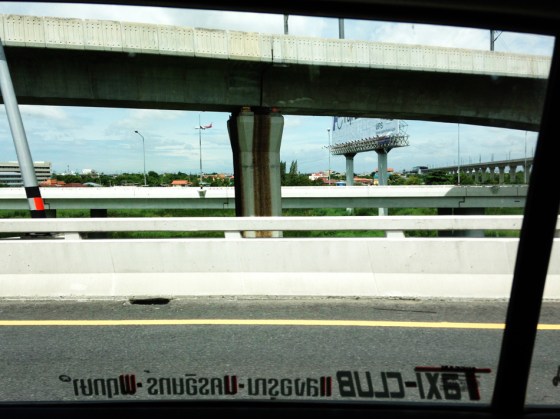
Or I’m thinking about the concept of ‘now’ seated here in the backseat of a taxi to the airport, looking out my window at a landscape of connecting routes flashing by, and engine noise, vibration, bumps and jolts of road surface. Or trying to get emails on my phone but there’s no Internet right now. Try again later… where are we now? Glance at the taxi’s GPS, our point of present location on the map moving in tiny increments across the screen.

Time divided, subdivided and sliced into multi-channel TV programs, compartmentalized, locked down tight – the totality of it impossible to define. The impossibility of finding a way out of constructs framed in words: who, what, where, when, and why. Language gives everything names, Monday, Tuesday, Wednesday… different ways of describing present time. It’s always today, no matter if I call it yesterday, tomorrow or next week – today is every day. And even if I’m living in a make-believe world where it’s always ‘somewhere else’, all of that is included in present time too, ‘today’ occurring forever and always in rotations of the planet Earth. More than 1000 miles per hour of yesterdays, todays and tomorrows experienced in countless generations of endless time.

The illusion of solidity and grounded-ness created in awareness, the conscious state experienced in a soft body-mind organism that can process data. The feeling of I, me, and my, is the ‘I’ of everything that has ever been. A connectedness with all that is outside and all that is inside. A ‘world’ shared with all living beings as if it were a meal for a great number of guests at a huge table. Talking about all that we all love and all that we hate. All they create, all they destroy and all the words of politicians vanish into thin air, all conflicts are resolved eventually and it’s our mutuality, the fundamental sense of the feel of the air. Just holding in mind the scale of how vast this kind of love might possibly be… is enough to begin to know it.

Looking back again at my screen, still no Internet – a spinning cursor in a frozen background space, the unstated presence, the ‘is-ness’. An easefulness spreading through the face, the scalp, the head, the neck, shoulders and arms. A whole-body experience contained in this small space; metal, plastic, electric-spark-gasoline-fueled internal-combustion engine on rubber wheels, and blur of unseen things in window light passing through the interior of the taxi, small red light showing the fare so far. Time to pause, take a deep breath in, filling the chest cavity from top to bottom, then the long breath out, unfolding like a long ribbon of road in a landscape, reaching out there to a vanishing point on the horizon.

“Time is the longest distance between two places.” [Tennessee Williams, The Glass Menagerie]

Note: excerpts from Eclipse by Pink Floyd

the world disappears

img_0019POSTCARD #224: New Delhi: Learning how to sleep without the pain meds and all those chemicals that used to help me so much before, but I’m just left there thinking about things in the darkness. Stories come and go, pondering over this and that, and the awareness of being caught up in the thinking thing gets included in the wandering. Searching for a way out, but if I think about how to stop thinking, the mind gets busy looking for a solution; finding something and comparing it with other reasons why I can’t stop thinking. Thinking has its own momentum, takes time for it to slow down, there’s the opportunity to allow it all to fizzle out. Everything evaporates for a moment.

In that instant there’s a no-thinking state, a great space opens up – an awareness of being aware. Silence and emptiness, held on pause. Then, somewhere on a different screen, the mind is alerted, there’s the desire to be actively thinking again, and an invitation to be engaged with it, but that fizzles out too. “Footfalls echo in the memory, down the passage we did not take, towards the door we never opened, into the rose garden.”*

The outbreath from the nostrils, so faint and light, stirs only the tiniest thing; the movement of a single strand of hair could wake me. No other sensory input the mind needs to be engaged with, no sense object activates the chain of events and all that remains is the mind’s cognitive function. A curiosity about this stirs; ‘self’ is a sensory experience. The experiencer is an experience – there is only experiencing.

Another wave of thoughts comes rushing in, stays for a moment and goes out again. I see it as if there’s an watcher seeing it from some hidden place, aware of it. Then the watcher disappears and it seems like only the awareness itself is left there. Then the awareness disappears and in its place, a sequence of half-seen obscure mental events, each one linking with the next. Some time later sleep comes and the whole world disappears.

‘The range of what we think and do is limited by what we fail to notice. And because we fail to notice that we fail to notice, there is little we can do to change; until we notice how failing to notice shapes our thoughts and deeds.’ [R. D. Laing]

————————-
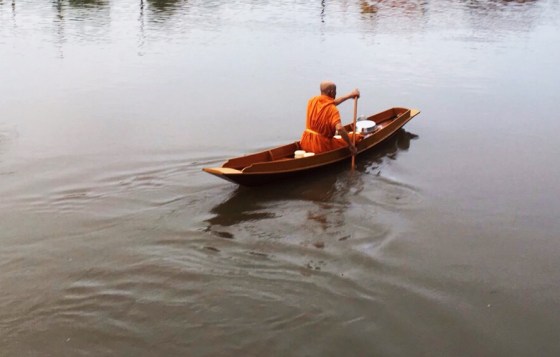
Photo: Dhammakaya monk collecting alms by boat.
*Excerpt from Four Quartets T. S. Eliot
This post was rewritten from earlier posts


first light

img_3224bPOSTCARD #223: New Delhi: Awake at 3.30 am here in our place next to the park, soft warm air oxygenated by trees, and the silence of birds asleep among the branches. Then breakfast with Jiab who is leaving on an early flight to Odisha, ceiling fans, coffee and bagels in the electric light of night, darkness filling the wide-open windows facing the park. Mosquito mesh screens are all there is to prevent the outside world from entering the inside world where we are engaged in the normal breakfasting activity. It’s as if it were a dream, ‘clink’ of knife on plate, coffee spoon in cup… ‘ting’.

In a huge noise of arrival, the taxi is suddenly here; a great blaze of color and light. Back door unhinges, bags inside, bye-bye, door slam, sound of engine and Jiab is gone into the blackness… sound receding and I’m left alone to contemplate the silence.

Feeling more at ease these days, due to improved pain meds, able to move with some comfort but getting up and sitting down again is a problem so I stay in the same position pretty much, and think about what I’m going to do before doing it.

I return to the breakfast table, fall into a kind of passive reflective awareness of the body and its fractured structure. The default is to equate blackness with negativity, pain with guilt – but watching the breath entering and leaving, I find I can be focused quite easily on the alarming ‘clunk’ sound of bone halfway through the in-breath as the broken ribs adjust with the swelling of lungs… slowly coming to terms with the small panic that arises sometimes.

The X-ray clearly showed two ribs broken and dislocated, frightening enough and yet a comfort to know the reason for the disquiet – the things-not-being-quite-right feeling. Human beings are such enduringly fragile creatures, held together with sinews joining muscle to bone that just calcifies and mends itself. The contemplation of it fits with everything I’ve come to accept here, resident in Asia more than thirty years – innovative ideas held together with bamboo, string and rubber bands. Nothing is permanent, exists for as long as needed then relinquished and gone…

The ghosts that rise out of the night are always the crows, unseen and heard before first light – they must have night vision – fearsome unloved creatures present in the last vestiges of night. For this short time, the crows own the world, and then light breaks through. A few twitters and it comes into consciousness like a wave floods everything. A birdsong extravaganza, surfing on the edge of dawn – the totality of it may be a sound-realm on a frequency only birds are aware of.

A few hours later, ‘ping’ a text message from Jiab in Odisha, nearly a thousand miles away. Daylight is established and it is undeniably day. Everything that went before is forgotten.

“Temporality temporalizes as a future which makes present in the process of having been.” [Martin Heidegger]

————————-

gone, gone, and gone

img_4482POSTCARD #222: Bangkok/New Delhi flight: An awareness of things as they are. The main event was the injection in the head and the constant (PHN) headache gone instantly. Wake up next day and it was still gone, gone as I write this, and it remains gone. So reassuring to know the transformation to ordinary things is possible, the car is back from the garage and out on the road again.

The release from head pain is still held back due to the pain of broken rib but so much easier to cope with now the headache has gone. Walking the miles in airports was thought to be a problem though, so Jiab convinced me to request a wheelchair. Wheelchair from check-in to the lounge then wheelchair to the plane, straight in and the first seat in C class section of the plane. Stewardess puts my bag away in overhead luggage space. Wonderful, I’d never been a wheelchair passenger on an aircraft before, my first time. Plenty of space in this expensive seat, a meal with endless courses, and I slept the rest of the way; so comfortable since these recent days of sudden pain, tossing and turning at night and discovering the only way to try to sleep is sitting up on an inclined wall of pillows.

The odd thing about being in a wheelchair is you approach silently, moving along very smooth floor surface feeling the vibration of small jolts of joints between tiles below, crowds part immediately. If anybody is still standing in the way friends will pull him away or the wheelchair guy says excuse me please? and they move straightaway. A few sideways glances and I resist the temptation to say Hi, how’re you doing? And sometimes feel I should try to look really sick, to provide a reason for being like this, problem is having a broken rib is not a noticable thing. But I keep looking ahead exercising the right to be in a wheelchair and humbled by the generosity of everyone giving way. Astonished by the experience of sitting on wheels in a public place, the great perspective of long airport walkways ahead and seeing the surroundings move towards and go through me. Also the thing about travelling long distances while seeing the world from a lower eye level – a familiarity, déjà vu, the memory of being a child again.

The wheelchair experience means an understanding of what helplessness is, understanding vulnerability, aging… it’s all coming unglued, bits dropping off, but the revelation comes along too there’s no point in feeling bad about yourself because you are simply incapable and that’s all there is to it. At the same time, being (temporarily) disabled gives some insight into the existential plight; the realization that most of us are held prisoner in a trance-like state, incultured into the ‘self’ fiction through the mirror of society’s fear of the unknown, living with a sense of purposelessness and not able to see it.

Not able to cope with pain, tragedy, loss; unable to see the awareness that accompanies our ordinary joys and sorrows – there’s more than one kind of awareness, this provides some relief from pain, ease and understanding; I can step back from the trauma and see it as coming from somewhere else. I can be engaged in clinging and at the same time be in a position to see that this is what’s happening. Letting go, it’s not ‘mine’ anymore.

Then we’re in New Delhi, into the Indian wheelchair and out onto the miles of ochre coloured carpet. At the end of a long time of sitting, I’m looking up at the immigration official; passport thump and wheeled in, permitted to enter the country.

“How should we be able to forget those ancient myths that are at the beginning of all peoples, the myths about dragons that at the last moment turn into princesses; perhaps all the dragons of our lives are princesses who are only waiting to see us once beautiful and brave. Perhaps everything terrible is in its deepest being something helpless that wants help from us.” [Rainer Maria Rilke]
————————–

Photo: Jiab’s collection from Ladakh

patterns in a cloudscape

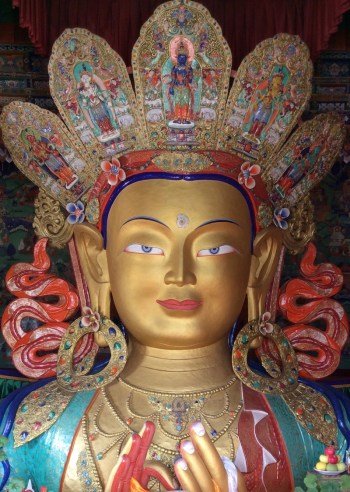
IMG_4196POSTCARD #221: Bangkok: Looking through these amazing photos from Jiab, now in Bhutan; mountain peaks disappear among the clouds. In the process of editing, I discover a curious arrow shape in the clouds, just to the right of the place where the sun is breaking through. Also to the left of the arrow point there’s the same form of another arrow shape breaking up into formlessness. It reminds me of the great wheeling patterns, above and over your head, seen in the cloudscapes of the North of Scotland where they have so much rain. It’s a small example of this kind of clockwork of interconnecting wheels created by vast and compex air currents that is seen here.

Something revealed when you crop the original, and attention is focused on the smaller elements contained in the image. Like discovering a window within a window and things are revealed that weren’t obvious at first glance. A small perceptual jump, the process of (eye + the object seen) is not a fixed thing, it’s flexible. I can say, yes I’ve seen it and yes I know what that’s about but that’s just the memory deciding what it’s going remember, what it’s going to recreate in the mind – there is no memory, just the act of remembering [Nyanaponika Thera]. What’s needed is the investigation, the motivated enquiry that just falls into shape when things are examined in more detail.

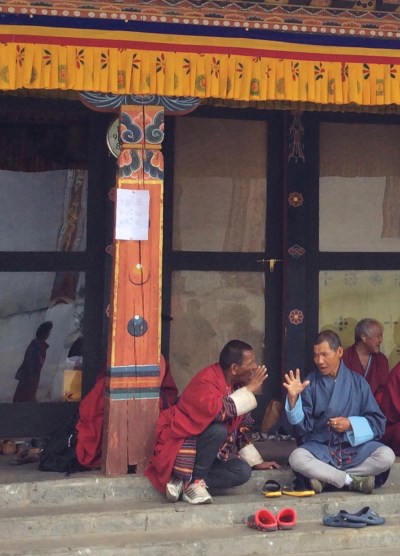
IMG_4145Also seen in Jiab’s next picture here; a group of people sitting on the steps of a public building. Photo taken because of the colourful costumes and painted building features. Zoom into a curiously emphatic conversation between two men; the man on the right seems to be interrupting the man on the left and somehow dismissing what he is is saying. There was something about this that seemed meaningful… then I suddenly saw it: they are deaf. What we are seeing is the language of the deaf, a visual system of facial expressions accompanying ‘signing’. How do I know this? I was a teacher of the deaf in a former life; seven years in London schools and adult evening classes. I used to know all this and how to fix hearing aids – a closer look at the photo reveals a man in profile in the background wearing a hearing aid. So this must be a group of signing deaf people waiting for the building to open and chatting among themselves.

These days I seem to pause in between things and fall into a contemplation of images like these with their connected meanings (yoniso manasikara). Pictures appear in the mind that have no words, just fall into a sequence. A story unfolds…

Right attitude allows you to accept, acknowledge, and observe whatever is happening – whether pleasant or unpleasant – in a relaxed and alert way. […] You are not trying to make things turn out the way you want them to happen. You are trying to know what is happening as it is. [Sayadaw U Tejaniya]
————————–

tipping point

IMG_3184POSTCARD #220: Chiang Mai: A long story short is that I fell, gravity got me, it gets us all in the end – flactured lib, the X-Ray man said, with poor pronunciation, in a Chiang Mai hospital. They took me home, but later that night I was having such an awful time sleeping, family members took me back, I had an injection and spent the night there. The ‘self’ is a sensory experience; everything I see, hear, smell, taste, touch, feel and think; cognition is a sense that responds to stimulii received through the senses. I inhabit a simulation.

Not possible to see it any other way – well, it is possible, you could see it another way but it’d just be ‘another way’of seeing the same thing. A dream-state set in the context of my being awake… There’s something about this that’s obvious, so clear and evident yet, again and again, when I look for it, it’s not there – the answer I seek is difficult to find because by seeking for it I create the state of seeking, and this makes it difficult. What happened? I’d had in fact, two falls; the first was straight back-over past the tipping point and down, crash. My PHN headache meds have something to do with that.

The second fall was some hours later when, getting up too quickly from the lying down position, then in slow motion; forgetting about the pain in the lower back, attempting to allow for that in mid-air, and the whole thing came down, collided with some hard-edged furniture on the way  … and that’s what did it for the rib.

So now I’ve two problems, one is the headache that returned, the returnee from some time ago carrying with it the strong pain meds; two is the fractured rib and mysterious, discovered bruises and scrapes. The disorientating pain meds for that too. I tread carefully, the world is a dangerous place… mindfulness is necessary. If the ‘I’ construct isn’t what this is, what is it, then? I can change the pronoun from ‘me’ to ‘it’ but it’s the same thing only there’s an ‘it’ that recognizes ‘itself’ everywhere.

“The apparent reality of the mind, body and world is imagined with the thought that thinks it. In other words, the constructs of thought, that is, the beliefs we have about the mind, body and world – are only real for thought itself.” [Rupert Spira]

————————-

exploitation

IMG_0631b

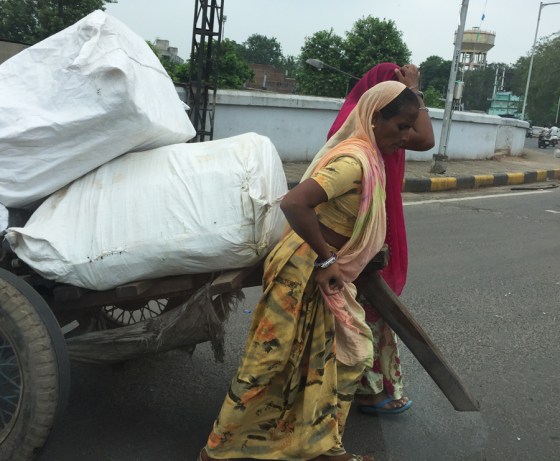
POSTCARD #219: Delhi: Everything comes to a stop when I see this photo, sent by Jiab in Gujarat, West India. All the pain and suffering I’ve experienced recently is suddenly nothing when I see the endeavor of this woman pulling what looks to be the trailer belonging to a truck. Even so, some would say, it’s easy for me to say, easy for me, comfortable in my male middle class security… and I search for words: admiration, respect, deference. None of these seem to describe the way that lady who looks like my Auntie is pulling that thing with the momentum of a short run at it, to get up and over the incline leading up to the bridge, then over the top and holding the weight as the trailer gathers speed on the downside.

When I first examined the photo it looked like there were two women pulling the trailer but the lady in the maroon colored sari just happens to be there, on the left of the one in the lemon colored sari. So Auntie is on her own, I imagine a person with the ability to bring up children, keep the house in order and do this physical work – “Ginger Rogers did it backwards and in high heels”.

It seemed to me, looking at all Jiab’s photos that everyone there in Ahmedabad was/is engaged in some form of labor: men, women and children. It’s worth saying that most people in the West have the idea that the population in India are passive subjects of poverty. This is not the case; everybody in the family is employed except the very young and the very old. Poverty exists because of exploitation by employers and those further up the hierarchy. Cultural aspects come into conflict with Western expectations and standards imposed by two hundred years of British rule.

It’s not easy to accept the truth that wealthy societies exploit ethnic minorities and migrants. In Scotland almost the entire berry picking for the fruit jam industry and preparitory work for the fish products industries is done by East Europeans. In Japan they have the ‘Three Ds’: Difficult, Dirty, Dangerous. All of this kind of work is done by migrant labor. I find it’s necessary to go into ‘reality check’ mode, to make sure the world I’m creating in my head does not exclude these truths.

Theirs is a level of suffering hard to endure. There’s just no getting away from it. Would it be meaningful if I were to address people like Auntie in the photo about choosing the Buddhist liberation, the Path to enlightenment? Aside from a very few cases, I don’t think so. For them, it’s about holding on, not letting go; as long as they have the strength to withstand hardship, it will go on like this. They’re putting their small earnings together as a family collective. They structure their lives around employment and can’t escape from that unless they step out of the earning momentum they’re stuck in, and risk losing everything.

But who am I to comment on their lives? I have one or two classic rednecks in my family and with them I’m stuck at the getting-a-word-in-edgeways stage, or never-had-a-proper-job-anyway statement, and it never ever goes beyond this. So, really how can anything be said that’s not hopelessly hypothetical? Best to have opinions unsaid and instead, have compassion, empathy, understanding.

‘An error does not become truth by reason of multiplied propagation, nor does truth become error because nobody sees it.’ [Mahatma Gandhi]

————————–

groundedness

IMG_0682POSTCARD #218: New Delhi: Jiab sent me this pic of the cow in Gujarat. There’s always something that ‘clicks’ inside me when I see the cow in the city traffic in India. The aloof separateness of the Gods. Something about the bovine ‘mother’, sacred cow that all Hindus are conscious of.

There’s also  a memory of something from my home on the farm in the North of Scotland when I was a kid. I remember long nights and short days, aunties and grannies wearing comfortable wooly cardigans, porridge in a cracked bowl, coal and wood fires, cows in the fields, a black-and-white collie dog – and it’s this that I notice about the rural/urban Indian cities, cows sitting on the pavement, goats nibbling and chickens pecking around, the sound of a cockerel in the distance. It’s the farmyard scene where I was brought up that followed me here!

There’s a familiarity about it, pictures in the gallery of the mind, and yes I’d like to have a home surrounded by arable lands and farmyard animals, but for a very long time now there’s been only a series of temporary homes – all good, I share my life with Jiab and we’ve gotten used to the way things are. Living like a pair of migratory birds. In each place I have my favourite chair, books, and all the things I need. It works okay except sometimes I might spend a long time searching the bookshelves for a book I’m sure is there then realise it’s not in these bookshelves, it’s the other bookshelves, about 2000 miles away. So I have to let that one go, although I can see it there in the mind’s eye.

These days, reading is done mostly on devices and when I get on the plane I have my laptop like other passengers and when I reach ‘home B’ or ‘home C’ I get online automatically with the wifi there and plug my speakers into the socket on the laptop in its position there. And I hardly ever feel dispersed, or stretched, an okay sort of expansive feeling. In this context, it suits me well to follow the Buddha’s Teachings on going-forth, homelessness, non-attachment, no-self.

Whether there is a ‘self’, yes/no, is best not thought about too much because saying ‘yes’ or ‘no’ to it is, in so many words, identifying ‘self’’. Words identify things, language has a default mechanism that allows me to select what ‘I’ want it to be (also what I don’t want it to be) and the resulting attachment to all that I love and hate. I stay with it, see it happening, stay mindful about where the nearest emergency exit is located but very rarely needed – and just open the heart/mind citta to the world as wide as possible.

The presence of the cow wandering through industrialised Indian cities triggers something. The smell of cow dung brings me down to earth, generates a sense of groundedness for the time it’s needed for, then I’m up and away again. It’s also a pretty attractive life; the ability to just wander anywhere in benign foreign lands, live in the fortunate state of being without the tugs and pulls of desire and worldliness.

“Feel nothing, know nothing, do nothing, have nothing, give up all to God, and say utterly, ‘Thy will be done.’ We only dream this bondage. Wake up and let it go.” [Swami Vivekananda]

————————-

Excerpts from an earlier post: ‘Connectedness’

green-leaf shadows

foliage1POSTCARD #217: New Delhi: As if it were a story about a wormhole in time that permits a returning to the past to change the way events took place then and how this has a fundamental effect on present time, I’m able to re-experience an event in the deep past I haven’t visited since the intensity of the headache diminished, and allow that event to change according to present circumstances, wholesome and bright.

These sudden moments of deep reflection not in the centre of thoughts, more at the edge of vision, we can easily fall into and the old story of it unfolds, but seen in less self-adhesive circumstances. Thus the forever ‘stuckness’ that has held one so tightly and for so long is suddenly melted into softness, dispersed in the awakening from the memory of it.

Then before I can seem to retrace the steps that took me there, I find that same deep swoon back to a space in time again, and affirmative extending of the arm to reach the ‘me’ then, caught in another remembered event that’s been a burden for decades, untangling the knots of it from the depths and a raising up into clearer water where it breaks the surface into the wet sunlit present moment. This how it’s been in the varying shades of darker and lighter green-leaf shadows in the rooms of the house, all its windows open to the park, where it’s been raining for so long I can’t remember when it began.

“Give up both righteousness and unrighteousness. Give up both truth and untruth. And then give up that by which you have given up those two.”

————————-

[source of the quote: http://www.yogananda.com.au/upa/Upanishads_by_Shankara02.html#liberation
Note: development of an earlier post titled: changing the past

Dipa Ma

DipaMaPOSTCARD #216: Somehow I’ve been thinking about Dipa Ma lately; the Bengali meditation teacher who had such a large influence on IMS teachers like Sharon Salzberg, Joseph Goldstein, Jack Kornfield and others who believe she was an enlightened being. Just looking at her face on the cover of the book, such a welcoming presence. There are accounts of people who never met Dipa Ma having seen/felt Dipa Ma’s grace, her loving kindness – not in a strange or exceptional way, quite ordinary. Whenever there’s a moment that requires special compassion, the presence of Dipa Ma is there.

That’s how it is for me now; it’s like she’s here by my side. It’s as if she is saying to me that this present moment is absolutely right as it is, no need for anything else. Gone are all stray and wandering thoughts that tend to cling; they just disappear. How can it be possible to have the feeling you are close to someone you’ve never met and all you know is what you’ve read about her? I think it’s because that’s just how she was; always approachable, she welcomed everyone. Dipa Ma was asked once about loving-kindness and mindfulness: ‘From my own experience, there is no difference between mindfulness and loving kindness.’ For her, love and awareness were one…. When you are fully loving, aren’t you also mindful? When you are mindful, is this not also the essence of love?’[Amy Schmidt]

These days I often think about her, whenever I’m in a difficult situation I find Dipa Ma is here too, deep breaths, and everything is ok.

————————-

‘Saintly beings, whether they are the Dalai Lama, Mother Theresa, Dipa Ma, or one thousand unknown saintly beings living amongst us, share the same fundamental characteristic of selflessness, great compassion, and peace. Each one of us can carry Dipa Ma’s legacy in terms of having that much peace and love. It takes its own time, yet it’s possible for anyone. In the end the point is not to be like Dipa Ma or some other great yogi or saint you might read about. The point is something much more difficult: to be yourself and to discover that all you seek is to be found, here and now, in your own heart.’ [Jack Kornfield]


This post reblogged from 2012