the who-I-am thing

BTS_Skytrain_over_Sala_Daeng_Intersection

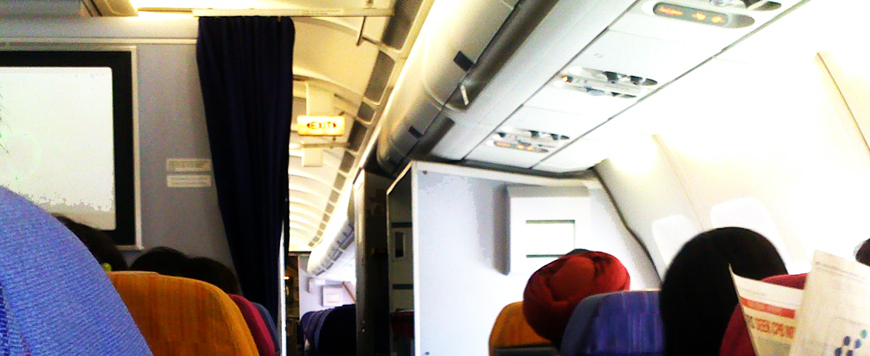
Bangkok: Flying above street level and over the rooftops in the BTS Skytrain on elevated track, bright yellow seats, red holding straps and blue wall sections. Primary colours; diminutive, childlike and cute; it’s a toytown train. Brushed steel, shiny chrome and a smooth metallic click of wheel on rails, rushing through a landscape of blue sky over the city as far as the eye can see; billboards and upper storeys of town houses, moving past in the foreground, tall buildings of steel and glass standing like pillars in the background urban concrete environment. Here and there on the train, are TV monitors fixed at eye level with adverts running continuously so that we can enter into a world of consumer preferences: the Western model, East Asian style, adapted to fit Thai cultural attitudes to spending. Stories acted out by adults who look like children; cute ‘faces’, attractive personalities, ‘charm’. Products presented as if it were a game, makes it all seem acceptable; we don’t see the high-voltage sales strategy, cloaked in naïvity – a new society, a whole new generation of consumers – the corporate entity engaged in long term planning.

coke ad.ploenchitBKKI can get caught by it, drawn towards the TV screen, something I see in the advert triggers it, and the who-I-am thing arises: I LIKE THIS and it all gets to be really important, relevant, vivid and intense. I feel suddenly energised, compelled and, I WANT TO HAVE IT, ready to start discussing with sales staff at the retail point and proceed with the purchase; the plastic in my wallet, the samsara of advertising. For me, no worries, it will cease of its own accord if I can allow it to become nothing, and fortunately it’s all in a language I can switch off from so it fizzles out…

To become a person, I have to ‘believe’ in it – I have to consciously engage with it. To become me, I have to think ‘me’. The ‘me’ that I believe in depends on me thinking it. I am conditioned to be attached to my opinions, my emotionality, and the sense of self in all kinds of ways. I can manipulate the conditioned world so that, from this perspective of thinking, I see (my)self situated favourably – or it could be unfavourably if I’m caught in being the victim (but there is a way out). Everything arises due to causes and conditions, then thinking about it, excessively and often enough to have it embedded in the fabric of this self construct I recognise as ‘me,’ subject to its perceived whims and waywardness, as some kind of fictional character.

But there is a way out; an intelligent reflection on the human predicament; a proximity-to but distance-from situation: the Middle Way. The practice is about this simple truth: don’t mess with it, it won’t arise if I don’t think it into being. And I am my own boss, the nearest thing to God, as we know it, is viññāṇa, conscious awareness, self-sustaining; I don’t create it. There’s the body, sitting here in this yellow plastic seat, minding its own business, other than that, anatta, no personal essence or substance or core or soul given to me by the grace of (some external force); nothing added, nothing extra. The simplicity of this seems to immediately throw everything to do with ‘self’ into disarray; enough to cause it all to come tumbling down; a house of cards. And an artificial voice announcement gets my attention: Siam-interchange-station-doors-will-open-on-the-right-hand-side-of-the-train. I join the throng of passengers squeezing through the door and pouring out like liquid into the centre of the shopping mall heaven realm experience. There’s nothing wrong with personality, it’s the attachment to it that’s the problem…
————————-
Upper photo image: http://commons.wikimedia.org/wiki/File%3ABTS_Skytrain_over_Sala_Daeng_Intersection.jpg
Lower photo image: Coke ad Ploenchit, collection author

seemingly continuous

BtnBuddha2Chiang Mai: 05.00 hours. Darkness of early morning. I can hear a motorbike some way off, coming nearer, and voices talking loudly. They’re shouting to be heard over the sound of the engine. The motorbike passes below my balcony on the third floor, sound fills the room, and I realize it’s the driver with a friend on the back having a converstation as they are going along. Curious acoustics here in this narrow street; concrete and glass buildings face each other. The sound of the two voices disappears quickly past my windows and moves on further down the street, contained in the little capsule of their moving world. I hear it again, faintly now, and fading into the distance.

Strange dream-like event; receiving pieces of an animated conversation moving past me at 30 mph. Then it’s gone from my auditory awareness and (I assume) is being heard by other people further along the street. There’s something here about consciousness creating a sense of continuity; like how you string beads on a necklace and it appears to be one whole piece. A continuous stream of individual events taking place and, in the context of the body, it appears to be one, on-going connected reality – an illusion. When I wake up in the morning, it takes a moment, and everything is a development of the night before.

It must have been the motorbike that woke me up; windows wide open all night in the hot air, with just the mosquito mesh separating me from the world outside. Only 20 miles to go, straight up in the sky, before you reach outer space; no gravity, the universe (where did I read that?). Wow! outer space is so near, half an hour’s drive to get there, if there’s no traffic problem. So, what does that feel like? I suppose it feels pretty… precarious, balanced on the end of a flagpole fixed on top of a monument – the absolute verticality of it… quite scary. The only thing that gives me any sense of stability is the ‘self’ I’m inclined to depend on sometimes? No wonder there’s this tremendous attachment to it; can’t let it go, irretrievably lost in thought; I am contained in this body, stumbling around in this small area I inhabit, on the surface of the planet. I am a bit uncomfortable with the reality of what exists only 20 miles above my head. And go through life assuming that all there ever is, or all there ever can be, is ‘me’; the experience of a created self.

I hear a sound, and think: if that sound is out ‘there’ then I must be hearing it in ‘here’: the subject/object duality: ‘I’ am my body, I am my feelings, I am my consciousness and everything else (that’s not ‘me’) is out ‘there.’ In here, I’m me, I have a personality, it’s myself. And Bert0001 refers to it as: the ‘my’ in ‘myself.’ A distinct feeling of focus that disincludes other evidence – it’s all about me. Fortunately, I can understand and know that the idea of a self just seems to be there, seemingly continuous – a kind of mirage. Delete the ‘my’ from ‘myself’ and I’m free of all the tugs and pulls of likes and dislikes, emotions are not ‘my’ emotions, they’re just emotions; things that happen – liberated from the papañca, proliferating concepts, and concocted thought trying to make something real that’s just not real at all.

I’m glad to be awake early, leaving this place tomorrow and I’ll have to pack bags and get ready. Why can’t I just walk on to the plane not check in any bags at all, only passport, ticket and the contents of my pockets? Why bother with luggage? Ah… if only life were so simple.

Some time after this I hear the Tuk-kae lizard chuckling in a corner somewhere: tuk-kae-tuk-kae tuk-kae. And the Coucal, (whoop-whoop bird) (centropus sinensis) clambering around in the branches; whoop-whoop-whoop-whoop-whoop…

————————-

‘Just as a monkey moving through the forest or the woods holds on to a branch, lets it go and holds on to another; in the same way what we call viññāṇa (consciousness) arises as one thing and ceases as another, by day and by night.’ [SN.II.95]

References in this post: Sue Hamilton: ‘Identity and Experience’
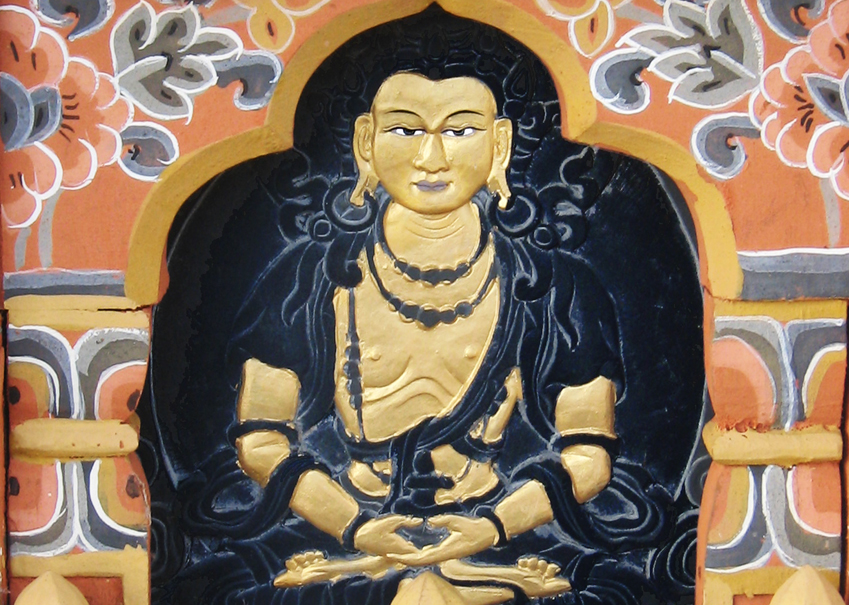
Photo: Buddhist shrine in Bhutan, collection Khun Pornchai

applied knowing

tukt18Mar5‘Either you look at the universe as a very poor creation out of which no one can make anything, or you look at your own life and your own part in the universe as infinitely rich, full of inexhaustible interest, opening out into the infinite further possibilities for study and contemplation and interest and praise. Beyond all and in all is God.’ [Thomas Merton, from: ‘The Intimate Merton’]

Chiang Mai: Standing by the main road facing traffic going into town, looking for the small red bus songthaew /song-tae-oo/. I see one coming in the distance. This time of day there’s always one nearby. It’ll go anywhere you want, the driver will fit you in, depending on the itinerary of the passengers already on board – so the journey may take a different route every time. That’s how it works; 20 baht (US: 69 cents) for a ride to nearly anywhere. There’s no designated route, no schedule, the songthaew just comes along and it’s a bit like jumping into a flowing river, holding on to a lifebelt and somehow it gets you there. I see the indicator light flashing, the songthaew stops, I tell the (lady) driver where I’m going, she says ok. I climb up two steps and get into the vehicle. Low headroom, sit down on the bench, smile at the other passengers, and fall into the mind-state of being taken away.

The outside world rushes by, seen through the open rear door of the vehicle and side windows with no glass; warm air rushes through. The way it unfolds is the way it is and everything is integrated, including my perception of it. The ‘world’ is the metal structure of this small vehicle enclosing the space I’m in; contained in the greater space all around and permeating through. Moving with the traffic next to the canal, water fountains, huge ancient trees and the remains of a 700 year-old wall that encloses the old city in a square. Same ‘now’ as it was then; being in the present moment at that time is as it is now, seven hundred years further on; or just a few seconds later, more-or-less the same. Conscious experience appears like a series of screen shots, holding the movement for a moment and it stays like that, then it changes slightly and becomes something else. Difficult to say how or when it alters but I notice it has changed only afterwards – like, that’s different from what it was a moment ago, isn’t it? It must have happened and I didn’t see it. Present time transforms itself. Seven hundred years in the past, it wasn’t any different for the people who lived then, returning, as I do, to this same reference point every time and seeing the situation from the perspective of ‘self.’

songthaew2It’s not anything, the only reason it’s there is that I linger with the idea of it. I can enter knowingly; I can consciously apply ‘knowing’ to the ‘self’ construct, applied knowing (not the theoretical kind), and the knowingness clears away the habituality. Thoughts that just wander for no reason are brought to an end by knowing that this is what it comes down to. ‘Every time I close the door on Reality, it comes in through the window.’ [Ashleigh Brilliant] All that remains is the emptiness of the moment; the sound of the engine, the vibration and the pressure of the bench I’m sitting on. There’s skin, hair; there are arms, legs, a head and eyes, ears, nose and tongue. I am a sensory-receptive organism. Just the warm air in my face and things rushing by. There’s identity but it’s nothing other than what it is; the personality flutters like a piece of cloth in the wind; coloured plumage of a bird and a sense of immensity occupies the entire background.

————————-

 ‘Perception… can easily be seized on as having a self-reality or as one’s self. The average villager likes to say that when we fall asleep, something that he calls the soul departs from the body. The body is, then, like a log of wood, receiving no sensation by way of eye, ear, nose, tongue, or body. As soon as that something has returned to the body, awareness and wakefulness are restored. A great many people have this naive belief that consciousness is the self. But, as the Buddha taught, consciousness is not a self in this sense. Consciousness is simply sensation and memory, that is, knowing, and is bound to be present as long as the body continues to function normally. As soon as the bodily functions become disrupted, the thing we call consciousness changes or ceases to function. For this reason true Buddhists refuse to accept consciousness as a self, even though the average person does accept it as such, clinging to it as “myself.” Close examination along Buddhist lines reveals that quite the opposite is the case. Consciousness is nobody’s self at all. It is simply a result of natural processes and nothing more.’ [Ajahn Buddhadasa, ‘The Things We Cling To’]

Upper photo: Chiang Mai tuktuk, lower photo: Songthaew

a sense of release

Pindabat 07Chiang Mai: 06.30 hours, sitting on the cushion watching the breath and listening to the monks chanting, some distance away. Soon they will stop just below my window, it’s takbat, people offer food, and there’s a special chanting of thanks anumodana. Suddenly the sound fills the room, that particular pitch of human voice frequencies that brings with it a kind of physical sense, an awareness of the body, heat, air, fluids, and bone, the experiential aspect of simply being alive, here and now. It has a familiarity to it, a resonance in the air triggers consciousness of the chest, drum-like lung cavity, the heart organ and the lower abdomen, limbs extend out from the centre. The soft hot brain organ at the top of the body, cranial cavities behind the face, ear membranes. It’s a discovery to revisit this known experience of the living body. There’s life for a short time. Then there’s death, something every living being is deeply familiar with; a feeling that’s comforting and stable here that says, Yep, this is OK… it’s allright, it’s exactly as it should be. There is no death; there’s only the end of life.

Somebody I know died recently and I’m a bit caught up in it. The memory of that person is all there is; faded like an old sepia tint photo. Where ‘is’ he right now? Do I believe in the idea of a heaven? I don’t know. It’s not an idea; it’s real. I choose to think in terms of reality – not abstraction. The enigma… the empty space where that person used to be. Nothing there now, but that’s just how it seems to be; if it is just ‘nothing’, I’d need to have something else there to confirm it is nothing. So it’s ‘nothing’ in the sense that it’s not ‘something’, not anything? Language tends to identify things, I have to try to see past the concepts the mind creates: ‘nothing’ is more like a feeling of no-thingness. It’s accepting change, aniccan, an easing-away from the tendency to hold on, to adhere, to stick like glue. Releasing that heaviness that doesn’t have a name; welded metal, concrete, brick and iron embedded in stone, it all just fades away. ‘melted into thin air … the baseless fabric of this vision… we are such stuff as dreams are made on…’

Thinking about death is really thinking about life. It’s always an overwhelming wonderful moment; story with a happy ending, details accumulate and appear to have form and direction. But only when the end comes near does it have a context. There’s something about it that’s seen in hindsight. The route by which I arrived at this point becomes somehow … satisfactory, just right – it was the correct way to come here and everything seems to unfold from this place. A curious reversal happens and I’m on the route to getting here and at the same moment I’m looking back on how it happened and how everything happens like this. And time is ordered, in the sequence it is, simply because it would be too confusing if everything was happening at the same moment.

In the end what’s left is the conscious experience of just sitting here in this quiet room with morning coming in through the windows. The monks have gone; nothingness means ‘I’ no longer have the burden of ‘my’ thoughts about ‘me’. There’s something  very normal about it; I let it all in and let it go; a great sense of release, of peace, of rest, of ease and gentleness…

————————

Photo: Monks go to collect food in the morning, from the WPN collection

deductive inductive

P1040044Chiang Mai: Small figure of M sitting at the breakfast table on a chair too low for her. The plate with her toast too high and elbows sticking out, takes a large scoop of grape jelly from the jar, carefully carries it, at eye-level, on the flat of her knife, wobbling-wobbling over to her toast, decends and lands on toast without spilling a drop. I’m kinda transfixed by this manoeuvre. We were playing a game where you have to say as many words as you can, beginning with a given initial letter. So it’s my turn; I watch her spreading the jelly over the toast and ask her to give me a word beginning with ‘S’ and immediately she says, ‘SpongeBob’, then continues spreading jelly on the toast. SpongeBob? I ask… and she says, yes (like, is there something wrong with that?) Pretty good, considering she’s only 8 and English is a second language.

Also that M is Thai and coming from a cognitive place that’s different from the rigid Western, logical, clearly-stated position, that-which-is-known. You could say the Thai way is remote from this. But M is a child, like any child, learning as she goes along. There’s the impact of SpongeBob to be included, same as it is with Western children but she’s got the advantage of having an inherited understanding that’s more intuitive, Eastern (inductive); feeling the way through and let’s not bother with objectives, goals and all that stuff, okay?

Westerners find it difficult coping without a given structure. It’s not LOGICAL. In the Western (deductive) behaviour, we almost always express things having a plan in mind; the idea of what we’re saying is right there at the beginning, clearly seen, and all the backup related to that follows after. Then there’s a conclusion at the end.

The Thais are sometimes shocked by the bluntness of this kind of thinking. Their way of expressing things is like the inverse of that, no real indication where it begins, plenty of general examples and there’s a conclusion in there somewhere but it’s difficult for us Westerners to find it because we didn’t understand how it started … it seems vague.

Hotel staff, tour guides, any situation where you’re asking for information at random: Excuse me, do you happen to know where I can …? This kind of question is an invitation for the Thai to lay out a tapestry of possibilities, together with additional info you might like to know.

Western visitors are baffled. The idea is that the solution to the problem is already there, an understanding of this is induced; the conclusion is inferred, arrived at: Yes! I see what you mean… the aha moment. There’s a skill in asking the question, of course, mindfulness, and that’s on-going for me, no expectations (that helps) and there’s a skill in the ability to be patient, appear interested while looking around for someone else who might know.

The West, separates God and the world. We are not Him, we are created by Him; a subject/object duality. The Eastern inductive reasoning understands the function of things through recurring patterns, a ‘puzzle made of its parts’. If there’s a God it must be ‘inside’ this, cannot be separate, it’s integrated. Not easy for me, letting go of the seeking for logical patterns of cause and effect that aren’t there. And I’m suddenly interrupted by M, who asks me if she can use the computer; she opens google, and finds a YouTube video of the Chipmunks singing Gangnam Style in cute squeaky voices: Op op op op, oppan Gangnam Style, Gangnam Style. Op op op op, oppan Gangnam Style…

————————-

Photo: Carved doorway Wat Phra Kaew, Elaine H collection

not something – not anything

central_dhayani_buddha

When the iron eagle flies and horses run on wheels, the Tibetan people will be scattered over the earth, and the Dhamma will go to the land of the white man.’ [Prophecy by 8th Century Indian sage Padmasambhava]

Chiang Mai: The flight takes four and a half hours, Delhi/Bangkok, then the long walk through this celestial airport and into the domestic terminal. It’s a one hour flight Bangkok/Chiang Mai and you’re there. Arrive late evening, drop bags in the hall and crash out on the bed like how you park the car: reverse in, switch off, lock doors, shut down and lights flash in acknowledgement. Sleep for eight hours, wake up next day and it’s one and a half hours earlier. Dis-joint-ed-ness of a different time zone, a bit bewildering. Pondering over something Ajahn Sumedho says about what is real and what is not; the real is not something, it’s more like it’s not anything. If I can see it like this, there’s a sense of ease; the holding-on thing is not getting in the way.

The flight experience is easy, it’s getting on the plane and getting off again that takes the time and if you have to do it twice, there’s an opportunity to contemplate the experience. At Delhi airport, I had an hour in duty-free up in a place on the second floor, looking out at the planes standing down there on the hot airport tarmac like huge lizards in the desert. Wings displayed like curious extended reptilian protuberances, skin stretched over a lightweight structure of hollow bones and the heaviest thing is the engine. Unbelievable power, hundreds of thousands of horsepower, and I’m caught for a moment, thinking of all these horses an A-380 needs, something like half a million horsepower. I imagine them galloping along the runway faster and faster and when they reach the speed of about 150 mph they all take one mighty leap up into the air, above the mountains, through the blue sky heaven realms, leaving a long straight line of white vapour in a southeasterly direction, and land in Bangkok, 1800 miles in the distance.

Over the hills and far away over many horizons; this is the place of my origin. Northern Europe, distant in time and space like another planet. I’ve left the past so far behind now, it feels like this is it; I made it into the future – time traveller contained in a bubble of the present moment. Thirty years of living in other people’s countries – gratitude – always a visitor. And here in Chiang Mai there’s M, my niece aged 8 years, who comes close to my face and looks intensely at my left eye, then her gaze flickers over to my right eye. She looks at that for a while; shifts back to the left eye again, then asks her mum: ‘Tamai lung mi tah si fah?’ (why does uncle have blue eyes?). And mum says it’s because he comes from the West and, over there, lots of people have eyes that colour. While this is going on, I have the wonderful opportunity to see M’s small face and almond shaped eyes absorbing me into her consciousness.

There’s a familiarity with Thailand that I don’t have anywhere else. I’m the pale skinned cognitive hybrid, one of these giants who live here, situated in the population but in a separate place… not really part of anything. I’m somewhere between being ‘in’ this world and being ‘of’ this world. Darwin’s Theory of Evolution seems to take on a different meaning: survival of the fittest – done so by any means to achieve that end lobha, dosa, moha  (Greed Hatred and Delusion). Thais just don’t see it that way, mai pen rai (nothing is serious), everything is light and easy, innovative ideas held together with bamboo, string and rubber bands. Easily relinquished, it exists only for the time it’s needed then it’s gone…

————————-

‘The real is not something, it’s not anything. It’s not a phenomenon. You can’t think about it, you can’t create an image of it. So we say unconditioned, unborn, uncreated, unformed. Anatta (not-self), nirodha (cessation), nibbana (liberation). If you try to think about these words you don’t get anywhere. Your mind stops, it’s like nothing. … if we’re expecting something from the meditation practice, some kind of Enlightenment, bright lights and world-trembling experiences, then we’re disappointed because expecting is another kind of desire, isn’t it?’ [The End of the World is Here, Ajahn Sumedho]

delbkkFlt

memories and the wind

stonefootCropNew Delhi: Gusty warm winds blow through the trees in the park, rustling the leaves and swishing the branches like the sound of waves breaking on the shore. The pigeons are exhilarated by it, flying over at tremendous speeds past me here sitting on the roof terrace, watching them now swoop up above my head – so actively engaged with the mechanism of flight, it’s as if the movements of their wings and the movement of the air are one and the same thing. A wind like this is energy to the birds; it’s a dance. Flight is an expression of the air displacement itself – flying and the wind – ground level is not the reference point; ‘up’ is not necessarily up and neither is down. I see them caught in rapid flight; a stationary moment in the air, suspended in time and space, then an audible flap of wingtip and change in direction.

This wind buffeting me around, hair whiplash on the forehead and the pages of my notebook suddenly leap and turn over on the spiral binding, fluttering through all my various handwritten notes over the last month. In this way, the wind blows through ‘mind’, stirring memories and things from the past, held for years, and released, they come flooding into present time. Each memory stays as long as it takes to examine, and the fullest extent remembered, like meeting an old friend. Time disappears for how long it takes to tell the story and, towards the end of the memory stream, the space behind is seen shining through, the images become transparent and vanish.

The next memory arrives after a moment, I examine that and it disappears like the others. It goes on like this, a collection of things from long ago and far away. Allowing thoughts to go by, unheld, uncaught – the opposite of catching fish; consciously unhooking fish-thoughts caught in the mind at some earlier time; letting them go free and they swim away. Memory stream moves from one moment to the next and I can’t actually see these moments… is this it? Is this the next moment? Is this it, now? Can’t be measured like that; just the circumstance itself; the situations and occurrences follow one another – not a sequence in time, it’s dependent on the nature of the events, there’s a linking that groups them together like coloured beads strung on a necklace.

Going back to Thailand tomorrow where it’ll be hotter than a locked laundromat dryer. Ah well, better go pack my bag now and… has the next moment arrived yet? The mental images and fragments have reformed themselves in the endless stream of things? Can we say, possibly, yes, this is, actually  the next moment? If so, I must have missed it, everything seems like it’s in the past again…

————————-

[Includes excerpts from: Birds on the Balcony 4]

‘Unhooking fish’ taken from an original idea by TJH
Photo image: dreamstime

how it seems (2)

080220131699New Delhi: Travelling across town, Shym is driving. He drives slowly and carefully, surrounded by vehicles honking their horns, cutting in on the nearside; they don’t like it that he’s driving slowly. But Shym remains calm – much ado about nothing – he’s an older man. Out there, fierce displays of male feathers in a ritual display resemble pure outrage, shouts and gestures through wound-down windows. If looks could kill… eyes sparkling with diamonds of malice, giving him ‘the daggers’…. Shym stays solidly as he is. Ah well, people, you can’t always get what you want. Sometimes you’re just stuck with it, you know? It’s how you respond to that unhappy state of ungratified wanting that determines the future for you; cause/effect – if you react with anger, it’ll lead to more anger. But these drivers seem to have gone way past that stage: up-to-their-eyes in the world of anger. Without their anger there’s no purpose in life. They thrive on the struggle; mythical realms of the Titans, and the Asuras, declaring a state of war that lasts an eternity. All this doesn’t phase Shym, at the correct time he slides the steering wheel slowly through his fingertips, indicators flashing clicka-clicka-clicka, telling the world, I am now turning right, and the car sweeps around like a large boat in a wide arc. The surrounding traffic forced to move out of the way. The response is plosive, to say the least. But, well that’s just how it is.

I’m sitting in the back, looking out through tinted windows, incognito, people can’t see me in here – a car wearing dark glasses. Nobody knows I’m inside, the voyeur, the invisible man, looking out at the world all around. I feel like I’m not here. Everything passing by outside the windows of the car; events come and go, arrive and leave. Things occur in random order and drift away without leaving anything behind, video images recorded on security cameras from various places in the 360 degree coverage, showing the car entering the car park, that I’ll never see. I say something to Shym and I hear my own voice in the acoustics of the car; the sound of it causes me to pause for a moment. Everything stops… it takes an effort to get started again. Before it happens, just this silent space. The body feels light and I’m seeing through it.

We turn into the car park. Parking attendant looks like ex-military, sharp uniform, whistle held in his teeth, a piercing blast, signals for us to go left but Shym indicates right. Outrage, more whistle blasts, and he comes up to the car, peers in through the tinted glass, hand cupping the space around his eyes to shade from the sun, I see a large bristly moustache and yellow teeth, the glass fogs up slightly and there are small bits of spittle from his hot breath and shouted words. But Shym gently points with an inclination of the body and politely insists that he’d prefer to go right, not left. More displays of warlike behaviour but I can see this is an act, it’s only how it seems to be. So we are allowed to go right, there’s no problem.

I’m amazed how this system works. All my assumptions are wrong. Attachment due to causes and conditions, that’s all. It’s like everything is a continuation of how things have been; inherited from some former time, or former life, the outcome of actions still hanging around due to tanha, attachments… velcro fastenings, super glue, magnets, welded bridge structures and all the mind stuff about wanting things to be like this or like that or wanting things to be different from what they are. The created ‘self,’ seeing the world according to likes, dislikes and preferences, obscures cessation; doesn’t see that things stay as they are only for as long as it takes. Then it all dissolves in a myriad of changes, disintegrates, crumbles away. We can’t hold on to anything. It all comes to an end.

[Link to: how it seems (1)]

————————-

‘…when attention is drawn to the presence of the Knower, to that which knows and experiences, whatever that is, it immediately becomes obvious that there is something present that is conscious of the body, the mind and the world. As we do this, whatever it is that knows seems suddenly to become more present. It shines. In fact it is simply discovered to have been always present, but apparently eclipsed by our exclusive focus on the known.’ [Rupert Spira, ‘The Transparency of Things’]

space and thoughts

white buddha dreamstime

New Delhi: It’s that Sunday morning feeling again; so silent, the neighbour’s dog feels uneasy about barking too loudly – maybe there’s nothing to bark at. Sadly, it walks to its place on the balcony and looks out… nope, still nothing happening out there. No intruders on the property, no people anywhere to be seen. The world is asleep… the zzz, zzz ZZZZZs, slow breathing of sleep; the no-work-today comfort zone. No need to get up until early afternoon. Sleeping off the excesses of the night before; dinner started at 10pm and the party went on until sometime after two o’clock in the morning.

I didn’t get to sleep until late but it wasn’t because of partying, it was the neighbour (not the ‘dog’ neighbour, the other one). These people decided to have a medium/large social event last night – verging on the mildly-obstreperous. The noise and kerfuffle became kinda abstract to me, drifting in a coma of half-sleep, sounding not like people having a party, more like a party among the animals at the zoo; two or three hippopotamuses (hippopotami?) trying to get comfortable in a room too small for them – getting up and sitting down again and disturbing each other in the process, smashing small breakable things, reversing into corners and making squelchy sounds along the side of the wall with their great weight squidging around awkwardly. Slightly frenzied but not ‘losing it.’ A bit farmyardish too, with yelps and howls, crowing chickens and meowing cats and geese and ducks; somebody with hiccups. On the other side, the dog barking on the balcony – dogs of the mind bark – and the whole thing reached a kind of pandemonium of people talking over each other in a flowing jibberish of words, scraps of music mindlessly playing in two different places, punctuated with the odd crash, squeak and shout. Other percussive noises, the smell of beer floating out into the air and a cloud of cigarette smoke from men standing outside the house, speaking on the phone, lengthy shouted monologues in a language I don’t understand.

It’s really noticeable that the mind grabs at something immediately; velcro fastening, unpleasant rip as it comes apart, so you leave it attached: Yep, I could get really angry about this… There is nothing pleasant about this feeling at all, no reason for it to be there other than simply the desire it has to adhere-to, and ‘be’ something. It’s ‘birth’ in the Buddhist sense. No matter how mindful I am, there’s that driven brooding thing, the scenarios of outrage. I concentrate on letting the mind untangle itself from the problem; just letting it get on with it; it goes away for a while. Then it comes back again and eventually I move through to the front room, wrap myself in a blanket, sit on the cushion, and get ready to remain there until it’s over – watch the breath…

See where the mind leads, where it goes how it reacts to ‘me’ trying to hold it, how it is able to concentrate and how it does that. A bit like getting to know it as if it were a stranger, rather than thinking it’s ‘me’ and I can control it. It really is undeniably noisy next door, it needs attention and I give it what it needs and what’s left over gets focussed on the struggle to be in a state of peace – not a placid thing, mostly it’s like swimming in dangerous waters, but knowing that as long as mindfulness is maintained, there’s no threat at all from the carnivorous species of the deep. Just letting them be there. Anger/distress is a passing mental state, same as everything else, nothing special.

There is the body, the heat, the cold, the hard, the soft, and the thinking mind starts to drift. Let it go where it wants; a sense of travelling behind it, follow it, be curious about where it goes. Disengage from the attachment, just enough to feel safe from the slings and arrows of outrageous fortune, flying around dangerously and ricocheting off the walls and ceiling.

There is Rupert Spira’s example [Link below] about a room filled with people. ‘I’  am the space in the room, the people are my thoughts and images, bodily sensations and world perceptions. All kinds of people in the room, large, small, kind, unkind, intelligent, unintelligent, loud, quiet, friendly, unfriendly, etc…, each doing their own thing. But what they do or say has no effect on ‘I’, the space of the room. The space is there now and it will be there when the people go home. The space, is/was there before the building was constructed and will be present after it is demolished, it’s always present.

Now it’s later, the morning after. Am I the only one awake? So quiet, the electric hiss of the computer seems loud. It may have been on a morning like this, in those historical times, that Siddhartha Gotama, the prince who became the Buddha, woke up in the rooms in the palace, where the  endless parties had taken place, surveyed the devastation of spilt drinks and furniture tumbled over, and seen the true reality of the event… he just knew, this is not where it’s at. Left the palace, gave away everything he possessed and set off across the landscape…

————————-

‘Our objective experience consists of thoughts and images, which we call the mind; sensations, which we call the body; and sense perceptions, which we call the world. In fact we do not experience a mind, a body or a world as such. We experience thinking, sensing and perceiving. In fact all that we perceive are our perceptions. We have no evidence that a world exists outside our perception of it. We do not perceive a world ‘out there.’ We perceive our perception of the world and all perception takes places in Consciousness.’ [‘The Transparency of Things’, Rupert Spira]

only the world ends

five_dhayani_buddhas2

‘The world, ‘loka’, is the world as we experience it: sight, sound, smell, taste, touch, thought, emotion and feeling – my world, your world. It’s not the abstracted, geographical planet, universe-type world. It’s the direct experience of the planet, the people and the cosmos. Here is the origin of the world, the cessation of the world and the way leading to the cessation of the world.’ [‘Consciousness: Invisible, Radiant, Limitless’, Ajahn Amaro, Buddhadharma, December 1st 2003]

New Delhi: Power cut and everything in the house goes totally black; streetlights are out too, the whole thing…. Use my phone as a torch, an island of light and fumbling for matches. A candle placed exactly for this eventuality; strike a match, some comfort in the small light and scented flame. Okay, so how long is it going to be? Listening to all the generators out there like a fleet of helicopters has landed in the street, rotor blades whipping round – time passes, yep! it’s going to be a long one. Go through to bedroom, get into bed with clothes on because it’s cold, heating is out too.

Unexpected, unplanned situation. The warmth of bedding, face on pillow cover; no other input from the outer environment except sounds coming from the freezer in the kitchen: creak, crack, creak – ice is starting to melt. Listening in the silence between the creaks, no other sounds, only this; the listening action, and that small space before the thinking process is engaged. What is it that is aware of this? Consciousness removed from the sensory experience of everything I see, hear, smell, taste, touch, feel and think; outside of the elements: earth, water, fire, air – and not held by time.

Unsupported consciousness, an awareness that’s different from the basic functions of interacting with the world; distant from the usual state of simply being aware of what’s going on in the body/mind organism and that’s enough – living in a dream; the deluded not-knowing state and random karma: ‘a tangled skein of thread, a woven nest of birds, a thicket of bamboo and reeds…’ The thinking thing gets a hold, loves it, hates it; tries to control it, tries to figure it out. And beyond all of that is the unsupported consciousness. It’s there that my curiosity is drawn.

Some controversy over viññanam anidassanam, a synonym for Nibbana, the unconditioned consciousness, non-temporal, the consciousness that is outside of everything and includes it all. Theravadin extremists argue that this leads to the idea of a soul and the god/creator thing we’re familiar with from church conditioning. I’m reminded that all the Teachings were intended to be tools to assist in our awakening. We don’t attach to them, develop a clear mind, let go and see for ourselves.

Blinding light, suddenly, all the lights in the house start up at the same time. Generators outside shut down, fridge begins to hum, water heater starts to hiss and bubble. I go through and start the computer, find the page about Unsupported Consciousness by Ajahn Amaro: ‘In describing unsupported consciousness, the Buddha taught: “Wherever there is something that is intended, something that is acted upon or something that lies dormant, then that becomes the basis for consciousness to land. And where consciousness lands, that then is the cause for confusion, attachment, becoming and rebirth, and so on. But if there is nothing intended, acted upon or lying latent, then consciousness has no basis to land upon. And having no basis to land, consciousness is released. One recognizes, ‘Consciousness, thus unestablished, is released.’ Owing to its staying firm, the heart is contented. Owing to its contentment, it is not agitated. Not agitated, such a one realizes complete, perfect nibbana within themselves.” (Samyutta Nikaya 12.38 and 22.53)’

————————-

 ‘… the Buddha asked his disciples, “If there was a house with a wall that faced out towards the east and in that wall there was a window, when the sun came up in the morning, where would the shaft of sunlight fall?” One of his monks replied, “On the western wall.” The Buddha then asked, “And if there’s no western wall, where would the sunlight land?” The monk answered, “On the ground.” Then the Buddha responded, “And if there’s no ground, where will it land?” The monk replied, “On the water.” The Buddha pushed it a bit further and asked, “And if there’s no water, where will it land?” The monk answered correctly when he said, “If there is no water, then it will not land.” The Buddha ended the exchange by saying, “Exactly so. When the heart is released from clinging to what are called the four nutriments—physical food, sense contact (sight, sound, smell, taste, touch), intention and consciousness—then consciousness does not land anywhere. That state, I tell you, is without sorrow, affliction or despair” (Samyutta Nikaya 12.64).’ [Excerpt from Ajahn Amaro, ‘Attending to the Deathless, Buddhadharma, December 1st 2003]

Note: ‘Only the World Ends’ is the title of the autobiography of Ajahn Tate, translated by Jayasaro Bhikkhu.
Gratitude to Fierce buddhist  for the image used in this post header