quicker than thinking

140220131706

New Delhi: Sitting under the thatched shelter built on the roof terrace here, watching a small bird about the size of a large bee, so tiny! Is it a relative of the humming bird? Wikipedia says it’s a Purple Sunbird, less than 10 cms, the male is a kind of black-purple. This one, I see from the photo, must be the female, a more sedate olive green. Yep, this is the lady Sunbird, so small, it’s like it’s almost not there at all; takes my breath away. How can such a thing exist? A delicate speck of life, fragile and light; there’s birth and there’s death and there’s the bit in between. That’s where the Sunbird is, so brief… I suppose these tiny birds have just evolved like that because predators can’t catch them – always one step ahead of everything. Its movements are immediate, now here, now there; the quality of sunlight – elusive, a flicker of pure reality. Not like a bird, more like the shifting of my line of vision as I try to follow where its gone, then my conscious seeing of it in another place happens at the same time as the actual presence of the small creature itself, perched on a twig and ready to dart off somewhere….

olive-backed-sunbird-878cd193cd11f74dfc50b102c567baa7The alertness of the Sunbird is having an effect on me, how to identify this? It’s as if there’s a space between the things we take for granted and ponder over; a small gap, there in the absence of the object that has not yet arrived. The Sunbird gets to that place before we can even think of it being there. Faster than thought. I’ve noticed a few references to this space before something happens and after it’s finished; recently found it in the context of the short emptiness just before giving way to an emotion [Kadampa Life calls it ‘an inch of space’. Follow this link: Being realistic]. There’s room to move before giving way to an automatic thought response. There’s a moment before cognition locks in; a gap in time, quicker than thinking that allows the mind to see it all as it is – a small window opens and we see the whole thing passing by, sorry, can’t stay, got to rush, bye! Off it goes in a continuation of its itinerary, if it comes around here again, everything will be completely different; we may not remember it was this…

My eye follows the little brown bird as it flits and hovers from flower to flower and doesn’t seem to mind me being here quietly watching. Then it flies over the parapet of the roof terrace, hesitates there in the air, buzzing wings, makes a decision to go left and down, veers off in that direction and it’s gone…

————————-

‘This awakened consciousness, as pointed out by the Buddha, is not conditioned as with the six kinds of consciousness (the six sense-doors: eyes, ears, nose, mouth, body or mind), neither being part of the natural world (earth, water, fire, and wind), nor having size, being neither long nor short; it is without texture, being neither fine nor coarse; it is without moral quality either, being neither pure nor impure; neither is it psychological in nature (nama) nor physical (rupa). It is invisible, limitless, and radiant.’ [Ajahn Sumedho, ‘Awakened Consciousness’]

wake up

Tibet,Lhasa96(5)cropThere’s a book by Jack Kerouac titled ‘Wake Up’, the story of the Buddha in the style of the ‘beat’ way. I used to have it on my bookshelf in the house in East Anglia and one day the electrician came to the house to fix some circuits and his young assistant picked up the book; a young guy, long hair sticking out, wearing shorts and running shoes, tattooed legs, said he’d heard of the Buddha and also Kerouac and that was pretty cool. So we had a little discussion about this. Later on I noticed the tattoo on his leg, there was something familiar about the flowing calligraphic style and then I remembered: Oṃ maṇi padme hūṃ in Tibetan script. I asked him about it and he was pleased that I’d noticed it; said he got it recently, didn’t know much about what it was, really, just looked good. And I told him, it was nice, and we looked at it for a while; him spinning his leg around so I could read it all, leg hairs and the indigo coloured inks. I said that I’d read somewhere this six syllable statement contains the essence of the entire teaching of the Buddha, according to Tibetan tradition. ‘Cool,’ he says. There it was, the innate consciousness in nature, activated by mysterious Sanskrit sound frequencies in harmonic resonance, tattooed on the leg of an electrician’s assistant in East Anglia.

500px-OM_MANI_PADME_HUM_HRIKerouac begins with the statement: ‘Buddha means the awakened one.’ Buddhism is the wake-up call; it’s built-in – comes with the software. There’s the quality of being aware; receptive to the whole thing. The sensation of sunlight on my skin, of how the body senses the outer world, and everything I see, hear, smell, taste, touch, feel and think. The mental faculty senses the larger consciousness, looking to see what that might be. It’s not the thoughts, the thinking process, or the identity of ‘me’ engaging with this. It’s anatta, what’s outside of all of that; an awareness that includes everything. And I can find it coming out through all the layers created by the mind. Just trying to understand what it takes to see what that sort of thing could be.

This holds my attention in a particular kind of way. It’s a kind of alertness, an ongoing investigation into the present moment and everything about the sensory function and the cognition of it is there too. It’s triggered by a simple curiosity: what is this? And the attitude of careful listening, I am the awareness inside of the object outside, awareness is both and everywhere is here, everything is this;  as far as the eye can see.

‘Thus Tathagata, He-Who-Has-Attained-to-Suchness-of-Mind and sees no more definite conceptions of self, other selves, many divided selves, or one undivided universal self, to whom the world is no longer noticeable, except as a pitiful apparition, yet without arbitrary conception either of its existence or non-existence, as one thinks not to measure the substantiality of a dream but only to wake from it; thus Tathagata, piously composed and silent, radiant with glory, shedding light around, rose from under his Tree of Enlightenment, and with unmatched dignity advanced alone over the dreamlike earth as if surrounded by a crowd of followers, thinking, ‘To fulfill my ancient oath, to rescue all not yet delivered, I will follow out my ancient vow. Let those that have ears to hear master the noble path of salvation.’[Jack Kerouac, ‘Wake Up,’ 1955]

————————-

Image (upper): detail from a photo by Louk Vreeswijk (lower): Om Mani Padme Hum, in Tibetan script

metta/loving-kindness

blue.buddha2Valentine’s Day 2012: ‘All you need is love, love, love is all you need…’ One very small problem about love is that if you love this person, you can’t love that other person as much. So you have to manage all the likes, dislikes and unlikes; friend and ‘unfriend’ too. The stormy weather of loving one thing completely and other things not at all – but how can we love everything? The practice of mettā holds all beings in loving-kindness; all phenomena, all sentient beings, we contemplate in terms of loving-kindness. Okay but it’s not easy to love everything… yep, some things aren’t very lovable; lovability potential: zero. No matter how much I try, I can’t love that thing; sorry, no, I can’t do it. But what I can do is have mettā for the feeling that I can’t do it; I can have loving-kindness for my resistance to loving the unloved. Being open to all conditioned experience with an attitude of kindness, and accepting things as they are; this is the practice of mettā.

The aversion I experience is not so much about the unloved thing itself, it’s about ‘me’ struggling to accept the reality of it being there. Mettā is about non-aversion, if I have aversion for the unloved, it just exacerbates the situation. Allow it in to conscious awareness, the unlovedness, let it be there and just know this feeling as it is now. Okay, so I leap into a state of aversion as soon as I open up to it like that. But I have mettā  for that state too. I can come back later, try again; I can be patient with this condition as it is right now in this present moment. Having mettā means allowing it to be. I’m not interacting with it, I’m just willing to be with it. It’s the same as everything else, its nature is impermanent, it changes, breaks down, crumbles into pieces and it’s gone. I’m not looking for the natural cessation of it, though, that’s not the goal. I’m just allowing it to be as it is, accepting that and, bit by bit, there’s a release of the tension caused by ‘me’ resisting the presence of the unloved. That’s the point of the exercise.

The effort to get away from the reality of the unloved, restimulates the discomfort and negative emotion starts building up again. Even so, there’ll be times when it’s possible to just receive the experience without resisting it. I see then, this is the way to go; loving the unloved. Over time, things begin to change, there’s a willingness to let everything be as it is, pleasant feelings and unpleasant feelings. I can have mettā for all the negativity locked away inside, opening the door, letting it all go; freedom! The heart isn’t heavy with dislike, blame and resentment. A sense of lightness and well-being.

————————-

‘By reminding ourselves to have metta for the feelings we experience – not thinking about them or analysing them but going to the place in the body itself, to the mental quality, really embracing that – really being willing to feel those particular emotions, they become bearable. By changing our attitude to one of acceptance rather than of rejection, to interest, rather than just wanting to get rid of them, we find that they are things we can tolerate. Then they cease on their own, for all conditions are impermanent.’ [‘Universal Loving Kindness‘ by Ajahn Sumedho, Forest Sangha Newsletter, October 1997, Number 42]

–  g  r  a  t  i  t  u  d  e  –

being here

131120121589

New Delhi: This is the 100th post! I feel like I should celebrate, I’m a blogger centenarian! But still a youngster, I think. Many bloggers are much older than me. So, what’s going on here? This blog is about the Buddha’s teachings, Advaita Vedanta, non-duality. I went public on July 6th, 2012 and I’ve been putting up new posts every three days, mostly, since that time. Now it’s ‘The One Hundredth’, and I was going to use that title for this post but it’s been used already – the 100th in the TV series: ‘Friends.’ The dhammafootsteps blog is, of course, about reaching out to friends, but the discussion is about just being ‘here.’ We’re all here in our various states of being, in different parts of the world; in different time zones and we’re all individually contemplating our own experience of being ‘here.’ Blogging is a good medium for this kind of thing because, just being ‘here’ is what everybody is talking about or describing, one way or another – isn’t it?

Here’s something from: Beyond The Dream: ‘…the awareness that looked out of our eyes as a five year old is the awareness that’s looking out of our eyes now.’ When I read that sentence it had a curious effect; there was an instant understanding of what being ‘here’ means. Then the next thought was, what is ‘the awareness’? And it’s a good question, that one, you can just go on asking it…. It’s like trying to understand sati-sampajañña, clear comprehension; what does that mean? And maybe I’m off somewhere searching for the meaning of clear comprehension, overlooking the fact that all the confusion is still there in my head. So, I’ll never find clear comprehension that way, because every time I think I’ve found it, the confusion just jumps up in its place. Eventually I realize clear comprehension means understanding the confusion. It has to be that way; clear comprehension of the confusion, and not some kind of desired state of clarity that doesn’t exist. The confusion is, I can’t see reality because I’m too engaged with the idea of it.

In the West we suffer from the creator-god condition; God made the world so the world and God are two separate things. I see the world from some impossible place outside of it; I’m on shaky ground here, in control mode, there’s the paranoia of thinking I can’t let it go and the fear of having to hold on indefinitely. All the clutter and stuff and mental goings-on and stumbling over all the indistinct, half-seen, misunderstood truths – believing that this is what life is about. Not able to see that it just doesn’t matter what kind of story is showing on the screen, it’s all fiction, created by the mind, arising and ceasing, dependent on causes and conditions and the karmic outcome of past events.

The mind doesn’t create awareness, mind is contained in the awareness. It’s something like, awareness is there, I just think I can’t see it. Thinking I can’t see it, is another mind moment that exists temporarily in the awareness. Being here is about getting to know everything there is to know about what that means….

————————-

relinquishment

111120121545North India: Early morning light, people wrapped in shawls, long scarves bound around the head and tied under the chin. Dark faces, eyes looking out and they see me for an instant through the window – eye contact. I’m on a tourist bus, just passing through this small township, on the way to somewhere else. I think they see me as one of those who live in maya, not in the real world; living in a dream, and they might laugh to themselves; I’m naïve, dependent on support mechanisms that I pay for with an impossible wealth. It’s true; I’m in awe of them and, for me, their reality is unreachable. I don’t know anything about the actuality of their lives. My ongoing practice of  ‘self’ consciousness reflecting upon itself is maybe something that comes naturally to them.

Inside the dark interior of their houses, I see shadows moving in the dim light of old-style incandescent 25-watt bulbs in unsteady current, candles, oil lamps and small burning fires. Domestic items, pots and plates, carefully placed outside on the ground and I feel they should be inside. A pregnant woman glances at me for a momet with deep eyes and there’s something supernatural about it. I look away. The houses all look like they’re only partly built. Bare brick walls and there’s one incomplete upper floor, or some part of the house seemingly under construction. I ask the tour guide and she tells me it’s because you don’t have to pay tax if your house is still being built. These half-built houses are everywhere; a family living on the ground floor and upstairs bare brick walls reaching up like pillars with no roof, just the sky. There’s an underlying uneasiness about it all, it seems to me; inadequate shelter, no protection, and a fierce tenacity of holding on to life.

There are others in more hazardous circumstances, street people and those with no dwellings at all, the dispossessed. Beyond that the sadhus, bearded men with matted hair in yellow robes, white pigment smeared across the forehead, incense and candle-wax – hovering in a kind of other dimension – a living statement that all that is born, ends. It ceases. We die because we were born. That’s how it works. There’s birth and death in every moment. It’s so obvious, but I can’t see it.

I don’t want to see the cessation of anything; I want to hold on to what is good but it falls away to nothing and I start looking for something else to replace it. Chasing after things I want, and running away from other things I don’t want, creates the illusion that this is what life is about. I’m tossed around in the experience of having this, and rejecting that. And even the quiet space that just comes along by itself sometimes; the neutrality of neither this nor that – even in that place I’m dissatisfied. It’s a kind of nowhere thing.

I’m subject to praise and blame, pleasure and pain, fame and disrepute, gain and loss [Eight Worldly Dhammas]. All I can do is react or respond; and I cannot seem to see that everything that happens now is the result of something that happened at some earlier time when I was reacting or responding, just as I’m doing now: vipaka-kamma, resultant kamma. This is what comes of it. And it’s so obvious, all I have to do is allow the cessation to take place but I can’t see it.

Dukkha, suffering is looking for certainty in something that is, by its very nature, uncertain; running from one thing to the next, looking and looking, and pretending the uncertainty is not there. The Ajahns say, stay with it until you see the cessation. Everything comes to an end. This is what it actually is… the letting-go of it, giving it all away, relinquishment….

————————-

‘I am of the nature to age, I have not gone beyond aging; 
I am of the nature to sicken, I have not gone beyond sickness; 
I am of the nature to die, I have not gone beyond dying; 
All that is mine, beloved and pleasing, will become 
otherwise, will become separated from me.’ [From: The Five Subjects for Daily Recollection, Chanting Book]

Photo: From the Buddhist Sites Tour album

somewhere over the rainbow

A burst of light from behind clouds

Bangkok-Delhi flight: Something happens to interrupt the dream… it wakes me up and I remember I’m on the plane. It’s a window seat, clouds outside and a huge horizon – the curvature of the earth. Here in the confines of economy class, the large man next to me wears a short-sleeved shirt and has hairy arms, the passenger in front has extended his seat all the way back, and it’s like his head is in my lap. I feel I’m part of the South Asian population already. Stewardess announcement:  ‘raydee and gentermens…’ Thai, mispronunciation of the L and R consonant and a plurality problem, ‘.. ensure window shades are up, armrest is down, fold away table up, and chair forward… If I think too much about it, I get lost with the instructions. ‘And this concludes our fright service…’ Reminds me of a flight to Jakarta once; and the last part of the stewardess announcement: ‘… and the penalty for dlug tlafficking is death, thank you.

The final part of the Woody Allen movie I was watching before I went to sleep is still showing on the screens. I don’t have the sound plugged in, just looking at the actors fumbling around like serious, grown-up children. The ‘I’ metaphor is an image projected on a screen; reassuring in the midst of our existential anxiety. Consciousness plays the game of hide-and-seek, concealment and obscuring – if consciousness is revealing itself, it means it’s also obscuring itself and things appear to be what they are not. Woody Allen has a cartoon face, he was born with it, that was/is his destiny. I plug-in the sound to see what it’s about – the idleness of it is immense, samsara, conversations of no consequence unravel here during the time it takes from departure point A, to arrival point B at the speed of 600 miles per hour.

Watching other people looking around, heads spinning left and right, down, up, coordinating body movements; going along the aisles and coming back to their seat, holding on to chair backs as they go, simply occupied with the physicality of being in the limited interior of this aircraft, mesmerized by the phenomenon of individuality. There’s not anything beyond the mind’s perception of itself as the leading actor in this movie; the assumption is that, one way or another, everything coming through the sense gates and into the mind is about ‘me.’

‘Infinite being playing the game of limited being. The limited being is a construct we’ve taken on; it’s like this because the infinite being that we are isn’t bothered by limitations and permits everything with infinite love…’ [David Bingham, Conscious TV]

Plane tilts over and makes a left-hand turn. Sunlight comes in through the cabin windows on the right side and sweeps around the interior as the plane changes direction, circles around and goes into descent. It’s as if it were a flying house, spinning around on its axis (We’re not in Kansas anymore, says Dorothy to Toto. We must be somewhere over the rainbow.’) Audio switched on; music for arriving. Slow calm triumphant music has a kind of congratulatory sound; the final approach; our journey’s end. And the digital map of the world shown on the monitor has the illuminated flight path BKK/DEL as a diagonal line about 30 degrees North East with the small icon of the plane now circling over New Delhi – population 16 million, including rural/urban seasonal migrants. A few moments later: BUMP BUMP wheels touch down on runway. Population increased by one planeload.

————————-

‘I’m not afraid to die, I just don’t want to be there when it happens’ [Woody Allen]

uncreated

22012013326Chiang Mai: Sitting at my desk and there’s somebody drilling in the floor of the apartment upstairs, just above my head. Renovations are going on up there. There’s been a lot of banging and drilling these last few days but this sound is incredible. It’s a hammer drill drilling through hard concrete; the sound is vibrating through the structure of the building and if I lean my elbow on my desk heavily, the vibration is conducted through the elbow and bone structure of my arm, to cupped hand holding my jaw, clenched teeth and the skull is vibrating in resonant frequency. I’d really like that sound not to be there and it takes a moment for the thinking mind to create a background to this event. Maybe I should go out for a walk somewhere. Is there somewhere I can hide away?

Then a child starts crying, it’s small voice going on in a seemingly inconsolable way. I can hear mother’s voice there as well. Yes, I’d be upset too if I was woken up by this kind of noise… and there’s a resentment about the noise building up inside me; a very large complaint-mode beginning to take shape. In an instant it’s formed. Who is responsible for this? I’m looking for somebody to be at fault here, who’s to blame for this? I come from a society conditioned by blaming; searching for the scapegoat. Blame it on somebody – or blame myself, that’s just as effective: I should never have taken the lease for this place…. Then that whole emotional thing just disappears as quickly as it arose.

I hear a plane approaching; it’ll fly over in a few seconds. We’re in the flight path here – departing flights, from Chiang Mai airport, flying quite low and heavy with fuel. Some are very large passenger jets that go to Singapore and this must be one of them. In a moment, the immense sound is present;  everything in the apartment, and outside too, submerged in a collosal din. This is like an epic disaster movie! I can hear the hammer drill and the child crying but it’s as if I’ve gone deaf, the sounds are so faint. The thinking mind is quiet, only the presence of this noise; a great chasm opening up in the fabric of reality, getting wider and wider and the receiving of this whole experience.

I’m drawn to these strange moments when there seems to be no thought at all. The mind just stops, allowing the immense sound to exist. There’s mindfulness of ‘self’ continuing as it always does but there’s no connection with it. I can be aware of this automatic self, just go along with what it’s doing as if it were something separate. The applied thinking mind; just seeing it and everything that arises, ceases.

The totality of aircraft noise recedes and hammer drill sensory impingement returns. Crying child remains unconsoled and for a little while I give way to the raging fire of emotion again. The thinking mind is engaged: a kind of intensly gridlocked traffic of thoughts driven into near collision with other thoughts and backing up and trying to find a way out of this cramped condition.

Then I step out from it. There’s a pause and in the small space that exists I remember the Ajahn talking about sati-sampajañña, saying consciousness is a natural function, it is ‘uncreated’, there is no sense of self associated with consciousness. Outside the thinking mind there is only the uncreated. I look around for the pause… it’s still there, a curious extended, stretched-out moment when there’s just no thought at all….

It’s getting easier now, the child is not crying anymore. When the drilling stops, the silence is overwhelming. Mango trees outside my window; sunlight on leaves, branches move slightly as tiny squirrels leap around in playfulness.

————————-

the whole nine yards

2013-01-18 16.29.22

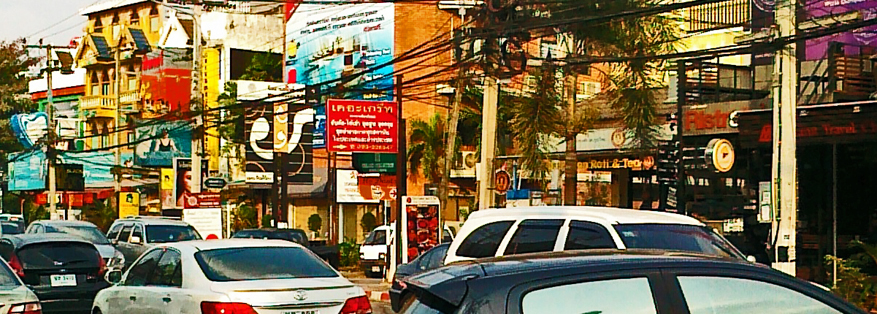
Chiang Mai: Somebody gives me a lift downtown and she’s upset about the traffic, shouting at the other drivers, voice echoing around in the acoustics of our small vehicle, really letting it all go. She’s a local person and this kind of pressure-valve release is weird, like a bad dream; road rage is the same everywhere, I suppose. We’re accelerating down these narrow sois (small streets) lined with parked cars, pedestrians everywhere, sudden braking and lurching around corners, then reversing all the way out of there because there’s an obstruction. I’m sitting in the back seat, she’s twisted around peering through the rear window, as she negotiates reverse gear, so I get to look at this tense face, complaining about how these drivers all come from the hills; they don’t know anything about road courtesy; the whole nine yards …

Maybe she’s just having a bad day – correction, she is having a bad day. What to do? I can get upset about how upset the driver is, or I can just watch the road on her behalf – two options. I opt for watching the road; the mindfulness thing, and immediately I’m into this kind of alert awareness of everything that’s happening. I’m discovering this (or maybe I always knew) instinctive preparedness that just seems to engage: life is fragile and tenuous. At the same time struggling a bit with the other option: Hey! what’s all the fuss about? Smile and pretend it’s not happening. But there’s just no getting away from it, and this fully switched-on-headlight of fierce alertness is locked in and focused.

Part of me is asking what is going on here? There’s awareness, conscious awareness and then consciousness itself – so this is it, the big question… what is consciousness? Turn the mirror around like that, and consciousness sees itself; there’s a duality and we return to the default reality of ‘me’ in here and ‘that’ out there. It’s this thing about mirrors again; ‘I’ become the subject of what is being mirrored: you can see for yourself, it’s saying, this is proof of how it is… right? But I choose to take refuge in awareness of the danger, rather than do the ostrich-head-in-the-sand thing. I can take sati-sampajañña, awakened awareness, as my refuge. The inclination is to be awake, to be watchful, all sensory receptors are switched on full blast; any little sense of ‘me’ as a person is a distraction. So this is the way to go, I stay with that and there’s a clear knowledge that it’s not a ‘created’ mind state. It’s something Ajahn Sumedho would call the Unconditioned [see link below].

We get to the destination and I’m very glad to get out of the car, ‘thanks for the lift!’ Wow, life, as we know it, returns – it puts on its appearance of comfortable familiarity. Amazing, how does it do that? It really is such a fine balance, we are just on the edge of all this disappearing, all the time! And with conscious awareness the system is more inclined to go directly with what is really happening than run for safety in some kind of ‘pretend’ world. I wonder, though, what happens to people who’ve never bothered to look beyond the reality of the fictional ‘self’. It would require a lot of last minute revisions; could it all be done in time?  Maybe it’s possible.

The driver… well I dunno, but she was pretty good. Somebody told me later she did a training course in driving emergency vehicles, so maybe that’s it – life for her is just one continuing emergency. That’s OK too….

————————-

‘… We take that which is aware of the conditioned realm, sati-sampajañña, awakened awareness, as our refuge, rather than trying to find or create a condition that will give us a false sense of security. We are not trying to fool ourselves, to create a sense of security through positive thinking. Our refuge is awakening to reality, because the unconditioned is reality. Awareness, awakeness, is the gate to the unconditioned…. You can’t take refuge in your thoughts or your perceptions. That’s just the way the conditioned mind functions. It can’t help it. It can’t do anything other than that. You can only take refuge in awareness. All the problems are resolved right there. Of course, the conditioned mind thinks that awareness is nothing; it not worth anything – but it’s everything….Whatever assumptions you have about yourself, no matter how reasonable they might be, they are still a creation in the present. By believing in them, by thinking and holding to them, you’re continually creating yourself as a personality.’ [Ajahn Sumedho, ‘The Problem of Personality’]

backstory

Iceland wave1Chiang Mai: Skype call from P in the North of Scotland, walking through a shopping mall interior, holding up his phone camera in front of him and I’m able to enter into a view of the world at this moment, about 5500 miles away. It feels like I’m really there; a chromium steel, tiled and glass environment with Starbucks and everything is recognizably ‘the mall’. People wearing scarves and hats, thick clothing – it’s below freezing outside that building. Light from the mall windows fading out to zero white, pixelated edges of electric blue and turquoise suggests air so cold it’s like an ice-cream headache, chilled nasal passageways and cranial cavities. I’m thinking of ice-rinks, peppermint and menthol. Words come out with vigour in great gusts of steamy vapour.

I lived there in a former life – long ago and far away. The sharp clear air, constant wind, and winter daylight lasts only a few hours; it was a world without colour. Cold, wet, windy and the mind is saying: ‘No, I don’t like this. I want sunshine, I want warmth,’ the samsara of wanting it to be different from how it is. And eyes looking through the gap between hat and scarf, out into the world but inwardly removed and seeing the sunshine in some fictional landscape created in the mind. I didn’t know anything about the Buddhist perspective on Suffering, dukkha nirodho ariya sacca, at that time, just ‘driven’ by a sadly dysfunctional family and nameless hunger that arises from the feeling that there has to be something better than this.

So, one thing led to another, and it’s a long story, but eventually I discovered it’s not ‘me’, it’s just the way it is. I can have loving-kindness, mettā, for the created ‘me’ and lighten up about that. I don’t get seriously into it any more, now there’s that distance from my constructed identity. It’s been with me all those years, wow, like something historical: ‘This is the house that Jack built.’ And now I’m here in South East Asia; not too hot at this time of year, warm like a Mediterranean summer; rubber slippers, shorts and a T-shirt. The quality of light is amazing, colours of things are outstanding, as if lit from within – a Disney cartoon – papaya fruit is an amazing fluorescent, magic-marker orange; green trees against blue skies and the whole thing feels like it’s been photo-shopped. The air is warm like a soft quilt cover wrapped around the shoulders, with no weight, so you feel this lightness – ‘Unbearable Lightness of Being ‘ by Milan Kundera, worth reading if only for the title.

But all this coming to an end very soon, less than a week to go before the time comes to go back to Delhi and the colder climatic conditions of the North. Not able to flop around in thin cotton clothing any longer… nope. This time next week I’ll be socked and shoed and trousered, and scarved and coated, hair-combed, passported and ticketed and transported to the North of India in a passenger jet, but that’s not happened yet so there’s time to reflect on that difference and get ready for the adjustment.

I’ve been living in other people’s countries for more than 30 years; met Jiab on the way. She still identifies with her Thai cultural context. I’ve nearly forgotten mine. I used to go back to the family home up there at the top of the world and most people couldn’t remember me; all the elders’ hair going grey, and greyer then white, Now I go there for funerals and people just don’t know me at all. I’m a foreigner there and a foreigner everywhere else. I’m more into the Thai world than any other culture – they see me as a kind of cultural hybrid.

There’s a shrine in Jiab’s family home; a structure of tiny ornate tables placed one on top of each other, in a hierarchy of size. The larger ones are at the bottom and smaller ones placed on top and even smaller ones placed on top of them. It’s built up to about five levels. An ascending, perspective effect as things recede above eye level with candles and an image of the Buddha on the topmost table. It’s the one where he’s protected by the hooded snake god Naga, extending Cobra neck hood and curved over the head of the Buddha forming a kind of umbrella (there was a rainstorm at the time of approaching enlightenment). Above that, framed on the wall, there’s a row of these faded old sepia photos of Jiab’s ancestors. There they all are, looking down at me. I feel their gaze because I’m not just a cultural hybrid in their eyes, I’m from a different planet too. I sometimes feel they need to look at me more carefully than they look at other visitors to the shrine. So I just let them do that, it’s a kindly gaze, without the burden of thought, comfortably dwelling in a state of wakefulness, and understanding things in their actuality.

P1030977

————————-

Photo (upper) Iceland wave, Peter H. Photo (lower) Chinese temple BangPah-in, Elaine H

how it seems (1)

2013-01-09 11.48.37I SEE THE WORLD through a built-in selection process that reflects and supports the default state of mind; it’s like fish cannot see the water they swim in; so obvious, yet… but I can get it to fit, more or less, according to my likes and dislikes and fall deeper into the dream. I make it into something good or bad or whatever and the fact that I can’t see it – well, it just does that. I call it reality. How I perceive the world is dependent on causes and conditions that were here before I was born; you could say it comes with the software. I think I’m an independent being not affected by anything or not affecting or influencing anything else. I can’t see this is a work of fiction and it’s all being monitored by the ongoing needs and requirements of an entity I created; a ‘self’ that has no real substance. I’m dismayed, of course, by how it all gets swept away in randomness; subject to the kamma, unknowingly created at some earlier time.

 ‘… It’s because of not understanding and not penetrating this Dhamma that this generation is like a tangled skein, a knotted ball of string, like matted rushes and reeds, and does not go beyond the cycle of the planes of deprivation, woe, and bad destinations.’ [Tanha Sutta: Craving” (AN 4.199)]

The outer world just rolls along, as it does, in all its diversity, and totally neutral. Whether there’s belief it’s this or that, makes no difference; it’s just how it seems. The devastating emptiness of it all means the population is driven to get and do and attain and protect and defend. It’s a battlefield. To avoid and deny, to have fear and anxiety and be controlled by authority and feel threatened with the flimsy nature of existence, although the absolute fragility anicca, is the beauty of it. But the population can’t see it like that. They are clutching at straws but don’t see it like that; don’t see they are maintained in an unknowingness of the world like penned animals are by the farmer, well intentioned though he may be, in order to cultivate a special kind of hunger, upadana tanha (clinging and craving) – and the economy depends on this. The greater the craving, the faster the turnover of stock and the Western style of God together with governments and the corporations are simply involved in farming the population.

I can understand why the Buddha was thinking the Dhamma was too subtle and there was no point in teaching it because no one would understand. I can see how, in those historical times of feudal hierarchy, it would have seemed impossible to create social change…. and is it any different now? It seems just as impossible for people to understand today. I wonder if I really fully understand it myself. I’m no different from other people, this is our shared suffering. But the Buddha changed his mind about it being too subtle. He said there is a way out and we can find it in the framework of the Four Noble Truths. The teaching has survived 2600 years. Understanding replaces misunderstanding; ignorance is pushed out. There’s a simple curiosity and this quiet state of at-ease knowingness….

Big_Buddha_statue,_Bodhgaya

————————-