10 million to 1

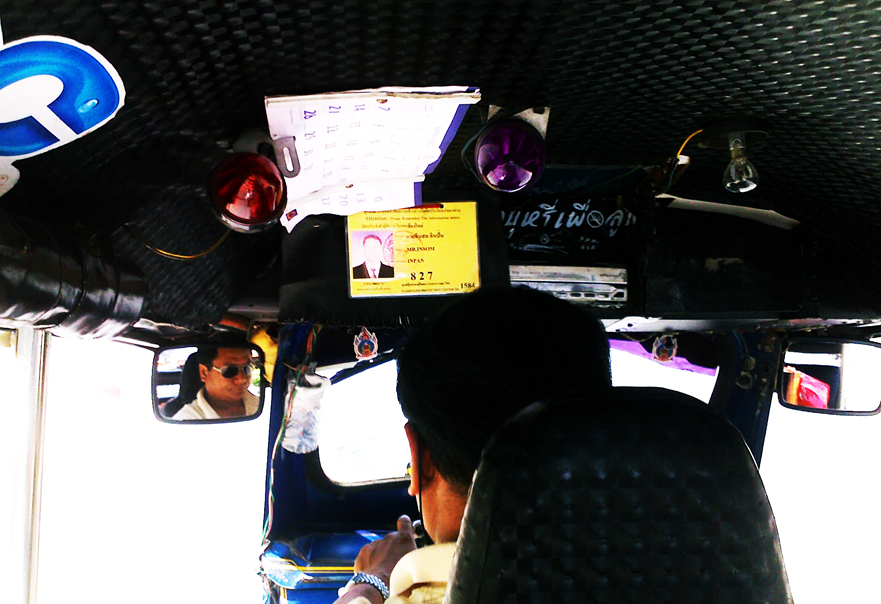
Bangkok: I’m in a downtown area, standing under an umbrella, trying to hail a taxi; heavy rain here and the traffic is going slow. A taxi pulls up, bright yellow and green, open the door and get in. There’s that strong smell of krating daeng (red bull), and jasmine flower garlands. I see a Buddha rupa and various auspicious objects everywhere. The taxi is old-style, well maintained but at the end of its days. The same could be said of the driver; ‘Loong’, meaning ‘uncle’, a respectful term used with any old man. In fact he’s more like great-grandfather, smiling, childlike and ancient.

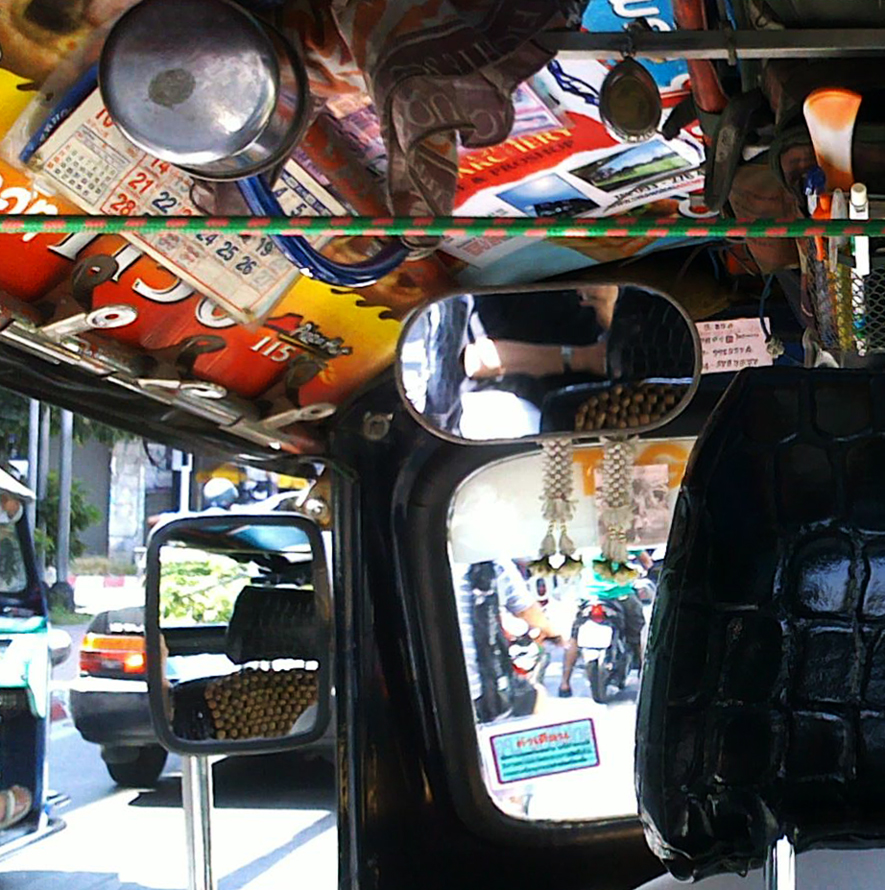
The most noticeable thing about him is he’s got no teeth and insists on grinning all the time. He’s likeable, asks me all the usual questions and it turns out his daughter lives near to where I live in Bangkok and that’s a talking point. He brings his attention to driving the car and I’m wondering how this is going to turn out, but it seems to be good enough. So I settle back and look round the interior of the cab because it is crowded in here. Blessings and charms are painted on the ceiling, a great profusion of strings of beads, amulets and decorative hanging things tinkling and clanking from the rear-view mirror, and it takes me a little while to notice that the dashboard is covered with all kinds of toy objects stuck on with adhesive. The dog with the nodding head, and they all have moving, swinging heads, like this; coiled spring necks and crazy grinning faces that wobble slightly with the vibration of the engine but roll around madly every time his taxi makes a sudden movement, a touch on the brakes, an abrupt acceleration. It’s quite mesmerizing.

I’m just taking it in here, all these wobbly heads and various swinging objects in the middle of the windscreen; a part of the journey I didn’t expect. I get in his taxi simply to travel from point A to point B thinking that he just takes me there – and he does that but feels it necessary to surround his passengers with… something, what is it? I know some Thais who would feel uneasy in here, seeing a connection with phi (superstition). I don’t engage with that stuff and thinking it’s like this because, for him, it’s just boring and pointless; there’s no reason for this journey or any journey, and this is a kind of anchor. Somebody else will get in, after I get out, and that person will tell him to go somewhere else and off he goes. When he gets there it’s the same as the place he just left, and all other places. Traffic in the city is like water in the river; it gets everywhere, into all the corners where there’s space for it.

Every passenger who gets in has a directional goal-orientated intention; this old driver is not part of that, even though he is very much present. For him it may seem incidental in a profound sort of way; just wandering all over the town in randomness and along the way he’s arrived at the concept of all these wobbly heads, I suppose. It’s suitable because it’s meaningless, like everything else. His taxicab is like this because he’s in a place where it’s always ‘now’. Most of the cause/effect, time-bound, goal-directed thinking is just not there. Apart from control of the vehicle, which he must know completely, he is free; he’s not going anywhere because he doesn’t need to go anywhere; there’s nothing he needs. He just takes other people where they want to go and there’s just the emptiness of it.

In the Hermann Hesse novel: ‘Siddhartha’ (chapter 9), Siddhartha speaks to Vasudeva, the ferryman, about a lesson the river teaches, that time does not exist. “The river is everywhere at the same time, at the source and at the mouth…in the ocean and in the mountains, everywhere, and the present only exists for it, not the shadow of the past, nor the shadow of the future… Nothing was, nothing will be, everything has reality and presence.” He talks about listening to the ‘voice of the river’ and I’m wondering if it’s something like this that Loong is experiencing after a lifetime in the timelessness of this huge city.

Loong drops me where I want to go and it’s still raining. I get all the stuff done I was going to do and a few other things too and after a couple of hours I’m in some other part of town in another taxi. We’re stuck at traffic lights and I see this taxi go by with the same wobbly heads on the dashboard; amazing coincidence, considering there are 10 million people in this city – it’s Loong! And he doesn’t have a passenger. Quick decision, I pay off the taxi I’m in, the lights are still at red, jump out and run through the rain to Loong’s taxi. Open the passenger door and jump in – surprise, surprise! There’s wild laughter, and Loong’s great toothless mouth and all of it suddenly feels like a continuation, I was here all the time; I never got out of his cab the first time; the interval that happened in between was a daydream.

So, we set off back to my place and he’s happy about that because he gets to visit his daughter who lives nearby. I hear him explaining things to her on the phone. He’s too old to be driving, really, and as he’s doing that, I have a chance to revisit the strange and interesting timelessness that Loong’s taxi seems to contain.
personifications 1

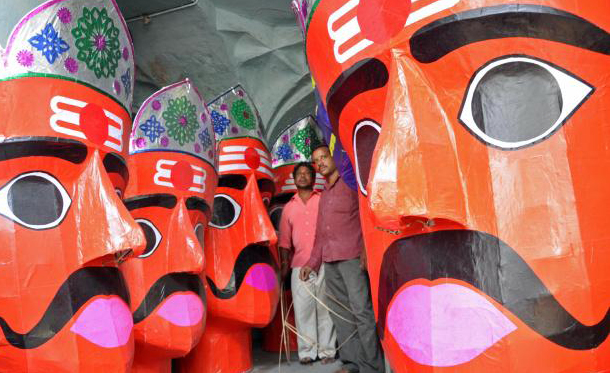
Note about the image: Ravana, huge demon-like effigies, are created for the Dasera festival which was held in India recently. The effigies are packed with straw and the highlight of the event is when they are set alight [Link to: The Hindu newspaper]. What I’m writing about here is the attachment we (Westerners) have to effigies such as teddy bears and the inclination to personify objects as a way of supporting the concept of an individual ‘self’ separate from the world.

Bangkok: I’m in a townhouse in the centre of the city; arranged to meet some people about a school-kids party event. Na Uan is here and the room is full of huge plastic bags containing something… is it teddy bears? Yes, teddy bears. She says, they were donated by an Australian NGO to be given as prizes for the main quiz event. And my first reaction is, how cute! Then that feeling falls away; they’re just teddy bears, a lot of them, packed together in these large plastic bags. I see them all squashed up inside the plastic, upside down, sideways and limbs all tangled together and faces pushed flat against the tight surface of the stretched bag. They’re looking particularly unloved; not cute at all. I ask Na Uan, shouldn’t we take them out of the bag? No, we can’t because they’ll get dusty if we do. Seems like not the kind of thing to do with teddy bears, keep them in plastic bags, they can’t breathe… ? I have to remind myself they’re not living beings.

But the best is yet to come, Na Uan rolls out another plastic bag containing the largest teddy bear I’ve ever seen, it is about 4 feet high in the seated position, squashed up, golden furry body and wide-eyed inquiring alertness about the face, everything flattened tight against the polythene surface, and totally suffocated like the others. Why am I going on so much about teddy bears? It’s because I spent the night there and had to sleep in the same room with all the teddy bears, trapped inside their plastic bags. I got to sleep in the end; woke up in the morning and there they all were again, looking out at me in their appealing way..

It’s this thing about ‘self’, there’s just no getting away from it. We take the mind to be self but it’s a succession of mental elements nāma rising and falling away and seeing, hearing, thinking is the same; the body too, rūpa, one day here, next day gone. The five khandhas – it’s doubtful if they were of any substance in the first place. Sounds like a sad story and I suppose that’s why there are teddy bears we can hold on to – and other things. We try to bring our sense of ‘self’ into reality with these personifications, images of ‘self’, but that falls away too. None of it works, there’s just this great emptiness where the individual self supposedly resides and the great big teddy bear looking at me now from across the room cannot convince me otherwise. It doesn’t work like that.

Interesting to see Na Uan’s attitude about all this; individuality creating existential anxiety; it’s a Western thing. It has no meaning; there are many things like this that happen here in Bangkok that Na Uan doesn’t understand and that’s ok, not important. She is one of eight sisters and brothers, an integral part of a community that takes support from each and every individual present, one way or the other. Yes all kinds of stuff Na Uan didn’t have to learn and get involved with when she was a kid. Good for her. The ‘self’ problem is still there, though, but maybe the Thais are very much less attached to it than we are.

There’s a question about what remains after you see through everything that is not the ‘I’ you take it to be. There’s a quote by Sri Ramana Maharshi: ‘… the one who eliminates the ‘not I’ cannot eliminate the ‘I’… find the source and then all these other ideas will vanish and the pure Self will remain.’ It’s possible to have assumptions about the ‘pure Self’ and about what ‘will remain’. The Buddha’s teaching is that if you can completely deconstruct the ‘I’, nothing is left behind, ‘no remainder’. This must be a teaching about tanha, the natural inclination to hold on to the very end – as we do with teddy bears and everything else. All there can be is the clear-minded investigation of this.

Sometime after that I was having breakfast, pa tong ko, deep fried dough pieces in the shape of an X and soy bean drinks with dried fruits and somebody arrives in a pick-up truck and takes the bags of teddy bears away. It was like they were never here.

————————-

Photo Image: The Hindu Newspaper

A Sea of People

Bangkok: I arrived at Don Mueang aiport, Sunday 28 October, unusually busy; three or more flights arriving at the same time. Through the exit marked TAXIS, out to the street area and about five hundred people are waiting for taxis; wow! Everything in Bangkok is on such a huge scale. It was the last day of the school holidays so families were returning from the provinces to the city. It looked like it was going to be a long wait, but it wasn’t bad, very well handled, airport officials steering this great sea of people into lines, no problem. And lined up on the other side of the crowd barrier was a virtual convoy of waiting taxis, four lanes wide and stretching back as far as the eye could see.

But the initial reaction is frustration, of course. I’d just arrived from Ch’mai and that small town thing where there’s less of the kind of situation that invites you to get engaged, upset about it and thus vent your spleen. I’m saying this because a part of me wasn’t ready to have a frustrating situation like this, but that’s the thing about frustrating situations, they just come along when you least expect it and there you are, same old story. Interesting to see how fast the energy of aversion arises and you’re locked into an immediate response; struggling with ‘self’ among all the other ‘selves’ – ‘me’ first, ‘me’ first, all trying to get a taxi before there are no taxis left and I’m reminded of a Bob Dylan line: ‘… tryin’ to get to Heaven before they close the door…’ Seeing it in this way means thank goodness there’s mindfulness and an opportunity to bring what I know from the Thai othon (patient endurance) to conscious awareness and immediately there’s a small space in the mind and it’s a bit easier to take. These are the teachings I’ve absorbed from the Ajahns; there’s also uppekha (equanimity) in there somewhere and the fact that this is what life is about; the ups and downs of it and the Eight Worldly Dhammas

Deep breaths… and contemplating the value of standing meditation. I’m in one of three very long lines of people with trolleys and pulling wheeled luggage but no jostling, no push-and-shove; well-behaved, and the Thais are calm. So I get calm too. I realize that what the frustration is about is not being able to see what’s going on – the limitations of our human physicality? All I can see are the backs of people’s heads and I’m moving my head from side to side, trying to see past all the other heads down there to the taxi kiosk at the end of the line, very far away. What’s going on down there? But all the other heads are doing the same thing and my line of vision is obscured by somebody else’s head, moving from side to side because the head in front of him is in the way. Moving my head like this probably causes other heads behind me to have to do the same thing. And there’s a consciousness of this.

Curious and interesting, hundreds of wobbling heads; the face is on the front and there are no sensory receptors on the back, no rear-view mirror either but it’s a possibility? All sensory data is received in the front and ears on the sides. Seeing the back of someone’s head is like looking at a closed-door, so there is a natural tendency to want to get around to the other side see the face. No, can’t do that kind of thing in a line waiting for taxis; we just have to switch off the ‘search’ function and allow things to happen. There’s an Alan Watts observation about it being like the headlight of a car. ‘The headlight illumines the road in front but does not shine on the wiring that connects it with the battery, and the battery with the engine. And so, we are not ordinarily aware of how we are aware.’ [Zen and the Beat Way, Alan Watts]

I got a taxi okay, no problem, and it was a lady driver, Khun Siripon, which was nice because there’s never any hassle with a lady taxi driver, thank you Khun Siripon! When we got to the house, I paid the fare, gave her quite a large tip and she turned round to look at me, face-to-face and the wai she gave in response was so respectful, I was humbled. Amazing.

I was going to write something else about Douglas Harding, ‘On Having No Head’ but that’ll have to be done some other time.

————————-

world as thought-construct

Chiang Mai: 06.00hrs. Sitting on the cushion before the day actually begins and there’s that colourless light of dawn filling the room, a greyish-green glow. After what seems to be quite a long time, the day gets it’s total act together and the sun rises; things take shape in my vision and colour enters the visual world. The show has started. Sky is blue, sun is yellow, plants and trees are green. That’s how it is here at, 18°47’N, 098°59’E. I notice it because of having only recently returned to this place from the Northern Hemisphere where there are these same colourless dawns; but they’re followed by colourless days – often and unforeseen; the changeability of everything. For the local people there’s no experience of continuity.

I do find it curious here that every day is pretty much the same, some small seasonal differences but not much. For the people in this location it’s always been like this, of course. It’s how it was when they were born; it’s how it was when all known persons in their lineage were born and future generations will go on like this. There’s never any experience of anything being different from this. And for me too; all my sunny days in Asia in the last 30 years could be said to be simply one very long day – the period of night time is a blink of the eye; one huge flow of days, like moments moving along in their sameness, never ending.

In this context it’s easier to get a handle on the teachings of Ādi Śaṅkarācārya, in South India, in the 8th Century (the days were exactly the same then as they are today) and the Advaita truth of timelessness where the endless day, that I am experiencing now, stretches all the way back into the past and out into the future, in one continuous ‘now’ time happening everywhere. There’s no end to it and no beginning. Time and space phenomena are delusions, add-ons. There are, therefore, no causal relationships; cause-leading-to-effect is a temporal process – thought-constructed, and not what I take it to be because the entire objective world is a thought-construct, created by desire-motivated ways of thinking and acting. ‘…Time is generated by the mind’s restlessness, its stretching out to the future, its projects, and its negation of ‘the present state.'[6]’

Knowing this, from the Advaitist perspective, is the whole Truth. Nothing needs to be attained or done; one simply wakes up to the truth of Ātman/Brahman, and anything other than this is māyā, delusion. Where does māyā fit in? No explanation; it cannot be inside or outside Brahman; one doesn’t know where that could be (māyā truly is a delusion). Buddhist practice or any spiritual practice is not a solution to the problem, just another version of the problem itself. Any practice leading to an enlightenment experience maintains the dualism that it strives to escape; projecting a thought-constructed goal like this into the future loses the ‘now’, the place of liberation.

‘… there is absolutely nothing to attain, which is not to deny that that is something to be realized clearly. The difference between attainment and such realization is that only now can I realize I am that which I seek. Since it is always now, the possibility is always there, but that possibility becomes realized only when causal, time-bound, goal-directed ways of thinking and acting evaporate, to expose what I have always been: a formless, qualityless mind which is immutable because it is “nothing,” which is free because it is not going anywhere, and which does not need to go anywhere because it does not lack anything.’ [David Loy]

The colourless dawns, followed by colourless days in the N. Hemisphere did not bring me to this experience of continuity. I stumbled upon it in Asia and found traces of it in this location: ‘Everything – subject, object and the perceiving thereof – is inseparable from this experience-ing-aware-ing-ness … and who can escape this immanence?’ The Buddhist experience tells me there has to be a middle way in here somewhere. I’m looking for some route that allows Sankara’s truth of Ātman/Brahman to be combined with the Buddha’s no-self truth in nibbana. The Buddhists will say I’ll not find anything, the Advaitists will say there’s only One thing to be found: “all of the above”. But there has to be a middle way in here somewhere. The investigating process itself is the Path: ‘the nature of the self and causes and conditions.’ Beyond that is speculation.…

————————-

This post created with excerpts from: ‘The Path of No-path: Śaṅkara and Dogen on the Paradox of Practice’ by David Loy

Quote from: miriam louisa

Quote from: undividedexperience

– g  r  a  t  i  t  u  d  e – 

Photo image: Ch’mai TukTuk

Constructedness

Chiang Mai: I met somebody in a coffee shop the other day and he was saying, it’s all just words, isn’t it? We were talking about the difference between the Advaita Self and the Theravada Buddhist no-self. I was saying no-self is a deconstructed form of Self. The man in the coffee shop wouldn’t say yes or no to that (it’s all just words). Theravadin Buddhism is about seeing through the constructedness of the ordinary self we all experience as who we are. Take that to pieces through meditational investigation and wise reflection, follow the Path and you end up with the state of final deliverance, the unborn, ageless, and deathless; Nibbana.

Advaita doesn’t need to get into that because the state of non-duality is pre-existing. You can’t break it down into its parts because it’s already there. You just need to ‘see’ it. Speculative conjectures, say the Theravadins. The quest to know the Self in Brahman is simply the mind’s natural yearning for a comprehensive unity; trying to reach ‘Nibbana’ by intellectual means. What we need to do is remain grounded in actuality and by humble, sustained spiritual practice, work to liberate ourselves from the dualities contained within human experience. This living experience of things as they really are, is the starting point and framework. Buddhism attempts to diagnose the central problem at the core of human existence, dhukka and to offer a way to its solution. ‘This is suffering, this is the origin of suffering, this is the cessation of suffering, this is the way leading to the cessation of suffering.’ The Buddha didn’t say exactly what happens after that.

In Advaita there’s a kind of built-in narrative that seems to be associated somehow, more literalist than what I’m used to in the Theravadin Buddhist way. This is where I return to at the end of the day. Maybe it’s because that’s how I started out on the Path. I learned how to take things apart carefully to see how it all works; how it can be reconstructed or deconstructed and it looks like there’s no final state, the ‘world’ remains as transformation; it’s all about phenomena that are dependent on other phenomena, and nothing in the world has a true independent reality.

This is different from the Advaitist ‘absolute reality’, the single homogenous and continuous structure of Brahman, the ‘Oneness’. The question is, what’s the difference between ‘absolute reality’ and ‘no independent reality’? An intuitive sense tells me both ‘absolute reality’ and ‘no independent reality’ are relevant to the Path – I don’t see why there should be an impossible difference between them because the ‘Oneness’ includes everything. Like my friend in the coffee shop says, it’s all just words, isn’t it? Take the words away and and there’s nothing left – only conscious experience.

————————

‘Early Buddhism conflates subject into object. Consciousness is something conditioned, arising only when certain conditions exist. The self is merely an illusion created by the interaction of the five aggregates. The self shrinks to nothing and there is only a void; but the Void is not a thing — it expresses the fact that there is absolutely nothing, no-thing at all, which can be identified as the self.

Advaita Vedanta conflates object into subject. There is nothing external to Brahman, the One without a second. Since Brahman is a non-dual, self-luminous consciousness, consciousness expands to encompass the entire universe, which is but the appearance of Brahman; everything is the Self.’ [Enlightenment in Buddhism and Advaita Vedanta: 
Are Nirvana and Moksha the Same? David Loy]

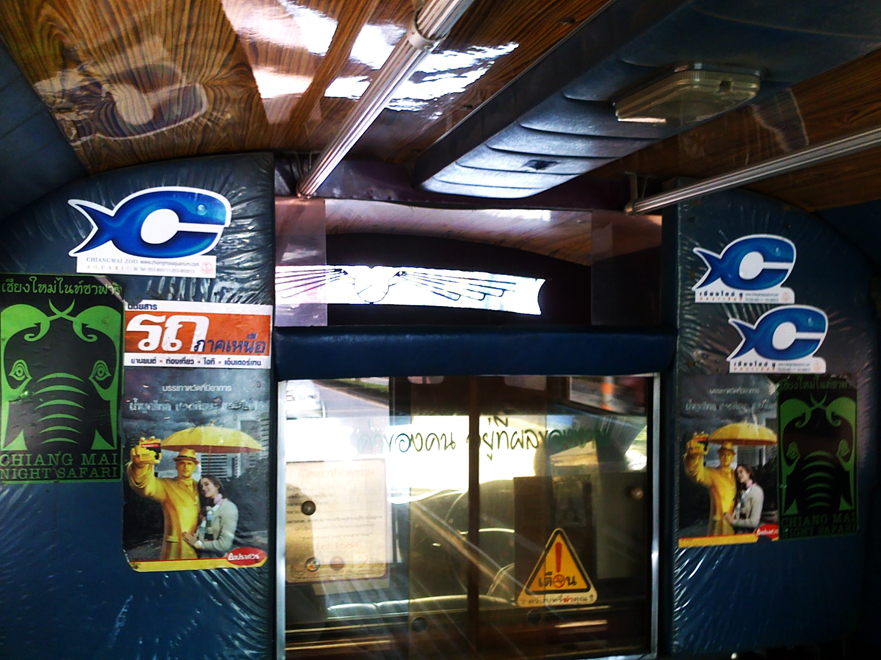
Photo: People Carrier (Songtaew) Chiang Mai

no-thingness

Chiang Mai: I’m in this 3rd floor apartment, lying on the sofa and the balcony door is open. The sound of a plane coming in to land (this building is near the airport and in the flight path), I’ll resist the impulse this time to try to take a photo of it – lean backwards over the balcony… scary. So I lay down flat on the sofa, ready for the immense noise, and the aircraft flies over. The sound is absolutely devastating. The glass of windows, masonry walls, ceiling and floor vibrate… and just at that moment I see the upside-down reflection of the plane in the highly polished floor tiles. It’s there for an instant, flying away across the floor, out to the balcony, and leaves my vision at the same time as the huge sound ends.

An upside down passenger jet flying across my room; such an extraordinary event, I think I need to write that down – where’s my pen? Something to write on? Look in my wallet, and a piece of paper falls out. It’s an old, creased, folded, coffee-shop receipt and on the back of it is written the word ‘extrinsic’. Hmm… so what is this? I made a note of that word for a reason, but what was it? Can’t remember, and now here it is again: extrinsic: adjective: not essential or inherent; not a basic part or quality; extraneous’ (extrinsic at Dictionary.com).

What is it connected with? There’s no context and it doesn’t seem to belong anywhere, yet there’s a familiarity… I feel I should know what it is – the essence of the object seen from outside of it? Something that would answer the question: What is its ‘whatness’? How is its ‘howness’? Somewhere in the realm of seemingly incidental meanings that arise of their own accord as if they’d been consciously created, contained in words, and language itself is the metaphor.

This word ‘extrinsic’ appears to be outside of the moment I’m in, and as soon as I think that, everything shifts to include it. Interesting, maybe, simply because I’m now outside the aircraft and usually I’m inside the aircraft, going between India and Thailand. It’s as if ‘extrinsic’ is a location in the construct, the object seen from the outside, looking in. And ‘intrinsic’ is another location, the subjective sense of the object. The ‘all-aroundness’ and the ‘all-it-isness’ is the totality of the ‘world’.

Everything is interrupted by the sound of another passenger jet approaching. I drop everything and lie back on the sofa to get the full impact of the sound… upside down plane flies across the floor.


“All life is a single event: one moment flowing into the next, naturally. Nothing causing everything. Everything causing everything.” [Wu Hsin]


the doorway

London-Bangkok flight: What a strange way to spend the afternoon… brilliant clear light enters the window as if we were in a room high up in an apartment building. Purple carpet with yellow stars, walls are grey, the fittings are of brushed steel, but I’m somewhere in the air, and thousands of miles away from where I was 8 hours ago. The little old house in East Anglia is empty now, I packed up and left it behind.

Last thing was to bless the room; a blessing and a ‘thank you’ for providing shelter, and doing this also helps me to be alert, mindful and ready for the next thing. Hands held in anjali, and walking through all the rooms in that small dwelling saying in my mind: ‘May all beings live in safety, be happy, be healthy, live with ease. May all persons who come here after me find the same feeling of security and stability I found in this place.’ Then step outside, close the door, double lock it and into the taxi. It helps give a sense of closure, or something, at the end of an event. I recommend it. Recently I came across something very similar about blessings that I liked [Link]

After that, walking through the airport halls and passageways and all these people just moving along with their bags; as you pass them there’s a hint of something familiar – it’s that transitory ‘thing’. Airports and stations are an extraordinary example of it, in fact it’s always there – there at the corner of one’s vision. We’re all having the same kind of experience; we’re all going ‘away’; we’re all in transit; this is the time after we left and before we arrive. This is aniccan the ‘in-between’; the moment of transforming.

Change is there all the time – might seem like a contradiction. There’s a Nagarjuna quote: ‘All things are impermanent, which means there is neither permanence nor impermanence…’  could be a koan; the constant sweeping along of aniccan and waves of change. But immediately it says to me, first I need to lighten up and there’s always something new, gently nudging at the elbow and that’s what makes it possible to ease away from attachment.

If I’m free from ‘holding’, I can easily pass through the layers and corridors of the travel experience, part of the great river of human beings, all of us on the way to ‘somewhere’, surrounded by advertising images of well-off, good-looking people smiling all the time; Julia Roberts doing a Gucci advert? Celebrities I know but can’t remember their names, just posing as ‘themselves’ wearing a watch the cost of a small car. I look closely, trying to remember who it is, and fall into the dream.

They look secure, confident, happy and everything is going allright for them. They don’t seem to suffer from that great chasm of nothingness situated in the centre of everything; the ‘me’ I live with. What is it they have that I don’t? If I could have whatever it is they have, I could be happy, like them…? I’m drawn towards ‘the purchase’ by scenarios and strategies created by commercial psychologist witchdoctors who can manipulate my conscious experience.

Mindfulness means I stay free of the hunger and the urge. Here on this plane I can see  a small piece of  sky out there. It’s sufficient to remind me that if I get pulled into consumerist samsara too much, there’s a doorway in the mind which leads to freedom from sufferingthe remainderless fading & cessation, renunciation, relinquishment, release, & letting go of that very craving. Just knowing this is enough.

‘Within that cycle [the wheel of birth and death (samsara)], there is one doorway through which we can step out, namely, between feeling[Vedana] and craving[Upadana]. All the other steps of dependent arising are automatic causes and effects. Unless we learn to live with unpleasant and pleasant feelings without wanting to get rid of the one or keeping and renewing the other, we don’t have access to that doorway.’ [Aaya Khema, When the Iron Eagle Flies, Transcendental Dependent Arising p55]

non-becoming

OLD NOTEBOOKS: East Anglia: Dreamy half-formed images swim before the eye without identity, no recognizable or known parts of the image. I’m trying to see it this way: no identity, otherwise ‘self’ intervenes and it ‘becomes’ something [bhava]. I’m falling asleep again; still early morning, comfortably dark and sitting on the cushion on a futon on the floor in the upstairs room. One advantage of sleeping on the futon is that you can roll over and up into the sitting position on the cushion quite easily – a smooth transition from sleep to wakefulness. The disadvantage is that it’s difficult to stay awake.

The process of waking up in the morning means the mind is in the process of getting shaped into a form, a ‘self’, and it all gets locked down then; ‘becoming’. So what I’m trying to do here is not let that happen. Without the habitual inclination towards ‘self’, conscious attention gently searches out another way, one that is identity-free, no ID card. The problem is, of course, ‘self’ tries to take over, as usual and if the identity-free state is present, ‘self’ understands it to be sleep. So I start to drift off to sleep again. I see it happening and think: Hey! Why should the ‘self’ impose itself like this? But the ‘self’ goes around imposing ‘itself’ and making assumptions about everything all the time and if I were to just let it go on doing that, I’d not see that things are actually quite different from how they appear to be.

Continue the meditation by following the breath, and a curious feeling that I’m sitting at an angle, or the weight of the body is over on the right side and on the left side there’s something like an empty space… what’s happening? Next thing is, I’m thrust into another dreamlike scenario and some sort of memory sequence. Here we go, I’m falling asleep again and losing it all in the dreamy half-formed images of the sleep I just emerged from. Mindfulness cuts in when I remember to let it all go. Hold on and let go… I need to hold on to the intention to let go. Everywhere I look there’s a ‘self’ searching for an opportunity to create an identity, (sakkayaditthi) ‘personality view’. It’s what holds beings in the cycle of rebirth. Breaking out of the cycle is arrived at by non-becoming – allowing it to ‘become’ without becoming.

————————-

It does not appear or disappear.
It is not born and does not die.
It is neither constructed nor raised up,
Neither made nor produced.
It is neither sitting nor lying,
Neither walking nor standing still,
Neither moving nor turning over,
Neither at rest nor idle.
It does not advance or retreat,
Knows not safety or danger,
Neither right nor wrong.
It is neither virtuous nor improper.
It is neither this nor that,
Neither going nor coming.
[Lotus Sutra]

Photo: Louk Vreeswijk

something else

London: I’m in a narrow rush-hour train, standing in an integrated mass of human bodies all supporting each other. I’ve got something to hold on to above my head which is fortunate because the train is shaking about on uneven tracks, noisy and exhilarating. This really is the whole experience of train travel…. Then it settles down to a smoother pace and I’m focused on the closeness with other people; fragrance of wet raincoats and a forest of arms reaching up to hold on to roof bars, blocking the view. Somewhere nearby, a voice suddenly shouts out: ‘I’M ON THE TRAIN’ – a man speaking on his phone…

‘I think, therefore I am’ [cogito ergo sum] The Buddha noted the inherent problems in this kind of thinking: “I am the thinker’ lies at the root of all the categories and labels of conceptual proliferation, the type of thinking that can turn and attack the person employing it… “Do I exist?” – It depends on what you mean by “exist.” “Do I have a self?” – It depends on what you mean by “self.” Thinking driven by definitions like these often falls prey to the hidden motives or agendas behind the definitions, which means that it’s unreliable.’[Thanissaro Bhikkhu]

The man on the phone continues with his loud conversation, surrounded by people with grim faces who don’t speak. He disregards us completely, asserting himself in this space that everybody is squeezed together in, caught in the dis-ease of ‘deadly tedium’. We are struggling over this intrusion of the man and his phone but holding our composure with patient endurance. Folded newspaper in front of the face to avoid eye contact, we are managing to ignore each other completely. Turn the page of the newspaper, fold it back skillfully without untoward touching and have a casual glance all around, as I’m doing it, just in case there’s anything that needs to be noticed, looked at or ‘seen’. No, everything is as it should be; newspaper held like demure fan that masks the face, and doing the crossword: 7 across: Four letters, ‘It may follow something  _ _ S_. Meanwhile the man talking on his phone is saying the line is breaking up because we are going through a tunnel.

I am committed to a world of consumption of goods and services. I want to have more of what I like and less of what I don’t like. I’m not interested in things that are neutral, they are meaningless (it’s a pity really, because the neutrality of feeling is the Way To Go). I am therefore in a chronic state of dissatisfaction because I never get what I really want. Okay, but as long as we’re mindful, it can be manageable? Well, it’s allright for some, you might say, for those of us who have recently returned from somewhere colourful and bright, light and cheerful, sun shines all the time; smiling Thai faces and their polite behaviour. But isn’t it just that they have a more cheerful kind of dukkha over there?

There’s a passenger announcement: ‘…delays at Croydon and Blackfriars due to congestion’. Then entering Liverpool Street: ‘… this train will not stop at Liverpool Street because of “flooding” at the Eastbound station (flooding?) and will continue on to Aldgate where passengers can take the train back and enter from the Westbound station which is unaffected and we apologize for any inconvenience.’ I have to ask other passengers what the announcement was about and surprised to discover everyone is friendly; the shared burden of these times of hardship and emergency – something conditioned by World War II?

I get there finally, near the end of a long list of Anglo-Saxon place names, and walking along with the South coast tourists in the pleasant harbour area of a town near the sea at Eastbourne. I’m looking for the office of an agent I have to visit and the phone in my pocket is ringing, who can this be… Hello? Jiab, she’s in Peru; hard to believe. She wants to know, can I get some of these wipes that are good for doing polished wood, and get a few packs, please? I have to take them with me when I come to Thailand. I hold up the phone high in the air so she can hear the Eastbourne seagulls all the way over there in Peru; a great swirl and echo of Northern seabirds singing in the wind, like cats mewing in the air.

————————-

 ‘It’s because of not understanding and not penetrating this Dhamma that this generation is like a tangled skein, a knotted ball of string, like matted rushes and reeds, and does not go beyond transmigration, beyond the planes of deprivation, woe, and bad destination.’ [DN 15 PTS: D ii 55 Maha-nidana Sutta: The Great Causes Discourse]

the end of TV

OLD NOTEBOOKS: East Anglia: There used to be a TV here but I gave it away. A big old fashioned dinosaur TV, too large for this little old cottage. No room for it; limited floor space, low ceiling height, clutter and junk (jutter and clunk). I manhandled the TV upstairs but it was no good there; then downstairs again and hurt my back in the process. It was always in the way; just too big. I had it under the table for a while but it looked silly there… and I started to see that it had to go.

But I was dependent on TV watching; every other activity took second place to that, and attempting to disengage from TV was a struggle. What to do? I’d try switching it off suddenly, right in the middle of something, a chat show, whatever, just to see what the room felt and looked like without all the noise, bright lights and rewarding, congratulatory applause. But every time I did that, the absolute silence of a world without TV was devastating! The lack of colour and severity of greyness in the house was just… sad! I had to switch it on immediately. TV was like a friend, I couldn’t say goodbye to it. I kept on doing that, though, switching it off and on again, in the middle of programmes, to surprise myself. Eventually I started to get interested in the idea of the silence that remained without TV, typical of the location I was in – a house surrounded by quiet fields and nature.

But TV-cold-turkey was no fun and I was in denial for a very long time. Then one day I was watching the BBC news and noticed the newsreader pronounced his words with a weird sort of ‘smirk’… kinda disgusting, and then the whole ugly ‘self’ aspect of it was revealed. Shocking, but I was glad it happened because it was obvious then that I didn’t feel comfortable with TV in the house – it had to go. I carried it out the back door and left it in the garden; went back inside and discovered this huge space in the room where it used to be. Interesting to see the directions in the room created by a focus on TV; chairs arranged so that viewing could take place comfortably. So I rearranged the furniture, changed it all around, and that was really quite liberating.

I’d return to the kitchen window from time to time and look at the TV out there in the garden – holding my attention, still… thinking, that object should be ‘inside’, not ‘outside’. Completely out of context in the garden, but I just left it there; no longer connected to it. Later that day, it started to rain and drops were falling on the dusty black surface – the urge to take it back in… that was difficult. The neighbour dropped by and he said it’s not a good thing to leave a TV out in the rain. I told him I didn’t want it anymore, maybe he’d like to have it for his spare room? Okay thank you very much… and, you’re welcome. So I gave him the channel changer and that was it. Off he went and I watched him carry it into his house, happily bewildered by my generosity and failing to understand my joy at having escaped the inertia of TV.

That was then; and this is now. I’m sitting on the cushion in an absolutely compelling silence. It’s before dawn, still dark, and I have the window wide open. Not cold but it’s raining, I’m upstairs and can hear a few rain drops hit the window sill, most of the rain drops are still on the way down. I want to experience this rain so I go downstairs open the back door, get my meditation cushion positioned so that I’m not bothered by drops or wetness coming into the house. Sitting on the surface of the planet listening to the rain striking the hard concrete outside and the grass beyond that. The open door to the garden, no wind here, dry and the sound of raindrops merged together in one whole mass of tiny collisions. An endless wave of pitter-patter-pitter-patter, like thousands of tiny finger snapping sounds. The generosity of rain.

[Link to: Rain]

————————

‘Like a thief entering an empty house, bad thoughts cannot in any way harm an empty mind.’ [Padmasanbhava]

Photo Image Source