More Than Enough

Mitt Romney’s 47% remark drew a lot of attention, perhaps revealing an uncharitable, grudging attitude but it does inevitably bring us around to seeing a quality we all possess: generosity of spirit. Generosity, as a mental, emotional letting go, means releasing the tenacity of holding on to things. Baggage, all that heavy stuff we burden ourselves with, is removed in one single act of generosity. What’s wrong with being generous; cultivating an inward disposition to give? A glad willingness to share what we have with others – why not? We have more than enough. Give it away. Ease the discomfort of being driven to fulfill that urge to ‘have’, a hunger created by always wanting more. All of it is gone when you’re generous.

Brainstorm the word ‘generosity’ and you come up with loving-kindness, compassion, empathy, well being, freedom. You find gratitude, grace, honour, motivation, encouragement. Generosity is everything. It’s nature is to share, recycle, circulate; it can only be given, never taken. With generosity we can accept, we can share, we can forgive. Generosity leads to wisdom – the truth is without bias. There is an understanding of things as they really are.
In Buddhism, generosity is seen as a way to counteract greed. It’s a way of helping others and a means of lessening the economic disparities in society. Generosity is part of Right View. The dhamma of generosity is a gift for all of society as we struggle for meaning in a world of dollars, logos, oil and military spectacle. The dhamma of giving is a disinfectant, a gunk dissolver, an antidiote for the monetary values, brand names that clutch at our hearts.

‘The complex American culture of healthy (that is, democratic) and unhealthy (worship of profit) elements…. Even middle-class Americans, rich by the standards of most of the worlds people, spend much of their money on indulgences, entertainment and addictions.’ [Practising Generosity in a Consumer World]

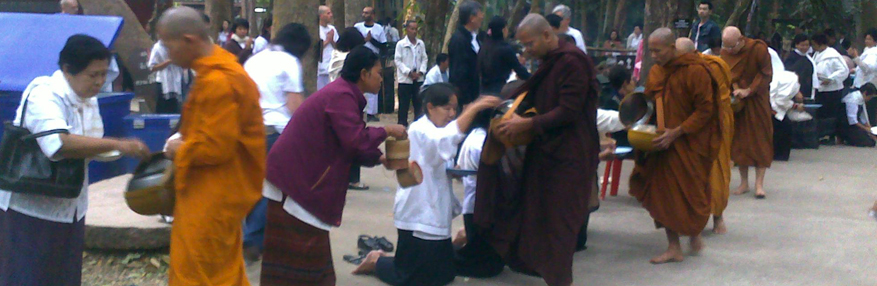
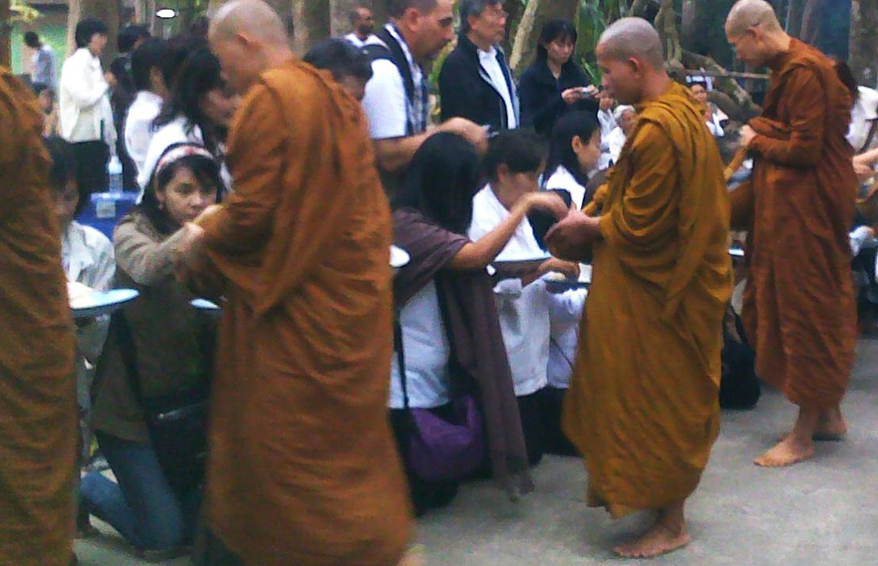
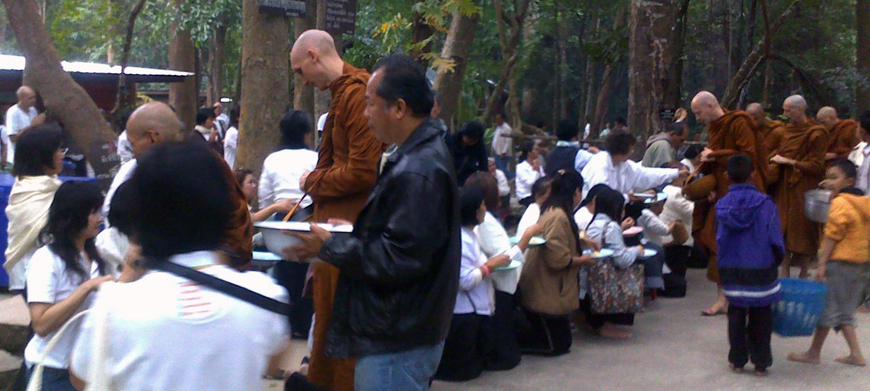
The cultivation of generosity directly debilitates greed and hate, while facilitating that pliancy of mind that allows for the eradication of delusion. In Buddhist countries, babies are taught when they are about six months old to put food into the monk’s alms-bowl. The whole family applauds as the sticky rice drops from that little hand into the monk’s bowl. The kid gets the idea early on: when stuff leaves your hand, you feel happy. It feels good to give. Everything the Buddhist monk receives is a gift, an offering. Ajahn Amaro describes it in this way: ‘Our bodies are fueled by the food that is offered to us. In fact, scientists say that all the cells of the body are replaced every seven years, so any of us who has been ordained for that long now has a body that is completely donated. If it were not for the accumulated kindnesses, efforts, and good will of countless hundreds and thousands of people, this body would not be able to sustain itself. Kindness is the actual physical fabric of what we think of as ‘me.” [Generosity in the Land of the Individualist]

There’s the story about a seeker and a wise man talking together and the wise person has a most incredible jewel. The seeker is absolutely dazzled by the jewel and asks the wise man if he would give him the jewel. And the wise man gives it to him. The seeker is very excited and afraid that the old wise man is going to change his mind, so he hastily says goodbye and goes off. A short while after that he reappears, approaches the wise man with great humility and respect, lays the jewel down in front of him on the ground and says he’d like to make a trade. He’d like to exchange this jewel. And the wise man asks him what he wants to exchange it for. The seeker says he would like to exchange the jewel for knowledge of how to gain the sort of mind that could give up a jewel like that without a second thought. [This story appears in Khanti – Patient Endurance]

————————-

The gift of Dhamma excels all gifts. The flavour of Dhamma surpasses all flavours. The delight of Dhamma transcends all delights. Freedom from craving is the end of all suffering. Dhammapada 354
This post was created from the following references: Bhikkhu Bodhi: ‘Dana: The practice of Giving’. Ajahn Amaro: ‘Generosity in the Land of the Individualist’. Ajahn Jayasaro: ‘2. Khanti – Patient Endurance’ from ‘The Real Practice’ (Three Talks to the Monastic Community of Wat Pah Nanachat). Bhante Shravasti Dhammika – Link to source for: ‘Dāna, the development of its concept and practice’, Toshiichi Endo. Santikaro: ‘Practicing Generosity in a Consumer World’ from ‘Hooked’ (Buddhist Writings on Greed, Desire, and the Urge to Consume) page 198

Photos: Kathina at Wat Pahnanachat 2010 by PB

Low Headroom

East Anglia: Here in the cottage and wide awake at half past three. There was a full moon shining in the window of my little room like a headlight in the clear sky and it woke me up. Came downstairs and got a fire blazing in hearth. The last of last years logs in the shed covered in cobwebs. Nothing has happened here for a year except the neighbour coming in to clear the junk mail once a week. Cold, quiet and that alone feeling; fields all around. I must be the only one awake in a radius of some miles, except for party-people and the night shift down at the Quay. I’m in this wide-awake condition, alert and ready to get on with the day, ears buzzing with the absolute silence of the English countryside.

In this 200 year-old building, the main door is very low, 5ft 6 inches; duck your head to enter and exit. Sometimes the rising up occurs too early and the head collides with the door frame.

I know it well, it’s happened a number of times and thus I have this bruised head and resulting consciousness of the head situated at the top of the body that reminds me of Douglas Harding’s idea of Headlessness. I met him once at his house near Ipswich, not very far from here. He was my neighbour but I never knew him, met him only that one day when Jiab and I went to visit with two bhikkhus. We stayed for the meal and after we’d eaten, did the thing with the paper cylinder that Douglas used to demonstrate the headless reality. What I remember was seeing his cheerful pink-cheeked face at the end of the cylinder he and I were holding and the distinct fragrance of lunch. Sad to think he’s gone now. Douglas Harding passed away in 2007 at the age of 98. The photo above was taken in 2005.

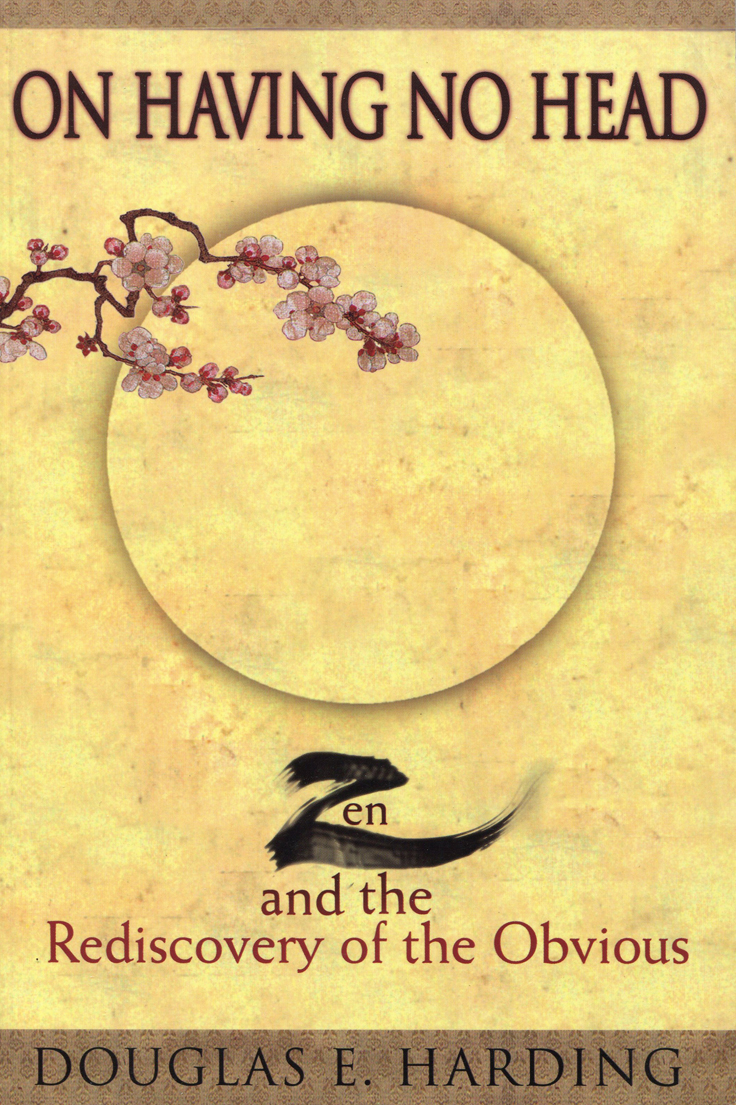
After that I ordered his book: ‘On Having No Head’ on amazon and delivered here by Parcelforce, a company that sounds REALLY assertive. Looking at this now and the description of his visit to the Himalayas and that moment when he discovered he had no head: ‘…what I found was khaki trouserlegs terminating downwards in a pair of brown shoes, khaki sleeves terminating sideways in a pair of pink hands, and a khaki shirtfront terminating upwards in—absolutely nothing whatever! … this hole where a head should have been was … a vast emptiness vastly filled, a nothing that found room for everything—room for grass, trees, shadowy distant hills. I had lost a head and gained a world.’

The ‘headless’ condition he describes at length is something I’ve considered many times. Now seated here at the desk upstairs on revolving office chair, yellow vinyl floor surface, facing the small window, no curtains, dark black outside, the window glass reflects the interior of the room and back of desktop computer. I find the Douglas Harding Quotes page.

‘The lost Gospel according to Thomas, discovered “by accident” in an Egyptian cave in 1945, couldn’t have appeared at a more opportune moment in history, or with a message that speaks more directly to our condition and needs.’ [Link to: Douglas Harding Quotes]

Birdsong… sun is coming up and I see a flat landscape; low lying sunbeam illuminates a few remaining cornstalks in the harvested field, they are a golden colour. Blue sky, it’s a new day, clear away all the shadows of night and I’m pondering the evidence that all and everything is in the space where the head used to be. Is this what Jesus was really teaching? [Link to: Nag
 Hammadi Manuscripts]

————————-

‘… your humanity is like a disguise, an incarnation you have taken on to be here in this world. Inwardly you are God, outwardly you are a person – a unique person with a special contribution to make. Instead of thinking you are just that person, that appearance, you are awake to the Power behind you, the Safety within you, the Source of inspiration and guidance at the heart of your human life. This enables you to be yourself even more so.’ [Douglas Harding Quotes (link above)]

Main Photo, left to right: the Author, Catherine Harding, Douglas Harding, Ajahn Dhammiko and Ajahn Visuddhi

A Little Country

Genève-London Flight: Darkness and the cold mountain air of a Swiss morning just before the 06.00hrs news broadcast; they are playing a short extract of birdsong – the first broadcast of the day. It arises from silence on the car’s speakers, increasing in volume and gradually becomes noticeable; very much like the real thing. Birdsong and high frequency sounds reduce stress, I feel relaxed. Day begins, the news in French as we sail through the silent Genève streets to the airport. Taxi like a limo; everything is reassuringly taken-care-of. No problem, no suffering; the heaven realms.

Airport check in, and through to Departures, impossibly expensive luxury goods in Duty Free. At the Easyjet desk, staff wear fluorescent orange Hi-Vis vests; cheap and cheerful. We are processed, boarded, I have time to find an aisle seat, stow away my bag. Up and away and the next thing is, I’m looking from the plane down on the surface of the planet.

Clouds cover the landscape with openings here and there where I can see the ground below. Very soon we are at the French coast and the clouds disperse as we fly over the English Channel. I can see a few isolated ships with lights on; it’s still early morning. In a very short time the coast of England appears up front and if I look behind me I can still see the coast of France – hadn’t realised how close these countries are to each other.

England is a patchwork quilt of very small fenced enclosures. Everything is the same as it was when I left a year ago; it could have been yesterday. I think I recognize the little houses down there, same flight path as before. No change. Buildings last for hundreds of years, built from iron, brick and stone. It was all here before I was born and will be here after I’m dead. So different from the bamboo and thatched roof dwellings of South East Asia; they fall apart and new ones are built in their place. That kind of fragility and tenuous existence is frightening for people who live in a stormy climate like this, surrounded by the sea.

Concrete bulwarks along the English coast keep the sea out. The threat of the sea engulfing the land is psychological; an island mentality. The perceived fear that it’s impossible to open up to fully accommodate this energy of life. We have to hold it back. There is no space in this little country; cross from East to West by road and it’s done in a few hours. The recognition comes back to me – I know this feeling; a deep familiarity. The claustrophobia of ‘self’; I am an island surrounded by water. There is this anxiety that comes from always wanting to know things are under control; the sea will not breach the flood barriers.

Descend at Gatwick, off the plane and processed through formalities. Large posters saying you cannot bring potatoes into the United Kingdom… okay so this is my last chance to declare hidden contraband of illegal potatoes. Welcome to England. ‘Passengers are reminded not to leave baggage unattended.’ It’s only 07:55 hrs, thanks to 1 hr time difference; a sense that you’ve arrived before you left? The day is yet to begin; dull grey, cold and damp. The Rail Network, rock’n roll, rough and ready; an empty beer can rolling around on the floor of the train carriage. Seats are small, very close to each other but passengers are all looking the other way. How good it would be if we could all just be friends…. My niece would say: can you give me a hug please?

 ————————-

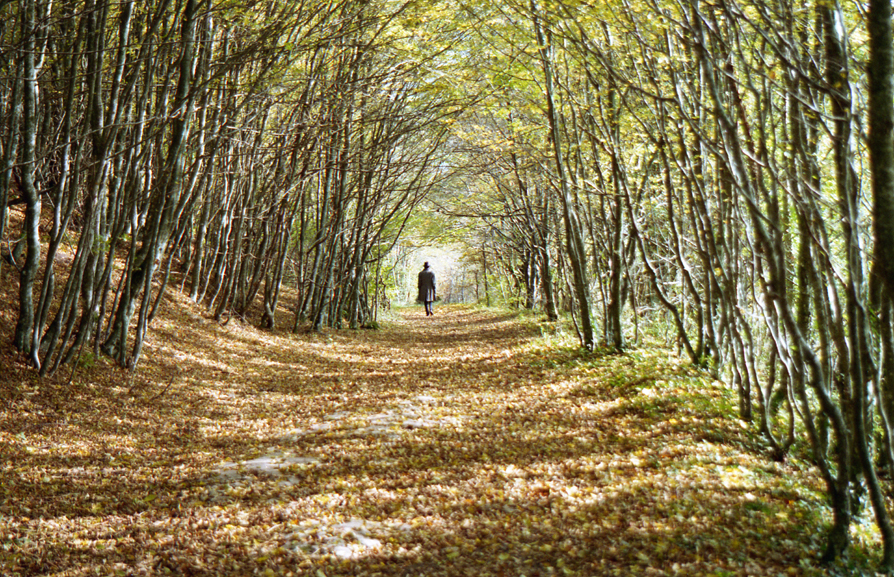
Let there be a little country without many people.
 Let them have tools that do the work of ten or a hundred,
 and never use them. 
Let them be mindful of death
 and disinclined to long journeys.
 They’d have ships and carriages,
 but no place to go.
 They’d have armor and weapons,
 but no parades.
 Instead of writing,
 they might go back to using knotted cords. 
They’d enjoy eating,
 take pleasure in clothes, 
be happy with their houses, 
devoted to their customs.

The next little country might be so close, 
the people could hear the cocks crowing
 and dogs barking there,
 but they’d get old and die
 without ever having been there.

[Tao Te Ching, Chapter 80, translated by Ursula K. Le Guin ]

Photo: Louk Vreeswijk


Transparent

Switzerland: Up here on the 7th floor of the building, windows look out both at the back and at the front. Light enters the apartment from both sides. They call it, traversant. Quite nice but not something you’d notice unless, maybe, if you are a practicing Buddhist and you ‘notice’ things more than other people? That’s how it was for me this morning, doing walking meditation jonkrom from one window to the other: 35 paces in a straight line, then turn around and walk back.

I start the walking meditation path at the West side of the apartment and the balcony (where the pigeons are roosting [Link to: Birds on the Balcony 4]). Walking slowly and mindfully away from the balcony, through the hallway and into the bedroom, then to the window and I’m at the East side of the building. Pause there for a moment, look out the window, and I see the rays of the rising sun behind the apartment building opposite. I turn around with my back to the rising sun and walk back the way I came, through the hallway, into the main room and straight on to the window and I’m looking out at the balcony again. Pigeons look at me curiously. Pause for a second and turn around and go back. Walking forwards and backwards like this, watching the movements of the body, is the essence of walking meditation.

Every time I walk to the East side, where the sun is rising, I notice it’s getting a bit brighter but I don’t think too much about this at first. The whole of my side of the building is presently in the shadow created by the sun behind that building out there. Slowly stepping out my 35 paces forwards and 35 paces back to this point and returning to this window, it becomes obvious: the shadow is diminishing and the sun is in my eyes. I pause there at the end of the jonkrom path on that East side, turn around and walk back to the West side. The sun is beginning to shine in the window along the direction of my walking path and a shadow is cast by my legs walking. This is an amusing discovery and concentration falls away from the jonkrom so I stop to consider what’s happening.

The sun is now shining all the way through the apartment to the front window.  It seems to be happening very quickly. How is it that I didn’t notice this before? It must be, at this time of the year, the sun is at a lower angle in the Northern Hemisphere? The sunbeam extends all along my meditation path; a brilliant band of sunlight with illuminated specks of dust caught floating in the air, all the way straight through to the front balcony on the West side. It is in full sunlight, lit from the back of the house all the way through and out to merge with the sunlight in this side – it’s as if the building is suddenly not here.

Standing there with my back to the sun and looking out the West side of the building, in the direction of the path of sunshine, I can see the shadow of the building cast on the ground outside and on the building opposite. I should be able to see where I am in the shadow… and after a while studying this, I’m able to identify the window where I’m standing. I can see a small shape of light in the large shadow.

The sunshine is passing through the whole building and, standing there in the sunbeam, it seems as if the sun shines through me; permeates the mass of the building and everything in it through all the corridors and window apertures. The building and everything in it is engulfed in light – everything suddenly immersed in a great flood of light passing through; a distinct sense of transparency; a nothingness of being.

The phenomenon lasts for a little while then the sunbeam moves out of range and the apartment returns to its normal level of light.

Photo image above: 18th Century gravestone, Jewish cemetery, Ouderkerk aan de Amstel, by Louk Vreeswijk

Alert

Switzerland: Sun rising, water reflects the light and a black crow flies in from the lakeside with louder and louder calls until it passes below the balcony and the sound gets fainter as it disappears behind the next building, then into the distance … CRAWCRAW.  I’m sitting here, alert, and listening to that sound until nothing can be heard at all. No object to activate ear consciousness. It’s the Sunday morning sleep-late feeling; only the zzz zzz zzz ZZZs coming from all the apartment buildings around. Look out the window, nobody about, streets are empty. Am I the only one awake? I listen for some sound and there isn’t anything happening here; only the act of listening. Awareness poised, waiting for some object to come into range of the receptors. Without an object, awareness goes on forever. I can hear some sounds that are very far away, therefore I have an idea of  ‘faraway-ness’. Beyond the range of receptors there is the great empty dome of sky, the void, suññatā1, spreading out around all things and present in all things

Attention drifts away and a series of incidental thought episodes appear; an anthology of short stories, then it’s all gone again in a moment. The empty space returns, the interval; why this pause? What is this still point where there’s no thought?

‘… (the) still point is not in the mind, it’s not in the body; this is where it’s incapable of being expressed in words, ineffable. The still point isn’t a point within the brain. Yet you’re realising that universal silence, stillness, oneness where all the rest is a reflection and seen in perspective…. personality, kamma, the differences, the varieties … are no longer deluding us because we’re no longer grasping at them.’ [‘The Way It Is’, Ajahn Sumedho, page 123]

The period of pause is just the space that happens before the next intensely demanding thought arises and the tendency to create an identity for it, but before that happens there is this state of nothing. A non-event is taking place; everything gradually stops shifting around, settles down; time begins to stretch out and it all moves incredibly slowly. I forget and attention wanders again.

A pigeon flutters in, comes to rest on the balcony rail, folds away it’s wings, and there’s this small sigh. Quite a deep bird-sized sigh, filling its lungs with air, releasing it and a little ‘bob’ of the fat round body: ah, that’s nice…. It looks at me with extended neck curiously then gets involved in preening feathers in strangely revealing postures.

I hear Jiab in the back room, doing things. She arrived from Phnom Penh via Bangkok yesterday. Not jet-lagged, she says, but we do have to do the laundry at this unusually early time in the morning. The laundry room is in the mezzanine of the building, so off we go, very quietly, one step at a time, downstairs, 6:00AM, past all the sleeping doorways of other people’s apartments, carrying the laundry in bags and trying to be really silent because the whole thing is a bit like being in a graveyard.

Then Jiab wants to sneeze… Oh no! It’s held for a moment then escapes. A surprisingly loud short sound like the bark of a small dog played backwards. The noise of it echoes around the tiled corridor and staircase, the glass panels vibrate for a moment; metal rails hum in resonance and there’s the echo of it all through the stairwell. Dynamic. The silence is shocked by it! We spend some time after that trying to control the intense laughter as we go quietly down with our heavy bags.

————————-

1suññatā: (Śūnyatā) the absence of inherent existence in all phenomena.

Alert to the needs of the journey,
 those on the path of awareness, like swans, glide on, leaving behind their former resting places. [Dhammapada verse 91]

Mitt Romney & Right Speech

Mitt Romney making mileage (one way or another) from events in Libya? He’s saying all the wrong things. As a general rule, Right Speech is not something politicians are good at. Their intention is to get people to believe in an illusion. Probably not very different from how things were 2600 years ago. The Buddha’s Teaching on Right Speech may well have been introduced after hearing the politicians of his day manipulating the truth for all the usual reasons. And that’s why we have the Teaching on Right Speech. It’s called ‘right’ speech because language doesn’t stretch far enough to accurately express all the subtleties of how people communicate. The important thing is to get it right and I’ve used Mitt Romney here as an example of getting it wrong.

‘The importance of speech in the context of Buddhist ethics is obvious: words can break or save lives, make enemies or friends, start war or create peace. The Buddha explained right speech as follows: 1. to abstain from false speech, especially not to tell deliberate lies and not to speak deceitfully, 2. to abstain from slanderous speech and not to use words maliciously against others, 3. to abstain from harsh words that offend or hurt others, and 4. to abstain from idle chatter that lacks purpose or depth.’ [Link to: thebigview/eightfoldpath]

‘Abandoning divisive speech… What he has heard here he does not tell there to break those people apart from these people here…Thus reconciling those who have broken apart or cementing those who are united, he loves concord, delights in concord, enjoys concord, speaks things that create concord…

Abandoning abusive speech… He speaks words that are soothing to the ear, that are affectionate, that go to the heart, that are polite, appealing and pleasing to people at large…

Abandoning idle chatter… He speaks in season, speaks what is factual, what is in accordance with the goal, the Dhamma, and the Vinaya. He speaks words worth treasuring, seasonable, reasonable, circumscribed, connected with the goal… [The Samaññaphala Sutta, Kevatta Sutta and Cunda Kammaraputta Sutta]

————————-

‘In the case of words that the Tathagata knows to be factual, true, beneficial, and endearing and agreeable to others, he has a sense of the proper time for saying them. Why is that? Because the Tathagata has sympathy for living beings.’ [Abhaya Sutta]

[This post is based on an idea put forward by HLS]
Photo image: Yakshas (Thai: Yak) are common as guardians of the gates in Buddhist temples throughout the country. The yakshas are the attendants of Vaiśravana, a beneficent god who protects the righteous.


Storm

Switzerland: Just before the storm started I was having this problem with the internet upload speed; trying to get a post into Publish but Mbps too low; let’s see, okay try again; waiting for it to come up with the WordPress site to click on the upload button, maybe it’ll do it this time. Nope…  stuck again and I start to take it personally, caught in thinking this is ‘bad.’ And, pretty soon, it gets blown out of proportion, turns into a small crisis, like a fire burning down the house. The intensity of feeling is incredible. This is what a very low internet speed can do.

Am I in withdrawl? Focus for a moment, just there at the desk, feet flat on floor, watch the breath, stop the mind, and suddenly I’m in an empty space, surprised to discover it was that quick! And without the wandering thoughts, there is just silence! Just the physical awareness of the body, comfortably seated with this inactive thought process… I could hear the storm really loud around this time; lightning and thunderous bangs and crashes across the sky – a perception of vast distance.

It’s like someone in the floor above has gone berserk, pushing over huge pressed steel cabinets and metal desks, metal oil drums, BOOOOM, BADAAANG, and a small silence in between, then the echo of it returning from a long way away in the immense space of night sky. Still sitting at the desk in the violence of the heavens and the room is brightly illuminated by a flash of lightning very close, followed immediately by another overwhelming CRASH. The lights go out, and for a moment I’m thinking the sound is the bricks and masonry of the building tumbling down.

I fall to the floor in a crouched position to protect the head and then up from there quickly out to the front room, and exit by jumping over the balcony from our place on the seventh floor? No, can’t do that, look here and there, no damage I can see. The flap of wings as birds roosting on the balcony rail are stirring a bit, but they’re not really getting in a tizz about this. If the buildings were to fall to the ground, no problem, they’ve got wings and can just fly away.

Back into the room, waken up the computer and I get a connection right away, loading completed immediately. And that’s the story of how I got this post done in a room full of flashing lights like a Press event taking place and uploaded no problem – harvesting ambient electricity? The sounds of war and bombing raids; the noise of it was colossal, somebody said later it’s because of the Jura mountains reflecting the sound and the lake resonating like a huge sheet of metal; an area of about 500 square kilometres.

The first noble truth says simply that it’s part of being human to feel discomfort. We don’t even have to call it suffering anymore; we don’t even have to call it discomfort. It’s simply coming to know the fieriness of fire, the wildness of wind, the turbulence of water, the upheaval of earth, as well as the warmth of fire, the coolness and smoothness of water, the gentleness of the breezes, and the goodness, solidness, and dependability of the earth. Nothing in its essence is one way or the other. [Pema Chodron]

Link to: Weather and the Four Noble Truths, Pema Chödrön

————————-

Aloneness

Switzerland: No news from Jiab in Cambodia. People call me up looking for her and I tell them: Sorry, Jiab is not here right now, she’s coming back in a few days. I’m like a recorded message. This is how it is with us; Jiab is the star of the show, I’m the supporting act. Tried calling her one night last week – 6.45am in Phnom Penh, Hotel Intercontinental, room 710: ‘Just one moment please…’ and the receptionist connects me to her room; I can hear the phone ringing. Then a very sleepy voice says, quite loudly, ‘Thank you!’ and puts the phone down! Disconnected and I’m 6000 miles away again. Try again; key in this very long number and wait. Explain to the receptionist, she connects me, and same thing happens: ’Thank you!’ and puts the phone down. This time the receptionist put me on hold and, I imagine, explains that this isn’t a wake-up call, it’s an overseas call. Eventually I get through and Jiab is so totally and profoundly asleep, the conversation had to be abandoned. I guess I called too early.

Truth is, I’m in a state of aloneness here. The Worldly Winds are blowing hard and strong. In the post office sits a lady behind the glass window with her painted smile of resignation because obviously the answer is ‘no’ even though the question hasn’t been asked yet. And even when I manage to engage her in a dialogue, there’s that clear signal that if we’re going to talk, let it be known she is somebody who doesn’t listen to people – asks me a question and eyes glaze over as I give her the answer; not listening because she’s busy with the next question. Maybe she was just having a bad day.

After I get back to the apartment it feels like I’ve been wounded in battle; discomfort likely to break out into fully fledged distress any minute. I manage to do a sidestep before it locks into place. I wrote a post about this: Skillful Avoidance; if you can sidestep the clinging tendency, the ’velcro’ of self cannot attach and in its place there’s a feeling of relief, wow! how good is that! This feeling moves it all forward in a wholesome direction. These small successes are necessary here in a non-Buddhist country where people are careless about what they say at the best of times.

I’ve lived in Thailand for more than 20 years and I’m used to being in a Buddhist society where, on a very ordinary level, people are generally courteous; they smile, they’re pleasant and try to be helpful. You can see monks everywhere and there’s the atmosphere of mindfulness. When I’m in Europe, I have to take extra care in relating to others and it does get to be difficult. But that’s the way it is, and I have the opportunity to watch my reactions here whereas in Thailand I don’t have to do that. But anyway, when Jiab is with me I can get things more in perspective – and she’s not here….

I’m part of it but not ‘in’ it and can see what’s going on; insulated against the fierceness of it. I get into the apartment at the end of the day, door is closed and it’s all gone. My files, books and notes about the Buddha’s teaching are here. All my friends in the world seen through the window of computer screen are practicing Buddhists and I have a small correspondence with Buddhist monks. If the doorbell rings, I take a deep breath because it’s not impossible the flames of unrest will come leaping into my quiet space and what I’ve noticed is that it’s an all-inclusive situation; my reactions, my aversion to it, all become part of the ‘me’ thing.

The fact that I dislike it exacerbates the problem – then I heard Ajahn A. saying something wise about it’s the energy we use in being averse that creates the obstacle, not the ‘obstacle’ itself. The energy accumulates and the tendency is for it to come into ‘being’. All the usual suspects are there; the same old familiar stories unfolding. I can see the accumulated energy; simply that and nothing more. I don’t need to love it, don’t need to hate it, don’t need to hold on to it: ‘Sabbe dhamma nalam abhinivesaya’. Nothing whatsoever should be clung to. There’s a separation from all ‘likes’ and dislikes’; a pleasant feeling of aloneness and wishing people well.

————————-

The Eight Worldly Winds, Ratanagiri Newsletter [Link to: Hilltop]

Photo: Louk Vreeswijk

Birds on the Balcony 4

Switzerland, September: It’s a really windy day up here on the 7th floor. The birds on the balcony [Link to: Birds on the Balcony 3], huddled and sheltering on perches made from bamboo canes bound with string and held with duct tape. These pigeons are getting tugged at by the wind, pushed from side to side but claws are anchored firmly to the perch. This strange high wind comes at you from any direction, very gusty, buffets the birds around because of feathers designed to catch the slightest up-draught of air and a weightless skeletal structure. It’s a problem sitting on the perch on a day like this, but they do have these extremely long toenails to hold on with. The wind can’t snatch them away.

This is how it is. If you’re a pigeon, a life form evolved from the causes and conditions of air and wind currents, there’s the danger of getting whisked away in the wind at any moment. Necessary to quickly find shelter and, for young birds, sometimes it does go wrong. Yesterday I was downtown waiting at the bus stop; it was windy like this and suddenly a bird drops straight down from above and soft-lands on the street, feathers sticking out at all angles showing white undersides. People waiting at the bus stop go: wooooo! in unison. It was a young pigeon. The bird corrects itself and walks around in circles, dazed, a car swerves to avoid it. The young bird walks in a zigzag fashion across the road jumps up on the pavement; wide-eyed with its sense of danger and takes refuge in a doorway behind the bus stop.

The dukkha of a windy day. It’s the mistral coming from the Mediterranean and North Africa; sudden gusts of wind come at you in a kind of anarchy of directions, very intense for a day or two then it’s gone. The pigeons are so actively engaged with the mechanism of flight, it’s as if the movements of their wings and the movement of the air are one and the same thing. I see them caught in hectic flight movement; a stationary moment in the air, suspended in time and space, then the audible flap of wingtip and fluttering away – adjusting wing positions in response to complex changes in wind direction.

Each air current has a quality that results in the corresponding wing tilt and flip, extend and hold. If you’re a bird, ground level is not the reference point; ‘up’ is not necessarily up and neither is down. Bird flight is an expression of the air movement itself, sudden and unpredictable; birds in flight and the sky – the space where the flying takes place; it’s about non-duality: ‘self and other, subject and object, organism and environment are the poles of a single process1‘ The flying and the air are not different, there’s no separation, no division between them.

‘… an ever-present no-boundary awareness wherein the subject and the object, the seer and the seen, the experiencer and the experienced form a single continuum.2

A wind like this is energy to the birds; it’s a dance. All their skills and everything they are is in readiness, alert. They have the ability to do all of it. Flying and the wind are in unison. But they need to find a place to shelter and these birds come into the balcony space here, grab on to a perch, clamp down on the landing gear, and claws lock into place. Held like this until the wind has gone. Eyes glaze over; they’re in a state of partial sleep, head sunk into the body, feathers fluffed out. They’re just not concerned at all about the wind buffeting them around – or me, looking at them through the glass, or what goes on inside this terrestrial place, 7 floors up from ground level. It could be anywhere, just a place, like the branch of a tree, elevated as it is, to be a convenient stopover for birds of the air.

————————-

‘I am infinite like space, and the natural world is like a jar/ I am like the ocean, and the multiplicity of objects is comparable to a wave/ I am like the mother of pearl, and the imagined world is like the silver/ Alternatively, I am in all beings, and all beings are in me. To know this is knowledge, and then there is neither renunciation, acceptance, or cessation of it.’ [Ashtavakra Gita 6.1 – 6.4]

[Image source: detail from: pigeon_flock_large_0410094946. I am grateful for the use of this image]

1Alan Watts, The Book on the Taboo Against Knowing Who You Are  

2The Essential Ken Wilbur, page 21: The Real Self

9/11 (2012)

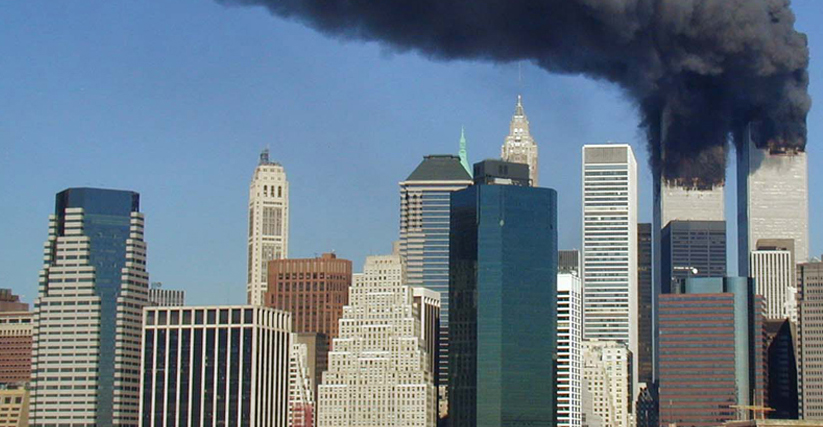
September_11_(Wiki)Excerpt from ‘A Buddhist Reflection on the Tragedy of September 11’ by Ajahn Jayasaro, 2001: In this excerpt, Ajahn Jayasaro is talking about how we can learn, through the Buddha’s Teaching, to face this tragedy and here he refers to the three-fold training: sila (morality) samadhi (focus) panya (wisdom). Excerpt begins with sila (morality) and the link with volition: ‘Linking morality to volition means that to be consistently moral we need to educate ourselves about volition, not in the abstract as an intellectual exercise, but in the concrete present, as it manifests in our experience. The central role played by volition demands that we develop a power of introspection, an honesty and willingness, and an ability to look very clearly at our mind. We need to develop this form of education to the extent that we don’t rationalize our cravings and fears so automatically, that we are unable to lie to ourself as we used to do. In responding to a painful situation, for instance, we have to observe to what extent we are affected by the desire for justice, and to what extent for revenge. Is anger present, self-righteousness, fear? Are these wholesome or unwholesome qualities of mind, — to be trusted or not?

Morality here then is not a matter of following a number of rules or commandments, but of using precepts as tools in which to be clearly aware of and responsible for the motives behind one’s actions. Although the moral training in Buddhism demands a certain amount of awareness and a capacity for introspection, it is not the whole of the training. There are also specific practices for educating our emotions and discernment.

Thus we refer to a three-fold training, one which provides a framework within which to address the difficulties or dilemmas that we face in our lives. The training in morality is the foundation. It involves firstly the intelligent adoption of standards of conduct towards the external world and particularly other human beings, and then learning how to be mindful of them in daily life and bring them to bear on our behavior.

It is at this level of the training that we see the central role of self-discipline. But self-discipline is far from being a panacea for all our ills. We can’t decide not to get angry as an act of will, we can’t decide not to feel vengeful, we can’t decide not to have emotions. If we misapply self discipline then we create the conditions for guilt and repression.

Emotions are one natural part of our  life. We have to understand them. Some emotions deserve to be cultivated, others do not. In our gardens we distinguish between weeds and flowers. Although we remove weeds we don’t consider our garden evil for having them. So the first principle of training the emotions and mental states is that force doesn’t work; intelligence, sincerity and patience do.

The second can soon be clearly seen: the ability to abandon the unwholesome qualities in our minds and encourage the wholesome is conditioned to a great extent by our ability to focus and concentrate our mind. This aspect of mental culture has been neglected in the Western world for many centuries. An educated person, in Buddhist view, is not only someone who can think rationally, analytically, but is also someone who can, on the necessary occasion, stop  thinking altogether.

The mind, which is bound to mental states, tends to see things as clear cut, black-and-white, and often over simplifies the complexity of situations; it reacts in habitual ways. The mind which can put down habitual thinking processes, stand back from the rush of thought and emotion, suddenly has access to far more choices and pathways.

The Buddhist insistence is merely that the most constructive action springs from stillness. The wisest reflection takes into consideration, not only our own immediate interest or the interest of our particular group or nation; it also bears in mind the interests of our children, our children’s children and many generations in the future who are yet to be born. And this kind of thinking demands the ability to step back from one’s immediate attachments. It is dependent on mental culture, mental development.

The third aspect of this training is the training of wisdom and understanding, teaching people how to really look at their actions and their consequences, seeking to understand situations more clearly. Initially it means regularly contemplating the very simple facts of life which we tend to overlook, in particular the nature of change. Changes may be slow methodical, expected, welcome but they may also quite often be sudden, unexpected and unwelcome. It is an inarguable fact that every one of us, sooner or later, will have to be separated from those whom we love.

The Buddha encouraged us to be students of change and to understand its nature. We should be looking at change, looking at uncertainty, looking at insecurity face-to-face everyday. Life is insecure. There is no real security in a changing world and the frantic search for an unrealistic security is only going to lead to tension and pain. There has to be a certain point where we create the conditions for security as best we can, but humbly acknowledge the fact that ultimately we have no defence against uncertainty and change. We have no rights. We can and should create conventions about human rights and it is important that such rights are vigorously upheld in human society. But ultimately, we have rights to nothing except the way things are: we are born, we get old, we get sick, and we die. We must be patient and willing to keep going against the grain of self-indulgence, looking again and again at the way things are; educating ourselves about those things which brighten and clarify our minds; those attitudes, those thoughts, those emotions which cloud and brutalize our minds. The more we do this work, the more we see that we have a choice which way we want to go, the way of darkness or the way of light.’

————————

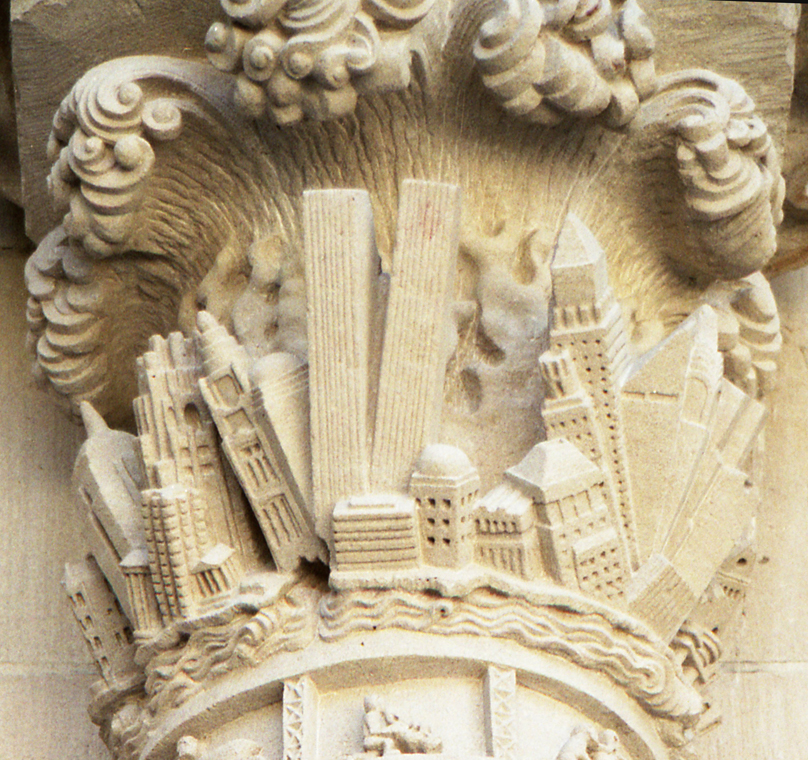
Lower photo by Louk Vresswijk, taken in July before the attacks, shows the twin towers in a modern New York setting. Location, a column in Cathedral Saint John the Divine, 1047 Amsterdam Avenue, NYC.
DSC_1404


Ajahn Jayasaro [Link to: 9/11 A Buddhist Reflection pdf]