Listening 2

kalighat4New Delhi: [Link to: Listening 1] Sitting here, listening to sounds all around, far away and just on the edge of hearing. The process itself seems to select the sound – or the sound is selected (by some unseen process) and ‘I’ don’t have control over it. Kitchen noises, isolated clatter of plates: clink, rolling-around clunking sounds, as objects gently collide with the environment: bump, scrape; cupboard doors close, metal sink noises, cutlery makes high frequency sounds I can’t easily identify. Jiab is doing something in there. Some time later, she comes into the room with a tray and plates, maple syrup and banana: ‘Pancakes!’ she says, and I go to the table. Taste the pancakes. There’s a cognitive function which investigates the senses, different from the receptivity of the sense base āyatanāni; the gates through which the flow of sensory data enters. It’s like a security system which monitors events taking place and identifies objects from outside the body that enter inside by way of taste, tactile sense, mind sense, ear, eye and nose,.

Other sounds come into auditory range; there is recognition, they are registered, processed; memory updated. It happens in a tiny fraction of a second, so fast it feels like trying to find words for it now is in slow motion, another kind of temporality. Auditory events jump out of the background, enough to be perceived consciously rather than just being part of the general surroundings of mixed ‘noise’. The process selects one and it’s not there until I focus on it – or until the mechanisms of focussing are turned in that direction. I listen rather than just hear – see, rather than just watch. It’s the gate of awareness sati sampajañña, through which there is awareness of all the other senses and the sense of being aware itself. It’s an alertness, a presence, the eye that turns inwards – a consciousness of the sensory experience that’s superimposed on sensory consciousness. Cognitive functioning is a sensory organ – consciousness is a sensory organ.

There’s always a returning to look for the beginning of it, how did it start? I only know that at some point, before I was properly aware of it, the parts came together into some kind of recognizable whole and now a thought appears in a small window, the story of it unfolds and ‘I’ am immediately part of this. ‘I’ am involved in the story and the story is about ‘me’. When I leave the story and the window closes, I get a short glimpse of something that tells me there was a window there – and it’s not there anymore. There is no ‘I,’ it just looks like that because everything has the quality of being seen in hindsight.

The process is seemingly directed towards a ‘self’ but if there’s no input, there’s no ‘self.’ Sensory mechanisms are functioning without ‘my’ involvement anattā; they’re waiting for things to arrive because it’s in their nature to do that. All there is, is this alertness. Seeing, hearing, smelling, tasting, touching and cognitive functioning; all are receiving the universe and, since all are also a part of the universe, it’s an all-inclusive experiencing of the universe that’s receiving itself. Just a state of ‘listening’, like a radio telescope dish situated in the middle of a desert somewhere pointing at the sky.


1317385111831

the end of the line

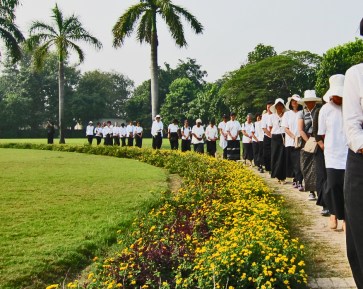
IMG_4239 (1)Safdurjung station: Welcoming committee, red carpets and flower petals strewn around the platform, it’s the end of the line; the end of the trip. It’s where the train stops and we get off, but not really the end of the line. The line goes on from here and connects up with other lines in the network and links up with neighbouring countries then ultimately with the network that stretches out over the whole planet. It doesn’t start anywhere and it doesn’t end. There’s an interesting reference to this in the Hermann Hesse novel, ‘Siddhartha’, saying that time doesn’t exist in a flowing river, it’s everywhere at the same time, only the present exists, no past, no future….

There’s something about being on a train that imposes a kind of inevitability of circumstances on everything. There’s no deviation from the direction the train is moving in. The thought sequence, following an ongoing linking, travels along of its own volition, and takes shape as it goes; episodes from an anthology of short stories. It stops sometimes but that’s not the end; the stopping/starting of it is a characteristic of the story’s unfolding.

A particular event occurs somewhere in the process that suggests how the beginning might have taken place. Later this goes into ‘refresh’ and there’s a new possible beginning. Then another one after that and again, then it’s not important anymore. Mind links it all up or associates random parts of it in some barely satisfactory way and this is how the whole thing seems to sustain itself from moment to moment. It’s samsara; driven by some kind of underlying seeking-for-something that can never be found; there’s only the ‘seeking’. A slightly suffocating, enclosed feeling about it all – it can’t be “held” beyond a certain limit, and eventually I wake up. Everything still quite clear in the memory for a while then completely forgotten.

With mindfulness of papañca (mental proliferation), the process of conceptualising is just a process – no person there doing it. The application of mindfulness, which puts an end to belief in the fictional ‘self’, is also just a process – no person there doing it. It sort of does it itself. As long as there is an intuitive notion of “wholesomeness”, the recognition that what I’m doing is ethically correct sila, then there’s an opportunity to sense if something is right, or it’s the right way to go about it and the process of mindfulness runs by itself. No self, anatta, nobody at home; just an operating system, Windows 8, MacOS Lion, and beyond. A determined and purposeful search to find out exactly where this ‘no self’ exists will yield nothing, of course, because ‘no self’ doesn’t exist. Follow this reasoning to its obvious conclusion and it’s a way of saying nothing exists. So, if there is no ‘self’, who or what ‘sees’ there is no ‘self’ and I asked Ajahn about it: ‘If everything without exception is “not self” including the “I” that’s investigating this – then where does it all lead?’ Without hesitation, Ajahn said “enlightenment” and looked at me with these grey eyes, waiting for the next question ….

IMG_4241

Many thanks to Khun Witit Rachatatanun for the photos in this series of posts

rope seen as snake

OLD NOTEBOOKS: Nontaburi, Thailand: Alone in a house surrounded by trees. Leaves filter a lovely green light all around; birds, lizards, squirrels, I see something move out on the patio… is it a bird, dropped down from a branch to peck at something? There, it moves again – just a hop and it’s a few feet further on. I sit very still, don’t want to frighten it away. I see it now, in the same position, not moving. After a long time waiting for it to change position, I decide to slowly get up and see what happens when I do that. It’s still not moving – maybe it’s injured. I go out on the patio and walk up to it. Ahhh… the bird is not a bird, it’s a large brown leaf, blown by the wind across the patio surface.

Go back inside and look at it again. It looks exactly like a bird, and just then a gust of wind blows the leaf. The animation of it is absolutely convincing, but I see it now as a leaf, not a bird. How strange, believing that something is there, then having to accept that it’s not. The teaching about the rope and the snake; a piece of rope lying on the ground is thought to be a snake. It’s an analogy of ‘self’ seen in consciousness + name-and-form: I recognize that the rope is a rope, not a snake, and can see how the illusion occurs. Or I may not see it and be convinced it’s a snake… maybe for a long time – a whole lifetime preoccupied with a ‘self’ that isn’t there.

This small epiphany occurs after another curiously similar event took place in this quiet house. I’m alone here except for D who is a grad student, working part-time, and he also takes care of the place. I don’t see D much, he works night shift sometimes, sleeping in the middle of the day. The house is large and I’m never absolutely sure if he’s here or not. Usually he stays in his room so I’m used to not seeing him around. I just quietly go about the house, day after day, not making too much noise in case he’s sleeping and quite often forget about him completely.

Then, just the other day, I start to wonder what happened to him. I look in the car park and his car is not there. When did I last see his car? Two days ago, or longer than that? I go to look at his laundry – could be the same laundry that’s been there for a while… clothes without a person inside them – remembering the movie: The Time Traveller’s Wife. I have to stop for a moment and think, when did I see him last? Go up to his room, door is open, nobody there. Hard to believe, I assumed D was in the house but I’ve been alone the whole time. The leaf-seen-as-bird metaphor. Something I thought was there, wasn’t… thinking it’s one thing, then it’s not. The usual sense of ‘me’ suddenly gone… then it returns again. Everything feels light and transparent.

‘It was as if lightning coursed within my chest. The impact lasted for a while, and for the next few weeks whenever I saw people, they seemed like a magician’s illusions in that they appeared to inherently exist but I knew that they actually did not.’ [‘How to Practice: The Way to a Meaningful Life’. The Dalai Lama, in the sixties reflecting on the Rope Seen As Snake metaphor, phenomena being dependent on conceptuality and his discovery that the “I” exists conceptually, dependent on mind and body; not an entity in itself] Source: Emptiness and Existence:

————————-

This post reblogged from July 12, 2012