the way it unfolds

IMG_2356POSTCARD #158: Chiang Mai: The tuk-tuk driver outside the Shangri-La Hotel charges me too much – he thinks I’m tourist staying at the hotel but I’m not, I’m visiting the tailor in the lobby. So I agree to the tuk-tuk price, not overly concerned, and he starts up the 2-stroke engine; key-turn ignition, a few revs of the throttle and I climb in. He edges out into the road, and in a flash of passing vehicles makes a fortuitous U-turn in fast-moving traffic so suddenly it takes a moment to see we’re facing the opposite direction, speeding away in a swirl of noise, vibration and acceleration. The outside world invades my space, rushes through a hot wind, no walls, no windows, no glass, except the driver’s windscreen up front and for a moment I’m drawn to that. But the accelerating jolts as he overtakes vehicles in front throws me back into a kind of La-Z-Boy sprawl across the double seat where it’s more comfortable, holding on to my possessions in case they get blown away in the gusts of air. And, at least, this way I can see out, under the overhanging flaps of the stretched canvas roof, blowing in the wind.

Everywhere you go in central Chiang Mai the old canal is on your right side. It forms a square, and to go from south to north the one-way traffic has to go round three sides of the square. Water fountains, huge ancient trees and the remains of a 700 year-old wall that encloses the old city inside the square. It all looks the same, all these journeys connected end-to-end, thinking of it as a repeat pattern, the total itinerary, past lives spent here and there, divided and subdivided into periods and instants of looking out at the world flying by thinking: ‘where are we now?’ But not recognising anything and in the blink of an eye back to being busy with thinking. Everything fits together, including my perception of it – the way it unfolds is the way it is.

The tuk-tuk stops at the traffic light and driver switches off the engine to save gas. All of a sudden it’s quiet; the tick-tick and creak of hot metal, smell of tarmac. Here I am in this laid-back position as if lounging in a fifteenth century market stall waiting for customers. Bamboo poles and the roof is thatch, enclosing the space I’m in; contained in the greater space all around. People walking by the wall, fifteenth century bricks sagging and curved like a slow moving wave that’s formed with the gradual sinking of foundations.

Same ‘now’ as it was then; seven hundred years in the past, it wasn’t any different for the people who lived then, returning, as I do, to this same reference point; ‘me’ the human being, eyes looking out ‘there’ at the world. All that remains is the emptiness of the moment; the sound of the engine, the vibration and the pressure of the bench I’m sitting on. There’s skin, hair; there are arms, legs, a head and eyes, ears, nose and tongue. I am a sensory-receptive organism. Just the warm air in my face and things rushing by.

‘… impossible to be aware of an experiencer because it is always the experience itself that momentarily occupies that space.’ [Alan Watts, ‘The Wisdom of Insecurity’]

————————-

Note: excerpts from an earlier post titled ‘applied Knowing’

not alone

IMG_2346POSTCARD #157: Hat Yai: The 15th day of the 10th lunar month, October 12th, was the annual Respect for the Dead day in Thailand. Facebook busy with the exchange of photos showing the preparation of food offerings to the Dead and the large social events that took place in the temple grounds afterwards. Communities sharing the food they made in their own homes and ‘offered’ to the boowa in the temple’s cemetery area where the ashes and remains of the ancestors are kept. The people of the old world built a narrative around the enigma of death, life and the whole question of why we are here. It explains the mystery in a way everyone in the community can understand, something consciously shared. It also explains it to me, a westerner, 30 years in Asia, having one foot in both worlds – maybe I’m more asianized these days. With this awareness of death, I find I’m not alone anymore, all of a sudden… wow! In the West we somehow forgot there was anything we were supposed to know about life and death so we stopped looking. Forgot about the subjective world and spent most of the time browsing internet pages about quantum mechanics instead.

It’s not that we just don’t talk about death, we pretend it’s not there. Death is what happens to other people… something obscure, like spirituality; words cloned from an ancient artefact wrapped in the strangeness of another age. Jesus, Mohammed, Shiva, Buddha discovered the truth was inside, a seed germinating from ancient beginnings. They and all the revered persons in the history of the world were teaching people to find it for themselves (comes with the software). It’s not about having somebody else do it on our behalf.

But conjurors, alchemists, science developed and the Object elbowed its way into our lives, shoved Subjectivity out of the way, and we started to focus on what’s inside, thinking it’s out ‘there’. Instead of the actual experience, I’m listening to a story about what’s happening, watching a movie in my head; inventing a self that’s satisfied sometimes, or dissatisfied other times, a self that is incomplete, unfulfilled, searching for the truth and what’s real, and failing to see that it’s the searching that maintains the state of being lost. Thinking I am the only one that’s me, or is that just a thought thinking it’s me? And when, in the peace and quiet emptiness of the moment, there is no hungry ‘self’, no driving urge to have, to possess, to be… it’s possible to see that this world of suffering can be brought to an end.

“… death is as near to him as drying up is to rivulets in the summer heat, as falling is to the fruits of the trees when the sap reaches their attachments in the morning, as breaking is to clay pots tapped by a mallet, as vanishing is to dewdrops touched by the sun’s rays …” [Visuddhimagga, Mindfullness of Death]

————————-

Photo: Jiab’s community in the shared meal after the ceremony

changing the past

IMG_0577[This post is written in response to a Time Machine Challenge from Linda, at Litebeing Chronicles.] October 10, 2015, Chiang Mai, Thailand: I’ve had this intense headache and neck pain since the beginning of September. Postherpetic Neuralgia (PHN), nerve damage caused by herpes zoster, and trying to come terms with the fact that it could be like this for the rest of my life – what does that mean? Now the pain is cushioned, I’m on Neurontin 100mg x 3 per day and they say this drug changes my attitude to pain. But at the beginning there were intervals when homeopathic remedies had an effect and the pain was gone for a time. The relief was overwhelming; how could the pain just disappear like that? I needed to know. The inclination was to turn towards it, questioning – rather than turning away in defence… finding some relief in switching off the default sense of: this pain is happening to ‘me’… and suddenly finding there’s no ‘me’ the pain is happening to.

In that heightened state of mind I’d get on to my meditation cushion, carefully… any slight movement and the headache returns. And it’s as if I’m sitting at the edge of the sea, beach sand beneath my folded legs. An incoming wave of thought enters, swirls around for a while then spins away with the outgoing tide – nothing remains. There’s not anyone engaging with these thoughts. Shortly after that another wave comes crashing in; incidental mental conversations scatter on the beach sand… things of no consequence, attention-seeking chatter of the mind dwindles away as it recedes, and it’s gone; returning to the silence of no thinker, falling into a landscape of pain-free, ease and gentleness.

What strange karma could have led to this? Present time conditioned by past experience, yet there’s also the possibility that the past can change according to how it is perceived in present time. Returning to old memories with such vivid clarity that it all seems quite different – I recreate an object in memory according to present circumstances. Reopen a remembered event that’s troubled me for decades and, for the first time I see it in a kindly way. Either it was ‘me’ that got in the way and that’s what caused the problem, or it was somebody else’s ‘me’ that obscured the issue. Forgiveness and compassion for the way we’re all caught (everyone is), trapped in thought and driven by the suffering of ‘self’ wanting things to be different, other than what they are. I’m aware of circumstances I’d not noticed at the time and that past event becomes redefined in the process of reviewing the situation.

The past is a remembered ‘now’. There’s the scary familiarity of bad memories – but it’s not as it was before; same story but somehow seen clearly and portrayed differently… a new production of an old movie, there in the altered past, seeing the present moment as a kind of back-to-the-future thing. Kindnesses and sorrows over the denial and avoidance – how could it be like this? It’s an acceptance in a no-choice situation, a giving-way-to-it action; passive understanding that there’s got to be a willingness to relax the resistance and allow everything to pass through, unheld…

“If we could read the secret history of our enemies, we should see sorrow and suffering enough to disarm all hostility.” [Henry Wadsworth Longfellow]

————————–

Thanks Linda! Look out for the next Litebeing Chronicles entry in this series October 11 by Sue. Note: excerpts from earlier posts included here. Photo: The moving walkway to the domestic terminal Suvarnabhumi Airport (Bangkok)

stowaway

IMG_1376bPOSTCARD #154: Delhi: For a few days now my bag has been lying on the bed while I search around for the clothes I’m taking with me on the trip to Thailand. The lid is hinged back, wide open like the beak of a baby bird in the nest. When the bag is filled to capacity (cases are always filled to capacity) it’ll close its mouth turn over on to its upright position and be wheeled away to the car, off to the airport, the check-in desk and into the cargo of the plane… a capacity inside a capacity.

At this time though, the case is still unpacked and maybe I should not leave the cover of it open like this in case there are small creatures in the air that decide to fly into the bag and come with me to Thailand – like the time we were living in Switzerland and Jiab came back from a long trip to South America and the last stop was Peru. From Jorge Chávez Airport in Lima, she had three connecting flights, many delays and more than 24 hours travelling before she was back in Switzerland in the evening. Totally exhausted, she opened her in-flight bag to take a few things out and went to sleep immediately. I didn’t move the bag, left there lying open and went to sleep too – if I had closed the bag, then the stowaway wouldn’t have escaped into the room, or when it did, there’s a chance we’d have seen it….

In the morning I woke up to this blat-blat-blat sound coming from the mezzanine upstairs, so I went up to have a look. Step by step and cautiously, there was a table light that had been on all night. Something was inside the shade – a very strange winged insect banging itself against the light bulb. When it stopped and lay resting on the inside of the shade I could see it was a hard shelled beetle-like creature that folded its wings up inside its shell… hmmm this thing didn’t come from Europe, I’d seen something like it in India. I went down to the kitchen and found an empty glass jar with a screw lid and came back upstairs; it was flying at the light bulb again, blat-blat-blat. When it stopped for a rest, I manouvered it into the jar, got the lid on and took it downstairs. A kind of greenish square-shaped thing with a pointy end, about three quarters of an inch in size and sort of flat, like a spade.

I tried to get Jiab to wake up to look at it, but she was not interested in that, totally asleep and it wasn’t easy. A very bleary-eyed, jetlagged look at what I held up in the jar for her to see brought only puzzled silence. After some consideration she said: Insects should not be in the house, and collapsed back on the pillow. So that was it, much later we discussed how it could have got here and decided it must have come in through an open window on her last day in the hotel in Lima and landed on the contents of the open bag. She closed the lid on it unknowingly, went to the airport and thus it stowed away on the flight to Europe.

I studied the insect in the jar for a while then took it to the balcony, unscrewed the lid and gave it its freedom in the warm spring air. Watched it fly off down to the bushes and grass below. Who knows? Maybe it found distant members of a species once related, twice removed, reproduced and now there’s a hybrid genus developing in that part of Europe waiting to be discovered.

“The present changes the past. Looking back you do not find what you left behind.” [Kiran Desai, The Inheritance of Loss]

————————-

Photo by M, showing her bag (upper left, light blue with pattern) being loaded on a domestic flight from Chiang Mai to Bangkok

before already

IMG_0574bPOSTCARD #153: Delhi: Getting things organized for the flight to Thailand, I go through my files and find this photo taken at Delhi Airport Departures last time I was there. Unfamiliar with this kind of airport signage: STOP/ LOOK/ GO, I’m lost for a moment in the what-came-first directionality, then I see it’s meant to be for vehicles approaching from the left. The driver is supposed to stop at the word STOP, then drive to the word LOOK, then he is ready to GO. Curious incongruities for me, an observer at the window on the third floor of the passenger terminal, I feel like a tiny speck in a huge transparent glass and steel building. A time/space anomaly, I’m reminded of something somebody said; part of a conversation with a married couple I know, in Chiang Mai. German husband and Thai wife – she doesn’t speak German, he doesn’t speak Thai. They use English to communicate, husband speaks it with traces of Thai pronunciation, and wife has a slightly German accent. We’re having tea together and I’m the only native speaker in the room so I naturally start to facilitate their searching for words, then realise I don’t have to do that, of course – English is their link language and over the years they’ve worked out their own system.

Their dialogue is a hybrid of grammar forms improvised as they go along. We’re getting ready to go out and husband says to wife, Where my blue socks. Wife tells husband: in the ironing basket… (mumbling quietly to herself in Thai: he can’t find anything because he doesn’t look properly). As he’s walking off to the laundry basket husband says, why you can move things without telling to me, and she follows it up with, I tell you before already.  I lose track of the conversation then, thinking… before already, huh? Is it a point in time somewhere before ‘already’ happened? Or is it that she already told him about the socks, and that was before something happened that’s not referred to here.

You can say it in Thai (bok gon laew*) but in English it suggests there’s an instant in time we are searching for but haven’t discovered yet. Miniscule shavings of time, events that last for 100 attoseconds, or 100 quintillionths of a second (note: 100 attoseconds is to one second as a second is to 300 million years). The illusion of duration, I’m experiencing a before/already disorientation, the present moment constantly updating itself in an attempt to find out where we are now. Cause and effect are parts of the same event; ‘before already’ is a screenshot capture of karma particles (cittas) in the time construct we inhabit. Lost in translation, so vast it doesn’t matter any more.

One moon shows in every pool;
in every pool, the one moon.
[Zen Forest Saying]

————————-

*bok gon laew: บอกก่อนแล้ว say before already

pasta in the past

IMG_2234bPOSTCARD #152: Delhi: Video call from M, my Thai niece, she’s showing me her new glasses… they make her look so grown-up, hard to believe she’s only 11 years old. I remember when she was little, using English words and that creative playfulness: ‘pasta in the past’, something she learned about the word ‘pasta’ having its origins in China and brought to Italy by Marco Polo in the 13th century. So it became pasta (in the past) – as in pasta/ presenta/ futura – but it was also from the movie ‘Frozen’ where the main character (Elsa) sings the song, ‘Let It Go’ and there’s the line ‘the past is in the past…’ (click here for 9 second link) and M was singing along with a video of it as, ‘pasta in the past’, either because that’s how she heard it in some other animation, or she thought it was funny, or both… I can’t remember.

The wisdom of this childlike intelligence that seeks/finds creative solutions to problems – I must have had in my own childhood, over many horizons, long ago and far away. All the ups-and-downs; all the dramas embedded in our history that make us who we are now and form the characteristics of our future time. Births, deaths, marriages; I have a fragile, old, yellowed newspaper clipping of an obituary column that describes my grandfather who came from the Orkney Islands in the North of Scotland and was drowned in a fishing boat in the Moray Firth before I was born. The unseen cause/effect of emotional catastrophes enduring for decades; we’re unknowingly driven to take responsibility for things over which we have no control, thinking (or believing) that by chance we might stumble upon the key to unlock it all; the karma that’ll undo the karma that led to this.

M asks me: Toong Ting, you feel better now? How about your Chingo? (Shingles)… I tell her, yes, I’m okay now, thanks. She looks at me, Did you go to the hospital? (we go to the outpatients section of the local hospital rather than a private doctor) Yes, I went to the hospital, showed the doc my skin rash, looked really yukky, told him about the bad headache all the time. Did you eat the medicine Toong Ting? Yes… we take medicine, we don’t eat medicine, and she knows this but can’t be bothered to make the change from the Thai translation: kin ya

I took homeopathic medicine towards the end of the three-week frenzy of stabbing pain, then the recovery and falling into a huge landscape of pain-free, ease and gentleness. Altered state, revisiting old memories with such vivid clarity it all seemed quite different – I thought the past was irredeemable but it’s not. The past changes according to how it is perceived in present time. And I’d been so firmly attached to the endless thinking-about-thinking, watching the same old rendition of the story I’d assembled over the years.

My world was transformed, ideas and perceptions started to change; a fierce face appears in a kindly way, the scary familiarity of events unfolding but portrayed differently… a completely new production of an old movie. Kindnesses and sorrows, things I’d not noticed at the time become redefined in the process of mindfully remembering the situation. It’s as if I’m seeing my missing grandfather coming back to life; a rebirth happening here and now – in the same way this video call from M is happening now, although she is 2000 miles away. Toong Ting?, M asks, when you come to Thailand? I tell her it’ll be 29 September, that’s next Tuesday… Okay, bye! Everything comes full circle again.

A monk asked Yueh-shan, “What does one think of while sitting?”
“One thinks of not thinking,” the Master replied.
“How does one think of not thinking?” the monk asked.
“Without thinking,” the Master said.
[Zen mondo]

————————-

the orange tree

IMG_2323bPOSTCARD 151: Delhi: Wake up in the morning and it takes a moment before I remember who I am. There’s a sense of having to press START to get it going, then the pieces fall into place… some parts of the jigsaw are late in arriving, fit into position as the image appears; it’s somehow reassembling to become a different picture as the moments pass… becoming another new picture, and more and more pictures. Then there’s the remembered pain – head turning on the pillow, stare at the ceiling; must have had it all through the night, but… not as bad as it was? Gently sit up and see how that goes, balance the cranium on top of spinal column, get up from the bed and gently walk through to the front room as if tight-rope walking… start the day.

Years go by, living on received sensory data and just taking it all for granted. Tiny molecules of experience passing through the organism in great rivers, and all of it goes unnoticed… until it malfunctions in some way. The buildings collapse, a natural disaster, illness – herpes zoster virus, shingles; permanent headaches. Through necessity I develop more of an investigative attitude to actions and reactions, monitoring the mind-body-world situation I am in, we are all, always, in… consciousness. Then the remedy, the simple homeopathic miracle and immediately some easing, enough to make the return to ordinary things seem possible.

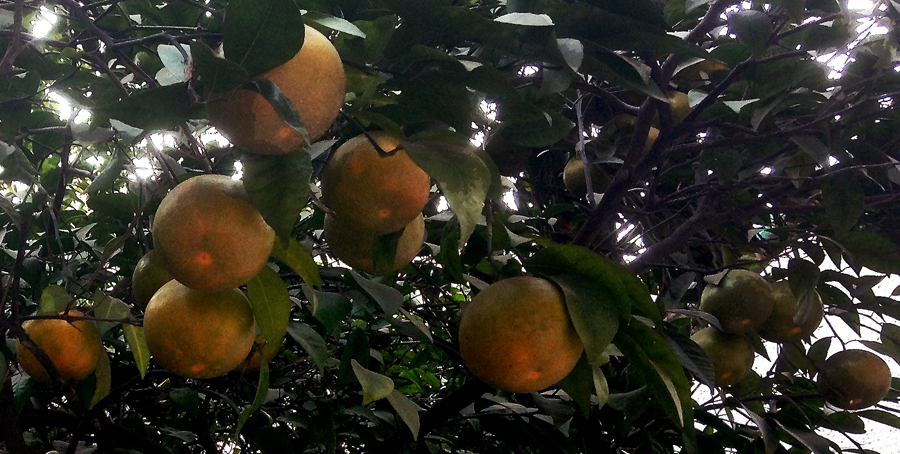
Birdsong outside. A dog barks. Voices in the street. I go up to walk on the roof terrace. Look over the edge, the orange tree encroaching on our roof – see the first ripening orange this year. It looks out of focus because it’s arising out of the green it was before. Curious magic, the orange is changing colour as I stand here watching it in the early morning sunlight; object of consciousness becomes who I am – the ongoing transformation…

Beyond the mind there is no such thing as experience. Experience is a dual state. You cannot talk of reality as an experience. Once this is understood, you will no longer look for being and becoming as separate and opposite. In reality they are one and inseparable like roots and branches of the same tree. Both can exist only in the light of consciousness, which again, arises in the wake of the sense ‘I am’. This is the primary fact. If you miss it, you miss all. [Sri Nisargadatta Maharaj]

IMG_0241

————————-

Lower photo: last year’s oranges
Sri Nisargadatta Maharaj quote source: This Unlit Light
~   G   R   A   T   I   T   U   D   E   ~


9/11/2015: perception

September_14_2001_Ground_Zero_02A Buddhist Reflection: Survivors describe how, after the debris and dust settled, there was only blue sky where the twin towers used to be. It was as if the awful devastation hadn’t occurred, mind turns away… natural reaction, a kind of sleight-of-hand,  conjuring trick – one thing becomes something else, what is seen and what it appears to be merge together. Human beings have a deep familiarity with the illusion – everything we see, hear, smell, taste, touch is perceived. Consciousness of the world unfolds and thought rationalises how it appears to be. It’s this, it’s that, the illusion insists on being there until things hidden and obscured are revealed and we cannot return to the unknowingness of how it was before… ignorance is a kind of ignoring.

Form and formlessness; there are planes, explosions and buildings disappear. The video running continuously on YouTube for 14 years, I know the sequence in detail. I also know how the mind habitually joins up all the loose ends of awareness input, interpreting reality, perception is interpretation. Now you see it, now you don’t… a technology that can break up the molecular structure of concrete, turns buildings to dust – hoover it all up, remove melted steel remnants and everything is gone. I try not to think about it anymore; war and disaster, samsara of violence, distress, pain, fear and that underlying sense that something about this is not what it seems to be… learning to live with that uncertainty.

Mind is powered and driven by TV news – forgetting that it’s just a presentation, a performance in the studio. Hair-styling, cosmetics, the newsreader is an actor reading from a script. TV news is a created product based on an event manipulated to get it to fit into media format. TV news producers create a scenario of righteous anger, Sodom and Gomorrah retributional justice; it’s all ‘their’ fault, not our fault, blame and guilt… complicity. The tendency to contract into self, ‘I’ caused it to be ‘wrong’ – no, I don’t want to think about this anymore, don’t want to dwell on anything sinister…

People living in war-ravaged countries (such as Iraq for example) know that when a traumatic event takes place everything changes. After the disaster, our surroundings are seen in a different way; in the aftermath of this truly catastrophic circumstance we come to realise that the smoke was actually dust. What we believed in before this happened disintegrates, a basic truth now included in our worldview… nothing is permanent – history taking place before our eyes. Fourteen years after the experience, some ease can be found in simply knowing the ‘terrorists’ created a shockwave that unknowingly opened a window of awareness to world attention.

Dependent on the eye and forms, visual-consciousness arises. The meeting of the three is contact. With contact as condition there is feeling. What one feels, that one perceives. What one perceives, that one thinks about. What one thinks about, that one mentally proliferates. With what one has mentally proliferated as the source, perception and notions resulting from mental proliferation beset a man with respect to past, future, and present forms cognizble through the eye (Majjhima Nikaya, I, 111–112).

————————
Photo source: Wikimedia Commons – https://commons.wikimedia.org/wiki/File:September_14_2001_Ground_Zero_02.jpg#/media/File:September_14_2001_Ground_Zero_02.jpg
[See also earlier posts:
9/11 2014,
9/11 2013
9/11 2012]
Related source: ‘Working with Perception’ by Ajahn Sucitto


improvisation

IMG_2123POSTCARD 149: Delhi: Mall architecture, astonishingly playful buildings, concrete and steel monuments and shrines to maya (sanskrit: illusion) – in Chiang Mai they even named a shopping mall ‘MAYA’. The population welcomes the idea; step into the illusion… air-conditioned, bright and colourful. More and more of these in Bangkok, over the top – a lightweight upbeat city culture, low labour cost and construction projects are ongoing. Something hopelessly inevitable about it careering towards the relentless consumer culture of the West – except that in the East, people are more likely to ‘know’ when they’re stepping into the illusion. Cultural tradition, awareness and vestiges of spirituality; besides, everybody here knows that if somebody is in the market trying to sell you something, it means you have the option to negotiate a fair price… not so in the Mall, and that’s why so few people go there.

The Mall culture affects only a small percentage of the population (sounds like a virus) and, I have to say I’m sometimes part of that minority; the need for essential things for devices, bookshops and a good baker. To get to our mall we have to drive out of town and the three-building complex is situated in an undeveloped area – there’s a fourth building going up at the time of writing. Construction site workers’ community nearby, chickens and goats in a hot dry, dusty landscape. Come off the highway, through a great winding turn of rough unsurfaced road, potholes and puddles of water and into the short entry, manned by security – car examined, mirrors held underneath, look in the trunk, the engine. More security at the entrance, metal detector and security guards carry out a full body search before you get in the door.

It’s as if the whole concept of consumerism is subject to scrutiny; not as easy as it is in the West to simply be ‘pulled’ into the Mall like a magnet and disinclined to escape from the illusion. For many people the whole thing seems impossible to change, situated at the end of the consumerist food chain, as they are, and trapped in that predicament. No alternative, we have to purchase the product because we can’t create it ourselves – so far away from the artisan, so far away from doing things ourselves. People believe they can’t improvise… forgetting that the whole thing is improvised… language is improvised, life itself is improvised. All the systems that are in place were improvised to start with, and even though we may be subject to skillful marketing strategies, there’s still the innate ability to be creative, to improvise, to invent, to innovate, to find a way out of the illusion.

These carnivorous marketing creatures have to be gently pushed into the background in order to bring what’s really meaningful in life into focus. There’s a lightness, a floating in the air… the open-endedness of the human situation, groundlessness.

“What can we gain by sailing to the moon if we cannot cross the abyss that separates us from ourselves?” [Thomas Merton]

————————-

photo: shopping mall Bangkok

tilt

Photo 1-2POSTCARD 147: Delhi: Phone rings. It’s a message from Jiab in Mumbai… image downloading, a photo taken from her car window. Reflections in the glass make it look like the yellow-top taxi is fusing into the back of the red bus. She’s stuck in a traffic jam; same here in central Delhi (on my way to Khan Market), rivers flowing through all the urban creeks and tributaries, as one vast river and this curious thought that it’s the same time at any point along its route. Or extended through every passageway in the city, as a mass of end-to-end steel/chrome-plated metal, creaking along like the glacier I visited a long time ago in Switzerland moving so slowly, the end of its 133 kilometer length is four hundred years older than its beginning.

Placing parenthesis around a block of time creates a beginning and an end, the world seen in a particular context… ‘my’ view of reality and the actual state of things out ‘there’ appears separate from me. I live in an illusion, riding around like a passenger seated in the vehicle of the body, input from data received through sight, sound, smell, taste, touch – and a mind that creates meaning based on memory files of similar events occurring in the past. There’s this identification with the thing-ness of things, thoughts, solutions and problems, reviewing, seeking, and memories of past times.

Yet, I can see the mind as an object; I am an organism contained in and created by the ‘world’, a body made of earth, water, fire and air. And if they’ve invented something that can break up the molecular structure of solid objects, concrete and steel, I find it impossible to believe, of course, more likely to disbelieve – but, given this all-inclusive subjectivity as the nature of the world, I’m inclined to believe it is possible, and everything tilts in an unexpected way.

Traffic seized up here in the approach to Khan Market, but the signal is still good so I take a picture and send it to Jiab in Mumbai, 1400 kilometers away.

IMG_2301

‘Things are not what they appear to be: nor are they otherwise.’ [Śūraṅgama Sūtra]

————————-