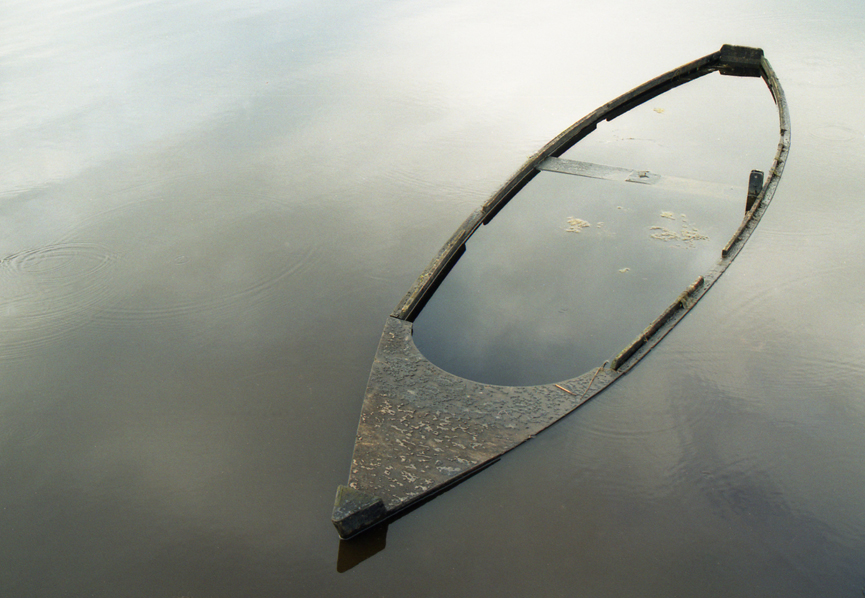
non-becoming

OLD NOTEBOOKS: East Anglia: Dreamy half-formed images swim before the eye without identity, no recognizable or known parts of the image. I’m trying to see it this way: no identity, otherwise ‘self’ intervenes and it ‘becomes’ something [bhava]. I’m falling asleep again; still early morning, comfortably dark and sitting on the cushion on a futon on the floor in the upstairs room. One advantage of sleeping on the futon is that you can roll over and up into the sitting position on the cushion quite easily – a smooth transition from sleep to wakefulness. The disadvantage is that it’s difficult to stay awake.
The process of waking up in the morning means the mind is in the process of getting shaped into a form, a ‘self’, and it all gets locked down then; ‘becoming’. So what I’m trying to do here is not let that happen. Without the habitual inclination towards ‘self’, conscious attention gently searches out another way, one that is identity-free, no ID card. The problem is, of course, ‘self’ tries to take over, as usual and if the identity-free state is present, ‘self’ understands it to be sleep. So I start to drift off to sleep again. I see it happening and think: Hey! Why should the ‘self’ impose itself like this? But the ‘self’ goes around imposing ‘itself’ and making assumptions about everything all the time and if I were to just let it go on doing that, I’d not see that things are actually quite different from how they appear to be.

Continue the meditation by following the breath, and a curious feeling that I’m sitting at an angle, or the weight of the body is over on the right side and on the left side there’s something like an empty space… what’s happening? Next thing is, I’m thrust into another dreamlike scenario and some sort of memory sequence. Here we go, I’m falling asleep again and losing it all in the dreamy half-formed images of the sleep I just emerged from. Mindfulness cuts in when I remember to let it all go. Hold on and let go… I need to hold on to the intention to let go. Everywhere I look there’s a ‘self’ searching for an opportunity to create an identity, (sakkayaditthi) ‘personality view’. It’s what holds beings in the cycle of rebirth. Breaking out of the cycle is arrived at by non-becoming – allowing it to ‘become’ without becoming.

————————-

It does not appear or disappear.
It is not born and does not die.
It is neither constructed nor raised up,
Neither made nor produced.
It is neither sitting nor lying,
Neither walking nor standing still,
Neither moving nor turning over,
Neither at rest nor idle.
It does not advance or retreat,
Knows not safety or danger,
Neither right nor wrong.
It is neither virtuous nor improper.
It is neither this nor that,
Neither going nor coming.
[Lotus Sutra]

Photo: Louk Vreeswijk

Birds on the Balcony 3

Switzerland, August: Awake at 4:00 AM this morning, came through and switched on the kitchen light: neon tube fluorescent, flicker-flicker flick. Light everywhere, through the windows illuminating the outdoor furniture on the balcony of this 7th floor apartment and the pigeons sleeping there wake up: croo-croo, croo-croo! Had to switch off the light again and they were quiet as soon as I did that. Now I’m sitting in the darkness, held back in my domestic activities by the wildlife on the balcony. What to do now? It takes me a while to get round to noticing this silence the pigeons are in. I get my meditation cushion and place it on the sofa with other cushions to stop it from sinking into the softness and get up on that, a little unsteady but balanced at this slightly higher elevation so I’m able to see the round shapes of the sleeping birds through the window. I’m in their quiet space, we share the peace of this Sunday morning – so silent here, high above street level. There’s a presence around these sleeping birds; there’s an immediate focus on metta loving-kindness to all beings:

‘All people, all animals, all creatures, all those in existence, near and far, known to us and unknown to us. All beings on the earth, in the air, in the water. Those being born, those dying. May all beings everywhere live in safety, be happy, be healthy, live with ease…’

Attention wanders and the mind enters into the story of it all: the bird out on the balcony, nesting in the Christmas tree bucket then there were two eggs, they hatched out and there were two babies and Ajahn V even did a little blessing for them when he came to visit [Link to: Birds on the Balcony1 and Birds on the Balcony2]. The young birds became adults and now we have a small family group inhabiting the balcony. Two adults and two young birds and there’s another one – the mysterious ‘other’ … the alpha male has taken a second wife? I’m saying this because there’s often some upset out there; some extended flapping of wings in the evening as they get their places in the hierarchy settled for the night – it’s like who gets to perch next to whom. I can’t imagine… return to mindfulness mode:

‘Let them not do the slightest thing that the wise would later reprove. Wishing: in gladness and in safety, may all beings be at ease. Whatever living beings there may be; whether they are weak or strong, omitting none, the great or the mighty, medium, short or small, the seen and the unseen, those living near and far away, those born and to-be-born — may all beings be at ease.’

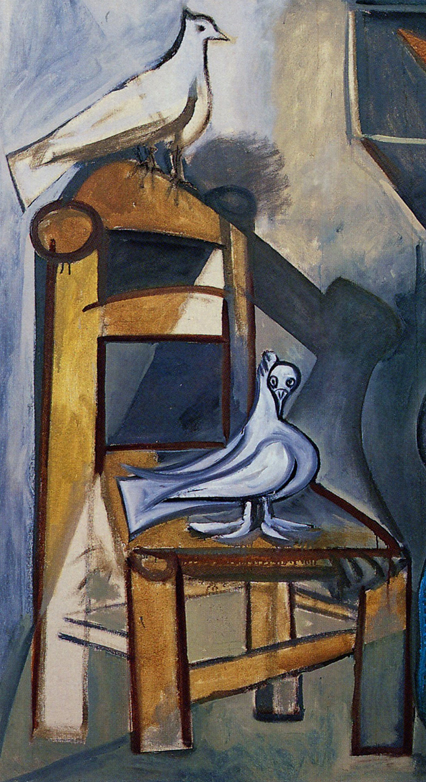
Eyes open slightly in the half-darkness. I’m perched on my high cushion like one of the birds. Morning light is coming up. I see them more clearly now. They’re sitting on different parts of the old artist’s easel that I left out there because it’s too big to have inside the apartment. It looks strangely like a work of art, some kind of out-of-context aesthetic event, but can’t think what that might be…. Picasso did some paintings of pigeons and doves that had moved into his studio in the South of France. I look at these pictures and I just know what that must have been like.

One bird begins to waken up, wing stretch, flutter, flap. They’re here with us, sharing the same worldview. Without us, the birds wouldn’t be on this balcony – they’d be on someone else’s balcony, okay, but the whole thing is about inter-dependency. We all need each other. I am one part in the vast body of life, distinct yet intimately bound up with all living beings. Eyes close again, return to meditation mode:

‘… so with a boundless heart should one cherish all living beings; radiating kindness over the entire world: spreading upwards to the skies, and downwards to the depths; outwards and unbounded, freed from hatred and ill-will. Whether standing or walking, seated or lying down free from drowsiness, one should sustain this recollection.’

After a while, in the light of early morning, I notice an odd silence in the bird group out there; no wing-flap. Get up and go over to see. They’re poised on the balcony handrail; all looking out, little necks stretched out and eyes focused on the space outside; the great swimming-pool of sky. Still no movement. Then simultaneously they burst into flight, and gone. As one unit they drop over the balcony and down. A moment later I see them swoop and swirl in a great arc in the sky then on eye level with this 7th floor and in a direct line away from me, they vanish in the distance.

————————-

[Excerpts from: Karaniya Metta Sutta also excerpts from loving-kindness meditation by Jack Kornfield, Susan Salzberg]


the seer & the seen

I’M ON THE DOWNTOWN BUS, on the way to meet Jiab to help her choose a new pair of shoes. There is this short piece I’m reading from ‘The Essential Ken Wilber’: ‘… the mystics are not describing the real self as being inside you – they are pointing inside you. They are indeed saying to look within, not because the final answer actually resides within you and not without, but because as you carefully and consistently look inside, you sooner or later find outside. You realize, in other words, that the inside and the outside, the subject and the object, the seer and the seen are one, and thus you spontaneously fall into the natural state.’ I have an understanding of this but cannot experience it right now because I’m holding on to something that’s causing it not to happen. I’m a ship sailing away but only as far as the anchor chain allows… tug! The anchor is firmly embedded in the duality of the world – I need to see that the anchor is part of subjectivity too.

Bus arrives at the stop and I get off. Go find Jiab and we look at a few pairs of shoes. She is browsing so I slip away unnoticed and wander into the men’s department to look around there. In the corner there’s a chair in the section where they have folded socks placed in display stands. Nobody here, secluded, I could sit on the chair and read my book. Okay, sit down, open at the page and then thinking there’s something interesting about this totally unknown place, it feels nice. And a quick decision, I’ll try some meditation, let go, and see what happens.

Eyes are closed for a while but flickering eyelids: the ‘public’ aspect of it is making me a bit uneasy. There is the tendency to open my eyes whenever there’s a sound nearby, wondering if somebody is coming. Difficult to concentrate, so I try it with eyes half-open. After a while I can gradually relax into this state of focusing, not on anything in particular, just focusing on focusing; the act of focusing itself. Looking at everything that occurs with mindful alertness.

It’s about the experience of just being here; random sounds, voices, and the patterns of socks folded in packs to show off their colourful designs. Folded socks all around, up above my head and down almost to floor level. There’s a kind of peripheral vision thing going on, pulsating colour: maroon, bottle green, cream coloured diamonds and brown/orange diagonal dashed lines – like North African ceramic floor tiles. All the sock patterns start to move and vibrate. This must be exactly how the sock manufacturers would want the sock-buying customer to view their product.

Phone rings; it’s Jiab. I have to go and take a look at shoes she likes. I can hear my voice in this small space I’m in, but it’s somehow not the ‘me’ I’m used to. I get out of there and next thing is I’m looking at Jiab’s feet in different types of stylish footwear. A purchase is made and we head for the exit. I have to wait there for a moment as Jiab goes back inside to get something and really for the first time I’m able to let go of a whole lot of habitual stuff.

Just standing there at the exit watching the people go by, the traffic, the noise; there’s something about doing this in a public place that makes it more meaningful. It’s also the first time for me to enter this kind of contemplative mind state outside of Asia – and in the familiarity of European surroundings. Then walking through the streets, I’m seeing blurred images of people going by in a strangely different time and space. What I’m thinking is that this kind of contemplation in Europe, in close proximity to other human beings in a public place where, normally, nothing like this ever happens, initiates a special kind of mindful alertness; and it is, what you could call, quite exceptional.

It goes on like this; moments of mindful alertness all over the town; easily falling into a state of no thought, just colours/sounds in the immediate environment. Then waiting for the bus, just watching that moment, and suddenly the bus looms up silently, fills my vision, get on, sit down and we sail away as one group contained in a large vehicle. Public transport is wonderful. All senses awake, functioning. Alert and wakeful about the surroundings, idle thoughts just become silence.

I am a human being on a moving bus, large windows and whole landscapes move through the interior of the bus in waves, washing away mind processes as we go on. Here, in all this movement, I can have a sense of: ‘…what I am looking out of is what I am looking at’, and what that means right now. I can see it’s about the journey to get there rather than the arrival because after that there’d be the full understanding of it and none of this would be important.

————————-

‘The Absolute Subjectivity that can never be objectified or conceptualized is free from the limitations of space and time; it is not subject to life and death; it goes beyond subject and object, and although it lives in an individual, it is not restricted to the individual.’ [The Essential Ken Wilber, The Real Self, page 23](see summary in Texts)


Skilful Avoidance

CORELcurvesA small town in South India: I was walking through a quiet part of town. Not much going on, turn a corner and there’s this mother hen fussing around agitatedly with her brood of little chicks all going ‘chee-eep, cheep, cheep.’ And the hen is making loud cluck-cluck, cluck-cluck noises and strutting around, strangely fast, unusual body movements, like a dance. It didn’t look right somehow, the mother hen was dashing about and jumping backwards and forewards and the little chicks were falling over themselves trying to keep up with her. I stopped to watch and thought, wow, what is going on here?

But mother hen had seen something ominous up there in the sky… and I was about to find out what it was. Suddenly there was what I can only describe as a huge SWOOP down from above. A large bird of prey with outstretched talons ‘dropped’ from sky to earth – must have been going at a tremendous speed – and in a great wide arc curved back upwards in the direction it had come. It needed space to do this and I saw it from further down the road sailing on upwards in the momentum of its fall, and up in this large curve, then winging it’s way back to the higher altitudes. Amazing. There was just this almost silent whoosh of feathers and outstretched talons – but it missed the chicks! It didn’t get what it was after, the mother hen had saved the chicks with her strange dance. She and her happy brood went on with their day. ‘Cheep, cheep’, story with happy ending.

I was so glad to have been there and experienced it because afterwards it really, really cheered me up. The Great Bird of Prey missed it’s dinner, but the whole thing was a fortunate turn of events; cute little chicks with their lives all laid out in front of them, And, the thing is, it helped me a lot with a problem I was having with a little part time job I’d started. Something backfired, no proper contract; a breach in the proper way of going about things. Next thing I was unemployed. Then, to make matters worse, there was this irate person in the office who’d gotten the idea it was all my fault and no hope of convincing her otherwise. So it was just a case of skilful avoidance, dodging angry remarks fired at me like heat-seeking missiles.

But the missiles were not hitting the intended target. I was untouched – not a hair on my head harmed, just like the little chicks that avoided the steel talons of the Great Bird of Prey. The mind would become transparent, a large empty space; nothing can hit it because there’s nothing there. I was able to see what was going on and yet be unaffected by it. The fierce eyes, the anger, the voice: the missile misses the target and all that’s felt is the wind of it as it goes by.

What I learned from Ajahn is related to the teaching: sati sampajanna, clear comprehension and from that, the power of ‘wholesome’ thought – wholesome reasoning, or quiet focus. It’s the ability to look at any situation and “see” what it means (really) with alertness – no illusions, no assumptions – and monitor that ‘seeing’ with just the right balance of effort. Having ‘seen’, it’s possible to know that it is ‘mind’ that is the threat and the threat can be diverted from its course by kamma of Right Intention. It’s understood in a moment and after that the system does it all by itself. The simple power of all that is wholesome and correct in the world is sufficient to shield against the attacks from mind (it’s not a mine field, it’s a mind field). When I think of it now, I can see the fixed hovering of the bird of prey, suspended in the air. When I’m not thinking about it, it’s not there. Some things are just like that.

‘Footfalls echo in the memory.

Down the passage which we did not take.

Towards the door we never opened.

Into the rose-garden…..’

(Burnt Norton, T.S. Eliot)

Meditating at 600 mph

Bangkok/Zurich flight: I think there are about 350 men, women and children seated inside this lightweight metal cylinder with wings and gigantic engines, surrounded by high frequency white noise. On East to West journeys (Asia/Europe) at this time it’s just one long night. Food and drinks finished about 2 am. Now there’s the twelve-hour journey to get through; an uncomfortable, restrictive environment. The sound generated by the engines and air pressure and my hearing mechanism are all one and the same thing, inextricably linked. A shrill voice inside me wants to scream at exactly the same pitch as the engine sound, and so become silent in it. Aware that I could go down the road of wanting things to be different from what they are and, in the end, come to see that it is precisely this that causes the suffering, I give up – just no getting away from it. And it’s somewhere between that relinquishment and the sincere desire to be free from suffering that the thought arises: there must be some other way of doing this? And the Third Noble Truth comes walking down the aisle and says in a friendly voice: ‘Yes, there is some other way of doing this.’ Just the thought of it gives me encouragement and after that the flight experience becomes interesting.

Focus on breathing, there’s the presence of noise and I let go of thought. Familiarity of breathing and focus, mindfulness; sitting in this small space, aisle seat, environment of the plane and we career headlong through space at 600 mph, altitude 37,000 feet. Strangely, it feels the same as if I were sitting on the meditation cushion on the floor, terra firma. Einstein’s Theory on Special Relativity tells us everything inside this enclosed capsule is relative to itself, as it would be on the ground. I’m aware we are heading in one very specific direction at an immense speed. With eyes closed, the breathing tells me it’s possible to sense this direction we are headed in. If there were seats facing the opposite way, I could try sitting there and watching the breath to see if there’s a difference. But aircraft design doesn’t provide for that kind of investigatory requirement. They like to have everyone facing the same way.

Trying to get this and other things properly into context causes me to fall into a dreamless sleep for some hours and wake with the announcement: “Ladies and gentlemen, we are beginning our descent to Zurich… ensure your seatbelt is securely fastened and table folded away….’ Then plunging down through rain clouds and down again through many layers to a space where dimly below I see the surface of the planet, December atmosphere, everything is grey. Then down again into a layer of cloud, visibility decreases, the air seems like it’s obscured by fine cloud filters. Can’t see a thing outside the plane window. Aircraft drops, altitude is lower and the light becomes less and less. Then break through into an empty space between clouds, drop down into another layer and emerge into a sky free of clouds, high above Switzerland, snow-capped mountain peaks, and at ground level, the plain, way down there, everything looks dull and grey.

Arriving in a different time zone; here before you know it – takes longer to adjust to the new global positioning than it did to get here. My eyes are still dazzled by the brightness of Thailand, unaccustomed to the dim grey light of the Northern Hemisphere. How can people see here?

————————-

[‘11,000 metres below the sea, single-celled “bottom dwellers” exist in pressures equivalent to 50 jumbo jets piled on top of each other.’ Just getting on with their lives, pleased by encounters with small particles of food.]

Jesus and ‘Churchianity’ (1)

Bangkok airport

Christmas, Bangkok Airport, Departures: Bags packed, got passport and ticket – taxi to the airport. Checked in, immigration, security and step through into the glitzy duty-free with people and music circulating. Compelling christmas carols with full orchestral backing and we are swept away to a tinsellated heaven realm. The next music track is a syncopated, off-beat, acoustic guitar melody support for: ‘… the ho-lee bible says, mary’s boy-child, jee-sus christ, was born on christ-mas daaay…’ Enter coffee shop area as we reach the main chorus at full volume: ‘Hark Now, Hear The Angels Sing…’ waiters have that look: the thrill has gone, dulled minds, christmas carol track loop playing in their dreams.

When I was a kid, I’d ask people about Jesus and didn’t ever get a satisfactory answer: ‘Jesus was the Son of God’. I accepted it, but didn’t understand. That’s how it was and maybe it’s why, in later life, I started to search for a real spiritual path. And eventually I became a Buddhist; all’s well that ends well. And it’s only recently I’ve been able to see links between the Jesus Teachings and Eastern religious experience (Advaita Vedanta) so that brings the Jesus story very much closer to me.

I open the laptop in the middle of: ‘… the cattle are lowing, the baby awakes…’, internet connection, Google, Wikipedia, I find Brahman/Atman and substitute the word ‘God’ for Brahman and Jesus for Atman then edit out all Advaita Vedānta references, now try that and see. “… away in a manger, no crib for a bed…” Flip through all kinds of pages then discover this very interesting paper about Neo-Vedantic Christology given by an Indian clergyman: Rev. Dr. K.P. Aleaz in 1994.

It’s a series of short contributions from members of the Ramakrishna Mission Order; including S. Radhakrishnan (President of India 1962-1967), and I find something here that is pretty critical but reflects the feeling about the Church I had in school days. And it’s reassuring to read about it now and know I was probably not alone in having the thoughts I did, back in those days:

 ‘Christianity considered the human person (Man), to be a sinner, a worm and that is why it could not understand the message of potential divinity implied in his (Jesus’) saying, ‘I and my father are one’. (Swami Vivekananda)

I’m reading about how Jesus’ pure religion of heart (was converted into) ‘Churchianity’. It goes on to talk about ‘renunciation’, interesting, I find I don’t feel comfortable with the word: ‘renunciation’ in this context, associations with guilt, Christian conditioning. I only recently rediscovered the meaning of it in the Buddhist sense: ‘renunciation’ means joyfully giving things up, letting-go. That helped me leave these old associations behind. It goes on to say:

 ‘The West has distorted the religion of renunciation and realization of Jesus into a ‘shop-keeping religion’ of luxury and intolerant superstitious doctrines.’ [Swami Vivekananda]

That was in 1994, we’d say rampant consumerism today. And I see it all around me here in the shopping area, Jesus as purchasing initiative. Where did it all go wrong? When I was a child, nobody really studied Jesus’ Teachings, it was the domain of the clergy. The general public, believing it on a superficial level just muddled along and no questions were asked. And it occurs to me that the Christian clergy today, vicars and priests, those who are thinking about this realistically, must have difficulty sleeping at night?

‘… the universal message of Jesus which comprises the ideas of the indwelling divinity, of divine grace, universal ethics and spiritual realization was distorted by the Christian Church through fettering it in cast-iron dogmas of innate vileness of human nature, ‘the scape-goat’ and ‘the atonement’, physical resurrection and the second advent, earthly kingdom and the imminence of the Day of Judgment which are purely tribal in their scope.’ [Swami Ranganathananda]

Well, that kind of remark would cause the cups and saucers to rattle a bit at the vicar’s tea party. Rev. Dr. K.P. Aleaz reassures us, towards the end of the paper:

 ‘Today, the lost universal message of Jesus can be regained with the help of Advaita Vedanta; the Christian dogmatic assertions no more need distort the meaning of the gospel.’

Interesting how the word ‘salvation’ has an odd heaviness about it – my Christian conditioning again. The dictionary says: preservation or deliverance from harm, ruin, or loss. I think it’s about having Wisdom. If you have Wisdom you won’t fall into the deep hole. If you do fall in, Wisdom will get you out. Trust in that. Swami Abhedananda points out that, from the Church point of view:

‘Salvation is the redemption from sin through faith in the atoning sacrifice of Christ, the Son of God. But Jesus did not teach the idea of vicarious atonement; what he taught was ‘the kingdom of Heaven is within you’.

As I see it, Jesus is saying: Heaven is within you. Simple, and that’s all there is, we aspire towards that Truth. On the other hand, the Church is adding something extra, something manipulative about atonement. It’s easy to see it now and, I guess, it must have been something they just went along with in those days. Another thing is, you will have noticed I put a strikethrough in: ‘the kingdom’ so instead of: ‘the kingdom of Heaven” and we can just say “Heaven” instead. Here’s a very nice Advaita quote that I like a lot:

 ‘God is pure knowing itself. God is beyond everything that can be conceived or thought about. Words cannot describe it. God is beyond space and time. God is infinite Being, infinite Consciousness, and infinite Bliss.’

The Rev. Dr. K.P. Aleaz is saying the non-dual relation that Jesus had with God the Father is something all of us can have, ‘through the renunciation of the lower self.’ (giving up the illusion of ‘self’ emerging from the Five Khandas.) It means humans can become ‘God’-conscious. Each soul has this latent potential and ‘… the resources of God which were available to Jesus are open to everyone. Christ’s statement, “behold the kingdom of God is within you” refers to the divinity within the human person.’ (my strikethrough) The important word here is ‘divinity’, Jesus was teaching the subjective realization of human divinity and therefore subject/object unity: ‘… “I and my Father are one’, ‘God is within you’ and in declaring himself as the son of God (Jesus is) inviting others to be sons of God too….” (Bhawani Sankar Chowdhury)

The Advaitist view is that the self of the human person (Atman) is ever united with the Supreme Self (Brahman); God always shines as our Inmost self and we can realize it here and now. Christians can understand this, Buddhists can too but Theravadins have a problem with the ‘anatta’ and ‘atman’ issue – if it were in the context of formless realms, maybe ….

The Christmas carol tracks have moved on to ‘Sti-ill, the night, Holee the night, Shepherds watched their flocks by night…’ I get up to leave, laptop in carry-on bag and head for the Gate. It’s a 12 hour flight to Zurich, hopefully I’ll get some sleep; economy class, not much legroom. Let’s see, conditioned experience, same old thing. Cold and snow at the other end. Goodbye everyone in this restaurant and this place, blessings and, ‘jingle bells, jingle bells …’ follows me all the way until I don’t notice it, it’s gone, and I’m on the way to the Departure lounge.

Original source: Rev. K. P. Aleaz Neo-Vedantic Christologies

[Link to related Post: Jesus and Advaita Vedanta]