the forever window

http://www.dreamstime.com/-image12334007POSTCARD#57: Bangkok: Early evening, M asks what kind of walls I’d like to have in the house she’s building for me. It’s the Minecraft game, everything created from virtual terrain, mountains, sea, sky and a square sun. She looks up from the iPad window and turns to me with enquiring lift of the eyebrow (a nine-year-old veteran). I say well, how about stone – walls are made of stone, aren’t they? It’s an unimaginative answer lacking in conviction – not paying attention properly. I ask what the choices are. She taps the screen to show me: gold, lapis, and you could have diamonds. Generosity. But I’ll just have the stone, please – keep it simple (thinking to myself is she going to come out soon from this digital dream she’s fallen into? Come out, it’s late and you have to do your homework. Be mindful and attend to things in the real world?) But there’s no ‘real’ world here. M says, what kind of roof you want in your house, Toong-Ting? (It’s her name for me) and I’m drawn into the discussion again. You like floor tiles Toong-Ting? I say what I’d like, and that looks nice (trying to reach her by telepathy, please, please emerge from the iPad window soon and think about the homework always in arrears!) For a moment it seems like she’s going to close the iPad but no, it goes on: why do you want that one? This other one looks nicer, does it look nice to you Toong-Ting?

I find answers that fit each question, but there’s no end to it; I know now the point of the exercise is to indulge expansively in this great wealth of choices. We have to try them all. No such thing as a final choice. The iPad is a forever window, a deep lake of astoundingly rich colours that’s difficult to surface from after you’ve fallen in – everything else in ‘real’ life is sadly dull. M dives into the forever window simply because it’s there. The containment of it is the context. The question answers itself, no need even to ask, cause becomes effect, timelessness without end.

Then for a moment she emerges from the dream, a flicker of alertness in her eye. Quickly, grab the opportunity! Act out a continuation of playfulness and joy, extend the interest to our surroundings and she decides to follow. Good, yes! It’s like guiding someone dismayed by sensory overload. Now let’s close the forever window for a while, shall we? Life is the same as it was but it’s quite nice out here. Fetch the school bag, heavy with stuff, reach inside and pull out a scrumfled homework book from the tangle of scraps of food wrappers in there, bits of tissue, and an overall blueness from a pen that flooded its ink inside the bag, a long time ago. My fingers are always slightly blue after visiting M’s bag; I go wash my hands while she considers her homework.

They have to make a simplified pop-up book page; the double page you open and a whole scene pops up. Wow, we never had homework like this when I was a kid! The teacher has given her a model of the folded-out paper mechanism she has to copy. A small spark of interest. Can do by myself now, Toong-Ting, she says, goes over to the sofa and pulls a large cushion over her head: but I have to think it first… stays under the cushion for quite a long time and I’m beginning to think I should ask if she’s okay under there. But next time I look M has cut and formed the folded-out bit with a scissors, glued on the picture that’s supposed to ‘pop up’ and it works – yaay! Well, not brilliant, but homework is not supposed to be a fun thing, it just gets ‘finished’. It’s done, put it away, now where were we? A voice says: may I borrow your iPhone, Toong-Ting?

‘We have a duty to befriend those aspects of obedience that stand outside of our house and shout to our reason, “O please, O please, come out and play.” For we have not come here to take prisoners or to confine our wondrous spirits. But to explore ever and ever more deeply our divine courage, freedom, and light.’ [Hafiz: ‘We Have Not Come To Take Prisoners’]

————————-

windows

BKKtaxi2POSTCARD#55: Bangkok: Coming in from the airport in a taxi with my Thai niece. I call her M, nine years old (soon be 10) and playing Minecraft on my iPhone all day. Glass window opens into another reality, digital trees, cubed terrain, oceans and snowscapes in a gravity reduced space. ‘Look, Look, Toong-Ting’, she says. Since she was an infant, M has called me Toong-Ting; holding on to her baby talk of the past and now it’s somehow cool to call me that. I lean over to see what’s going on in her window: building an ice palace with Lapis and Gold entranceway while playing the ‘Let it Go’ soundtrack from the movie, ‘Frozen’. I listen, ask questions, sing along and we exchange views – limited because English is a second language. When there’s nothing left to talk about, she returns to the Minecraft world and I hover in space waiting for the next question to arrive.

I am the support system, resource person, back-up plan. We came by plane from Chiang Mai this morning and the day has passed us by like this; M absorbed in her Minecraft software and the outside world seen from a sequence of moving vehicles we’re in, time and space transforms around the moment. Clouds in high altitude sky of 30,000 feet, mountains of buildings in the urban landscape and M emerges from the dream from time to time to pull me into the depths of the inner world she’s in – let’s see what she’s doing there… we dialogue about it, laugh, and she disappears further into subterranean caves, while I swim up to the surface again. There’s only a short time for me to look at the page I’m reading… sometimes only a few seconds before the next request arrives: “Look Toong-Ting, look, look…” I take a deep breath and dive into the water again. In the intervals between these visits to M’s world, I’m having to be mindful and speed-read my text like pieces clipped from a larger flow of words; one piece jumps out more than anything else:

A man is searching for God but gets frustrated in his effort, throws a stone into the water and a fish sticks its head out, says: ‘You think you’ve got problems? I’ve been swimming in this river my whole life looking for water, dying of thirst and cannot find any water to drink.’ The man says, ‘But the river is filled with water, there’s not a spot in the river where there is no water. Just open your eyes and you’ll see.’ And the fish says, ‘same with you; you’re surrounded by God. God is all around you and within you. Yet you say you can’t find God…’ [Sant Rajinder Singh: “The Love of God Is All Around Us”] (Click here for the original source: Holy Notion/ God and the Self)

Our taxi arrives at the house, get inside and M runs around discovering the familiarity of the last time we were here. Later in the day we’re in a corner of the room where she has her playthings scattered around. Everything lying in disarray after a particularly large creative frenzy of cutting out and the sticking of things with glue, scotch tape, adhesive coloured paper and bits of old Christmas decorations, recycled. And when every additional use these items might be put to is thoroughly exhausted, M moves to Minecraft videos on my laptop: “Look Toong-Ting, look…” she says.

I position myself so I can see the screen, participate when I’m needed, and otherwise pleasantly distracted by the surroundings; the world suddenly thrust into a clear, enhanced three-dimensional presence. Objects become somehow… known? All our bags and things just lying where they got dropped, extensions and extrapolations of the environment of rooms, the furniture, the plants and trees outside. A momentary happiness, bien-être, no words for it…

‘… the Truth and the way leading to it are often indicated by what they are not rather than what they are… in the Upanishads, ‘neti… neti’, meaning ‘not this… not this’, the reality of appearances is rejected. In Christian theological language, referring to what things are not is called the ‘apophatic method’, also known as the via negativa.’[Ajahn Pasanno & Ajahn Amaro: The Island – An Anthology of the Buddha’s Teaching on Nibbana]

————————-

passing through 1

tuktukChmai4POSTCARD#54: Chiang Mai: Situated at the top of a column of words (at the time of writing), light and easy, a feeling of no-thingness, the world is here but no serious attachment to anything. Emptiness of space in the place where “I” have not yet arrived and the sensory mechanisms that give the world meaning for me are still offline. Look at the altitude app, it says 1043 ft. above sea level, add 180 feet for the height of a 7 floor building and my location is identified. I am standing with my bag here on the top floor of said building, waiting for the elevator down… everything goes down from here. Doors open, step in with my bag on its little wheels, doors close, and down we go. It’s a small elevator space with large mirror. Is this good or bad; the witchcraft of mirrors. Study my reflection, hmmm… look into my eyes and see my eyes looking back out at me – slightly scary, stop doing that. Elevator stops at the 3rd floor, doors open, nobody there… a volume of 3rd floor air enters, doors close. We go down again, floor numbers on the indicator decrease as we descend further. Look at my reflection like a friend standing next to me. Examine the teeth in a large wide grin; watch myself holding this grimace, weird guy. Try to be normal; this is how I’m seen in public. Elevator reaches the ground level.

The people in the lobby are engaged in a conversational event that started before I got here and there’s a pause in the dialogue as I step into their space. Eyes look… do we know you? Smile, show teeth, no cause for alarm folks, just passing through. Walk out the main door and lift my bag down the steps. Street restaurants, the smell of exotic cooking, noise and clatter, a child cries, bicycles creak, rubber wheels on hot tarmac, a motorbike fills the place with sound. I have the feeling that I’m now situated at the top of a column of bones, ligaments, tissue, fluidity, and looking out of two holes in the skull that bond together into a single screen monitor – just the edges seen and the side of the nose. If I focus on something in the environment, through sight, sound, smell, taste, touch, there’s a curious ‘entering’ takes place… the outside world invades totally, no boundaries, and my whole head disappears* (funny how it does that) and there’s only the world, with me in it, headless. Everything switches back to normal view, when I want it to, and back to watching my feet appear and disappear on the ground below, one at a time: left, right, left, right. My bag following behind, rumbling along on its little wheels, slippers flip-flop on soles of feet…

Looking for a passing tuk-tuk or some means of public transportation that’ll take me to the airport. Reality check: am I at peace with myself? Is there an easefulness or am I busy thinking about things? How am I feeling? Allow the software to do its job; the facility of reflecting on how all this is going so far. Outer noise and heat find a way through the senses and have an effect on the mind/body organism in its ambling walk down the road – that stumbling gait, typical of lanky Western folk. Pleased to know how it feels and I can be aware of the sensation without making it into something I love or hate. Letting the events of the mind go unheld; give it all away, the great generosity of relinquishment. Be kind to myself, the ongoing practice of learning how to live my life. Tuk-tuk arrives, get in, wind in my face….

‘Human beings have a reflective quality that steps back from experience and says: “I don’t like this. It shouldn’t be this way. Stop it!” The aim of the spiritual path is to fully understand that the main problem of life is not that the government is unfair, that one isn’t getting enough money, that there is hunger, violence, pain or sickness, not even that one isn’t loved – but the feeling in the reflective mind of being bound down by these circumstances. Once we have clearly understood the mind, we can experience patience, equanimity, and release – even in predicaments that can be difficult or unpleasant.’ [Ajahn Sucitto, ‘Making Peace With Despair’, from the volume: ‘Peace and Kindness’]

————————-

*Reference to: ‘On Having No Head’ by Douglas Harding
–  G  R  A  T  I  T  U  D  E  –

corridors

IMG_0533POSTCARD#53: Delhi – Chiang Mai journey: A day of travelling, 9½ hours door to door – say two miles of walking through corridors in three airports and a total distance of about 2000 miles. It’s like a long tunnel of facing mirrors, continuously extending out in front of me as I’m moving through; the illusion that I’m entering something but never really getting there because another environment contained inside it opens up, and within that environment there’s another. No end to it and dizzy with the glitz of endless duty-free, life-size enhanced photos of celebrities wearing impossibly expensive watches, diamonds, gold; perfect dental work and a great wealth of cosmetics and perfumery. Pause for a moment to consider the mental state of marketeers who create this outrageous fiction. All the suffering, sadness and disappointment in life is caused by attempting to gratify the desire to make things different from what they are.

It doesn’t have to be like that – there is the Noble Eightfold Path. Keep walking, the corridor extends on through areas of wall-to-wall alcohol and tobacco products – follow the signs, stay on the route. Look at my watch frequently, look at boarding pass, look at time of boarding… calculate the amount of time remaining as I’m walking along. Bag on shoulder, laptop inside and a book: ‘Unborn’ by 17th century Zen Master Bankei. “The farther you enter the truth, the deeper it is.” Speed up the pace slightly, legs appear below; left foot, right foot… and a slight arm-swing – eyes looking out, reality is a projection of sensory functioning and the experience of containment in a body with four limbs, a head. The skull is worn like a crash helmet; brain occupies all the space inside… feeling like it’s cramped in there? Strange how this metaphor is everywhere, things inside other things, corridors inside other corridors.

Down the last corridor and into the aircraft. Stewardess with palms held together as if in prayer, bows head and says, “sawadi ka.” It’s the Thai flight and today I’m sitting in seat number 48G. Have I been in this seat before? Did I sit here last time, here in exactly the same seat, in exactly the same aircraft? I feel like I should carve my initials somewhere, or do something to say I was here, like the handprint found in the prehistoric Lascaux caves in France. Waves of human beings pass through these corridors, no individuality, only data, anonymous builders of the pyramids, information about itineraries, arrivals point A – departures point B. Clearance from control tower, taxiing to runway, a huge acceleration, velocity and takeoff…

259982750

“The mind that’s not conditioned is originally unborn; what is conditioned doesn’t exist—that is why there’s no delusion. Though the years may creep ahead, mind itself can never age… always just the same. Wonderful! Marvelous! When you’ve searched and found at last the one who will never grow old—‘I alone!’ The Pure Land where one communes at peace is here and now, it’s not remote, millions and millions of leagues away.” [Zen Master Bankei, 1622-1693.]

————————-

getting attention

traff.1POSTCARD#52: Delhi: There was a time when I wasn’t here – not born yet. The world just going on as it does without having anything to do with that person called ‘me’. I didn’t exist then. There’s an anonymity about this that’s quite liberating. Thinking about it here in the car, looking at the world going by, same world that was out there before I was born. I’m on the way to pick up my Thai visa for the Bangkok trip this weekend – heavy traffic and stuck behind a truck. I take a photo of it simply because of the way all the words and colours insist I look at it, shouting out at me, trying to get my attention. Is it this kind of attachment to ‘self’ that causes ego-rebirth? A whole truck is suddenly reborn in front of me, identity smeared over every part of it, saying: ‘I’ am here; this is ‘my’ place! It has to be allowed for; make space for it in all the honking, hooting/tooting and scenarios of outrage where everybody really wants to be somebody. Press your horn to announce your presence. Do it loudly, you think a lot of yourself.

Mindfulness of conflict, resentment and holding a grudge; loving-kindness, compassion, metta-karuna. I’m a long-term outsider, now more than 30 years of living in other people’s countries. It means there’s a distance between ‘me’ and how things are done. As far as possible, the ‘I’ is understated, indirect, a release of the tenacity of ‘grip’ on how I (personally) think things should be. Thus I discover these days, local people look at me and I become invisible. They can’t get me to fit into their social scale, eyes glaze over. I unexist for them. I understand it to be that easing off from holding on to identity, almost to the point of letting go completely – the Buddha’s teaching on anatta, no-self. Extraordinary in my case because the I-am-not-here thing happens twice, two cultural settings: India and Thailand. I’m invisible in both countries, just my name on the lists of foreign residents, photo attached; ‘me’ in dress shirt, formal expression, hair combed, ‘smile please!’ I take out the ID I carry with me here and look at the photo, stamped, authorized, signed, registered, watermarked. It’s my identity, but is it ‘me’?

I’m not convinced. Is it proof that I exist? …em, it’s a picture of a man who looks like me, having his picture taken. All I have by way of proof that I exist is the subjective experience of it and the present moment that is undeniably everywhere, in the unlikeliest of places. The ubiquitous presence of now, I keep bumping into it, oh… what’s this? The present moment seen in a cloud of unknowing. Or I’m thinking it’s something it isn’t. Or I accept the present moment is as it is, whether I am aware of it in its as-it-is-ness’ or not.

Other times it’s seen as if standing at the bow of a small ship plunging through the waves, rising and falling, just on the point of leaving the past and surging into the future, but not there yet – never reaching that point. All the surrounding clutter and stuff of the mind is pushed away by the waves and the movement of the ship passing through. Long intervals between things… why this pause? How come there’s nothing to think about? What happens when the thinking thing stops – what happens after that? But the question just leads to more thinking. No answer, no question, stillness – a state of mind that’s free of all the tugs and pulls. Slow down, stop. Contemplate the body and mind; breathe in/breathe out, there is heartbeat, consciousness of the mystery: out there/in here…

‘…looking for the first time at homemade movies taken a few weeks before his birth. He saw a world that was practically unchanged—the same house, the same people—and then realized that he did not exist there at all and that nobody mourned his absence… But what particularly frightened him was the sight of a brand-new baby carriage standing there on the porch, with the smug, encroaching air of a coffin; even that was empty, as if, in the reverse course of events, his very bones had disintegrated.’ [The autobiography of Vladimir Nabokov: “Speak, Memory”, page 1]

————————-

over there

chaop-nontPOSTCARD#51: Delhi: Jiab left for Bangkok this morning and in the afternoon I get a text message saying she’s over there now; it’s a 4 hour flight, no jet-lag and it’s warm and nice. Later I’m up on the roof terrace and she calls me on Skype, laughing and talking… checking out, meanwhile, how she looks in the little window in the Skype frame; eyes anchored in the same position as she’s turning her head from side to side. I’m holding my phone screen like I’m inside a mirror looking at her sitting in that same room I was in just a week ago. What time is it there? 1½ hours ahead, so I’m in another time zone, one I know quite well, a kind of back-to-the-future thing. I have to think about it for a moment… the ‘now’ I experience at this moment was the future for me when I was there in the past. Pause for a moment, let’s see… there is always only ‘now’, past-time and future-time swirling around it in a vortex. I need to get some distance from it, so I think in these terms: I, as the subject, see ‘it’ as the object over there somewhere. The world is ‘seen’ and the one who sees it, curiously absent at the actual moment of seeing, is currently processing the image, and trying to locate the ‘now’, which by this time, seems to be lost somewhere in the past (or the future).

Senses interact with the outer environment, the brain conjures up the colours, sounds, smells, tastes, feelings; these inner landscapes of the mind, and I don’t usually even consider that the reality behind the dreamscapes of the senses is in any way different from what I think it is. The 7 basic colours in the spectrum created by the human brain may be sourced in a field of colours nobody has ever seen; all the subtleties between a white opalescence that’s nearly turquoise, and black that’s not a colour in itself but an iridescent purple.

I’m thinking of these exotic birds up here on the roof terrace, perched on the electric cables at eye-level and looking at me – outrageously coloured, orange, black purple, way off the scale of normality. What is it with these birds? Do they fly in and out of this unseen world we’re talking about here; into that reality where ordinary speech frequencies sound the same as the arbitrary shrill whistles, trills and pings of birdsong; an ocean of intoxicating tastes and fragrances, and a vast range of tactile sensations? You could say it’s totally out of this ‘world’.

We have to filter all this exotic disorder or we’d go insane, get it into a simple format so we’re all watching the same movie: ‘oh, I see what you mean.’ It’s an objectified reality; the world is a concept understood by the mechanism I call ‘me’. The snag is though, the constructed ‘self’ has it’s own momentum and I need to be mindful about engaging with whatever it is that’s invading sensory awareness at the time. Let it pass through like a river in a landscape, and be mindful of the tendency to fall into the dream, into the fiction I’ve created; a pleasing kind of hypnosis or an exhausted state where I find I’m subject to conditions seemingly situated in the reality I created ‘over there’. I need to be mindful that, to become me, I have to think ‘me’. The ‘me’ that I think I am depends on me ‘thinking-it’ into being. Be able to release from this tendency and mindful of the times when I forget to be mindful…

Our objective experience consists of thoughts and images, which we call the mind; sensations, which we call the body; and sense perceptions, which we call the world. In fact we do not experience a mind, a body or a world as such. We experience thinking, sensing and perceiving. In fact all that we perceive are our perceptions. We have no evidence that a world exists outside our perception of it. We do not perceive a world ‘out there.’ We perceive our perception of the world and all perception takes places in Consciousness.’ [‘The Transparency of Things’, Rupert Spira

————————-

Photo image by KP: Chaopraya River at Nontaburi, seen from the Tree House Restaurant

a patch of sunlight

IMG_0540POSTCARD#50: Delhi: It’s cold here, fingertips touch the keys tentatively, unwilling to make contact. Feeling chilled all the time and can’t seem to get comfortable with this February weather. I just arrived from Thailand, my bag, still unpacked, contains the blue sky and sunshine of white shorts, sunglasses, T-shirts and rubber slippers. Wow it was hot there; I’m reluctant to let go of that nice feeling.

It’s like the world extends only as far as the immediate surroundings of where I’m currently situated and it takes a little time to reassemble things if I move 2000 miles to somewhere else. There’s the tendency to hold on to nice things and I’m particularly reluctant to let go of it this time because the visit to Delhi is only for a couple of weeks, then I go back to Thailand again. So I’m in transit, not really ‘here’, and that’s why I’m making the excuse that it’s not necessary to unpack my bag.

My bag is an extension of ‘me’, it’s my identity, part of the self-construct I’ve created, the same as everyone else’s sense of ‘self’. I feel a fondness for my bag, a familiarity and a connection with that small volume of folded clothing, flattened garments, papers, books and various computer cables, that’ll be zipped up tight, X-rayed and pushed back into its space in the aircraft baggage section along with all the other bags, and away we go back to the sunshine. But that hasn’t happened yet, and I’m stuck here in the cold for a number of days.

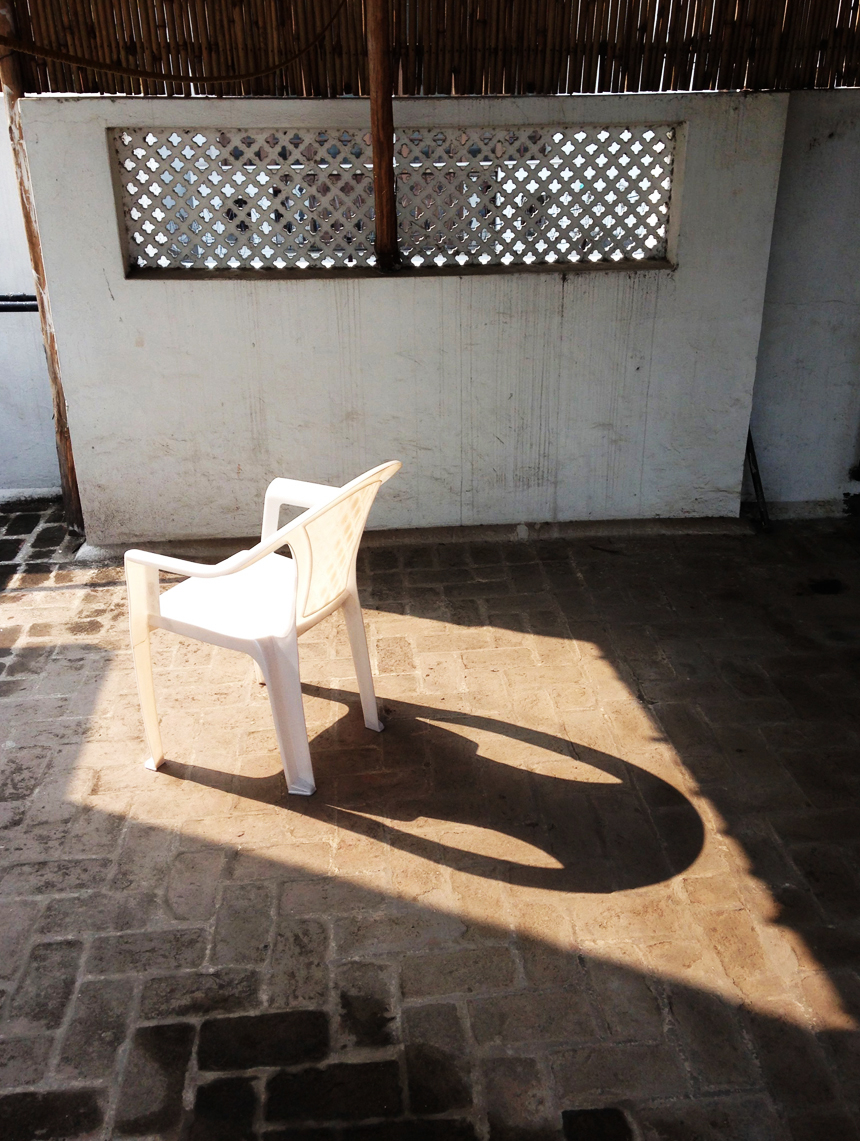
When it’s warm enough I go up on to the roof terrace, to the place where the sun shines through between the buildings and there’s a patch of sunlight where I can sit  on my chair. The chair is in the same place it was two months ago and for a moment there’s a kind of presence about that empty chair… déjà vu; the ‘self’ that was there at that time is gone completely, no familiarity with it – yet I remember being here quite clearly. Now I’m sitting in the warm sunshine, recreating a ‘self’ that suits this time and place, for this duration, knowing that soon it’ll be gone too. Phenomena are as they are for a short time and disappear; it’s as if the appearance of everything has the quality of a pencil sketch, a pleasant unfinishedness.

I look at things, and they’re gone – it’s the time needed to process the thought. Objects are experienced not in present time but just as they’re slipping into the past; everything is always seen in hindsight. Conclusions arrived at after the event. Nothing remains. The day I die will be an ordinary day. The moment after I’m gone will be no different from any other. It’ll be like a pause in the middle of a sentence… the focus on the object slips away, the next moment will just be the next moment and things will go on as if nothing happened. The fragility of the world held for an instant then it’s gone, only the space where everything used to be and the silence left behind…

‘Usually when we hear the teaching on not-self, we think that it’s an answer to questions like these: “Do I have a self? What am I? Do I exist? Do I not exist?” However, the Buddha listed all of these as unskillful questions. Once, when he was asked point-blank, “Is there a self? Is there no self?” he refused to answer. He said that these questions would get in the way of finding true happiness. So obviously the teaching on not-self was not meant to answer these questions. To understand it, we have to find out which questions it was meant to answer.’ [Thanissaro Bhikkhu:Selves & Not-self: The Buddhist Teaching on Anatta’]

————————-

magha puja day 2014

OB-SC487_0308ai_H_20120307120048POSTCARD#49: Delhi: It’s Valentines Day today and by coincidence it also happens to be a special day for Buddhists; Magha Puja Day, the full moon of the third lunar month. On this day, 2500 years ago, 1250 enlightened monks came from different places in India to pay respect to the Buddha. No mobile phones in those days, of course, so how did they get it organised? Maybe it was telepathic, all these monks had been ordained by the Buddha himself and it had only been 7 months since the Buddha had had the experience of enlightenment – a time when everything must have been vital and immediate. The arrival of the monks was thought to be a key event in the development of the Dhamma teachings and this was when the Buddha gave the “Ovadha Patimokkha” discourse: the three principles of the Teachings: do good, abstain from bad action, and purify the mind.

On Magha Puja Days in Thailand there’s the circumnambulation ceremony, walking clockwise three times around the temple holding flowers, incense and a lighted candle. For me it’s a time to sit on the cushion for a while, if possible outside in the moonlight. A time to consider what it must have felt like to be present in that ancient gathering. The great circle of the full moon in the dark sky of 2500 years ago illuminating everything, and the assembly of monks seen in its mysterious silver light. That moonlight would have been the same as the moonlight we experience today. The function of seeing is the same now as it was then. And for those monks sitting in the moonlight so long ago, the associated consciousness that arose through the act of seeing was the same consciousness arising that is always arising; consciousness of an ever-present flow of sensory data from outer to inner. They would have contemplated the truth that ‘I’ am a mind/body organism and an inseparable part of the whole that appears all the way through time – everywhere it’s the same moment. For those monks sitting in meditation all those centuries ago, the sensation of the breath in the nasal passages, a coolness of air gently present, would have been no different from how I experience it now. They would have contemplated the breath in this way; watching the in-breath, the out-breath, and the awareness that arises with that feeling was the same awareness I experience here and now.

Through the subjectivity of human experience, that special Magha Puja event of the gathering of the 1250 monks is suddenly brought into present time. The ‘now’ that happened then is the same ’now’ happening as I write this, 2500 years further on in linear time. The entire history of the world is like a very, very, very long moment. The ‘now’ moment is, of course, always present and, although I may think of that gathering of monks 2500 years ago as happening in the ancient past, I have to remember that a moment experienced at that time was a moment happening in present time for those who were there.

————————-

“Refrain from doing evil,
 cultivate that which is good; 
purify the heart.
 This is the Way of the Awakened Ones.” [Dhammapada v. 183]

‘The first stage of cultivating the way is refraining from following all that is evil. It is about learning to say ‘no’ to ourselves when we need to. As a result, we discover later we can say, ‘yes’ without losing ourselves. If we don’t recognize our unwholesome impulses for what they are, we might think the bad stuff is only in other people. The second stage of cultivating the way is developing that which is good. Even if it is only a small moment of goodness, don’t dismiss it. The third stage is purifying our effort of the taint of ‘me’. Even when we have completely finished redecorating a room, the smell of paint fumes remains. Though our practice might be getting stronger, the sense of self-importance could be getting stronger too.’ [Ajahn Munindo, Friday 14th February 2014 – Magha Puja]

valentine palindrome: 14/02/2014

IMG_0532bPOSTCARD#48: Bangkok Airport: Man wearing a bright red shirt leans backwards with hands behind his head just as I take the photo and it looks like a heart shape. Sitting in a coffee shop at Concourse B waiting for the 8.40 pm flight to New Delhi, decided to take the photo of the interesting curved shaped roof structure and didn’t see the heart-shape till I arrived in Delhi. A happy coincidence… and Valentines Day is special this year because of the palindromic sequence of date, month and year: 14/02/2014. Coming into Delhi from the airport, in the midst of pretty fierce traffic, I thought how nice to have this kind of numerical valentine and a day of love in a city that’s normally bristling with displays of proud male plumage and all things unloved. Then, looking through the image gallery in my camera phone, I discovered the photo – a gift, there in all the noisy traffic, a reminder to see beyond the tightly controlled mind state experienced in the driver’s seat.

The contemplation on loving-kindness, metta, begins with a focus on myself, my own well-being, and using that as a point of reference, I can extend it to others: “Just as I wish to be happy and free from suffering, so may all beings be happy and free from suffering!” Then I extend the thought of loving-kindness to a person for whom I have love and respect; and to those who are close to me. Extending then to those who are indifferent and to those disliked. It’s about the necessity of cultivating feelings of kind consideration to others; a conscious act of generosity rather than abiding with the unconscious default holding and keeping things to myself.

Arrived at the house, good to be back after two months away. Unpacked and found the Buddha’s Words on loving-kindness: the Karaniya Metta Sutta.

This is what should be done
By one who is skilled in goodness,
And who knows the path of peace:
Let them be able and upright,
Straightforward and gentle in speech,
Humble and not conceited,
Contented and easily satisfied,
Unburdened with duties and frugal in their ways.
Peaceful and calm and wise and skillful,
Not proud or demanding in nature.
Let them not do the slightest thing
That the wise would later reprove.
Wishing: In gladness and in safety,
May all beings be at ease.
 Whatever living beings there may be;
Whether they are weak or strong, omitting none,
The great or the mighty, medium, short or small,
The seen and the unseen,
Those living near and far away,
Those born and to-be-born
May all beings be at ease!
Let none deceive another,
Or despise any being in any state.
Let none through anger or ill-will
Wish harm upon another.
Even as a mother protects with her life
Her child, her only child,
So with a boundless heart
Should one cherish all living beings;
Radiating kindness over the entire world:
Spreading upwards to the skies,
And downwards to the depths;
Outwards and unbounded,
Freed from hatred and ill-will.
Whether standing or walking, seated or lying down
Free from drowsiness,
One should sustain this recollection.
This is said to be the sublime abiding.
By not holding to fixed views,
The pure-hearted one, having clarity of vision,
Being freed from all sense desires,
Is not born again into this world.

[Karaniya Metta Sutta: The Buddha’s Words on Loving-Kindness (Sn 1.8), translated from the Pali by The Amaravati Sangha]

————————-

[See also the Buddhist teaching on The Four Sublime States: Contemplations on Love, metta, Compassion, karuna, Sympathetic Joy, mudita, and Equanimity, upekkha, by Nyanaponika Thera]


‘now’

BkkTaxi3POSTCARD#47: Bangkok: So profoundly stuck in this traffic jam it feels like time has stopped. It’s not today; it’s yesterday – same taxi, same traffic jam. I raise my head from the book I’m reading and look out at the world. No sense of having moved further on, the back ends of vehicles and bits of buildings. This is a continuation of the same day and the interval that happened in between, dinner, 8 hours sleep; it was a daydream. Look at my watch, same time, same place I was in yesterday. The same people (probably) all headed in the direction they go in every day. Look down at my book again, eyes scan the text… where was I? Remembering my place by association with events taking place around me. The sounds of the gear stick shifting through its worn engagings and the accelerator pedal, the brake, then the gear stick again… parts of the story seem related to parts of the journey. The words I’m reading are flickering around the interior of this cab. Parts of sentences and interesting phrases get wrapped around the objects in this small space.

It feels good in here, inside this metal shell that’s holding me cushioned in a womb-like environment, bent over the book in my lap and looking outside from time to time. The experience of the ‘now’ moment is the same ‘now’ moment everybody else is experiencing… a hesitant, preoccupied ‘now’, maybe, for many of us; teetering on the brink of wanting things to be different from what they are. The traffic is hard to believe. Skillful avoidance of the tendency to hold on to the thought it ‘shouldn’t be like this.’ Look around the interior of the taxi, devotional flowers hanging up front in the windscreen and up above I see the painted marks of a holy person’s blessing on the underside of the roof. Grey/blue seating, a public space, registration numbers for the driver and the vehicle. A photo of the driver with his name in English.

We don’t have a conversation. I say: rod tid… (bad traffic eh?). And he says: yeu! (too much). We’re comfortable with the silence after that. For him, it’s a pointless journey to nowhere in particular – no problem; it’s often like this. Pause for a moment and watch the in-breath, the out-breath; mindfulness. A moment’s reflection and meditative contemplation in a Bangkok taxi… this is how it is for him. After I get out, somebody else will get in and off to the next place. When he gets there it’s the same as the place he just left. Where are we now? There’s a huge map in his head. City traffic is like a river, it gets into all the corners and any place where there’s space for it, finding its own level and passing through the hundreds of miles of its landscapes as it makes its way to the sea.

Like a boat on the river going with the current, the ‘now’ feels like it’s not moving. Only when the trees on the riverbank are seen is there a sense of movement, of moving through time. The ‘now’ is experienced in this present time as it has been for millions of years. I can imagine a time in what I would call the ancient past, but a moment experienced then happened in present time; it was ‘now’. A prehistoric being may have been sitting on a rock or a branch, exactly where I’m sitting, inside this cab… looking around – just as I’m doing now – and the ‘now’ experienced then would have been no different from the ‘now’ experienced at this moment.

‘The river is everywhere at the same time, at the source and at the mouth…in the ocean and in the mountains, everywhere, and the present only exists for it, not the shadow of the past, nor the shadow of the future… Nothing was, nothing will be, everything has reality and presence.’ [Hermann Hesse: ‘Siddhartha’, Chapter 9]

————————-