deities in the hall of mirrors

article-2378854-1B00FA8A000005DC-995_634x1281POSTCARD #156: Chiang Mai: I arrive in the hospital waiting area with the pain, this intrusive stabbing pain in the head and neck, postherpetic neuralgia, a permanent headache; sounds worse than it is – could be I’m getting used to it. There’s a flat screen TV and a coffee place, maybe I should order something? I have the iPhone to fiddle with, get busy with that… not interesting. Okay so try thinking about something else, but at this particular moment, there’s nothing else to think about – only the pain all around the right side of my head and neck. Think of something… thought itself is a free app I have the option to download on the mind/body device (namarupa) but even though I don’t have to download it, some of it seems to be here already, appears involuntarily. I hear the thoughts, the ‘voice’ inside the machine shouting out: Hey! the pain is happening to ‘me!’ It’s not happening to you, or them, or him, or her, it’s happening to me! The pain is ‘mine’, I am ‘possessed’ by it. Everything I love and hate, everything I love to hate – it belongs to ‘me’… it’s ‘my’ enemy!

With the pain swirling like a dense, dark cloud around my head and neck, I step carefully over to the TV that nobody is watching. There’s a remote, so I can flip through the channels and see where that gets me. Bend down to get the remote and the storm of pain happening to ‘me’ is there again, overwhelms everything, too much, for a moment I give way to it… and it’s then I notice there’s a space of somehow being detached from the pain, it’s something that’s not felt anymore, enough of an easing back from it to see the pain is an appearance, like everything else.

Sit down in front of the TV. Focus on the remote, press the buttons… so many channels. Some channels I recognise, then up into higher and higher numbers; places I’ve never been in before. Almost all of the channels are hazy or white-noise then I break through into a place that’s loud, clear and colourful. A Korean game-show, dubbed in Thai. It’s as if the storm of pain is all around but outside of this curious place – I’m safe in here. The scene unfolds, all the characters are lipsticked and painted with cosmetics like grotesque clowns, with amazing hair and impossible teeth, an embodiment of consciousness deeply obscured in layers of ‘self’. Man created God in his own image; a mirror reflection of the ego.

It’s a serious competition about trivialities; guests make appearances, have to tell anecdotes related to the question to gain points. They gaze at each other and see themselves as their own reflections; deities in the hall of mirrors – adults dressed to look like ‘cute’, children (kawaii), a real live dream-world; and the winning of the prize! Lights, colours music, the reward, congratulations, created laughter, spontaneous and heartening applause…

Just then, the nurse calls my name, I have to go and see the doctor. I get up from the chair slowly and take my pain away from the transparency of this kind of joyful TV state that’s doing its best to cultivate a desire for everything that is pleasing and a loathing dislike of everything that’s displeasing, perhaps unintentionally encouraging the hating of it, the not-wanting-it-to-be-there inverted craving, that contributes to the intensity of driving the economic machine… a kind of mental captivity; never seeing that the business of the actor is in the nature of appearances. The art of the illusionist, the politician…

Quiet minds cannot be perplexed or frightened, but go on in fortune or misfortune at their own private pace, like a clock during a thunderstorm. [Robert Louis Stevenson]

————————-

Photo showing a product that creates a lower eyelid bulge. Source

why?

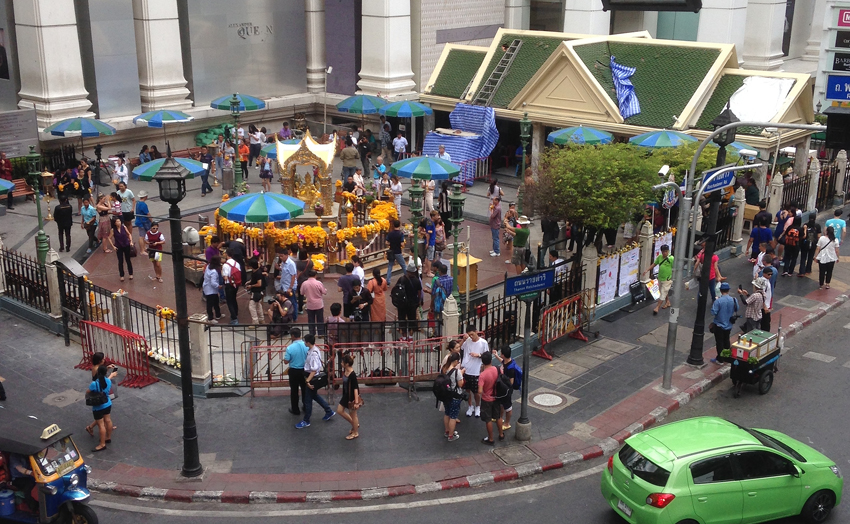
matichon.cov1827POSTCARD 145: Bangkok: The front cover of the Matichon newspaper weekly supplement shows pictures of the Erawan Shrine with the headline: ‘why’, ทำไม (tham mai). Whoever is responsible for the bomb would have been aware of the damage to relationships with China, and aware of the damage to the Thai government for failing to protect the public. Seems strange to me that even though it’s a four-headed Hindu, Brahmin shrine, worshippers are mostly Chinese Thais and it’s popular with Chinese tourists from Hong Kong, Singapore, and the new wealth of mainland China, group-tours of families and young people mostly. Maybe it’s not political, an act of madness – the shrine has a curious history. Inevitable, though, that everyone assumes it’s political; the small cartoon character in the lower right appears in every edition of the Matichon weekly. In this one the character wears a black armband and is saying: “So now we have finally come to this!” A provocative statement – a comment about anti-government groups, trying to harm the Thai economy.

IMG_2291It’s a mystery. I visited the shrine yesterday, most of the barriers are moved away now, some repairs still to be done to the roof where the explosion blew off roof tiles. The pedestrian bridge is cordoned off with tape to stop people leaning over to take photos. The same great cloud of incence hangs in the air above a continuing throng of hundreds of people visiting throughout the day and night with their offerings and countless bowings of head and hands, burning incence sticks held in hands, and palms together as if in prayer (anjali). I’m amazed by the passion of the ritual, there’s always been some intensity of thought here – not an open free mind, it’s not meditative… it’s something ‘willed’. There’s an undercurrent of some sort of unknown energy, people cling to the idea of it, the deity can save us if we believe in Him; we worship somebody else ‘doing it’ on our behalf – we are subject to that.

Strange to see this, because Thailand is a Buddhist country and Buddhism is about not engaging with the ‘story’, it’s about understanding the constructed nature of what has been handed down to us and stepping outside of that to see the non-duality between ourselves and the world. Like the original Jesus Teachings, you simply ‘see’ the Truth of it; the reality that surrounds us all the time; like the Hindu Brahman, the Oneness, the God-state that’s here and now.

The people who visit here every day must be sincerely involved in mindfully finding their way through the busyness of their lives. Others may visit when they have an extreme situation they’re worrying about, they come for help; a desperate prayer for what ‘I’ want, what I think I need. I can’t imagine what they receive from this, only more of a focus on situations that are absent of that thing that is desired. Why? What can I learn from this? Is there a Teaching here? Or maybe there’s something wrong with the question. It could be superstition, misguided intentions, living in illusion; ‘the futile pursuit of happiness’ it’s always disatisying because it doesn’t do enough, I want more of it – the fleeting happiness found in consumerism doesn’t hit the spot.

Traffic noise echoes off the concrete structures all around. Heat and incence smoke rising…

IMG_2281

‘The ego’s attachment to power of any kind is linked inextricably to the fear of losing that power and thus becomes a source of suffering.” (Ramdas)

————————–

History: In 1956, an astrologer advised building the The Erawan Shrine to counter negative influences and the bad karma believed caused by laying the foundations of the Erawan Hotel on the wrong date. Furthermore, the Ratchaprasong Intersection had once been used to put criminals on public display. The hotel’s construction was delayed by a series of mishaps, including cost overruns, injuries to laborers, and the loss of a shipload of Italian marble intended for the building. In 2006, the shrine was vandalised by a Thai man believed to be mentally ill. After smashing the statue with a hammer, he was himself beaten to death by angry bystanders.

everything is a metaphor

IMG_2142bPOSTCARD #122: Chiang Mai: Jiab suggested we hire a car with driver and  go to Doi Ang Khang, the mountain, for some fresh air and hill walking – beneficial for health for someone in my condition. Do I want to do this? Ask a question, and the answer comes with it – as if it were part of the question. The answer is in the asking. So off we went. M sitting beside me in the car and I had my passport in my jeans pocket. She felt the hard square shape: What’s this Toong Ting? I said it was my passport. M knocked on it with the knuckle of her finger:
Knock, knock!
Who’s there?
Hank…
Hank who?
You’re welcome.
It’s playing with the idea that Thais cannot pronounce properly the ‘th’ sound in ‘Thank You’. Then another one:
What kind of dessert do ghosts like?
I don’t know.
Ice cream (I scream).
That led to the pronunciation, and difference in meaning between ‘dessert’ and ‘desert’. For example, the whole central part of Australia is mostly a vast area that consists of nothing but custard and bananas and blobs of ice cream, fruit and currants.

It was a four-hour journey, pretty scary steep incline of roads and sharp bends kept us alert. Also gulping of air to get rid of the ear pops until we finally got to the top, into the hotel room and M runs through all the space, jumps on the three beds and into the bathroom. Mirror takes up the whole wall. I see her looking at herself – not satisfied. Ah well, we don’t usually fall in love with our reflected image, there’s always something judgmental – things that are always not as good as they could be (the Buddha’s teaching on Suffering Dukkha). The antidote is alert watchfulness, mindfulness, sati; mindful of being mindful, remembering to remember to remember. Learning how to learn.

Lunch came and before we could start to eat, M had to take a photo of it and send to her friends. It’s an amazing thing that we use the wonders of technology to send an image of somebody’s lunch over the Internet; a created postcard sent and instantly received. Then the actual lunch is eaten and gone forever. Except that M wouldn’t eat enough, and Jiab said something about she was too thin. I could feel the hopelessness in M, like… please don’t tell me this again! So I said I thought M looked nice, thin, elegant: What does elegant mean Toong Ting? I said she looked like a movie star, beautiful… then after that I kinda regretted saying it because she started acting strangely. We got back to the room and she’d hardly look at me and at the same time cuddle up against me. But it was soon forgotten when we got out and started the walk up the mountain.

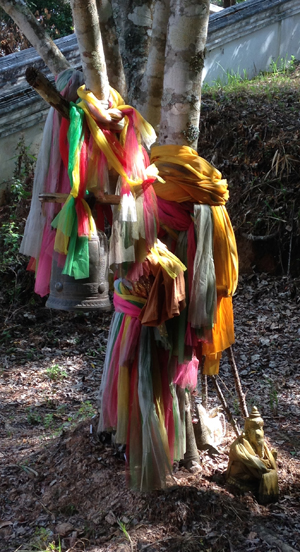
The first stop was the pagoda, one hundred and ninety steps up and down. I couldn’t quite figure out why it was there, except that everything is a metaphor. Trees wrapped in coloured cloth, auspicious meanings I understand only because I’m expected to understand (to be continued)

“our world and the beings in it in all their diversities are but the illusive manifestations of mind. While the illusion is taking place, it is “real”, but its essence is unreal like a dream. Therefore regard all phenomena as insignificant, similar to a dream, and rest your mind in this perspective in the moment.”[ The Seven Points of Mind Training of Atisha]

————————–

The Atisha quote comes from a comment by Ben Naga in a recent post
~ G R A T I T U D E ~

conflict & release

121120121567“Metta is non-discriminatory. It doesn’t mean liking one thing rather than another, it isn’t a question of singling out: “I love this person, I don’t love that one.” [Ajahn Sumedho, “Universal Loving Kindness” From Forest Sangha Newsletter, October 1997]

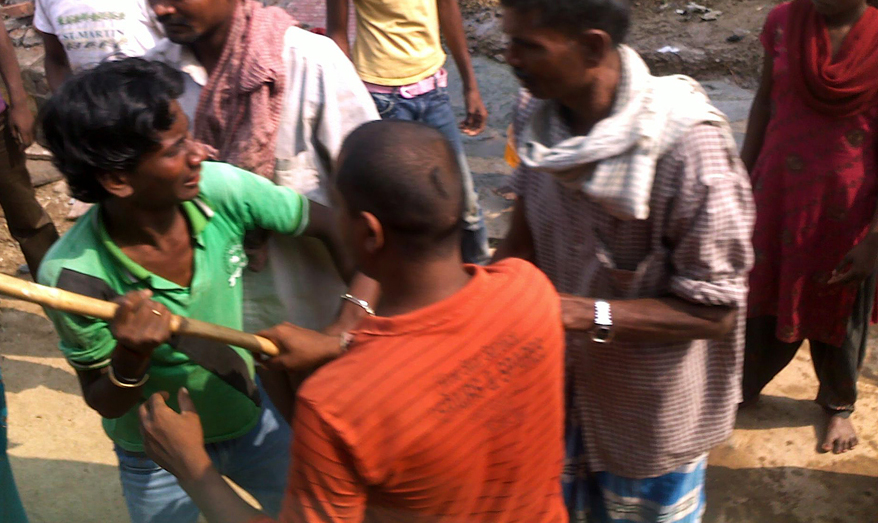
North India: The image here shows some kind of serious argument happening among a group of men, viewed from the window of a moving bus. I couldn’t actually see what was happening because other passengers were in the way, but I got the camera into a space near the window of the bus and took the picture, guesswork, thinking it’ll not come out clearly but it did – perfectly positioned in the centre of the frame. The man in the green shirt is trying to do something with that pole and the other guys are struggling with him violently. The bus pushed itself on through the crowd and the people made space for it. When we got up close, all I could see was the top of their heads and I took the photo without seeing where to point the camera…

The bus moved on and we were gone in a moment, accelerating along empty streets. I was amazed to see the photo after we’d moved away from the area. What to do with it? The tremendous intensity coming from the green-shirted man is scary – murderous feelings in the air. There’s another emotion too, he looks tearful, as if he might start to cry. It was an event I didn’t see, all I have is this picture of it. I could hear the explosions of angry voices, and the memory of it is still a bit scary, but it didn’t happen to me. If it hadn’t been for the camera lens, I’d not have seen it. As long as no effort is there to keep it going, conflict falls away. But we fuel the fires to keep the conflict going; our wars and war-mongering, allowing everyone the means to build up the tension, justified outrage, creating stories in the mind. We could just as easily allow it to fall away, but we’re drawn in, and it gets to a point when conflict is inevitable; this is always how it is.

Then Ajahn Vajiro was in town the other day and somebody asked him about what to do when you have to put up with some unreasonable, insensitive person giving you a hard time and you have to see this person on a daily basis. Ajahn spoke about the Brahma Viharas and later Suffering, the First Noble Truth and how the Buddha didn’t say he could eliminate suffering – he gave us the tools to escape the suffering. It led me to see that conflict is resolved if we can focus on the subjective nature of it, see our own anger, and see the anger the ‘bad guy’ has to cope with, and recognise it as exactly the same thing – what’s the difference?

The practice of meditation is the solution. Ajahn talked about getting to know the inner world; start from there, explore the universe from the inside. It’s not just about feelings of bliss and peace, that’s there too but it’s about the real world. Long term goals. Following this path, you get to know about suffering; you notice your own suffering, you have compassion and act towards others with compassion when you notice the suffering in your opponent. Apply wisdom – especially if your opponent is swinging a long pole, aimed at your head. See the angry person as someone who doesn’t understand his/her own suffering and recognise their difficulty – then get out of the way of the swinging pole!

It’s about the difference between ‘knowing’ and ignorance. Ignorance is the result of unskilful action. Non-ignorance (knowing) is about accepting limitations and doubt. It’s not a sure thing but it doesn’t have to be a serious drawback; having to cope with being not sure, uncertainty. Ajahn V described it as being at the edge of the known; doubt is nearly knowing what it is…. In a different context, uncertainty is what’s in the wrapped gift you’ve been given. You don’t know what’s inside until you open it….

————————-

“The metta – kindness – engendered in us encourages us to accept ourselves and others, and so to understand ourselves and others. Understanding implies wisdom. And this wisdom is that which allows us to find the way, to grow beyond, or let go of, that which limits and binds the heart. The kindness expressed to others allows them to accept themselves and others. This is an emotional, gut or heart acceptance that allows the acts of body, speech and mind that are a response to that which is perceived as `other’ to be kind; not motivated by not-liking, not motivated by aversion or fear. The effect is unlimited Metta is radiant and attractive, warming to those that are cold, cooling to those that are hot.” [Venerable Ajahn Vajiro – “Mature Emotions ” from the Forest Sangha Newsletter]

nothing cannot be anything

hand image3Delhi: There’s a needle in my arm. Strange how the body accepts this intrusive object and the antibiotic fluid coming through it that enters the blood stream. Veins have a plasticity like something synthetic we recognize from the world of manufactured polymer substances. But human tissue is better; you can make a hole in it and it repairs itself. You can cut it, stitch it up, remove parts of it and replace these with other parts that fit. The human body is a miracle. The pain of this needle, though, has a directness, increasing, then easing off, over and over, dukkha, there’s no getting away from it.

I don’t want it to be there, vibhava-tanha, I want to disconnect it from the plastic tube leading to the upside-down bottle suspended from the hook above my head. It feels unnatural; it shouldn’t be like this…. Lying here on the bed looking up and counting the drips that fall into the receptor that fills the tube; one drop every 4 seconds and that’s the rate of the fluid flowing down the tube into my pierced blood vessel. It’s a full bottle, and there are others I have to take after this one… treatment for an intestinal infection – nothing really extraordinary in a country like India, in the hot season, when all kinds of bacteria thrive. Caused by drinking water from a filtered system that didn’t filter. Organisms survive the filtering system; bugs everywhere in this intensity of 43°C.

I need to find a way of getting through this period of invalid status and prolonged boredom of a plain room with hospital fittings, plugs and sockets in the walls, hospital furniture and a TV screen I’m not interested in. Dissatisfaction with things; clicking the buttons that control the position of the hospital bed; down/up and up/down. Lying here with eyes closed, listening to the metal trash bin; it makes a satisfying percussive sound when the cleaner presses the pedal with his foot, lid springs open and strikes the wall next to it Clang! He releases the pedal and the lid closes: Flumpf an airtight trash bin with plastic bag liner. Crash! Flumpf! again and it’s joyful and funny.

I need some joy here, there are men in dark navy uniforms in the room; cleaners with large grey floor mops that look like they’re soaked in muddy water swabbing the tiles; smell of Dettol stings the eyes. Muddy grey mops and dark navy uniforms seem out of place in an environment of lemon yellow, soft pink walls; pastel shades and shiny chromium fittings. The muddy grey mops are a bit scary also, because I’m sensitive to things that appear dirty, having fallen into this sickness as a result of drinking water from a filter machine installed at home that allows dirty water to come through.

‘We’re not in Kansas anymore Toto…’ The doctor said always drink boiled water in the hot season, organisms are present in the water, filter or no filter. I feel some frustration with the company that sold me the water filter: ‘it shouldn’t be like this’but we don’t live in a world of ‘should’ and ‘shouldn’t – western theory applied in an Indian context. We expect it to work, and it doesn’t. Western systems are deductive and life is inductive. Organic growth has no beginning no end. How to understand that, what to do? Don’t make it into a structure. Let it be nothing.

So I can lie here on the bed with my eyes closed and the cleaners expect me to be like this because I’m a hospital patient. And in this curious public place, enter meditative contemplation, watching the breath, the rising and falling of the chest. Allow the thoughts that arise to fall away and be replaced by others that I allow to fall away and allow everything to fall away and cease, as far as possible – just the effort of trying to do this leads to a quietness in the mind; spaces of no thought. There’s some peace to be found in this activity. And from here consider nothingness, just nothing, no thought. It’s not an idea of nothingness, that’s a concept. Nothing cannot be  anything. Nothing cannot be located anywhere in time or space; no before, no after. If it is truly nothing, it can have no cause or effect. I can’t work towards some mind state in future time when I’ll see what ‘nothing’ really is, it has to be now, it’s always ‘now’. Nothing cuts through, penetrates, and dissolves everything. It’s just nothing.

————————-

‘One must have a mind of winter… (to behold) the nothing that is not there and the nothing that is.’ [ Wallace Stevens, The Snow Man]

Photo image: http://www.jeffzinn.com/wp-content/uploads/2011/12/poor.jpg

relaxed resistance

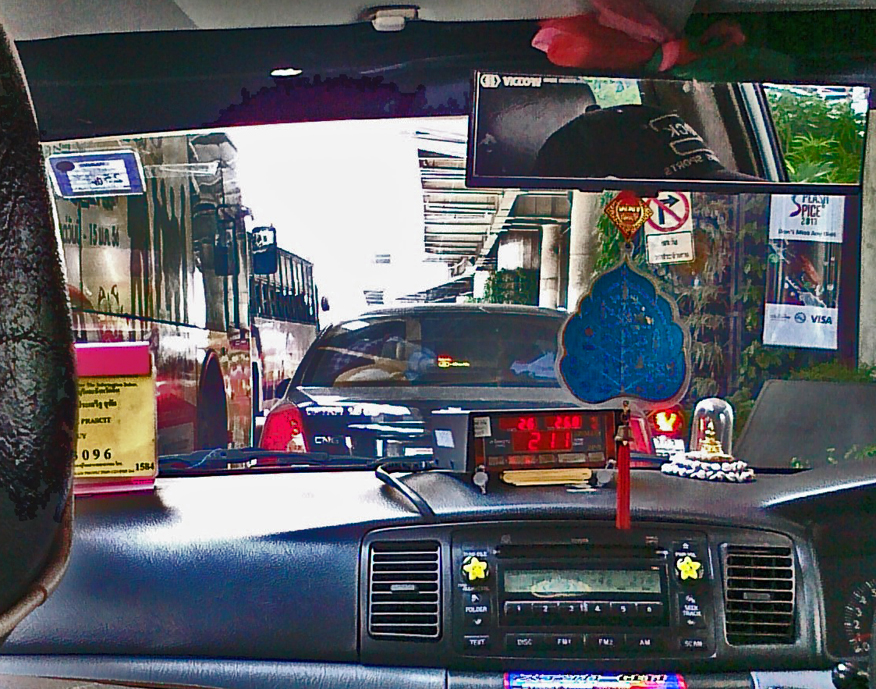
TaxiBKK2Bangkok: In a taxi on the expressway and it looks like the whole route is blocked with traffic but we are moving along slowly. A small voice is saying, we’d’ve been better off taking the ordinary route through streets with traffic lights and the congestion of that would’ve been quicker than this… yes, possibly, but hypothetical. And I’m not getting pulled into that scenario, thanks, no. Strangely, I feel no frustration sitting here. The taxi driver’s radio is playing; it’s a call-in chat dialogue with music.The mind isn’t absorbed into it, the sound is just there. It’s not loud, it’s not demanding; sometimes I notice it consciously then the mind moves on somewhere else. And, there’s that small voice again saying, wow! this could get really boring. But it’s not like that, it’s a neutrality maybe, there’s just this experience right now; the reality of being here. Nothing else to do, so obviously it’s okay to stay with what’s ‘here’ and see where that gets me.

One thing that helps is that there was this really nice post I read the other day [‘The Path of Waiting’] and I’m thinking of that now in this place where traffic is at a standstill, nearly. It’s the idea that we’re always waiting on something, somewhere, most of the time and it helps if you can be ‘willing to stand hand in hand with your waiting for a few moments.’ It was that, I think, that started me off in this mind direction of, let’s see what this waiting thing feels like. So now I’m hand in hand with my waiting and it feels nice.

The mind is clear, free and empty. There’s a careful observation and contemplation of everything that’s happening, it’s like being focussed on balance and openness – poised between things, in a sort of high altitude mind-place of emptiness. That’s all, and everything just seems to be slowly moving along here, the moment transforms itself and there’s this attitude of gentle curiosity, like what’s this now? I hear the small voice again; a shadowy question hovering on the periphery: how come I’m not frustrated by this endless traffic situation? Nope, it’s not necessary to go there; no desire to get pulled into that. It’s the wisdom of just mindfully placing one foot after the other on to stepping-stones that lead over the river to get to the other side. There’s something about the easy lightness of this that makes it obviously the right thing to do, and what else is there to do anyway? Not a lot, I look out the window and see the gridlock of slow-moving metal parts in this tremendous heat.

Amazing really because I’m not feeling the frustration of it. There have been times in the past when it would’ve resulted in a semi-suppressed raging inferno and getting engaged with it, or trying to get rid of it, would seem like the way to go. Getting rid of stuff always seems like the right thing to do; a kind of righteous feeling; got to clear up this mess, okay, let’s get on with it! But that hasn’t worked for me, experience has shown…. Long ago and far away, I remember the Ajahns telling me about this – well, I didn’t know what I was doing at that time – and the teaching was about how I was unintentionally holding on to some unpleasant mind state, even though I was sure that trying to get rid of it was the thing to do. The desire to get rid of, vibhava-tanha, is a desire, same as the desire to have something is a desire; they are the same. So the teaching is that trying to get-rid-of-it is like trying to get rid of the desire to get rid of it, and it doesn’t work like that – all I’d be doing is creating more suffering.

It’s fortunate for me that I’m seeing it like this today, I need to remember how it works. The problem is really with the resistance to frustration – so, relax the resistance, allow the frustration to come in. Know what it’s like when it’s present, know what it feels like (the holding on to it) when it’s there. Knowledge replaces ignorance, we are not deluded by it any more. So, I’m just moving along now; looks like the traffic flow is easing up a bit – getting there…

6388612-machomikemd

————————-

‘… in the context of the four noble truths, the origin of suffering (dukkha) is commonly explained as craving (tanha) conditioned by ignorance (avijja). This craving runs on three channels:

(1) Craving for sense-pleasures (kama-tanha): this is craving for sense objects which provide pleasant feeling, or craving for sensory pleasures.

(2) Craving to be (bhava-tanha): this is craving to be something, to unite with an experience. This includes craving to be solid and ongoing, to be a being that has a past and a future, and craving to prevail and dominate over others.

(3) Craving not to be (vibhava-tanha): this is craving to not experience the world, and to be nothing; a wish to be separated from painful feelings.’ [dukkha samudaya (wiki)]

Upper photo: collection of the author
Lower photo: Virtual Tourist/machomikemd

castles made of sand

2013-01-13 09.40.12

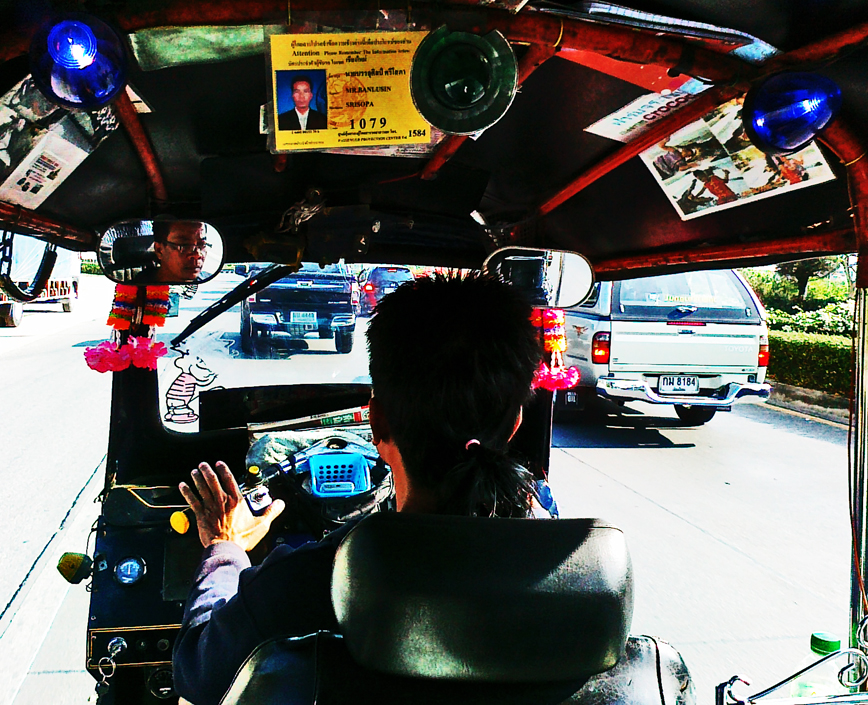
Chiang Mai: Traffic congestion at the intersection and everything comes to a standstill. The tuktuk driver makes some remark, I ask him what he’s saying and out comes a whole string of words I think I can’t understand. Then I start to recognise a few familiar vocabulary items and can reply with the same kind of observation. He laughs and says this thing I’ve never heard before: jai yen-yen (heart stay cool) jai ron mai dai (heart hot – not okay). So what now? He looks around to see if we can do a U-turn; not possible, we have to wait and see, and he switches off the engine. Sit back, relax, silence, it’s strange to be suddenly quiet after the large sound of the 2-stroke engine stops with the flick of a switch. Seems like another world; sitting on a sofa in someone’s living room, decorative chromium bars – an old-fashioned ice-cream parlor on wheels? The driver has photos of his family stuck above the windscreen, and decorative flower garlands swaying in this slight wind. No walls, a canvas roof and the outside world enters my space, like it’s always been here; the inside merged with the outside. Birds could fly through… it’s odd, just metallic creaks and the sound of other engines turning over. The smell of fuel, tarmac; this is somewhere in some part of town. Ah well,  I’m glad it’s not too hot, we might be here for a while.

I could send someone a text message …reach for my phone – then resist the urge. Okay, so, what’s the plan? All things are now directed here: the Plan; an habitual thing from long ago, frequent updates, always in line with current changes. It’s a comfortable space I create in the mind and that’s okay but sometimes I feel compelled to have a plan about the Plan. Then a plan about the plan about the Plan. The Plan is an end in itself, detached from its location in some future time, it’s now placed in present time – more like a plan for the present moment. We’re always only part the way through anything, anywhere, anyway and never at the end – we just don’t know what happens after that. Nobody ever came back from What Happens After That to say what it was like… we just don’t know.

Nothing is permanent, anicca, but the intervals between change may be immense; it doesn’t change for a very, very long time – then it does. I have a vision of it coming to an end one day… there goes the world, collapsing like a dead star, all matter reduced to an atom… all gone in a flash. Or maybe it’ll be slower; bits start to fall off and you hardly notice. And there’ll come a time when the System and all who sail in her will begin to fall in on itself like great empires do that have spanned the centuries; in the end, become too unreal and like castles made of sand and all things subject to collapse, tumble to the sea – nothing is permanently permanent – eventually. But it depends how you choose to see it, of course. In a different kind of temporality, it would just arise again and pick up where it left off; a continuous unfolding transformation and that’s how it is, even as we speak.

Something happening up front, cars beginning to move, the driver switches on the engine and it starts up immediately, a few turns of the throttle and we’re suddenly not there anymore, away in an exhilaration of speed and noise….

————————-

‘For many lives I have wandered, looking for, but not finding the house-builder who caused my suffering. But now you are seen and you shall build no more. Your rafters are dislodged and the ridge-pole is broken. All craving is ended; my heart is as one with the unmade’ [Dhammapada v.153-154]

everything that arises…

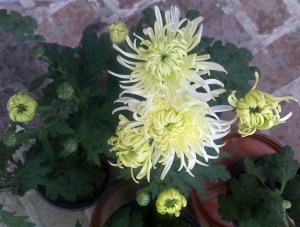
bgv2New Delhi: Flocks of chattering green parrots in the trees and birds of prey slowly circling around in the upper sky. I watch them from our place on the roof terrace. There’s a table, chairs, an extension cable for electric kettle and all kinds of plants in the sunshine; bougainvilleas and chrysanthemums. If you have ‘chrysanthemums’, why can’t you have ‘chrysanthedads?’ I ask Jiab who is reading the Matichon (Thai) newspaper with great scrutiny. But this doesn’t seem to be worthy of comment right now… and after a period of silence, I get busy with shifting these heavy flowerpots full of earth into a beam of sunlight. Much huffing and puffing, when I’m finished with that and sitting on my chair, looking at what I’ve done, Jiab says to me: ‘… happy now?’ And I suppose I am.

Happy, yes – except of course for that lingering sense that things are not right; not as I’d want them to be. But I’m happy enough, yes. Why? Because all these things that I think are not as good as they could be or should be (even worse); all these things are just there – then they’re not there, I’ve forgotten about them. That’s how it is, I’m not holding on to them. The dark cloud of unhappiness is not hanging over me today up here on the roof terrace with flowering plants in the sunshine. No, it’s a clear blue sky and I can see there is suffering dukkha in the world, yes, but that’s because we’re holding it there, unknowingly. Let it go and there’s no suffering – can it be as easy as that? Maybe it needs sustained effort, over a long period of time. But even so, that’s the idea of it. One can feel inspired, motivated knowing there is an end to it. And I suggest this possibility to Jiab, who now inclines towards me thinking maybe I seem to be making a more intelligent remark this time.

And we talk about that for a while. It’s always interesting for me to hear what she says because like most Thais she knows the Pali terms in the buddhasassana, having learned the chanting by heart in elementary school. Jiab is also fortunate because her Dad was a monk for a couple of years and was able to explain the dhamma to his children: that life is permeated with suffering caused by desire, that suffering ceases when desire ceases and that enlightenment obtained through sila, samadhi, panya (right conduct, meditation and wisdom) releases one from desire, suffering, and rebirth.

What it comes down to in the end, is the basic truth that everything that arises passes away and the Venerable Assaji statement: “Of things that proceed from a cause – their cause the Tathagata has told. And also their cessation — Thus teaches the Great Ascetic.” [Venerable Assaji answers the question of Śāriputra the Wanderer], and how Śāriputra was totally blown away by that and people were getting enlightened on the spot as a result of the Venerable Assaji statement. In this context I’m thinking it means if you can see and are aware of suffering caused by tanha, the attachment to things you love and hate, that’s all there is to it; you see it, you know it, ignorance is gone and no matter how much it is held or the tenacity of the habit to hold on, suffering will pass away of its own accord: “Whatever is subject to origination is also subject to cessation.” And there’s a sudden burst of noise from the green parrots in the trees opposite, so we go and take a look at what’s going on over there, but it’s not anything.

chrysanthemoms

Photos: bougainvilleas and chrysanthemums

the journey to get there

Nepal/India border: Trying to find a wet-wipe in my pocket to remove a food stain on my white T-shirt here in the hotel dining room (on the way to Lumbini). If you’re on the road, you have to carry all your possessions in your pockets and it ends up like you’re a walking bathroom cabinet, laden down with personal effects and bits and pieces from the journey. I start to unload things, a toothbrush, a shaver, a wrapper from a holy piece of gold leaf, a ticket stub that allows entry to Bodh Gaya shrine, a pack of tissues, a wad of 10 Rupee notes (US$0.18) for giving away to beggars and all kinds of coins in small denominations; heavy bulging pockets but no wet wipe, so I go to the bathroom to get some water to wash the stain out.

Step inside and the floor is covered in water of dubious origin, splish splash across to the sink. Wash stain off T-shirt and I just know that if I start thinking, I don’t want it to be like this, I’m going to make it worse than it is already: ‘Feelings of pleasure and pain, like and dislike, arise from sense-contact…’ [Ajahn Chah, Timeless Teachings] So I focus, mindfully, on the task right now and, splish, splash, splish out into the sunshine. I suppose it’s just a different way of looking at priorities. There’s a whole lot of things going on here I just don’t know anything about – some of it is difficult to accept, all of it is richly vibrant. Another instance of it was when we entered the hotel dining room, white linen table cloths and silverware, and there was this absolutely deathlike chemical smell. Somebody said afterwards it was the disinfectant that’s used here. It was like something volcanic. The sensory cognition mechanism gets hold of something it hasn’t experienced before and attempts to identify it by retrieving files from the data bank. What gets conjured up is a series of exotic possibilities. After a while, it became less noticeable, then it seemed like it was completely gone – maybe it was still there but we just didn’t notice anymore.

I’m inclined to think visiting the Buddhist historical sites is mostly about the journey to get there; if you’ve done it, you’ll know what I mean. There are extraordinary and wonderful stories about this journey, some can be found in Ajahn Sucitto’s two volumes: Rude Awakenings and ‘Great Patient One’. And I’m wondering how things were during the Buddha’s time, less people and pre-industrial, but was this vibrant energy, that’s here now, present then? Could this have been, in some way, the context that played a part in and inspired the effort to find a way out of suffering?

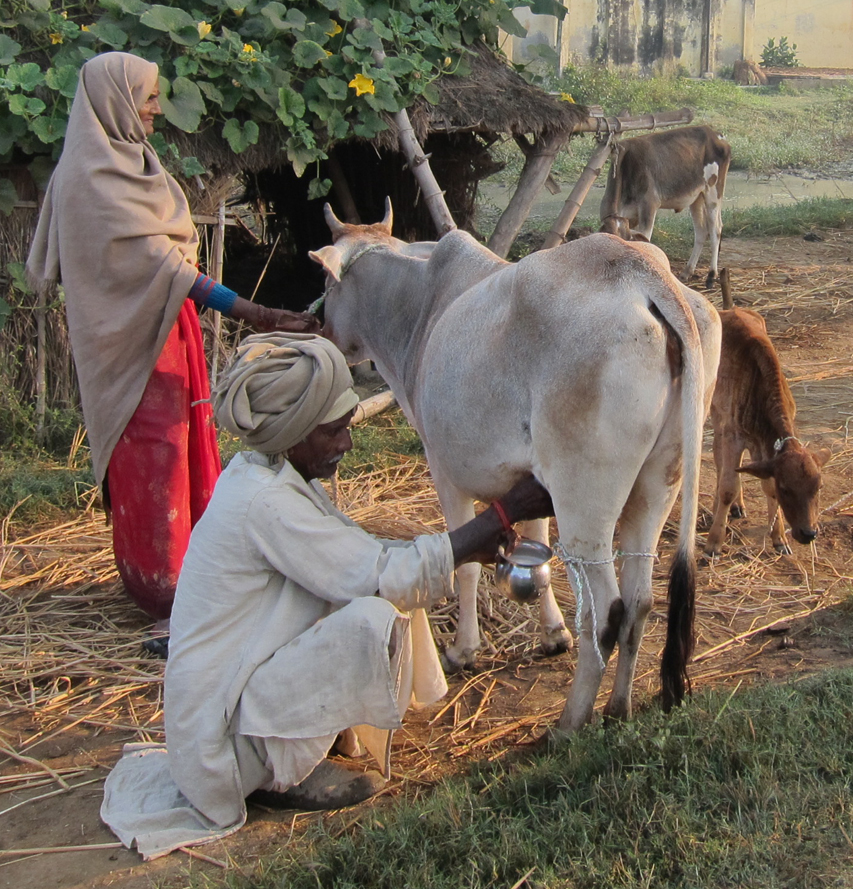
All kinds of stuff going on. Some time later in the day, I passed a cow eating cardboard packaging from a wastepaper bin. It raised it’s head from the bin and there was a long strip of torn cardboard dangling from the mouth, chomp, chomp chomp. Then later I saw another cow tearing off a piece of paper poster stuck on a wall, using it’s long grey tongue with front teeth to trap the small paper scrap quite skillfully. It must be the paper saturated in paste made from some kind of ingredient like flour and the cellulose in cardboard is edible. Just snacking; they  looked like healthy animals. In the time of the Buddha they wouldn’t have been eating cardboard, they’d have been eating other things but allowed to roam around freely, same as they are now. And here I’m looking at things that are not much different. The centuries pass, industrialization arrives, and the cows wander into the 2nd Millenium AD in a rural environmnet that’s pretty much the same as it was in those ancient times.

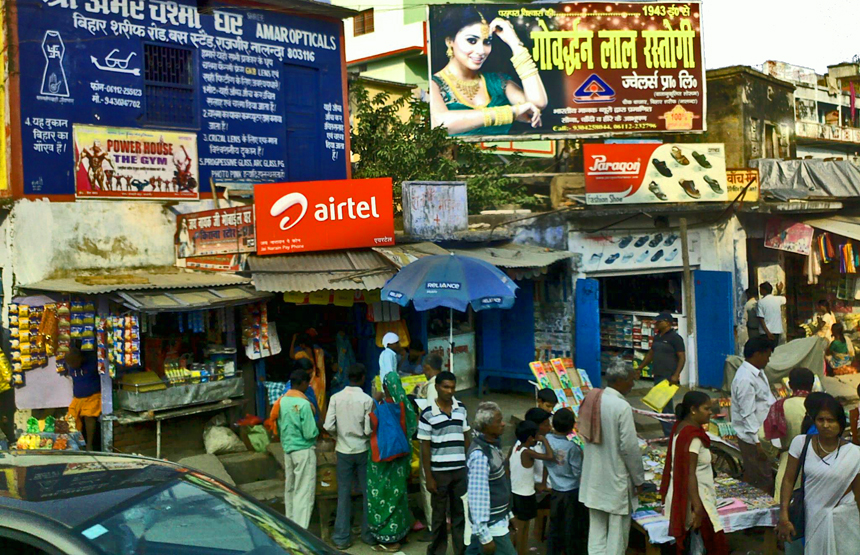
Upper photo: view from the bus to Nepal, Lower photo: from the Witit Rachatatanun Collection

A Little Country

Genève-London Flight: Darkness and the cold mountain air of a Swiss morning just before the 06.00hrs news broadcast; they are playing a short extract of birdsong – the first broadcast of the day. It arises from silence on the car’s speakers, increasing in volume and gradually becomes noticeable; very much like the real thing. Birdsong and high frequency sounds reduce stress, I feel relaxed. Day begins, the news in French as we sail through the silent Genève streets to the airport. Taxi like a limo; everything is reassuringly taken-care-of. No problem, no suffering; the heaven realms.

Airport check in, and through to Departures, impossibly expensive luxury goods in Duty Free. At the Easyjet desk, staff wear fluorescent orange Hi-Vis vests; cheap and cheerful. We are processed, boarded, I have time to find an aisle seat, stow away my bag. Up and away and the next thing is, I’m looking from the plane down on the surface of the planet.

Clouds cover the landscape with openings here and there where I can see the ground below. Very soon we are at the French coast and the clouds disperse as we fly over the English Channel. I can see a few isolated ships with lights on; it’s still early morning. In a very short time the coast of England appears up front and if I look behind me I can still see the coast of France – hadn’t realised how close these countries are to each other.

England is a patchwork quilt of very small fenced enclosures. Everything is the same as it was when I left a year ago; it could have been yesterday. I think I recognize the little houses down there, same flight path as before. No change. Buildings last for hundreds of years, built from iron, brick and stone. It was all here before I was born and will be here after I’m dead. So different from the bamboo and thatched roof dwellings of South East Asia; they fall apart and new ones are built in their place. That kind of fragility and tenuous existence is frightening for people who live in a stormy climate like this, surrounded by the sea.

Concrete bulwarks along the English coast keep the sea out. The threat of the sea engulfing the land is psychological; an island mentality. The perceived fear that it’s impossible to open up to fully accommodate this energy of life. We have to hold it back. There is no space in this little country; cross from East to West by road and it’s done in a few hours. The recognition comes back to me – I know this feeling; a deep familiarity. The claustrophobia of ‘self’; I am an island surrounded by water. There is this anxiety that comes from always wanting to know things are under control; the sea will not breach the flood barriers.

Descend at Gatwick, off the plane and processed through formalities. Large posters saying you cannot bring potatoes into the United Kingdom… okay so this is my last chance to declare hidden contraband of illegal potatoes. Welcome to England. ‘Passengers are reminded not to leave baggage unattended.’ It’s only 07:55 hrs, thanks to 1 hr time difference; a sense that you’ve arrived before you left? The day is yet to begin; dull grey, cold and damp. The Rail Network, rock’n roll, rough and ready; an empty beer can rolling around on the floor of the train carriage. Seats are small, very close to each other but passengers are all looking the other way. How good it would be if we could all just be friends…. My niece would say: can you give me a hug please?

 ————————-

Let there be a little country without many people.
 Let them have tools that do the work of ten or a hundred,
 and never use them. 
Let them be mindful of death
 and disinclined to long journeys.
 They’d have ships and carriages,
 but no place to go.
 They’d have armor and weapons,
 but no parades.
 Instead of writing,
 they might go back to using knotted cords. 
They’d enjoy eating,
 take pleasure in clothes, 
be happy with their houses, 
devoted to their customs.

The next little country might be so close, 
the people could hear the cocks crowing
 and dogs barking there,
 but they’d get old and die
 without ever having been there.

[Tao Te Ching, Chapter 80, translated by Ursula K. Le Guin ]

Photo: Louk Vreeswijk