
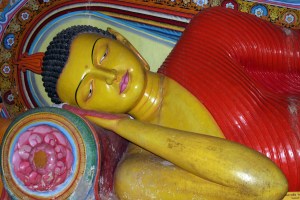
 OLD NOTEBOOKS: The images of Gautama the Buddha we have today portray him as a person from the educated class, someone we might recognize as not unlike many of us who have the ability to see ordinary life at a distance, without any immediate financial concern about things in general because we live in a society that takes care of itself (as it was for Gautama before he left the palace). Or maybe we’re desperadoes, adventurers with a special genius and exceptional skill and energy that creates equanimity in times of brinkmanship and it’s the sheer confidence in our ability that allows us to see this truth; the suffering of the ordinary worldling is caused by wanting things to be different from (other than) what they are, and never managing to reach the desired state.
There is another a form of Buddhism that reaches the ordinary people of India through the Ambedkar conversion from the socially oppressed Dalit caste to Buddhist, in the hope of a better life. This has become a political issue and some would say the Buddha was an activist attempting to create social change – I think most would agree that, sadly the politics of the situation has confused the Buddha’s original teaching. The Ambedkar Buddhists are the fifth largest religion in India. The Dalit Buddhists I have met, those with university degrees at doctorate level, are actively searching for a way of integrating those parts of the Buddha’s original teaching.
In the West, people have to structure their lives around employment. Their innate ability to be happy is exploited by commercial strategies and a fleeting, temporary happiness has come to be built-in to the system. People can’t escape from that unless they step out of the social momentum they’re in and this means there’s the risk of losing everything. So they’re trapped in the system.
As Pankaj Mishra says: “Buddhism has always attracted the elite of whatever society it has traveled to, partly because you need to have traveled through a certain experience of materialism in order to arrive at the sense that there is something problematic about desire and longing, how they don’t lead to happiness, and more often than not lead to unhappiness. If you are still struggling to fulfill your fantasies of wealth, power, status, Buddhism is less likely to appeal to you.” [‘An End to Suffering’ Pankaj Mishra‘]
Maybe we are seeing some similarities here reading this while stretched out on the sofa with an iPad at this very moment, giving some thought to the situation of Gautama leaving his comfortable home and stepping into the unknown, in search of a spiritual life. In Thailand there’s the option of living in the monastery for a period of time in order to follow the spiritual path. In fact you can spend your whole life there. This kind of choice is held in high regard by Thai society. In the West we are in one way or another committed to our earning capacity. There is virtually no spiritual option of this kind in the system – other than self-study and the support from nearby Buddhist monasteries. A Google search for Theravada monasteries in USA and other parts of the world will explain that anyone is welcome to share in the one meal of the day, free of charge, the activities, Dhamma talks in the monastery and accommodation can be arranged.
“You should live as islands unto yourselves, being your own refuge, seeking no other refuge; with the dharma as an island, with the dharma as your refuge, seeking no other refuge.” [selected from the Buddha’s final words]
————————-










 dhamma footsteps
You must be logged in to post a comment.