everything that arises…

bgv2New Delhi: Flocks of chattering green parrots in the trees and birds of prey slowly circling around in the upper sky. I watch them from our place on the roof terrace. There’s a table, chairs, an extension cable for electric kettle and all kinds of plants in the sunshine; bougainvilleas and chrysanthemums. If you have ‘chrysanthemums’, why can’t you have ‘chrysanthedads?’ I ask Jiab who is reading the Matichon (Thai) newspaper with great scrutiny. But this doesn’t seem to be worthy of comment right now… and after a period of silence, I get busy with shifting these heavy flowerpots full of earth into a beam of sunlight. Much huffing and puffing, when I’m finished with that and sitting on my chair, looking at what I’ve done, Jiab says to me: ‘… happy now?’ And I suppose I am.

Happy, yes – except of course for that lingering sense that things are not right; not as I’d want them to be. But I’m happy enough, yes. Why? Because all these things that I think are not as good as they could be or should be (even worse); all these things are just there – then they’re not there, I’ve forgotten about them. That’s how it is, I’m not holding on to them. The dark cloud of unhappiness is not hanging over me today up here on the roof terrace with flowering plants in the sunshine. No, it’s a clear blue sky and I can see there is suffering dukkha in the world, yes, but that’s because we’re holding it there, unknowingly. Let it go and there’s no suffering – can it be as easy as that? Maybe it needs sustained effort, over a long period of time. But even so, that’s the idea of it. One can feel inspired, motivated knowing there is an end to it. And I suggest this possibility to Jiab, who now inclines towards me thinking maybe I seem to be making a more intelligent remark this time.

And we talk about that for a while. It’s always interesting for me to hear what she says because like most Thais she knows the Pali terms in the buddhasassana, having learned the chanting by heart in elementary school. Jiab is also fortunate because her Dad was a monk for a couple of years and was able to explain the dhamma to his children: that life is permeated with suffering caused by desire, that suffering ceases when desire ceases and that enlightenment obtained through sila, samadhi, panya (right conduct, meditation and wisdom) releases one from desire, suffering, and rebirth.

What it comes down to in the end, is the basic truth that everything that arises passes away and the Venerable Assaji statement: “Of things that proceed from a cause – their cause the Tathagata has told. And also their cessation — Thus teaches the Great Ascetic.” [Venerable Assaji answers the question of Śāriputra the Wanderer], and how Śāriputra was totally blown away by that and people were getting enlightened on the spot as a result of the Venerable Assaji statement. In this context I’m thinking it means if you can see and are aware of suffering caused by tanha, the attachment to things you love and hate, that’s all there is to it; you see it, you know it, ignorance is gone and no matter how much it is held or the tenacity of the habit to hold on, suffering will pass away of its own accord: “Whatever is subject to origination is also subject to cessation.” And there’s a sudden burst of noise from the green parrots in the trees opposite, so we go and take a look at what’s going on over there, but it’s not anything.
chrysanthemoms

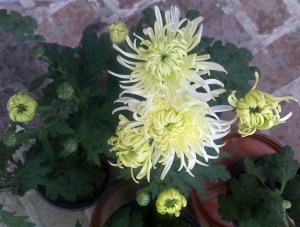
Photos: bougainvilleas and chrysanthemums

Buddhists and Christians

Chiang Mai: A very nice short flight here from Bangkok yesterday, 1 hour 10 minutes. They serve a small meal; it was like going upstairs to have lunch in the clouds, then it’s time to come down again. During the flight I was able to have a discussion with somebody I met there about Christianity and Buddhism – is there ‘something’ there (God) or is there not anything? And ‘not anything’ implies something that cannot be verbalised.

It is a bit like tight-rope walking for me as a Western Buddhist and now 30 years in Asia but still subject to the conditioning of the Church and childhood memories of it in the West. With my Christian companion here, there is agreement on many things. The main thing we agree about is that human beings may experience a certain kind of realization that there is no ‘self’, no identity, nothing there; nothing in the mind/body organism, it’s a construct. There’s a feeling of ‘lack’, and the shock that comes with this discovery causes dismay, distress, etc. Christians say the realization of emptiness is the absence of God, and this knowledge facilitates the entry of God, the creator of everything. This is what fills the emptiness; a significant turning point for all Christians.

Buddhists encounter this feeling of ‘lack’ in the same way but will not ‘fill’ it with anything, rather, they contemplate the emptiness of it in depth; examine the associated emotional reactions with mindfulness and come to see that, this is how it is. Śūnyatā, the emptiness, the lack of ‘self’ is everywhere and in all things. The understanding that everything is without ‘self’ helps Buddhists to contemplate the constructed nature of the mind. It’s possible to see the whole picture; how everything works and where we go from here. It’s an open-ended, investigative approach that may lead to an understanding of the non-duality of the observed world and the observer of it, together as a oneness. What the Christians call God must be inside this, because it is all-inclusive. There cannot be anything outside of it.

Christians will depend on the attachment to a belief in God for guidance and that’s how they see the world; they might say that ‘emptiness’ for the Buddhist is the Buddhist sense of God? And Buddhists could consider it this way, but the Buddha didn’t see any point in going further with that because the important thing is to make sure you are seeing reality correctly; anything else is getting caught in wishful thinking. Necessary because working only with belief and faith and no pragmatic teachings means there are all kinds of things that can go wrong with it. Christians are focused on the experiential aspect; Buddhists say conceptualizing a God leads to attachment, tanha; the desire for, and attachment to, ideas and ideals, views, opinions, theories, conceptions and beliefs. [Dhamma-taṇhā, Walpole Rahula].

If I say the word ‘God’ to myself, something comes into my mind, the word ‘God’ has an immediate emotive effect. Certain assumptions arise and the mind is already closed around it; it’s a ‘special’ thing. When Christians talk about God, what they’re referring to (I think) is the God they are creating in their own minds – their loving devotion to a personal god: a deity who can be related to as a person, but God is beyond everything that is conceived or thought about. There is no adequate analogy, words cannot describe it. It cannot even be imagined because it is beyond space and time. Buddhists stay separate from the God concept because to become involved with it means making assumptions about a kind of consciousness that is totally different from ordinary mind states. This is not to say there is no God, for me, at this time, it is impossible to express in words what God could be.

Then there’s a stewardess announcement, the plane is starting its descent, please put your fold-away table up, arm rest down, and chair forward. I get lost in the directions for a moment; a small clutter of prepositions, then were on firm ground again.

————————-

‘Both Jesus and the Buddha were pointing to something that could not be found in the context of ordinary ‘mind’, the Buddha’s goal was to strive to realise the unconditioned, the unoriginated, the deathless, that which is free from mortality. So did the Buddha find God? Was it this that he called Nibbana? God is not Nibanna, because when we speak about ‘God’ we start getting ideas in our head about what God is and that is very far from the unborn, the unconditioned, the uncreated, the unoriginated, the deathless. All these words tell you nothing. What comes into your mind? Nothing. Anything you might say or try to put into words to describe God is an image in the mind. There are no words for it.’ [Ajahn Jagaro]

‘God is God only in relation to man. God appears in the material world like the reflection of the moon in a pool of water, as part of the illusion that is the context of man searching for God with his mind. What man sees becomes “God” (gender neutral; “He” only for explanatory purposes). He is Omniscient, Omnipresent, Creator of the world. He is both immanent and transcedent, full of love and justice. He may be even regarded to have a personality. He is the subject of worship.’ [Wikipedia Brahman page]

Image: Peter Henderson

personifications 1

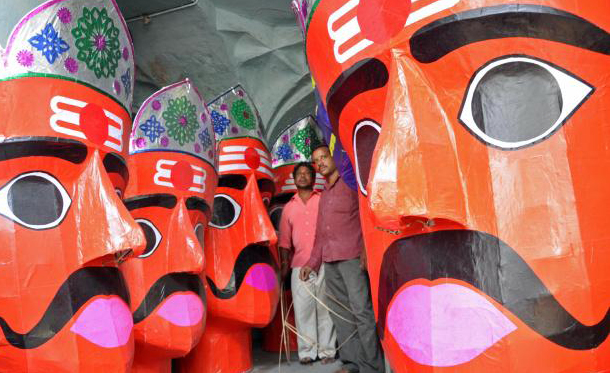
Note about the image: Ravana, huge demon-like effigies, are created for the Dasera festival which was held in India recently. The effigies are packed with straw and the highlight of the event is when they are set alight [Link to: The Hindu newspaper]. What I’m writing about here is the attachment we (Westerners) have to effigies such as teddy bears and the inclination to personify objects as a way of supporting the concept of an individual ‘self’ separate from the world.

Bangkok: I’m in a townhouse in the centre of the city; arranged to meet some people about a school-kids party event. Na Uan is here and the room is full of huge plastic bags containing something… is it teddy bears? Yes, teddy bears. She says, they were donated by an Australian NGO to be given as prizes for the main quiz event. And my first reaction is, how cute! Then that feeling falls away; they’re just teddy bears, a lot of them, packed together in these large plastic bags. I see them all squashed up inside the plastic, upside down, sideways and limbs all tangled together and faces pushed flat against the tight surface of the stretched bag. They’re looking particularly unloved; not cute at all. I ask Na Uan, shouldn’t we take them out of the bag? No, we can’t because they’ll get dusty if we do. Seems like not the kind of thing to do with teddy bears, keep them in plastic bags, they can’t breathe… ? I have to remind myself they’re not living beings.

But the best is yet to come, Na Uan rolls out another plastic bag containing the largest teddy bear I’ve ever seen, it is about 4 feet high in the seated position, squashed up, golden furry body and wide-eyed inquiring alertness about the face, everything flattened tight against the polythene surface, and totally suffocated like the others. Why am I going on so much about teddy bears? It’s because I spent the night there and had to sleep in the same room with all the teddy bears, trapped inside their plastic bags. I got to sleep in the end; woke up in the morning and there they all were again, looking out at me in their appealing way..

It’s this thing about ‘self’, there’s just no getting away from it. We take the mind to be self but it’s a succession of mental elements nāma rising and falling away and seeing, hearing, thinking is the same; the body too, rūpa, one day here, next day gone. The five khandhas – it’s doubtful if they were of any substance in the first place. Sounds like a sad story and I suppose that’s why there are teddy bears we can hold on to – and other things. We try to bring our sense of ‘self’ into reality with these personifications, images of ‘self’, but that falls away too. None of it works, there’s just this great emptiness where the individual self supposedly resides and the great big teddy bear looking at me now from across the room cannot convince me otherwise. It doesn’t work like that.

Interesting to see Na Uan’s attitude about all this; individuality creating existential anxiety; it’s a Western thing. It has no meaning; there are many things like this that happen here in Bangkok that Na Uan doesn’t understand and that’s ok, not important. She is one of eight sisters and brothers, an integral part of a community that takes support from each and every individual present, one way or the other. Yes all kinds of stuff Na Uan didn’t have to learn and get involved with when she was a kid. Good for her. The ‘self’ problem is still there, though, but maybe the Thais are very much less attached to it than we are.

There’s a question about what remains after you see through everything that is not the ‘I’ you take it to be. There’s a quote by Sri Ramana Maharshi: ‘… the one who eliminates the ‘not I’ cannot eliminate the ‘I’… find the source and then all these other ideas will vanish and the pure Self will remain.’ It’s possible to have assumptions about the ‘pure Self’ and about what ‘will remain’. The Buddha’s teaching is that if you can completely deconstruct the ‘I’, nothing is left behind, ‘no remainder’. This must be a teaching about tanha, the natural inclination to hold on to the very end – as we do with teddy bears and everything else. All there can be is the clear-minded investigation of this.

Sometime after that I was having breakfast, pa tong ko, deep fried dough pieces in the shape of an X and soy bean drinks with dried fruits and somebody arrives in a pick-up truck and takes the bags of teddy bears away. It was like they were never here.

————————-

Photo Image: The Hindu Newspaper

Homer & the 1st Noble Truth

Switzerland: An old Simpsons episode appears out of nowhere, just as I’m beginning to despair here in the long journey through Central European TV channels; one end to the other, then back again. The samsara of television. So I do find something I can identify with in Homer’s world view, but afterwards, I notice, there’s this strange, unreal quality; the Simpsons effect. Everything else on TV seems changed and it takes some time for this altered perception to pass. The way I find to emerge from the ennui mind is through recognition of the Noble Truth of Suffering: dukkha, the characteristic ruminations of thought, same old thing, and I can just say: oh, that’s what it is, let it go and be done with it. But, how about poor old Homer? I wonder if the creators of the Simpsons ever properly considered that Homer might have a basic understanding of the Noble Truth of Suffering? It seems unkind if they didn’t. He’s so close to it but never quite gets there.

Whether it’s intended or not, Homer is at the very beginning of the spiritual search. He is pre-first Noble Truth, doesn’t know this is dukkha; he doesn’t know what it is. He hates it, he loves it, he’s indifferent to it, he is in denial. He’s so totally immersed in the experience of it, there’s just a dull glow of obscured awareness – enough to see that this is the fundamental human condition? Probably not, Homer is so busy ‘wanting’ things to be different from what they are, he doesn’t realise that this involvement with tanha craving/desire is exactly the reason he’s in the unpleasant situation he’s in.

He tries to see beyond desire and sees only more desire. The idea of ’giving up desire’ triggers the conditioning that desire is ‘bad’. It does stuff to Homer’s head. That’s why he got the idea inverted somehow and managed to explain it to himself that giving up desire is ‘bad’. This means he’s not able to see that (even if he did get it the right way round) we don’t give up desire because it’s ‘bad’, we give it up because it’s what’s causing the pain.

The possibility of release: 3. nirodha [there is a way out], and: 4. magga [this is how you do it], these things are not on his to-do list. Homer has the wrong idea, completely, but I have to remember he is a cartoon character – and I have to consciously remind myself about this. There is no ‘Homer’, there is no ‘self’, there is only the driving mechanism of craving and attachment. Homer can’t see it in this way because he’s conditioned to believe that if there’s desire, it must be happening to ‘somebody’ and that’s Homer. So, it looks like the way to go is to gratify that desire immediately, rather than stop and look at how it came to be like this.

Everyone would be very happy if the creators of Homer could get around to thinking about Homer’s predicament: what does it take for him to get closer to his desire urge and look at what’s really going on there? Without responding to the tugs and pulls, just observing, he’d see that the desire is there because it’s in the nature of desire to be like that. Homer’s curiosity, a dim glimmer of wisdom, is all it needs to clear away the ignorance – there is understanding and desire loosens the tenacity of its hold on him.

Accepting the Noble Truth of Suffering means he can let it go. He’s not confused by it or perplexed by the fact that he doesn’t know what’s wrong. He knows what it is. Knowledge displaces ignorance, so he can let it go. The difficulty of being bound up in difficulty is suddenly not there anymore. Instead there’s the familiar feeling that things are fine just as they are and something about this says to him there can be a profound awakening to the allrightness of just being in the moment.

This small glimpse of the innate quality of peace all beings share might be enough for Homer to seek the Path to Liberation.

————————-

‘The first of the four noble truths of Buddhism, that there is suffering in life, was enormously important to me. No one had ever said it out loud. That had been my experience, of course, but no one had ever talked about it. I didn’t know what to do with all the fear and emotions within, and here was the Buddha saying this truth right out loud. I wasn’t alone, I wasn’t weird, and I didn’t have to feel isolated. For the first time I didn’t feel so utterly alone, like I had a shameful secret…. Then I learned the next three noble truths – I could do something about the suffering. I could change how I dealt with it. I could approach my pain with compassion instead of bitterness, in community rather than isolation. I could change my relationship to pleasure. The Buddha offered a very simple, pragmatic tool — meditation – to transform one’s relationship to everything.’ [Sharon Salzberg, except from an interview in Huffington Post Aug 30 2012]

bird in the mall

THE NUMBER 9 BUS drops me in town and I find a place with tables and umbrellas in a shopping mall. Order something and open my bookmarked page: ‘Satisfaction is a moment of relief from the pressure of wanting.’ [‘Who Dies’ by Stephen and Ondrea Levine] That small moment of relief from the pressure of wanting comes with an increasing thirst for more.

Just then, a little bird appears at the table; hops over, quite close to me, where there are crumbs scattered, looks at me with a flick of the head, picks up a crumb and flies away, whrrrt. Mall sparrows are incredible, living in a totally artificial environment, high ceilings, glass roof, enclosed – this place doesn’t really look like what it’s trying to be; obviously artificial green foliage descending from stylized pillars made from polystyrene, surfaced with a resin that makes it look like marble.

I go on reading and the bird comes back, picks up another big crumb and flies off, whrrrt. I can see it going up to the top of a pillar and now perched on the plastic leaves, then disappears in the foliage. Hmmm… a nest constructed from woven drinking straws, paper serviettes, fragments of cash till receipts, hidden in the simulated foliage up there. Generations of sparrows and other creatures have lived inside these places for years, urban wild life, that has long since lost the way back to the ‘real’ world. The birds wouldn’t survive out there, they’ve adapted to conditions in here; proximity to table crumbs.

The small sparrow comes back to my table, takes another crumb, flies off again, whrrrt. The speed of the action… snatch, fly, eat. Feed the offspring and that’s how it evolved. The dukkha of endless searching is not an issue for this bold little bird. It has everything it needs maybe. Time for me to go. Across the road and the tram I need arrives at the stop, traffic lights change and I cross over and jump on. Light and easy, moving from one thing to the next. Not driven by wanting things to be how I’d like them to be. It’s got to do with the way you see it; the tram speeds up and glides along on smooth rails.

————————-

‘When desire does not shape the mind and limit it to thought, consciousness becomes translucent. Entering into the spaciousness of the original mind, we become the vastness itself. Inseparable from all else, at one with all that is.’ [Stephen and Ondrea Levine, ‘Who Dies’, chapter 4: ‘The Thirsty Mind’]

Too Much is Never Enough

Tanha

“If this sticky, uncouth craving overcomes you in the world, your sorrows grow like wild grass after rain.” (Dhammapada 335)

Tanha perpetuates ‘the fever of unsatisfied longing’; the opposite of bien être (sense of well-being). Tanha is not a happy bunny. It attempts to feed the hunger of ‘wanting’ but the action of feeding it only sharpens the edge of appetite; there’s never enough. Tanha is a deep craving for ‘self’. It is astonishing to think that the ‘self’ we have constructed to fill the void of ‘no self’ is the direct result of tanha. I am ‘me’, here in this world, because of tanha.

Tanha is the cause of Suffering, the 2nd Noble Truth, the 7th step in the Paticcasamuppada. Tanha is the reason for rebirth. In the story of King Assaka and Queen Upari, Queen Upari died and became a cow dung beetle in the next life. But she felt quite at home in her lowly existence as a cow dung beetle and this is due to tanhã (craving) which finds delight everywhere. Tanhã gives pleasure, delighting in whatever sense object presents itself – tanhã has the tendency to delight wherever it finds rebirth. Reborn as a dog, it takes delight in a dog’s existence; reborn as a pig, as a fowl, there is always delight in each existence.

It explains very well the reason why some people you meet are absolutely committed to ‘wrong view’ with an intensity that takes your breath away. They believe they’re right and the rest of the world is wrong. No matter what anybody says, they continue to do it the wrong way. Life is pretty difficult for somebody like that. I’m reminded of a song from the 60s: ‘The original discriminating buffalo man. He’ll do what’s wrong as long as he can.’ (Lyrics: The Minotaur’s Song’ by Incredible String Band [link])

Tanha is step 7/8 in the paticcasamuppada causality sequence. Interrupt the sequence there and bring the whole thing to an end. I first came across it in Walpole Rahula’s ‘What the Buddha Taught’, then later in Ajahn Buddhadasa [link] The way to deal with tanha is to cut off the conditions that lead to its arising. The entry point here is the step before it: 7. Vedana. At the vedana stage, there are three possibilities: the arising of pleasure, or pain or neutral feelings. If feelings of pleasure or pain arise, then craving or aversion will follow and tanha will be the result.

‘… if, by an act of will, only the neutral feeling was allowed to arise from contact with the object… the seventh link would be neutralized, de-activated. That being so, tanha could not arise, and the next link (upadana) would fail to arise and so on …” Eric Cheetham, “Fundamentals of Mainstream Buddhism”, p214-215

For me, the discovery that interrupting the sequence at Vedana changed the momentum of everything was awesome, to say the least. This is how I quit the tobacco habit (and other things). By allowing the neutral response (at Vedana) to be present for a moment, I noticed an easing in the craving, a cessation – just enough to trigger my curiosity… what is going on here? The first time this happened, the cessation took place just as my recognition of it clicked as (possibly) ‘the way out’, and I knew then I’d cracked it. Now I see it’s about staying a little distant from it, and allowing the craving to start the process of cessation by itself. Trying to confront/defeat the craving will not work because willed action only causes it to arise again.

Time went on and the craving would arise but there was always cessation. By my continuing to recognize that it’s in the nature of Tanha (as with everything else) to be transient like this, it was seen as something that comes and goes – bye-bye craving. The neutral feeling didn’t register as anything (that’s the thing about neutral feeling) and there was a space, a gap that wasn’t there before. Curiosity about this new space, just discovered, led to extra motivation. I could see that I was changed. Situations that used to completely overwhelm and demolish me seemed more distant; I’d found a way of looking at them as if they were something quite separate.

Other habitual behaviour began to fall away. I began to notice the wonderful emptiness or the wholeness or … (whatever word you use isn’t quite it), a great peace in the space of the mind that comes about when you understand that there is a way out of Suffering. I figured out that I am not dependent on the ‘dependent’ mind state tanha. I can walk away from it; everything that arises, ceases.

[link to image source]