furtherance

[Continued from last week] We got back to Bangkok from Osaka, Japan late Saturday night, 15 July. Even though, 2500 miles (4000 kms) away, the mind, still in Japan, shifts to the events that led up to M in Osaka finding the apartment next to the Buddhist temple, where she is now.
One curious coincidence I forgot to mention in last week’s post was the numbers of the street/apartment address contain her birthday date: I Chome (district) – 3 – 19: M’s birthday is March 19. She noticed it immediately of course, when she made her way to the address for the first time, not thinking too much if this was the place she would choose to stay, yes-or-no…  but if you like the karma of finding a location next to a Buddhist temple, as well as the birthday date/ number coincidence, and things just feel right, the conclusion is: of course, yes! So, she signed the contract and moved in. Since then we have walked around the grounds so many times of our quiet neighbour, resting here for the last 1,430 years,  we feel there’s a connection with this place, the oldest Buddhist temple in Japan, (Shitennō-ji;  四天王寺 (Temple of the Four Heavenly Kings).

Such a great expanse of historical time between then and now, and today the temple grounds are surrounded by the urban structures on all sides. So how relevant are the Buddha’s Teaching in Japan today? I see it everywhere, community orientated, living close together; similarities in cultural behaviour, the same characteristics of a Buddhist society as you find in Thailand. The Dharma lasts for ever – even if it’s wiped out by war or disaster… it comes alive again with the right kind of cultivation and the journey goes on. Circumstances cause things to change, evolve, according to karmic influences of this-and-that moving on in furtherance of the here-and-now that was the there-and-then,and the human condition as such.
“Dedicate whatever happiness you enjoy to all sentient beings, wishing that whatever you have gained from your own virtuous actions will help nurture and serve everyone. All that you do and experience, all your happiness and suffering, should lead to the development of bodhicitta.” [Sechen Rabijam Rinpoche from ‘Equanimity,’ Great Middle Way]

It was this idea of a birthday that reminded me of the Teaching that consciousness is birthed into every moment. There’s a talk by Thai monk, Phra Payutto, titled ‘Perfect Happiness’ that expresses this concept of generating happiness. The talk was given at the 84th birthday event of a local person, then transcribed in Thai and translated in English. I have selected excerpts here that convey the simplicity and profound beauty of the Buddha’s teaching which only Phra Payutto can communicate.

“Everyone is searching for happiness; however, some people may not realize that happiness is something we can generate on the spot, within our own hearts. Whenever we are endowed with such qualities as faith, love, a sense of friendship, joy, and clarity of mind, happiness arises spontaneously, in an instant.Today we are celebrating a birthday. If we think of a birthday as marking the day when our lives began—when we came into the world— then we are thinking of the past. We cannot go back in time and relive any past events, but we can in present time. The Buddha’s teachings, show us we are born in every moment, both physiologically and mentally. In terms of the mind, we can say there are both positive and negative births. Unwholesome states should be prevented from arising, understandably, and we strive to give birth to wholesome mind states: delight, joy, ease, inner clarity, faith, mindfulness, love, concentration, diligence, wisdom, etc. With the arising of such wholesomeness, our birthday celebrations are genuinely warranted.

Human beings naturally desire happiness and so, the teaching: ‘birth is suffering.’  may be unhelpful. But the Buddha was referring to an aspect of nature, to the reality of conditioned phenomena; what this means is that birth is subject to laws of nature: anicca (impermanence), dukkha (suffering) and anatta, (nonself). All things arise, are sustained, and then pass away. Everything is subject to change, unable to maintain its original state of existence. Everything exists according to causes and conditions. These are all attributes of nature, following a natural order.The dukkha inherent in nature, however, is not identical to the dukkha (‘suffering’) in the hearts of human beings. Dukkha arises, or does not arise, based on whether we relate to the dukkha inherent in nature wisely or unwisely. In the context mentioned above, the Buddha was simply describing a phenomenon inherent in nature, a truth of nature. Conditioned phenomena invariably conform to this teaching on the Three Characteristics, anicca, dukkha and anatta, but if we conduct ourselves unwisely, the dukkha inherent in nature turns into suffering in our hearts. Suffering arises because people relate to nature unwisely. If we leave the dukkha inherent in nature to its own devices—we leave it be, as it naturally is and do not allow it to create suffering in our hearts. He urged us to relate to suffering skilfully, and we will be happy. The way to become free of suffering and realize happiness is to understand and gain insight into suffering. By living our lives discerningly, we gradually experience more genuine and reliable forms of happiness and our suffering diminishes, to the extent of it being dispelled all together: all that remains is happiness.There is thus a special technique to be applied vis-à-vis suffering. Here are four practical guidelines on how to relate to suffering and happiness:

1. Refrain from creating extra, unnecessary suffering for oneself.

2. Do not forsake righteous forms of happiness.

3. Do not indulge in any sort of happiness, even righteous happiness.

4. Strive in order to realize higher forms of happiness.

If we are able to accord with these principles, it can be said that we are practising correctly.

[More next week]

taking refuge

Hotel room on the 17th floor, Osaka, Japan. Hi everyone, this is Tiramit with Jiab here visiting our Thai niece M… some readers will know of M when she was little with all her questions addressed to me as “Toong-Ting.” Now she is 19 and doesn’t call me that anymore, calls me “T-T” instead (sounds more like ‘dee dee’). M is fluent in English, now studying Japanese language, and aiming for a similar level of fluency or enough to get her up to college-level … after that, let’s see.

I’m amazed, M took responsibility for nearly everything to do with getting the apartment selected, location ok, rent ok, (Japan is not cheap). Size of rooms, tiny but ok. All the forms to fill in to do with her one-year visa and there was all the paperwork to do with sending the cattos to Japan.

All of this done online in Bangkok by M, reading enough Japanese from her one-year class in BKK before coming. Jiab helped with setting up the bank and the school facilitated some of the stuff, but M did most of it, also a couple of phone calls to the house agent in Japan and that was it!

She left for Osaka with Jiab (overnight flight from Bangkok), checked out the house agents, selected a place next to a Buddhist temple and there was some waiting in a coffee shop near to the temple to get the confirmation from the owner of the apartment. Then PING! … a text message saying ok, confirmed, and they had a moving-in date.

Ok so let’s get to the airport and they were back in Bangkok in three days. How was it done without a single hitch and in such a short time? Vipaka Kamma (karma) is the answer. We are all studying the Buddha’s teaching and actively involved with our Buddhist groups, so the apartment next to the temple just conjured itself up, and “dōzo,” there you are. This apartment was waiting for you, M and the cattos, rest here, rest assured, take refuge in the triple gem.

It wasn’t till after the apartment was confirmed that I did a google search on our nearby Shitennō-ji Temple, and found out about the founder, Prince Shōtoku, 1,430 years ago. So, I’ll leave you with a few Wikipedia paragraphs and see you this time next week back in Bangkok.

Shitennō-ji;  四天王寺 (Temple of the Four Heavenly Kings), regarded as the first and oldest Buddhist temple in Japan. The construction of Shitennō-ji was commissioned by Prince Shōtoku in the year 593 as part of a national project to promote Buddhism. The prince invited three Korean carpenters to come to Japan and lead the construction of Shitennō-ji.

The Prince is renowned for modernizing the government administration and for promoting Buddhism in Japan. Over successive generations, a devotional cult arose around the figure of Prince Shōtoku for the protection of Japan, the Imperial Family, and for Buddhism. Key religious figures claimed inspiration or visions attributed to Prince Shōtoku.

Shōtoku was an ardent Buddhist and is traditionally attributed the authorship of the Sangyō Gisho commentaries on the Lotus Sutra, the Vimalakirti Sutra, and the Śrīmālādevī (Siṃhanāda Sūtra). The first of these commentaries, Hokke Gisho, is traditionally dated to 615 and thus regarded as “the first Japanese text”, in turn making Shōtoku the first known Japanese writer.

There is a letter to Emperor Yang of Sui which contains the earliest known written instance in which Japan is referred to as “the land of the rising sun.”

He is also known for bearing the Sanskrit Dharma name Bhavyaśīla which was awarded to him by Bodhidharma. Bhava (भव) means being, worldly existence, becoming, birth, production, origin – also: habitual or emotional tendencies which lead to the arising of the sense of self, as a mental phenomenon.  Śīla (in Sanskrit) or sīla (in Pāli), means “behavioral discipline”, “morality”, “virtue” or “ethics” in Buddhism

A legend claims that when Bodhidharma came to Japan, he met with Prince Shōtoku whilst under the guise of a starving beggar. The Prince asked the beggar to identify himself, but the man did not reply. Instead of going ahead, Shōtoku gave him food, drink, and covered him with his purple garment, telling him to “lie in peace”.

The second day, Shōtoku sent a messenger to the starving man, but he was already dead. Hereupon, he was greatly grieved and ordered his burial. Shōtoku later thought the man was no ordinary man for sure, and sending another messenger, discovered the earth had not been disturbed. On opening the tomb there was no body inside, and the Prince’s purple garment lay folded on the coffin. The Prince then sent another messenger to claim the garment, and he continued to wear it just as before. Struck by awe, the people praised the Prince: “How true it is that a sage knoweth a sage.”

[A closing note about Shinto] Shinto is often cited alongside Buddhism as one of Japan’s two main religions, and the two often differ in focus; Shinto is a nature religion – the belief that the natural world is an embodiment of divinity, sacredness or spiritual power. The focus in Shinto is on adapting to life’s pragmatic requirements. While Buddhism emphasises the idea of transcending the cosmos, which it regards as being replete with suffering. The focus is on attaining liberation from the clinging to existence, marked by impermanence (anicca), dissatisfaction/suffering (dukkha), and the absence of lasting essence (anattā).

2021 looking forward

POSTCARD#401: Bangkok: Happy New Year to all blogging friends everywhere in the world! The year 2021 has potential for being a much better year than 2020. Hopefully by this time next year Covid infections in the world will have peaked and the vaccines are successful in creating optimum herd immunity… hopefully.

Christmas day was an ordinary day for us, no reason for Santa to fly in on his reindeer sleigh, because Thailand is a Buddhist country. People go to work, schools are open, it’s a day like any other day. Except that our 16 year-old Thai niece we call M, had her hair colour changed to a subtle shade of white-blond and wore a red dress to attend her SAT class in central Bangkok.

Otherwise we had a quiet time contemplating these ‘tidings of comfort and joy,’ without all the ho-ho-ho! Happy to have M, she of the white-blonde hair, who comes from Chiang Mai but now with us in Bangkok since July. Not able to go back to her home for visits because of Covid. She is here to improve on her GED and SAT scores. Also looking carefully at University entrance requirements.

It has been a fairly peaceful year for us, mostly in lockdown, unlike the frequent-flying thing that was going on before Covid. I’d be travelling between Delhi and Chiang Mai to visit M so that she’d not forget me! I remember when she was 12, on a particular day that I recall clearly, M runs out the door to spend the day with her friends, then comes back quickly and over to where I’m sitting: Toong Ting? I am going now. Bye-bye! And she runs out again. I sit there for a while being Toong Ting, her pet name for me, part of her baby talk that remains because it’s thought to be cute when applied in a grandfatherly way.

Then I went away to Delhi and came back again, the same year, and she was definitely taller; longer and elongating like a plant in the darkness searching for the light, sprawled on the back seat of the car in an adolescent bundle of legs and arms, wearing a diver’s watch, colorful T-shirt. Long black hair that forms a curtain revealing a small oriental face sometimes seen when adjusting the thread of earphones cable then disappears again – sorry, she’s not available at the moment, plugged into two phones, watching youtube videos while checking for messages at the same time… our questions addressed to her remain unanswered.

She is still quietly being her own self but surprisingly communicative at times – becoming a person. The whole thing dependent on the time needed to grow, of course. When we are in the Nontaburi house, she sleeps until noon then phones a food delivery from her room and appears downstairs to get it from the motorbike guy, goes back to her room to eat it there… some of us might think this is a bit, well, antisocial? But here in Thailand, nobody gets upset… it’s the Buddhist way, if you’re a kid?

M seems to be happy, at ease and does everything she’s good at, really well; her school work, socializing with new friends and not coming home too late, passing exams with good scores… all of it is done properly, commendable and very suitable for a teenage daughter/niece.

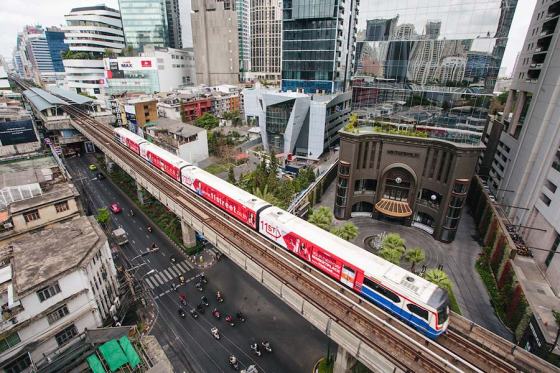
Jiab is noticeably engaged in taking care of M and goes to great lengths to accommodate her needs, cooks the food, does the laundry, drives her to school or, when we are in the apartment downtown, to the BTS station (Bangkok Transport System). It’s an elevated rail track over the streets and rooftops, called the Skytrain and her stop: Phaya Thai Station is only 5 minutes from Ari Station, where we are – get off at the third stop.

That location is linked to the airport route and near the popular shopping center of Bangkok where it’s all young people, and being looked at is the primary concern, while looking at others who look nice, can be a discussion point. M does stand out in the crowd, of course, with her hair colour when almost everyone else has Asian black hair She is extraordinary in that regard, has a pretty face like a child and is slim. Always in good-looking clothes, and so on, also politically aware, asks intelligent questions, remembers things and reminds me about the names of things when I forget.

So we have been very fortunate having M with us, and I’m going to write some more about her soon.

2021 Looking forward.


Smaller than a grain of rice, smaller than a grain of barley, smaller than a mustard seed, smaller than a grain of millet, smaller even than the kernel of a grain of millet is the Self. This is the Self-dwelling in my heart, greater than the earth, greater than the sky, greater than all the worlds. [Chandogya Upanishad 14.3, 8th-10th century BCE]

wordless and indefinable

POSTCARD#397: Phuket (say: pooket): The first time for us (Jiab and me), in many months, to be ‘away’. Short attention span due to being in one place in time then in another place another time. In this other place we’re in, lies the memory of what happened in that place, up-to-date but all-too-soon it is replaced by the experience of the next place in time, thus pushing things along and along… time connected with place.

The car came for us early that morning headlights ablaze, at the house in Nontaburi, and daylight was only just coming up when we arrived downtown at the condo, forty-five minutes later. This is the thing about having two places of residence, arrivals and departures don’t mean the same as they did because there’s no point of origin. The travelling between two separate halves gets to be structured into chunks of attention that last for the duration of their passing and are replaced by the next chunk of attention.

M was still sleeping when we got there – teenagers sleep and grow long limbs like tree branches. So eventually we got her to wake up, she started a small breakfast there and finished it in a plastic bag when we were in the car headed for the airport.

Smooth, sweeping highway between tall buildings. Awareness of ‘the whole thing’ is not yet engaged and there’s only just enough time to decide what this is before it changes into something else. Everything is as it is for a moment of consciousness, and another – then it changes again. Thought is a downloadable app – install/uninstall, thinking is the whole story; random episodes, snippets, individual words. In the interval that the mind is engaged in ‘thinking it’, everything moves on and I can never seem to catch up – can never find the right words to express it… wordless and indefinable.

Fragments of a thought arise again, pieced together from associated thoughts, memories of a past time brought into present time, together with things thought about in future time. Pause for a moment and everything stops… just the circumstance itself. It takes some effort to get it started again. Maybe there is only one moment – only one, all the time.

Language is like an overlay placed on reality, gives everything an identity, tells the story, creates a fiction I get lost in. Nothing is what I think it is. The present moment feels like it’s an immediate event occurring ‘now’, but there’s also a feeling maybe, that it’s not that at all.

Time is a measurement I apply – applied time. Maybe this is something that’s not happened yet… it happens later, gets reflected upon and what I think is ‘now’ is actually a fraction of a moment of hindsight situated in future time? How can I be sure things are what I think they are when I’m only always just feeling my way through something not experienced yet? Looking at what it’s not and everything on the other side of that, must be what it is.

The huge airport looms up and engulfs us three small people, getting smaller and smaller, with rolling-along-luggage at our feet and swept into the mass of human beings coming from somewhere and going to another somewhere.

“All life is a single event: one moment flowing into the next, naturally. Nothing causing everything. Everything causing everything.” [Wu Hsin]


mindfulness of pain, part 2

POSTCARD#338: Chiang Mai: Now three months since the event in November of last year, and the recovery from that blow to the centre of the chest, delivered like a heavyweight boxer’s punch – devastating. This is what it felt like. What happened was, around 9pm I was going through the crowds on Nimanheman Road with my Thai niece M, in the almost daylight brightness of studio lights suitable for taking selfies out on the street I suppose. Flashing illuminations distracted me and I stumbled on something in the darkness of a shadowy stretch of unsurfaced sidewalk, lost my balance and fell forward like a tree is felled in the forest. Broke a rib somehow, but the main thing was, I did something to the sternum, (the sternum is that vertical bone in the centre of the chest). This bone took the impact of the fall – I fell diagonally on a concrete step, hands held out to break the fall, but as the floor comes rushing up to meet me, it’s the step that takes the weight BANG!

I’m face-down on the step – small Asian hands reach out to help me get up. M leans forward and says in my ear, “Toong Ting, do you want me to call an ambulance?” I tell her I’m okay, (so practical, M is. She is 14 now and dyed her hair canary yellow, but that’s another story). Also thank you and smiling to all these kind people (note: real concern, anxious faces), more hands held out to help me get back to where I once belonged… the realm of all upright, upstanding, decent, and respectable persons.

What does this look like? Old guy with wispy white beard sinks down in the crowd, has a stroke or something? Falls on the rough un-surfaced sidewalk. No, no, I’m okay, just tripped, slipped, tumbled, stumbled, fumbled? I’ll be allright, thanks for your help, it’s okay – I’m getting some of their anxiety. Best stand up, no matter how inviting that unsurfaced sidewalk looks like a nice place to lie down and get comfortable. No, no, and I start moving around, to reassure everyone that this old guy escaped the clutches of gravity once again.

We made it back to the apartment without me feeling any pain, but next day the agony in the chest was something to behold. The breath-taking scale of it… just turning over in bed would throw me into a trauma of panic, difficult to find the way out of. Ordinary things, like getting up from the sitting position were so overwhelming I’d stay seated for most part of the day.

Meditation was/is a necessity, I had to develop skills fast for this 24 hour, no-choice pain situation. Almost always at night, when sleep would find me seeking a position or a place somewhere, somehow, something bearing the characteristics of rest, and following the pathways leading to a comfortable place to be in, to inhabit for a few hours and the easefulness of that, but not to dwindle there or linger too long, lest it becomes something impossible to extricate myself from – all these tugs and pulls that mindfulness uses to remind us where the Path leads.

Then as far as possible, a quiet investigation into the pain, and the reaction to it, again and again. Contemplation over the breath-taking scale of it; what to do? not much more than that, but by the end of January, I came out of it with a greater awareness of this part of the body… in the East it’s the Chit, the heart, the mind. The idea that identity was situated in the Brain didn’t make sense at all

What’s happening to me? Examining the X-ray of the broken rib I could see all the other broken ribs fused together any old way (this is how they mend themselves), bits sticking up where there shouldn’t be, and seen so clearly because they’re all on the same side of the body. Four broken ribs which occurred separately are all on the left side?

What kind of karma could this be; the ribs, the blow to the center of the chest, and the long surgical scar in the abdomen where a Thai surgeon removed two cancer tumors in the colon more than twenty years ago, and lastly, my Post Herpetic Neuralgia in the right occipital nerve, feels like a blow to the head, never gets better, a permanent headache. It’s all just so intrusive, so violent, how can this be? As far as personalities go, I’d say and others would agree, I’m not a violent person! Doesn’t make sense, karma like this is surely irredeemable!

Ajahn Vajiro was passing through town the other day so we met him at the airport and I asked him about these traumatic circumstances, and what to make of this strange karmic outcome? He shook his head saying, never mind about that, get back to the one who knows. In Thai it’s poo roo (poo: person, roo(v): to know.

Examples: poo ying: lady, poo chai: man.

You could say poo roo is the higher self, except that it’s a personification, which brings us back to the subject/object divide. What was meaningful for me was how Ajahn began articulate the blessings the Four Brahma-Viharas, while explaining the quality and meaning of the words:

1) Goodwill / Metta, Loving kindness.

2) Karuna / Compassion, is what goodwill feels when it encounters suffering: it wants the suffering to stop.

3) Mudita / Empathetic joy), what goodwill feels when it encounters happiness.

4) Upekkha / Equanimity)

The acoustics of Ajahn Vajiro’s words still remain in present time, everything about who I am, disappears for an instant and there’s only awareness. I experience this awareness physically, in the centre of the chest, spreading out to the shoulders. In Pali it’s citta, the heart. Felt exactly in the same place where the huge punch in the chest happened… curious and strange, best left alone, unsaid, unexamined, and questions unanswered do not create the subject/object divide. Thought and language are the apps, while awareness is the operating system. It comes before anything else, here in the centre of my being.

Awareness precedes thought. As soon as I think about it, the whole thing becomes duality, subject/object. This time, I’m inclined to take it further, and that awareness (object) is ‘me’ (subject), ‘self’. This ‘self’ says it’s ‘my’ awareness, ‘I’ am the subject of awareness. But when this ‘self’ that I believe to be ‘me’, starts to look for the ‘me’ that possesses awareness, it finds that it’s the other way round: awareness has to first start looking for the ‘me’ (and the ‘me’ can’t be found).

There are many ways that this metaphor can be constructed. Please let me know how it looks in the comment box.

T

the karma of getting there

POSTCARD#304: Chiang Mai : 7am: The sound of a text message wakes me; Jiab arrived in Bangkok. Overnight flight from Delhi – and… what’s this? “Have you ordered a taxi yet?” Hmm? Taxi? What day is it? Oh no! I’m leaving today, not tomorrow… a flash of movement, brush teeth, shower, fling clothes in bag… quick tidy-up of rooms, swallow a headache pill, into taxi and it’s a struggle to stop the rushing and bumping into things in my head, breathe slow and deep and just let the driver take me to the airport.

Okay for time, as long as nothing untoward takes place, like what happened on the way to the airport once, in a taxi stuck in a long line of cars. A very strong smell of something like an omelet… what’s going on? We get to the obstruction, a collision of some sort involving a pickup truck filled to the maximum with trays of eggs… broken eggs everywhere, egg shells floating in puddles of egg all over the road surface. The egg-man in the middle of the sea of raw eggs sitting on the edge of his truck, head in hands.

Reminds me I have my headache to think about, and how best to manage that having swallowed a pill before breakfast – slightly dizzy, just to make things worse. We are at the airport, and embark on the karma of this route; the directional momentum through escalators, corridors, doorways – catch a glimpse of other people in their karmic paths. I enter and exit enclosed airport spaces that contain me in their capacity for a moment then I’m gone. Passing through other portals, and down the narrow tube that brings me to my small seat area, looking out through the window, under the blue dome of sky, pink-white heavenly clouds: at 35,000 feet and this is your captain speaking, we are now descending to Bangkok where the weather is sunny and bright with a temperature of 34° Centigrade and 94° Fahrenheit.

I feel stretched, part of me is 367 miles away, back at the condo in Chiang Mai having breakfast and listening to the birds interrupt the silence. Another part of me is gone with M, to New Zealand. M is my Thai niece now aged 14. She looks like a miniature adult. It was the day before yesterday, I went with her to the airport, we all had lunch, me and M and her mum and after that, I’m in the back seat with M, bags everywhere, a leisurely drive to the airport, laughing and chatting.

Suddenly mummy says something in Thai about a passport, M replies, saying she doesn’t have it! Car swerves across the highway, U-turn at the next opening and we are headed back the way we came. Mummy driving like a mad person, steering with one hand on the wheel, and with the other, calling the teacher who is going with the kids to New Zealand to say sorry M might be a little late.

So we got there, Mummy runs into the house to get the passport and while she’s away, M says to me quietly that they had to leave their house that morning exactly at the auspicious time given them by a ‘holy’ person, and mummy forgot the passport then, because she was too busy with getting the exact time precisely  right.

Enough said about that, another wild race back to the airport. Meeting the others and it all ended well, M waved to me at departures, went to New Zealand and took a part of me with her.

It’s the karma of getting there, I’m just mindfully aware of the direction and being propelled through the portals and gateways: this and then that, and the next thing. Some people, burdened with their superstitions for better, for worse need to be blessed by the holy person – and I suppose some would regard the egg-man as an example of someone who should have gone to receive the blessing but he didn’t and there you are.

There are the waves and there is the wind, seen and unseen forces. Everyone has these same elements in their lives, the seen and unseen, karma and free will. [Kuan Yin]


what is ordinary

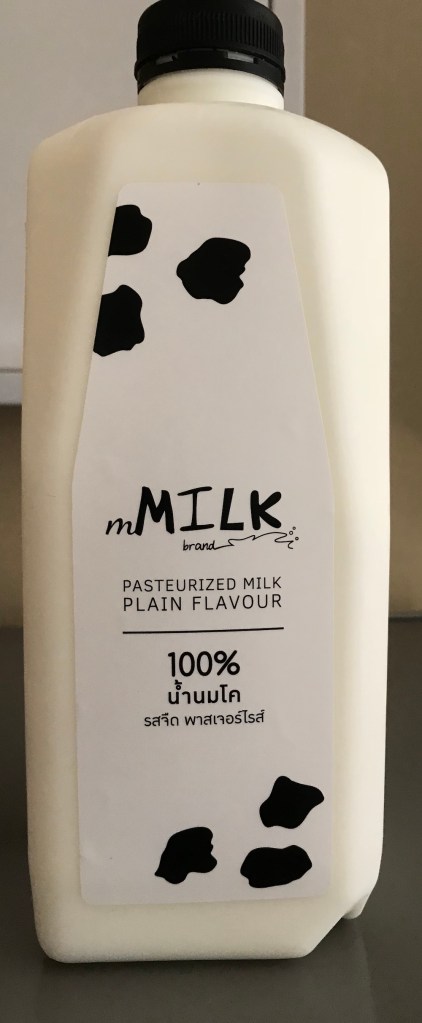
POSTCARD#303: Chiang Mai: I picked up a carton of milk in the supermarket with the label, “Plain Flavor”… looked at it disbelievingly; hmmm, if it is plain, how can it have a flavor? I was wrong of course, according to my Thai niece M (see the M posts) who is now 14. She explained to me that a Thai company makes the milk, and it is ‘plain flavor’, in Thai; รสจืด rod jeud, because there are so many flavors in Thai food, something that is ‘plain’ has its own flavor, doesn’t it? How could it not be like that?

Yes but the milk in that carton is manufactured, created in a laboratory with cow’s milk as a starting point for all kinds of elaborate subtleties in taste. So let’s agree that cow’s milk is the ‘real’ taste, okay? Extensive experimentation and proliferation spin-offs arrive at the so-called ‘plain’ flavor, a laboratory product that mirrors the real taste of milk. I see it this way because in the West (and that includes the whole of the Indian subcontinent), we are part of the Great Cow Culture; consumers of cows’ milk, we are the children of the bovine deity.

From South East Asia to the Far East, it’s a rice culture, so there’s a proliferation of rice products parallel to the milk culture – no real familiarity with milk. I heard from Japanese friends that in a confined space like an elevator, the Western body sometimes gives off a noticeable smell of sour milk. Ah well, I lived in Japan for three years and nobody said anything to me about such odors. Maybe they were being polite. I drink milk, therefore I am (an upright, standing-on-it’s-hind-legs, cow person).

Jiab says what difference does it make, the whole thing is perception anyway, and why do I have to go on and on about something as ordinary as cow’s milk. It gives me pause, as some things in Thailand do, but what does ‘ordinary’ mean? I’m deeply familiar with the taste of cows’ milk, from childhood in the North of Scotland, the place I was born. I remember warm cow’s milk from the body-heat of mama cow at breakfast time on my grandfather’s farm, there in the half light before dawn.

I remember the constant wind, the sharp clear air, and summer sun shining all day and all night (latitude: 57.4778°). I couldn’t now say it was ‘ordinary’ there, a Viking consciousness of the North, proximity to the Arctic circle where morning emerges from the glimmer of light all night, because it never gets dark in the summer time (see ‘Insomnia’ movie 2002 starring Robin Williams and Al Pacino). The school holidays, full of light, all through the summer months… an endless time.

Winter is the other way round, there’s hardly any light at all. Sharp rebound on the opposite wall of the court. Extreme is not the word, when I bade farewell to the windy, blustery North and headed South, it was hard to believe weather conditions could be so … ordinary? What is ordinary? The absence of that vital quality of what a thing essentially ‘is’. At that time, the adventure had been intense, ordinary things were extraordinary – I didn’t know of any other way to see the world. I didn’t see that the polarization was caused by this confusion of thought underneath everything, just circulating around a great chasm of uncertainty.

Never-the-less one perseveres with the needs of the journey and on to locations where the surroundings are extraordinary, and familiar in that sense. I just kept on going, driven by the need to fill the empty space inside me with something – that underlying Buddhist sense of lack (although I didn’t know that ordinary things are, somehow exceptional), and learning how to not want to fill the emptiness with everything and anything.

Then seeing the Truth of strawberry, vanilla, chocolate, and coconut flavor, as well as the Plain Flavor, along with all the others to form an endless proliferation of choices that distract the mind for no purpose other than alerting the innate creaturely hunger.

Thus hovering on the edge of awareness, I fall into the realm of samsara without end, but Awareness picks me up and I’m back in wakefulness again. Mindfulness (of awareness) exists because my attention to remembering it is activated as soon as it’s not there …

A sense of the universe, a sense of the all, the nostalgia which seizes us when confronted by nature, beauty, music – these seem to be an expectation and awareness of a Great Presence. [Pierre Teilhard de Chardin]


Thank you M for writing the Thai for rod jeud (plain flavor)

thank you for five years

POSTCARD#273: Chiang Mai: Woke up this morning and it was my birthday, go gently into that septuagenarian world and remember there’s gravity, mindfulness is a necessity. I’ve been here since Tuesday, wandering around these rooms looking for words… unfamiliar with the aloneness, and all this enclosed empty space. Just ‘me’, mirror reflection of the world out there, in some form or other. Consciously aware of it sometimes, other times not. There’s seeing, hearing, smelling, tasting, touching and cognitive functioning – the all-of-the-above option, an all-inclusive experiencing of awareness receiving itself. What I don’t know is assimilated (we are Borg). Walk to the window; look out (no ‘out-there’ out there separate from what’s in ‘here’). Go back, sit at the desk for a while, look at the laptop monitor, the keyboard… write something, get up and walk around again.

Then I’m off downtown in a tuk-tuk, engine noise and wind in the face blows away all thought. What is the story so far? My niece M reached the age of 13 and now she is an elongated stalk, turns sideways and disappears. Taller than her mom by one inch – but, looks to me like M remains the same height and her mom is shrinking away, squeaky voice nobody pays much attention to. M still calls me Toong-Ting, the foolishness of it insists on dignity. I feel like I should have something wise to say… there’s no self, or there’s only the ‘self’ appearing in the awareness that’s here and has always been here “Pretending you’re not “it” is exactly the same as “it”‘ [Alan Watts]

You could probably say the illusion of self is part of what the whole thing is about… an all-inclusiveness, buy-one-get-one-free acceptance and given over to the care of a Higher Power, Brahman, God. Or whatever it is that carries meaning; the optimum reality, selecting the data that fits the theory; looking for the story that makes it all make sense. Hard to say, for me, it’s not there, unless I focus on it being there… maybe that’s just what it does.

Culture is a link that needs to be updated all the time and if I’m not in that culture, the software isn’t updated. More than thirty years living with other people’s preferences, and only returning to how I choose to live my life when there’s an opportunity. As the years go by, one forgets what some of the original choices were, and those are replaced by some of the more recent familiarities.

And there’s this blog and all my blogging friends and their friends, and I’m really so glad to know you. Thank you for five years of dhammafootsteps.com

‘Wandering through realms of consciousness like a refugee, thought looks for a home. Thought thinks that perhaps by clinging to this or to that, it can find a home. In this way, thought forms attachments with names and forms, with concepts such as “is” and “is not,” “self” and “other,” “me” and “mine,” and with emotions like envy, pride, and desire. It is the mission of thought to form these attachments in hopes of finding a home. Thought wants to own its own home.’ [Thought Is Homeless/The Endless Further/ 2012 July 16]


the look of flowers

POSTCARD #261: New Delhi: looking at Facebook pics of my niece M aged 13, in New Zealand, reminds me of how it was when I was her age; studied many things in school but never learned (or escaped from learning) what lay beneath the overlay of becoming some ‘body’ – a person with a job, an identity and this is ‘me’ how are you?

Intuition told me it wasn’t the whole story. Living a lie, I must have thought. Nobody taught us about the art of living (or maybe I wasn’t listening), somehow missed the bit about being at peace with the sense of I-am-ness, only that jittery feeling of physicality, and living on the edge. Mind searching for motivation in situations that offer comfort, gratification in pleasure, gratification in displeasure too, justified raging and things out of control, everything thrown to the wind.

Stumbling and crashing through the successes and failures of many lives, and coming to India more than thirty years ago – there to be suddenly awakened to The Whole Thing. So much can be said about that, but now here in New Delhi on a Sunday morning, no traffic noise, just blue sky and birdsong. Flowers seen in a passing eyebeam with that look of being looked at.

Then, ‘regret’ arrives from somewhere thousands of miles from here and in a great expanse in time. It appears in the form of a small boy, bowed head, scruffy uniform, string showing at the collar, latch-door key kid. Headmaster in a huge voice says, ‘you have to think about what you’re doing before you do it, okay?’ Small boy nods, says some words of respect, and shuffles out of the room. Headmaster was talking about mindfulness decades before it came to be what it is today – for me, it was something intuitively know but still unlearned.

In a split second I see that moment there and then encapsulated in the here and now of present time. The boy in a state of anxious urgency every day, no real home, slightly unstable and the struggle to get it right without anyone to reassure him that yes, you can use intuitive guesswork even if you have nothing to go on. The built-in reasoning of mind in these circumstances is enough. So I’m the adult here, now playing the part of headmaster, saying, ‘yes kiddo, you’re right, and it’s allright, you can do that, no problem!’

Even now when I see the English word ‘ignorance’ translated from the Pali word ‘avidya’, it brings a slight twinge of anxiety of school days, built-in conditioning and authoritarian adults. Then, reaching out to that kid with the burden of failure, standing before the Headmaster, I can correct the thought enslavement of ignorance, because it’s not that. You need to have the context of stability, look at this state of not knowing, and being as open as you can to it, see that it’s not not-knowing, it’s ‘knowing’. Then it becomes the Pali word ‘vidya’ The seed of knowing planted deep in the ground of what is not known… the metaphor of the lotus rising from the mud.

Looking through M’s photos of her in New Zealand, being who she is, and for me it’s surprising to see it’s as easy as that. Thus stepping into my own timeline to make these corrections so that everything unfolding from there and then to here and now is free of obstructions – gone is the dark fear experienced by the schoolboy and in its place is the light of knowing.

“And the bird called, in response to the unheard music hidden in the shrubbery, and the unseen eyebeam crossed, for the roses had the look of flowers that are looked at.” T. S. Elliot, The Four Quartets


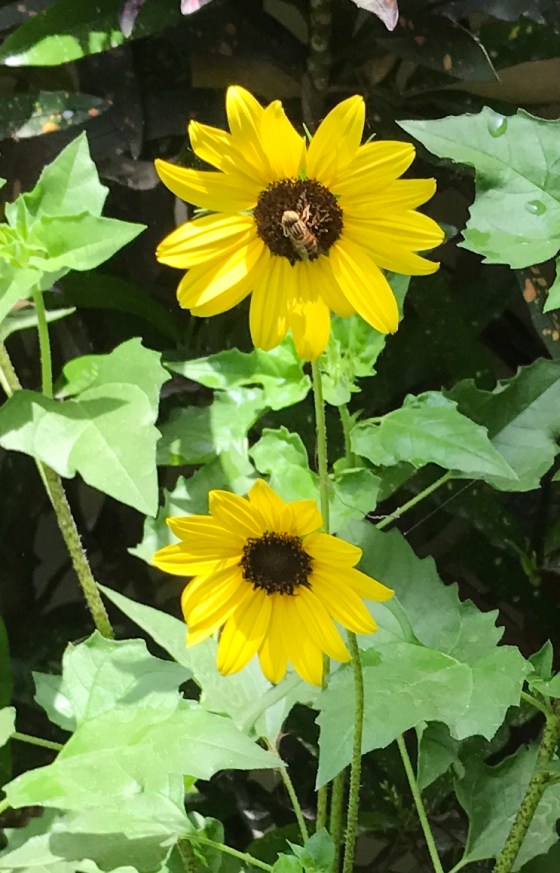
Photo: sunflowers in our garden. I took the photo not expecting to see the bee in the flower head!

there and back again

img_0371POSTCARD #241: Chiang Mai: Went down to Bangkok with Jiab and our niece M, aged 12, for the New Year get-together with family, which was happening in the house where we used to live. Strange familiarity of furniture and objects seeming to jump out and call to me… M’s old toys abandoned here and there – a childhood almost gone. The next day, she went back to Chiang Mai with her mum, Jiab set off for Wat Poo Jom Gom, a remote Buddhist monastery near the border with Laos, and the others who were there all left for their homes in the South.

I stayed on in the Bangkok house for another day, a quiet time reflecting on how it used to be, living there, but mostly revisiting the things we talked about the night before – as we do, thinking about what was said, received, held, seen, nurtured… and noticing then, how the memory is displaced by the next moment of remembering – a kind of a death – and all of it, soon enough, fading away into forgetfulness.

Too much to be retained in conscious thought, and a gentle amnesia takes the place of that which groups all conversations in the mind so they form into one. A fleetingness takes away a thought, complete in itself, a picture seen in an instant just as it’s passing away. I seem to understand what was said better than I did when saying it at the time, busy as we are, putting the thought-forms into words… with a return at the end of each response and remark for the others to link with the place where I’d entered the dialogue.

Without trying to make it into anything, just playing my part in the discussion, waiting to see how it was going and where, while all sorts of things came tumbling out in unrehearsed, articulated speech… slotting into the right places. And something is said which fits in place of the piece that’s missing but we only see how it belongs there, after it’s placed. And the whole thing works so well after that, there’s no memory of it ever having been other than what it was/is, perfectly balanced.

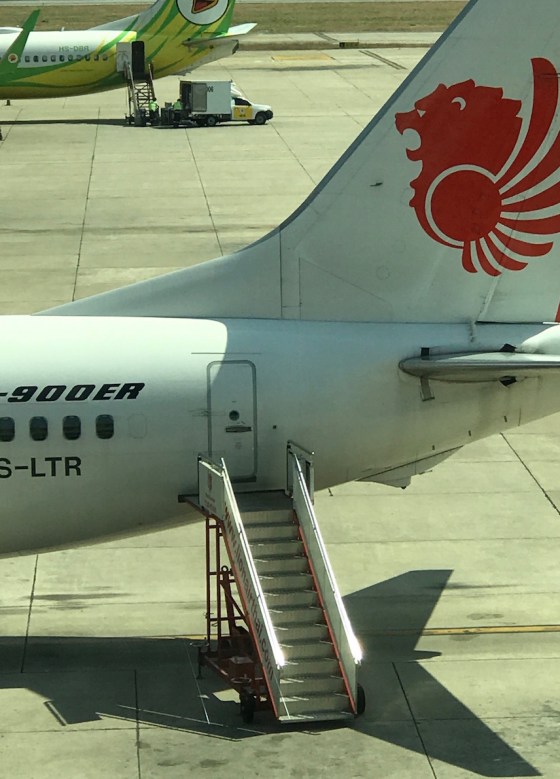
Jiab returned from the Wat and the next day we went to the airport together. She was going South and me, back up North. Her flight to Hat Yai was leaving just before mine to Chiang Mai. Bye-bye at the turning of the ways in the long corridor at Don Mueang Departures. Waiting for boarding, she sent me a text saying to look out the window because her aircraft at gate 46 was opposite mine at 55. Her plane took off and mine must have followed on the single runway. Up and away… taking our separate directions above the clouds. How strange and funny to be up ‘there’ together in the air, she in her plane and me in mine, as if we’d been in two ships sailing in an ocean that reaches all other oceans and seas everywhere in the world.

img_5405

“Because the mind has no beginning or end, you can’t use the mind to put an end to the mind. Because there’s no inside, outside, or in between, if you look for the mind, there’s no place to find it. If there’s no place to find it, then you can’t find it. Therefore, you should realize there is no mind at all. And because there is no mind at all, demon realms can’t affect you. And because you can’t be affected, you subdue all demons.”
Hui-chung (578-650)


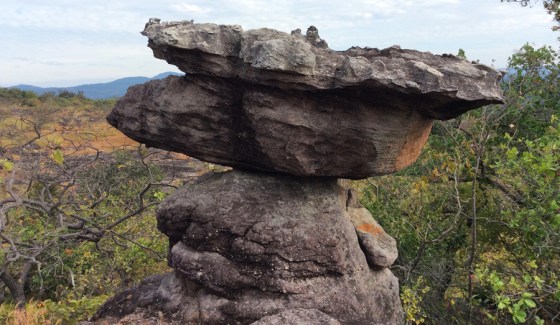
Lower photo: Curious rock formations at Poo Jom Gong, the sea that went away…