Suitable Nimitta and Useless Nimitta

POSTCARD#464: It is very helpful to cultivate nimittas of the sort perceived as a  light. These  “light  nimittas”  are  the  best  vehicle  for  transporting  the  meditator  into  the  jhānas. However, it is just possible, but rarely done, to enter a jhāna by using “feeling nimittas” instead. By this I mean that one sees no light in the mind but instead experiences a feeling of bliss in the mind. It is important to note that the sense of touch (the last of the five senses) has been transcended and such a feeling of bliss is experienced completely by the mind sense. It is a pure mental object again, but perceived as relating closely to a physical feeling of bliss. This is a bona fide nimitta. But it is much more difficult to work with such a nimitta to gain access into jhāna, though it is not impossible. For these reasons, it is recommended to cultivate the light nimitta if one aspires for the jhāna.

There are some visual nimittas that are of no use on the path into jhāna. It is helpful to identify these “useless” nimittas so that one will waste no time with them.

Sometimes whole scenes can appear clearly in the mind. There might be landscapes, buildings, and people, familiar or strange. Such visions might be fascinating to watch, but they are of little use. Moreover, they are meaningless, and one should certainly not mistake them as some revelation of truth. Experience shows that visions arising at this stage are notoriously deceptive and completely untrustworthy. If one likes to waste time, one can linger on them a while. But the recommended thing to do is to remove all interest and go back to the beautiful breath. Such complex nimittas are merely a reflection  of  an  overcomplicated  mind.  The  mind  should  have  been  calmed  into  simplicity  much more effectively before letting go of the breath. When one sustains the attention on the beautiful breath, uninterrupted  for  long  periods  of  time,  then  one  is  training  in  simplicity.  Then  when  the breath disappears, a simple unified nimitta arises, one that is suitable for progress.

A less elaborate nimitta, which is still overcomplicated, can be called the “firework nimitta.” As the name suggests this consists of many bursts of light at the same time, even of different colours. Again, this firework nimitta is a sign that the mind is still too complicated and very unstable. If one wants, one can enjoy the sideshow for a short time, but one should not waste too much time there. One should ignore all the razzle-dazzle, return to the breath, and develop more one-pointedness and calm.

The next type of nimitta can be called the “shy nimitta,” a single pure light that flashes up quickly then disappears. After a few minutes it flashes up again. Each time it lasts only a second or two. Such a nimitta is much more encouraging. Its simplicity shows that the mind is one-pointed. Its power is a sign that pītisukha is strong but its inability to remain after breaking through into consciousness show that the level of calm is not quite enough. Instead, one patiently waits, developing more calm, allowing the mind to become more receptive to the very shy nimitta. As will be explained later, at greater length, this nimitta disappears because the mind overreacts to its arrival, usually with excitement or fear. By establishing a solid calm and having the confidence to not react at all, the shy nimitta returns and stays longer each time. Soon, such a nimitta loses its shyness and, feeling accepted in the mind’s calmness, remains a long time. One should attempt this approach first. But if the nimitta continues being shy and shows no sign of remaining longer, then one should return to the beautiful breath and ignore it. When one has built more tranquillity of mind with the beautiful breath, then one can return to the shy nimitta to see if it will establish itself this time.

Another type of nimitta is the “point nimitta,” a simple and powerful light but ever so small, which persists many seconds. This nimitta can be very useful. It shows that one-pointedness is excellent, calm is sufficient, but pīti-sukha is still a bit lacking. All one needs to do is gently look deeper into the point nimitta, letting mindfulness zero in. Then it appears as if one’s awareness comes closer to this nimitta and its size starts to increase. As it expands a little, one should keep one’s focus on the center, not on the edges or beyond the edges. By maintaining the mind’s focus sharply on the center of the point nimitta, it increases in power and grows in pīti-sukha. Soon the point nimitta unfolds into the best nimitta of all.

The best nimitta, the one most suitable for jhāna, begins by resembling the full moon at midnight in a sky free of clouds. It rises unhurried when the beautiful breath softly disappears. It takes three or four seconds to establish its presence and settle down, remaining still and very beautiful before the mind’s eye. As it remains without effort it grows brighter, more luminous. Soon it appears brighter than the sun at midday, radiating bliss. It becomes by far the most beautiful thing one has ever seen. Its beauty and power will often feel unbearable. One wonders whether one can take so much bliss of such extreme power. But one can. There’s no limit to the bliss one can feel. Then the nimitta explodes, drowning one in even more bliss, or one dives into the center of the radiating ecstasy. If one remains there, it is jhāna.

Continued next week: 1st April 2022

The Nimitta: The Home Stretch into Jhāna

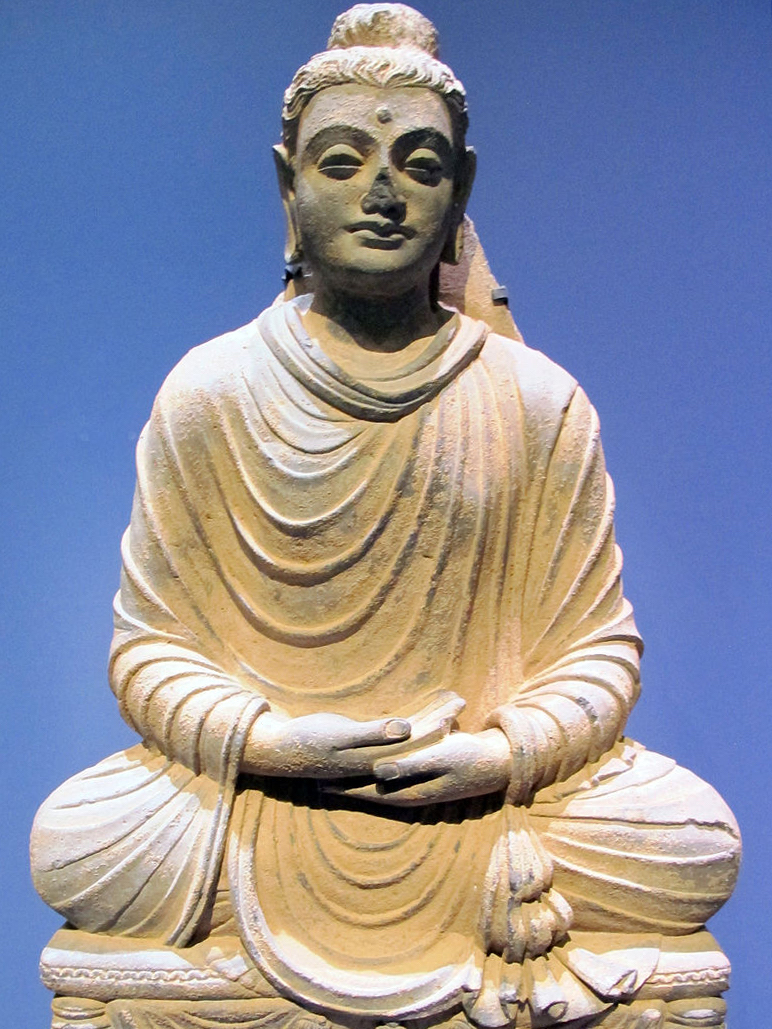
Hong Hien Tu temple. Buddha statue (Credit: BSIP SA / Alamy Stock Photo)

Editor’s note: Readers will have noticed the text for the post titled: The Home Stretch into Jhāna dated March 18 2022 is a repeat of the previous post dated: March 11 2022. My apologies for this error. The text below is the intended post for March 18 and continues in sequence from March 11 2022.

When the nimitta does not appear

POSTCARD#463: For some, when the breath disappears, the nimitta doesn’t happen. No lights appear in their mind. Instead,  they  are  left  with  a  deep  feeling  of  peace,  of  emptiness,  of  nothing.  This  can  be  a  very beneficial  state  and  should  not  be  belittled,  but  it  is  not  jhāna.  Moreover,  it  lacks  the  power  to proceed any further. It is a cul-de-sac, and a refined one at that, but it is incapable of being developed further. There are a number of methods to bypass this state, generate the causes for nimitta, and go deeper into the jhānas.


The  state  above  arises  because  one  did  not  cultivate  sufficient  pītisukha  along  with  the  breath. There  was  not  enough  delight  when  the  breath  disappeared,  so  mindfulness  had  no  clear  mental object of beauty on which to settle. Understanding this, one needs to put more value on developing delight when one is watching the breath, and cultivating that delight until it becomes a strong sense of beauty. For example, you may regard the breath as an old and well-loved friend who brings you joy, and that joy lets you look on the breath as beautiful. Whatever skillful means one employs, by paying careful attention to the beauty alongside the breath, the beauty will blossom. What one pays attention to usually grows.


In the previous chapter, one was cautioned not to be afraid to delight in meditation. I regard this exhortation as so important that I repeat it here almost word for word: Do not be afraid to delight in meditation. Too many meditators dismiss happiness, thinking it unimportant or believing that they don’t  deserve  such  delight.  Happiness  in  meditation  is  important,  and  you  deserve  to  bliss  out! Blissing  out  on  the  meditation  object  is  an  essential  part  of  the  path.  So  when  delight  does  arise alongside the breath, you should cherish it and guard it accordingly.


Another reason for the nimitta not arising is that one hasn’t invested enough energy into the knower. As explained in the previous chapter, delight is generated by letting energy to flow into the knower. Usually, most of our mental energy gets lost in the doing, that is, in planning, remembering, controlling and thinking. If one would only redirect one’s energy away from the doer and give it all to the knower, to attentiveness, then one’s mind would become brightened and energized with delight. When there is lots of delight, strong pītisukha, then after the breath disappears the nimitta appears. So maybe the reason why a nimitta doesn’t appear is that one has devoted too much energy to controlling and not enough to knowing.


However, if the breath has disappeared but still no nimitta arises, then one must be careful not to fall into discontent. Discontent will wither any pītisukha already there and urge the mind into restlessness. Thus discontent will make the arising of a nimitta even more unlikely. So one must be patient and seek the remedy in becoming aware of contentment and letting it consolidate. Just through paying attention to contentment, it usually deepens. As contentment grows stronger, delight will arise. As delight grows in power, the nimitta  appears.


Another useful method to arouse the nimitta when the breath disappears, is to focus more sharply in the resent moment. Present-moment awareness is the very first stage of this method of meditation. It should have been established at the beginning, but in practice, as the meditation progresses and one pays attention to other things, the present-moment awareness can become a little sloppy. It may be that one’s mindfulness has become smeared around the present moment instead of being precisely focused. By noticing this as a problem, it is very easy to adjust the focus of mindfulness to be knife-edged in the centre of now. Like adjusting the lens of a telescope, the slightly blurred image becomes very sharp. When the attention is sharply focused in the present moment it experiences more power. Pītisukha comes with the sharpening of focus and the nimitta soon follows as well.
Continued next week: 25th March 2022

The Jhānas II: Bliss upon Bliss

The Nimitta: The Home Stretch into Jhāna

POSTCARD#462: When the breath disappears and delight fills the mind, the nimitta usually appears. I briefly discussed nimittas and their characteristics in chapter 2; here I discuss them in greater depth. Nimitta, in this context, refers to beautiful “lights” that appear in the mind. I would point out, though, that the nimittas are not visual objects, in that they are not seen through the sense of sight. At this stage of the meditation, the sense of sight is not operating. The nimittas are pure mental objects, known by the mind sense. However, they are commonly perceived as lights.

What is happening here is that perception struggles to interpret such a pure mental phenomenon. Perception is that function of mind that interprets experience in terms we can understand. Perception relies  crucially  on  comparison,  interpreting  new  experience  as  similar  to  previous  experience. However, pure mental phenomena are so rarely visited that perception has great difficulty finding anything  at  all  comparable  to  these  new  experiences.  This  is  why  nimittas  appear  strange,  like nothing  one  has  ever  experienced  before.  But  the  phenomena  in  the  catalogue  of  one’s  past experiences that come closest to these nimittas are simple visual lights, such as a car headlight, a flashlight in the dark, or a full moon in the night sky. Perception adopts this close but imperfect comparison and interprets the nimittas as lights.

It was for me a fascinating discovery to realize that everyone who experiences these nimittas experiences exactly the same thing! It is only that meditators interpret the experience in many different ways. Some see the nimitta as a pure white light, others see it as golden, some as deep blue. Some see it as a circle others as an oblong, some see it as sharp edged, others as fuzzy edged. There is indeed no end to the features of nimittas that meditators describe. The important thing to know is that colour, shape, and so on are irrelevant. Perception colours the nimitta and gives it shape just so one can make sense of it.

When the Nimitta Comes Too Early

Sometimes a “light” can appear in the mind at a very early stage of the meditation. For all except accomplished meditators, however, such intruders are highly unstable. If one focuses one’s attention on them, one will not get anywhere. It is not the right time for nimitta. It is best to regard them as distractions and go back to the main task of the early stage out of which they came.

There is more uncertainty what to do when a nimitta appears at the stage of the beautiful breath when the breath has yet to be calmed close to disappearance. Again, the nimitta appears intrusive. It interferes with the main task of sustaining one’s awareness on the beautiful breath. If one deliberately turns  from  the  breath  to  the  nimitta,  it  usually  doesn’t  remain  long.  The  mind  is  not  sufficiently refined to hold a subtle nimitta. One needs additional practice on the breath. So the best thing to do is to  ignore  the  nimitta  and  train  all  one’s  attention  on  the  beautiful  breath.  Often,  after  one  has followed this advice, the nimitta comes back, stronger and brighter. Ignore it again. When it returns a third time, even more powerful and radiant, go back to the breath. Practicing this way, eventually a very  powerful  and  brilliant  nimitta  will  break  into  your  awareness.  You  can  go  with  that  one. Actually, it is almost impossible to ignore. That one usually takes you into jhāna.

The above can be compared to a visitor knocking on your door. It could be just a salesman so you ignore his knocking and go on with your own business. Often that is the end of the matter. Sometimes, though, the visitor knocks again, louder and longer. You ignore him a second time. Then, after a few moments’ silence, he bangs even louder and more vigorously. This persistence suggests that the visitor must be a good friend of yours, so you open the door, let him in, and have a great time together.

Another method of dealing with an early nimitta that arises at the stage of the beautiful breath is to incorporate the nimitta into the middle of the breath. One trains to visualize the situation as similar to a jewel being held in the centre of lotus petals. The shimmering jewel is the nimitta, the lotus petals represent the beautiful breath. If the mind isn’t quite ready to stay with the nimitta, it still has the breath to anchor it. Sometimes the mind is so unprepared that the breath appears to close in on the nimitta, and as a result the nimitta disappears leaving only the beautiful breath. This step backwards does not disturb the meditation. At other times, the mind is well prepared for the nimitta and the nimitta is strengthened and expands, pushing out the breath, which disappears beyond the edges of one’s awareness, leaving only the nimitta. This method is skillful because it doesn’t involve moving the mind from one thing to another – a coarse movement that disturbs the meditation significantly. Instead, one just passively observes the transition from the beautiful breath to the nimitta, and maybe back again, allowing the process to develop or recede according to nature, not according to one’s desire.

Although the following advice is for accomplished meditators only, by which I mean those with plentiful experience of jhāna, it is included here for the sake of completeness. When one is skilful in entering into jhāna and one has experienced a jhāna recently, the mind is so still and powerful, even before one begins to meditate, that one may skip many stages. So much so that one may arouse the nimitta almost immediately after starting. The mind being so used to nimittas and so favorably disposed towards them, literally leaps onto the nimitta and the nimitta stays. Soon jhāna is reached. For such accomplished meditators, the earlier the nimitta arises, the better.

Continued next week 18th March 2022

The Jhanās I Bliss

Editor’s note: in the original, pages 127-133 (print book copy) the author looks at the Jhanās from a historical and theoretical point of view. That section is not included here, if anyone would like to have it, please let me know [dhammafootsteps at gmail dot com] – let me have your email address and I will send the missing section. Now the author continues with the Jhanās in terms of their practice.


Pīti-sukha—Joy and Happiness

POSTCARD#461: In Pali the compound word pīti-sukha means the combination of joy  with  happiness.  One  can  use  those  words  for  many  kinds  of experiences, even worldly ones. But in meditation, pīti-sukha refers only to that joy and happiness that is generated through letting go.

Just as various types of fire can be distinguished by their fuel, such as a wood fire, oil fire, or bushfire, so can the various types of happiness be differentiated by their cause. The joy and happiness that arises with the beautiful breath is fueled by the letting go of the burdens of past and future, internal commentary, and diversity of consciousness. Because it is a delight born of letting go, it cannot produce attachment. One cannot be attached and let go at the same time. The delight that arises with the beautiful breath is, in fact, a clear sign that some detachment has taken place.

Pīti- sukha may arise from sensual excitement, from personal achievement, or from letting go. These three types of happiness differ in their nature. The happiness generated by sensual excitement is hot and stimulating but also agitated and therefore tiring. Repetition makes it fade. The happiness caused by personal achievement is warm and fulfilling but also fades quickly, leaving a vacant hole. But the happiness born of letting go is cool and long-lasting. It is associated with the sense of real freedom.

Moreover, the happiness generated by sensual excitement produces ever-stronger desires, making the happiness unstable and tyrannical. The happiness caused by personal achievement produces more investment in being a control freak and encourages the illusion of personal power. The controller then kills any happiness. The happiness born of letting go inspires more letting go and less interference. Because it encourages one to leave things alone, it is stable and effortless. It is the happiness most independent of causes and closest to the unconditioned, the uncaused.

It is important for success in meditation to recognize the different types of happiness. If the happiness that arises with awareness of the breath is of the sensual excitement – for example, waves of physical pleasure coursing through your body – it will soon disappear when effort is relaxed, leaving you heavy and tired. If the happiness is associated with the sense of achievement – “Wow! At last I’m getting somewhere in my meditation” – it will often disintegrate, destroyed by the arousal of the controller, ruined by the interfering ego. But if the happiness that arises from the beautiful breath is that born of letting go, then you feel that you don’t need you say anything or do anything. It becomes the happiness whose brother is freedom and whose sister is peace. It will grow all by itself in magnificent intensity, blossoming like a flower in the garden of jhāna.

In addition to the beautiful breath, there are many other objects of meditation: loving-kindness (mettā), parts of the body (kāyagatāsati), simple visualizations (kasina), and others. However, in all meditation that develops into jhāna there must come a stage where the pīti-sukha born of letting go arises. For example, loving-kindness meditation opens into a wonderful, gorgeous, unconditioned love for the whole cosmos filling the meditator with delicious joy. Pīti-sukha born of letting go has arisen and one is at the stage of “beautiful mettā.” Some meditators focus on parts of the human body, often a skull. As the meditation deepens as mindfulness rests on the inner image of a skull, an amazing process unfolds. The image of the skull in one’s mind starts to whiten, then deepen in colour, until it appears to glow with intense luminosity, as the “beautiful skull.” Again, pīti-sukha born of letting go has appeared, filling the whole experience with joy and happiness. Even some monks who practice asubha (loathsomeness) meditation, on a decaying corpse, for instance, can experience the initially repugnant cadaver suddenly changing into one of the most beautiful images of all. Letting go has aroused so much happiness that it overwhelms the natural disgust and floods the image with pīti-sukha. One has realized the stage of the ‘beautiful corpse.”

In meditation on the breath, the Lord Buddha taught the arousing of pīti-sukha along with the experience of one’s breath as the fifth and sixth steps of the 16-step ānāpānasati method. I dealt with this crucial stage of meditation at length above.

When pīti-sukha doesn’t arise, it must be because there is not enough contentment, that is, one is still trying too hard. One should reflect on the first two of the five hindrances. The first hindrance, sensory desire, draws the attention toward the object of desire and thus away from the breath. The second hindrance, ill will, finds fault with the experience of breath, and the dissatisfaction repels the attention from the breath. Contentment is the “middle way ”between desire and ill will. It keeps one’s  mindfulness with the breath long enough for pīti-sukha to arise.

The Way Into Stillness

Stillness means lack of movement. Since will causes the mind to move, to experience stillness one must remove all will, all doing, all control. If you grasp a leaf on a tree and try your hardest to hold it still, no matter how hard you try, you will never succeed. There will always be some vibration caused by slight tremors in your muscles. However if you don’t touch the leaf and just protect it from the breeze, then the leaf comes to a natural state of stillness. In exactly the same way, you cannot achieve stillness by holding the mind in the grip of the will. But if you remove the cause of movement in the mind, the will, the mind soon becomes still. Thus one cannot will the mind to be still. The way into stillness is through pīti-sukha born of letting go. Once the delight that comes with the beautiful breath appears, then the will becomes redundant. It becomes unnecessary since mindfulness stays with the breath all by itself, effortlessly. Mindfulness enjoys being with the beautiful breath, and so does not need to be forced.

When stillness appears it enriches the pīti-sukha. The deepening of pīti-sukha, in turn, creates even less  opportunity  for  effort,  and  so  stillness  grows  stronger.  A  self-reinforcing  feedback  process ensues. Stillness deepens pīti-sukha, and pīti-sukha increases the stillness. This process continues, when not interrupted, all the way into jhāna, where stillness is profound and pīti-sukha ecstatic.

In this chapter I have explored some of the issues often raised about the jhānas. The next chapter, on the nimitta, takes us farther down the road to the deep absorptions.

Continued next week: 11th March 2022

Mind Object Contemplation

POSTCARD#460: Objects of the mind are the last of the four focuses of mindfulness. The mind objects listed in the Satipaṭṭhāna Sutta are the five hindrances, the five aggregates, the six senses, the seven enlightenment factors, and the four noble truths. I understand this list to represent examples of mind objects, and therefore other mind objects not mentioned in the Satipaṭṭhāna Sutta, such as thought and emotions, may also be included.

Contemplating the Five Hindrances

As I’ve explained regarding contemplation of feeling (vedanā), the five hindrances must be abandoned before you can effectively contemplate anything. But how can you contemplate the five hindrances after you have abandoned them? As I stated above mindfulness can take as its object an experience that has already passed. Mindfulness includes memory. So superpower mindfulness can take up, for example, a previous example of sloth and torpor and hold that past experience still in its strong light long enough to see into its true nature. What you apprehend with superpower mindfulness is that these five hindrances are mere instances of images on the screen, that they are not yours or anything to do with you, as the following simile demonstrates.

An old school friend visited Jamaica many years ago. He went to see a movie in a drive-in theatre in a remote town well known for its violence. He was surprised to see that the screen was a two-foot thick reinforced concrete wall. It must have cost a fortune. People of that town, it turns out, were very fond of Westerns. However, when the story came to the inevitable gunfight, many members of the audience took out their own guns and joined in the action! If they didn’t like the sheriff, they shot at his image on the screen, or they blasted away at the Indians, or whomever else upset them. The owner of the theatre could not stop them from joining in the gunfights, and he had replaced so many bullet-riddled canvas screens that he built this indestructible concrete screen. Then his audience could join in the gunfights without ruin.

If, like these moviegoers, you identify images on the screen as real, you will want to shoot them. With mindfulness, however, you will see them as having nothing to do with you. When you see the hindrances merely as images on the screen of consciousness, you will not bother you ever again. You will be free.

Contemplating thought

Thought, the inner conversation, is an object of the mind that can generate immense suffering. It can manifest as restlessness, remorse, doubt, desire or ill will. As such, remorse is at the heart of the five hindrances. Persistent pessimistic thoughts lead to depression, even suicide. Obsessive fearful thoughts lead to paranoia. It should be obvious that there are great benefits to be won through contemplating thought according to this fourth satipaṭṭhāna.

Again, only superpower mindfulness can see through the con game that is thought. With ordinary mindfulness you tend to believe in the thinking, get caught up in it, even worship it as more truthful than reality. A hungry man goes to dine at an expensive restaurant and is handed the menu. He eats the menu, pays, and leaves. He is still hungry. The menu is not the food any more than thoughts are reality.

Superpower mindfulness sees that thought, at best, is one step removed from reality, and at worst it is completely removed. Ill will bends thought into anger, sensory desire inflates thoughts into lust, and restlessness twists thoughts into frustration. When seen clearly, thoughts can’t be trusted. Not even this one!

When satipaṭṭhāna sees thinking for what it truly is, a makeshift approximation,  then  we  experience  dispassion  with  regard  to  our  thinking.  The  sign  of  such dispassion and wisdom is that you can let go of thoughts at any time. The proof of such insight is your ability to be silent. In the suttas, a term for an enlightened one is santamuni, “silent sage.”

Contemplating Will

Another important mind object that I wish to discuss here is “will” (cetanā), which comes under the contemplation of the five aggregates (khandha) in this fourth satipaṭṭhāna. Will is “that which does” or the doer. As I mentioned above the will is one of the two last resorts of the illusion of self, along with the knower (citta). Contemplating the will, the doer, and seeing it as anattā is therefore crucial to the experience of enlightenment.

Years ago I was an active member of the Psychic Research Society at Cambridge University. Every year we would hire a professional hypnotist to demonstrate his craft, often to the great amusement of us students. Once the hypnotist put a receptive volunteer student into a deep state of hypnosis. In front of all the students the hypnotists told him that later in the evening when the hypnotist touch his left ear the student was to stand up and sing the British national anthem. And later after coming out from the hypnotic trance, when the hypnotist touched his left ear the poor student arose and sang “God Save the Queen”! He sang alone accompanied by great laughter. The most fascinating part of this demonstration was that, when questioned, the student was of the firm opinion that he had freely decided to sing the national anthem and gave some convoluted reason for it. It showed that even brainwashing appears to the brainwashed as free will.

You are deluded to think you are reading this of your own free will. My friend, you had no choice but to read this! Will is not the action of a being, it is the end product of a process,

When superpower mindfulness takes a recent experience of jhāna as its object it sees that will, the “doer” has completely ceased within that state. It has vanished for long periods of time. Contemplating a fully mindful state that is free of will allows you to see that “will”, “choice”, and the “doer” are not me or mine, not a self. Whatever you do is just a result of complex programming.

When I talk like this people get frightened. Such fear is a symptom that something you are so attached to, your will, is about to be taken away. We in the West are so attached to the delusion of free will, in fact, that we enshrine the illusion in our constitutions and declaration of human rights. You may raise objection that if there is no free will, why bother to generate the great effort needed for enlightenment? The answer should be obvious. You put forth great effort because you have no choice. It is only superpower mindfulness that has the strength to penetrate the barrier of fear erected by attachment and observe the process of will as it truly is. Like the thousand-petaled lotus, when the layer of petals that represent the “the doer” fully opens up, you see the unexpected, that there is no one in here doing all this. The will is anattā. Craving begins to unravel at this point.

Contemplating Emotions

The last of the mind objects that I want to discuss here is emotion. Emotion is that texture of mind categorized as depressed or inspired, guilty or forgiving, worried or serene, angry or compassionate, and so on. Emotions toss us around, and this often hurts. Emotions are mind objects, things that appear on the screen of consciousness, and are part of this fourth satipaṭṭhāna.

When I was already a young Buddhist I went to see the movie West Side Story. There is a heartbreaking scene at the end when the hero, Tony, runs to his lover, Maria, under a New York City streetlight, is shot, and dies in Maria’s arms. As their doomed relationship is tragically rent, they sing, “There’s a place for us. Somewhere a place for us.” Many in the audience began sobbing uncontrollably. Why did they cry? It was only a movie after all, just the play of light on a cloth screen.

When you are deluded by emotions you take them to be important, real, “mine”. You get so sucked in that you seek even unpleasant emotions like sadness repeatedly. Why is it that so many people go to a movie with a box of tissues knowing, from the reviews that it is a tearjerker? It is because they are attached to emotions, delight in them and identify with them. They don’t want to be free.

Superpower mindfulness focused on the emotions uncovers the reality of whether you want to be free or not. It pushes aside your preferences. You recognize that the emotions are seductive sirens beckoning you to their treacherous rocks. But in their essence they are but mind objects, causally conditioned like weather fronts passing overhead, having nothing to do with you. When you see the truth, you are detached from emotions and free from their tyranny.

Whatever is an object of the mind, whatever appears on the screen of consciousness – whether it be the five hindrances, thought, will, or emotions – can be put under the unremitting and penetrating beam of superpower mindfulness. There you will realise the completely unexpected. You will see what the Buddha saw under the Bodhi tree. The realization will dawn that all these events on the screen of consciousness, are just the play of nature not the play of God, not the play of a soul. There is nothing here. There is “nobody at home”. These mind objects are empty. They are no-self (anattā). The illusion has been seen through. You are now free, unaffected by any mind object.

The Buddha promised that anyone who practices the four satipaṭṭhānas diligently will reach the  state  of  either  the  non-returner  or  full enlightenment  in  seven  days.  Perhaps  you  now understand why many meditators have  been  disappointed  that  after  many  more  than  seven days  they’re  still  not  enlightened.  As  I  said  earlier,  the  reason  is  that  they  have  not  been practicing   satipaṭṭhāna   following   the   Buddha’s   instructions.   Try   it   and   see.   Develop superpower mindfulness generated by jhāna so you know for yourself how impotent ordinary mindfulness is. Put the citta (the knower) or cetanā (the will) under the spotlight of superpower mindfulness,  courageously  going  beyond  the  comfort  of  your  views.  Await  the  unexpected. Don’t second-guess truth. Wait with patience until the thousandth petal of the lotus fully opens to  reveal  the  heart.  That  will  be  the  end  of  delusion,  the  end  of  saṃsāra,  and  the  end  of satipaṭṭhāna.

Image: Buddha statue under construction at Khai Nguyen Pagoda, Vietnam, 2019, Photo credit MANAN VATSYAYANA/AFP/Getty Images)

Continued next week 4 March 2022 with “The Jhānas I: Bliss”

Mind Contemplation

POSTCARD#459: Bangkok: Editor’s note, continuing with our text “Mindfulness, Bliss, and Beyond” by Ajahn Brahm. This section is the study of the Four Foundations Of Mindfulness, which Ajahn refers to as the Four Focuses of Mindfulness.

This  third  focus  of  mindfulness,  observing  the  citta  or  mind  consciousness,  is  one  of  the  most difficult  to  practice.  Most  people’s  meditation  is  not  developed  sufficiently  to  even  see  mind consciousness.  Mind  consciousness  is  like  an  emperor  covered  from  head  to  toe  in  five  thick garments: his boots go up to his knees; his trousers go from his waist to his calves; a tunic stretches from his neck to his thighs and along his arms to his wrists; gloves cover his hands and forearms; and a helmet covers all of his head. Being so completely covered, the emperor cannot be seen. In the same way, mind consciousness is so completely clothed by the five senses of sight, hearing, smell, taste, and touch that you cannot see it underneath.

To see the emperor, you have to remove his clothes. In the same way, to see the citta, you have to remove the five external senses. It is the task of the jhāna to remove the five senses and reveal the citta. Thus you cannot even start to practice this third focus of mindfulness until you have experienced a jhāna. For how can you contemplate citta when you haven’t really experienced it? It would be like contemplating the emperor when all you can see are his (or her?) clothes.

Investigating the nature of citta is also like investigating the nature of gold. Before chemists even begin to test the material, they must ensure that the sample of gold is purified of all other elements and that what they have is 100 percent pure gold. Similarly before you begin to investigate the nature of citta you have to ensure that this mind consciousness if purified from all other types of consciousness, i.e., that the five external sense-consciousnesses have been abandoned. Again, this can only be done after emerging from a jhāna. Then superpower mindfulness takes the jhāna experience just past, a sustained experience of the citta set apart from the five sense, as its object of investigation. Only in this way will the truth be seen, that the citta is anatta, that mind consciousness is subject to arising and passing, that is it “me’, or “mine”, nor a self, that it is neither God nor cosmic-consciousness – that is just citta, a flame burning because of fuel.

Where the Citta Goes After Enlightenment

A flame depends on fuel. The word for “fuel” in Pali is upādāna. A candle flame depends on heat, wax, and a wick. If any one of those three “fuels” disappears, then the flame ceases. If a wind takes away the heat, the flame ceases. And if the wax is used up, the flame ceases. Once the flame ceases, it doesn’t go anywhere. There is no heaven where all good flames go to flicker for eternity. Nor does the flame merge with a comic transcendent Flame. It just ceases, that’s all. In Pali the word for a flame “going out” is nibbāna.

The citta too depends on fuel. The suttas say that citta depends on nama-rupa (body and objects of mind) and when nāma-rūpa ceases, the citta completely ceases (SN 47.42). It goes out. It “nibbānas”. It doesn’t go anywhere, it just cease to exist. Interestingly, the two famous bhikkhunīs Kisāgotamī and Pațācārā became fully enlightened when they saw the flame of a lamp go out (Dhp 275; Thig116).

The Nature of Citta

When you sustain superpower mindfulness on the pure citta, the nature of all types of consciousness reveals itself. You see consciousness not as a smoothly flowing process, but as a series of discrete, isolated events. Consciousness may be compared to a stretch of sand on a beach. Superficially, the sand looks continuous over several hundred metres. But after you investigate it closely, you discover it is made up of discrete, isolated particles of silicate. There are empty spaces between each particle of sand, with no essential sandiness flowing in the gap between any two particles. In the same way, that which we take to be the flow of consciousness is clearly seen to be a series of discrete events with nothing flowing in between.

Another analogy is the fruit salad analogy. Suppose on a plate there is an apple. You clearly see this apple completely disappear and in its place appears a coconut. Then the coconut vanishes and in its place appears another apple. Then the second apple vanishes and another coconut is there. That vanishes and a banana appears, only to vanish when another coconut manifests on the plate, then another banana, coconut, apple, coconut mango, coconut, lemon, coconut and so on. As soon as one fruit vanishes then a moment later a completely new fruit appears. They are all fruits but completely different varieties, with no two fruits the same. Moreover, no connecting fruit-essence flows from one fruit to the next. In this analogy the apple stands for an event in eye-consciousness, the banana for an incident of nose-consciousness, the mango for taste consciousness, the lemon for body consciousness, and the coconut for mind consciousness. Each moment  of consciousness is discrete, with nothing flowing from one moment to the next.

Mind consciousness, the “coconut,” appears after every other species of consciousness and thereby gives the illusion of sameness to every conscious experience. To the average person, there is a quality in seeing that is also found in hearing, smelling, tasting, and touching. We can call that quality “knowing.” However, with superpower mindfulness, you will discern that this knowing is not part of seeing, hearing, and so on, but arises a moment after each type of sense consciousness. Moreover, this knowing has vanished when, for example, eye consciousness is occurring. And eye consciousness has vanished when knowing (mind consciousness) is occurring. In the simile of the fruit salad, there can’t be an apple and a coconut on the plate at the same time.

That Which Knows Is Not Self

Contemplating consciousness in this way—seeing it as a series of discrete, isolated events with no thing  continuing  from  one  moment  to  the  next—undermines  the  illusion  that  there  is  a  knower, constantly present, which is always there to receive the experience of the world. You are unravelling the last refuge of the illusion of a self. Previously, it may have seemed so obvious to you that “I am the one who knows.” But what seems obvious is often wrong. Now you see it as just a “knowing,” as mind  consciousness,  like  the  coconut  that  is  sometimes  there  and  sometimes  not.  Citta  is  just  a natural phenomenon, subject to ceasing. It cannot be me, mine, or a self. That which knows, citta, is finally understood as anattā.

Satipaṭṭhāna, as noted above, is practiced for the purpose of realizing anattā—no-self. The two last resorts of the illusion of a self or soul are the knower and the doer. If you identify with anything as the essential “you,” it will be one or both of these. You assume that you are that which does or that which  knows.  These  two  deep-seated,  long-held  delusions  are  what  stand  between  you  and enlightenment.  See  through  these  illusions  once,  and  you  are  a  stream  winner.  See  through  these illusions every time, and you are an arahant.

Continued next week 25 February 2022 with “Mind Object contemplation”

Composition of the Body

POSTCARD#458: I remember when I was about eleven years old watching a television program on my parents’ black-and-white set that showed in gory detail major surgical operations common at that time. My parents and my brother had to leave the room, but they let me watch after I argued that the program was educational. I found it fascinating to see the innards of a body.

Many years later as a Buddhist monk I was eager to observe autopsies in Thailand and Australia. What fascinates me now is why some persons are repelled by the very thought of watching an autopsy, and often faint when they attend one. Even though we have all been taught biology at school, most of us are still in denial about the nature of our bodies. Why else would we faint or groan when seeing guts exposed?

We have a huge amount of attachment to this body, a delusion that causes us much suffering. By focusing superpower mindfulness on the composition of your body, you can penetrate the barrier of denial and fear and see the body as it truly is. It is just a body. Bits and pieces strung together and falling apart, neither beautiful nor ugly, neither strong nor weak. It is simply a thing of nature, not something of yours. Can you keep it fit and healthy forever? Can you stop it from dying? So who owns your body? Surely it must be obvious that nature owns your body, not you.

The sign that you have penetrated the truth of the body is the complete lack of fear about your own death. Another test of your insight is your response when a loved relative or close friend dies. If you receive a phone call telling you they have just been killed in a road accident and you reply, “Yes, that’s to be expected,” then you are free of attachment to the body.

The Corpse Meditations

Meditation on a corpse combines the contemplations of what a body is and what a body does. It produces revulsion at the beginning, insight in the middle, and liberation in the end. It’s powerful and effective.

A corpse from a road accident is quickly covered and sent to a funeral home, where it is embalmed and made up with cosmetics. The embalmer’s skill makes Uncle George look like he is happily sleeping rather than stone dead. We do not want to see a corpse as it truly is. We are more content to have the fantasy. Unfortunately, delusion demands a heavy price. The longer we delay understanding death, the more we will have to suffer from it.

When superpower mindfulness is focused on a corpse or on the clear memory of one, the dead body opens up like a thousand-petaled lotus and reveals the truth hidden deep beneath the surface. The corpse is teaching you that this is what your body does—it gets old, falls apart, and dies. This is the destiny of your body and all others. Such insight produces dispassion with regard to this body and disinterest in getting another body. Seeing a corpse disintegrate and return to its natural state proves once again who the real owner is—nature. No longer will you be attached to your body, take delight in your partner’s body, or fear death. And if the insight reaches to the core, then you will never again come to birth in another body.

Feeling Contemplation

The second focus of mindfulness is feeling (vedanā). This term needs explanation because “feeling” is not quite accurate as a translation. In English “feeling” has a wide range of meanings. It can mean both emotional states and physical sensations in the body. The Pāli word vedanā means that quality of every conscious experience—whether through sight, sound, smell, taste, touch, or mind—that is pleasant, unpleasant, or somewhere in between.

In English we use different words to convey pleasantness or unpleasantness in each of the six senses. If we’re relating to a sight, we call vedanā “beautiful,” “ugly,” or “average.” If we are talking about sound, vedanā is “sonorous,” “grating,” or “uninteresting.” If we’re describing bodily sensations, vedanā is “pain,” “pleasure,” or “dullness.” That agreeable quality which is common to beauty, melody, and physical pleasure is called sukha vedanā, or “pleasant feeling.” That disagreeable quality common to ugliness, discordance, and physical pain is called dukkha vedanā, or “unpleasant feeling.” That which is neither agreeable nor disagreeable is called “neutral feeling.”

It is to be remembered that the qualities that we perceive as beautiful, ugly, sonorous, pleasurable, and so on do not reside in the object. Otherwise we would all agree on what was beautiful or pleasurable. The agreeable, disagreeable, and neutral qualities are values that we add to reality through our conditioned mind. Again, vedanā means that quality accompanying every conscious experience that you feel as pleasant, unpleasant, or somewhere in between.

When mindfulness is strong and stable, you can investigate vedanā, present and past, without complicating the matter with desire and aversion. When the mind is weak in samādhi and the five hindrances are present, the mind reacts to unpleasant vedanā with aversion and responds to agreeable vedanā with desire. Such reactions stir the mind and distort the truth, in much the same way that winds stir up waves on a lake and distort the images of fish swimming below the surface. This demonstrates yet again the importance of jhāna experience prior to satipaṭṭhāna in order to suppress the five hindrances, especially desire and ill will, in order to have the capability to view the vedanā with complete dispassion.

The Rise and Fall of Vedanā

When the mind is still and free from both desire and aversion, it sees that sukha vedanā (pleasant feeling) is no more than a pause between two moments of dukkha vedanā (unpleasant feeling). Indeed, you can also discern that the intensity of the pleasure in sukha vedanā is directly proportional to the degree of unpleasantness that went just before, and the intensity of the pain in dukkha vedanā is measured by the amount of happiness that you have just lost.

In a chilling book describing imprisonment and torture as a political prisoner in Argentina during the 1970s, an author relates that his most painful experience was not the beatings or the sessions on “Susan” (the name the guards gave to the electric shock torture machine). The worst moment, after endless months of imprisonment, was when his persecutors handed him a letter from his wife. He had blotted out from his mind all memory of the happy years before prison in order to cope with the terror and hopelessness of the present. That letter brought up many warm memories of his wife and family, and made the darkness and agony of his situation even more unbearable. He cursed his wife for sending that letter and screamed deep inside, louder than he ever had under electric shock. As this story graphically illustrates, the intensity of your pain or discontent is proportional to the degree of the happiness that you recall has now vanished.

Vedanā Does Not Belong to You

Vedanā is thus clearly seen to be conditioned, in the same way that night conditions day and day conditions night. It is merely the dualistic play of nature. Vedanā is beyond your control and beyond anyone’s control. It is understood to be not mine, not me, not a self. Understanding vedanā in this way through superpower mindfulness, as just vedanā and beyond anyone’s control, gives rise to dispassion toward pleasure and pain. You realize with certainty that there can be neither permanent pleasure nor permanent pain. A perfect heavenly world is seen as a sensory impossibility, merely wishful thinking, and an eternal hell is similarly implausible.

Thus the purpose of this second focus of mindfulness is to gain the insight that vedanā is not mine, that pleasure and pain twirl around each other, two inseparable partners on the dance floor of saṃsāra. Craving becomes pointless. And when craving is finally abandoned, there is freedom from pain (and from happiness too).

Continued next week 18 February 2022 with Mind Contemplation

Satipaṭṭhāna and Anattā

POSTCARD#457: Bangkok: [Editor’s note: this excerpt is from ‘The Thousand-Petaled Lotus’, last paragraph, page 109 in the print copy: “… when petal number one thousand opens up, so beautiful and unworldly, then you see the famed jewel in the heart of the lotus. Do you know what that jewel is? – a diamond? a ruby? No it’s emptiness. You see the priceless gem of emptiness in the very heart of the body-mind and this is not what you would ever have expected. That’s how you know it is not just another petal. Emptiness is something of a completely different nature to every other petal, to every other thing. Nothing! To reach this far usually requires superpower mindfulness sustained on its focus for a very long time.

The Purpose of Satipaṭṭhāna

So what is the purpose of satipaṭṭhāna? The purpose is to see anattā, that there is no self, no me, nor anything that belongs to a self. As it says in the texts, “Such mindfulness is established enough to discern that there are just the body, feelings, mind, and objects of mind” and that these are not me, not mine, nor a self (this is how I (the author) translate a phrase in the suttas).

When you keep in mind that the purpose of satipaṭṭhāna is to uncover the delusion of me, mine, or a self, to see anattā or the “emptiness in the heart of the lotus,” then the way of practice becomes clear. In particular you can appreciate why the Buddha taught just four focuses for mindfulness: body, feelings, mind, and mind objects. He taught these four because these are the major areas where life assumes a “me” or a “mine.”

So the satipaṭṭhāna practice sustains superpower mindfulness on each of the four objects in order to unravel the illusion of a self. You have been deluded for too long, identifying with the physical body, regarding your feelings as yours (and therefor subject to your control), assuming the mind (the process of knowing) to be your self and attaching to the objects of mind as matters of concern to you.

Summary of the Preliminaries

1. vineyya loke abhijjhā domanassam – first abandon the five hindrances through the practice of jhāna.

2. satimā – be possessed of superpower mindfulness resulting from jhāna.

3. atāpi – diligently sustain that superpower mindfulness on the focus.

4. sampajāno – keep in mind the purpose of satipaṭṭhāna on each of the four focuses in turn.

Body Contemplation

In the Satipaṭṭhāna Suttas there are fourteen areas for focusing mindfulness involving the body. They are grouped as follows: (1) breath, (2) bodily posture, (3) bodily activity, (4) composition of the body, (5) the body seen as four elements, and (6) the nine corpse contemplations. Here, I will discuss briefly all but the fifth.

Breath

In Indian philosophy, the breath (prāṇa in Sanskrit) is sometimes considered to be the vital essence of a human being. Indeed, the Pāli word for “animal” is the same as the word for “breath,” pāṇa. Similarly, the English word animal is derived from the Latin animalis, meaning “having breath.” Certainly, in ancient times the breath was considered to be such an important part of life that it was thought to be almost identical to a self or soul.

By focusing superpower mindfulness on the breath, it is possible to experience the breath as an empty process, completely subject to conditioning, with no being in here doing the breathing. Moreover, in deep jhāna, we can experience the breath disappearing altogether (in the fourth jhāna) with no danger to life.

During my teacher Ajahn Chah’s long sickness, he would often stop breathing. On one such occasion the new nurse on duty became alarmed. He knew that Ajahn Chah must die one day, but he didn’t want it to happen on his shift! The attendant monks on duty that night reassured him that Ajahn Chah had done the same many times before and that it was just a sign of deep meditation. The nurse was still worried and so took blood samples every few minutes during the hours without breathing to ensure that the blood was still well oxygenated. After all, as long as there is enough oxygen available in the blood there will be no harm to the body. The nurse discovered that even though Ajahn Chah was not breathing for a long time, the oxygen level in the blood remained constant. In jhāna, the metabolism is so slowed down that you are using almost zero energy. You don’t need to breathe.

Why is it that ordinary people gasp when they are excited, or struggle for breath just before they die? Perhaps their attachment to their breath is deeper than they realized. Remember, satipaṭṭhāna uncovers attachments that are completely unexpected. When you experience the cessation of breath, then it is obvious that it is not yours at all. From that insight, attachment to breath unravels.

Bodily Postures and Bodily Activities

There are two ways to understand something: by contemplating what it is made of and by contemplating what it does. Here we are analyzing this body by contemplating what it does. It is an illusion to think that I am walking, standing, lying down, sitting, stretching my arm, and so on. The truth is that there is a body doing this, not an I.

Many high achievers in sports, the arts, or even meditation, describe a state of selflessness called entering the “zone.” When a famous classical Indian dancer I knew was asked how she could perform to such a high standard, she replied that she practices and practices, but when the performance begins, she deliberately forgets everything she has been taught. She “gets herself out of the way” and allows the dance to take over. This is a classic description of entering the zone. When the athlete is in the zone, she can move effortlessly, gracefully, and faultlessly. When the meditator is in the zone, he can watch samādhi deepen beautifully, seamlessly, and wordlessly. You clearly experience all this as mere process, with no being driving the process. It is anattā, no-self.

You observe bodily postures and activities with superpower mindfulness and quickly enter a zone where all bodily postures and activities are seen to be mere cause-driven processes, not self-driven ones. You become less of a control freak concerning this body. You detach and live at ease.

Some teachers mistakenly think that mindfulness must always be focused on activities in the present moment. In fact the Pāli word for mindfulness, sati, also means remembering. Superpower mindfulness can focus on an object many moments old, bore into it without the object fading, and uncover its truth.

For example, in the Satipaṭṭhāna Sutta one is asked to practice mindfulness focused on sleeping. Even arahants are not aware when they’re asleep, so what does this mean? Some translators have attempted to solve this question by changing the meaning of the exercise to mindfulness on falling asleep. However, the Pāli word used in the Satipaṭṭhāna Sutta means “in sleep,” and there is a different phrase for falling asleep, niddaṃ okkamati. The practice of mindfulness focused on sleeping means one uses a previous experience of having been asleep as the focus of superpower mindfulness in the present. It is mindfulness that takes an old experience as its object. This may seem pedantic to you now, but it becomes crucially important, as you will see, when I explain the focus of mindfulness on the citta (mind consciousness).

Continued next week 11th Feb 2022 with Composition of the Body

Review of the Five Hindrances

Image Source: Monk Pillars

POSTCARD#456: Bangkok: The suttas say that one practices satipaṭṭhāna “having temporarily abandoned the five hindrances.” That means that a prerequisite for the practice of satipaṭṭhāna is the abandoning of the five hindrances first! MN 68,6:“not attaining a jhāna, the five hindrances invade one’s mind and remain. Attaining a jhāna, the five hindrances do not invade the mind and remain.”) Anyone who has experienced a jhāna knows that after emerging, one’s mindfulness is so powerful and so easy to sustain. This is the result of the five hindrances being absent.

Editors note: Continuing from last week with our review of the Five Hindrance, please note 1. sensory desire kāmma-cchanda was included there, but for convenience’s sake we have included it here also.

1. sensory desire kāmma-cchanda

 The compound kāmma-cchanda means ‘delight, interest, involvement with the world of the five senses. At the start of your meditation, place the mind beyond the reach of the five senses by returning to present-moment awareness [chapter 1, stage one, print copy, page 7]. Most if not all of our past and future is occupied with the affairs of the five senses. Through achieving present-moment awareness, we cut off most of the kāmma-cchanda. [see also: silent present-moment awareness – stage two, print copy, page 11]

 2. ill will (vyāpāda).

The  usual understanding of this second hindrance is anger toward another person. But it is more likely to be toward yourself or even toward the meditation object.

Ill will towards yourself can manifest as not allowing yourself to bliss out. There are many people who have deep guilt complexes. This is mostly a Western trait because of the way most of us have been brought up. Guilt and punishment are inseparable in our culture and in our minds. Punishment may be denying ourselves some kind of pleasure, happiness or freedom. People in the West just keep on seeking punishment. It’s crazy!

Goodwill Toward Yourself

Give  yourself  a  break, do  some  loving-kindness  meditation [Page 34 Print copy. Key in: Loving Kindness in the WordPress search box]. Say  to yourself, “The door to my heart is open to all of me. I allow myself happiness. I allow myself peace. I have goodwill toward myself, enough goodwill to let myself become peaceful and to bliss out on this meditation.”

3. sloth and torpor (thinā-middhā)

I’m sure we know it all too well through our experience of meditation. We sit in meditation and don’t really know what  we  are  watching,  whether  it’s  the  present  moment,  silence,  the  breath,  or  whatever.  This  is because the mind is dull. It’s as if there are no lights turned on inside. It’s all gray and blurry.

Making Peace with Sloth and Torpor

The  most  profound  and  effective  way  of  overcoming  sloth  and  torpor  is  to  make  peace  with  the dullness and stop fighting it! When I was a young monk in the forest monasteries in Thailand and became sleepy during the 3:15 A.M. sitting, I would struggle like hell to overpower the dullness. I would usually fail. But when I did succeed in overcoming my sleepiness, restlessness would replace it. So I would calm down the restlessness and fall back into sloth and torpor.

The Knower and the Doer

It  took  many  years  to understand what was going on. The knower is the passive half of the mind that simply receives information. The doer is the active half that responds with evaluating, thinking, and controlling. The knower and the doer share the same source of mental energy. Thus, when you are doing a lot, when you have a busy lifestyle and are struggling to get on, the doer consumes most of your mental energy, leaving only a pittance for the knower. When the knower is starved of mental energy you experience dullness.

4. Restlessness and Remorse (udhaccha-kukkccha)

The main component of this hindrance is restlessness of mind. But first let me briefly address the matter of remorse. Remorse is the result of hurtful things that you may have done or said. In other words, it is a result of bad conduct. If any remorse comes up in meditation, instead of dwelling on it, you should forgive yourself. Everyone makes mistakes. The wise are not people who never make mistakes, but those who forgive themselves and learn from their mistakes. Some people have so much remorse that they think they can never become enlightened.

Restlessness

Whether we find joy or not depends on the way we train our perception. It’s within our power to change the way we look at things. We can look at a glass of water and perceive it as very beautiful, or we can think of it as ordinary. In meditation, we can see the breath as dull and routine, or we can see it as very beautiful and unique. If we look upon the breath as something of great value, then we won’t get restless. We won’t go around looking for something else.

That’s what restlessness is, going around looking for something else to do, something else to think about, somewhere else to go—anywhere but here and now. Restlessness is one of the major hindrances, along with sensory desire. Restlessness makes it so hard to sit still for very long.

Contentment  is  the  opposite  of  a  fault finding mind. You should  develop  the  perception  of contentment with whatever you have, wherever you are, as much as you can. Beware of finding fault in your meditation, that  thought  is  the  very  cause  of restlessness. It doesn’t matter how the meditation is going, be absolutely content with it and it will go deeper. If you’re dissatisfied with your progress, then you’re only making it worse. So learn to be content with the present moment. Forget about jhānas, just be content to be here and now, in this moment.

Watch the silence and be content to be silent. If you’re truly content, you don’t need to say anything. Don’t most inner conversations take the form of complaining, attempting to change things, or wanting to do something else? Or escaping into the world of thoughts and ideas? Thinking indicates a lack of contentment. If you’re truly contented, then you’re still and quiet. See if you can deepen your contentment, because it is the antidote for restlessness.

5. doubt (vicikiccā)

Doubt can be toward the teaching, about the teacher, or toward yourself.

Doubt can also be directed toward what you are experiencing now: “What
is this? Is this jhāna? Is this present-moment awareness?” Such doubts are hindrances. They are inappropriate during meditation.

If while meditating the thought “Is this jhāna?” arises, then it cannot be jhāna! Thoughts like that can’t come up within these deep states of stillness. Only afterward, when you review those states, can you look back and say, “Ah, that was a jhāna.” If you get into any difficulty in your meditation stop, and rather than think “Is this a jhāna”, ask yourself, “Which of the hindrances is this?”

[Below are the five hindrances in the usual order in which the Buddha lists them:

1. sensory desire (kāmma-cchanda)

2. ill will (vyāpāda)

3. sloth and torpor (thinā-middhā)

4. restlessness and remorse (udhaccha-kukkccha)

5. doubt (vicikiccā)]

Continued next week 4th February 2022

The Importance of Jhāna for Satipaṭṭhāna

POSTCARD#455: Bangkok: If mindfulness is like a light, meditation brightens that light. When I (the author) was a young monk at Wat Pa Nanachat in Northeast Thailand, I became quite peaceful by doing walking meditation in the hall. I would walk with my gaze on a spot on the concrete floor some two meters ahead. Then I had to stop. I couldn’t believe it, but the dull concrete surface began to open up into a picture of magnificent beauty. The various shades of gray and the texture suddenly appeared as the most beautiful picture I had ever seen. I thought of cutting out that section and sending it to the Tate Gallery in London. It was a work of art. An hour or two later, it was just a boring, ordinary piece of concrete again. What had  happened,  and  this  may  have  happened  to  you,  is  that  I  had  a  short  experience  of  “power mindfulness.” In power mindfulness, the mind is like a megawatt searchlight, enabling you to see so much deeper into what you are gazing at. Ordinary concrete becomes a masterpiece. A blade of grass literally  shimmers  with  the  most  delightful  and  brilliant  shades  of  fluorescent  green.  A  twig metamorphoses into a boundless universe of shape, color, and structure. The petty becomes profound and the humdrum becomes heavenly under the sparkling energy of power mindfulness.

What is happening is that the five hindrances are being abandoned. When they are gone the experience is like seeing through a windshield that has been cleaned of grime and dust, or hearing through ears that at last are unclogged of wax, or reflecting with a mind released from its fog. When you know the difference between power mindfulness and weak mindfulness as a personal experience, not a mere idea, then you will understand the necessity of jhāna prior to satipaṭṭhāna.

Jhāna generates “superpower” mindfulness. If power mindfulness is like a megawatt searchlight, then jhāna-generated superpower mindfulness like a terawatt  sun.

The Thousand-Petaled Lotus simile is used in this way because there are a thousand or so levels of reality to uncover. The practice of meditation takes many hours of sitting, uncovering many deep layers of delusion and wrong  ideas  about  yourself  and  the  world.  When  the  Buddha  taught  that  the  root  cause  of suffering  is  avijjā,  or  delusion,  he  did  not  say  that  it  would  be  easy  to  uncover.  Avijjā  is uncovered, as it were, in layers, like the opening of the lotus petals.

Recall that a lotus closes all of its petals at night. In the morning the first rays of the sun begin to warm the lotus. This is the trigger for the lotus to open its petals. It takes a long time, many minutes for the warmth to build up enough for the first layer of petals to open. Once the outermost petals are opened, the warmth of the sun can shine on the next layer of petals, and after a few moments of uninterrupted light they too open up. This allows the next layer to receive warmth the warmth and soon it opens up in turn. A thousand-petaled lotus requires a very strong sun sustained for a very long time to open every petal and reveal the famed jewel at its heart.

 In satipaṭṭhāna, the thousand-petaled lotus is a simile for this body-mind, that is, “you” – or whatever you like to call that which is sitting somewhere right now reading this page. The sun is a simile for mindfulness. You have to sustain power-mindfulness for a very long time on this body-mind to allow the innermost petals to open up. If the five hindrances are there, no insight happens, just as when there are clouds or mist, the sun cannot warm the lotus.

[Editor’s note: Here the author reviews the five hindrances, “obstacles that you will  meet  in  your  meditation  and  that  you  should  learn  to  overcome.” Key in: The Five Hindrances in the search box in the WordPress app. Then: The Second Hindrance, etc.] These  obstacles  to  deep meditation  are  called  in  the  Pāli  language  nīvarana.  Literally  that  means  “closing  a  door”  or “obstructing  entering  into  something,”  and  this  is  exactly  what  the  hindrances  do.  They  stop  you from entering into the deep absorption states, jhānas. They also obstruct or weaken wisdom and strengthen delusion.

These are the five hindrances in the usual order in which the Buddha lists them:

1. sensory desire (kāmma-cchanda)

2. ill will (vyāpāda)

3. sloth and torpor (thinā-middhā)

4. restlessness and remorse (udhaccha-kukkccha)

5. doubt (vicikiccā)

Basically, these five hindrances stand between you and enlightenment. When you know them, you have a good chance of overcoming them. If you have not achieved the jhānas yet, it means you have not fully understood these five hindrances. If you have gotten into such deep states, then you have overcome the hindrances. It’s as simple as that.

The Five Hindrances

1. sensory desire kāmma-cchanda – the compound kāmma-cchanda means ‘delight, interest, involvement with the world of the five senses. At the start of your meditation, place the mind beyond the reach of the five senses by returning to present-moment awareness [chapter 1, stage one, print copy, page 7]. Most if not all of our past and future is occupied with the affairs of the five senses. Through achieving present-moment awareness we cut off most of the kāmma-cchanda. [see also: silent present-moment awareness – stage two, print copy, page 11]

Continued next week, Friday 28th January 2022, with the review of the five hindrances