
memories and the wind

stonefootCropNew Delhi: Gusty warm winds blow through the trees in the park, rustling the leaves and swishing the branches like the sound of waves breaking on the shore. The pigeons are exhilarated by it, flying over at tremendous speeds past me here sitting on the roof terrace, watching them now swoop up above my head – so actively engaged with the mechanism of flight, it’s as if the movements of their wings and the movement of the air are one and the same thing. A wind like this is energy to the birds; it’s a dance. Flight is an expression of the air displacement itself – flying and the wind – ground level is not the reference point; ‘up’ is not necessarily up and neither is down. I see them caught in rapid flight; a stationary moment in the air, suspended in time and space, then an audible flap of wingtip and change in direction.

This wind buffeting me around, hair whiplash on the forehead and the pages of my notebook suddenly leap and turn over on the spiral binding, fluttering through all my various handwritten notes over the last month. In this way, the wind blows through ‘mind’, stirring memories and things from the past, held for years, and released, they come flooding into present time. Each memory stays as long as it takes to examine, and the fullest extent remembered, like meeting an old friend. Time disappears for how long it takes to tell the story and, towards the end of the memory stream, the space behind is seen shining through, the images become transparent and vanish.

The next memory arrives after a moment, I examine that and it disappears like the others. It goes on like this, a collection of things from long ago and far away. Allowing thoughts to go by, unheld, uncaught – the opposite of catching fish; consciously unhooking fish-thoughts caught in the mind at some earlier time; letting them go free and they swim away. Memory stream moves from one moment to the next and I can’t actually see these moments… is this it? Is this the next moment? Is this it, now? Can’t be measured like that; just the circumstance itself; the situations and occurrences follow one another – not a sequence in time, it’s dependent on the nature of the events, there’s a linking that groups them together like coloured beads strung on a necklace.

Going back to Thailand tomorrow where it’ll be hotter than a locked laundromat dryer. Ah well, better go pack my bag now and… has the next moment arrived yet? The mental images and fragments have reformed themselves in the endless stream of things? Can we say, possibly, yes, this is, actually  the next moment? If so, I must have missed it, everything seems like it’s in the past again…

————————-

[Includes excerpts from: Birds on the Balcony 4]
‘Unhooking fish’ taken from an original idea by TJH
Photo image: dreamstime

how it seems (2)

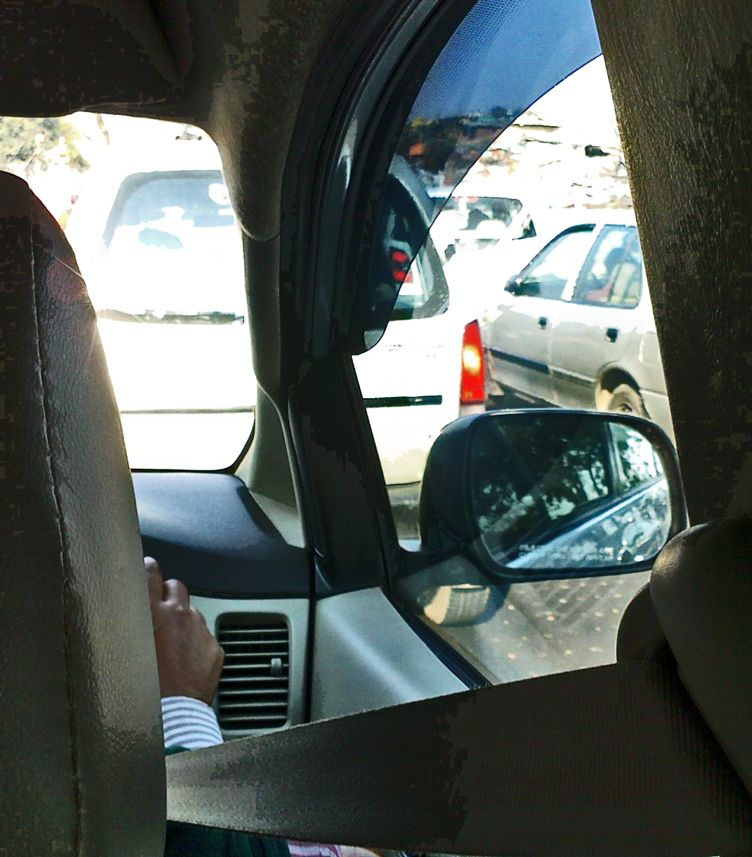
080220131699New Delhi: Travelling across town, Shym is driving. He drives slowly and carefully, surrounded by vehicles honking their horns, cutting in on the nearside; they don’t like it that he’s driving slowly. But Shym remains calm – much ado about nothing – he’s an older man. Out there, fierce displays of male feathers in a ritual display resemble pure outrage, shouts and gestures through wound-down windows. If looks could kill… eyes sparkling with diamonds of malice, giving him ‘the daggers’…. Shym stays solidly as he is. Ah well, people, you can’t always get what you want. Sometimes you’re just stuck with it, you know? It’s how you respond to that unhappy state of ungratified wanting that determines the future for you; cause/effect – if you react with anger, it’ll lead to more anger. But these drivers seem to have gone way past that stage: up-to-their-eyes in the world of anger. Without their anger there’s no purpose in life. They thrive on the struggle; mythical realms of the Titans, and the Asuras, declaring a state of war that lasts an eternity. All this doesn’t phase Shym, at the correct time he slides the steering wheel slowly through his fingertips, indicators flashing clicka-clicka-clicka, telling the world, I am now turning right, and the car sweeps around like a large boat in a wide arc. The surrounding traffic forced to move out of the way. The response is plosive, to say the least. But, well that’s just how it is.

I’m sitting in the back, looking out through tinted windows, incognito, people can’t see me in here – a car wearing dark glasses. Nobody knows I’m inside, the voyeur, the invisible man, looking out at the world all around. I feel like I’m not here. Everything passing by outside the windows of the car; events come and go, arrive and leave. Things occur in random order and drift away without leaving anything behind, video images recorded on security cameras from various places in the 360 degree coverage, showing the car entering the car park, that I’ll never see. I say something to Shym and I hear my own voice in the acoustics of the car; the sound of it causes me to pause for a moment. Everything stops… it takes an effort to get started again. Before it happens, just this silent space. The body feels light and I’m seeing through it.

We turn into the car park. Parking attendant looks like ex-military, sharp uniform, whistle held in his teeth, a piercing blast, signals for us to go left but Shym indicates right. Outrage, more whistle blasts, and he comes up to the car, peers in through the tinted glass, hand cupping the space around his eyes to shade from the sun, I see a large bristly moustache and yellow teeth, the glass fogs up slightly and there are small bits of spittle from his hot breath and shouted words. But Shym gently points with an inclination of the body and politely insists that he’d prefer to go right, not left. More displays of warlike behaviour but I can see this is an act, it’s only how it seems to be. So we are allowed to go right, there’s no problem.

I’m amazed how this system works. All my assumptions are wrong. Attachment due to causes and conditions, that’s all. It’s like everything is a continuation of how things have been; inherited from some former time, or former life, the outcome of actions still hanging around due to tanha, attachments… velcro fastenings, super glue, magnets, welded bridge structures and all the mind stuff about wanting things to be like this or like that or wanting things to be different from what they are. The created ‘self,’ seeing the world according to likes, dislikes and preferences, obscures cessation; doesn’t see that things stay as they are only for as long as it takes. Then it all dissolves in a myriad of changes, disintegrates, crumbles away. We can’t hold on to anything. It all comes to an end.

[Link to: how it seems (1)]

————————-

‘…when attention is drawn to the presence of the Knower, to that which knows and experiences, whatever that is, it immediately becomes obvious that there is something present that is conscious of the body, the mind and the world. As we do this, whatever it is that knows seems suddenly to become more present. It shines. In fact it is simply discovered to have been always present, but apparently eclipsed by our exclusive focus on the known.’ [Rupert Spira, ‘The Transparency of Things’]

space and thoughts

white buddha dreamstime

New Delhi: It’s that Sunday morning feeling again; so silent, the neighbour’s dog feels uneasy about barking too loudly – maybe there’s nothing to bark at. Sadly, it walks to its place on the balcony and looks out… nope, still nothing happening out there. No intruders on the property, no people anywhere to be seen. The world is asleep… the zzz, zzz ZZZZZs, slow breathing of sleep; the no-work-today comfort zone. No need to get up until early afternoon. Sleeping off the excesses of the night before; dinner started at 10pm and the party went on until sometime after two o’clock in the morning.

I didn’t get to sleep until late but it wasn’t because of partying, it was the neighbour (not the ‘dog’ neighbour, the other one). These people decided to have a medium/large social event last night – verging on the mildly-obstreperous. The noise and kerfuffle became kinda abstract to me, drifting in a coma of half-sleep, sounding not like people having a party, more like a party among the animals at the zoo; two or three hippopotamuses (hippopotami?) trying to get comfortable in a room too small for them – getting up and sitting down again and disturbing each other in the process, smashing small breakable things, reversing into corners and making squelchy sounds along the side of the wall with their great weight squidging around awkwardly. Slightly frenzied but not ‘losing it.’ A bit farmyardish too, with yelps and howls, crowing chickens and meowing cats and geese and ducks; somebody with hiccups. On the other side, the dog barking on the balcony – dogs of the mind bark – and the whole thing reached a kind of pandemonium of people talking over each other in a flowing jibberish of words, scraps of music mindlessly playing in two different places, punctuated with the odd crash, squeak and shout. Other percussive noises, the smell of beer floating out into the air and a cloud of cigarette smoke from men standing outside the house, speaking on the phone, lengthy shouted monologues in a language I don’t understand.

It’s really noticeable that the mind grabs at something immediately; velcro fastening, unpleasant rip as it comes apart, so you leave it attached: Yep, I could get really angry about this… There is nothing pleasant about this feeling at all, no reason for it to be there other than simply the desire it has to adhere-to, and ‘be’ something. It’s ‘birth’ in the Buddhist sense. No matter how mindful I am, there’s that driven brooding thing, the scenarios of outrage. I concentrate on letting the mind untangle itself from the problem; just letting it get on with it; it goes away for a while. Then it comes back again and eventually I move through to the front room, wrap myself in a blanket, sit on the cushion, and get ready to remain there until it’s over – watch the breath…

See where the mind leads, where it goes how it reacts to ‘me’ trying to hold it, how it is able to concentrate and how it does that. A bit like getting to know it as if it were a stranger, rather than thinking it’s ‘me’ and I can control it. It really is undeniably noisy next door, it needs attention and I give it what it needs and what’s left over gets focussed on the struggle to be in a state of peace – not a placid thing, mostly it’s like swimming in dangerous waters, but knowing that as long as mindfulness is maintained, there’s no threat at all from the carnivorous species of the deep. Just letting them be there. Anger/distress is a passing mental state, same as everything else, nothing special.

There is the body, the heat, the cold, the hard, the soft, and the thinking mind starts to drift. Let it go where it wants; a sense of travelling behind it, follow it, be curious about where it goes. Disengage from the attachment, just enough to feel safe from the slings and arrows of outrageous fortune, flying around dangerously and ricocheting off the walls and ceiling.

There is Rupert Spira’s example [Link below] about a room filled with people. ‘I’  am the space in the room, the people are my thoughts and images, bodily sensations and world perceptions. All kinds of people in the room, large, small, kind, unkind, intelligent, unintelligent, loud, quiet, friendly, unfriendly, etc…, each doing their own thing. But what they do or say has no effect on ‘I’, the space of the room. The space is there now and it will be there when the people go home. The space, is/was there before the building was constructed and will be present after it is demolished, it’s always present.

Now it’s later, the morning after. Am I the only one awake? So quiet, the electric hiss of the computer seems loud. It may have been on a morning like this, in those historical times, that Siddhartha Gotama, the prince who became the Buddha, woke up in the rooms in the palace, where the  endless parties had taken place, surveyed the devastation of spilt drinks and furniture tumbled over, and seen the true reality of the event… he just knew, this is not where it’s at. Left the palace, gave away everything he possessed and set off across the landscape…

————————-

‘Our objective experience consists of thoughts and images, which we call the mind; sensations, which we call the body; and sense perceptions, which we call the world. In fact we do not experience a mind, a body or a world as such. We experience thinking, sensing and perceiving. In fact all that we perceive are our perceptions. We have no evidence that a world exists outside our perception of it. We do not perceive a world ‘out there.’ We perceive our perception of the world and all perception takes places in Consciousness.’ [‘The Transparency of Things’, Rupert Spira]

only the world ends

five_dhayani_buddhas2

‘The world, ‘loka’, is the world as we experience it: sight, sound, smell, taste, touch, thought, emotion and feeling – my world, your world. It’s not the abstracted, geographical planet, universe-type world. It’s the direct experience of the planet, the people and the cosmos. Here is the origin of the world, the cessation of the world and the way leading to the cessation of the world.’ [‘Consciousness: Invisible, Radiant, Limitless’, Ajahn Amaro, Buddhadharma, December 1st 2003]

New Delhi: Power cut and everything in the house goes totally black; streetlights are out too, the whole thing…. Use my phone as a torch, an island of light and fumbling for matches. A candle placed exactly for this eventuality; strike a match, some comfort in the small light and scented flame. Okay, so how long is it going to be? Listening to all the generators out there like a fleet of helicopters has landed in the street, rotor blades whipping round – time passes, yep! it’s going to be a long one. Go through to bedroom, get into bed with clothes on because it’s cold, heating is out too.

Unexpected, unplanned situation. The warmth of bedding, face on pillow cover; no other input from the outer environment except sounds coming from the freezer in the kitchen: creak, crack, creak – ice is starting to melt. Listening in the silence between the creaks, no other sounds, only this; the listening action, and that small space before the thinking process is engaged. What is it that is aware of this? Consciousness removed from the sensory experience of everything I see, hear, smell, taste, touch, feel and think; outside of the elements: earth, water, fire, air – and not held by time.

Unsupported consciousness, an awareness that’s different from the basic functions of interacting with the world; distant from the usual state of simply being aware of what’s going on in the body/mind organism and that’s enough – living in a dream; the deluded not-knowing state and random karma: ‘a tangled skein of thread, a woven nest of birds, a thicket of bamboo and reeds…’ The thinking thing gets a hold, loves it, hates it; tries to control it, tries to figure it out. And beyond all of that is the unsupported consciousness. It’s there that my curiosity is drawn.

Some controversy over viññanam anidassanam, a synonym for Nibbana, the unconditioned consciousness, non-temporal, the consciousness that is outside of everything and includes it all. Theravadin extremists argue that this leads to the idea of a soul and the god/creator thing we’re familiar with from church conditioning. I’m reminded that all the Teachings were intended to be tools to assist in our awakening. We don’t attach to them, develop a clear mind, let go and see for ourselves.

Blinding light, suddenly, all the lights in the house start up at the same time. Generators outside shut down, fridge begins to hum, water heater starts to hiss and bubble. I go through and start the computer, find the page about Unsupported Consciousness by Ajahn Amaro: ‘In describing unsupported consciousness, the Buddha taught: “Wherever there is something that is intended, something that is acted upon or something that lies dormant, then that becomes the basis for consciousness to land. And where consciousness lands, that then is the cause for confusion, attachment, becoming and rebirth, and so on. But if there is nothing intended, acted upon or lying latent, then consciousness has no basis to land upon. And having no basis to land, consciousness is released. One recognizes, ‘Consciousness, thus unestablished, is released.’ Owing to its staying firm, the heart is contented. Owing to its contentment, it is not agitated. Not agitated, such a one realizes complete, perfect nibbana within themselves.” (Samyutta Nikaya 12.38 and 22.53)’

————————-

 ‘… the Buddha asked his disciples, “If there was a house with a wall that faced out towards the east and in that wall there was a window, when the sun came up in the morning, where would the shaft of sunlight fall?” One of his monks replied, “On the western wall.” The Buddha then asked, “And if there’s no western wall, where would the sunlight land?” The monk answered, “On the ground.” Then the Buddha responded, “And if there’s no ground, where will it land?” The monk replied, “On the water.” The Buddha pushed it a bit further and asked, “And if there’s no water, where will it land?” The monk answered correctly when he said, “If there is no water, then it will not land.” The Buddha ended the exchange by saying, “Exactly so. When the heart is released from clinging to what are called the four nutriments—physical food, sense contact (sight, sound, smell, taste, touch), intention and consciousness—then consciousness does not land anywhere. That state, I tell you, is without sorrow, affliction or despair” (Samyutta Nikaya 12.64).’ [Excerpt from Ajahn Amaro, ‘Attending to the Deathless, Buddhadharma, December 1st 2003]

Note: ‘Only the World Ends’ is the title of the autobiography of Ajahn Tate, translated by Jayasaro Bhikkhu.
Gratitude to Fierce buddhist  for the image used in this post header

quicker than thinking

140220131706

New Delhi: Sitting under the thatched shelter built on the roof terrace here, watching a small bird about the size of a large bee, so tiny! Is it a relative of the humming bird? Wikipedia says it’s a Purple Sunbird, less than 10 cms, the male is a kind of black-purple. This one, I see from the photo, must be the female, a more sedate olive green. Yep, this is the lady Sunbird, so small, it’s like it’s almost not there at all; takes my breath away. How can such a thing exist? A delicate speck of life, fragile and light; there’s birth and there’s death and there’s the bit in between. That’s where the Sunbird is, so brief… I suppose these tiny birds have just evolved like that because predators can’t catch them – always one step ahead of everything. Its movements are immediate, now here, now there; the quality of sunlight – elusive, a flicker of pure reality. Not like a bird, more like the shifting of my line of vision as I try to follow where its gone, then my conscious seeing of it in another place happens at the same time as the actual presence of the small creature itself, perched on a twig and ready to dart off somewhere….

olive-backed-sunbird-878cd193cd11f74dfc50b102c567baa7The alertness of the Sunbird is having an effect on me, how to identify this? It’s as if there’s a space between the things we take for granted and ponder over; a small gap, there in the absence of the object that has not yet arrived. The Sunbird gets to that place before we can even think of it being there. Faster than thought. I’ve noticed a few references to this space before something happens and after it’s finished; recently found it in the context of the short emptiness just before giving way to an emotion [Kadampa Life calls it ‘an inch of space’. Follow this link: Being realistic]. There’s room to move before giving way to an automatic thought response. There’s a moment before cognition locks in; a gap in time, quicker than thinking that allows the mind to see it all as it is – a small window opens and we see the whole thing passing by, sorry, can’t stay, got to rush, bye! Off it goes in a continuation of its itinerary, if it comes around here again, everything will be completely different; we may not remember it was this…

My eye follows the little brown bird as it flits and hovers from flower to flower and doesn’t seem to mind me being here quietly watching. Then it flies over the parapet of the roof terrace, hesitates there in the air, buzzing wings, makes a decision to go left and down, veers off in that direction and it’s gone…

————————-

‘This awakened consciousness, as pointed out by the Buddha, is not conditioned as with the six kinds of consciousness (the six sense-doors: eyes, ears, nose, mouth, body or mind), neither being part of the natural world (earth, water, fire, and wind), nor having size, being neither long nor short; it is without texture, being neither fine nor coarse; it is without moral quality either, being neither pure nor impure; neither is it psychological in nature (nama) nor physical (rupa). It is invisible, limitless, and radiant.’ [Ajahn Sumedho, ‘Awakened Consciousness’]

wake up

Tibet,Lhasa96(5)cropThere’s a book by Jack Kerouac titled ‘Wake Up’, the story of the Buddha in the style of the ‘beat’ way. I used to have it on my bookshelf in the house in East Anglia and one day the electrician came to the house to fix some circuits and his young assistant picked up the book; a young guy, long hair sticking out, wearing shorts and running shoes, tattooed legs, said he’d heard of the Buddha and also Kerouac and that was pretty cool. So we had a little discussion about this. Later on I noticed the tattoo on his leg, there was something familiar about the flowing calligraphic style and then I remembered: Oṃ maṇi padme hūṃ in Tibetan script. I asked him about it and he was pleased that I’d noticed it; said he got it recently, didn’t know much about what it was, really, just looked good. And I told him, it was nice, and we looked at it for a while; him spinning his leg around so I could read it all, leg hairs and the indigo coloured inks. I said that I’d read somewhere this six syllable statement contains the essence of the entire teaching of the Buddha, according to Tibetan tradition. ‘Cool,’ he says. There it was, the innate consciousness in nature, activated by mysterious Sanskrit sound frequencies in harmonic resonance, tattooed on the leg of an electrician’s assistant in East Anglia.

500px-OM_MANI_PADME_HUM_HRIKerouac begins with the statement: ‘Buddha means the awakened one.’ Buddhism is the wake-up call; it’s built-in – comes with the software. There’s the quality of being aware; receptive to the whole thing. The sensation of sunlight on my skin, of how the body senses the outer world, and everything I see, hear, smell, taste, touch, feel and think. The mental faculty senses the larger consciousness, looking to see what that might be. It’s not the thoughts, the thinking process, or the identity of ‘me’ engaging with this. It’s anatta, what’s outside of all of that; an awareness that includes everything. And I can find it coming out through all the layers created by the mind. Just trying to understand what it takes to see what that sort of thing could be.

This holds my attention in a particular kind of way. It’s a kind of alertness, an ongoing investigation into the present moment and everything about the sensory function and the cognition of it is there too. It’s triggered by a simple curiosity: what is this? And the attitude of careful listening, I am the awareness inside of the object outside, awareness is both and everywhere is here, everything is this;  as far as the eye can see.

‘Thus Tathagata, He-Who-Has-Attained-to-Suchness-of-Mind and sees no more definite conceptions of self, other selves, many divided selves, or one undivided universal self, to whom the world is no longer noticeable, except as a pitiful apparition, yet without arbitrary conception either of its existence or non-existence, as one thinks not to measure the substantiality of a dream but only to wake from it; thus Tathagata, piously composed and silent, radiant with glory, shedding light around, rose from under his Tree of Enlightenment, and with unmatched dignity advanced alone over the dreamlike earth as if surrounded by a crowd of followers, thinking, ‘To fulfill my ancient oath, to rescue all not yet delivered, I will follow out my ancient vow. Let those that have ears to hear master the noble path of salvation.’[Jack Kerouac, ‘Wake Up,’ 1955]

————————-

Image (upper): detail from a photo by Louk Vreeswijk (lower): Om Mani Padme Hum, in Tibetan script

metta/loving-kindness

blue.buddha2Valentine’s Day 2012: ‘All you need is love, love, love is all you need…’ One very small problem about love is that if you love this person, you can’t love that other person as much. So you have to manage all the likes, dislikes and unlikes; friend and ‘unfriend’ too. The stormy weather of loving one thing completely and other things not at all – but how can we love everything? The practice of mettā holds all beings in loving-kindness; all phenomena, all sentient beings, we contemplate in terms of loving-kindness. Okay but it’s not easy to love everything… yep, some things aren’t very lovable; lovability potential: zero. No matter how much I try, I can’t love that thing; sorry, no, I can’t do it. But what I can do is have mettā for the feeling that I can’t do it; I can have loving-kindness for my resistance to loving the unloved. Being open to all conditioned experience with an attitude of kindness, and accepting things as they are; this is the practice of mettā.

The aversion I experience is not so much about the unloved thing itself, it’s about ‘me’ struggling to accept the reality of it being there. Mettā is about non-aversion, if I have aversion for the unloved, it just exacerbates the situation. Allow it in to conscious awareness, the unlovedness, let it be there and just know this feeling as it is now. Okay, so I leap into a state of aversion as soon as I open up to it like that. But I have mettā  for that state too. I can come back later, try again; I can be patient with this condition as it is right now in this present moment. Having mettā means allowing it to be. I’m not interacting with it, I’m just willing to be with it. It’s the same as everything else, its nature is impermanent, it changes, breaks down, crumbles into pieces and it’s gone. I’m not looking for the natural cessation of it, though, that’s not the goal. I’m just allowing it to be as it is, accepting that and, bit by bit, there’s a release of the tension caused by ‘me’ resisting the presence of the unloved. That’s the point of the exercise.

The effort to get away from the reality of the unloved, restimulates the discomfort and negative emotion starts building up again. Even so, there’ll be times when it’s possible to just receive the experience without resisting it. I see then, this is the way to go; loving the unloved. Over time, things begin to change, there’s a willingness to let everything be as it is, pleasant feelings and unpleasant feelings. I can have mettā for all the negativity locked away inside, opening the door, letting it all go; freedom! The heart isn’t heavy with dislike, blame and resentment. A sense of lightness and well-being.

————————-

‘By reminding ourselves to have metta for the feelings we experience – not thinking about them or analysing them but going to the place in the body itself, to the mental quality, really embracing that – really being willing to feel those particular emotions, they become bearable. By changing our attitude to one of acceptance rather than of rejection, to interest, rather than just wanting to get rid of them, we find that they are things we can tolerate. Then they cease on their own, for all conditions are impermanent.’ [‘Universal Loving Kindness‘ by Ajahn Sumedho, Forest Sangha Newsletter, October 1997, Number 42]

–  g  r  a  t  i  t  u  d  e  –

being here

131120121589

New Delhi: This is the 100th post! I feel like I should celebrate, I’m a blogger centenarian! But still a youngster, I think. Many bloggers are much older than me. So, what’s going on here? This blog is about the Buddha’s teachings, Advaita Vedanta, non-duality. I went public on July 6th, 2012 and I’ve been putting up new posts every three days, mostly, since that time. Now it’s ‘The One Hundredth’, and I was going to use that title for this post but it’s been used already – the 100th in the TV series: ‘Friends.’ The dhammafootsteps blog is, of course, about reaching out to friends, but the discussion is about just being ‘here.’ We’re all here in our various states of being, in different parts of the world; in different time zones and we’re all individually contemplating our own experience of being ‘here.’ Blogging is a good medium for this kind of thing because, just being ‘here’ is what everybody is talking about or describing, one way or another – isn’t it?

Here’s something from: Beyond The Dream: ‘…the awareness that looked out of our eyes as a five year old is the awareness that’s looking out of our eyes now.’ When I read that sentence it had a curious effect; there was an instant understanding of what being ‘here’ means. Then the next thought was, what is ‘the awareness’? And it’s a good question, that one, you can just go on asking it…. It’s like trying to understand sati-sampajañña, clear comprehension; what does that mean? And maybe I’m off somewhere searching for the meaning of clear comprehension, overlooking the fact that all the confusion is still there in my head. So, I’ll never find clear comprehension that way, because every time I think I’ve found it, the confusion just jumps up in its place. Eventually I realize clear comprehension means understanding the confusion. It has to be that way; clear comprehension of the confusion, and not some kind of desired state of clarity that doesn’t exist. The confusion is, I can’t see reality because I’m too engaged with the idea of it.

In the West we suffer from the creator-god condition; God made the world so the world and God are two separate things. I see the world from some impossible place outside of it; I’m on shaky ground here, in control mode, there’s the paranoia of thinking I can’t let it go and the fear of having to hold on indefinitely. All the clutter and stuff and mental goings-on and stumbling over all the indistinct, half-seen, misunderstood truths – believing that this is what life is about. Not able to see that it just doesn’t matter what kind of story is showing on the screen, it’s all fiction, created by the mind, arising and ceasing, dependent on causes and conditions and the karmic outcome of past events.

The mind doesn’t create awareness, mind is contained in the awareness. It’s something like, awareness is there, I just think I can’t see it. Thinking I can’t see it, is another mind moment that exists temporarily in the awareness. Being here is about getting to know everything there is to know about what that means….

————————-

relinquishment

111120121545North India: Early morning light, people wrapped in shawls, long scarves bound around the head and tied under the chin. Dark faces, eyes looking out and they see me for an instant through the window – eye contact. I’m on a tourist bus, just passing through this small township, on the way to somewhere else. I think they see me as one of those who live in maya, not in the real world; living in a dream, and they might laugh to themselves; I’m naïve, dependent on support mechanisms that I pay for with an impossible wealth. It’s true; I’m in awe of them and, for me, their reality is unreachable. I don’t know anything about the actuality of their lives. My ongoing practice of  ‘self’ consciousness reflecting upon itself is maybe something that comes naturally to them.

Inside the dark interior of their houses, I see shadows moving in the dim light of old-style incandescent 25-watt bulbs in unsteady current, candles, oil lamps and small burning fires. Domestic items, pots and plates, carefully placed outside on the ground and I feel they should be inside. A pregnant woman glances at me for a momet with deep eyes and there’s something supernatural about it. I look away. The houses all look like they’re only partly built. Bare brick walls and there’s one incomplete upper floor, or some part of the house seemingly under construction. I ask the tour guide and she tells me it’s because you don’t have to pay tax if your house is still being built. These half-built houses are everywhere; a family living on the ground floor and upstairs bare brick walls reaching up like pillars with no roof, just the sky. There’s an underlying uneasiness about it all, it seems to me; inadequate shelter, no protection, and a fierce tenacity of holding on to life.

There are others in more hazardous circumstances, street people and those with no dwellings at all, the dispossessed. Beyond that the sadhus, bearded men with matted hair in yellow robes, white pigment smeared across the forehead, incense and candle-wax – hovering in a kind of other dimension – a living statement that all that is born, ends. It ceases. We die because we were born. That’s how it works. There’s birth and death in every moment. It’s so obvious, but I can’t see it.

I don’t want to see the cessation of anything; I want to hold on to what is good but it falls away to nothing and I start looking for something else to replace it. Chasing after things I want, and running away from other things I don’t want, creates the illusion that this is what life is about. I’m tossed around in the experience of having this, and rejecting that. And even the quiet space that just comes along by itself sometimes; the neutrality of neither this nor that – even in that place I’m dissatisfied. It’s a kind of nowhere thing.

I’m subject to praise and blame, pleasure and pain, fame and disrepute, gain and loss [Eight Worldly Dhammas]. All I can do is react or respond; and I cannot seem to see that everything that happens now is the result of something that happened at some earlier time when I was reacting or responding, just as I’m doing now: vipaka-kamma, resultant kamma. This is what comes of it. And it’s so obvious, all I have to do is allow the cessation to take place but I can’t see it.

Dukkha, suffering is looking for certainty in something that is, by its very nature, uncertain; running from one thing to the next, looking and looking, and pretending the uncertainty is not there. The Ajahns say, stay with it until you see the cessation. Everything comes to an end. This is what it actually is… the letting-go of it, giving it all away, relinquishment….

————————-

‘I am of the nature to age, I have not gone beyond aging; 
I am of the nature to sicken, I have not gone beyond sickness; 
I am of the nature to die, I have not gone beyond dying; 
All that is mine, beloved and pleasing, will become 
otherwise, will become separated from me.’ [From: The Five Subjects for Daily Recollection, Chanting Book]

Photo: From the Buddhist Sites Tour album

somewhere over the rainbow

A burst of light from behind clouds

Bangkok-Delhi flight: Something happens to interrupt the dream… it wakes me up and I remember I’m on the plane. It’s a window seat, clouds outside and a huge horizon – the curvature of the earth. Here in the confines of economy class, the large man next to me wears a short-sleeved shirt and has hairy arms, the passenger in front has extended his seat all the way back, and it’s like his head is in my lap. I feel I’m part of the South Asian population already. Stewardess announcement:  ‘raydee and gentermens…’ Thai, mispronunciation of the L and R consonant and a plurality problem, ‘.. ensure window shades are up, armrest is down, fold away table up, and chair forward… If I think too much about it, I get lost with the instructions. ‘And this concludes our fright service…’ Reminds me of a flight to Jakarta once; and the last part of the stewardess announcement: ‘… and the penalty for dlug tlafficking is death, thank you.

The final part of the Woody Allen movie I was watching before I went to sleep is still showing on the screens. I don’t have the sound plugged in, just looking at the actors fumbling around like serious, grown-up children. The ‘I’ metaphor is an image projected on a screen; reassuring in the midst of our existential anxiety. Consciousness plays the game of hide-and-seek, concealment and obscuring – if consciousness is revealing itself, it means it’s also obscuring itself and things appear to be what they are not. Woody Allen has a cartoon face, he was born with it, that was/is his destiny. I plug-in the sound to see what it’s about – the idleness of it is immense, samsara, conversations of no consequence unravel here during the time it takes from departure point A, to arrival point B at the speed of 600 miles per hour.

Watching other people looking around, heads spinning left and right, down, up, coordinating body movements; going along the aisles and coming back to their seat, holding on to chair backs as they go, simply occupied with the physicality of being in the limited interior of this aircraft, mesmerized by the phenomenon of individuality. There’s not anything beyond the mind’s perception of itself as the leading actor in this movie; the assumption is that, one way or another, everything coming through the sense gates and into the mind is about ‘me.’

‘Infinite being playing the game of limited being. The limited being is a construct we’ve taken on; it’s like this because the infinite being that we are isn’t bothered by limitations and permits everything with infinite love…’ [David Bingham, Conscious TV]

Plane tilts over and makes a left-hand turn. Sunlight comes in through the cabin windows on the right side and sweeps around the interior as the plane changes direction, circles around and goes into descent. It’s as if it were a flying house, spinning around on its axis (We’re not in Kansas anymore, says Dorothy to Toto. We must be somewhere over the rainbow.’) Audio switched on; music for arriving. Slow calm triumphant music has a kind of congratulatory sound; the final approach; our journey’s end. And the digital map of the world shown on the monitor has the illuminated flight path BKK/DEL as a diagonal line about 30 degrees North East with the small icon of the plane now circling over New Delhi – population 16 million, including rural/urban seasonal migrants. A few moments later: BUMP BUMP wheels touch down on runway. Population increased by one planeload.

————————-

‘I’m not afraid to die, I just don’t want to be there when it happens’ [Woody Allen]