suspended disbelief

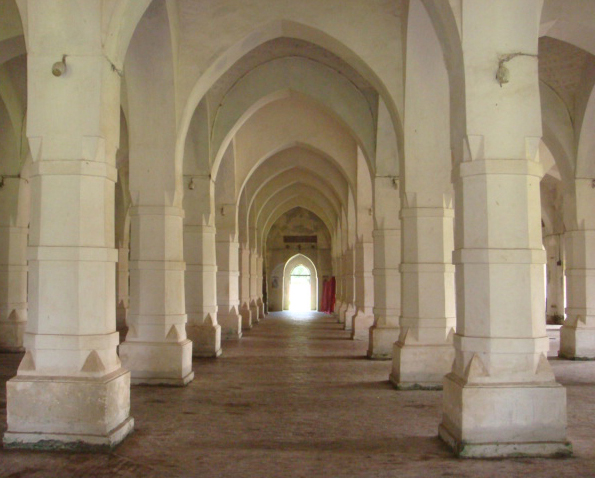
StACaPOSTCARD #04: St Andrews, Scotland: It’s a sharp bright light, different from the sunshine of South East Asia, comes at a lower angle; the sunbeam seems to shine straight into my eyes. Quite blinding in the early morning, I’m dazzled and have to shade my eyes to look up at the ruins of the nave of St. Andrews Cathedral, against the Northern sky. A great emptiness, 12th century mediaeval folk saw it as the ‘Glory of God’, projecting a ‘self’ onto empty space and if there was an intuitive sense – a normal inquiring mind – that something about this is not quite right; the sense of lack, unconvinced, doubting – could it really be God? If it was like this, they were living in fear of their own natural thinking processes and reasoned that it must be because ‘we are all sinners’ and the Church is there to ‘save’ us. Religion was/is power; the Church of Rome, then the Scottish Reformation claimed all the wealth of the Cathedral of St Andrews. Not much in history about the spiritual life of those who lived in that place, studied, prayed, meditated; their compassion, or loving kindness…

I see the door arches and passageways, people walked through here and lived their lives, breathed this air. How was it then; the existential reality of these 12th Century Britains? Conscious experience was the same in mediaeval times as it is today: outer object triggers inner recognition/desire. Example found in the Old Testament: Adam sees the apple: I want that… Dependent origination (paticcisammupadda) in an Old Testament format: there’s an apple out there and I want it but there’s conflict in the mind, associating a fictional self with a normal response; sorry this apple belongs to someone else and you can’t have it. How to resolve this? The response to the apple is normal, the process of human consciousness must be universal – there was never any time when people didn’t react/respond like this. Today we can apply understanding; how does the process work? In those days, no other way to understand it, you have desire for the apple, you are a born sinner, believe in God, and have your sins forgiven… and that was it – no other instruction. Thank goodness I discovered Buddhism.

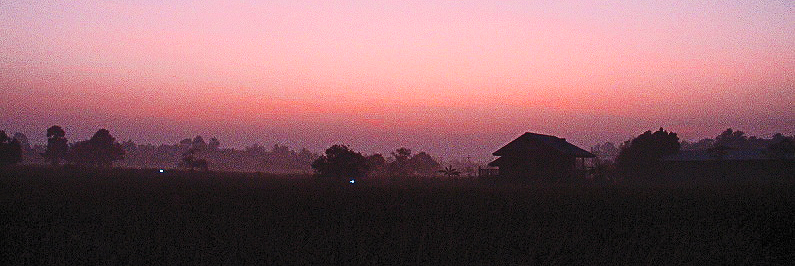
It’s daylight until very late at night here, a long twilight going through to dawn the next day – really no darkness at all. The morning gathers momentum and we’re flooded with sunshine, day after day, everybody stumbling around in a state of astonishment, suspended disbelief. The sense of being on an island doesn’t seem to be here in Scotland, we are not held, contained, more like we are dispersed, all the way to the Northern region; Orkney, Shetland, Faroe Islands, the Arctic Circle and beyond…

————————-

Ignorant of their ignorance, yet wise in their own esteem, these deluded men, proud of their vain learning, go round and round like the blind led by the blind [Mundaka Upanishad 18]
a small island

050POSTCARD #03: London: Writing this on the new iPhone I bought in Apple Store, Covent Garden. Takes some getting used to. The keyboard is tiny; index finger placed on the letter key blocks out the whole letter – fingers too thick. The letters ‘O’ and ‘P’ are difficult, and when I type ‘M’, I hit the backspace instead. Jiab can do it okay, she has fingers as thin as flower stalks. Maybe I’ll give it to her…? A friend fixed me up with a blue-tooth keyboard and small projector (Optima). I’m using the image on the wall like a screen. Uploading the post to WordPress is possible with wordpress mobile but only with a good Wi-Fi connection. Interesting to work in miniature like this – there’s something about the smallness of it that suits things here in UK.

We’re in a tiny hotel room, just enough space for everything. The streets outside accommodate pedestrians on the pavement, and a narrow road allows the big black taxicabs to rush by. Could be a claustrophobic feeling if you think about it too much, compressed, economy of space provision. Don’t think about it. Japan is the same, squeezed into a little country. It is a small island, travel across from East to West and you come to the sea again – I am marooned. Geographical aloneness. The world is out ‘there’. I remember the separateness; the belief in a ‘self’ but seeing only the lack of it, and nearly a lifetime is taken up with looking for the answer to this conundrum – seeking. Now coming back from Thailand where I’m living in somebody else’s country, an outsider, and finding that it’s been so long since I was in the UK, where I was born, I’ve become an outsider here too. Can’t relate to this culture; holding on to a UK identity and there’s really not anything to support it, just my attachment. Most people I knew then are gone, I’m a homeless person, staying in hotels, staying with people I met in Buddhist groups, friends, and at Buddhist monasteries on the way.

Pretty nearly everyone here is an outsider, a visitor. So many different languages: Italian, Japanese, French, South American and others – where are the English people? It’s the holiday season, maybe they’re in someone else’s country too, being outsiders there? All the staff in hotels, restaurants and shops are East Europeans. Visitors come here and what they see is a system run by other visitors to England. A picture of England; a picture of reality – when was it not like this? Buildings and statues of eminent Victorians, a solitary man standing alone, high up there on a plinth, pigeons sit on his head. Splendid isolation, tourists take pictures of each other standing next to the man’s name carved in the stone of the base of the statue’s plinth and up above he’s there, looking out at other statues. I feel I should know who he is, I’m British, I should know… but you’d have to have studied history to know that. I can’t remember, it couldn’t have been important to me. All I see here is a monument to ‘self’, the grandeur of it escapes me. But it was important to the people of that time; statues, ornate buildings, the opulence and wealth of the Empire recorded in history. Such a great achievement, such a small country. This was. Can’t help reflecting on the fact that it’s all a fiction created by the storytellers of the day about a reality somewhere else, far away – samsara, stories from a small island.

‘There is a path to walk on, walking is being done but there is no traveller. There are deeds but there is no doer. There is no self. The thought of a self is an error and all existences are as empty as whirling water bubbles, as hollow as the plantain tree. There’s a blowing of the air but no wind that does the blowing. There is no self, there is no transmigration of a self; there are deeds and the continued effect of deeds…’ [Ramesh S. Balsekar, ‘Advaita, the Buddha and the Unbroken Whole’]

————————-

250720131971


Optoma projector on gorilla tripod keyboard and iPhone

nothing extraordinary

photo-1POSTCARD #02: London: There’s a crowd standing around the entrance to the Underground Station. It looks like an emergency, police cars pulled up on the pavement, and an area is cordoned off with white tape stretched across entry points to the station entrance. All traffic is redirected and pedestrians can’t get through either. A policeman gives me directions to the Underground station entrance on the other side; so reassuringly calm, I’m made to feel convinced there’s nothing unusual about this situation of flashing lights, bulletproof vests and loud crackling voices on the police audio system. Pay no attention if there’s a slight urgency in the air and the world seems like it’s falling apart, it’s all being taken care of…

Strange circumstances, we all think, realising what we are expected to do is adjust to it, stay within the familiarity of ‘self’ mode, conventional reality. Mesmerised by strategies to keep the population from mass hysteria. No, really, everything is perfectly allright sir… and I feel a hesitation; it wouldn’t be polite to ask the policeman what’s actually going on here, to take up any more of his time with awkward questions – no, and thank you, you’ve been so nice about this, thank you very much – very English. You hear the word ‘thank you’ constantly; THANKYOUs are everywhere, staying with how it appears to be; nothing extraordinary here, no, no… but I sense something catastrophic; a great yawning chasm opening up beneath my feet. Things are clearly not allright and there’s this sudden desire to be absent, distance myself from this location ASAP.

tube pic1Depending on a self that’s seemingly in ‘here’ creates the objective state – I am inside looking out through the eyes; seeing what’s going on out ‘there’ – a world separate from where ‘I am’. Duality. It’s an illusion, and part of this illusion is that the mind is maintaining the illusion. The policeman is maintaining the illusion, media, culture, everybody I meet reinforces the illusion because we’re all doing it. Even when I can see there’s no self to speak of – nobody at home – the mind is always telling itself there is a ‘self’ in here. And this is the situation; seeing past the ordinary self where there’s a ‘me’, a GPS locator: YOU ARE HERE. This is how it is that I arrive at the Underground entrance by way of the small backstreets, following the crowd. Then down two long escalators, deep under the ground, down and down to the depth of what feels like a ten storey building. At the very bottom of this is the tunnel and the track. Heavy old metal train careering in with a great whoosh of tunnel air, I get into the carriage and we’re off clattering through the blackness of the underground network, rattle-bang-clink, rattle-bang-clink, rattle-bang-clink….

————————-

‘… the distinction between an ever-changing experiential response to the environment, and the concept of a reified continuous self living in an objective world,’ [Gay Watson, ‘I, Mine and Views of the Self’]

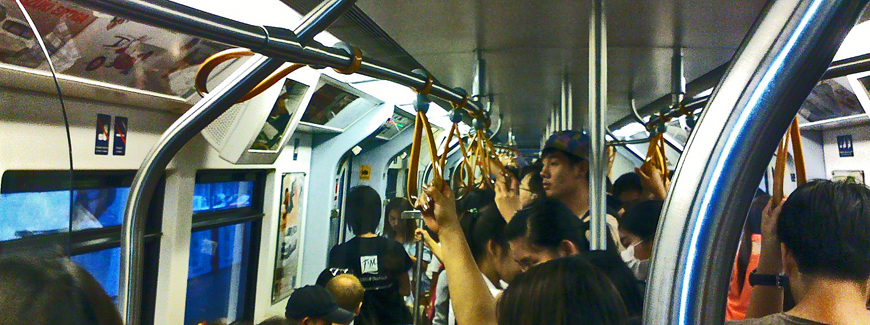
Upper photo: Newcastle Rail Station, lower photo: London Underground train

a kind of alertness

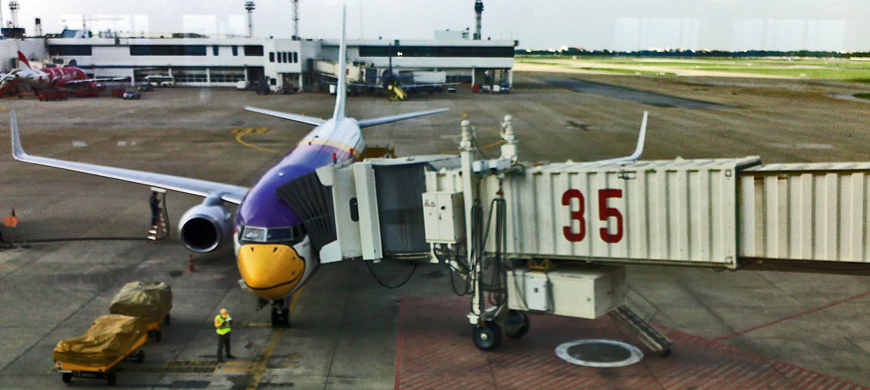
100720131952POSTCARD #01: Chiang Mai: A slight breeze disturbs the wind chimes, tinga-tingaling… ting. An unfinished sequence of musical notes. It diverts my attention from these rememberings, one by one, rushing towards me like a single wave quickly covers the smooth beach sand for a moment then recedes. The wind chimes again: tingaling-ting… ting, a sense of something suspended, isolated, uneasy – butterflies in the tummy – why should it be like this? The fact that I don’t know why it’s like this, causes the uneasy feeling to be there, ‘a riddle, wrapped in an enigma.’ Uncertainty, impermanence, the Ajahn Chah teaching, ‘Not Sure’ [mai nae]; poised on the edge of something – a kind of alertness. I’m going to UK, it’s to do with that; leaving Chiang Mai tonight, only a few hours left. Flight to Bangkok, change planes and I’ll be in London on Sunday morning – 5½ hours in the past. Thinking about Inkland (England, as M calls it), a great flood of memories and the revisiting of these times. I’m not feeling sure about it; Inkland is such a ’proper’ place (compared with Thailand), not sure about being not sure and remembering other times when I was not sure.

Only two weeks in the UK and too many things to do; a sequence of events planned; connecting with trains often delayed, sometimes cancelled, and meeting people in places I don’t know. So many things dependent on so many other things. And so much of it is unresolved until it unfolds, piece by piece and fits together in the right order. A handful of printouts of train tickets and hotel reservations, it’s hard to keep it all in my head. I feel cramped, it’s time to finish off planning for this event – the event is already here, it’s happening now! Time to get ready to go to the airport. Tidy up this placet; the Zen of housekeeping, inner peace, do the ironing…

Hot iron on freshly laundered fabrics, comforting, homely, perfumed smells. It has a soothing effect. Ironing out all these little wrinkles, the silvery nose of the hot iron smoothens them all away, warm to the touch. Place the folded packets of clothing in the suitcase. Peace and flatness. Being mindful of the ‘not sure’ thing, it’s caused by my being not sure about it. As long as the uncertainty is out there somewhere, neither in nor out, it’s uncertain. So I know I have to embrace it, give it a hug, be open to it and allow the uncertainty to enter – there’s nowhere else for it to go. The willingness to let it in, leads to an immediate sense of release, inside and outside. Wind chimes go: tingaling again, joyful sound. Passport, ticket, wallet, I’m on my way. Goodbye house, anjali…

————————-

just this

Sunrise (1)WPNChiang Mai: 05.30 hrs., ‘… down the long and silent street, the dawn, with silver-sandalled feet…’ daylight creeps into the rooms and it’s my birthday today! I suppose one’s birthday is something to be possessive about: ‘my’ birthday. I was born on this day quite a long time ago in the North of Scotland and now I’m here in the silence of a Chiang Mai morning in the North of Thailand. Open all the windows and a breeze blows through in all directions, curtains and fabrics that haven’t moved for a month in the stillness of this interior, flutter and flap against the walls – a sheet of paper flies off my desk, lands on the smooth floor tiles and slides away. It feels like the world outside is inside; all of a one-ness and this mind/body awareness (that is ‘me’) spreads out from here, through the trees, up and into the dome of the sky as far as the eye can see.

Skype call from Jiab in Delhi, happy birthday, and in the video window I can see our room, the place I usually inhabit. Jiab is at the desk where I normally sit. It’s still dark there, daylight here. Two people talking with each other but often occupied with the tiny image of themselves that appears in the Skype window, lower right. Eyes are sometimes directed away, how does my hair look? Jiab tells me the story about how she was born on the night of the full moon and so her actual birthday is not always on the same day. The family lived in an old forest area in the South of Thailand. Jiab remembers her father saying it was the light of the full moon that guided him through the trees to bring the midwife to their house. And a phone-call from M, happy birthday Toong Ting! She calls me that because she’s my 9 year-old niece. Toong Ting, when you go to Inkland? She asks me this, meaning ‘England’ but I like ‘Inkland’ (the place that makes ink?), so I tell her I’m going to Inkland on Saturday 13th, but it’ll be Sunday 14th by the time I get there. We have a discussion about the time difference thing and M knows about this, having visited Japan earlier this year. Only 9 years old, but she has an understanding of the world and systems that’s so much in the present moment it takes my breath away.

http://www.dreamstime.com/-image17433969Children teach us about birth and the great mystery. About 10 years ago, there was an episode from a BBC series on the human body that showed a woman giving birth – so vivid, I suddenly felt this immediacy of it happening to me: the blinding light, echoing sounds; the coldness, the impact of air entering the nasal passages? Revisiting the birth experience. Emerging into the world,  the first total sensory consciousness sweeps through and the body/mind organism is turned inside-out. That TV film left me quite transformed… Now it’s later, many years later, and there’s ‘me’ and this old body, getting settled on the cushion for a 30 minute meditation sit on ‘my’ birthday. These are the same body parts, regenerated, expanded in a lifetime, worn a bit smooth, puckered up at the edges. Skin, muscle, flesh; soft rubberoid plasticity, and these mysterious organs held by ligaments bonded into solid bone. The whole thing maintaned by the tremendous heat and energy processed from food, the fuel for the engine. And there’s the fluidity enclosed in bubble-like spaces, gurgling away all the time. The breath enters the body as a kind of wind, gusting in and out. It comes back and blows everything all over the place, withdraws in a moment and it’s gone again. Mind mesmerized by the form and function of the body, seemingly trapped in this limited temporality; cause/effect – then for an instant, seeing the truth of the Five Khandas. Thin skin of eyelid slides over surface of smooth eyeball and the dimly seen light entering my darkness; just this…

‘Each and every mental and physical process (namarupa) must be observed as it really occurs so that we can rightly understand it in its true nature. That right understanding will lead us to remove ignorance (avijja). When ignorance has been removed, then we do not take these mind-body processes to be a person, a being, a soul or a self. If we take these mind-body processes to be just natural processes, then there will not arise any attachment. When attachment has been destroyed, we are free from all kinds of suffering and have attained the cessation of suffering.’ [Venerable Mahasi Sayadaw]

————————-
‘…down the long and silent street, the dawn, with silver-sandalled feet…’ taken from ‘The Harlot’s House’ by Oscar Wilde. Upper photo image taken from the WPN archive. Lower photo image: dreamstime. Gratitude to Rory and his post for the inspiration: http://beyondthedream.co.uk/2013/07/05/tao-te-ching-28-keep-to-the-feminine/

seeing things backwards

010720131926

Bangkok/Chiang Mai flight: Stone cold in Departures, AC has me chilled to the bone. I walk around the shopping area, just to be doing something, and go to the magazine and newspaper shop. They have packs of Thai alphabet cards – just what I was looking for! I can find the vowel set, but not the consonant set and I ask the lady at the desk if she has it. Stress on her face as I’m asking the question; she thinks she will not be able to understand… then she realizes I’m speaking Thai – a small jump in the air, joyful surprise. Wow! Okay, so… but she’s forgotten the question. I ask again if she has the consonant cards. She starts looking but can’t find them: oh, no have, solee! (sorry) Disappointed. I get the vowel cards anyway and ask her how much it is. She says 47 baht but when she rings up my money at the cash desk, she says 74 baht – checking my change afterwards, she was right first time, 47 baht – just said it round the wrong way (47 or 74?) seeing things backwards is a problem for her sometimes. No worries, everything moves along; flight is called and we are boarded. Stewardesses in lemon yellow costume, it’s all doll-like, pretty and cute – the plane has a bird’s face painted on the nose. You can buy gifts from a trolley coming along the aisle; do I need a vinyl blow-up inflatable airplane? Nothing to get heavy about, overly serious about; no need to get stuck thinking about anything hopelessly imponderable.

eu-ahEven so, it’s noticeable how the mind will attach to an object and hold on to it with the intensity of a velcro fastener bonding with its surface; the desire for adherence. The thinking mind presents a range of options; I can choose to ‘be’ something, contained in an acted-out scene from a movie I’m watching about ‘my’ life. It’s birth in the Buddhist sense jati: the I-am-here thing. It’s sometimes an uncomfortable, driven, locked-in state that arises through examining an event, and returning to it again and again, simply because I’m so used to seeing the situation from this perspective of holding on to it, I expect it to be the same starting point of my meanderings every time.

Mindfulness of this unaware habituality. Knowing it’s like this means ignorance (not knowing) is gone, vanish’d into thin air. I enter the space knowingly, intervention in the probability sequence. Instead of the intensity of mind, there’s just the intensity… a tightness of posture – maybe that’s how it started – relax the neck, the forehead. No thought associated with it. No goals to which I’m compelled to strive for; what the eye doesn’t see, the heart doesn’t grieve for. Undoing all the knots tied in memory, letting the mind untangle itself from the problem: good, bad, whatever. Letting it all go, giving it room.

Reminded of Ajahn Pasanno’s reflection on Ajahn Chah’s teaching: ‘A coconut tree draws nutriments from the planet; it draws elements good and bad, clean and dirty, up through the roots and into the top of the tree and then produces fruit that gives both sweet water and delicious coconut.’ And Ajahn Pasanno describes how we don’t need to be concerned about the different experiences that we have of the world, everything is drawn up through the ‘roots’ by way of the three-fold practice: sila (virtue), samadhi (concentration), paññā (wisdom). All experiences, good, bad, whatever, are transformed into insight, understanding, balance and sense of peace.

In-flight announcement: … we are now making our descent… please ensure your window shutters are up, arm rests down, seat backs forward and tables folded away – a small cluster of prepositions. Plane lands and luggage collected, out into the clean Chiang Mai mountain air. Shortly after that I’m in a tuk-tuk headed down to the supermarket to get supplies.

tt05July13

————————-

Photo image upper: My plane to Chiang mai
Middle:  Thai vowel/dipthong ‘eu-ah’
Lower: Chiang mai tuk-tuk

necessity of mindfulness

2012-03-31 12.35.44Bangkok: Getting into town from the airport is okay to start with, gliding along the elevated highway in a huge open landscape, and all the good-looking 21st Century buildings pointing up into the evening sky like some futuristic sci-fi heaven realm. Then, as we get near the exit, the traffic slowly starts to fuse together in a mass of end-to-end steel/chrome-plated metal units, creaking along like the glacier I visited a long time ago in Switzerland moving so slowly, the end of its 133 kilometer length is four hundred years older than its beginning. Struggling with the thought that I don’t want it to be like this, causes and conditions, the traffic is like nature, the ocean, the weather. Reminded of the Ajahn Chah image of leaves in the trees blowing in the wind in a rising and falling motion for as long as the winds last. And how it’s the moods of the mind blowing like the wind that cause the restless, uneasy feeling. In its original state, the mind is still and calm.

300620131923_crop

The next day I have to go to the eye hospital, blurred vision in the left eye, and procrastinating about that for a long time. Sometimes stumbling into things and I’m gently squeezing through the crowds at the skytrain entrance to get the ticket in the turnstile, remembering how it all works. There’s an alertness, awake and mindful, I am a foreigner living in someone else’s country. Getting off the train is complicated, it’s a place I’ve not been to before. Not finding the correct exit because the signs are unclear, I can read Thai but I choose to go with the North/South orientation of the map, knowing that if I face the way the train is travelling as I get off, in this case North, and as I go down the staircases and escalators to street level, I’m always orientated in that same Northerly direction and the traffic will be going North. All this because doing a U-turn can be a lengthy process here; somebody said the whole of Bangkok is one large, U-turn…. A pink and white cab is waiting and I tell the driver where I’d like to go – will he take me? He thinks for a bit (doing U-turns in his head), yes, ok. So we’re off.

At the hospital, it’s a long session. They put some drops in my eyes to enlarge the pupils so their equipment can see inside the eyeball. The doctor asks me if there’s anybody to take me home because the drops in the eyes will make things a bit indistinct for a few hours. Understatement. When I step outside the world is a blur, a smear, a sea of colour, yellow, green and pink taxis, red tail lights of vehicles in vivid splashes. No form or definition anywhere; I’ve lost my North/South orientation, having come in by a different door. Get on the first motorbike taxi that comes along and allow him to sort it out. We get up to a surprising speed going along what I believe to be the wrong side of the road, dodging oncoming traffic, weaving in and out of the other lane, wherever there’s a space. A great whoosh of hot wind, noise and get to the Skytrain station so fast it’s like we arrived before we set off. Give the guy a good tip and then it’s just a case of getting the North/South thing sorted out, following the crowds up the escalator, on to the train, and into the coolness of the AC carriage, with this wild wind blowing through the mind; papañca, proliferations arising from the single thought that I have an eye operation on August 9th. Necessity of mindfulness…

300620131924

————————-

‘To be mindful means to have metta towards the fear in your mind, or the anger, or the jealousy. Metta means not creating problems around existing conditions, allowing them to fade away, to cease. For example, when fear comes up in your mind, you can have metta for the fear — meaning that you don’t build up aversion to it, you can just accept its presence and allow it to cease. You can also minimise the fear by recognising that it is the same kind of fear that everyone has, that animals have. It’s not my fear, it’s not a person’s, it’s an impersonal fear.’ [“Mindfulness: The Path to Deathlessness: The Meditation Teaching of  Venerable Ajahn Sumedho.”]

forbearance

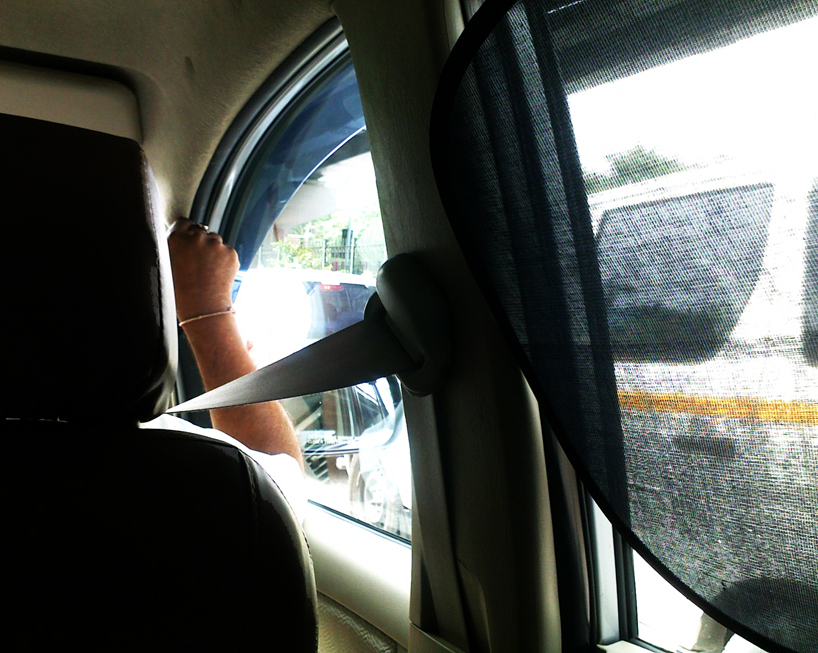
260620131912New Delhi: Moving through the streets to get on the highway to the airport; rough and bumpy, chunks of road surface missing. Demolition and construction, the urban environment is getting knocked down and rebuilt. We stop at an obstruction in the road caused by a large lorry unloading bricks, sand, cement and all I can see is the rear end of all these small vehicles standing together, jostling to get through… transportation of goods and services; bits of pipes and fittings, cables and plumbing items. Packages wrapped in plastic, held with bungee cords on the back of motorbikes; components, textiles, items boxed in packaging. A cycle rickshaw with a refrigerator on the back, and another one blocking the space with a large plywood panel tied on with rope at an awkward angle.

Drivers getting upset, the sound of horns, people walking around this blockage and through the traffic, carrying things on their heads, dragging children. Pavements are not for pedestrians, there are obstacles, tree roots, missing paving stones, sometimes no pavement at all; heaps of rubble, deep holes below where the drainage system is seen. The earth is beneath the streets, beneath the tarmac and the concrete and the clay, a substance created by erosion, geological conditions. The ‘developing world’ – no such thing as the ‘developed’ world. All of it is subject to change.

Up above, there’s a mass of overhead cables slung between high concrete posts, and a barefoot technician is up there on a bamboo ladder resting on the cables themselves, pushed out in a big stretch to accommodate the weight of him on the ladder. He’s threading another set of cables through, his partner below holding the ladder and traffic gets past them like the river flows around the stones in its path.

The infrastructure of the city is in the centre of my vision, not hidden. Everything that the environment is made of; all this is seen, the inside of it as well as the outside. Systems, processes, how things are done – evidence that the world itself is a constructed thing, put together, assembled, built. It has an unfinished look, bits of it are missing, removed, or not installed yet, or just left exposed; somebody took away the screws that hold the cover plate in place.

Things are unexpected, uncertain, everything is so much not what we think it is, there are no assumptions. The Western point of view that it ‘shouldn’t be’ like that – it ‘should be’ like this, is a concept imposed on a living organism, alive and moving. If I allow the organism to be as it is, I can disengage from the mind state where I think it’s something it’s not, and everything that’s currently bothering me about that disappears. I choose to be with the uncertainty of it, more and more; look at the dilemma of suffering without attaching to it; and challenge my tendency to see it in terms of a constructed self: anicca, dukkha, anatta – impermanence, suffering and no ‘self’.

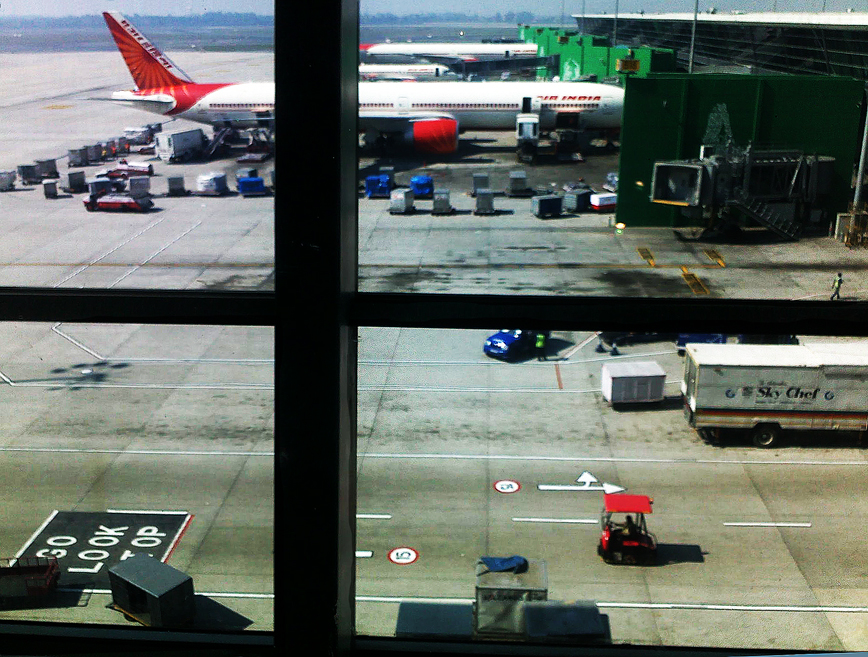
Dl_departuresArrive at the airport, check in, and through to Departures, happy to be in these ‘normal’ surroundings …the flight for Bangkok is now ready for boarding… I’m just a visitor, on my way to somewhere else. It’s difficult for me to have the infrastructure poking through into the way I choose to see things, because usually I have negativity and unpleasantness hidden away. Since childhood, my belief has been based on affirmative statements: the act of creation and the idea of a heaven… only pretty words. The truth is that ‘heaven’ is a reality beyond description – language doesn’t go that far. This kind of childlike ‘heaven’ is a fiction, not real in the sense that I am in the real world; the nuts-and-bolts of conscious experience, the present state of affairs. This here-and-now reality is fundamentally the same as it was 2,600 years ago, in the time of the Buddha, here in India.

What I’m trying to do now is to resolve the issue of fearful uncertainty by accepting the fact that there is an underlying sense of suffering (1. dukkha) in life and I need to contemplate this feeling with forbearance, rather than run away from it all the time. The direction this contemplation takes is simply to find out what it is I’m doing that’s causing the suffering (2. tanha), and stop doing that. It’s about letting go of whatever it is that’s causing it and I notice when that happens, the suffering stops (3. nirodha). This insight suggests there is a possibility I can stop the suffering completely and I follow the guidelines (4. magga) that show me how to do this consciously, in daily life. [The Four Noble Truths]

Time to go now, hand over the boarding pass to the Thai staff, she separates it along the perforation and hands me back the tab with my seat number. Goodbye India! I’ll be back in two months. Laptop bag on shoulder, and off down the passageway to the aircraft…

————————-

–  G  R  A  T  I  T  U  D  E  –
The subject matter and title of this post indirectly inspired by: Forbearance by Norman Fischer http://standinginanopenfield.wordpress.com/2013/05/19/forbearance-by-norman-fischer/ Also mentioned in that site, a comment by Dominic724: ‘Without forbearance it’s just a pile of pretty words’. The ‘pretty words’ comment triggered a memory of the Joni Mitchell song titled: ‘The Last Time I Saw Richard’ (1970) and ‘pretty lies’ (When you gonna realize they’re only pretty lies …). Lower picture image: Delhi Airport Departures

Kiki

kiki arrived

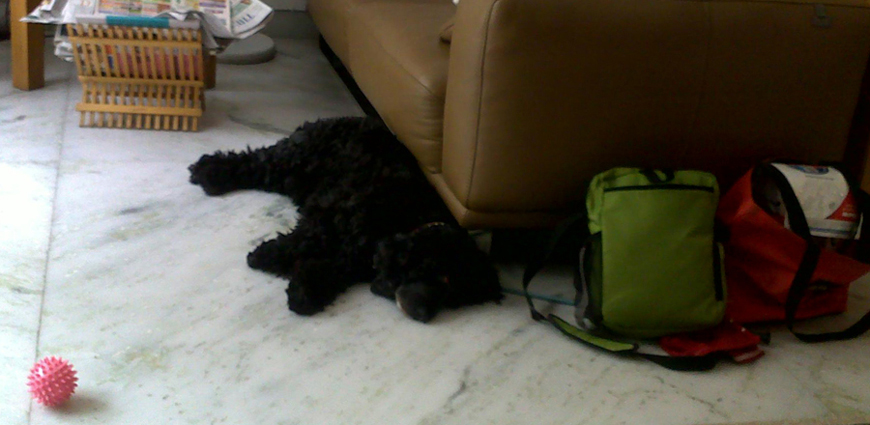
New Delhi: Kiki came to stay with us for a few days. Her owners went to Calcutta on business. Kiki is a black Cocker Spaniel, 10 years old in October this year and people say if you multiply a dog’s age by seven, you get the equivalent age in humans; so she’s like an oldish lady now. Kiki was born in Thailand, moved to Japan with her Japanese owner, then to Bangladesh, Vietnam, back to Japan and now she’s in India. A much-travelled small dog, Kiki has her own immigration documents, a kind of doggie passport. I first met Kiki in Bangladesh 4 years ago and it’s a bit sad to see she doesn’t remember me at all. But she’s older now, seen a lot, she’s slower and can’t be expected to remember everything. Kiki comes towards me with her little pink ball held in the mouth, drops it in a practiced way so that it rolls towards me. I pick it up and throw it and she runs to get it, but after about four throws she has to stop and have a rest.

We are given Kiki’s things in two small bags, food, blanket, toilet equipment, ball and her owners say bye-bye Kiki! and leave. Kiki spends a long time sitting at the patio door looking out, waiting to see if they’re coming back. But they’re not coming back; I try to engage with her, I try to speak with her in a kind of doggie-speak, cute high pitched baby chatter. But it’s not working very well because most of the time her owners speak to Kiki in Japanese. Kiki just looks at me, looks at Jiab, responds in a friendly way, but there’s a distance. Jiab and I are just the faces of this moment; she knows we are the carers. Kiki has had carers speaking to her in Thai, Bengali, Vietnamese and Japanese and, anyway, she’s limited because she’s a dog…. Now she’s just wondering which one of us, Jiab or me, is the one to whom she will be answerable; which one is the main provider of food and taker-out-for-walks? And it’s a new experience for us too, we don’t know much about looking after dogs. So I’m wondering how this’ll go, and thinking Kiki probably has that figured out already; the pros and cons of this situation, a naïve, abundant provider of tasty scraps from the table?

So we’re eyeballing each other like this, a certain curiosity and interest in the air and Kiki is totally black like a photographic negative, I can’t see any face, only a strip of pink tongue hanging out. I’d be staring at her intently looking for a face then I discover it, see the black eyes, black nose and aware, all of a sudden, that Kiki is looking back at me! An encounter. Quite a lot of licking; affectionate doggie wetness – I put her food in the dish and there’s great excitement but she doesn’t eat, just sits there looking at it. I’m thinking maybe she doesn’t like it… but then she turns around and looks at me, face to face, eye-contact, quite a meaningful moment. A recognition; is it about gratitude? I say something like, go on then Kiki… and she starts to eat, tremendous crunching noise, her bowl-shaped dish amplifies the sound, and the scrape and clatter of the dish sliding on the hard floor as it gets pushed along by a long black nose. Maybe the hesitation at the start was her saying: look, I’m sorry, this is going to be noisy, okay? Same thing with water, I’m sitting at the desk quietly and there’s this huge shlooshing, splooshing sound.

kikiphoto1The ‘face’ of Kiki got to be more and more of a significant element in our communication – no expression, quite plain, just a kind of awareness: non-verbal gazing at each other. At one point I say to her: where’s your ball? and she immediately starts running around looking for it. I realise then that her Japanese owners must say that in English. So I get down on the floor and we are both looking under the sofa and the chairs. In the middle of all this, we look at each other, I’m on my knees, at her level. I say to her: I don’t know where it is… hold that gentle look for a moment: I don’t know… consider the enigma of our shared existence. There’s something about this that gets my attention, she just looks. I come closer and look again at her dark face placed in a dark wooly body. There’s a little movement of the head. I look under the sofa she’s sitting next to and there is the ball! Difficult to reach because it’s behind the bar but I can just get it, flick it out and Kiki runs off across the room chasing it. She catches it and comes back to me, drops it and I have to throw it again….

————————-

the opportunity

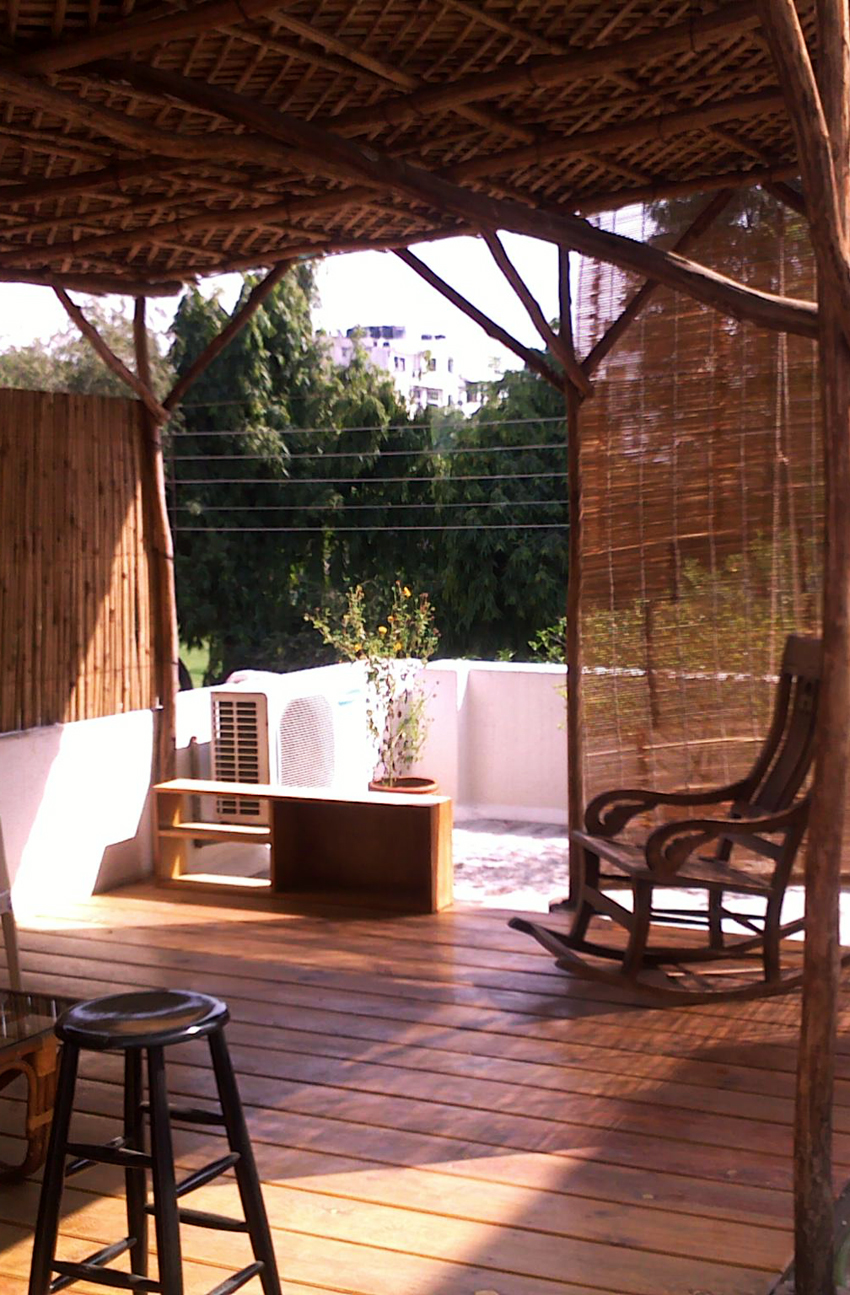
200620131896_2New Delhi: I leave the door open that leads to the roof terrace and come downstairs. Ksum is in the kitchen, cleaning up. She says: You no close door up? Pointing, so that I can understand her English; large black eyes look at me; blue sari, olive skin, Assamese Buddhist, originally, converted by Christian missionaries. Then she’s smiling in a kind of patient way when I start to explain I’d like to have the door open, to get fresh air? Looking at me like, does she have the energy to tell me this? Ked come in. You know Ked? …raises her voice because maybe I’m deaf or something, Ked come in, you open door. And I’m thinking… what’s Ked? And there’s that incredulous look. You no unerstan’ Ked?  Ked come in door, come down stair, into house steal food from all th’ trash‘n make a mess everywhere! And then I understand Ked is ‘Cat’… pronunciation is different. She sees the dawning of recognition on my face. Ahh… she says on my behalf, and nods her head with a sideways slant, goes back to her work; like I need to be told everything. I go upstairs to close the door then decide to step out on the roof terrace where the air is cool and nice.

Wow, Ksum having a bad day. But she’s right about Ked, cat; instinct and the window of opportunity – or door, in this case. There’s also monkey, of course, and rat, and all the other freeloaders and opportunists out there in the world of Wild Life, claws, wings, beak and teeth, quick and clever; skills evolved from when they were all dinosaurs. The ability to grasp, snatch, hold and eat. Human beings similarly motivated, driven by desire. Reacting to the sensory world – sights, sounds, smells, tastes, touch, mental objects, and grabbing at these with extraordinary speed. The habituality of it inherited from former lives… the reason I was reborn in this world is that I’m attached to everything I love and hate. We keep coming back. It’s the relentless search to feel good about everything, and avoid feeling bad about everything when the good feeling falls apart.

Carrot-and-stick; the good feeling is nice when it’s there and the bad feeling is nice when it’s not there. The good feeling makes it seem like everything in the world is allright, joyful, a sense of success; it’s rewarding. And the bad feeling is the opposite; a strange sense of failure, guilt, and fear – I’m bounced off the wall and wanting the good feeling again with renewed hunger. Chasing my tail. Stuck in the duality of exchanging the bad feeling for the good feeling – something thought to be deservedly earned, a reward for time spent in bad feeling. Stuck in a rut on the consumer treadmill without any belief in anything beyond that. Seemingly there’s no choice, earning just enough money to pay for what it takes to make me feel good for a short time, then I’m feeling bad again. All I really want is some peace and calm but it seems to be so hard to find.

210620131902Loving kindness and compassion for those in Suffering. The system creates the predicament. Most people think there’s no way out, even though the opportunity is there. It’s like the example of being locked up in a prison cell for years. Then, one day somebody comes into the cell and gives you the key to the door, so you can open it and you’re free. But instead of doing that, if you’re a ‘believer’, you put the key in a special place and pray to it every day, believing you’ll be able to endure all the hardships of your prison cell by worshipping the key. You don’t know what to do, doubt, uncertainty, fear, confusion. Other people, ‘non-believers’, disagree with your worshipping; they say, we don’t believe in religion or anything, so they decide the best thing to do is just get rid of the key and throw it out the window.

The key is not an end in itself. Just a key; meditation practice, mindfulness, just the intention to be mindful is enough. Back off from the automatic pull; the sense of something out there that I’m drawn towards… and the internal sense of ‘me’. There’s nothing there, only the Five Khandas (Five Aggregates): form, feeling, perception, mental formations and consciousness. ‘… stopping the mind, stopping the flow of thoughts that are proliferating, stopping the flow of moods that get drawn into either attraction or aversion. We return to a clear center, to awareness’ [Ajahn Pasanno, ‘On Becoming and Stopping’]. No holding on to anything, no holding on to the teachings even. Learning how to use the key. Maybe it’ll take a lifetime, but what else is there to do that’s as valuable as this? Allowing everything to arise and fall away. Cessation. No remainder. Nothing whatsover is to be clung to: sabbe dhamma nalam abhinivesaya.

200620131891‘We use the pleasant and unpleasant feelings to measure our success or failure. If we experience something pleasant, we think we’ve succeeded. If we experience an unpleasant feeling, we think we’ve failed. This comes from a place of becoming, what we have become through bhava tanha or vibhava tanha. We judge it in terms of the desire to maximize the pleasant and minimize the unpleasant.’ [Ajahn Pasanno, ‘On Becoming and Stopping’]

————————-

The story about the key comes from ‘Religious Conventions and Sila Practice’, Ajahn Sumedho, Cittaviveka 1992. Upper photo: the door to the roof terrace. Middle photo: sitting area on roof terrace. Lower photo: a plant called ‘Ladies Who Wake Up Late’ (flowers every day but late in the morning)