conflict & release

121120121567“Metta is non-discriminatory. It doesn’t mean liking one thing rather than another, it isn’t a question of singling out: “I love this person, I don’t love that one.” [Ajahn Sumedho, “Universal Loving Kindness” From Forest Sangha Newsletter, October 1997]

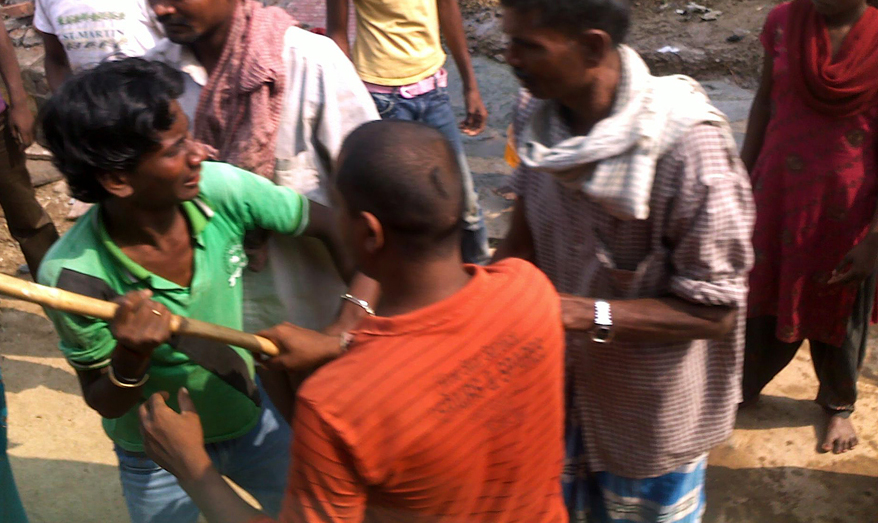
North India: The image here shows some kind of serious argument happening among a group of men, viewed from the window of a moving bus. I couldn’t actually see what was happening because other passengers were in the way, but I got the camera into a space near the window of the bus and took the picture, guesswork, thinking it’ll not come out clearly but it did – perfectly positioned in the centre of the frame. The man in the green shirt is trying to do something with that pole and the other guys are struggling with him violently. The bus pushed itself on through the crowd and the people made space for it. When we got up close, all I could see was the top of their heads and I took the photo without seeing where to point the camera…

The bus moved on and we were gone in a moment, accelerating along empty streets. I was amazed to see the photo after we’d moved away from the area. What to do with it? The tremendous intensity coming from the green-shirted man is scary – murderous feelings in the air. There’s another emotion too, he looks tearful, as if he might start to cry. It was an event I didn’t see, all I have is this picture of it. I could hear the explosions of angry voices, and the memory of it is still a bit scary, but it didn’t happen to me. If it hadn’t been for the camera lens, I’d not have seen it. As long as no effort is there to keep it going, conflict falls away. But we fuel the fires to keep the conflict going; our wars and war-mongering, allowing everyone the means to build up the tension, justified outrage, creating stories in the mind. We could just as easily allow it to fall away, but we’re drawn in, and it gets to a point when conflict is inevitable; this is always how it is.

Then Ajahn Vajiro was in town the other day and somebody asked him about what to do when you have to put up with some unreasonable, insensitive person giving you a hard time and you have to see this person on a daily basis. Ajahn spoke about the Brahma Viharas and later Suffering, the First Noble Truth and how the Buddha didn’t say he could eliminate suffering – he gave us the tools to escape the suffering. It led me to see that conflict is resolved if we can focus on the subjective nature of it, see our own anger, and see the anger the ‘bad guy’ has to cope with, and recognise it as exactly the same thing – what’s the difference?

The practice of meditation is the solution. Ajahn talked about getting to know the inner world; start from there, explore the universe from the inside. It’s not just about feelings of bliss and peace, that’s there too but it’s about the real world. Long term goals. Following this path, you get to know about suffering; you notice your own suffering, you have compassion and act towards others with compassion when you notice the suffering in your opponent. Apply wisdom – especially if your opponent is swinging a long pole, aimed at your head. See the angry person as someone who doesn’t understand his/her own suffering and recognise their difficulty – then get out of the way of the swinging pole!

It’s about the difference between ‘knowing’ and ignorance. Ignorance is the result of unskilful action. Non-ignorance (knowing) is about accepting limitations and doubt. It’s not a sure thing but it doesn’t have to be a serious drawback; having to cope with being not sure, uncertainty. Ajahn V described it as being at the edge of the known; doubt is nearly knowing what it is…. In a different context, uncertainty is what’s in the wrapped gift you’ve been given. You don’t know what’s inside until you open it….

————————-

“The metta – kindness – engendered in us encourages us to accept ourselves and others, and so to understand ourselves and others. Understanding implies wisdom. And this wisdom is that which allows us to find the way, to grow beyond, or let go of, that which limits and binds the heart. The kindness expressed to others allows them to accept themselves and others. This is an emotional, gut or heart acceptance that allows the acts of body, speech and mind that are a response to that which is perceived as `other’ to be kind; not motivated by not-liking, not motivated by aversion or fear. The effect is unlimited Metta is radiant and attractive, warming to those that are cold, cooling to those that are hot.” [Venerable Ajahn Vajiro – “Mature Emotions ” from the Forest Sangha Newsletter]

nothing cannot be anything

hand image3Delhi: There’s a needle in my arm. Strange how the body accepts this intrusive object and the antibiotic fluid coming through it that enters the blood stream. Veins have a plasticity like something synthetic we recognize from the world of manufactured polymer substances. But human tissue is better; you can make a hole in it and it repairs itself. You can cut it, stitch it up, remove parts of it and replace these with other parts that fit. The human body is a miracle. The pain of this needle, though, has a directness, increasing, then easing off, over and over, dukkha, there’s no getting away from it.

I don’t want it to be there, vibhava-tanha, I want to disconnect it from the plastic tube leading to the upside-down bottle suspended from the hook above my head. It feels unnatural; it shouldn’t be like this…. Lying here on the bed looking up and counting the drips that fall into the receptor that fills the tube; one drop every 4 seconds and that’s the rate of the fluid flowing down the tube into my pierced blood vessel. It’s a full bottle, and there are others I have to take after this one… treatment for an intestinal infection – nothing really extraordinary in a country like India, in the hot season, when all kinds of bacteria thrive. Caused by drinking water from a filtered system that didn’t filter. Organisms survive the filtering system; bugs everywhere in this intensity of 43°C.

I need to find a way of getting through this period of invalid status and prolonged boredom of a plain room with hospital fittings, plugs and sockets in the walls, hospital furniture and a TV screen I’m not interested in. Dissatisfaction with things; clicking the buttons that control the position of the hospital bed; down/up and up/down. Lying here with eyes closed, listening to the metal trash bin; it makes a satisfying percussive sound when the cleaner presses the pedal with his foot, lid springs open and strikes the wall next to it Clang! He releases the pedal and the lid closes: Flumpf an airtight trash bin with plastic bag liner. Crash! Flumpf! again and it’s joyful and funny.

I need some joy here, there are men in dark navy uniforms in the room; cleaners with large grey floor mops that look like they’re soaked in muddy water swabbing the tiles; smell of Dettol stings the eyes. Muddy grey mops and dark navy uniforms seem out of place in an environment of lemon yellow, soft pink walls; pastel shades and shiny chromium fittings. The muddy grey mops are a bit scary also, because I’m sensitive to things that appear dirty, having fallen into this sickness as a result of drinking water from a filter machine installed at home that allows dirty water to come through.

‘We’re not in Kansas anymore Toto…’ The doctor said always drink boiled water in the hot season, organisms are present in the water, filter or no filter. I feel some frustration with the company that sold me the water filter: ‘it shouldn’t be like this’but we don’t live in a world of ‘should’ and ‘shouldn’t – western theory applied in an Indian context. We expect it to work, and it doesn’t. Western systems are deductive and life is inductive. Organic growth has no beginning no end. How to understand that, what to do? Don’t make it into a structure. Let it be nothing.

So I can lie here on the bed with my eyes closed and the cleaners expect me to be like this because I’m a hospital patient. And in this curious public place, enter meditative contemplation, watching the breath, the rising and falling of the chest. Allow the thoughts that arise to fall away and be replaced by others that I allow to fall away and allow everything to fall away and cease, as far as possible – just the effort of trying to do this leads to a quietness in the mind; spaces of no thought. There’s some peace to be found in this activity. And from here consider nothingness, just nothing, no thought. It’s not an idea of nothingness, that’s a concept. Nothing cannot be  anything. Nothing cannot be located anywhere in time or space; no before, no after. If it is truly nothing, it can have no cause or effect. I can’t work towards some mind state in future time when I’ll see what ‘nothing’ really is, it has to be now, it’s always ‘now’. Nothing cuts through, penetrates, and dissolves everything. It’s just nothing.

————————-

‘One must have a mind of winter… (to behold) the nothing that is not there and the nothing that is.’ [ Wallace Stevens, The Snow Man]

Photo image: http://www.jeffzinn.com/wp-content/uploads/2011/12/poor.jpg

girl at the traffic lights

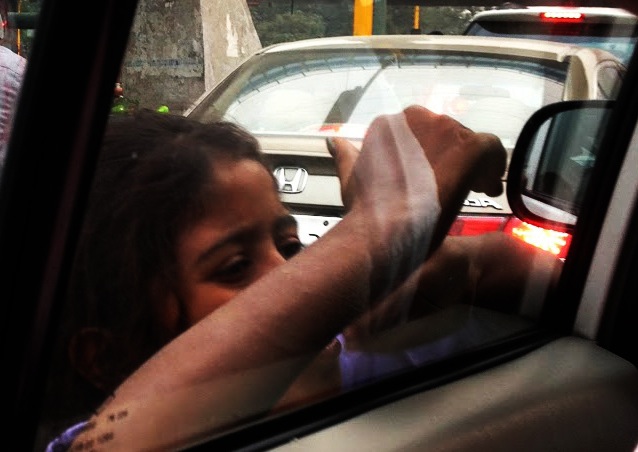
090420131781New Delhi: Sitting in the car, Shym driving, and I’m in the back seat looking out through tinted windows, incognito. Slow down and stop at the traffic lights. Street people and traders walking up and down between the vehicles, selling kiddy’s toys, books, and all kinds of stuff. Children with bunches of wilted  roses knocking on windows, and discussing with passengers in auto rickshaws. One of them presses her face against my window, hands and arms cupped around her head so she can see inside through the tinted glass film. A shadowy head and face spin around looking for where I’m situated in the dark interior. Finds me, then some kind of eye contact, and: tap-tap-tap-tap on the glass with a small coin…. tap-tap. Doing it just to see what’ll happen. Shym puts the car in gear and drives forward a little bit, trying to discourage her but she remains stuck to the glass like glue, walking sideways, legs slightly back out of the way of the turning wheels.

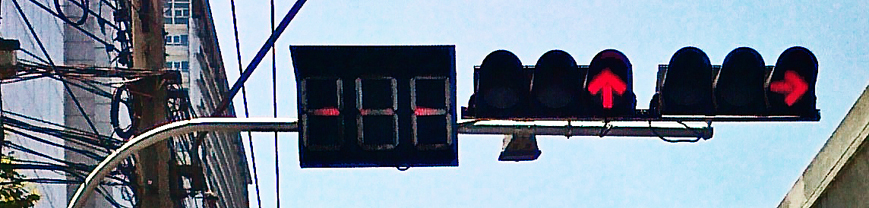
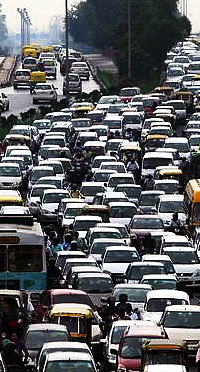
IMG_9171I slide down the window and give her a folded 10-rupee note. Hot street air enters the cool interior of the car like a blast from a huge hair dryer, and I see a dark girl about 9, with hair a light reddish-brown colour, dusty with the street atmosphere. The entrepreneur. How does it look to her? A foreigner gives her money, somebody with colourless eyes, pale, half invisible; like a creature that lives at the bottom of the sea, no sunlight. Her dark eyes hold my attention, intense, penetrating; there’s only ‘the look’. I slide up the window again. Giving her a few rupees is encouraging this kind of livelihood – that’s not really what I want to happen… but what to do? The lights change and we’re off, accelerating through the traffic, overtaking on the left, or the right, wherever there’s a space.

lights1

There’s a small smear on the glass where she was looking in. How does the world seem, seen through her eyes? Must be a no-choice situation; hardship at a level I can’t comprehend – we’re not watching the same movie. But it reminds me of something in the early times in Scotland. In those days I was pretty much caught between polarities. A rocky road. I went down South to England and I’d look at other people’s lives there; unbelievable to me, how their reality seemed to be so… bland? Where I was living you’d open the door of your house to go out and the wind would blow you back in. Extremes of climate, extraordinary confrontations; the rough and tumble. At that time, I didn’t know about the Buddhist perspective on suffering dukkha, all I had was the experience of it. The cloud of unknowing… life was held by random karma. Consciousness was a kind of unconsciousness. Awake but unclear, living in a dream… dum-di-dum. Subject to all the whims and fancies; tugs and pulls. Like/unlike – and for long periods, quite lost in samsaric realms. I thought I could just carry on like that, hoping to muddle on through…

Carefree, at times, and reckless, not happy, no sense of an applied mindfulness other than, okay, so… what’s going on here? Sometimes I was nearly right, other times terribly wrong. I’d weather the storm and somehow things stayed okay. The mistake was (although there are no mistakes) I’d be trying to get ‘it’ to do something or be something or become something (or not become something), without realizing that I didn’t have to do anything with it, or make a ‘thing’ out of it, or have it become anything. Just letting it be there in the background, or the foreground or seeing it in the middle distance, not focusing on it unduly – whatever. So the ‘it’ became not so important; less and less of an identity found in the ‘object’, more like a larger subjectivity. It’s the same for everyone but at the time I thought it was just happening to ‘me’.

AVN_TRAFFICDELI_282719eIt’s not about guarding that little self-construct called ‘me’. The Buddha’s Noble Truth of Suffering is about receiving the suffering as it is, conscious experience. Open wide and let it in so then there’ll not be a self for it to attach to. If I can allow the Suffering to enter, I’m not confused by it or perplexed by the fact that I don’t know why I don’t know what it is. I ‘know’ what it is: maintaining a ‘self’ that isn’t there. So I can let all of that go. It’s about relinquishment, giving it all away – a shared experience. A kind of generosity, like giving money to the girl at the traffic lights; she was there to enable my simple act of generosity (raison d’être for panhandlers). Who knows, maybe she has the wisdom I’ve been looking for all these years. I’ve been caught in delusion, a dull puzzleheadedness, caused by the influence of the painted consumer god, the psychiatric witch-doctors – is it so very different from her world? Failing to see that if my life is never nourished by anything greater than what I need and want, I become cynical and negative. There are some people like that; holding on to ‘self’ with such tenacity, they get old and bitter with disappointment. Offering something to somebody else makes me feel good, brings gladness into my life… ‘The Buddha-Dhamma spreads out from here to all sentient beings throughout the universe. Mettā, loving–kindness and goodwill is generated for the welfare and development of all beings everywhere: seen, unseen, born, not born yet, animals, devils and angels. The whole cosmology of possible sentient beings is included in the practice of mettā bhāvanā…’ [Ajahn Sumedho]

————————-

– G  R  A  T  I  T  U  D  E –
Ajahn Sucitto, for the use of the word: ‘puzzleheadedness’ also edenriley.com and thehindu.com

halfway through the hot season

roofsala2New Delhi: I wake up sometime deep in the afternoon. No need to look at the clock, the haze of light tells me it’s not yet 4pm, the time when it turns towards late afternoon and the cooler evening. So I continue lying there on the sofa, for a while, letting it sink in that I need to go upstairs to the roof terrace and get my laundry off the line – left for too long, the clothes get crisp and semi-baked. In a few minutes I’m upstairs, open the door at the top landing and step out into +40° centigrade, a blaze of mature, afternoon sunlight reflected off the concrete floor and walls. The air is a tangible thing, heavy like liquid, consistency of thick translucent soup. It has weight; there’s a sense of displacing the quantity of it that equals the mass of your body as you walk through – it squelches around the back and over your head and occupies the place where you were a moment ago. The presence of this extraordinary heat causes the mind to create reasons for it. Difficult to see clearly, most of the time I am involved with it (or I am it), depending on perceptions and understanding of the circumstances:

lnvestigating the mind… requires the use of the very thing we want to study. The mind functions as both the subject and object in this case. ln a conventional sense, this limits us to a superficial understanding, possibly coupled with a glimpse of some deeper aspects in the mind (or qualities of mind) that we recognize only through intuition. The superficiality is locked in by our descriptive language that attaches labels to the surface of things, preventing a meaningful exploration of either subject or object. Meditation is the entering into this process. It allows us to penetrate the barrier of chaotic language, taking us beyond rationality and placing the mind’s eye beyond the influence of the intellect.’ [Ajahn Sumano, ‘Meeting the Monkey Halfway’]

I go over to look at the tap where the monkeys come to drink and when they’ve finished, leave the water running and the tank goes dry. Then we have to start up the pump more often than usual. But no sign of any activity here, no puddles, no monkeying around. There’s a large basin full to the brim sitting below the tap. Jiab suggested we put it there, instead of the monkeys allowing the tap to run like that, and they can drink and fool around with the water – generosity. The neighbours would probably not approve of us providing facilities for the monkeys, even though we’re just allowing them to do what they do and be what they are – monkeys. For me it’s a novelty; they’re our near cousins, there’s a mutuality, we have some understanding of how we each see the world.

I was in a taxi one day, passing a garbage recycling area at the side of a road; workers sifting through the trash with long rakes and forks and the whole thing watched by a large troop of silent monkeys sitting in the branches of an overhanging tree. Suddenly this big monkey tumbled out of the tree, so fast I didn’t see how it was done, rolled across the ground and with very long outstretched arm, pointed fingers, grabbed an orange that nobody had noticed lying there in the trash. And in a moment was back up in the branches again, unpeeling it and guarding against covetous looks from other monkeys. I noticed the workers smiled and laughed at this amazing skill. Then the taxi moved on…

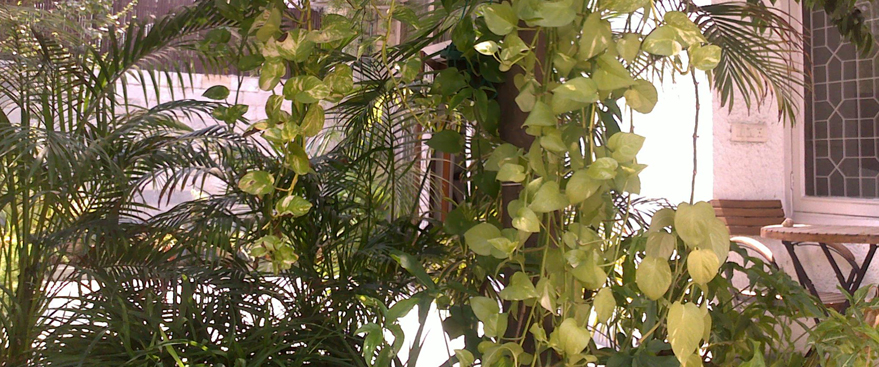
I get my laundry off the line quickly. Held in the fold of an arm, the clothes are hot and burning. Open the door, scald fingers on door handle, step into the stairwell, close the door behind me to stop the furnace heat from getting in. Down the stairs, drop the laundry in the basket and into the L-shaped room; two air-conditioners running, three ceiling fans, and my desk is in there, in the coolest corner of it. Smooth tiled floor where I walk barefoot and all curtains drawn closed to keep out the glare, except for one that offers a shaded view through the foliage of the large leafy tree outside in the garden and the various tints of transluscent green leaves through which sunlight filters. I see in the newspaper today the southwest monsoon arrived in Kerala, South India. Here in Delhi, we’re maybe only halfway through the hot season…

garden1

————————-

‘… the impact of the innumerable impressions crowding in upon man from the world of outer and inner multiplicity, papanca.’ [The Heart of Buddhist Meditation Nyanaponika (Thera)]

Note: The monkey and the orange story developed from a discussion with Lisa A. McCrohan

sustaining factors

monkey-tap-india_1626153iNew Delhi: Monkeys swing through the trees, jump down on to the roof terrace and turn on the tap to have a drink of water. I don’t mind; except that they don’t turn it off when they’re finished, just leave it running – water trickling down the drain from up above – that’s how I know they’ve been there. The neighbours have the same problem. I see somebody climbing up a ladder to the water tank up there at the highest point… what’s he doing? hmmm, replacing the tank lid; the monkeys have pulled it off to get in and drink, and have a little freshen up. Yes, well, it’s hot here, Jiab said around 45°C. Not worth it, being precise about temperatures above 40°, just waves of hotter air wafting around in slightly less hot air, something like being in a swimming pool of hot water. It’s so hot, I feel like a pancake on a hot plate. I don’t want to eat a pancake, I feel I am a pancake… cooked and kept warm. No problem, really, we have a room in the house with air-con, and I’m in there. All I need to consider are these long power cuts, but nothing more than 10 minutes. Longer than that is uncommon. But it did happen once [Link: Power Failure], what can you do? If it happens, it happens – the uncertainty element. Causes and conditions, no more than that. Phenomena are sustained only as long as their sustaining factors remain:

‘When this exists, that comes to be. With the arising of this, that arises. When this does not exist, that does not come to be. With the cessation of this, that ceases.’ Samyutta Nikaya 12.6

I can’t say I’m as detached as that when it comes to coping with stifling heat but knowing that this is how it is helps me to ease off and away from the proliferating stories in the head I don’t know are there because I’m seeing through them [Link to: The World is Made of Stories]. If there happen to be long periods with no air-con, it’s best to go outside, find a shady spot to sit and say hello to the neighbours, who’re all outside for exactly the same reason. Outside is better than in; the heat is trapped in these brick and concrete oven-like buildings. But, so far-so good, most of the time I’m sitting in this cool room.

It’s still early morning but I better get on and cook the food for the day because the kitchen will be like a furnace by noon. I open the door to go in there and enter an atmosphere that could be the planet Mars, images of volcanic slopes and bubbling lava… I have to boil water in the electric kettle, a curious old thing made of metal and if you forget to empty out any remaining water at night, when it has cooled down, tiny ants climb up the side and sit there enjoying the coolness of this small reservoir. Then, for some reason I find them drowned in the water the next morning. I think they must drift off in a dream state and fall in. I suggested to Jiab we just spoon out the ants, then boil the water but this is not well received: I do not want tea made with water that has been swam in by ants! So I’ve learned to empty out leftover water in a bucket to give to the plants.

Kettle boils, add the hot water to the steamer, put in the vegetables and switch on the gas. I can sympathize with the ants, there’s a ceiling fan spinning around, swooshing and splooshing the hot air in gusts and not doing much to lower the temperature. I have to switch it off, even so, when using the gas cooker because the gas flames get blown out and I’d asphyxiate in gas-flavored hot air (limp bizkit, chocolate starfish and the hot dog flavored water – no, no, not that, please…). Switch on the extractor fan, maybe that’ll help. The stove heats up the atmosphere by another 10 degrees and now it must be about 50°C. Strangely, it seems okay because there’s an object in awareness; the heat is coming from that; the gas stove. I don’t notice it’s hot, just standing waiting for the food to heat up, then it’s done and I can return to my cool room…

All there is is sitting in the coolness with this mindful alertness: the possibility that the power may go out any moment. There are more attention-grabbing existential phenomena but this’ll do me… listening for the monkeys and M’s little rhyme she taught me in Thailand comes to mind…

Five little monkeys jumping on the bed, one fell off and bumped his head. Mama called the doctor and the doctor said: “No more monkeys jumping on the bed.” Four little monkeys…

280520131847

————————-

Upper Photo: monkey-tap-India_16761531 GIRISH KUMAR : Message : Animals in News. Lower Photo: Cassia fistula, golden shower tree (the tree the monkeys use to access my roof).

loving-kindness to animals 2

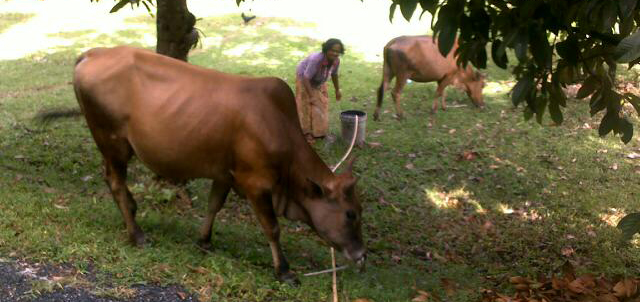
cows2A village near Hat Yai:  Going to see the cows with M and we meet the first one. I ask M about pulling on the rope tied through it’s nose and if she thinks that would be painful? M tells me it’s like pulling your hand and she pulls me along by holding on to my finger: ‘Like this Toong-Ting’ – laughing, Toong-Ting as a reluctant cow… I can hear the voice of (her auntie) Pa K, who lives here, a down-to-earth farming person; and I guess M must have asked Pa K the same question and she’d shown her, as M shows me now. I’m also aware that M sees me a bit like a grown-up child, because I’m a foreigner and have such naïve views about things. For us Westerners, the simplicity of rural life is attractive, but we’re not able to see it in the long term, or accept the hard work that’s necessary to be able to live like that. Also having to accept basic truths like killing animals for food and all that… yes, well, I don’t discuss this with M. We just go on through all the wet ground towards the other cows in the distance.

There was another time I came here to visit the cows, and met the little cow with the bamboo bell around its neck: clacka-clacka sound when it’s eating grass – strange grass-eating rhythms. We stop and look at it, and it looks at us. Such a miniature creature, it looks like a calf, and comes towards me with cautious movements, swinging head in motion with the way it walks. It raises it’s head and points a snuffling, sniffing wet snout in my direction; bits of grass and green stained mouth. Large snorts. Then it extends a long tongue and sticks it in it’s nostril (how do they do that?), comes a bit closer and there’s quite a bit of sniffing of the air around me. This cute little cow is curious about me due to a certain familiar milky smell coming through the pores of my skin? It’s not smelling the others who are with me like this… Thais don’t drink much milk so I’m thinking, hmmm, here’s proof that the Western body releases a noticeable odour of milk. I know this little cow has never been near to a Western person before in its life. The recognition of this milky smell, a familiarity: I am an upright, standing-on-it’s-hind-legs member of the species – a cow person? A bit disturbing… I’m conscious, all of a sudden, that humans are carnivores and there’s this unpleasant conceit about being at the top of the food chain that’s bothering me right now.

Scan-130523-Cow1

Later, reflecting on this while eating a breakfast of grains, nuts, fruit and cow’s milk – jaws move in a slightly circular motion, down up, down, up, down, grind, grind, and swallow. I’m an animal too. I consume the environment, whether it’s other animals, fish, vegetables, eggs, milk and – we are the cow’s babies! I notice cutting up vegetables is a bit of a sacrifice too; every time I start to cook food there is the opportunity for this kind of contemplation. Vegetables and fruit may not have the obvious characteristics of sentient beings but we may eat their reproductive organs along with everything else and that’s kinda weird…

There’s a couple of lines of text somewhere in an essay by Tan Ajahn Buddhadassa, that I cannot find at the moment; it’s about consciousness of all the things we eat, bits of animals, poultry and fish and how all their ghosts will come back to haunt us in the end. Pretty scary, nowhere to run, everything we are: mental, physiological, flesh, blood, and bones is a composite of what we have eaten, internalized. And it extends back through the generations to the beginning of time. The cellular substance of what we are is a genetic composite of all kinds of animal fats and enzymes and there’s just no getting away from it.

Contemplating the eating of meat helps me to see the true extent of my delusion driven by a voracious appetite for all consumables. Things I feel drawn to consume surround me – non-food items; ideas, concepts, ‘mind’ hungers for mind object. Consciousness is clouded over by habitual ‘mind’. Remove habitual ‘mind’ and there may be something like a deluge of reality comes in and with it comes a satisfactory understanding of the mystery that people eat animals.

Scan-130523-cows3

When Acharn Mun was at the end of his life, weak and lying in a village in NE Thailand, a very large number of his followers began to assemble. He asked the bhikkhus to take him away from the village because the villagers would have to kill many animals to feed those people. They took him to a nearby town where there were market places and various kinds of prepared food could be easily obtained. Shortly after that Ajahn Mun passed away.

‘From the day of my ordination I have never thought of harming (animals), let alone killing them. I have always extended my loving-kindness to them, never neglecting to share with them all the fruits of my merit. It would be ironic if my death were to be the cause of their deaths (‘The Venerable Phra Acharn Mun Bhuridatta Thera, Meditation Master’, page 201 – 202).

————————-

Sections originally posted in loving-kindness to animals 1 and re-posted here.


the holding-on habit

2012-06-01 17.46.31A village near Hat Yai: Sitting in the house with M, it’s been raining and the farmyard is a plethora of muddy things. M is inclined to stay indoors and that’s how it is today, a day of uncertainty, the catastrophe of failed projects, unfinished paper structures, and fooling around with the camera phone. M is tired with the stories in her 9 year-old world. Some excitement and interest when: clacka-clacka, the sound of the cow with the bamboo bell around its neck, energetically chomping the grass that grows around the house – all this thick lush grass in the wetness. The other cows, four altogether, have been brought home because it’s the end of the day and soon they’ll be herded into the cowshed and closed in for the night. I ask M if she’d like to go out? We can get the big umbrella and go look at the cows? But this is not a good question to ask right now.

Complex emotions, M is suffering a disappointment. We took her to the bookshop in town. There was a book about science with a ‘SUPER SCIENCE KIT’ in a large box that went with it. The thing is, it was really too advanced for M but she became convinced she had to have it. So we got it, came back to the house and I started to look at the instructions. Opening the box and assembling the pieces of the kit, test tubes and small pieces of plastic equipment – all that goes okay, but following the instructions to carry out the experiments, has no meaning for her. She simply doesn’t know where to begin and I can’t explain because of our limited communication. She tries to enter a created story with a ‘pretend’ thing but science doesn’t work like that. Somebody thoughtfully removes the difficult SUPER SCIENCE KIT and all that can be done now is damage repair. M is quiet. I ask her if there’s anything I can do, and she says, ‘… no, is OK, Toong-Ting.’ (Toong-Ting is M’s pet name for me.) I suggest we read a book or play with the iPad… then I remember there’s no Internet and some of her apps don’t work. That’s part of the problem. ‘No, Toong-Ting, is OK,’ she says.

So I sit with her, everything is dull and meaningless – I can feel it too. M makes small, whimpering sounds like her digital kittens on the iPad. She’s holding my arm, cuddled up in a small ball next to me, eyes closed and face hidden away, struggling with the uncertainty of her world. Thai children are taught othon [khanti] patient endurance – or it could be an inherited character trait. I don’t have any children of my own, so no experience; having M in my world is an opportunity for me to learn. What I notice is, there are no tears or tantrums that I’d expect (from Western children). Here, it’s more like a locked-in holding. I’m available, ready to support, but I can’t do much to divert her attention. It’s the holding-on habit and what this is about is just allowing for these moments of not knowing that we’ve all got to get through, somehow, and the uncomfortable feelings that go with it. Just letting them go…

I’m affected by the mood, it’s really tense, but can sit quietly without making a ‘thing’ out of it. The self is a sensory experience. The experiencer is itself an experience. Consciousness is the sensory organ of the void. There can be nothing separate from this, except the ability to think about things. The question, then, is: what is thought? And thinking about thought, itself, leads only to the empty space where the question used to be…

Some time after that somebody finds a small bottle of food colouring in the kitchen and I show M what happens when you put a tiny drop of it into a test tube of clear water. The violet colour is like a tendril of descending smoke curling around the inside of the test tube and her whole attention is focused on this extraordinary event; the world is opening up again… wow! how to develop this? The uncertainty of the moment has vanished and suddenly everything seems full of wonderful choices….

Cowscrop

————————-

‘What effort should I make? Should I do something about this situation or simply watch my mind?’ Such moments of not-knowing are precious. Uncertainty does not have to be seen as failing. In fact we might lose something important if we are in a hurry to push past it. The actuality is I don’t know what to do and there is not necessarily any fault in that. If, however, I’m completely caught in the momentum of wanting to escape suffering, I may miss the truth of the situation, as it is, and learn from it. With the confidence that comes from our commitment to precepts we can afford to trust in being patient and aware of ‘not-knowing’, and the uncomfortable feelings that come with it. Feel the force of the momentum of wanting to get away from it, to ‘solve it’; stubbornly refuse to be drawn along. We can experiment with waiting until the feeling of being driven subsides and quietly listen to what intuition suggests we could do.’ [Ajahn Munindo, Dhammapada v. 276]

 [Note: There are references here to, ‘the experiencer is itself an experience’, taken from an Internet source I can no longer find. If anyone knows the origin of it, please let me know, thank you!]
Upper Photo: My pic of M taking a photo of me. Lower photo: The cows coming home

mind-boggling blog awards 1

804px-ErasumsDurerHi there, blogger buddies. This is about a couple of award nominations that arrived at my door the other day, sent by Rory, at beyondthedream.co.uk. It reminded me about other award nominations I’d received, just left there on the shelf, gathering dust. Why? Because I have a pretty small group of blogger buddies in my little window here and the requirements are finding others to nominate… that’ll be too difficult, I thought. So, well, anyway, this is how things were and I wasn’t sure what, how, where to begin. Then it seemed do-able, somehow, and I started to get into it a bit more. In the process, I began to think about the idea of REFRESH and renew and to reappraise the whole concept. Thinking about it can go on and on but it’s the doing-of-it that makes it work. It’s a good thing really, the circulating Awards for these really mind-boggling blogs to be found here and there on the planet, I never really doubted it. It does need a bit of focus to get it all presented correctly, but what I see now is that doing this, collecting all the links and connecting it all up, of course, brings us all closer together.

So that’s how it happened for me and I’m grateful for Rory’s nominations for both the Versatile Blogger award, and the Best Moments Awards. I’ve been following Rory’s blog, beyond the dream, for about 6 months and there’s all kinds of interesting observations on Non-Duality in his archives. Also a wealth of related material that’s well researched. I’m a regular visitor. Okay, then, this is what it looks like:

versatile blogger award

And now I have to share SEVEN THINGS ABOUT MYSELF:

1. I was born in the North of Scotland. It’s really cold there – and that’s all I can say about it.

2. My favourite fiction authors are Richard North Patterson, Scott Turow, Robert B. Parker and K. C. Constantine.

3. There are two exceptional countries in the world, Switzerland and Japan.

4. I had cancer in 1994, in Thailand and some Theravadin Buddhist monks helped me manage the pain and recover from surgery. After that I became a Buddhist.

5. I do 30 mins meditation every morning. But sometimes I forget.

6. At the Delhi meeting in 2012, the Dalai Lama spoke to me and held my hand. His skin is so soft!

7. My wife is Thai, we have no children of our own but take care of our 9 year-old niece part-time.

best-moment-award

Awarding the people who live in the moment,

The noble who write and capture the best in life,

The bold who reminded us what really mattered –

Savoring the experience of quality time.

RULES:

Winners re-post this completely with their acceptance speech. This could be written or video recorded.

Winners have the privilege of awarding the next awardees! The re-post should include a NEW set of people/blogs worthy of the award; and winners notify them the great news.

RESOURCES:

  • What makes a good acceptance speech?
    • Gratitude. Thank the people who helped you along the way
    • Humor. Keep us entertained and smiling
    • Inspiration. Make your story touch our lives
  • Get an idea from the great acceptance speeches, compiled in
  • MomentMatters.com/Speech
  • Display the award’s badge on your blog/website, downloadable in MomentMatters.com/Award
  • ACCEPTANCE SPEECH:
  • Thank you everyone for following my blog and all your ‘likes’ and comments. It means a lot to me. What am I trying to do with my blog? It’s been described as chapters in a travelog/spiritual autobiography. That’s it, more or less; the Buddha’s Teaching on the simple reality of being here. And that’s why I believe blogging is important; we’re all in different parts of the world, yet we’re all here, each in his/her reality space, contemplating this, reading others’ pages, writing our own. That’s the internet, it’s simply amazing. The intention is just to share what I’ve learned about how it works, moment by moment. I’d call it Applied Buddhism, rather than the theoretical kind. It’s the doing-of-it, the ‘practice’ that has helped me. And it’s in this way that I hope it can help other people. The sense of it is generosity, relinquishment, giving it all away, no holding on, no attachment. All this springs from G R A T I T U D E to the monks in Thailand who helped me in 1994, and changed my life. It’s only been about 9 months since dhammafootsteps went public but, bit by bit, it’s becoming part of my life. I spend the first two hours of every day reading the blogs I follow and checking comments and replying to these. I copy parts of posts that are interesting and paste them into my own notes. My own posts are often developed from this source material. It’s how we learn. And so that’s all I have to say right now. I’ll be back soon with some other award nominations that are lying on the shelf. Thanks again for the nominations and thanks too everyone for doing what you’re doing and the creativity of all bloggers everywhere.
  • NOMINATIONS:
  • a mindful traveler
  • A4man
  • burgessart
  • everyday gurus
  • gems of delight
  • grow your innerself
  • julie green
  • ladybluerose
  • mindful diary
  • poet4justicedotwordpressdotcom
  • shift
  • spiritual artwork
  • superaalifragilistic
  • the wind horse blog
  • who is bert
  • ps. could someone tell me how to get rid of the formatting of these bullets?
  • Image: Durer engraving of Erasmus 1526, Rotterdam, Holland

persistence of the dream

Mpic2A village near Hat Yai: Here in a house surrounded by trees, it’s nearly one year since I was last in this place [Link to earlier post: ‘nothing in itself’]. Birdsong and mostly quietness; only a faint noise from the road reaches us here, drifting in according to wind direction. And the sound of two puppy dogs yap-yap tied up on long leads, getting bathed by being dragged along the concrete path, pulled under the garden tap and held there as long as possible (they’re so small you can do that), then untangling the leads is the difficult part. They soon dry off in the hot sun. The chicken population chirp-chirp of last year has disappeared from this world, some eaten by carnivorous nocturnal creatures that watch from the edge of the clearing. Most are eaten by carnivores who live in the house – thus the truth of farmyard life is revealed. A new population of chickens pecks the ground chirp-chirp where the others once pecked, and who’s to say they’re not the same ones reborn? A piebald kitten miaow goes around seeking attention, miaow. Four cows; three have bells tingaling, tingaling, tingaling around the neck and there’s one with a bamboo bell that goes clacka-clacka. Three of the animals are dignified and silent; there’s one that goes moo-aaaah, feeling a bit hard-done-by, maybe. I don’t know if it’s the one with the bamboo bell; that’s just the way it is, no obvious connection; no reason for it – or for anything. There’s just this multiplicity of loosely related phenomena that has the characteristics of a farmyard scene. It’s like this right now because it’s nearly evening, and everything’s going: chirp-chirp, yap-yap, miaow-miaow, tingaling-tingaling, clacka-clacka and moo-aaaah. Sun turns orangey, pinkish purple, sinks rapidly below the horizon – no twilight. Approaching darksome night mystery, and wild nocturnal carnivores wait in stealth at the edge of shadow. Insects zzzzzling and large moths surround the porch light that’s left on till morning.

28052010010Upstairs in the half-dark of the guest bedroom, M can’t go to sleep. ‘I not go to sleep yet, Toong-Ting. You have to tell me a story’, she says, addressing me as Toong-Ting, in her 9 year old way of giving people and things in the World different names. It’s my responsibility, I’m the fictionist. Too late now to go find a story book from downstairs, and I try telling her that…‘Then you tell me your story, your own’, M says. This means I have to invent something… there’s just no getting away from it. So, in an inspired moment, I start telling her about all the birds here around the house and, when we leave next week, all the chickens and the rooster and the ducks and birds in the trees and the owls will come with us to the airport. They’ll have to take a taxi by themselves because there are so many of them but the driver can follow us in our car. They don’t have to check in any bags because they don’t have any bags, of course. They just get on the plane with us, perch on the seat backs and arm rests and fold-away tables and go: chirp-chirp, cockadoodledoo, quack-quack, woo-woo, tweet-tweet as the plane rushes along the runway, up into the air, flies away into the clouds, far far away until nobody on the ground can see it anymore. There’s a short pause and M asks me, ‘Leally (really) Toong-Ting? Why the birds go in a plane, they can fly by themselves?’ And, yes, there’s this unforseen logistical problem about the story, I realize – so, I begin my explanation for these circumstances then notice that M has fallen into the dream and is already asleep…

————————-

‘If in this way I see one of these creatures withdraw from my sight without my ever knowing where it goes to, and another appear without my ever knowing where it comes from…; then of course the assumption that what vanishes and what appears in its place are one and the same thing, which has experienced only a slight change, a renewal of the form of its existence, and consequently that death is for the species what sleep is for the individual…’  [Schopenhauer, The World As Will and Representation, Supplements to the Fourth Book, Chapter XLI: On Death and Its Relation to the Indestructability of Our Inner nature]

no more than this

161120121610Chiang Mai/Bangkok flight: Sitting on the plane with M beside me, my Thai niece, and her coloured Tshirt, funny hat; her iPad mini and her 9 year old vision of the world. I’ve been watching her use these kiddy’s applications; cute kittens with large eyes and she shows me how they respond to your voice; all kinds of stuff. We can make fruity ice-cream drinks, waffles and cup cakes with different kinds of toppings and M insists I have an opinion about what kind of toppings to have – lemon or strawberry? It’s important! M asks me in basic English; only the key words: What you like, Toong-Ting? So I choose a lemon topping. When it’s finished we eat the cup cake by tapping a finger on the screen. The name Toong-Ting is part of her former baby language she doesn’t use any more but, somehow, M decided to keep it as my name. She selects things in this unique way because English is a second language. Maybe it’s easier to say Toong-Ting than my actual name, or she likes the idea of being cute (I think it’s this).

And so the time is taken up with M asking me about various things like this. I engage with her on these points and in the intervals, when she’s busy with the iPad, I’m simply aware of our physical presence. There’s really not anything left to think about… mindfulness, waiting for the next question. In the silence there’s a curious emptiness, just a quiet awareness, bhavanga, the space in-between; not reacting to stimuli, there’s nothing happening. Just being here; the knowingness of it. My responsibility is to take care of M; to respond to her small requests in a way that’s in tune with her way of thinking and her use of English. That’s all. We are linked in our present-time mutuality and there’s nothing else coming into consciousness from the outside world unless it’s something very interesting or something we need to be careful about. Right now, here in the aircraft seats, it’s all very bland and neutral. Somehow I seem to have sidestepped my own mental activity; the usual state of affairs of the mind, the way the ‘self’ attempts to perpetuate itself is seen; there’s only this, being here…

Then the cup of coffee is served and M says I should have the powdered creamer in the packet that comes with it: ‘Why you not put that in your coffee, Toong-Ting?’ and she looks at me with these almond shaped eyes and little face… so I put the powdered milk in, even though I normally take black coffee. She watches me open the paper packet and pour it in, her eye level is much nearer to the brim of the cup than from where I’m seeing it. I lean over, we watch this together, powder dissolving in the cup in small clouds and imploding movements. I never really noticed it before… children are here to teach adults (I read in a blog recently?). M tells me to try it and see if it tastes nice. I try it and say yes.

Looking out the window, down on the land below, there’s the surface of the planet; swirling movements of rivers and patterns of vegetation, land shaped by many hundreds of years of the wind and climate, and it looks like the powdered milk dissolving in the coffee. Liquid in a small plastic cup 38,000 feet above what’s seen on the surface of planet below; macro/micro, the oneness, all things have the same characteristics. ‘Look, look at this, Toong-Ting!’ and I have to look again at something else M is doing and make a comment about that. We discuss it for a while, then back to considering the powdered milk in the coffee and I’m feeling this same continuing state that’s empty of thought. I know that M is going to ask another question soon so part of my attention is occupied with being ready for that with a clear mind; metta, loving kindness. I’m a passive passenger transported on an aircraft, aware of the immediate surroundings; a gentle bumping of the plane, the hiss and hum of the engines. Just a sort of space I am occupying right now, no more than this…

————————-

‘Bhavanga literally means “factor of life”; bhavanga is usually translated into English as “life-continuum”. The bhavanga-citta keeps the continuity in a lifespan, so that what we call a “being” goes on to live from moment to moment. That is the function of the bhavanga-citta.’ [Introduction to the Abhidhamma]

Photo Image: Flowers growing in a Thai temple in Buddhist India