wisdom in unknowing

ChmaiNshopChiang Mai:  Street-side, noodle shop, low headroom under wide umbrellas placed at an angle to create shade. I duck my head and squeeze through into this place, aware of obstructions and watching for uneven surfaces at ground level I could trip on; feet in rubber slippers appear below me, first left then right, then left… ask the noodle shop man if he has what I want, find an empty place, sit down and look around. Thai language like birdsong and traffic sounds, a bell rings, cooking pots collide, somebody’s ring tone… ‘hello?’ All kinds of noises, smells and the fragrance of jasmine with faint odour of a sewer nearby – not unpleasant. The mind has to discern which is which according to likes and dislikes. And the high-activity level of it all more or less insists on mindfulness. Head spinning around to register environmental activity; this curious reality of receiving sensory input by means of sense organs situated mostly around the head and face, has that effect of the whole head seeming to enter into an ‘outside’ world.

Attention moves from one thing to the next. Loud sounds take priority over quieter sounds, the whole sequence adjusts to allow for it, then continues as it was before. In the same way, a chain of thought waits to be completed as soon as there is a gap in the flow of other thoughts. It’s the traffic of thinking about things; the mechanism engaged in its functionality, never any peace. I find some stability in the constructed self and hold on to that – that’s what it’s there for.

Focus on a particular sound, or sensory object and logic says if that’s out ‘there’, then I must be in ‘here’ – subject-object link activated by default. The world enters through eye, ear, nose, mouth, body feeling, mind, and creates consciousness: ‘I’ am born and the ‘world’ is out there. Being a ‘self’ is a little trick I learned when I was a child, it’s not real. It only appears to be a personal experience, because if there’s a sound that’s not demanding my attention, there’s only a neutral awareness, no reaction, nobody at home; the sound is there but there’s just the receiving of it and our shared world. Sensory input enters and there’s no ‘self’ to really notice it’s there, so I imagine it just buffets around for a while like the wind from the fan above my head disturbs the papers on my table and then it’s quiet again.

Conscious awareness is the sixth sense. It knows the other five senses, and knows itself as a ‘self’ then attachment to that dissolves away; the ‘self’ aspect is gone – seeing the events without the story. Deconstruct everything, carefully disassemble it to see how it all fits together, like a mechanic breaks down a car engine into its parts. And this is such a phenomenal thing to do, putting it  back together again doesn’t seem worthwhile.

‘Self-realisation can know itself within complete ignorance, so self-realisation is possible for someone who’s had no education and it can also be possible for a king. There are no preconditions to self-realisation. Self-realisation isn’t just for those who’ve undergone years of spiritual practice….’ [David Bingham, Conscious TV]

Can’t be ‘complete ignorance’, let’s call it ‘unknowing’. Just another mind state. I can look into my own ‘unknowing’ and it’s as if there’s a small seed of wisdom in there, buried deep in the layers of unknowing, that’s saying, come on, wake up! I could call it the Noble Truth of Waking Up (numbered 2a and it comes between Tanha and Nirodha). This is how it looks to me now; there’s the focus on Anatta and freedom from suffering and the Non-Duality ‘no-thing-ness’ takes on a whole different meaning.

————————-

a movement in time

P1030990Chiang Mai: Walking back from the market carrying bags of vegetables through groups of slow-moving people in brightly coloured clothing; noise, heat, bright sunshine, large, coloured umbrellas and dense dark shadow. All kinds of obstacles on the pavement, sidewalk – more like walking on the edge of the road, sharing the space with the traffic, things being as they are, in this densely populated place where the sidewalk is often needed for other civic requirements. Maybe a phone box takes up the whole area. Or there’s a tree in the way, uneven paving stones due to ongoing repairs, or a raised concrete lid over a drain, fallen in, and one corner sticks up at an angle so you step down to street level because it’s easier. Then there’s a parked car in the way and you have to get around that; mindfulness of moving traffic coming in all directions. There’s an alertness that just automatically locks in place, obstructions and dangers above and below and on all sides like this, the infrastructure intrudes, but always there’s just enough room, squeezing through a sort of tunnel of directional force that extends in front, takes me along out from the space I’m in here now, along the way through this urban clutter and busy-ness of objects.

Then something happens that’s completely unexpected. There’s a green cloth sheet that obscures a construction site on my left side; three or four floors up, scaffolding, ropes and there’s a tied-up bundle of concrete blocks being lowered down above my head – it’s coming too quickly, I can see it in the corner of my vision. This lowering bundle strikes a sticking-out platform on the way down and a large board catapaults out, spins in the air and lands just behind me CRASH! There it is, a long heavy scaffolding board held by the green cloth sheet, now ripped, and the board caught there in a small cloud of dusty air. If it had been one second earlier…. People stop and look up, call to the workers in the building. They lean over, wide-brimmed straw hats, observe the scene. There’s some shouting and I don’t want to get involved in this; continue down the path to the apartment, nearly there. Open the door and the air conditioning hits me, up in the elevator, unlock door and into my quiet rooms.

I’m trembling, – there’s an elation too, can’t decide if I’m happy or scared out of my wits. Can’t get over how near I was to being injured by that falling board. The important thing is that it missed me and maybe that’s the way to go with this – no matter how near it was, it didn’t happen. Something is telling me I need to let go of the holding-on thing here; just calm down and watch the breath for a bit. Open the laptop, start-up, find the page I was looking at yesterday, Sangeeta’s ‘Serene Reflection’ and her Inner Landscapes page:

http://serenereflection.wordpress.com/2011/09/30/inner-landscapes/

‘I meander along the babbling brook – all the while realizing that its song comes from the obstructions it surmounts.’ It all fits together. There may be obstructions in the babbling brook but the water passes through them all anyway. We hear the sound of it: a river of small collisions. The near accident is telling me the World is all of this and more; the obstacles and that which encounters the obstacles. Sometimes I can look for an understanding of it everywhere and not find anything because I am part of what I’m looking for; that which is looking for itself, not finding it and seeing that this is what is taking place. This is what it is really but I can’t see it. Or you can say there’s nothing to find anyway because, always, it’s the World revealing itself, and ‘my’ seeking it isn’t actually doing anything. It’s simply a movement in time. This thought is enough to see the event as part of a very much larger all-inclusive whole…. And I can abide in that restful awareness.

P1040085

————————-

Photos: Bang Pah In (upper) & Khaosan Road (lower) by Peter and Elaine Henderson

a handle to hold on to

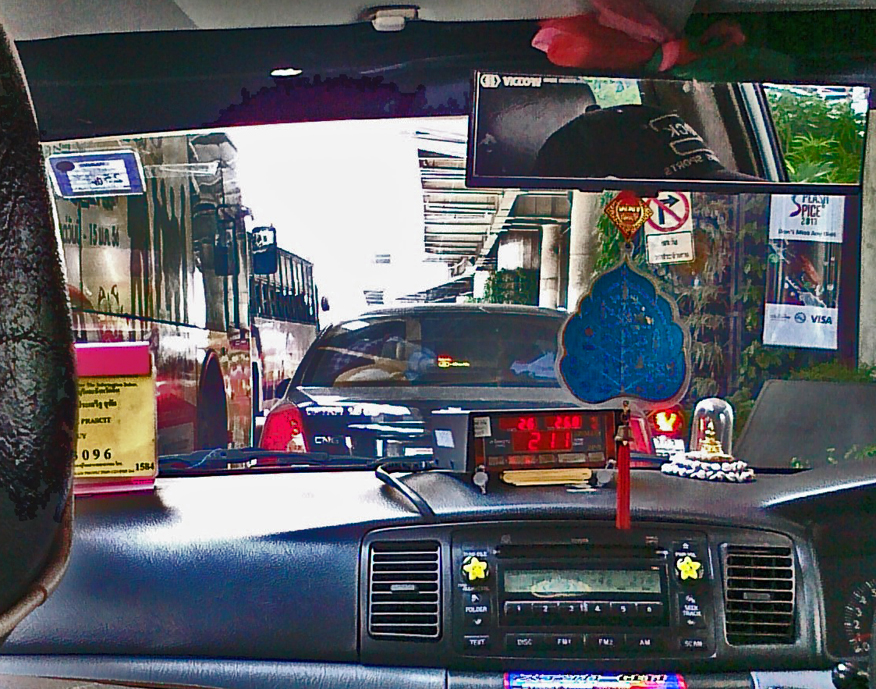
201020121489Chiang Mai: Going to the airport in a tuktuk through a network of small streets. It’s probably a shortcut, but all these speed bumps? I’m feeling a bit queezy, seasickness must be like this. Or is it just that I’m surprised to be rolling up and over joyful little mountains. First the front wheel then the back wheels (three-wheeled vehicle), again and again; overkill on speed bumps. Sure enough it makes you feel giddy, all the ups and downs and I don’t ‘like’ it much but my wanting it to not be like this is making it into an issue. It’s a control thing, it’s about the so-called ‘me’. ‘I’ am the problem because, in fact, there’s nothing here; a body-mind mechanism that can process and transform data, the Five Khandas, that’s all. Nobody at home, no ‘self’ anatta, no-thingness. Only namarupa responses, natural processes and the feeling of ‘I’, ‘me’ and ‘mine’ arises due to the curious nature of sensory experience – this game of hide-and-seek, and the flip-side of concealment is revelation?

Maybe so but first things first, at this point in time I’m having an acute bout of speed-bump nausea and the small discomfort of it is in the centre of consciousness. Some basic sense informs me it’s a mistake to try to reject it or think it shouldn’t be there, I’d be better to get around to accepting it; the 1st Noble Truth, a deep acceptance that causes the ‘holding’ to ease off and there’s definitely something about this teaching; if you can understand it, the suffering disappears. The first time I came to see it, all kinds of habitual ‘holding’ that had bothered me for years just fell away. Gratitude to the Ajahns in Thailand for their guidance. It seems to me now though, there’s still something I’m not getting here? I’d been thinking that all the Theravadin masters are teaching, in their tremendous intensity and detail, is mindfulness about what you’re doing and the skill of letting-go. Beyond that there’s nothing said except the reference to it as the ‘deathless’.

‘When meditators practise correctly and have the discernment to see that quality (of deathlessness) as it really is, the result is that they can withdraw their attachments from all things — including their attachment to the discernment which enters in to see the quality as it really is. The practice of all things good and noble is to reach this very point.’ (Ajahn Thet)

Non-duality teachers talk about pure consciousness in the sense of something tangible; they’re saying there’s something ‘there’. The ‘I’ that is arising is the ‘I’ of everything. Theravadin Buddhists, on the other hand, are saying it can’t be like that; it’s emptiness – if you think there’s something there, it’s a handle to hold on to and the whole thing is about letting go, not holding on. So, today I’m thinking it’s helpful to have the stability of that ‘thing’ and I’m holding on; I want there to be something in that space, a sense of familiarity, it’s a known place and the sick feeling can be happening in an awareness that’s much larger than the confines of the cramped ‘self’. No little ‘me’ having to cope with it, the speed-bump nausea is not ‘mine’, no ownership, it’s not personal.’ It’s about learning how to be a totally open presence, aware of the way the ‘self’ perpetuates itself – on all levels and not buying into that.

A short while after that, thankfully, we get out of the narrow streets, small intersections, and onto the open space of a smooth, flat, easy highway in one long straight route across to the airport….

————————-

the way out

yak2Chiang Mai: 06.00hrs and it’s still yesterday in the West, internet is slow and unpredictable, busy with the millions of people over there wishing each other well for 2013, sending messages, sharing images, ‘liking’. World is populated with beings preoccupied with devices that can render the ‘self’ as an actor that ‘I’ choose to project to others; mind reflects upon itself in its own world, is aware of its perception of itself as subject in its own blissful states. Other times seeking to escape from the perceived emptiness surrounding the idea of ‘me’ being separate from the world; go that route and, in the end, there can only be an experience of total aloneness – it can’t be that way. But here, some people find God, superimpose a personification on that emptiness. Others just go along with it anyway, what else is there… we’re all on the road to nowhere, yes, I could be convinced, enough to comply with the economic system the politicians try to assure me is real even though I know it’s just based on a concept.

So, taking it on face value, like this I know the whole thing could so easily fall apart, it’s so very fragile but somehow it doesn’t – there’s that collective holding-on thing. The God mechanism is there whether I believe in it or not and I may go on being controlled by circumstances or I can decide to investigate, examine it. What’s going on here? I see everything in the world, through consciousness but I can’t see consciousness itself because I am that consciousness, there’s a subjectivity about everything. Then, when I see things and other people out there in the ‘world’, I’m suddenly an individual again, a self, separate from the world. ‘I’ engage with everything, subject to inherited kamma and actions create more kamma, mostly of no consequence, possibly laying foundation for another state of being at some future time? And from that ‘distant’ place, this place ‘here’ is seen in hindsight, as if it were a former life – this is how it began?

Why bother with beginnings, so distant and removed from this time and place. There’s only what there is now; no past and no future – time is a construct. I’m here situated in the East, 7 hours ahead of London, 12 hours ahead of New York, 15 hours ahead of San Francisco and then time measurements come to an end somewhere in the Pacific ocean, so it’s called a different day, of course. Continue in that direction and I return to the time zone I’m in now, except that, supposedly it’s the day before yesterday. It’s not, of course, it’s always the same day, only present time exists. Always present time and the way out of this puzzle is here, nirodha, Third Noble Truth.

“… the remainderless fading & cessation, renunciation, relinquishment, release, & letting go of that very craving. (the noble truth of the cessation of dukkha) “— SN 56.11 (dukkha nirodho ariya sacca).

Daylight coming through the windows, I hear the monks chanting downstairs and go to the small balcony, to see. Down below there are about thirty people from the hotel opposite kneeling, receiving blessings for the New Year – and two large baskets of donated food, dāna generosity. Four monks in pale tangerine robes facing the small group and the sound of Pali verses created in the Buddha’s time 2600 years ago…

————————-

– Best wishes for 2013 fellow bloggers and thank you for dropping by in 2012 –

the conditioned realm

CambodiaAnkorApril00(6)detailChiang Mai Airport: Waiting in departures to board the delayed flight to Bangkok. Three flights leaving around the same time, very crowded and all seats near the gate are taken. It’s the peak tourist season, young Caucasians sprawled around on the floor, everywhere. Long legs, pointed elbows sticking out – This Is Our Way – a sea of brightly coloured T-shirts, shorts, rubber slippers. And no room in the small coffee shop either; a forest of exposed limbs, tattooed legs, bosoms, identity obscured behind dark glasses, headphones, peaked caps and hunched over iPhones and digital devices, sucking up drinks through a plastic straw and I’m thinking of the tubular proboscis of a large alien insectoid. This is how the Gap Year looks. Like they’re sensory-experience junkies, got to have that input by way of the sense gates ayatana – closed to the world and the thought of emptiness is a seriously bad dream.

They do have that intense look, though, that says they know the ego of the West is a self-sustaining concept running out of battery and most likely to fizzle out quite soon; you could say impermanence, annican there’s no substance to it, same with all things. There’s the Christian God of the West everyone is trying to distance themselves from; the one-and-only-God, elite club that disincludes two thirds of the world’s population because they’re not Christian. It’s like a right wing supremacist movement, same as the so-called Muslim extremist groups – spot the difference – pretty ugly; there’s a war and both sides pray to God to win. God gets confused and there’s another war, and another…. So they can’t be talking about God, the Ultimate Reality, what they’re talking about is one of the gods of the conditioned realm. The logic of this is inescapable – how could God be something that one religion has and another doesn’t have? But there’s a kind of nobody-at-home look on the faces of my Christian friends when it seems like I’m going to want to try to discuss this point further.

These young people are all ordinary, well-intentioned folk and, just on this level, doing what they believe is the right thing, believe in the naiivity; subject to their conditioning in the West, their peers, parents, school, government. Maybe they’ve come here as part of a response to the human wake-up call – the built-in awakening opportunity that exists in mystical religions, Muslim, Hindu, Buddhist and others. It’s there too in the postmodern world; deconstructing, breaking it all down until there’s absolutely nothing left and the wake-up call is activated. Some people wake up, but some just don’t wake up at all.

It gets complicated and that’s why the Buddha was saying life is difficult enough as it is so let’s not get engaged with the God concept, okay? Attachment to the idea of it becomes a desire in itself and that’s what’s causing the problem. Ultimate reality is so fragile and subtle you can never be absolutely sure you’re not still setting it up so you’re seeing it the way you want it to be, still in the conditioned realm and far from the Truth. The best thing to do is not call it anything, cultivate mindfulness, clear comprehension, discerning awareness and take care; see how that goes.…

————————-

‘… the illusory world is through attachment. We think we all live in the same world as personalities, but every one of us lives in a world of our own creation. We have certain things in common but so much of our life is personal and unique to ourselves. That world we create is not the objective world we believe we’re living in, we’re living in a world of our own creation. That’s why it’s so difficult relating to each other, isn’t it? We’re coming from different worlds – you feel, sometimes, you’re living with a bunch of aliens!’ [Ajahn Sumedho, ‘In Awareness There is No Dukkha’]

Photo: Louk Vreeswijk

habituality of former lives

WatPohGuardianChiang Mai: 07.00 hours, alarm rings…. It takes a moment and then I remember I’m in the Chiang Mai apartment, arrived from Delhi last night. Heavy curtains over the window; a darkness I’m not used to. It’s quiet here, the sound of monks chanting anumodana on the edge of hearing… takbat. A motorbike whizzes by in the distance; nothing else. Senses are alert, listening, feeling, searching for a way to ‘become’ something that will establish ‘me’ in this place, at this point in time and all the clutter and stuff that’s associated with that. But I can’t fall into habitualities right now, I’m distracted by these new surroundings and keep returning to the minimalism of no thought. There’s an opportunity to leave it all in the impersonal state of not becoming.

I go to the window to see the monks, through the empty rooms as yet uninhabited; space/time occupied with the moving of its integral parts – chapters from a book about tenants moving into a new apartment, the ending hasn’t been written yet and the beginning is a continuation of what happened before. Future time slides into present time, tomorrow becomes today, and ‘now’ becomes yesterday – here we are in the awareness of this moment, the means by which we arrive at this point in time remains a mystery. More chanting, open the curtain and all the windows. Three monks in orange robes and a small group of kneeling Thai tourists from the hotel opposite. Ah yes, many people are on holiday today and it’s quiet like this because it’s Christmas day 2012, I’d forgotten about that – here in a Buddhist country where, really, Christmas is just an ordinary day.

Jesus and all the other great teachers in history were really saying the same thing. In the peace and quiet emptiness of the moment there is no hungry ‘self’, no driving ‘urge’ and it’s possible to see that this world of suffering is a self-created delusion. We are continually re-born into this state due to the habituality of former lives; trying to get what we want or to get rid of what we don’t want, thinking that this is how to get it right. But still caught in attachment upadana; the desired state belongs to ‘me,’ the act of possessing it requires that there has to be an ‘I.’ Everything I have, everything I want, all of this is ‘mine.’ Even that which I consider to be ‘my’ enemy, this is also ‘mine.’ Thus creating a self that is incomplete, unfulfilled, I’m searching for the truth in this and fail to see that it’s the searching that maintains the state of being lost.

In the same way belief in an external creator creates attachment and unthinking devotion to this returns me to the same point of entry, again and again. It’s not about taking refuge in the Jesus or Buddha of the mind. It’s about sila, samadhi, pannya: virtue/ mindfulness of present time/ and the applied intelligence that goes with it. Slowly waking up to this awareness of reality….

————————-

‘If those who lead you say to you, “See, the kingdom is in the sky,” then the birds of the sky will precede you. If they say to you, “It is in the sea,” then the fish will precede you. Rather, the kingdom is inside of you, and it is outside of you. When you come to know yourselves, then you will become known, and you will realize that it is you who are the sons of the living father. But if you will not know yourselves, you dwell in poverty and it is you who are that poverty.’ [Selected Sayings of Jesus from Gospel of Thomas, Nag Hammadi manuscripts]

Photo: Elaine Henderson

the end of the world

dreamstimefree_97357

‘In my beginning is my end. In succession
, houses rise and fall, crumble, are extended,
 are removed, destroyed, restored, or in their place
 is an open field, or a factory, or a by-pass.
 Old stone to new building, old timber to new fires, 
old fires to ashes, and ashes to the earth 
which is already flesh, fur and faeces. Bone of man and beast, cornstalk and leaf.
 Houses live and die: there is a time for building 
and a time for living and for generation 
and a time for the wind to break the loosened pane
 and to shake the wainscot where the field-mouse trots
 and to shake the tattered arras woven with a silent motto.’ [T. S. Eliot, Four Quartets, East Coker 1]

Delhi-Bangkok flight: The stewardess comes to my seat and asks me, would you like a hot towel sir? I say OK, thinking, do I need that too…? Altitude of 28,000 feet, travelling at 500 miles per hour; we must all be moving along here like extended strings of spaghetti in a streak of light. She takes one out with her little forceps from the small box she’s holding, drops it in my hands so I can catch it and it burns my fingers for a moment then becomes a cold and clammy thing with which to wipe the face and hands. Not the ‘hot-towel’ experience I thought it’d be and I notice in passing it’s like all other sensory experience, a bit of a let-down. The sensitivity of the mind is not held by the limitations of the body and I’m always looking for more than what there is. The mind continually searching beyond the present instance; using one thing as a springboard to get to the next, means that everything is driven on and on, and the present time is not here at all.

Consciousness, perception, and reality interact by way of the six sense doors: eye, ear, nose, tongue, feeling, and mind. The one that is accessible is the mind sense-door, leading to awareness of all the other senses, including the sense that it is self-aware; a cognitive functioning focussed on the sense of awareness. Everything falls away, leaving only the arising and ceasing of things. Then that falls away too and there is ‘the end of the world’. Beyond that, awareness continues – not dependent on conditions supporting awareness.

‘When no personal image is created… there is nothing to lose, a sense of gladness, uplift, joy and serenity.
 With the cessation of such a death-bound frame of reference there is the living of the True life, the Holy life. [Ajahn Sucitto, from the Introduction to “The Way It Is”
 by Ajahn Sumedho]

————————-

161120121610

“And what is the ending of the world? … Dependent on the intellect & mental qualities there arises intellect-consciousness. The meeting of the three is contact. From contact as a requisite condition comes feeling. From feeling as a requisite condition comes craving. Now, from the remainderless cessation & fading away of that very craving comes the cessation of clinging/sustenance. From the cessation of clinging/sustenance comes the cessation of becoming. From the cessation of becoming comes the cessation of birth. From the cessation of birth, then aging & death, sorrow, lamentation, pain, distress, & despair all cease. Such is the cessation of this entire mass of stress & suffering. This is the ending of the world.” [Loka Sutta: The World” (SN 12.44), translated from the Pali by Thanissaro Bhikkhu]

Listening 2

kalighat4New Delhi: [Link to: Listening 1] Sitting here, listening to sounds all around, far away and just on the edge of hearing. The process itself seems to select the sound – or the sound is selected (by some unseen process) and ‘I’ don’t have control over it. Kitchen noises, isolated clatter of plates: clink, rolling-around clunking sounds, as objects gently collide with the environment: bump, scrape; cupboard doors close, metal sink noises, cutlery makes high frequency sounds I can’t easily identify. Jiab is doing something in there. Some time later, she comes into the room with a tray and plates, maple syrup and banana: ‘Pancakes!’ she says, and I go to the table. Taste the pancakes. There’s a cognitive function which investigates the senses, different from the receptivity of the sense base āyatanāni; the gates through which the flow of sensory data enters. It’s like a security system which monitors events taking place and identifies objects from outside the body that enter inside by way of taste, tactile sense, mind sense, ear, eye and nose,.

Other sounds come into auditory range; there is recognition, they are registered, processed; memory updated. It happens in a tiny fraction of a second, so fast it feels like trying to find words for it now is in slow motion, another kind of temporality. Auditory events jump out of the background, enough to be perceived consciously rather than just being part of the general surroundings of mixed ‘noise’. The process selects one and it’s not there until I focus on it – or until the mechanisms of focussing are turned in that direction. I listen rather than just hear – see, rather than just watch. It’s the gate of awareness sati sampajañña, through which there is awareness of all the other senses and the sense of being aware itself. It’s an alertness, a presence, the eye that turns inwards – a consciousness of the sensory experience that’s superimposed on sensory consciousness. Cognitive functioning is a sensory organ – consciousness is a sensory organ.

There’s always a returning to look for the beginning of it, how did it start? I only know that at some point, before I was properly aware of it, the parts came together into some kind of recognizable whole and now a thought appears in a small window, the story of it unfolds and ‘I’ am immediately part of this. ‘I’ am involved in the story and the story is about ‘me’. When I leave the story and the window closes, I get a short glimpse of something that tells me there was a window there – and it’s not there anymore. There is no ‘I,’ it just looks like that because everything has the quality of being seen in hindsight.

The process is seemingly directed towards a ‘self’ but if there’s no input, there’s no ‘self.’ Sensory mechanisms are functioning without ‘my’ involvement anattā; they’re waiting for things to arrive because it’s in their nature to do that. All there is, is this alertness. Seeing, hearing, smelling, tasting, touching and cognitive functioning; all are receiving the universe and, since all are also a part of the universe, it’s an all-inclusive experiencing of the universe that’s receiving itself. Just a state of ‘listening’, like a radio telescope dish situated in the middle of a desert somewhere pointing at the sky.

1317385111831

everything that arises…

bgv2New Delhi: Flocks of chattering green parrots in the trees and birds of prey slowly circling around in the upper sky. I watch them from our place on the roof terrace. There’s a table, chairs, an extension cable for electric kettle and all kinds of plants in the sunshine; bougainvilleas and chrysanthemums. If you have ‘chrysanthemums’, why can’t you have ‘chrysanthedads?’ I ask Jiab who is reading the Matichon (Thai) newspaper with great scrutiny. But this doesn’t seem to be worthy of comment right now… and after a period of silence, I get busy with shifting these heavy flowerpots full of earth into a beam of sunlight. Much huffing and puffing, when I’m finished with that and sitting on my chair, looking at what I’ve done, Jiab says to me: ‘… happy now?’ And I suppose I am.

Happy, yes – except of course for that lingering sense that things are not right; not as I’d want them to be. But I’m happy enough, yes. Why? Because all these things that I think are not as good as they could be or should be (even worse); all these things are just there – then they’re not there, I’ve forgotten about them. That’s how it is, I’m not holding on to them. The dark cloud of unhappiness is not hanging over me today up here on the roof terrace with flowering plants in the sunshine. No, it’s a clear blue sky and I can see there is suffering dukkha in the world, yes, but that’s because we’re holding it there, unknowingly. Let it go and there’s no suffering – can it be as easy as that? Maybe it needs sustained effort, over a long period of time. But even so, that’s the idea of it. One can feel inspired, motivated knowing there is an end to it. And I suggest this possibility to Jiab, who now inclines towards me thinking maybe I seem to be making a more intelligent remark this time.

And we talk about that for a while. It’s always interesting for me to hear what she says because like most Thais she knows the Pali terms in the buddhasassana, having learned the chanting by heart in elementary school. Jiab is also fortunate because her Dad was a monk for a couple of years and was able to explain the dhamma to his children: that life is permeated with suffering caused by desire, that suffering ceases when desire ceases and that enlightenment obtained through sila, samadhi, panya (right conduct, meditation and wisdom) releases one from desire, suffering, and rebirth.

What it comes down to in the end, is the basic truth that everything that arises passes away and the Venerable Assaji statement: “Of things that proceed from a cause – their cause the Tathagata has told. And also their cessation — Thus teaches the Great Ascetic.” [Venerable Assaji answers the question of Śāriputra the Wanderer], and how Śāriputra was totally blown away by that and people were getting enlightened on the spot as a result of the Venerable Assaji statement. In this context I’m thinking it means if you can see and are aware of suffering caused by tanha, the attachment to things you love and hate, that’s all there is to it; you see it, you know it, ignorance is gone and no matter how much it is held or the tenacity of the habit to hold on, suffering will pass away of its own accord: “Whatever is subject to origination is also subject to cessation.” And there’s a sudden burst of noise from the green parrots in the trees opposite, so we go and take a look at what’s going on over there, but it’s not anything.

chrysanthemoms

Photos: bougainvilleas and chrysanthemums

things left undone

IMG_4170New Delhi: 05.00 hours. Jiab’s got a cold, she’s been coughing all night, I’m sitting in the front room, hunched over an electric fire, feeling the heat and staring at the glowing bars, I have to blink, even the surface of the eyeball feels hot. It triggers a childhood memory about sitting at the fireside during the long winters in Scotland. Not as cold here, I have to take Jiab to the doctor at 10.30. And considering now, Ajahn Chah’s expression: mai neh (Thai), ‘not sure’, uncertainty: and how, at this time of year in Scotland, ‘uncertainty’ means that if the heating should fail, we’ll all be in sub-zero conditions. Things are just that bit more vital in these circumstances, closer to the edge. Mindfulness is a requirement.

And it feels like I’m just filling in time here, pondering over some future event. It arrives in present time, finds I’m not here, still thinking about it in its future context, far away in a hypothetical state beyond the ‘now’ where all the other schemes, plans and things are left undone. I have a mind to put an end to this, abandon all of it. Half-formed entities without reality that I’ve cherished for years, give them their liberty, let them escape; knowingly release the attachment to all them. Let them go.

Light is coming up. There’s a curious bird perched on the branch outside the window, lively and alert. I’d like to go nearer to see it, but it’s too cold over there so I watch it from my place by the heater. At the point where the eye and the object meet, phassa, a conscious sensory event takes place; a moment of contact between the subjective state and the outer world. It mirrors a similar moment of cognition in the inner being. This basic truth holds my attention for a while and when I look again the bird has flown away.

————————-

PHOTO: CANDLE FLOATING ON THE RIVER GANGES