a future un-lived in

New Delhi: Sunday morning, early, everyone deeply asleep. A dog barks, forming a single sound isolated in the quietness like the frog haiku: The old pond, A frog jumps in: Plop!” The echo reflected off the walls, window glass, ting! For a moment I feel like I’m not here, invisible. This is how it’ll be after we move away from here and the house is to be demolished as soon as we leave, the house agent says. A new apartment building will take its place. How does this feel? Hovering at the edge of vision, large men with jack-hammers, iron picks and shovels, restless, waiting for us to go.

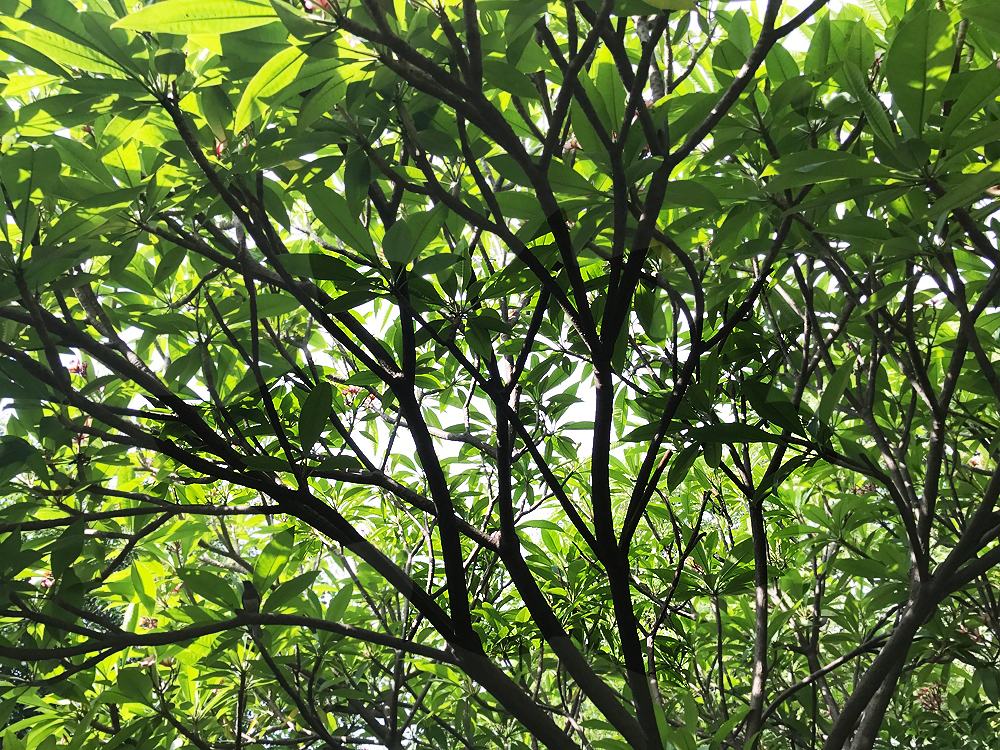
There are huge profits to be made renting out apartments in this area. Our old house is wasted real estate. For us, the tenants, of course we suffer the loss. The entire space we inhabit right now will disappear completely, only the Frangipani tree remaining; leaves covered in masonry dust until the monsoon winds blow, then the rains come and wash the leaves clean again. I try to picture it; we move out and the same day demolition begins; roof is off before lunchtime, walls come down in the afternoon, trucks drive away with all the rubble and there’s nothing but empty space… birds fly through.

Long after this, maybe we forget our old house has been deleted from memory files, and try to remember what it was like being here… unsupported imaginings, totally gone, no evidence here of the building we used to call home – nothing to back it up. Is death like this? This is the end; a future un-lived in, present time has no materiality. I see myself here in an almost invisible house, standing on the second floor with vestiges of walls, floor crumbling away, and I’m just floating up there.

The vanishing of it also somehow associated with darkness, I can’t see anything; for example, entering a darkened room, and have to search for the light switch on the wall, at the door frame b by practiced palm and fingertip reaching over the cool wall until it gets to the switch click. In the other rooms it’s more difficult to find the switch and I’m often stuck there groping in the darkness but no light switch to be found. I close my eyes as if that might help, trying again and again. How can this be? Am I comfortable with the thought I don’t know, and knowing I don’t know? Yes, it was there, but it’s not there now.

No resting place, all is movement, a composition of joined-up pieces which fit together like a jigsaw puzzle makes a picture, then broken up into pieces and back in the box, lid closed. Next time it’s opened and put together, a different picture appears and different players. Transition of moving parts everything has changed again. Not ‘here’ for long enough to say much, just passing through. Sorry, can’t stay, got to go now. But wait, not yet… we’re here until the end of September. This short time we’re in right now is only one moment in countless tiny instances, citta moments, and in larger chunks of time, a sequence of images form movement like the ‘stills’ creating continuity in the old 35 mm celluloid film shown in the cinema, the Moving Picture Show.  First posted August 27, 2017

Anicca (Impermanence), a core Buddhist doctrine stating all conditioned things (physical/mental) are transient, constantly changing, and subject to decay, arising and passing away moment by moment, a fundamental truth revealing the unstable, unsatisfactory nature of existence and the absence of a permanent self, leading to liberation (Nirvana) when truly understood.

somewhere else

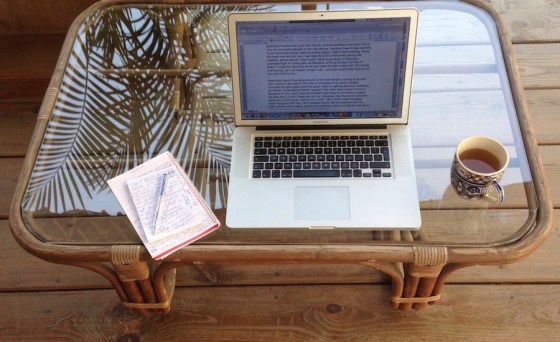
IMG_2056POSTCARD #195: NEW DELHI: These easy days of gentle sunshine on the roof terrace coming to an end. The long shadow of departure is approaching again and I’m caught in the momentum of its passing, swept through airport halls, the layers and passageways of the travel network. Checked-in, identified, one self-contained unit flowing along in the great river of humanity 24/7 passing through these air-conditioned corridors within corridors connected end-to-end, telescoped into smaller passageways, and down into the low ceilinged capacity, enclosed space of an aircraft seat made to measure, reduced, restrained, tightness in the knees squeezed in. There’s a small video screen about 18 inches from my face, showing hundreds of movies. Fold-down tables upon which, small trays of food are placed, fit exactly, and inside they’re divided into even smaller dishes. Small cup, small spoon, absolutely tiny packets of salt and pepper and a toothpick…

In no time at all, the food trays are cleared away, watch videos for four hours flying time, sleep for a while, go to the bathroom, then we’re there – just beginning to feel comfortable and it’s time to go. Passengers squeeze and squidge along the aisles like one body of thick fluid bristling with hand-held luggage and jamming up the doorway. The space we’re in opens out and extends, becomes a passageway then a larger space, all of us holding a destination in mind. Eyes hardly ever meet, preoccupied with mobile devices or searching for signs. Turn left, then right, stand in the immigration queue, passport stamped thump. Out of there and I’m in a different country.

I’m going to Carolina in my mind, or is it just a continuation of the last journey? Home is an expanded concept, ‘many mansions’, memory of former lives. It has the feeling of an in-transit time; where we were after we left and before we arrived. It’s the ‘in-between’ time (when is it never the in-between’ time?) on the way to or coming back from somewhere else. There’s a Nagarjuna quote: ‘All things are impermanent, which means there is neither permanence nor impermanence…’ Change sometimes takes a very long time to happen. Usually though there’s enough time to rest, open up everything and lay out my things, then pack with fresh clothing and something new arrives; I’m swept away in the velocity of thought. These easy days of gentle sunshine on the roof terrace coming to an end…

“Just as it is known
That an image of one’s face is seen
Depending on a mirror
But does not really exist as a face,
So the conception of “I” exists
Dependent on mind and body,
But like the image of a face
The “I” does not at all exist as its own reality.”
[Nāgārjuna, c. 150 – 250 CE]

————————-

directionality

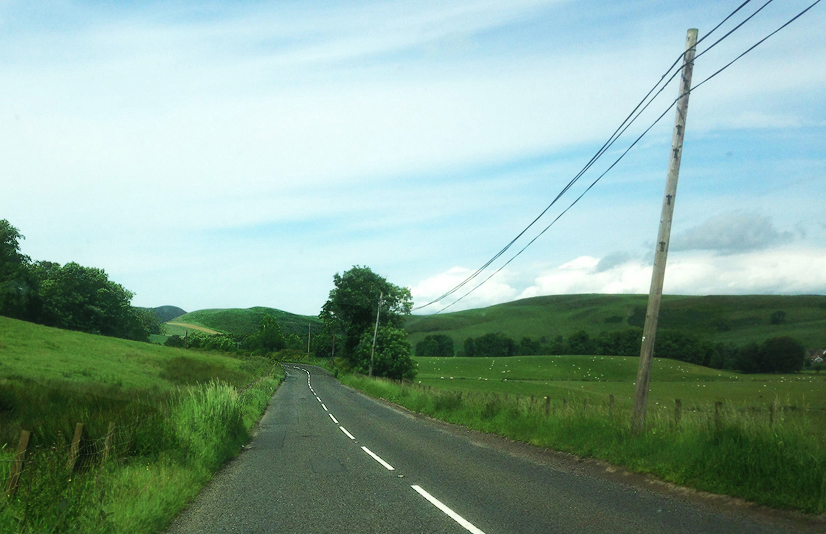
IMG_2214bPOSTCARD 137: The Edinburgh Road: For a moment I’m conscious of the present moment contained inside this moving vehicle following the white line marked in the centre of the tarmac, captivated by the directionality of the journey hurtling through a kind of wormhole in space/time, and plunging towards a vanishing point that never arrives. Pieces of a picture landscape, like a giant jigsaw, fly up and pass through the windscreen of the car, through the transparency of self and a new picture is forming. Left-hand bend approaching, steer around that, attention caught by a constant continuity of looped overhead cables on the right that continually sweep upwards and fall away like waves ebb and flow. Into a right-hand curve… tilt and rising with the camber of the road on the left side then level out and down into the next one. More curves and bends, dizzy and bewildering, winding down these slopes and (ear-popping) altitude drops on the way that leads to the coast.

This must be an old drovers’ road to the markets in the town, it’s foundations laid by the hooves of herds of animals following a path through ancient forests that once were here, and finding a route around swamps and boulders; obstacles long since filled in and cleared away. Now there are just fields of sheep and grass and crops, featureless hillsides – only the road remains, it’s twists and turns carry no meaning. Land owners’ properties claimed on either side have trapped it in its original form, a skeleton from the past, a craggy old branch of a tree, its shape created by historical circumstance.

The outer world becomes neutral, non-intrusive random thought mechanisms that function at the edge of a dream pull me into the gentle whirr and flicker of thinking-about-things, just as we’re coming into Edinburgh. Drop some people here at the train station, then on to drop the rest of us at the airport. Strange to suddenly be in the centre of a town, held by the traffic lights and see people crossing over – reverse culture shock; I’m not used to seeing Europeans, dark-haired, golden, Asian faces with almond shaped eyes fill my world. Memory of a former life, strange familiarity, déjà vu… this pavement, these streetlights, have I been here before? But it’s just somewhere on the way. No, wait… was it here that an event took place, long since forgotten? But no explanation seems to fit – it’s just what’s happening – the world, doing its thing. All that is here is a reflection of me passing through. It appears in present time, and then it’s gone.

Ed.people1

“No man ever steps in the same river twice, for it’s not the same river and he’s not the same man.” [Heraclitus]

————————-

uncertainty (mai nae)

IMG_0141POSTCARD #13: Bangkok: Raining heavily at the airport, poor visibility on the highway into town. Traffic moving steadily through the downpour, a large spray of water hits the windscreen, sploosh – like driving through a car wash. Reminds me of Scotland, wild, wet and windy; weather is unpredictable. You expect it to be one thing but it’s something else instead; uncompromising in its insistence that it is what it is – and not what you think it is. Thai language/cognition is like this, so different from the West; making assumptions based on the Western model doesn’t always get you where you want to be.

I explain to the taxi driver where I want to go, saying there are two ways to get there: he can go on the tollway but better to take the turn that gets us on to vipawadi. We come to the place to make the turn, but the driver doesn’t go that way; we pass it…. It takes a moment for me to see what went wrong: he’s thinking the vipawadi turning is the way I don’t want to go, not the way I want to go. All it takes is one small slip in the logical sequence of the language and I get the opposite of what I intended. Ah yes, well, sometimes it’s like that. No holding on unduly to things you expect to be ‘right’ when they prove to be otherwise. After two decades in Thailand, I suppose I’m used to it; a familiarity with not quite knowing what to expect. ‘…many problems are the result of us expecting that there should be a solution.’ [Ajahn Tiradhammo]

Thai semantics are a bit elusive, the language doesn’t stretch the way you’d expect it to. Anticipating reactions to a request, statement or question – not the best way to go. A structure created by words to explain a concept and the assumption is that the listener understands what I’m saying in the way I mean it to be understood, but it doesn’t work like that. Words are just reference points; they’re sort of out there, ready to be shared with everyone. People interpret them in the way they understand it best. Usually it’s the meaning I’m hoping for, but not always. I try to be minimalist, the complexity of it reduced as far as it’ll go. Allow the selected words to carry the meaning and if it’s misunderstood, try to find an indirect way to approach the problem by letting go of the idea that it’s somehow ‘wrong’. This is ‘the land of smiles’, a cultural  tendency to not confront the issue – we become so focused on the ‘should’ we forget the ‘maybe’. The journey takes the time it takes, through the floods and downpour, but we reach the house okay, of course. The sky clears. Rainbows, green leaves in the trees drip crystal drops… soon after that the rain stops.

‘We can easily get caught up in thinking that life should conform to some definite plan. But by keeping a close connection with the truth of uncertainty we can soften the resulting frustration and negativity when the plan doesn’t unfold the way we think it should. We may even gain a clearer understanding of the real nature of plans: mere concepts about possibilities, rather than concrete programmes of actualities. Then whenever we find ourselves having to make plans we do it in pencil with an eraser in hand, and with the clear understanding that many other possibilities are available as well.’ [Ajahn Tiradhammo]

————————-
‘mai nae’, in the Thai language, means ‘uncertain’ – the living expression of the fundamental Buddhist teaching of anicca, or impermanence [Ajahn Tiradhammo]