memories and the wind

stonefootCropNew Delhi: Gusty warm winds blow through the trees in the park, rustling the leaves and swishing the branches like the sound of waves breaking on the shore. The pigeons are exhilarated by it, flying over at tremendous speeds past me here sitting on the roof terrace, watching them now swoop up above my head – so actively engaged with the mechanism of flight, it’s as if the movements of their wings and the movement of the air are one and the same thing. A wind like this is energy to the birds; it’s a dance. Flight is an expression of the air displacement itself – flying and the wind – ground level is not the reference point; ‘up’ is not necessarily up and neither is down. I see them caught in rapid flight; a stationary moment in the air, suspended in time and space, then an audible flap of wingtip and change in direction.

This wind buffeting me around, hair whiplash on the forehead and the pages of my notebook suddenly leap and turn over on the spiral binding, fluttering through all my various handwritten notes over the last month. In this way, the wind blows through ‘mind’, stirring memories and things from the past, held for years, and released, they come flooding into present time. Each memory stays as long as it takes to examine, and the fullest extent remembered, like meeting an old friend. Time disappears for how long it takes to tell the story and, towards the end of the memory stream, the space behind is seen shining through, the images become transparent and vanish.

The next memory arrives after a moment, I examine that and it disappears like the others. It goes on like this, a collection of things from long ago and far away. Allowing thoughts to go by, unheld, uncaught – the opposite of catching fish; consciously unhooking fish-thoughts caught in the mind at some earlier time; letting them go free and they swim away. Memory stream moves from one moment to the next and I can’t actually see these moments… is this it? Is this the next moment? Is this it, now? Can’t be measured like that; just the circumstance itself; the situations and occurrences follow one another – not a sequence in time, it’s dependent on the nature of the events, there’s a linking that groups them together like coloured beads strung on a necklace.

Going back to Thailand tomorrow where it’ll be hotter than a locked laundromat dryer. Ah well, better go pack my bag now and… has the next moment arrived yet? The mental images and fragments have reformed themselves in the endless stream of things? Can we say, possibly, yes, this is, actually  the next moment? If so, I must have missed it, everything seems like it’s in the past again…

————————-

[Includes excerpts from: Birds on the Balcony 4]

‘Unhooking fish’ taken from an original idea by TJH
Photo image: dreamstime

being here

131120121589

New Delhi: This is the 100th post! I feel like I should celebrate, I’m a blogger centenarian! But still a youngster, I think. Many bloggers are much older than me. So, what’s going on here? This blog is about the Buddha’s teachings, Advaita Vedanta, non-duality. I went public on July 6th, 2012 and I’ve been putting up new posts every three days, mostly, since that time. Now it’s ‘The One Hundredth’, and I was going to use that title for this post but it’s been used already – the 100th in the TV series: ‘Friends.’ The dhammafootsteps blog is, of course, about reaching out to friends, but the discussion is about just being ‘here.’ We’re all here in our various states of being, in different parts of the world; in different time zones and we’re all individually contemplating our own experience of being ‘here.’ Blogging is a good medium for this kind of thing because, just being ‘here’ is what everybody is talking about or describing, one way or another – isn’t it?

Here’s something from: Beyond The Dream: ‘…the awareness that looked out of our eyes as a five year old is the awareness that’s looking out of our eyes now.’ When I read that sentence it had a curious effect; there was an instant understanding of what being ‘here’ means. Then the next thought was, what is ‘the awareness’? And it’s a good question, that one, you can just go on asking it…. It’s like trying to understand sati-sampajañña, clear comprehension; what does that mean? And maybe I’m off somewhere searching for the meaning of clear comprehension, overlooking the fact that all the confusion is still there in my head. So, I’ll never find clear comprehension that way, because every time I think I’ve found it, the confusion just jumps up in its place. Eventually I realize clear comprehension means understanding the confusion. It has to be that way; clear comprehension of the confusion, and not some kind of desired state of clarity that doesn’t exist. The confusion is, I can’t see reality because I’m too engaged with the idea of it.

In the West we suffer from the creator-god condition; God made the world so the world and God are two separate things. I see the world from some impossible place outside of it; I’m on shaky ground here, in control mode, there’s the paranoia of thinking I can’t let it go and the fear of having to hold on indefinitely. All the clutter and stuff and mental goings-on and stumbling over all the indistinct, half-seen, misunderstood truths – believing that this is what life is about. Not able to see that it just doesn’t matter what kind of story is showing on the screen, it’s all fiction, created by the mind, arising and ceasing, dependent on causes and conditions and the karmic outcome of past events.

The mind doesn’t create awareness, mind is contained in the awareness. It’s something like, awareness is there, I just think I can’t see it. Thinking I can’t see it, is another mind moment that exists temporarily in the awareness. Being here is about getting to know everything there is to know about what that means….

————————-

everything that arises…

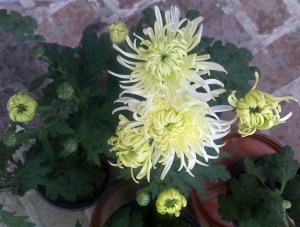
bgv2New Delhi: Flocks of chattering green parrots in the trees and birds of prey slowly circling around in the upper sky. I watch them from our place on the roof terrace. There’s a table, chairs, an extension cable for electric kettle and all kinds of plants in the sunshine; bougainvilleas and chrysanthemums. If you have ‘chrysanthemums’, why can’t you have ‘chrysanthedads?’ I ask Jiab who is reading the Matichon (Thai) newspaper with great scrutiny. But this doesn’t seem to be worthy of comment right now… and after a period of silence, I get busy with shifting these heavy flowerpots full of earth into a beam of sunlight. Much huffing and puffing, when I’m finished with that and sitting on my chair, looking at what I’ve done, Jiab says to me: ‘… happy now?’ And I suppose I am.

Happy, yes – except of course for that lingering sense that things are not right; not as I’d want them to be. But I’m happy enough, yes. Why? Because all these things that I think are not as good as they could be or should be (even worse); all these things are just there – then they’re not there, I’ve forgotten about them. That’s how it is, I’m not holding on to them. The dark cloud of unhappiness is not hanging over me today up here on the roof terrace with flowering plants in the sunshine. No, it’s a clear blue sky and I can see there is suffering dukkha in the world, yes, but that’s because we’re holding it there, unknowingly. Let it go and there’s no suffering – can it be as easy as that? Maybe it needs sustained effort, over a long period of time. But even so, that’s the idea of it. One can feel inspired, motivated knowing there is an end to it. And I suggest this possibility to Jiab, who now inclines towards me thinking maybe I seem to be making a more intelligent remark this time.

And we talk about that for a while. It’s always interesting for me to hear what she says because like most Thais she knows the Pali terms in the buddhasassana, having learned the chanting by heart in elementary school. Jiab is also fortunate because her Dad was a monk for a couple of years and was able to explain the dhamma to his children: that life is permeated with suffering caused by desire, that suffering ceases when desire ceases and that enlightenment obtained through sila, samadhi, panya (right conduct, meditation and wisdom) releases one from desire, suffering, and rebirth.

What it comes down to in the end, is the basic truth that everything that arises passes away and the Venerable Assaji statement: “Of things that proceed from a cause – their cause the Tathagata has told. And also their cessation — Thus teaches the Great Ascetic.” [Venerable Assaji answers the question of Śāriputra the Wanderer], and how Śāriputra was totally blown away by that and people were getting enlightened on the spot as a result of the Venerable Assaji statement. In this context I’m thinking it means if you can see and are aware of suffering caused by tanha, the attachment to things you love and hate, that’s all there is to it; you see it, you know it, ignorance is gone and no matter how much it is held or the tenacity of the habit to hold on, suffering will pass away of its own accord: “Whatever is subject to origination is also subject to cessation.” And there’s a sudden burst of noise from the green parrots in the trees opposite, so we go and take a look at what’s going on over there, but it’s not anything.

chrysanthemoms

Photos: bougainvilleas and chrysanthemums

things not being right

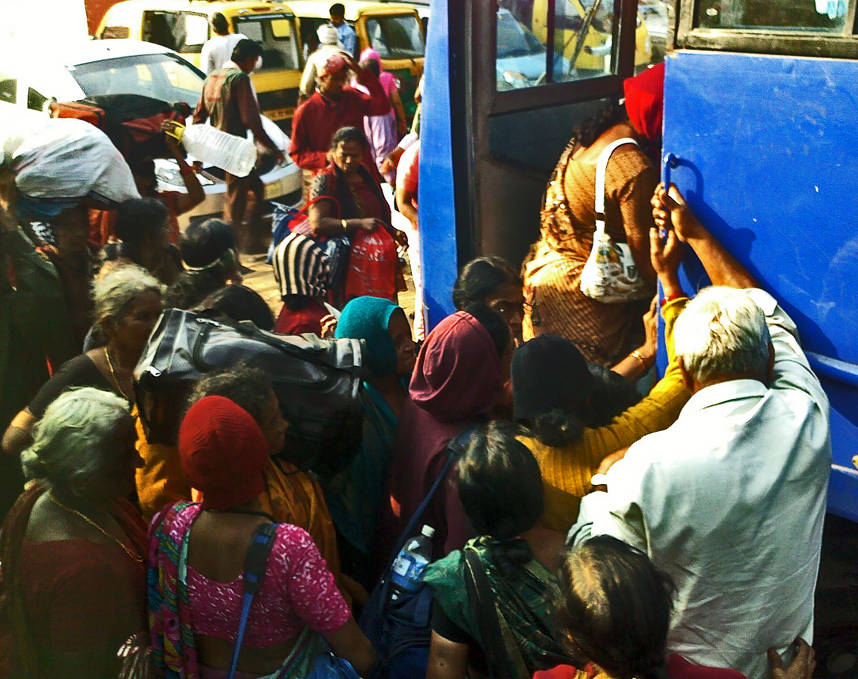
121120121558Road to Gorakhpur: 18.00 hours, we’re on the bus, there’s an immense noise from the engine and the driver is pressing the shrill, twin-pitched, piercing horn continuously as if he were practising a Miles Davis piece on the trumpet, over and over. Three and a half hour journey and I’m getting thrown around all over the place on this unbelievably rough road. The bus makes a sudden lurch and overtakes a slow moving vehicle; then again, rapidly making our way past all these trucks, one after another. It’s a convoy of Diwali Lakshmi Puja pickup trucks, each one with a generator throbbing in the back: boom, boom, boom, boom. And there’s the Lakshmi shrine all lit up with flashing red, blue and orange disco-lights and Hindi dance music at max volume: thud, thud, thud, thud, thud, thud – followed by a long line of young people running and dancing behind it. The distraction of this holds my attention for a while. It’s really like being on another planet – after a day spent in the silence of Lumbini and minimalism of Theravadin Buddhism.

It wasn’t a good day, pity. I was in the park with the group doing a couple of 45 minute meditation sits on the grass under the Bodhi trees in that historical place and it didn’t come together for me – just one of those things. I spent most of the time tossed around in the samsara of mind stories and now here on the bus, the difficulty of this journey propels me further into a small vortex of thoughts that I failed something, hopelessness and… what to do?

Try deep breathing, keep it simple and allow the chaos to be what it is. See it harden into a grasping knot of discontent and stay with the focus on breathing as I tightrope walk across the raging inferno of things not being right, not being the way I want them to be. It goes on like that for a while and eventually the fierceness of it lessens. The fires reduce to smouldering ashes and there’s a moment of relief. The pain of it is not there now – wait to see what this change will bring and when I look for it again it’s like there’s an empty space where the suffering used to be. I realize it’s gone.

Now it’s later. I’m looking through various notes and there’s a reference to the Noble Truth of Suffering that I copied from somewhere and I can’t remember where: ‘…the disenchantment, listlessness that arises from familiarity with fearfulness, unsatisfactoriness and the comfortless nature of things.’ Hardly an inspiring statement and I can understand why people see dukkha as pretty negative – what is this… masochism? It’s not that, it’s just facing up to it, no avoidance behaviour. I’m saying this because there was one time I was in a situation of no escape from serious physical pain; just no way out, the only thing to do, the only way to go was towards it; no more backing off from it. I had to accept it, let it in. Immediately I notice a small easing, enough to somehow find a release from it – not hard to do when there’s no choice and there’s no other direction to go but straight into it. In hindsight it seems as if I didn’t know it at the time but this was an important part of finding the way out? That’s how it was in the end; I could see the suffering, identify it – it’s like, oh yeh! I see now… and seeing it dispels the ignorance of not having any idea what’s going on and being controlled by it. That’s what lets it go (frees it). Off it goes, bye bye and the suffering is suddenly not there anymore. [Link to: Homer & the 1st Noble Truth]

The struggle itself is what causes the suffering. It’s about the energy used in trying to get away from it just fans the flames and makes it worse. And, because it’s habitual, maybe a lifetime of allowing it to be like this, it’s chronic and things just go on like that until I see the only thing that’s preventing me from letting go of suffering is that I’m still holding on to it….

————————-

‘We learn how to let go, in the process of observing the consequence of our grasping.’  [Ajahn Munindo, Dhammasakaccha]

expecting the unexpected

IMG_3972Gorakhpur station: 21.00 hours, just got off the bus and we’re waiting for everyone to assemble and walk together to the train. There are security guards here with short lathi sticks as if expecting a small riot. Darkness, shadowy figures flitting around and trying to see what’s going on, I’m confused by something that seems to be heaped on the road beside some parked cars. It’s a shapeless mass I cannot identify; looks like a pile of brownish-grey sacks filled with something – no, wait, it’s alive. I saw it move! What is it? And for a moment there’s uncertainty… something I cannot recognize, no matter how hard the brain fathoms it. Eventually I see it’s a cow sleeping on the road. I forgot, of course, that they have to lie down and sleep at night. I’ve seen plenty cows standing about, but somehow I assumed they’d be rounded up at night and put in cow sheds. Of course not; they just sleep on the streets; as if the whole environment were fields and meadows. Surprising really, a cow sleeping in a car park is the last thing I’d have expected, but you can expect events and occurrences to be unexpected here. It’s that thing again, difficult to understand, a consciousness of a sense object that’s unknown and the subsequent search for something that’s not in the data bank inevitably causes the mind to invent an explanation that will fill the empty space.

Tour guide blows his whistle, raises his little flag. We have to follow him. So we set off walking through the station in a long line, headed for the train. It attracts attention; we are the Buddhist pilgrims, dressed in white and black costumes and flanked by uniformed guards who raise their sticks and shout at the local people to get out of the way. Seems to me people here are used to the idea of privilege, hierarchy and the sons and daughters of the Buddhist feudal lords in some distant country are passing through, so get out of the way. It’s not a good feeling but that’s how it is here. On to the train and into our little carriage – just Jiab and me in this cosy place, quite nice. Preparing now for an overnight journey to Gonda then Sravasti.

IMG_3901After some time the train sets off, speed increases and the track is rough and bumpy, we have to get used to being thrown around. Along to the little bathroom to brush my teeth and holding on to every handhold available along the corridor; mindfulness of rock-and-roll. Inside, there’s a tiny sink in the corner with a shelf above it and I have to bend down, lower the head under the shelf and brush my teeth quite close to the sink. The movement of brushing teeth: updownup downupdown updownup is in sync with the rhythm of the train for a while then there’s a sudden lurch of the carriage, down and up. I hit my head upwards on the underside of the shelf and whack my elbow sideways on the wall, simultaneously.

Getting shoved around and bullied by the train causes irritation to flare up, it shouldn’t be like this, then it falls away – easier to see that letting-go thing when you’re in an unstable situation like this on a moving train and all the rough and tumble. There’s an underlying awareness that I’m rattling along at about 70 mph, everything is moving past me, sorry can’t stay, got to go, bye!… and I’m in a long tube, penetrating stable realty. Back along the corridor jiggidy-jig jiggidy-jig, nursing slightly painful elbow and into the carriage. Jiab is in the top bunk, and I’m down below. It’s all very different from normal environmental conditions, where there’s stability and a tendency to sink deeper and deeper in the slow mud of thinking-about-things.

I’m asleep straight away then four hours later something wakes me; back in the world of bump, rattle, bang – rattle, bang, bump. How to get back to sleep? I try watching the inbreath, the outbreath, lying flat on my back and the extremely bumpy track becomes the object of attention. It helps to see the bumps on the line not as bumps but as downward movements; small steps going steadily downwards, some steps are lower than others and it’s all going down bit by bit; sometimes there’s a little upwards return but mostly it’s small incremental steps getting lower and lower. Then it seems to land on a much lower step and down into a place where consciousness seems to remain steady, smooth and restful. It stays like that. A space stretches out from here that seems to encompass all the small steps that have occurred so far and all the steps yet to come. It’s in this space I’m able to settle. Sleep returns and the train goes on through the night in a straight line across the moonlit landscape, jiggidy-jig jiggidy-jig jiggidy-jig….

————————-

Photos from the Witit Rachatatanun Collection

a sense of urgency

India-Nepal highway: more like a simple farmyard road than a highway leading to an international border crossing; rough surface and missing chunks of tarmac create an incredible, bump, crash and rattle in the bus that goes on without end. Too much vibration to be able to sleep and impossible because of the noise the bus driver is making with the horn, a high volume squeak-and-squeal alternating between two notes. Cows and goats wandering around scramble to get out of the way; people on bicycles scatter to make room. If there’s a traffic jam, he gets angry, leans out the window and shouts. There’s a co-driver in the cab and he’s sent out to bully, threaten and persuade the drivers of the vehicles to move to one side. Co-driver gets back in again, then another obstruction. I’m sitting at the front of the bus behind the driver, looking through the large windscreen and it’s like everything is held together in a makeshift, temporary way; no time to do it properly, we have to hurry on – what is it? I’m thinking along the lines of a war-zone or some kind of catastrophic event has taken place and this is an emergency vehicle; there is danger and we are fleeing for our lives. But it’s not that, it’s just normal.

The bus gets seriously stuck behind a buffalo walking slowly, with her calf, down the middle of the road; despite the driver’s trumpeting two-note horn, mother buffalo won’t move from her place in the center of the road. Co-driver is sent out to chase the buffalos to the side so the bus can get through and he whacks mother buffalo hard on the rump, an audible WHACK! I can hear above all the racket. Unfortunately, this sends mother and calf off into a frantic gallop straight down the middle of the road. The bus still can’t overtake and has to follow these galloping buffalos for some distance. The driver is getting worked up into a fury, bus lurches to and fro while he’s yelling like a wild man out of the window, and barely in control of the vehicle. Eventually the buffalos run off to the side of the road, the engine roars into life and we accelerate away. Co-driver climbs back into the cab, breathless from trying to steer the buffalos and for a few minutes he has to defer to the driver’s seething anger directed at him. It’s bizarre and funny, but nobody on the bus is laughing.

I’m with a Thai tour group, reserved, polite, quiet behaviour, small body movements and everyone is sitting straight up, dressed in white top and black trousers or sarong. Could be they’re in a state of shock, never having experienced anything like this before. Somehow they all thought (and I did too) that in India there would be vestiges of the Buddhist loving-kindness and the generosity of letting-go but instead of that the whole thing seems to be about blatant greed, hatred and delusion; a skeletal hell realm of holding on tight and mad with desire. India is discovering it’s identity in the media and advertising. The bus went past a poster showing the actor Riz Khan in an advert for whiskey and the slogan is: ‘I have yet to become me’. I managed to get a slightly blurred photo of it.

What happened to Buddhism in India? There were the Islamic invasions and what little remained was assimilated into Hinduism. It could be that, long before that, King Ashoka considered that one day Buddhism in India would come to an end because it has no built-in mechanism to withstand a forceful take-over; it’s fragile and light and doesn’t attach to anything. For this reason he erected simple stone pillars in places where significant Buddhist events took place; they function like markers on Google maps. The locations are verified and Buddhists coming to India, foreigners like me, visit the sites, Bodh Gaya, Sravasti, Lumbini, see these pillars and take a moment to consider that, yes, it happened here. And if it weren’t for King Ashoka’s sense of urgency that these places could eventually be lost in history, there might be no traces of Buddhism in India at all.

no-thingness

Chiang Mai: I’m in this 3rd floor apartment, lying on the sofa and the balcony door is open. The sound of a plane coming in to land (this building is near the airport and in the flight path), I’ll resist the impulse this time to try to take a photo of it – lean backwards over the balcony… scary. So I lay down flat on the sofa, ready for the immense noise, and the aircraft flies over. The sound is absolutely devastating. The glass of windows, masonry walls, ceiling and floor vibrate… and just at that moment I see the upside-down reflection of the plane in the highly polished floor tiles. It’s there for an instant, flying away across the floor, out to the balcony, and leaves my vision at the same time as the huge sound ends.

An upside down passenger jet flying across my room; such an extraordinary event, I think I need to write that down – where’s my pen? Something to write on? Look in my wallet, and a piece of paper falls out. It’s an old, creased, folded, coffee-shop receipt and on the back of it is written the word ‘extrinsic’. Hmm… so what is this? I made a note of that word for a reason, but what was it? Can’t remember, and now here it is again: extrinsic: adjective: not essential or inherent; not a basic part or quality; extraneous’ (extrinsic at Dictionary.com).

What is it connected with? There’s no context and it doesn’t seem to belong anywhere, yet there’s a familiarity… I feel I should know what it is – the essence of the object seen from outside of it? Something that would answer the question: What is its ‘whatness’? How is its ‘howness’? Somewhere in the realm of seemingly incidental meanings that arise of their own accord as if they’d been consciously created, contained in words, and language itself is the metaphor.

This word ‘extrinsic’ appears to be outside of the moment I’m in, and as soon as I think that, everything shifts to include it. Interesting, maybe, simply because I’m now outside the aircraft and usually I’m inside the aircraft, going between India and Thailand. It’s as if ‘extrinsic’ is a location in the construct, the object seen from the outside, looking in. And ‘intrinsic’ is another location, the subjective sense of the object. The ‘all-aroundness’ and the ‘all-it-isness’ is the totality of the ‘world’.

Everything is interrupted by the sound of another passenger jet approaching. I drop everything and lie back on the sofa to get the full impact of the sound… upside down plane flies across the floor.


“All life is a single event: one moment flowing into the next, naturally. Nothing causing everything. Everything causing everything.” [Wu Hsin]


non-becoming

OLD NOTEBOOKS: East Anglia: Dreamy half-formed images swim before the eye without identity, no recognizable or known parts of the image. I’m trying to see it this way: no identity, otherwise ‘self’ intervenes and it ‘becomes’ something [bhava]. I’m falling asleep again; still early morning, comfortably dark and sitting on the cushion on a futon on the floor in the upstairs room. One advantage of sleeping on the futon is that you can roll over and up into the sitting position on the cushion quite easily – a smooth transition from sleep to wakefulness. The disadvantage is that it’s difficult to stay awake.

The process of waking up in the morning means the mind is in the process of getting shaped into a form, a ‘self’, and it all gets locked down then; ‘becoming’. So what I’m trying to do here is not let that happen. Without the habitual inclination towards ‘self’, conscious attention gently searches out another way, one that is identity-free, no ID card. The problem is, of course, ‘self’ tries to take over, as usual and if the identity-free state is present, ‘self’ understands it to be sleep. So I start to drift off to sleep again. I see it happening and think: Hey! Why should the ‘self’ impose itself like this? But the ‘self’ goes around imposing ‘itself’ and making assumptions about everything all the time and if I were to just let it go on doing that, I’d not see that things are actually quite different from how they appear to be.

Continue the meditation by following the breath, and a curious feeling that I’m sitting at an angle, or the weight of the body is over on the right side and on the left side there’s something like an empty space… what’s happening? Next thing is, I’m thrust into another dreamlike scenario and some sort of memory sequence. Here we go, I’m falling asleep again and losing it all in the dreamy half-formed images of the sleep I just emerged from. Mindfulness cuts in when I remember to let it all go. Hold on and let go… I need to hold on to the intention to let go. Everywhere I look there’s a ‘self’ searching for an opportunity to create an identity, (sakkayaditthi) ‘personality view’. It’s what holds beings in the cycle of rebirth. Breaking out of the cycle is arrived at by non-becoming – allowing it to ‘become’ without becoming.

————————-

It does not appear or disappear.
It is not born and does not die.
It is neither constructed nor raised up,
Neither made nor produced.
It is neither sitting nor lying,
Neither walking nor standing still,
Neither moving nor turning over,
Neither at rest nor idle.
It does not advance or retreat,
Knows not safety or danger,
Neither right nor wrong.
It is neither virtuous nor improper.
It is neither this nor that,
Neither going nor coming.
[Lotus Sutra]

Photo: Louk Vreeswijk

Birds on the Balcony 3

Switzerland, August: Awake at 4:00 AM this morning, came through and switched on the kitchen light: neon tube fluorescent, flicker-flicker flick. Light everywhere, through the windows illuminating the outdoor furniture on the balcony of this 7th floor apartment and the pigeons sleeping there wake up: croo-croo, croo-croo! Had to switch off the light again and they were quiet as soon as I did that. Now I’m sitting in the darkness, held back in my domestic activities by the wildlife on the balcony. What to do now? It takes me a while to get round to noticing this silence the pigeons are in. I get my meditation cushion and place it on the sofa with other cushions to stop it from sinking into the softness and get up on that, a little unsteady but balanced at this slightly higher elevation so I’m able to see the round shapes of the sleeping birds through the window. I’m in their quiet space, we share the peace of this Sunday morning – so silent here, high above street level. There’s a presence around these sleeping birds; there’s an immediate focus on metta loving-kindness to all beings:

‘All people, all animals, all creatures, all those in existence, near and far, known to us and unknown to us. All beings on the earth, in the air, in the water. Those being born, those dying. May all beings everywhere live in safety, be happy, be healthy, live with ease…’

Attention wanders and the mind enters into the story of it all: the bird out on the balcony, nesting in the Christmas tree bucket then there were two eggs, they hatched out and there were two babies and Ajahn V even did a little blessing for them when he came to visit [Link to: Birds on the Balcony1 and Birds on the Balcony2]. The young birds became adults and now we have a small family group inhabiting the balcony. Two adults and two young birds and there’s another one – the mysterious ‘other’ … the alpha male has taken a second wife? I’m saying this because there’s often some upset out there; some extended flapping of wings in the evening as they get their places in the hierarchy settled for the night – it’s like who gets to perch next to whom. I can’t imagine… return to mindfulness mode:

Let them not do the slightest thing that the wise would later reprove. Wishing: in gladness and in safety, may all beings be at ease. Whatever living beings there may be; whether they are weak or strong, omitting none, the great or the mighty, medium, short or small, the seen and the unseen, those living near and far away, those born and to-be-born — may all beings be at ease.’

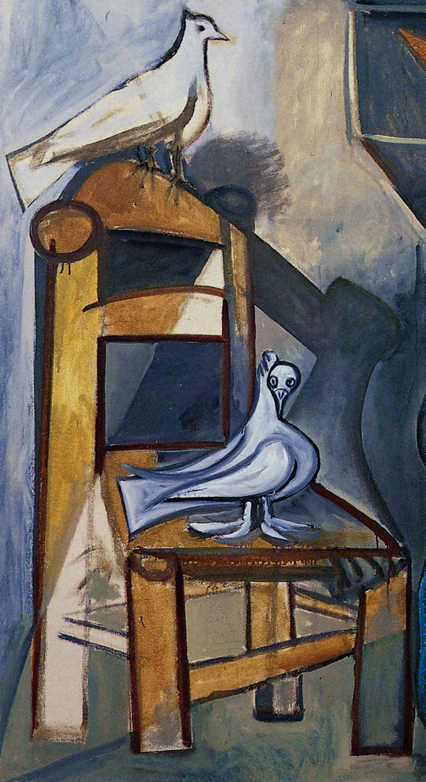
Eyes open slightly in the half-darkness. I’m perched on my high cushion like one of the birds. Morning light is coming up. I see them more clearly now. They’re sitting on different parts of the old artist’s easel that I left out there because it’s too big to have inside the apartment. It looks strangely like a work of art, some kind of out-of-context aesthetic event, but can’t think what that might be…. Picasso did some paintings of pigeons and doves that had moved into his studio in the South of France. I look at these pictures and I just know what that must have been like.

One bird begins to waken up, wing stretch, flutter, flap. They’re here with us, sharing the same worldview. Without us, the birds wouldn’t be on this balcony – they’d be on someone else’s balcony, okay, but the whole thing is about inter-dependency. We all need each other. I am one part in the vast body of life, distinct yet intimately bound up with all living beings. Eyes close again, return to meditation mode:

‘… so with a boundless heart should one cherish all living beings; radiating kindness over the entire world: spreading upwards to the skies, and downwards to the depths; outwards and unbounded, freed from hatred and ill-will. Whether standing or walking, seated or lying down free from drowsiness, one should sustain this recollection.’

After a while, in the light of early morning, I notice an odd silence in the bird group out there; no wing-flap. Get up and go over to see. They’re poised on the balcony handrail; all looking out, little necks stretched out and eyes focused on the space outside; the great swimming-pool of sky. Still no movement. Then simultaneously they burst into flight, and gone. As one unit they drop over the balcony and down. A moment later I see them swoop and swirl in a great arc in the sky then on eye level with this 7th floor and in a direct line away from me, they vanish in the distance.

————————-

[Excerpts from: Karaniya Metta Sutta also excerpts from loving-kindness meditation by Jack Kornfield, Susan Salzberg]


the seer & the seen

I’M ON THE DOWNTOWN BUS, on the way to meet Jiab to help her choose a new pair of shoes. There is this short piece I’m reading from ‘The Essential Ken Wilber’: ‘… the mystics are not describing the real self as being inside you – they are pointing inside you. They are indeed saying to look within, not because the final answer actually resides within you and not without, but because as you carefully and consistently look inside, you sooner or later find outside. You realize, in other words, that the inside and the outside, the subject and the object, the seer and the seen are one, and thus you spontaneously fall into the natural state.’ I have an understanding of this but cannot experience it right now because I’m holding on to something that’s causing it not to happen. I’m a ship sailing away but only as far as the anchor chain allows… tug! The anchor is firmly embedded in the duality of the world – I need to see that the anchor is part of subjectivity too.

Bus arrives at the stop and I get off. Go find Jiab and we look at a few pairs of shoes. She is browsing so I slip away unnoticed and wander into the men’s department to look around there. In the corner there’s a chair in the section where they have folded socks placed in display stands. Nobody here, secluded, I could sit on the chair and read my book. Okay, sit down, open at the page and then thinking there’s something interesting about this totally unknown place, it feels nice. And a quick decision, I’ll try some meditation, let go, and see what happens.

Eyes are closed for a while but flickering eyelids: the ‘public’ aspect of it is making me a bit uneasy. There is the tendency to open my eyes whenever there’s a sound nearby, wondering if somebody is coming. Difficult to concentrate, so I try it with eyes half-open. After a while I can gradually relax into this state of focusing, not on anything in particular, just focusing on focusing; the act of focusing itself. Looking at everything that occurs with mindful alertness.

It’s about the experience of just being here; random sounds, voices, and the patterns of socks folded in packs to show off their colourful designs. Folded socks all around, up above my head and down almost to floor level. There’s a kind of peripheral vision thing going on, pulsating colour: maroon, bottle green, cream coloured diamonds and brown/orange diagonal dashed lines – like North African ceramic floor tiles. All the sock patterns start to move and vibrate. This must be exactly how the sock manufacturers would want the sock-buying customer to view their product.

Phone rings; it’s Jiab. I have to go and take a look at shoes she likes. I can hear my voice in this small space I’m in, but it’s somehow not the ‘me’ I’m used to. I get out of there and next thing is I’m looking at Jiab’s feet in different types of stylish footwear. A purchase is made and we head for the exit. I have to wait there for a moment as Jiab goes back inside to get something and really for the first time I’m able to let go of a whole lot of habitual stuff.

Just standing there at the exit watching the people go by, the traffic, the noise; there’s something about doing this in a public place that makes it more meaningful. It’s also the first time for me to enter this kind of contemplative mind state outside of Asia – and in the familiarity of European surroundings. Then walking through the streets, I’m seeing blurred images of people going by in a strangely different time and space. What I’m thinking is that this kind of contemplation in Europe, in close proximity to other human beings in a public place where, normally, nothing like this ever happens, initiates a special kind of mindful alertness; and it is, what you could call, quite exceptional.

It goes on like this; moments of mindful alertness all over the town; easily falling into a state of no thought, just colours/sounds in the immediate environment. Then waiting for the bus, just watching that moment, and suddenly the bus looms up silently, fills my vision, get on, sit down and we sail away as one group contained in a large vehicle. Public transport is wonderful. All senses awake, functioning. Alert and wakeful about the surroundings, idle thoughts just become silence.

I am a human being on a moving bus, large windows and whole landscapes move through the interior of the bus in waves, washing away mind processes as we go on. Here, in all this movement, I can have a sense of: ‘…what I am looking out of is what I am looking at’, and what that means right now. I can see it’s about the journey to get there rather than the arrival because after that there’d be the full understanding of it and none of this would be important.

————————-

‘The Absolute Subjectivity that can never be objectified or conceptualized is free from the limitations of space and time; it is not subject to life and death; it goes beyond subject and object, and although it lives in an individual, it is not restricted to the individual.’ [The Essential Ken Wilber, The Real Self, page 23](see summary in Texts)