‘now’

BkkTaxi3POSTCARD#47: Bangkok: So profoundly stuck in this traffic jam it feels like time has stopped. It’s not today; it’s yesterday – same taxi, same traffic jam. I raise my head from the book I’m reading and look out at the world. No sense of having moved further on, the back ends of vehicles and bits of buildings. This is a continuation of the same day and the interval that happened in between, dinner, 8 hours sleep; it was a daydream. Look at my watch, same time, same place I was in yesterday. The same people (probably) all headed in the direction they go in every day. Look down at my book again, eyes scan the text… where was I? Remembering my place by association with events taking place around me. The sounds of the gear stick shifting through its worn engagings and the accelerator pedal, the brake, then the gear stick again… parts of the story seem related to parts of the journey. The words I’m reading are flickering around the interior of this cab. Parts of sentences and interesting phrases get wrapped around the objects in this small space.

It feels good in here, inside this metal shell that’s holding me cushioned in a womb-like environment, bent over the book in my lap and looking outside from time to time. The experience of the ‘now’ moment is the same ‘now’ moment everybody else is experiencing… a hesitant, preoccupied ‘now’, maybe, for many of us; teetering on the brink of wanting things to be different from what they are. The traffic is hard to believe. Skillful avoidance of the tendency to hold on to the thought it ‘shouldn’t be like this.’ Look around the interior of the taxi, devotional flowers hanging up front in the windscreen and up above I see the painted marks of a holy person’s blessing on the underside of the roof. Grey/blue seating, a public space, registration numbers for the driver and the vehicle. A photo of the driver with his name in English.

We don’t have a conversation. I say: rod tid… (bad traffic eh?). And he says: yeu! (too much). We’re comfortable with the silence after that. For him, it’s a pointless journey to nowhere in particular – no problem; it’s often like this. Pause for a moment and watch the in-breath, the out-breath; mindfulness. A moment’s reflection and meditative contemplation in a Bangkok taxi… this is how it is for him. After I get out, somebody else will get in and off to the next place. When he gets there it’s the same as the place he just left. Where are we now? There’s a huge map in his head. City traffic is like a river, it gets into all the corners and any place where there’s space for it, finding its own level and passing through the hundreds of miles of its landscapes as it makes its way to the sea.

Like a boat on the river going with the current, the ‘now’ feels like it’s not moving. Only when the trees on the riverbank are seen is there a sense of movement, of moving through time. The ‘now’ is experienced in this present time as it has been for millions of years. I can imagine a time in what I would call the ancient past, but a moment experienced then happened in present time; it was ‘now’. A prehistoric being may have been sitting on a rock or a branch, exactly where I’m sitting, inside this cab… looking around – just as I’m doing now – and the ‘now’ experienced then would have been no different from the ‘now’ experienced at this moment.

‘The river is everywhere at the same time, at the source and at the mouth…in the ocean and in the mountains, everywhere, and the present only exists for it, not the shadow of the past, nor the shadow of the future… Nothing was, nothing will be, everything has reality and presence.’ [Hermann Hesse: ‘Siddhartha’, Chapter 9]

————————-

gridlock

Bkktaxi4POSTCARD#45: Bangkok: The traffic is incredible – beyond credible, the French word incroyable comes to mind. I get in the taxi, tell the driver where I want to go and he sets off in exactly the opposite direction to where I’m going. Disconcerting… it’s like when you ignore the GPS and its voice keeps on telling you to: ‘please take the next U-turn where possible’. But doing a ‘u-ey’ (yooee, Aussie slang for U-turn) is no good when the whole city is one huge U-turn, interconnected with diversions and u-turns within u-turns. Diversion signs posted everywhere; alternative routes because this is the ‘Bangkok Shutdown.’ All roads leading to Thai Government Ministries are blocked by demonstrators… a protest campaign to force the government out of office before the February 2nd elections. A bit scary but no signs of violence here… I feel secure enough. Strange how the Thai population is able to accommodate these dangerous protests and life goes on pretty much as usual.

The taxi is now going along at walking speed through a crowded area. It’s the lunch hour, people rush out from offices and factories to get something to eat from the local traders. But there’s hardly any room, cars are occupying every space and there’s nowhere for pedestrians to walk. They filter through the flow of slow moving vehicles like water trickles through the stones and boulders in a stream. I try to get a good photo of it but it doesn’t make visual sense, everything is too close, I’d like to try making a cut-paper collage and paste pieces of images of traffic in a kind of jigsaw effect. Maybe it’s something I’ll do after this – at the moment I’m in this collage. I’m part of it, looking through the windscreen, past the passenger head-rest in front and seeing in between a building and a pedestrian footbridge overhead. Out there, there’s a small patch of blue sky, maybe 30 miles away and I can see a passenger jet ascending into the air.

I don’t know to what extent the government is really affected by these demonstrations; it’s the ordinary people who have to take the immediate pressure. But I’m a foreigner here and there’s all kinds of stuff I don’t understand. One thing I don’t understand is how everyone is able to keep their cool, no sounds of car horns at all; drivers maintain an outward calm. The Thai othon (khanti patient endurance), a Buddhist control of anger through the cultivation of mind, based on compassion for all living beings. But how does that sit with the fact that authority figures may be taking advantage of this willingness to comply. This putting-up-with-it thing is allowing all the political skullduggery to go on unchecked…

Bangkok celebrates Chinese New Year from 31st January (10% of the Thai population are of Chinese descent); a 15-day holiday period is coming up when people take time off to go around the city and upcountry visiting family members. How will the traffic be, I wonder. How about the Thai capacity to stay calm in difficult circumstances? Will the political leaders go on pushing until it explodes?

There’s a distinct feeling that, for the time being, everyone is just waiting quietly to see what will happen

‘In daily life we experience suffering more often than pleasure. If we are patient, in the sense of taking suffering voluntarily upon ourselves, even if we are not capable of doing this physically, then we will not lose our capacity for judgment. We should remember that if a situation cannot be changed, there is no point in worrying about it. If it can be changed, then there is no need to worry about it either, we should simply go about changing it.’ [The Dalai Lama]

————————-

evenness of 2014

IMG_0382POSTCARD #38: A village near Hat Yai: Here in a house surrounded by trees above window height on the ground floor and in the daytime everything is seen in a translucent green light. It’s an old rubber plantation, with some palms and huge banana trees. Now it’s night and I’m pretty well seeing double having been staring at words all day. Struggling a bit to stay awake to see the coming of New Year – thinking the number 14 is somehow nicer than 13 and also the number 2014 has a pleasant evenness about it? But maybe I’ll go to sleep, it doesn’t seem right to be awake when all the small creatures in the forest are either asleep or being strangely nocturnal and kinda scary in their stealth. I feel a bit obvious here with all the lights on in the house.

IMG_0380Cannot see well, the spellchecker rejects all the Thai and Pali words and onomatopoeias and my spelling innovations; and when it doesn’t know a word I’ve been clicking the ‘Add’ option so much it’ll render the spellchecker obsolete eventually. It’s getting difficult too because small insects attracted by luminosity of screen are walking around in my vision seemingly dotting the letter ‘i’ and crossing the ‘t’ or making an ending to a word that isn’t there. Cannot understand how they get through the mosquito mesh on the windows. I notice that the larger insects stop flying around when you put the lights out because they bump into things, it takes them a few moments to stop where they are, anywhere’ll do and just immediately go to sleep.  I’ll do that too, have to call it a day and shall set this Post so it’ll go out at midnight, and it’ll be the New Year then, Thai time: +7hrs GMT. So, all that remains is for me to say thank you friends and fellow bloggers for visiting me here in the year 2013, and best wishes for 2014. Metta, Loving Kindness, may your year be one of Mindfulness and Letting Go

– HAPPY NEW YEAR TO ONE AND ALL –

IMG_0367

generosity is letting go

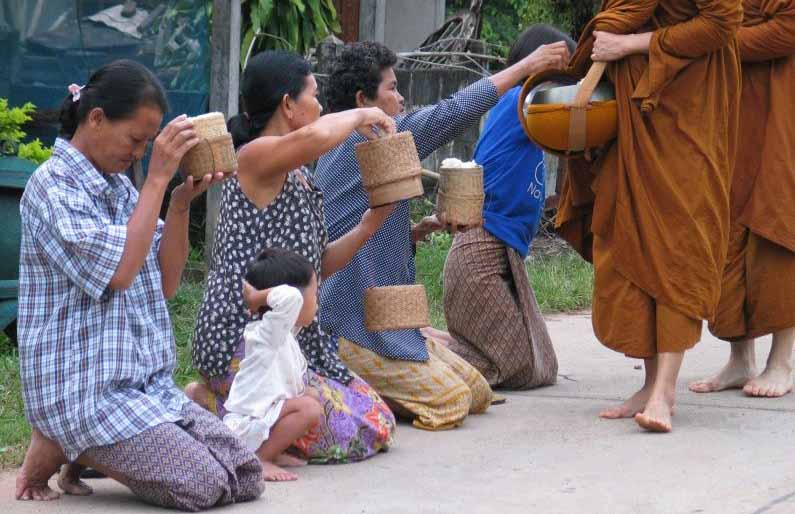
Pindabat 5POSTCARD #31: In Buddhist countries, babies are taught when they are about six months old to put food into the monk’s alms-bowl. The whole family applauds as the sticky rice drops from that little hand into the monk’s bowl. The kid gets the idea early on: when stuff leaves your hand, you get this happy feeling. It feels good to give.

Everything the Buddhist monk receives is a gift, an offering; the monk is a mendicant, and lives entirely on the generosity of others: ‘Our bodies are fueled by the food that is offered to us. In fact, scientists say that all the cells of the body are replaced every seven years, so any (monk) who has been ordained for that long has a body that is completely donated. If it were not for the accumulated kindnesses, efforts, and good will of countless hundreds and thousands of people, this body would not be able to sustain itself. Kindness is the actual physical fabric of what we think of as ‘me.” [Ajahn Amaro, ‘Generosity in the Land of the Individualist’]

Generosity is cultivating an inward disposition to give, a glad willingness to share what we have with others. Give it away, we have more than enough. Ease the discomfort of being driven to fulfill that urge to ‘have’, to ‘possess’, a hunger created by always wanting more. All of it is gone when you’re generous. Brainstorm the word ‘generosity’ and you come up with loving-kindness, compassion, empathy, well-being, freedom. You find gratitude, grace, honour, motivation, encouragement. Generosity is everything. It’s nature is to share, recycle, circulate; it can only be given, never taken.

Generosity, is a mental, emotional letting go; releasing the tenacity of holding on to things; all that baggage we burden ourselves with is removed in one single act of generosity. Generosity means not holding to the self-concept, the separateness applied to things that are really ‘in context’. Seeing it all as process, ever-changing; a connectedness with the outer world. Generosity leads to wisdom – the truth is without bias. The cultivation of generosity directly debilitates greed and hate, and facilitates the kind of mind that allows for the eradication of delusion.

‘There was a seeker and a wise man. The wise man had a most incredible jewel and the seeker was absolutely amazed by the jewel. He asks the wise man if he would give him the jewel. And the wise man gives it to him. The seeker is very excited and afraid that the old wise man is going to change his mind, so he hastily says goodbye and goes off. A short while after that he comes back, approaches the wise man with great humility and respect, lays the jewel down in front of him on the ground and says he’d like to make a trade. He’d like to exchange this jewel. And the wise man asks him what he wants to exchange it for. The seeker says he would like to exchange the jewel for knowledge of how to gain the sort of mind that could give up a jewel like that without a second thought.’ [This story appears in Khanti – Patient Endurance]

————————-

Sources include: Dana: The Practice of Giving
Excerpts from an earlier post: More Than Enough
Upper image is from the Wat Pahnanachat collection

non-aversion

IMG_0106POSTCARD11: Delhi: There’s a wasps’ nest in the bathroom at the end of the corridor. I’ve been away for two months, didn’t know it was there and didn’t notice it at first, in the half darkness of 5.30am, walking along to this bathroom we don’t normally use. And wearing glasses because I’ve always worn glasses but since the eye operation it’s all a blur. I forget, put them on and in the darkness, can’t see any difference. Switch on the light in the bathroom, look in the mirror; is this really ‘me’? An awareness of a low humming sound; a multi-frequency buzzzzzz, just on the edge of hearing. Something crawling on the window, what’s that? I have to take my glasses off to see, a strange reverse action I’m not used to, then wait for a moment until vision gets in focus… wow, a wasps’ nest in the bathroom, not good. Back out of there fast, close the door and get as far away as possible from it – closing all doors between me and it. Seeing imagined wasps in faulty vision.

It’s full daylight in an hour and I go back for another look… some kind of large-bodied heavy duty, Indian-wasp-like species; googled it later: ropalidia marginata. The nest is not actually in the bathroom, it’s built on the underside of the top part of the bathroom window, outside… thankful for that, but still kinda scary, even though there’s mosquito mesh on all doors and windows and they can’t get inside the house. I go outside to take a photo but nervous about all the activity so the pic is not clear. The wasps are transparent orange, the nest is grey, a truly colourless grey; remarkable because of its absence of colour. Kind of supernatural, like dust, or ash.

Ropalidia_marginata_2A species so distant from where we are, there’s a reluctance to look at this, yet a fascination with it; more like science fiction than real. The Queen wasp and attendants, baby wasps, larvae, that will emerge from all these small hexagonal openings. Yeh, well… somehow it’s difficult to think of them being cute. Wiki says the females contend with each other for the position of queen. They’ve evolved through aggression and hostility. How to understand this? I don’t know, but keeping a safe distance from it, and mindful of that action – not pushing away. The contemplation of aggressive aversion and the tendency to create a category for things I hate; enemies, difficult people, personality issues at the office – all kinds of other situations worse than that. Social conditioning has made me critical; looking for the fault in people, where to lay blame. Living in circumstances I don’t always feel comfortable with. Seeing what’s wrong, not able to see what’s right. Metta, loving kindness, isn’t a case of: “I love this person, but I don’t love that one.” Metta is non-discriminatory love, all beings have conscious awareness, a shared subjectivity….

Metta is unconditioned love; you don’t have more metta for the nice things and not as much for the bad things, it is evenly distributed: our beloved friends and our detested enemies. The action of metta is unconditioned, it is patience and non-aversion. We accept the pain, disappointment, failure, blame, persecution, abuse and all the experiences we can have in a lifetime. We begin with: ‘May I abide in well-being,’ starting with yourself. It’s an attitude of acceptance and patience with the way it is; accepting the anger, resentment, aversion, or the little petty things.’ [Ajahn Sumedho]

————————-

Lower photo from the Wiki page

conflict & release

121120121567“Metta is non-discriminatory. It doesn’t mean liking one thing rather than another, it isn’t a question of singling out: “I love this person, I don’t love that one.” [Ajahn Sumedho, “Universal Loving Kindness” From Forest Sangha Newsletter, October 1997]

North India: The image here shows some kind of serious argument happening among a group of men, viewed from the window of a moving bus. I couldn’t actually see what was happening because other passengers were in the way, but I got the camera into a space near the window of the bus and took the picture, guesswork, thinking it’ll not come out clearly but it did – perfectly positioned in the centre of the frame. The man in the green shirt is trying to do something with that pole and the other guys are struggling with him violently. The bus pushed itself on through the crowd and the people made space for it. When we got up close, all I could see was the top of their heads and I took the photo without seeing where to point the camera…

The bus moved on and we were gone in a moment, accelerating along empty streets. I was amazed to see the photo after we’d moved away from the area. What to do with it? The tremendous intensity coming from the green-shirted man is scary – murderous feelings in the air. There’s another emotion too, he looks tearful, as if he might start to cry. It was an event I didn’t see, all I have is this picture of it. I could hear the explosions of angry voices, and the memory of it is still a bit scary, but it didn’t happen to me. If it hadn’t been for the camera lens, I’d not have seen it. As long as no effort is there to keep it going, conflict falls away. But we fuel the fires to keep the conflict going; our wars and war-mongering, allowing everyone the means to build up the tension, justified outrage, creating stories in the mind. We could just as easily allow it to fall away, but we’re drawn in, and it gets to a point when conflict is inevitable; this is always how it is.

Then Ajahn Vajiro was in town the other day and somebody asked him about what to do when you have to put up with some unreasonable, insensitive person giving you a hard time and you have to see this person on a daily basis. Ajahn spoke about the Brahma Viharas and later Suffering, the First Noble Truth and how the Buddha didn’t say he could eliminate suffering – he gave us the tools to escape the suffering. It led me to see that conflict is resolved if we can focus on the subjective nature of it, see our own anger, and see the anger the ‘bad guy’ has to cope with, and recognise it as exactly the same thing – what’s the difference?

The practice of meditation is the solution. Ajahn talked about getting to know the inner world; start from there, explore the universe from the inside. It’s not just about feelings of bliss and peace, that’s there too but it’s about the real world. Long term goals. Following this path, you get to know about suffering; you notice your own suffering, you have compassion and act towards others with compassion when you notice the suffering in your opponent. Apply wisdom – especially if your opponent is swinging a long pole, aimed at your head. See the angry person as someone who doesn’t understand his/her own suffering and recognise their difficulty – then get out of the way of the swinging pole!

It’s about the difference between ‘knowing’ and ignorance. Ignorance is the result of unskilful action. Non-ignorance (knowing) is about accepting limitations and doubt. It’s not a sure thing but it doesn’t have to be a serious drawback; having to cope with being not sure, uncertainty. Ajahn V described it as being at the edge of the known; doubt is nearly knowing what it is…. In a different context, uncertainty is what’s in the wrapped gift you’ve been given. You don’t know what’s inside until you open it….

————————-

“The metta – kindness – engendered in us encourages us to accept ourselves and others, and so to understand ourselves and others. Understanding implies wisdom. And this wisdom is that which allows us to find the way, to grow beyond, or let go of, that which limits and binds the heart. The kindness expressed to others allows them to accept themselves and others. This is an emotional, gut or heart acceptance that allows the acts of body, speech and mind that are a response to that which is perceived as `other’ to be kind; not motivated by not-liking, not motivated by aversion or fear. The effect is unlimited Metta is radiant and attractive, warming to those that are cold, cooling to those that are hot.” [Venerable Ajahn Vajiro – “Mature Emotions ” from the Forest Sangha Newsletter]

loving-kindness to animals 2

cows2A village near Hat Yai:  Going to see the cows with M and we meet the first one. I ask M about pulling on the rope tied through it’s nose and if she thinks that would be painful? M tells me it’s like pulling your hand and she pulls me along by holding on to my finger: ‘Like this Toong-Ting’ – laughing, Toong-Ting as a reluctant cow… I can hear the voice of (her auntie) Pa K, who lives here, a down-to-earth farming person; and I guess M must have asked Pa K the same question and she’d shown her, as M shows me now. I’m also aware that M sees me a bit like a grown-up child, because I’m a foreigner and have such naïve views about things. For us Westerners, the simplicity of rural life is attractive, but we’re not able to see it in the long term, or accept the hard work that’s necessary to be able to live like that. Also having to accept basic truths like killing animals for food and all that… yes, well, I don’t discuss this with M. We just go on through all the wet ground towards the other cows in the distance.

There was another time I came here to visit the cows, and met the little cow with the bamboo bell around its neck: clacka-clacka sound when it’s eating grass – strange grass-eating rhythms. We stop and look at it, and it looks at us. Such a miniature creature, it looks like a calf, and comes towards me with cautious movements, swinging head in motion with the way it walks. It raises it’s head and points a snuffling, sniffing wet snout in my direction; bits of grass and green stained mouth. Large snorts. Then it extends a long tongue and sticks it in it’s nostril (how do they do that?), comes a bit closer and there’s quite a bit of sniffing of the air around me. This cute little cow is curious about me due to a certain familiar milky smell coming through the pores of my skin? It’s not smelling the others who are with me like this… Thais don’t drink much milk so I’m thinking, hmmm, here’s proof that the Western body releases a noticeable odour of milk. I know this little cow has never been near to a Western person before in its life. The recognition of this milky smell, a familiarity: I am an upright, standing-on-it’s-hind-legs member of the species – a cow person? A bit disturbing… I’m conscious, all of a sudden, that humans are carnivores and there’s this unpleasant conceit about being at the top of the food chain that’s bothering me right now.

Scan-130523-Cow1

Later, reflecting on this while eating a breakfast of grains, nuts, fruit and cow’s milk – jaws move in a slightly circular motion, down up, down, up, down, grind, grind, and swallow. I’m an animal too. I consume the environment, whether it’s other animals, fish, vegetables, eggs, milk and – we are the cow’s babies! I notice cutting up vegetables is a bit of a sacrifice too; every time I start to cook food there is the opportunity for this kind of contemplation. Vegetables and fruit may not have the obvious characteristics of sentient beings but we may eat their reproductive organs along with everything else and that’s kinda weird…

There’s a couple of lines of text somewhere in an essay by Tan Ajahn Buddhadassa, that I cannot find at the moment; it’s about consciousness of all the things we eat, bits of animals, poultry and fish and how all their ghosts will come back to haunt us in the end. Pretty scary, nowhere to run, everything we are: mental, physiological, flesh, blood, and bones is a composite of what we have eaten, internalized. And it extends back through the generations to the beginning of time. The cellular substance of what we are is a genetic composite of all kinds of animal fats and enzymes and there’s just no getting away from it.

Contemplating the eating of meat helps me to see the true extent of my delusion driven by a voracious appetite for all consumables. Things I feel drawn to consume surround me – non-food items; ideas, concepts, ‘mind’ hungers for mind object. Consciousness is clouded over by habitual ‘mind’. Remove habitual ‘mind’ and there may be something like a deluge of reality comes in and with it comes a satisfactory understanding of the mystery that people eat animals.

Scan-130523-cows3

When Acharn Mun was at the end of his life, weak and lying in a village in NE Thailand, a very large number of his followers began to assemble. He asked the bhikkhus to take him away from the village because the villagers would have to kill many animals to feed those people. They took him to a nearby town where there were market places and various kinds of prepared food could be easily obtained. Shortly after that Ajahn Mun passed away.

‘From the day of my ordination I have never thought of harming (animals), let alone killing them. I have always extended my loving-kindness to them, never neglecting to share with them all the fruits of my merit. It would be ironic if my death were to be the cause of their deaths (‘The Venerable Phra Acharn Mun Bhuridatta Thera, Meditation Master’, page 201 – 202).

————————-

Sections originally posted in loving-kindness to animals 1 and re-posted here.


no more than this

161120121610Chiang Mai/Bangkok flight: Sitting on the plane with M beside me, my Thai niece, and her coloured Tshirt, funny hat; her iPad mini and her 9 year old vision of the world. I’ve been watching her use these kiddy’s applications; cute kittens with large eyes and she shows me how they respond to your voice; all kinds of stuff. We can make fruity ice-cream drinks, waffles and cup cakes with different kinds of toppings and M insists I have an opinion about what kind of toppings to have – lemon or strawberry? It’s important! M asks me in basic English; only the key words: What you like, Toong-Ting? So I choose a lemon topping. When it’s finished we eat the cup cake by tapping a finger on the screen. The name Toong-Ting is part of her former baby language she doesn’t use any more but, somehow, M decided to keep it as my name. She selects things in this unique way because English is a second language. Maybe it’s easier to say Toong-Ting than my actual name, or she likes the idea of being cute (I think it’s this).

And so the time is taken up with M asking me about various things like this. I engage with her on these points and in the intervals, when she’s busy with the iPad, I’m simply aware of our physical presence. There’s really not anything left to think about… mindfulness, waiting for the next question. In the silence there’s a curious emptiness, just a quiet awareness, bhavanga, the space in-between; not reacting to stimuli, there’s nothing happening. Just being here; the knowingness of it. My responsibility is to take care of M; to respond to her small requests in a way that’s in tune with her way of thinking and her use of English. That’s all. We are linked in our present-time mutuality and there’s nothing else coming into consciousness from the outside world unless it’s something very interesting or something we need to be careful about. Right now, here in the aircraft seats, it’s all very bland and neutral. Somehow I seem to have sidestepped my own mental activity; the usual state of affairs of the mind, the way the ‘self’ attempts to perpetuate itself is seen; there’s only this, being here…

Then the cup of coffee is served and M says I should have the powdered creamer in the packet that comes with it: ‘Why you not put that in your coffee, Toong-Ting?’ and she looks at me with these almond shaped eyes and little face… so I put the powdered milk in, even though I normally take black coffee. She watches me open the paper packet and pour it in, her eye level is much nearer to the brim of the cup than from where I’m seeing it. I lean over, we watch this together, powder dissolving in the cup in small clouds and imploding movements. I never really noticed it before… children are here to teach adults (I read in a blog recently?). M tells me to try it and see if it tastes nice. I try it and say yes.

Looking out the window, down on the land below, there’s the surface of the planet; swirling movements of rivers and patterns of vegetation, land shaped by many hundreds of years of the wind and climate, and it looks like the powdered milk dissolving in the coffee. Liquid in a small plastic cup 38,000 feet above what’s seen on the surface of planet below; macro/micro, the oneness, all things have the same characteristics. ‘Look, look at this, Toong-Ting!’ and I have to look again at something else M is doing and make a comment about that. We discuss it for a while, then back to considering the powdered milk in the coffee and I’m feeling this same continuing state that’s empty of thought. I know that M is going to ask another question soon so part of my attention is occupied with being ready for that with a clear mind; metta, loving kindness. I’m a passive passenger transported on an aircraft, aware of the immediate surroundings; a gentle bumping of the plane, the hiss and hum of the engines. Just a sort of space I am occupying right now, no more than this…

————————-

‘Bhavanga literally means “factor of life”; bhavanga is usually translated into English as “life-continuum”. The bhavanga-citta keeps the continuity in a lifespan, so that what we call a “being” goes on to live from moment to moment. That is the function of the bhavanga-citta.’ [Introduction to the Abhidhamma]

Photo Image: Flowers growing in a Thai temple in Buddhist India

metta/loving-kindness

blue.buddha2Valentine’s Day 2012: ‘All you need is love, love, love is all you need…’ One very small problem about love is that if you love this person, you can’t love that other person as much. So you have to manage all the likes, dislikes and unlikes; friend and ‘unfriend’ too. The stormy weather of loving one thing completely and other things not at all – but how can we love everything? The practice of mettā holds all beings in loving-kindness; all phenomena, all sentient beings, we contemplate in terms of loving-kindness. Okay but it’s not easy to love everything… yep, some things aren’t very lovable; lovability potential: zero. No matter how much I try, I can’t love that thing; sorry, no, I can’t do it. But what I can do is have mettā for the feeling that I can’t do it; I can have loving-kindness for my resistance to loving the unloved. Being open to all conditioned experience with an attitude of kindness, and accepting things as they are; this is the practice of mettā.

The aversion I experience is not so much about the unloved thing itself, it’s about ‘me’ struggling to accept the reality of it being there. Mettā is about non-aversion, if I have aversion for the unloved, it just exacerbates the situation. Allow it in to conscious awareness, the unlovedness, let it be there and just know this feeling as it is now. Okay, so I leap into a state of aversion as soon as I open up to it like that. But I have mettā  for that state too. I can come back later, try again; I can be patient with this condition as it is right now in this present moment. Having mettā means allowing it to be. I’m not interacting with it, I’m just willing to be with it. It’s the same as everything else, its nature is impermanent, it changes, breaks down, crumbles into pieces and it’s gone. I’m not looking for the natural cessation of it, though, that’s not the goal. I’m just allowing it to be as it is, accepting that and, bit by bit, there’s a release of the tension caused by ‘me’ resisting the presence of the unloved. That’s the point of the exercise.

The effort to get away from the reality of the unloved, restimulates the discomfort and negative emotion starts building up again. Even so, there’ll be times when it’s possible to just receive the experience without resisting it. I see then, this is the way to go; loving the unloved. Over time, things begin to change, there’s a willingness to let everything be as it is, pleasant feelings and unpleasant feelings. I can have mettā for all the negativity locked away inside, opening the door, letting it all go; freedom! The heart isn’t heavy with dislike, blame and resentment. A sense of lightness and well-being.

————————-

‘By reminding ourselves to have metta for the feelings we experience – not thinking about them or analysing them but going to the place in the body itself, to the mental quality, really embracing that – really being willing to feel those particular emotions, they become bearable. By changing our attitude to one of acceptance rather than of rejection, to interest, rather than just wanting to get rid of them, we find that they are things we can tolerate. Then they cease on their own, for all conditions are impermanent.’ [‘Universal Loving Kindness‘ by Ajahn Sumedho, Forest Sangha Newsletter, October 1997, Number 42]

–  g  r  a  t  i  t  u  d  e  –

backstory

Iceland wave1Chiang Mai: Skype call from P in the North of Scotland, walking through a shopping mall interior, holding up his phone camera in front of him and I’m able to enter into a view of the world at this moment, about 5500 miles away. It feels like I’m really there; a chromium steel, tiled and glass environment with Starbucks and everything is recognizably ‘the mall’. People wearing scarves and hats, thick clothing – it’s below freezing outside that building. Light from the mall windows fading out to zero white, pixelated edges of electric blue and turquoise suggests air so cold it’s like an ice-cream headache, chilled nasal passageways and cranial cavities. I’m thinking of ice-rinks, peppermint and menthol. Words come out with vigour in great gusts of steamy vapour.

I lived there in a former life – long ago and far away. The sharp clear air, constant wind, and winter daylight lasts only a few hours; it was a world without colour. Cold, wet, windy and the mind is saying: ‘No, I don’t like this. I want sunshine, I want warmth,’ the samsara of wanting it to be different from how it is. And eyes looking through the gap between hat and scarf, out into the world but inwardly removed and seeing the sunshine in some fictional landscape created in the mind. I didn’t know anything about the Buddhist perspective on Suffering, dukkha nirodho ariya sacca, at that time, just ‘driven’ by a sadly dysfunctional family and nameless hunger that arises from the feeling that there has to be something better than this.

So, one thing led to another, and it’s a long story, but eventually I discovered it’s not ‘me’, it’s just the way it is. I can have loving-kindness, mettā, for the created ‘me’ and lighten up about that. I don’t get seriously into it any more, now there’s that distance from my constructed identity. It’s been with me all those years, wow, like something historical: ‘This is the house that Jack built.’ And now I’m here in South East Asia; not too hot at this time of year, warm like a Mediterranean summer; rubber slippers, shorts and a T-shirt. The quality of light is amazing, colours of things are outstanding, as if lit from within – a Disney cartoon – papaya fruit is an amazing fluorescent, magic-marker orange; green trees against blue skies and the whole thing feels like it’s been photo-shopped. The air is warm like a soft quilt cover wrapped around the shoulders, with no weight, so you feel this lightness – ‘Unbearable Lightness of Being ‘ by Milan Kundera, worth reading if only for the title.

But all this coming to an end very soon, less than a week to go before the time comes to go back to Delhi and the colder climatic conditions of the North. Not able to flop around in thin cotton clothing any longer… nope. This time next week I’ll be socked and shoed and trousered, and scarved and coated, hair-combed, passported and ticketed and transported to the North of India in a passenger jet, but that’s not happened yet so there’s time to reflect on that difference and get ready for the adjustment.

I’ve been living in other people’s countries for more than 30 years; met Jiab on the way. She still identifies with her Thai cultural context. I’ve nearly forgotten mine. I used to go back to the family home up there at the top of the world and most people couldn’t remember me; all the elders’ hair going grey, and greyer then white, Now I go there for funerals and people just don’t know me at all. I’m a foreigner there and a foreigner everywhere else. I’m more into the Thai world than any other culture – they see me as a kind of cultural hybrid.

There’s a shrine in Jiab’s family home; a structure of tiny ornate tables placed one on top of each other, in a hierarchy of size. The larger ones are at the bottom and smaller ones placed on top and even smaller ones placed on top of them. It’s built up to about five levels. An ascending, perspective effect as things recede above eye level with candles and an image of the Buddha on the topmost table. It’s the one where he’s protected by the hooded snake god Naga, extending Cobra neck hood and curved over the head of the Buddha forming a kind of umbrella (there was a rainstorm at the time of approaching enlightenment). Above that, framed on the wall, there’s a row of these faded old sepia photos of Jiab’s ancestors. There they all are, looking down at me. I feel their gaze because I’m not just a cultural hybrid in their eyes, I’m from a different planet too. I sometimes feel they need to look at me more carefully than they look at other visitors to the shrine. So I just let them do that, it’s a kindly gaze, without the burden of thought, comfortably dwelling in a state of wakefulness, and understanding things in their actuality.

P1030977

————————-

Photo (upper) Iceland wave, Peter H. Photo (lower) Chinese temple BangPah-in, Elaine H