valentine palindrome: 14/02/2014

IMG_0532bPOSTCARD#48: Bangkok Airport: Man wearing a bright red shirt leans backwards with hands behind his head just as I take the photo and it looks like a heart shape. Sitting in a coffee shop at Concourse B waiting for the 8.40 pm flight to New Delhi, decided to take the photo of the interesting curved shaped roof structure and didn’t see the heart-shape till I arrived in Delhi. A happy coincidence… and Valentines Day is special this year because of the palindromic sequence of date, month and year: 14/02/2014. Coming into Delhi from the airport, in the midst of pretty fierce traffic, I thought how nice to have this kind of numerical valentine and a day of love in a city that’s normally bristling with displays of proud male plumage and all things unloved. Then, looking through the image gallery in my camera phone, I discovered the photo – a gift, there in all the noisy traffic, a reminder to see beyond the tightly controlled mind state experienced in the driver’s seat.

The contemplation on loving-kindness, metta, begins with a focus on myself, my own well-being, and using that as a point of reference, I can extend it to others: “Just as I wish to be happy and free from suffering, so may all beings be happy and free from suffering!” Then I extend the thought of loving-kindness to a person for whom I have love and respect; and to those who are close to me. Extending then to those who are indifferent and to those disliked. It’s about the necessity of cultivating feelings of kind consideration to others; a conscious act of generosity rather than abiding with the unconscious default holding and keeping things to myself.

Arrived at the house, good to be back after two months away. Unpacked and found the Buddha’s Words on loving-kindness: the Karaniya Metta Sutta.

This is what should be done
By one who is skilled in goodness,
And who knows the path of peace:
Let them be able and upright,
Straightforward and gentle in speech,
Humble and not conceited,
Contented and easily satisfied,
Unburdened with duties and frugal in their ways.
Peaceful and calm and wise and skillful,
Not proud or demanding in nature.
Let them not do the slightest thing
That the wise would later reprove.
Wishing: In gladness and in safety,
May all beings be at ease.
 Whatever living beings there may be;
Whether they are weak or strong, omitting none,
The great or the mighty, medium, short or small,
The seen and the unseen,
Those living near and far away,
Those born and to-be-born
May all beings be at ease!
Let none deceive another,
Or despise any being in any state.
Let none through anger or ill-will
Wish harm upon another.
Even as a mother protects with her life
Her child, her only child,
So with a boundless heart
Should one cherish all living beings;
Radiating kindness over the entire world:
Spreading upwards to the skies,
And downwards to the depths;
Outwards and unbounded,
Freed from hatred and ill-will.
Whether standing or walking, seated or lying down
Free from drowsiness,
One should sustain this recollection.
This is said to be the sublime abiding.
By not holding to fixed views,
The pure-hearted one, having clarity of vision,
Being freed from all sense desires,
Is not born again into this world.

[Karaniya Metta Sutta: The Buddha’s Words on Loving-Kindness (Sn 1.8), translated from the Pali by The Amaravati Sangha]

————————-

[See also the Buddhist teaching on The Four Sublime States: Contemplations on Love, metta, Compassion, karuna, Sympathetic Joy, mudita, and Equanimity, upekkha, by Nyanaponika Thera]


‘now’

BkkTaxi3POSTCARD#47: Bangkok: So profoundly stuck in this traffic jam it feels like time has stopped. It’s not today; it’s yesterday – same taxi, same traffic jam. I raise my head from the book I’m reading and look out at the world. No sense of having moved further on, the back ends of vehicles and bits of buildings. This is a continuation of the same day and the interval that happened in between, dinner, 8 hours sleep; it was a daydream. Look at my watch, same time, same place I was in yesterday. The same people (probably) all headed in the direction they go in every day. Look down at my book again, eyes scan the text… where was I? Remembering my place by association with events taking place around me. The sounds of the gear stick shifting through its worn engagings and the accelerator pedal, the brake, then the gear stick again… parts of the story seem related to parts of the journey. The words I’m reading are flickering around the interior of this cab. Parts of sentences and interesting phrases get wrapped around the objects in this small space.

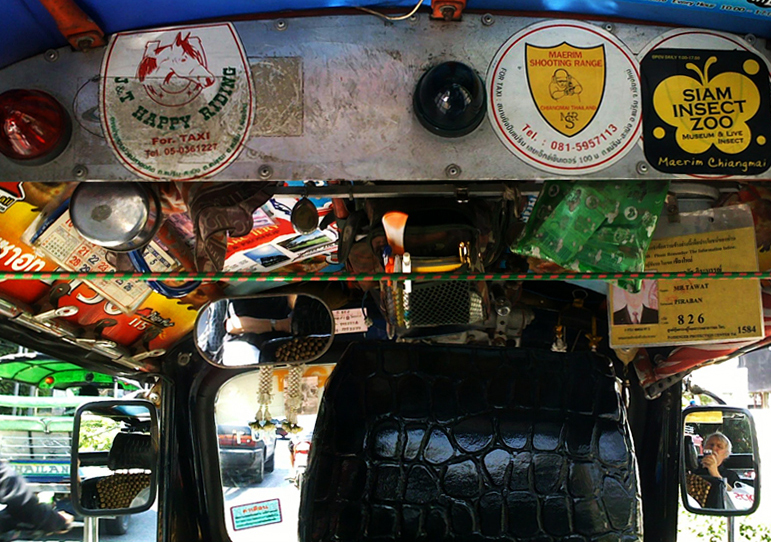
It feels good in here, inside this metal shell that’s holding me cushioned in a womb-like environment, bent over the book in my lap and looking outside from time to time. The experience of the ‘now’ moment is the same ‘now’ moment everybody else is experiencing… a hesitant, preoccupied ‘now’, maybe, for many of us; teetering on the brink of wanting things to be different from what they are. The traffic is hard to believe. Skillful avoidance of the tendency to hold on to the thought it ‘shouldn’t be like this.’ Look around the interior of the taxi, devotional flowers hanging up front in the windscreen and up above I see the painted marks of a holy person’s blessing on the underside of the roof. Grey/blue seating, a public space, registration numbers for the driver and the vehicle. A photo of the driver with his name in English.

We don’t have a conversation. I say: rod tid… (bad traffic eh?). And he says: yeu! (too much). We’re comfortable with the silence after that. For him, it’s a pointless journey to nowhere in particular – no problem; it’s often like this. Pause for a moment and watch the in-breath, the out-breath; mindfulness. A moment’s reflection and meditative contemplation in a Bangkok taxi… this is how it is for him. After I get out, somebody else will get in and off to the next place. When he gets there it’s the same as the place he just left. Where are we now? There’s a huge map in his head. City traffic is like a river, it gets into all the corners and any place where there’s space for it, finding its own level and passing through the hundreds of miles of its landscapes as it makes its way to the sea.

Like a boat on the river going with the current, the ‘now’ feels like it’s not moving. Only when the trees on the riverbank are seen is there a sense of movement, of moving through time. The ‘now’ is experienced in this present time as it has been for millions of years. I can imagine a time in what I would call the ancient past, but a moment experienced then happened in present time; it was ‘now’. A prehistoric being may have been sitting on a rock or a branch, exactly where I’m sitting, inside this cab… looking around – just as I’m doing now – and the ‘now’ experienced then would have been no different from the ‘now’ experienced at this moment.

‘The river is everywhere at the same time, at the source and at the mouth…in the ocean and in the mountains, everywhere, and the present only exists for it, not the shadow of the past, nor the shadow of the future… Nothing was, nothing will be, everything has reality and presence.’ [Hermann Hesse: ‘Siddhartha’, Chapter 9]

————————-

connectedness

DurakitPOSTCARD#46: Bangkok: Sitting in a taxi that’s stuck in traffic and I see these buildings through the window, take the photo thinking, wow! I can write a post about that. The floating staircases look like they were put in as an afterthought. Somebody came up with the idea and sketched it out on the back of a beer mat. Creativity. Things are linked in the mind – the symbol of a bridge, everything is connected. It all fits. Taxi still stuck and I’m searching around in the memory for something, through the staircases and corridors of no-words-to-describe-it, looking for a starting point. How to begin? A small insight comes along; it’s the karma of circumstances.

That’s why, who, where, what, which, when and how I came to be here in Bangkok, strange as it may seem, having started off in such a far-away place over the mountains, over the sea… the Northern part of the world, near to the Arctic region. Up there, the polarities of shady darkness and never-ending light inspire one thing above all: the desire to get on a plane to a sunny place in the Southern Seas and never come back. So that’s what I did.

When I came back I discovered thirty years had passed, the Rip Van Winkle effect – look in the mirror, hair gone white. Most of the people I knew are dead. It had been so long I’d forgotten the ‘me’ that used to be there. I gave some thought to the ‘me’ left behind in the sunny place in the Southern Seas, went back over to check on that but it wasn’t there either. All these hours and days over the years, looking out the windows of an airplane and the world coming in through these eyes but seeing it like it’s not ‘me’ personally that it’s happening to, more like it’s an extension of what’s out there.

There’s a connectedness. No ‘me’. The temporary self-construct that used to be ‘in here’, a tentative sort of half-existence, has gone. Gone is gone. No ‘self’, anatta, nobody at home. Elvis has left the building. I am a metaphor of ‘me’ looking out of the window of a moving vehicle going away to, or coming back from a place called ‘home’ in Bangkok at the present time but next week I’ll be in Delhi again and looking at ‘home’ from that location. I know that three weeks from now I’ll be in Chiang Mai in that place there called ‘home’, hang out for a while, contemplate the space I’m in, then after that, no plans…

Is there anything I can call a real home? (hold that thought)… there’s a memory of something being ‘home’ when I was a kid. I remember long nights and short days, aunties and grannies wearing comfortable wooly cardigans, porridge in a cracked bowl, coal and wood fires, a black-and-white sheepdog – and incidentally, the rural/urban thing about Asian cities, cows sitting on the pavement, goats nibbling and chickens pecking around, the sound of a cockerel in the distance; all this reminds me of the farmyard scene where I was brought up. There’s a familiarity about it

Fond memories, pictures in the gallery of the mind, and yes I’d like there to be a real home, but for a very long time now there’s been only a series of temporary homes – all good, I share my life with Jiab and we’ve gotten used to the way things are. In each place I have my favourite chair, books, and all the things I need. It works okay except sometimes I might spend a long time searching the bookshelves for a book I’m sure is there then realise it’s not in these bookshelves, it’s the other bookshelves, about 2000 miles away. So I have to let that one go, although I can see it there in the mind’s eye…

I feel dispersed, an okay sort of feeling. It suits me well to follow the Buddha’s Teachings: homelessness, non-attachment, no-self. Whether there is a ‘self’, yes/no, is best not thought about too much because saying ‘yes’ or ‘no’ to it is, in itself, identifying ‘self’’. Words identify things, language has a default mechanism that allows me to select what ‘I’ want it to be (also what I don’t want it to be) and the resulting attachment to all that I love and hate. I see it happening, stay mindful about where the exit is located, and open the heart/mind citta to the world as wide as possible.

————————

‘I place the word “Jesus” into my heart, and in a magical instant all those wordless, intangible sensations I have come to recognize as His Presence fill the room, as if that word was a seed dropped into the planter of my heart, which took root, and produced an entire orchard.’ [Excerpt from the post: Trending Towards Holiness]

–   G   R   A   T   I   T   U   D   E   –

gridlock

Bkktaxi4POSTCARD#45: Bangkok: The traffic is incredible – beyond credible, the French word incroyable comes to mind. I get in the taxi, tell the driver where I want to go and he sets off in exactly the opposite direction to where I’m going. Disconcerting… it’s like when you ignore the GPS and its voice keeps on telling you to: ‘please take the next U-turn where possible’. But doing a ‘u-ey’ (yooee, Aussie slang for U-turn) is no good when the whole city is one huge U-turn, interconnected with diversions and u-turns within u-turns. Diversion signs posted everywhere; alternative routes because this is the ‘Bangkok Shutdown.’ All roads leading to Thai Government Ministries are blocked by demonstrators… a protest campaign to force the government out of office before the February 2nd elections. A bit scary but no signs of violence here… I feel secure enough. Strange how the Thai population is able to accommodate these dangerous protests and life goes on pretty much as usual.

The taxi is now going along at walking speed through a crowded area. It’s the lunch hour, people rush out from offices and factories to get something to eat from the local traders. But there’s hardly any room, cars are occupying every space and there’s nowhere for pedestrians to walk. They filter through the flow of slow moving vehicles like water trickles through the stones and boulders in a stream. I try to get a good photo of it but it doesn’t make visual sense, everything is too close, I’d like to try making a cut-paper collage and paste pieces of images of traffic in a kind of jigsaw effect. Maybe it’s something I’ll do after this – at the moment I’m in this collage. I’m part of it, looking through the windscreen, past the passenger head-rest in front and seeing in between a building and a pedestrian footbridge overhead. Out there, there’s a small patch of blue sky, maybe 30 miles away and I can see a passenger jet ascending into the air.

I don’t know to what extent the government is really affected by these demonstrations; it’s the ordinary people who have to take the immediate pressure. But I’m a foreigner here and there’s all kinds of stuff I don’t understand. One thing I don’t understand is how everyone is able to keep their cool, no sounds of car horns at all; drivers maintain an outward calm. The Thai othon (khanti patient endurance), a Buddhist control of anger through the cultivation of mind, based on compassion for all living beings. But how does that sit with the fact that authority figures may be taking advantage of this willingness to comply. This putting-up-with-it thing is allowing all the political skullduggery to go on unchecked…

Bangkok celebrates Chinese New Year from 31st January (10% of the Thai population are of Chinese descent); a 15-day holiday period is coming up when people take time off to go around the city and upcountry visiting family members. How will the traffic be, I wonder. How about the Thai capacity to stay calm in difficult circumstances? Will the political leaders go on pushing until it explodes?

There’s a distinct feeling that, for the time being, everyone is just waiting quietly to see what will happen

‘In daily life we experience suffering more often than pleasure. If we are patient, in the sense of taking suffering voluntarily upon ourselves, even if we are not capable of doing this physically, then we will not lose our capacity for judgment. We should remember that if a situation cannot be changed, there is no point in worrying about it. If it can be changed, then there is no need to worry about it either, we should simply go about changing it.’ [The Dalai Lama]

————————-

light-headedness

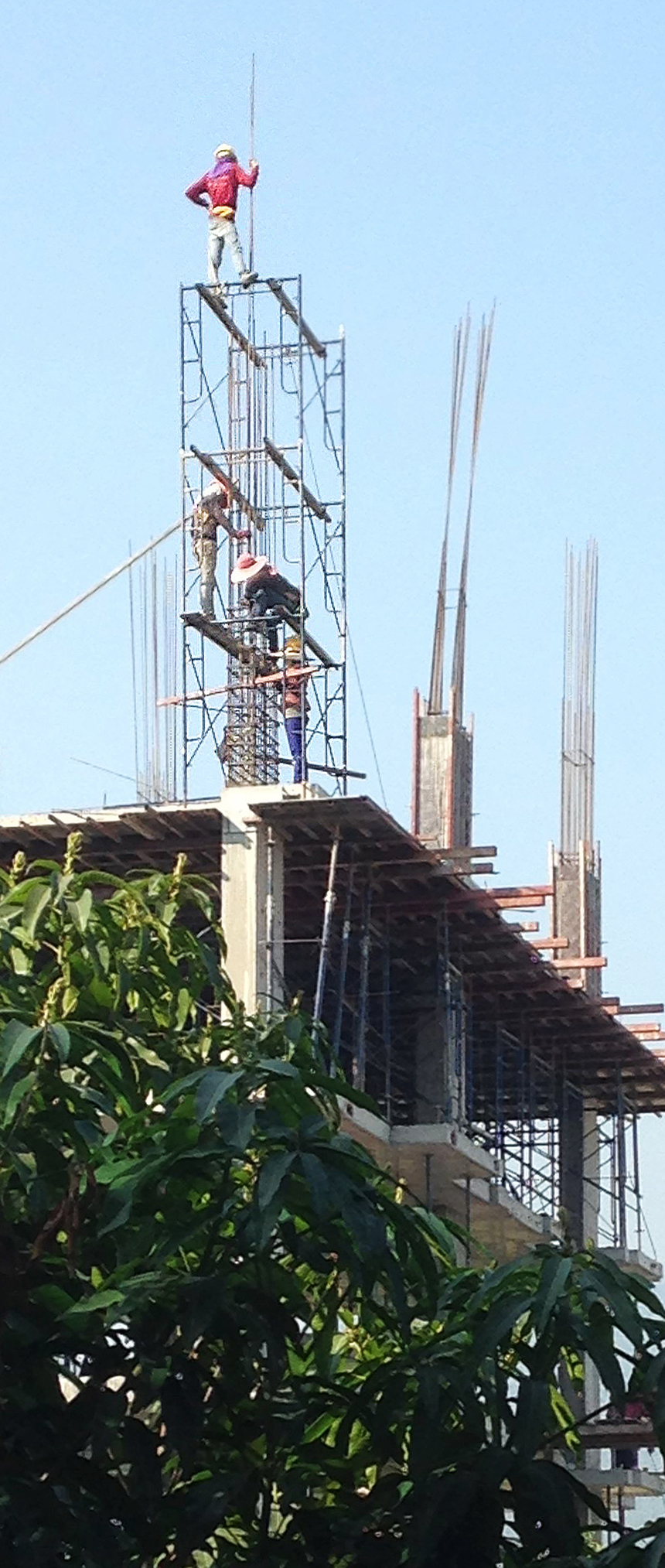
IMG_0460POSTCARD#42: Chiang Mai: Don’t know why or how it can be like this, but there’s a sense of joyfulness, today – floating free. An easeful vertigo that’s comfortably not lost its balance. I’ve been looking at the building under construction next door, and seeing it expanding upwards daily. It’s like something sculptural. The floors and wall surfaces that will hold the enclosed space we recognize as rooms and corridors are not complete, just the shape of the space within which things exists, a 3 dimensional photographic negative in the mind’s eye. The builders do everything in negative form.

They’ve done one new floor since I last wrote about it [structures]. Bricks and mortar with foundations deep in the earth. So fast, almost like everything is made out of paper, no gravity, no heaviness, and we’re in the realm of birds and flying. The guy in the red shirt seems to be the one who always goes up first; climbing into the sky. I don’t know what his life can be like, maybe bonded to his job, burdened with hardships, and struggling with the contractor over pay… but how could he not feel good today, standing up there in the cool morning and looking out, blue sky as far as the eye can see.

These builders are the heroes of the story, men and women in their wide brimmed straw hats, faces covered with cloth to protect the skin from the sun and regulation hard-hats squeezed down over the straw crown. The big bankers and investors might open bottles of champagne when it’s finished, but they’re nothing compared with these ordinary folk on the scaffolding who climb up into the sky on their flimsy structures and boards and the building follows on up behind them. It’s as if there was a hook in the sky they attach their ropes to and from there, can haul the building up, suspended.

IMG_0462BBuildings are the mountains of the city and the created world. These builders are rural/urban migrants; they’re from the villages and the mountains themselves; mountain climbers who build the mountains they climb. And seen from where I am, on the third floor, this mountain/building next to me appears above the tree line and looks strangely separate from the ground below – I can’t see the foundation, there’s sky above and (I assume) sky below. It’s a floating building.

A strange illusion, I’ve seen it in Switzerland, on walks around Dhammapala Buddhist Monastery. When you’re high up there on a steep incline, with trees near enough so you can see the forest floor below, the mountain above the treetops looks like it has disconnected itself from the earth, drifted away from its moorings; a gravity-free mass of rocky earth and vegetation floating in the sky. Thinking of the floating Hallelujah Mountains in the Avatar movie; based on the Huang Shan mountains in China.

There’s a light-headedness about this because, today, I’m somehow free from attachment to things in the mind. Considering the possibility that one reason human beings tend to be in a state of ‘holding’ a lot of the time, is that we’re all earth-bound creatures; attached by gravity to a spinning planet and the default mindset is this holding-on thing – can be difficult to feel comfortable about letting go. But today I feel released from that pressure; climbing the mountains in the mind. This freedom has always has been like this. I just didn’t notice.

‘The Buddha taught that clinging was the ninth link in the chain of Dependent Origination. In that chain, craving led to clinging, and clinging to “becoming” (bhava), i.e., to continued stuckness in cyclical existence. There are two places where the chain of dependent origination can be broken: at the point where a pleasant feeling turns to craving, and at the point where craving leads to clinging.  We can break the link of craving through awareness of its dangers and insight into where it will lead us.  We can break the link of clinging by simply letting go.’ [Seth Zuihō Segall]

————————-

fragments

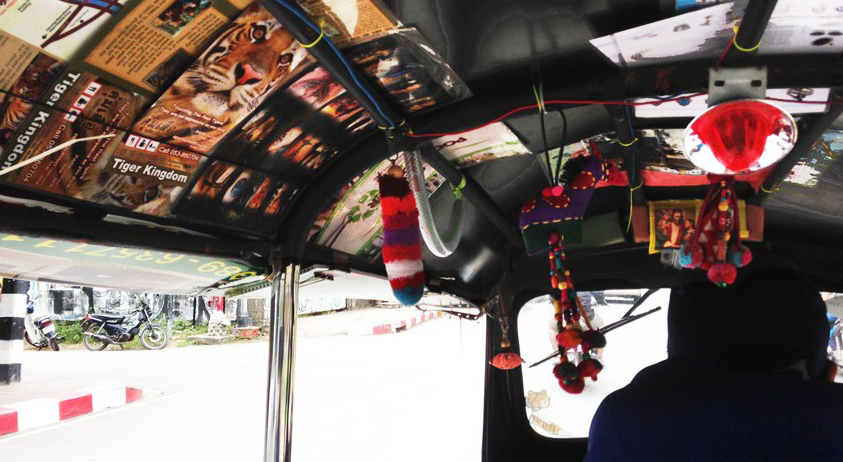
tuktuk1aPOSTCARD #41: Chiang Mai: Awake with the sound of birdsong and the first signs of daylight. A kinship with all beings. We breathe the same air, experience the same kind of heart beat – the tastes, the smells, light, sound, body sensations and consciousness. Suddenly a thought arrives, a memory of something that happened a long time ago; not important, like an aspect of another thought that got overlooked somehow – now seen in a different way, simple and easy to be with. I’m sitting on the edge of the bed, bare feet on cold floor; not completely awake, contemplating the start of the day and it takes a moment to notice this thought is still here. I have the feeling that I understand more about it now than ever before. Quickly! Get up, search around for a pen, I’ll have to write it down in my notebook before I forget.

In the next few minutes, the thought seems to expand, occupies my whole attention. It’s as if I’m seeing it all for the first time. Even as I’m going around doing early morning things, the thought remains – like a stationary object. A feeling of meaningfulness, a sense of amazement with the functioning of the mind; watching to see what it’ll do next, where’ll it’ll go after this. What’s it like? Getting to know it, like a child understands a thing directly. Got keys, wallet and down in the elevator, still thinking about it. Out on the street and walk to the main road. Aware of mind phenomena and looking at that thought in particular; the fragility of non-grasping and allowing things to be un-held. Where did it come from, where was it before it arrived here? Somewhere in The Great Space, fragments of it dispersed in actions not yet taken… am I creating the thought by noticing it?

A tuktuk stops, I get in, we accelerate along the road; wind in the face, noise all around. The present moment is an accumulation of pieced-together thought-items; bits of language imagery from environmental-input and memories of past-time brought into present-time, projected into future-time. Time is a human measurement: applied time. Reminds me of something I read in a book written by somebody wise, saying that TIME is just God’s way of preventing everything happening in the same instant. In one microsecond, the entire history of the world, up to the present and off into the future… watch it as it flies past.

Pause for a moment. Traffic lights at the intersection and everything stops; a curious extended, stretched-out moment – just the circumstance itself. It takes a conscious effort to get it started again. Is conscious awareness moving from one moment to the next? If so, is this the next moment yet? Are all the fragments of the next moment combined sufficiently in the endless stream of things so that I can now say definitively, THIS IS THE NEXT MOMENT? And all of a sudden it’s the past again. There’s only one moment, always has been. One long moment that includes immensely distant things. A single passing thought lasts a thousand years. Its parts so remotely scattered, a great ocean of nothingness invades the space between things. No easily seen reference points, objects get forgotten about eventually and all that remains is the idea that, a long time ago, I think I was searching for something but I can’t really remember. Anyway, I was never able to find it – still distracted sometimes by the idea that I might stumble upon it by chance one day, but otherwise at peace with everything the way it is.

IMG_0221b‘The fact that we can never “fully know” reality is not a sign of the limitation of our knowledge, but the sign that reality itself is “incomplete,” open, an actualization of the underlying virtual process of Becoming.’ [Slavoj Žižek]

————————-

structures

IMG_0395bPOSTCARD #40: Chiang Mai: Watching the construction of a new condominium next door that’s been going on for 6 months or more. It’s like a story: Once upon a time there was a construction site. Then there was the first floor. Now they’re up to the fifth floor and the structure is above the tree tops. I can see the workers, including women workers wearing wide brimmed hats, sitting there creating the metal reinforcement of the support pillar. They’re doing it by hand; twisting flexible metal wires around the vertical and horizontal parts, like you tie a plastic bag closed with a plastic cable tie. Not moving around too much, aware of the flimsy platform they’re on. No safety measures, other than the mindfulness of being careful.

There are another two condos being built on the other side. A constant coming and going of cement trucks through the narrow streets, and all around the clangs and bangs of construction site sounds. Noisy but I’m attracted by the creativity of it. These large structure were once an idea in an architect’s office and I can see the plans and diagrams that were drawn on draftsman’s paper coming to life in three dimensions. Throughout the day, I stop what I’m doing and go over to stand by one of my windows and maybe watch the huge crane lifting things up from the floor below and placing them on the new floor above. Then to the other window and see what’s happening there. The workers are active the whole time; rural/urban migrants from another strata in society, pluralism. Where they come from you could buy 5 acres of land with the money paid for one small unit in the condo they’re building here. What they get from this is an income, and there’s stablity, their children can go to school here, an opportunity to break out of the mould, social change is generational.

Their stamina humbles me, I’m a foreigner living in their country, my life style is so distant from theirs. I wonder if they have times when they get fed-up with it all? Are they as dissatisfied as I am? Would they understand how I sometimes pause in the writing of a piece, reflect on how much my original idea has changed since the beginning of it, and what I’d really like to do is take the whole thing to pieces and start again? Probably not, and I’m trying not to give up on it because this is already the third revision. In the West we can’t think of constructing without deconstructing. In the process of learning how to build things up, we learned how to knock things down. Click the remote and we’re watching a different movie; basic truths were disassembled overnight. Postmodernism arrived and everything came to pieces – nothing to hold on to. A world that’s always a work in progress, no final ‘finished state’.

New possibilites arise and one of these is the thought that maybe I’m not seeing the real world at all, what I’m seeing is something created in the mind; something ’seen’ in the way I want it to be. I can change the world to get it to fit when it doesn’t seem right according to the image I have of it – so how can I be sure I’m not simply thinking up a theory and creating supporting statements to prove it? My continuing engagement with it somehow confirms its reality… but is it really real? The question is the answer, it’s open-ended, exploratory – inductive reasoning. The solution is revealed in the process of examining the question. No subject/object dualism. Instead of trying to impose a structure on Nature, things take place subjectively. Finding the way that has a starting point inside, not outside; something I recognize in the interaction with the question.

Around noon, all the noise and clatter suddenly goes quiet. Lunchbreak. From my window I see the workers sitting in groups and some lying  in makeshift hammocks strung across the scaffolding supports in the cooler shaded floors: zzzzzzzz… the world is a kind of analogy, a figure of speech – the metaphor and reality. No final conclusion, forever on-going….

IMG_0403‘… houses rise and fall, crumble, are extended,
 are removed, destroyed, restored, or in their place
 is an open field, or a factory, or a by-pass.
 Old stone to new building, old timber to new fires,
 old fires to ashes, and ashes to the earth
 which is already flesh, fur and faeces,
 bone of man and beast, cornstalk and leaf.
 Houses live and die: there is a time for building 
and a time for living and for generation
 and a time for the wind to break the loosened pane…’ [The Four Quartets, East Coker, T. S. Eliot 1943]

————————-

evenness of 2014

IMG_0382POSTCARD #38: A village near Hat Yai: Here in a house surrounded by trees above window height on the ground floor and in the daytime everything is seen in a translucent green light. It’s an old rubber plantation, with some palms and huge banana trees. Now it’s night and I’m pretty well seeing double having been staring at words all day. Struggling a bit to stay awake to see the coming of New Year – thinking the number 14 is somehow nicer than 13 and also the number 2014 has a pleasant evenness about it? But maybe I’ll go to sleep, it doesn’t seem right to be awake when all the small creatures in the forest are either asleep or being strangely nocturnal and kinda scary in their stealth. I feel a bit obvious here with all the lights on in the house.

IMG_0380Cannot see well, the spellchecker rejects all the Thai and Pali words and onomatopoeias and my spelling innovations; and when it doesn’t know a word I’ve been clicking the ‘Add’ option so much it’ll render the spellchecker obsolete eventually. It’s getting difficult too because small insects attracted by luminosity of screen are walking around in my vision seemingly dotting the letter ‘i’ and crossing the ‘t’ or making an ending to a word that isn’t there. Cannot understand how they get through the mosquito mesh on the windows. I notice that the larger insects stop flying around when you put the lights out because they bump into things, it takes them a few moments to stop where they are, anywhere’ll do and just immediately go to sleep.  I’ll do that too, have to call it a day and shall set this Post so it’ll go out at midnight, and it’ll be the New Year then, Thai time: +7hrs GMT. So, all that remains is for me to say thank you friends and fellow bloggers for visiting me here in the year 2013, and best wishes for 2014. Metta, Loving Kindness, may your year be one of Mindfulness and Letting Go

– HAPPY NEW YEAR TO ONE AND ALL –

IMG_0367

patient understanding

IMG_0291POSTCARD #37: Chiang Mai/Hat Yai journey: The Chiang Mai flight to Hat Yai was discontinued just before our departure date, so the journey had to be made in two parts; the first flight to Bangkok the second to Hat Yai – a bit frustrating, yes, but that’s how my Western thinking can be fixated on the way things ‘should’ be, and not how they are. This is Thailand and no upset, just the sense that people were a tiny bit miffed about it. Then we discover the baggage can’t be checked through either, it means we have to collect everything from the luggage belt at Arrivals when we get to Bangkok then to Departures and check in again for the next flight. There were a lot of bags, and we had little M with us who is 9 years old and she’d have to be guided through the crowds safely. I felt I was beginning to lose it at that point but still no reaction from the others, just a kind of ‘no comment’ attitude and the sense of something being ‘held’.

I go along with the way everyone else is doing it; chai yen yen (keep a cool heart) chai ron mai dai (being angry is no good). Patient understanding, putting up with it quietly; othon, in Thai, it’s about accepting things as they are and not fuelling the fires. There’s a cultural tradition of this kind of inhibition of anger in public. It’s a big no-no. Why? Because when people really lose their cool they can go crazy. The word in Thai is baa, a kind of madness; political demonstrations with crowds running into a hail of bullets and not stopping until the cease-fire. So, we don’t want to go there. Thais have acquired the skill of abiding in the suppressed anger state so that the feeling can be allowed to pass and there’s sufficient clarity of mind to see what action can be taken.

We arrive at Bangkok, wait for the luggage at the belt, I get it all on to two trolleys, with little M sitting up on top of the bags and we make our way through the crowds to the elevator. Up to the second floor and enter through security and the baggage X-ray machines to the check-in desk again. There’s not much room and a large congestion of luggage trolleys. Tense pale faces, no anger, only the difficulty that people are having suppressing it. Sweat forming on the forehead, no expression, a tight smile when required, a mutual understanding and a calm appearance. Tread carefully, the fear of becoming angry makes the whole thing kinda fragile.

Recent political demonstrations highlighting the underhanded manipulative strategies that take advantage of this cultural quietness are an example of there being suddenly a legitimate reason for everything to go totally irrational. In this case, organised public protest against a Prime Minister who was put in place by a group of behind-the-scenes bad guys; a situation not unlike the period of George Dubya, the 43rd U.S. president. Both leaders were puppet-like, inarticulate, and the public fell into a kind of embarrassed silence; how can our leader appear to be so hopeless like this? This odd acceptance allowed the controlling group to manipulate events behind the facade. It was tolerated for a while due to the cultural ‘holding’ behaviour, then it exploded. These public protests pull things back into balance because Thais value peace. Anarchy and lawlessness are a scary alternative – almost like insanity. There will be stability, but only for a short time, it seems. Sadly, it’s likely to break out again. An impossible cycle…

IMG_0285

We get on the next flight, take-off and up into the clear blue sky again; out there, where there are no problems, the beautiful great curvature of the Earth. One hour and fifteen minutes later we descend into Hat Yai. The outer arrivals section full of Thai muslims in colourful head scarves and matching costumes, children running around. Into the car and out on the great North/South highway that connects Thailand to Malaysia and all the way South to Singapore.

 “In essence, the process of division is a way of thinking about things that is convenient and useful mainly in the domain of practical, technical and functional activities (e.g., to divide up an area of land into different fields where various crops are to be grown). However, when this mode of thought is applied more broadly to man’s notion of himself and the whole world in which he lives (i.e. to his self-world view), then man ceases to regard the resulting divisions as merely useful or convenient and begins to see and experience himself and his world as actually constituted of separately existent fragments.” [David Bohm]

————————-
The David Bohm quote above comes from The Ptero Card Post: I Fall to Pieces
–   G   R   A   T   I   T   U   D   E   –
Upper photo: Don Muan airport Bangkok
Lower photo: part of the whistle-blowing anti-government demonstration passing through the Siam Paragon shopping area in Bangkok 

maya & christmas

IMG_0220POSTCARD #36: Chiang Mai: Going around town in a tuk-tuk, seeing all these new shopping areas getting built and a huge shopping mall opens here soon called MAYA – a Sanskrit word meaning illusion. In Thailand the word maya is applied to the lifestyle of movie stars who have everything money can buy and their lives are thought to be unreal. In an intelligent way, everybody knows what maya is and what ‘reality’ is. But in the shopping mall context maya is presented as an attractive idea; it’s appealing, even though it’s an illusion, we’re partly agreeing with it; complicit in its being there. We might say well, okay it’s an illusion, but what’s wrong with that? Nobody wants to see it as calculated corporate planning to create a market for consumer goods… that would destroy the pretty illusion. Nobody wants to know that the local population, sons and daughters of rural/urban migrants, and naïve hill-tribe folk are likely to be swept away in the wave of purchasing choices. Unseen, built-in strategies contained in an imported Western model that doesn’t suit this culture… and we’re not willing to say there’s anything wrong with it because we’re all in some way compromised.

A kind of tacit approval of consumerist schemes embedded in our lives that has resulted in our losing so much of our inherited cultural traditions. The Christmas festival is layered over with the maya of santaclausisms and the Jesus Teachings are nearly lost in it. It’s as if the essential part of our spiritual Truth got forgotten along the way and consumerism came along in its place. It’s a mystery really, why it should be like this, but for some reason the early Church disapproved of the gnosis (knowledge) part of the teaching. Out went the pragmatic instructions on seeing the constructed nature of appearances and the stepping-through to discover the non-duality between ourselves and God. ‘His disciples said to him, “When will the kingdom come?” 
<Jesus said,> “It will not come by waiting for it. It will not be a matter of saying ‘here it is’ or ‘there it is.’ Rather, the kingdom of the father is spread out upon the earth, and men do not see it (113).”’[Nag Hammadi Manuscripts].

After an extended period of study and contemplation, one simply ‘wakes up’ to the Truth of it; the reality that surrounds us all the time; Brahman, the Oneness, the God state that’s here and now. You’ll notice I’m presenting the Jesus teachings as an instance of the Advaita experience, sourced in the Upanishads [I wrote another post about this, link to: Jesus and Advaita Vedanta]. I’m also including the Jesus Teaching in a oneness of spiritual teaching centred in that geographical region where the three Abrahamic religions arose: Christianity, Judaism, Islam and the connection with Brahmanic religions and Advaita Vedanta. Others related to this include Buddhism and Jainism. That region, from North India through to Israel and the Mediterranean, a distance of about 3000 miles, say from New York to San Francisco? I see it like a highway of knowledge, wisdom and information. All of it coming and going along the route many centuries before Jesus was born and many centuries after. All the world’s religions arose here.

Somewhere in this context lies the actuality of our Jesus experience; only traces of it remain – enough to know there is this huge feeling of goodwill towards all beings in the world and the universe.

Merry Christmas friends and fellow bloggers ~ Christmas 2013

————————-

Excerpts from: meta-narratives