sustaining factors

monkey-tap-india_1626153iNew Delhi: Monkeys swing through the trees, jump down on to the roof terrace and turn on the tap to have a drink of water. I don’t mind; except that they don’t turn it off when they’re finished, just leave it running – water trickling down the drain from up above – that’s how I know they’ve been there. The neighbours have the same problem. I see somebody climbing up a ladder to the water tank up there at the highest point… what’s he doing? hmmm, replacing the tank lid; the monkeys have pulled it off to get in and drink, and have a little freshen up. Yes, well, it’s hot here, Jiab said around 45°C. Not worth it, being precise about temperatures above 40°, just waves of hotter air wafting around in slightly less hot air, something like being in a swimming pool of hot water. It’s so hot, I feel like a pancake on a hot plate. I don’t want to eat a pancake, I feel I am a pancake… cooked and kept warm. No problem, really, we have a room in the house with air-con, and I’m in there. All I need to consider are these long power cuts, but nothing more than 10 minutes. Longer than that is uncommon. But it did happen once [Link: Power Failure], what can you do? If it happens, it happens – the uncertainty element. Causes and conditions, no more than that. Phenomena are sustained only as long as their sustaining factors remain:

‘When this exists, that comes to be. With the arising of this, that arises. When this does not exist, that does not come to be. With the cessation of this, that ceases.’ Samyutta Nikaya 12.6

I can’t say I’m as detached as that when it comes to coping with stifling heat but knowing that this is how it is helps me to ease off and away from the proliferating stories in the head I don’t know are there because I’m seeing through them [Link to: The World is Made of Stories]. If there happen to be long periods with no air-con, it’s best to go outside, find a shady spot to sit and say hello to the neighbours, who’re all outside for exactly the same reason. Outside is better than in; the heat is trapped in these brick and concrete oven-like buildings. But, so far-so good, most of the time I’m sitting in this cool room.

It’s still early morning but I better get on and cook the food for the day because the kitchen will be like a furnace by noon. I open the door to go in there and enter an atmosphere that could be the planet Mars, images of volcanic slopes and bubbling lava… I have to boil water in the electric kettle, a curious old thing made of metal and if you forget to empty out any remaining water at night, when it has cooled down, tiny ants climb up the side and sit there enjoying the coolness of this small reservoir. Then, for some reason I find them drowned in the water the next morning. I think they must drift off in a dream state and fall in. I suggested to Jiab we just spoon out the ants, then boil the water but this is not well received: I do not want tea made with water that has been swam in by ants! So I’ve learned to empty out leftover water in a bucket to give to the plants.

Kettle boils, add the hot water to the steamer, put in the vegetables and switch on the gas. I can sympathize with the ants, there’s a ceiling fan spinning around, swooshing and splooshing the hot air in gusts and not doing much to lower the temperature. I have to switch it off, even so, when using the gas cooker because the gas flames get blown out and I’d asphyxiate in gas-flavored hot air (limp bizkit, chocolate starfish and the hot dog flavored water – no, no, not that, please…). Switch on the extractor fan, maybe that’ll help. The stove heats up the atmosphere by another 10 degrees and now it must be about 50°C. Strangely, it seems okay because there’s an object in awareness; the heat is coming from that; the gas stove. I don’t notice it’s hot, just standing waiting for the food to heat up, then it’s done and I can return to my cool room…

All there is is sitting in the coolness with this mindful alertness: the possibility that the power may go out any moment. There are more attention-grabbing existential phenomena but this’ll do me… listening for the monkeys and M’s little rhyme she taught me in Thailand comes to mind…

Five little monkeys jumping on the bed, one fell off and bumped his head. Mama called the doctor and the doctor said: “No more monkeys jumping on the bed.” Four little monkeys…

280520131847

————————-

Upper Photo: monkey-tap-India_16761531 GIRISH KUMAR : Message : Animals in News. Lower Photo: Cassia fistula, golden shower tree (the tree the monkeys use to access my roof).

persistence of the dream

Mpic2A village near Hat Yai: Here in a house surrounded by trees, it’s nearly one year since I was last in this place [Link to earlier post: ‘nothing in itself’]. Birdsong and mostly quietness; only a faint noise from the road reaches us here, drifting in according to wind direction. And the sound of two puppy dogs yap-yap tied up on long leads, getting bathed by being dragged along the concrete path, pulled under the garden tap and held there as long as possible (they’re so small you can do that), then untangling the leads is the difficult part. They soon dry off in the hot sun. The chicken population chirp-chirp of last year has disappeared from this world, some eaten by carnivorous nocturnal creatures that watch from the edge of the clearing. Most are eaten by carnivores who live in the house – thus the truth of farmyard life is revealed. A new population of chickens pecks the ground chirp-chirp where the others once pecked, and who’s to say they’re not the same ones reborn? A piebald kitten miaow goes around seeking attention, miaow. Four cows; three have bells tingaling, tingaling, tingaling around the neck and there’s one with a bamboo bell that goes clacka-clacka. Three of the animals are dignified and silent; there’s one that goes moo-aaaah, feeling a bit hard-done-by, maybe. I don’t know if it’s the one with the bamboo bell; that’s just the way it is, no obvious connection; no reason for it – or for anything. There’s just this multiplicity of loosely related phenomena that has the characteristics of a farmyard scene. It’s like this right now because it’s nearly evening, and everything’s going: chirp-chirp, yap-yap, miaow-miaow, tingaling-tingaling, clacka-clacka and moo-aaaah. Sun turns orangey, pinkish purple, sinks rapidly below the horizon – no twilight. Approaching darksome night mystery, and wild nocturnal carnivores wait in stealth at the edge of shadow. Insects zzzzzling and large moths surround the porch light that’s left on till morning.

28052010010Upstairs in the half-dark of the guest bedroom, M can’t go to sleep. ‘I not go to sleep yet, Toong-Ting. You have to tell me a story’, she says, addressing me as Toong-Ting, in her 9 year old way of giving people and things in the World different names. It’s my responsibility, I’m the fictionist. Too late now to go find a story book from downstairs, and I try telling her that…‘Then you tell me your story, your own’, M says. This means I have to invent something… there’s just no getting away from it. So, in an inspired moment, I start telling her about all the birds here around the house and, when we leave next week, all the chickens and the rooster and the ducks and birds in the trees and the owls will come with us to the airport. They’ll have to take a taxi by themselves because there are so many of them but the driver can follow us in our car. They don’t have to check in any bags because they don’t have any bags, of course. They just get on the plane with us, perch on the seat backs and arm rests and fold-away tables and go: chirp-chirp, cockadoodledoo, quack-quack, woo-woo, tweet-tweet as the plane rushes along the runway, up into the air, flies away into the clouds, far far away until nobody on the ground can see it anymore. There’s a short pause and M asks me, ‘Leally (really) Toong-Ting? Why the birds go in a plane, they can fly by themselves?’ And, yes, there’s this unforseen logistical problem about the story, I realize – so, I begin my explanation for these circumstances then notice that M has fallen into the dream and is already asleep…

————————-

‘If in this way I see one of these creatures withdraw from my sight without my ever knowing where it goes to, and another appear without my ever knowing where it comes from…; then of course the assumption that what vanishes and what appears in its place are one and the same thing, which has experienced only a slight change, a renewal of the form of its existence, and consequently that death is for the species what sleep is for the individual…’  [Schopenhauer, The World As Will and Representation, Supplements to the Fourth Book, Chapter XLI: On Death and Its Relation to the Indestructability of Our Inner nature]

no more than this

161120121610Chiang Mai/Bangkok flight: Sitting on the plane with M beside me, my Thai niece, and her coloured Tshirt, funny hat; her iPad mini and her 9 year old vision of the world. I’ve been watching her use these kiddy’s applications; cute kittens with large eyes and she shows me how they respond to your voice; all kinds of stuff. We can make fruity ice-cream drinks, waffles and cup cakes with different kinds of toppings and M insists I have an opinion about what kind of toppings to have – lemon or strawberry? It’s important! M asks me in basic English; only the key words: What you like, Toong-Ting? So I choose a lemon topping. When it’s finished we eat the cup cake by tapping a finger on the screen. The name Toong-Ting is part of her former baby language she doesn’t use any more but, somehow, M decided to keep it as my name. She selects things in this unique way because English is a second language. Maybe it’s easier to say Toong-Ting than my actual name, or she likes the idea of being cute (I think it’s this).

And so the time is taken up with M asking me about various things like this. I engage with her on these points and in the intervals, when she’s busy with the iPad, I’m simply aware of our physical presence. There’s really not anything left to think about… mindfulness, waiting for the next question. In the silence there’s a curious emptiness, just a quiet awareness, bhavanga, the space in-between; not reacting to stimuli, there’s nothing happening. Just being here; the knowingness of it. My responsibility is to take care of M; to respond to her small requests in a way that’s in tune with her way of thinking and her use of English. That’s all. We are linked in our present-time mutuality and there’s nothing else coming into consciousness from the outside world unless it’s something very interesting or something we need to be careful about. Right now, here in the aircraft seats, it’s all very bland and neutral. Somehow I seem to have sidestepped my own mental activity; the usual state of affairs of the mind, the way the ‘self’ attempts to perpetuate itself is seen; there’s only this, being here…

Then the cup of coffee is served and M says I should have the powdered creamer in the packet that comes with it: ‘Why you not put that in your coffee, Toong-Ting?’ and she looks at me with these almond shaped eyes and little face… so I put the powdered milk in, even though I normally take black coffee. She watches me open the paper packet and pour it in, her eye level is much nearer to the brim of the cup than from where I’m seeing it. I lean over, we watch this together, powder dissolving in the cup in small clouds and imploding movements. I never really noticed it before… children are here to teach adults (I read in a blog recently?). M tells me to try it and see if it tastes nice. I try it and say yes.

Looking out the window, down on the land below, there’s the surface of the planet; swirling movements of rivers and patterns of vegetation, land shaped by many hundreds of years of the wind and climate, and it looks like the powdered milk dissolving in the coffee. Liquid in a small plastic cup 38,000 feet above what’s seen on the surface of planet below; macro/micro, the oneness, all things have the same characteristics. ‘Look, look at this, Toong-Ting!’ and I have to look again at something else M is doing and make a comment about that. We discuss it for a while, then back to considering the powdered milk in the coffee and I’m feeling this same continuing state that’s empty of thought. I know that M is going to ask another question soon so part of my attention is occupied with being ready for that with a clear mind; metta, loving kindness. I’m a passive passenger transported on an aircraft, aware of the immediate surroundings; a gentle bumping of the plane, the hiss and hum of the engines. Just a sort of space I am occupying right now, no more than this…

————————-

‘Bhavanga literally means “factor of life”; bhavanga is usually translated into English as “life-continuum”. The bhavanga-citta keeps the continuity in a lifespan, so that what we call a “being” goes on to live from moment to moment. That is the function of the bhavanga-citta.’ [Introduction to the Abhidhamma]

Photo Image: Flowers growing in a Thai temple in Buddhist India

remains of the dream

tuk18March

Chiang Mai: 05.00 hrs, phone alarm goes off, ascending ring tones of celestial music and the small window of digital light illuminates the dark room. Too bright, it’s difficut to see how to switch it off. OK, I got it…

Peace and quiet, it’s a Chiang Mai morning. Difficult to wake up because I just arrived from Delhi and there’s a time difference of 1½ hours – neither one thing nor the other and the remains of the dream scattered around. Fragments of a story and the urge to try to put the pieces together and recreate the dream. There’s this built-in curious ‘wanting’ tanha. Maybe I’ll find out what the story is about in the process of looking for the pieces that are lost?

Impossible. The predicament of the dream, the tendency to be wanting something… anything, it doesn’t matter; something to attain, obtain, procure, secure – a mood, a good feeling – the language of consumerism – wanting something, but I can never seem to narrow down the options sufficiently to actually get what I want, and all that’s left is the ‘wanting’ itself. Ungratified desire, just the wanting, hungry and dissatisfied, I feel like I want to get rid of the ‘wanting’ but wanting the ‘wanting’ to stop doesn’t make it stop. It only increases the level of ‘wanting’ and this is my suffering, dukkha….

Slowly moving up through the layers into a more wakeful consciousness, here. Difficult. All the pain meds for backache coming to an end now, very nearly pain-free for the first time in 10 days. Wonderful. So, I think I’m nearly able to pull the body into a meditational posture. Try it and see. Carefully adjusting the pillows and cushions on the bed to get myself sitting upright with folded legs. Aching knees because it’s been a while but it comes allright, settles down, and everything just falls into place again.

Mindfulness. The presence of the body, just quietly sitting here, and the mind slowly moving from sleep to wakefulness. The in-breath and the out-breath seem like incremental steps going higher and higher up a narrow winding stone staircase until it doesn’t go any higher and when I let go of that, the mind eases off into this state of peace. ‘… meditation is not an activity; it’s the cessation of an activity’ [Rupert Spira]. It’s about consciously not doing anything.

Peacefulness and fragments of the dream remain, pieces of a jigsaw puzzle. I’m drawn towards it, still, and inclined to try to put the pieces together again. The peaceful state becomes blissful, nice – if I merge with it, I’ll fall asleep and there’s a reluctance to do that. I’m holding on to it again, I see I’m trying to make it do what I want it to do, even though the blissful state is incidental, subject to change, annican, and I’ll never succeed with it.

It’s the ‘wanting’ thing again. I could ‘modify’ this and get it to be what I want? It would be nice if it were blissful all the time but I recognize something; the bliss can become irritation and sometimes it’s a hell realm and I have to get out of it quick… Heaven/hell, there’s no way of knowing which way it’s going to go, so I need to remove the function that tries to manipulate the pleasant state through greed and wanting.

This helps me to detach from it; let go of the bliss, bye bye… but it’s still there; just feels like it’s happening to someone else; generosity, share it with the world. Can’t find words to express. Leave it at that. I’m really a minimalist, anatta. No God, no ‘self’, no I, you, he, she, it, we, you, they – and the sentence often makes no sense because there’s no subject, no object. No problem, the feeling is too large, no words for it…

————————

“As far as the suns and moons extend their courses and the regions of the sky shine in splendour, there is a thousandfold world system. In each single one of these there are a thousand suns, moons, Meru Mountains, four times a thousand continents and oceans, a thousand heavens of all stages of the realm of sense pleasure, a thousand Brahma worlds. As far as a thousandfold world system reaches in other words [the universe], the Great God is the highest being. But even the Great God is subject to coming-to-be and ceasing-to-be.”[Anguttara-Nikaya X 29]

before the story begins

270420131799Delhi/Bangkok flight: People don’t normally go to Thailand for their holiday in the middle of the hot season – highs of 40°C –  mad dogs and Englishmen… No passengers, plane is nearly empty, fortunate for me with this back pain I’ve had for more than a week now. I set off on this journey knowing that really the last thing I’d want to be doing is getting into the overcrowded economy class section with no room to move. But the good kamma of plenty room today, I can position myself in the chair so there’s no discomfort and able to quietly contemplate the clouds in the sky. Everything seems so still, not really comprehending the phenomenon of travelling at 500 mph – 1 mile in seven seconds? I count to seven: 1-2-3-4-5-6-7 and one mile further on. Hmmm, it feels like everything is stable and down-to-earth; stewardess smiles sweetly: something to drink sir?… I feel I’m a bunch of time-stretched-out spaghetti strings, going most of the way back to the point of departure.

Consciously watch the breathing and the mind settles. Soon there’s the quiet space of no thinking. Watch the breath for a while but then, after a moment, something triggers thought again. A story starts up and I remember Lisa’s post, Doing Nothing Out of Anger: ‘…we have to get the story of it going in our head’. Without the story, it doesn’t happen. Usually you fall into it and it’s more to do with convincing yourself it’s like this, rather than it actually really being ‘this’. But there’s the small space just before it locks in and I can see that this is the last opportunity to consciously let go of the story-building, and be aware of the unchecked habituality that’s there for no good reason.

I read something about this in Rory’s blog/Tao Te Ching 12: The Inner World: ‘It’s been estimated that we think around 60,000 thoughts each day… probably over 90% of them are simply recycled from yesterday and the day before…’ Thoughts about absolutely everything – most of the world is inside your head. No wonder the space of no-thought is such a novelty to discover, no stories unfolding. Training the mind to consciously monitor the randomness, yoniso manasikara, contemplate the act of thinking with focus and concentration.

Mind settles again in the space of no thought, no end, no beginning, everything is always in present time, no past, no future… then, in the mind’s eye, I’m with my mother in the Care Home, holding her hand and she stops breathing, I see the moment she dies and it’s like her last teaching to me: this is how you die son, just watch me… and I see her move from the present into the past – forever.

A long time spent coming to terms with the fact that all of that is now irretrievably in the past; there are memories but if I don’t start the thinking process, there’s nothing there. Sometimes finding myself cast away on a small island of thought with stories like this, then the peace returns, sound of the aircraft. No thought, not trying to find it, not engaging with the story of it. We’re all just seeing ‘the seeing of it’. There’s something about the human reaction to the world, sensory organs mostly positioned around the face, so the head moves in response to functions of eye, ear, nose, tongue, skin and mind – the mind and stories, the ubiquity of the story.

The story is everywhere and it’s necessary to see the input clearly and the habituality. As far as possible let there be no reason for Mind to step in and take control, create the story of ‘me’; someone at the receiving end and the whole subject/object duality starts up. Without that there’s just the sensory receptors and our shared world. There isn’t anything else to be done; only to ‘see’ the reality – seeing the seeing; awareness of the awareness; knowing the knowing. ‘I’ am not creating it. Awareness has somehow sidestepped that. Seeing the events without the story.

On a journey like this, you somehow think that, at the destination, that’ll be the end – no more stories. But you arrive and there’s just another set of stories going on and we’re always only part the way through whatever story it is – same as what’s going on with everyone, everywhere else in the world, all at the same time.

Landing at Bangkok, yawn and swivel the lower jaw to release trapped air in the cranial passages; ears go ‘pop’ and a whole new 3D sound enters…. didn’t realize how cotton-wooly it was before. Ah well, so which gate are we coming in at? There’s a long walk to the domestic terminal and the next flight to Ch’mai…

————————-

dimensions of pain

DSC00134 Lake Wanaka - near Diamond LakeI WAKE UP FROM THE DREAM to find I’m shipwrecked on the sofa, notes and papers strewn around, a cold cup of coffee – how long have I been asleep? Turn to look at the clock, then the pain; lower back pain, oh… aaah! Yes, I remember now, I’ve been disabled for a few days and situated on the sofa mostly: pain is bad – I must have done something ‘bad’ to deserve this… the tendency to criticize oneself for having the pain, perpetuating the kamma of causes and conditions. I need to correct this frequently. Another thing is that I’ve had the pain often enough to know there’s a difference between the pain itself and the act of resisting it; also the attachment to wanting it to go away: I-don’t-want-it-to-be-there…. Profoundly desiring it to not-exist, vibhava-tanha, but I’ll not find any peace in attempting to gratify that need – although I may persist in trying. What to do? There’s nothing I can DO about it, except try to get comfortable and see how that goes. It’s a no-choice situation and, strangely enough, things start to improve as soon as I stop trying to do something about it…

Some years ago I had abdominal surgery (abominable abdominal surgery – no joke) two operations, 6 months apart. Just enough time to recover from the first before getting ready for the second. More difficult the second time around, because I knew what was coming. The first time it was unplanned, an emergency, severe abdominal pain, straight into the emergency room in a Bangkok hospital and admitted right away; something sinister and twisted in the large intestine. So I sign the no-liability form and get operated on the next day. The surgeon tells me after I come round, he’s removed two tumors together with a length of intestine – doesn’t tell me how much, I didn’t ask, and he also says he’s my closest friend; nobody else has ever left their handprints on my intestines!

Colonic cancer, I was lucky. In both operations the post-surgery period was dramatic. After the anesthetic had worn off, the pain arrived suddenly, right there in the centre of my physical being – absolutely no getting-away from it. The immensity of it occupying all the space and I’m backed into a corner. No escape, the only way I can go is forward, step into it. No choice, but dropping the resistance to the pain caused a moment of ease to arise, just before being swept away in the pain… wow, how did that happen? Clutching at straws: an insight, a tiny one, but it made a huge difference. There was desperation all around but just enough of an easing in the pain to tell me that whatever it was I’d done was good so how to do that again?

This back pain is the same kind of thing, but less intense, not erratic and scary. So I can allow it to be there. In contemplation of it, I see there are the other systems of the body all around the pain, normal stuff, just quietly ticking over. There’s sufficient space to distance myself from all the immediate responses to this pain; the obsessions and fears, mostly a conjured-up conceptualizing where, in different circumstances, like intense joy, it would lead to everything being compellingly interesting. And, in the same way, when I have intense pain I’m subject to fear and wild imaginings: ‘your joy is your sorrow unmasked. And the selfsame well from which your laughter rises was oftentimes filled with your tears.’ [On Joy and Sorrow by Kahlil Gibran]

Conceptualizing is an automatic default that returns always to that same starting point: the ‘self’. Unless something propels it right out of there (like what happened to me in surgery) there’s nothing beyond this, no real insight into finding the way out of pain. But what the Ajahns told me about the Buddhist teaching is that the mind is not self. Mind is the sixth sense – everything I see, hear, smell, taste, touch, feel and think. The mind sense usually leads to a consciousness of how everything is coming in from the outer world through sensory experience and that default to the sense of self: hey, this must be happening to ‘me’. With insight, the mind sense can bypass that, and then the pain is not happening to anyone – there’s no ‘me’ engaging with these thoughts. Instead there’s an awareness of the thinking process with no attachment, mostly abiding in a state of mindfulness and careful receptivity, sati-sampajañña; just looking to see what it might be. There’s a kind of alertness about the sensory function, and the simple curiosity: what is it? Just being open to what this could be, is enough to understand how it works…

————————-

Photo image by Louk Vreeswijk, New Zealand Collection

strange familiarity 1.

DSC00234 Wairakei Geothermal Power

‘…(it) is not an effort to achieve something. It is a state of effortlessness. It is a state of no-action. It is a state of tremendous passivity, receptivity. You are not doing anything, you are not thinking anything, you are not planning for anything, you are not doing yoga exercises, and you are not doing any technique, any method — you are simply existing, just existing. And in that very moment… the sudden realization that all is as it should be…’ Osho

————————-

New Delhi: Emerging from these long dark tunnels of constructed thought, blinking in the bright light of the present moment – it’s always the present moment, no matter what you call it; today, yesterday, tomorrow – it’s just knowing it is, that’s all. And even if you’re living in a dream where it’s always tomorrow, the present moment catches up with it and becomes now again – then it’s gone: ‘…now we are in the concept of now’ [Moojie]. Thinking about ‘now’ in the darkness of 05.00 hours at my desk; laptop feels hot and it’s a slow internet connection… just this large white open space where the page should be. In the tab it says, untitled and in the toolbar it says, about:blank, unstated presence. I have to wait for it, balanced on the edge… anticipation of it filling my vision with colour…. unfulfilled. Yet there’s something that I actually like about this, an emptiness that triggers the letting-go thing. I used to get caught up in that stressed feeling but today there’s a great easefulness spreading through the neck, shoulders and facial muscles. If I’m not feeling totally tensed up, waiting for something that I feel ‘should be’ loading faster than it is, there’s just this sense of letting things be as they are. It’s like a deep inbreath, filling the chest cavity from top to bottom, and the long outbreath becoming a ribbon of road in a landscape, reaching out there to a vanishing point on the horizon.

Some time after that, the page loads but I don’t notice it because I’ve wandered through to the kitchen and standing there considering the cavities and space above and all around and this strange familiarity (?) of the body/mind conscious state present here, in itself, since birth. Jiab comes through, says quietly: what you doing in here? And we talk for a bit about this thing called existence, connectedness with everything and all living beings… sharing it with others – like sharing a meal with guests, a basic sense we all have, just the feel of the air and the experience itself…. Jiab says: let’s make the breakfast then, shall we? And it changes to something else, another episode, and a different story… cessation, THE END, no layers or filters. Just trying to understand what that sort of thing might possibly be, is enough to begin to know it; to know that all that’s left are events and situations immediately associated with mind states as they arise – the result of kamma created in earlier times. The mindfulness (and whatever it takes) to allow it all to unfold, to be here and to pass away, annican, no holding….

————————

‘Thus everything lingers only for a moment, and hurries on to death. The plant and the insect die at the end of the summer, the animal and man after a few years; death reaps unweariedly. But despite all this, in fact as if this were not the case at all, everything is always there and in its place, just as if everything were imperishable. The plant always flourishes and blooms, the insect hums, animal and man are there in evergreen youth, and every summer we again have before us the cherries that have already been a thousand times enjoyed. Nations also exist as immortal individuals, though sometimes they change their names. Even their actions, what they do and suffer, are always the same, though history always pretends to relate something different; for it is like the kaleidoscope, that shows us a new configuration at every turn, whereas really we always have the same thing before our eyes.’ [The World as Will and Representation, Arthur Schopenhauer]

Photo: Steam clouds at a Power Plant in NZ, by  Louk Vreeswijk
This post is inspired by: LIFE AS IMPROV.COM what is meant by now and the Moojie video at the end. Also: AWAKE AND FINDING PURPOSE.WORDPRESS.COM The spiritual path. And the fisherman and the businessman.

inevitability of circumstances

the-fool-300A LONG TIME AGO I had the idea to write a book. It was 1983, I’d just started travelling around Asia and all this colourful, exotic stuff around me, I’d never seen before. So I started making notes. That was okay but I got stuck with it; no story-line, no plot and, for a while, I thought the story could be a kind of unfolding of events as they went along… but this was too wide, I needed to narrow things down a bit. Too complex, it’d give me a headache. I kept on making notes, anyway, believing that a story would reveal itself in the course of time, but it never did and I never figured it out. Years went by and I just carried on with more and more notes. Now I’ve got five A4-sized ring folders of typed notes I managed to print out from an old hard drive just before it finally crashed about 10 years ago, and I’m scanning these back into text files bit by bit. Also there are all these little old notebooks full of scribbles I have difficulty deciphering today – it’s like they were written by somebody else. I’m telling you this because this is how the blog came into being. The posts are developed from these old notes; you could say, altogether, this is the book I never wrote.

The difference is there’s a distance now that wasn’t there then. There’s no obvious author, thoughts without a thinker, it’s very much more indirect than it was. There are these faded old notes written by the younger me, on yellowing paper, etched into the surface with a dried-out ball-point pen and I don’t remember half of it. Now they seem to be a bit reckless, stepping into that magical world of heightened feelings that generates a kind of gripping intensity: the experience itself… what’s this? what’s that? Things had to be written down quickly before they’d disappear and I’d not be able to remember, suddenly –  wow! gone, they’d vanish and all I’d have were the fragments of their being there.

Of course, it was stress all the way; trying to hold on when holding-on wasn’t needed. The urgency of it going past too fast, whole scenarios flashing by like buildings seen through the windows of a moving vehicle and you see this shadowy reflection of yourself in glazed shop windows, looking out from a taxi or bus or car and always in the same position: the point of reference… Then I started to slow down, one thought-moment, then another thought-moment – we can’t have two thoughts at the same time – thinking is the linking thing. And eventually I arrived at an understanding that this is what the process is; a mindful effort to experience consciousness of the real live situation as it’s going along. Haphazard things that before just seemed to fit in as happy coincidences, came to be more like a recognition that all things are related anyway; similarities that link parts of the story together in a kind of inevitability of circumstances.

Jean_Dodal_Tarot_trump_Fool

So there’s now this quiet familiarity, and it’s more relaxed. Being free of the great rush that lasted all these years, I reckon I’ve arrived… yes, that’s it, the purpose in life has been achieved. I can see, though, there’s also something here that tells me it could be that I’m just experiencing normality. Isn’t this just ordinary reality? Isn’t this, in fact, the place where ‘normal’ people abide all their days, and what’s been happening is I’ve been practising brinkmanship, acting slightly mad all these years and have only returned to ordinariness? Ah well, whatever… I’m pleased because how could you not be? How much better and more mindful it is now compared to how it was then. And, okay, the transformation from that to this maybe makes it seem like something more than it is. Well, ho hum, it could be that the release from that samsara is all that can be achieved in one lifetime and just being happy with small miracles is all there is – nothing else needs to be done. So I go on here in this quiet place with the pleasantness of simple things and every day seems quite wonderful.

————————-

Upper Tarot image of the Fool: http://tarot-lovers.com/the-fool-detail.shtml
Lower Tarot image of the Fool: http://en.wikipedia.org/wiki/File:Jean_Dodal_Tarot_trump_Fool.jpg

redefining the question

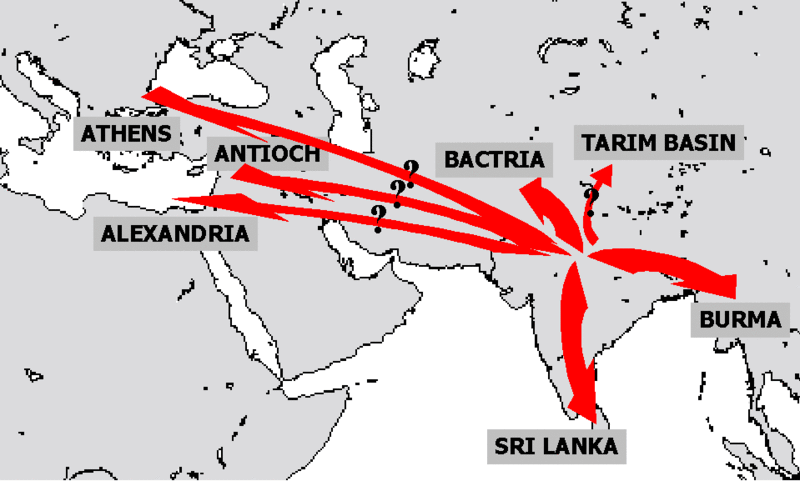
800px-Asoka_KaartNew Delhi: 04.00 hours. Awake at some time of darkness that’s neither night nor morning, getting some coffee and toast ready for Jiab going to the airport for the Gujarat flight at 06.00. Car comes, she gets in, bye… door-slam and she’s gone. Stars shining in the dark sky, then I come inside and look at a Google map of India with Gujarat there on the coast of the Arabian Sea – so that’s where it is… really not that far from Europe. Then take a look at the wiki map (shown above) of the Buddhist routes going out in all directions from North India in the time of Emperor Aśoka the Great, 273 BCE to 232 BCE. It looks like an explosion of consciousness that took place in North India, and spreading out from there; North, South, East, West, along the Old Silk Road directions. It goes West as far as the South-East Mediterranean countries; arriving there in pre-Christian times. Not impossible that the Buddha’s Dhamma had an influence on the Jesus Teachings. Maybe that’s why I had this strange recognition of it, déjà vu, when I first went to Wat Pah Nanchat. Studying Buddhism revealed fragments of an innate knowledge.

Text comes in, Jiab: ‘boarding soon’. It’s a two-hour flight, Delhi to Gujarat. Looking at the map again, I notice wiki uses the word, ‘proselytism’, but it can’t have been like that. There’s no doctrine of God-worship in Buddhism, ‘I believe (I believe) in God (there’s no real Teaching other than belief for me to study). In Buddhism (and Advaita Vedanta and the Tao), the separate ‘self’ is an illusion, ‘a cluster of memories, thoughts, habits and conditioning’, maintained due to this basic human tendency to hold on to stuff. It’s not about that, it’s not about our origin, our Creator or what we are made of, it’s about how the whole thing works. It’s a 2600 year-old teaching about learning how to see what our hang-ups are, and easing the burden. It’s not about living for our(selves): seeking, acquiring and hoarding, it’s about generosity, relinquishment and giving it all away*. It’s about mindfulness and the way things exist, rather than what exists. It’s about realities that fit into our world today, exactly as it was in ancient times. The Buddha anticipated modern physics: all matter is energy; beings exist as “bundles of energies” (five khandhas). It’s not about ‘self’, it’s no-self, anatta, it’s about consciousness, viññāna, and the big question: what is consciousness?

Central_Asian_Buddhist_MonksI go through to the bedroom to lie down for an hour or so; still not yet dawn. Watch the breath, conscious of the sound of the ceiling fan above me in the shadows, constant spinning cycle that somehow says something about the weight of the rotary blades. It looks like how it sounds: a spinning propeller of an old fashioned aircraft – consciousness of the visual image. Always there’s consciousness of something: consciousness of the smell of coffee and a crust of toast in the kitchen, the taste of it; consciousness of the soft bedding I’m lying in. There’s consciousness of thought and then there’s consciousness of no-thought – including my perception of it. Consciousness without an object, the still mind, unsupported consciousness – unconditioned? The non-dual perspective is that it’s like this anyway…. So it’s without an object in the sense that it is different from the basic functions of interacting with the world through sensory organs: eye, ear, nose, skin, mouth and mind; different from the state of being conscious of what’s going on in the body/mind organism, phassa, as a result of responses to the world outside. Not consciousness of… just consciousness itself – what is that? No answer… is this the kind of consciousness that’s needed to find the answer to the question or to redefine the question, maybe, or whatever… is it the true self?

If so, it’s not what I thought it was: ‘…this true self is also the fundamental source of all attachment to being and becoming… attachment to the allure of this primordial radiance of mind that causes living beings to wander indefinitely through the world of becoming and ceasing.’ [Luangta Maha Boowa]

If it’s not that, then it goes beyond words: ‘When all phenomena are done away with, all means of speaking are done away with as well.’ [Upasiva’s Questions (Sn 5.6)]

It all needs a larger context. Some time later, another text comes in, Jiab: ‘having breakfast in the hotel’. It’s 08.30 and she’s nearly 600 miles away….

‘Consciousness cannot be known by mind. The mind is an object. It doesn’t know anything. It is itself known by Consciousness.’ [Rupert Spira – Link to: Spiritual Artwork]

————————-

“If a monk abandons passion for the property of consciousness, then owing to the abandonment of passion, the support is cut off, and there is no base for consciousness. Consciousness, thus unestablished, not proliferating, not performing any function, is released. Owing to its release, it stands still. Owing to its stillness, it is contented. Owing to its contentment, it is not agitated. Not agitated, he (the monk) is totally unbound right within. He discerns that ‘Birth is ended, the holy life fulfilled, the task done. There is nothing further for this world.’ [Bija Sutta: Means of Propagation” (SN 22.54)]

*This post contains excerpts from: ‘Beyond The Dream, Tao Te Ching7: Selfless
Lower photo image: Central Asian monk teaching East Asian monk, 9th century fresco

hold on and let go

2013-04-01 15.24.34New Delhi: Arrived late morning on a flight from Thailand and Shym picks me up at the airport. It’s that feeling of bewilderment; having been scanned by X-ray machines, identified, processed, held in aircraft cabin pressure for 4 hours and transported. Now I’m here, nearly two thousand miles away from where I was, placed on the ground and having to reassemble the parts of who I am in this new context.

Where are we now? Eyes looking out, bright sunlight but not fiercely hot like Bangkok; more like a Mediterranean climate, feels okay. Heavy traffic, drivers with attention-seeking behaviour; the ‘BLOW HORN’ message on the back of trucks says everything. It’s a kind of open invitation to press your horn to say you’re here. Get out of the way! I am coming; it’s me! ‘Self’ is something real, something eternal, according to the Vedas and Upanishads – something that is. Completely different from the Thai Buddhist culture that I’m used to, which says that what we cling to as ‘self’ is really only impermanent phenomena subject to arising, changing, and passing away – nothing of substance.

India is not a Buddhist country, it used to be but the Teaching is more or less unknown today, and the only reason I make the comparison is that I’m often going between these two places, Thailand and India. It’s culture shock, really, happens every time. And now, stuck in this traffic jam, some drivers try to get relief by blowing their horn while we’re all at a standstill. I hear the sound and find I’m vibrating like a bell that has been struck… it’s the argumentative, provoking nature of it: I feel his anger. I forget about this when I’m away – an unavoidable reaction.

Mindfulness, focus on the breath, let it just be there – everything that arises ceases aniccan. In a moment the impact has gone, nothing special. I just need to be careful I’m not indirectly fanning the flames and causing it to blaze up again. I don’t want it to be like this but saying this doesn’t help because ‘not wanting’ (vibhavana) is as much a desire, as ‘wanting it’ is. If I continue to ‘hate’ it like this, I become even more attached to the anger of not-wanting it and cannot easily disengage from that. So, looking for the place that’s somewhere in the middle ground where I can find a temporary abiding.

It’s inevitable that North India looks confrontational when the Thai way is to keep your temper, whatever the situation; the chai yen concept (keep a cool heart). Thais very rarely show their anger. If there’s a problem, Thai people keep it inside… that particular intensity of unexpressed anger, like a pressure cooker that explodes suddenly – it can be dangerous. In 2001 a German motorcyclist, frustrated by the traffic situation, made an obscene gesture to a van driver and was shot dead. The van driver lost his cool. It’s what happens when you don’t manage to hold it anymore, the release is really explosive. In this kind of emotional holding, it can be pretty scary because everybody knows the consequence of a lifetime of intense holding; clinging with tenacity to the refusal to let go, and no safety valve. But not necessarily, Thai children learn about this Buddhist teaching at an early age, and in the right circumstances, most people see it for what it is and allow it to come to an end.

Then some hours later, I’m at the house, and somebody I don’t know is shouting in anger outside my front gate. I go to the window and a man is standing out there under the tree in the shade, talking on his phone in Hindi and waving his free arm. Shym told me the man was expecting to receive some money, seemingly, but didn’t get it and this was his reaction. The fury in his voice was like something Biblical, the wrath of God, I’m immediately intimidated, and the vibration of anger starts up again, it’s like a contagious disease. You just can’t pretend it’s not there – that compelling sense of ‘me.’ After a short while it’s gone, and I’m thankful there’s no ‘eternity’ in my mind: no heaven, no hell. There’s liberation from suffering: the way out, the Third Noble Truth, nirodha, and cessation, no holding. In the emptiness of the moment there is no self, only the stillness of the mind and everything comes to an end…

120420131785