immediacy

IMG_2161dPOSTCARD 146: Delhi: The early flight from Bangkok arrives in Delhi mid-morning local time. It feels like everything that brought me here has vanished; a curious missing piece of time, the four hours of travelling, and before that the Thai departures, the check-in desk, and before that the taxi that took me to the airport from my house in the darkness of very early morning, more like the middle of the night – all that has gone, the past is like a half-remembered dream.

I suddenly wake up in the middle of a Delhi traffic jam and it’s really confusing to be in this bright daylight after the darkness of the aircraft cabin. The transition into this reality so rapid, the split-second required for it to take form is… missing, yet an awareness of it having taken place remains – or the feeling that something just happened, whatever, and having to allow for the curious delay in the time it takes to recognize what’s going on. Suddenly there’s the blare of car horns from behind and vehicles overtaking as the driver adjusts to avoid a motorbike coming towards us on the nearside (why’s that man driving on the wrong side of the road?).

There’s an alertness, anticipated danger, preparedness… the car is buffeted around, rock-and-roll, accelerated, braked, jerked, vibrated and three lines of speed bumps one meter apart cause the vehicle to jolt six times. Then it stops. There’s an obstruction up front. Horns continue to blare and protest. What to do? The one-way system in Delhi is unrelenting; it can take a very long time to get back to where you want to be. So when the driver sees a gap in the flow and makes a smooth wide U-turn straight across four lanes of traffic, I feel like breaking into applause as we speed away in the opposite direction.

A few short turns through streets I’ve never been in before and we arrive at the house. Me and my suitcase of compressed, flat-pack clothing, ‘self’ assembly; get into the bathroom, shower, put on new clothes, and become someone else, an assumed identity. Step into the room: So, how was the flight? Yes okay not too crowded. Suddenly aware of having to speak in codes, chunks of language created by air forced through vocal cords squeaks like the reed of a wind instrument, and rolling articulated back throat cavities, deep volumes of sound, gasp and split bits of wet air that whistle and chirp for an instant in tongue, teeth and lip. Thought associates words which insist on naming things, integrate pieces of the jigsaw puzzle; a picture emerging as I speak, yet changing constantly according to the way the parts fit together.

Objects have that strange familiarity, rush towards me like old acquaintances… remember me? There’s a book on the desk, open it at the page where the marker was left the last time I visited. Return to that place but can’t recognize anything. The ‘now’ moment is here and in all other locations at the same time. All I can do is dig up a few artifacts from recent history before I have to go on again; the point of origin is so distant, I’d never find the way back to the beginning …

“The intimacy and immediacy of the now… is our only security. It is utterly vulnerable and completely secure. No harm can come to us in the now, no sorrow and no death. All our longing longs only for this.” [The Intimacy and Immediacy of the Now, by Rupert Spira]

————————-

awareness of awareness

wesak_lanterns‘Our awareness is like the air around us: we rarely notice it. It functions in all our waking moments and may even continue in sleep. Usually we are caught up in the content of our awareness, preoccupied with what we think, feel, and experience. Becoming aware of awareness itself is Receptive Awareness, very close to the idea of a witnessing consciousness. Resting in receptive awareness is an antidote to our efforts of building and defending a self: the assumption that there is “someone who is aware” falls away. Self-consciousness falls away; the distinctions between self and other, inside and outside, perceiver and perceived disappear. There is no one who is aware; there is only awareness and experience happening within awareness. We learn to hold our lives, our ideas, and ourselves lightly and rest in a spacious and compassionate sphere of awareness that knows, but is not attached.’ [Link to: Receptive Awareness]

POSTCARD #132: Delhi: Today, June 1st, 2015 is Visakha Puja – a special day in Thailand, Laos, Vietnam and Singapore. This day commemorates the birth, enlightenment (nirvāna), and death (Parinirvāna) of Buddha in the Theravada tradition. So you get all three on the same day. The events that take place on this day go all the way back to the time of the Buddha twenty-five centuries ago, monks chanting verses, there is a talk by a senior monk, listeners seated on the floor, and it fills me with awe to consider that it’s the same now as it was all those years ago; this moment here and now is actually that moment there and then. Everything about who I am, the clothes I wear, my appearance, identity, gender; all of that disappears for an instant in the huge span of time that appears to lie in between. There’s only awareness, I experience it physically, somewhere in the centre of the chest, spreading out to the shoulders. In Pali it’s called the citta, the heart.

Thought and mental activity are all located in the brain area; flashing like electricity voltage sparks, but awareness is in the centre of my being. Experientially I’m conscious that awareness is prior to thought and mental activity, awareness comes before everything. It’s there all the time, even when I’m asleep. I may assume that awareness is ‘me’, ‘self’. This ‘self’ says it’s ‘my’ awareness, ‘I’ am aware. But when this ‘self’ that I believe to be me starts to look for the ‘me’ that possesses awareness, it finds that it’s the other way round: awareness has to first start looking for the ‘me’ (and the ‘me’ can’t be found).

The question then arises, ‘who am I?’ I might say, well, I have an identity given to me by my parents, and a birth certificate, driving license, passport, ID card, and all this documentation is saying this is ‘me’. I have a personality; I’m like this, I’m like that. But it’s awareness that sees all this, the feelings, emotions, moods and I find the question: ‘who am I?’ is itself focusing attention, opening the mind, thoughts flicker and disappear, sparks fly, awareness sees all this. The identity, the personality is witnessed by awareness. Awareness was there before it all; before feelings, moods – emotions are objects of perception that awareness perceives. Awareness is what I am, it’s what all sentient beings are, it’s not personal, it’s everything. No beginning, no end, awareness has always been there. Awareness is spirit. Spirit is awareness

Most of the time I live with my small self, worn like a costume in a fancy-dress party, and function with other small selves doing the same thing. Same with everybody here today, at Vesakh time seated in meditation and focused on the Buddha’s teaching. But the Buddha wouldn’t have wanted us to say anything like, “I am a ‘Buddhist’”… beliefs appear in awareness, awareness is there before beliefs, before thought, before all that. There’s an awareness of a constructed ‘self’ – necessary for getting around. There’s this awareness and an awareness of the awareness itself.

————————

Photo source: http://asiaplacestosee.com/wesak-day-celebration/
Note: some parts of this post inspired by an Adyashanti talk in a post on the website: To Know Beauty/ Meditative Self Inquiry

the construct

IMG_1192OLD NOTEBOOKS: East Anglia: [post written in New Delhi] A group arrives at the mall coffee shop sorts out the chairs, a few remarks, laughter; look at the menu the waitress comes over. Give their order, then there’s nothing left to say. Silence. Each one pulls out a mobile device, phone or iPad, stares at screens whose reflected glow illuminates the face of the user. Heads tucked in to examine the picture, body crouched over in fetal position; hypnotized, fascinated with the object, unlearned, never thinking of the question ‘WHY?”

Dominated by thoughts of, who am I? How do I relate to everybody else: you, he, she or it – we, you they? “Me’ as an individual doesn’t seem to be anything more than just a member of a particular socio-economic group. From this way of thinking, I can see (my) self situated favorably – or it could be unfavorably if I’m caught in being the victim; subject to the karma of former circumstances – product marketing gently nudging at the elbow. I need to be thinking about the next option – expectations, responsibilities, things I ought to be doing. Thoughts thinking thoughts, thinking more thoughts and thinking about things to the extent that it all becomes habitual – embedded in the self-construct I recognize as ‘me,’ subject to causes, conditions in the world, which is also a construct, I am some kind of imaginary character in a fictional landscape.

There is so much that we cannot know, limitations of the senses, including the cognitive sense. But everything arises due to thought, the duration between one thought and another is non existent – thought knows nothing of it because thought only knows an object; all objects appear only in thought – no object, no thought. STOP THINKING and there’s the enigma… the empty space where that thought used to be. Nothing there now, if it is just ‘nothing’, I’d need to have ‘something’ there to confirm it is nothing. I can’t find the ‘something’. So it’s not ‘anything’, it’s ‘not something’ – it’s a feeling of no-thingness. But then I’m thinking about it again… it’s an easing-away from that heaviness of thought, that which built the construct; buildings, welded metal, concrete, brick and iron embedded in stone. All of it can be demolished in a day. It all just fades away. ‘Melted into thin air… the baseless fabric of this vision… we are such stuff as dreams are made on…’

“After having thus successively taken each member of the community in its powerful grasp and fashioned him at will, the supreme power then extends its arm over the whole community. It covers the surface of society with a network of small-complicated rules, minute and uniform, through which the most original minds and the most energetic characters cannot penetrate, to rise above the crowd. The will of man is not shattered, but softened, bent, and guided; men are seldom forced by it to act, but they are constantly restrained from acting. Such a power does not destroy, but it prevents existence; it does not tyrannize, but it compresses, enervates, extinguishes, and stupefies a people, till each nation is reduced to nothing better than a flock of timid and industrious animals, of which the government is the shepherd.” [Alexis de Tocqueville, 1805-1859]

being

IMG_0086b

POSTCARD #119: Bangkok: The Thai new year came and went and it happened I had to go for a medical, nothing important I thought, but the doc said I had high blood pressure and gave me all kinds of pills to take. Anyway, when M got to hear about it, I became her patient and she’d arranged something on the porch, a comfortable chair and low table for my laptop, thermos and books. There’s also a ceiling fan out there so it was nice to just sit in the garden and simply ‘be’  there with the birds and the squirrels and ‘be’ a human (‘being’ as a verb), just being human.

Trying to focus on the infinitive form of the verb ‘to be’, the strange thing is, when I catch up to the present tense: ‘I am,’ it immediately becomes the past tense: ‘I was,’ (a moment ago). Chasing the elusive present time, a mind function identifying a miniscule speck of familiarity in a vast universe of an expanded present moment stretched beyond belief. And in the time taken to process it, the present moment immediately moves back into the past. It feels like everything happens after the event. Impossible to comprehend, words cannot reach…

Birds fly in all directions; the numberless beings in the world, and M enters my line of vision, carefully carrying a small plate of fruit, places it on my table and asks me how I’m feeling. Looks at me with her small oriental face, her eyes shine – consciousness is limitless so it can take this form. She does a spontaneous twirl and runs off with a hop and a skip … still partly a child. M isn’t the individual ‘I’, she’s the ‘I’ of everything that ever was – no particular self, she has a great number of selves, spends her days multitasking identities. A fictional character dressed in a costume that lasts a lifetime, playing a part in a narrative contained in an anthology of short stories. And the book is shelved in a vast library categorized by subject and author, most of which we have all read at some point in former lives.

Can’t help thinking somehow I missed the point of it all in my own childhood. A shadow of regret; life was only attraction, aversion, indifference: I don’t want that, I want this – something thought to be deservedly earned because I’ve been having such a hard time trying to obtain it… always, always, out of reach. Believing in the user illusion; the things we cling to (the clings we thing to). And the Church days; pray for peace and experience struggle. Pray for understanding and discover confusion. Pray for patience and encounter unbearable endurance. I never thought there could be something wrong with the question. Belief in the impossible and denial of the obvious. ‘God’ is not an object, ‘God’ is the subject…

The entry point is time evolving, developing, mushrooming out in all dimensions; the effect becomes the cause of the next effect and next cause in events that seemingly merge from a ‘before’ to an ‘after’. The bigger picture is that of a great river enfolding/unfolding and the presence of a sense that all of it remains to be seen.

“…we do not experience a succession of nows. This present now is the only now there is. The now in which the body was born is the very same now in which these words are appearing. It is the only now there ever truly is. [Rupert Spira]

endless horizons

IMG_2054POSTCARD #113: New Delhi:  Carrying stuff upstairs, laptop under arm with notepad, phone in pocket, pen held in teeth, water bottle neck clasped between first and third fingers. Pause at the top of the stairs to turn the door handle (how much better it would be if we had three hands), it opens by practiced handle-lever push with thumb, and timed shoulder-shove. Out into the bright daylight of the roof terrace, carrying everything to the table, and unload piece by piece.

Bring the chair over and sit… now maybe I can relax for a bit in this warm spring-like weather. But the voices start up again as if they’ve been waiting off-stage for their big entry: What’s with all this control-freakery? Why try to do everything at once? Leaving on Saturday 28th night, red-eye flight to Bangkok, change for the Chiang Mai flight and arrive there early Sunday morning on 1st March. I know it’ll be hot in Chiang Mai and as we get nearer to April, hotter still. Then 1st May to UK because I have to get a new passport (no pages left), and two weeks later, back to Thailand on a tourist visa. One week later, the return to Delhi before my India visa runs out… and I need to have that renewed too. Then, to crown it all, it’ll be impossibly hot by the time I get back here, temperatures reaching their peak, 46°C.

Intrusive thinking about ticketing, schedules, filling in forms; uninvited thoughts gate-crash the party, insist on getting attention and shouting out: What’ll happen if the flight from Delhi doesn’t arrive in Bangkok on time, and I miss the flight to Ch’Mai? Noisy internal dialogues about the whole itinerary – I need to ease out from this clamour of conjured-up scenarios, imponderables and enigmas – searching for something creates the idea that it is lost. Delete the ‘my’ in my-self. They’re not ‘my’ thoughts; they belong to everyone – the generosity of letting go. None of it is ‘mine’, I don’t think these thoughts, these thoughts think me. I don’t breathe the air – the air breathes me. Cognitive functions synchronize things so the world appears the way it does. I don’t see the world; the brain selects what is seen. Sounds are heard, but there’s no listener. The ear is a musical instrument. The body is a sensory-acoustic device that plays an immense chord of vibrating harmonics at 432 Hz, the natural frequency of the universe.

Mind contemplating the experience of ‘me’ seated on the chair; aware of the pressure points where legs touch the seat, bearing the weight, arms on armrests, and everything else is empty space, just this invisibility. I’m not aware of the mass of internal organs… slightly unnerving; get up and walk around. Feet appear down below on floor surface: left, right, left, right. The roof-terrace enters my vision, floor, wall, the plants – objects seem to pass through the body. Meanwhile, far away over endless horizons, another place begins to stir with aliveness; this time on Sunday I’ll be ‘there’ in Ch’Mai – or Ch’Mai will be here in ‘me’….

scotland-trip-jan-15-385

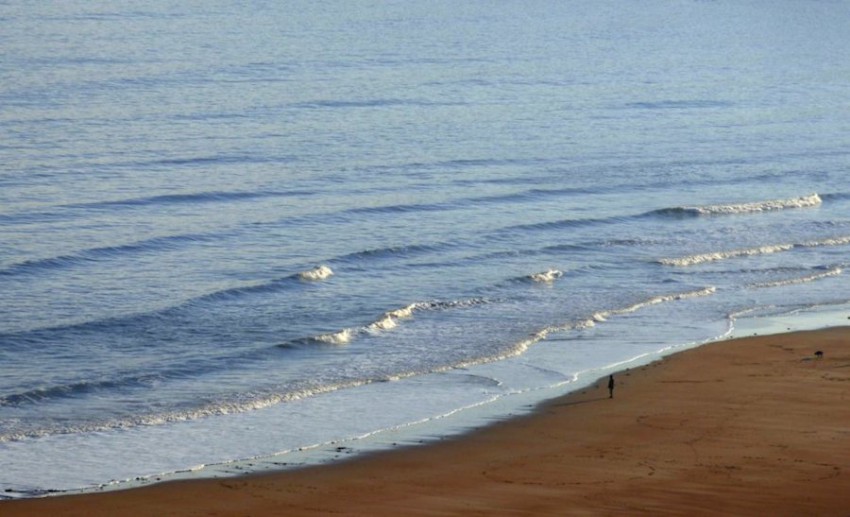
“And men go abroad to wonder at the heights of the mountains, and the mighty waves of the sea, and the wide sweep of rivers, and the circuit of the ocean, and the revolution of the stars, but themselves they consider not.”
[St. Augustine]

————————-

The photo of the sea at St Andrews comes from Sue Vincent’s post: The Elasticity of Time
–   G  R  A  T  I  T  U  D  E   –

the hide-and-seek game

IMG_0551b

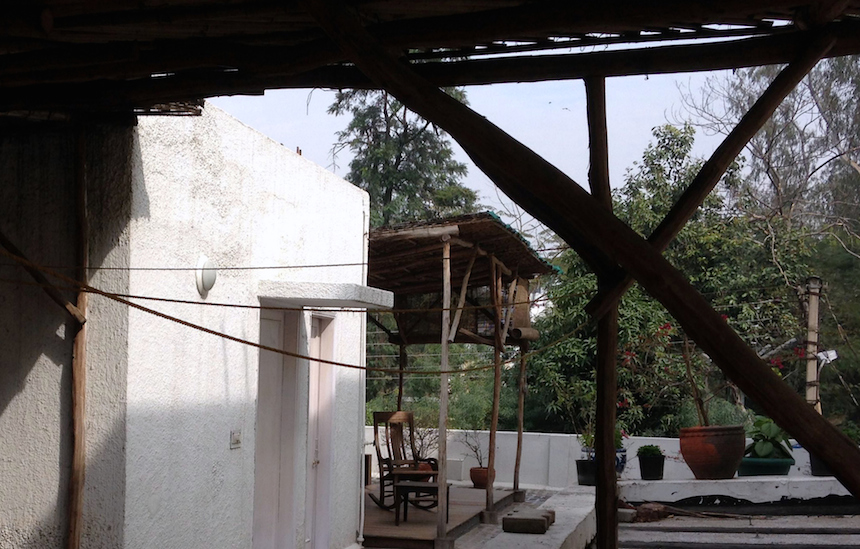
POSTCARD #85: Delhi: The house seems different; everywhere there’s the sound of Thai voices like the songs of birds echoing off the walls, ceilings and tiled floor. Guests in the spare room, girlfriends of Jiab here for a visit. They are greng-jai with me (reluctant to impose themselves) knowing I’ve had to move some of my things out of the way to allow space for them. I try to convince them, mai pen rai khap, no problem. I don’t mind having to use the bathroom on the roof… there’s a bathroom on the roof? Yes, it’s a partially built second floor, just the stairwell and the bathroom up there (see photo). There are also two thatched shelters to create shade in the hot season so that it’s cooler in the rooms below.

Hot, though. I can feel it as I’m going up with my bathroom things, but there’s a fan in there. Close the door and I’m in this personal space. Only one small window I can’t see out of. Feels like I’m hidden away from the world… birds sit on the roof, wondering where I’ve gone. Trees and the sky wait for me to come back. There’s a small mirror on the wall, I see my own face looking back at me, always the eyes are held – the awareness that looks out of the mirror. Is this my “self”… is this it? I feel like I’m “it” in the hide-and-seek game: Do you want to be “it”? No, not me thanks, I was “it” last time. Then I decide to volunteer, okay, I’ll be “it”, the one who has to stay at the designated base, close my eyes and count to 100, while everybody runs away to hide.

Commence ablutions, run the shower, get under the showerhead, hoping for cool water but it’s hot. Fierce sun shines all day on the outside water pipe that connects to the water tank on top. So I’m standing there waiting for the hot water to be used up and the cool water that’ll come from deeper down the water-tank. Sure enough, the cool water starts to come through… nice. Then it gets too cold, a gust of cool air from the fan whips up the cool temperature. It becomes icy for a moment – sharp needles – jump back from the shower to let the cold water run through, then under the showerhead again. The cool water starts to be replaced by surface tank water, which is warm, nice, and then it’s scalding hot – woa! Jump back from the shower again, dry off and open the door.

The world outside opens it eyes… ah, there you are. Towel around the middle for decency’s sake and step out. It’s possible to dry off in the sunshine – stand in the doorway of the bathroom to brush my teeth, shoosha-shoosha-shoosha… stop for a moment and look again at the face in the mirror. Is this the same “it” who played these hide-and-seek games so long ago? Is this the seeker? Looking out of these eyes in a reflection of itself, and seeing a world that’s separate from the sense of “me-ness” situated inside this body. We see each other like mirrors of ourselves, even though there’s no self to speak of, nobody at home. The closer I look, the more it’s not found. The enigma of stuck-ness…

Laughter of the Thais coming up from below, I go downstairs and make my way through them all… cognitive hybrid who speaks their language like a simpleton – they say I speak it well, this is why I never learned to be fluent. Really no need to ‘be’ anything, living in both worlds…

“You will never find it, because you are it. Therefore, seeking it is the denial of its presence. In seeking it, you compel it to seem as if hidden or lost. It is You that does not alter, You, Awareness. You are that for which you long and your longing is this very presence of love coupled with a thin veil of belief that it is absent, that it is an object that can be lost and found.” [Rupert Spira, All We Ever Long For]

————————-

getting attention

traff.1POSTCARD#52: Delhi: There was a time when I wasn’t here – not born yet. The world just going on as it does without having anything to do with that person called ‘me’. I didn’t exist then. There’s an anonymity about this that’s quite liberating. Thinking about it here in the car, looking at the world going by, same world that was out there before I was born. I’m on the way to pick up my Thai visa for the Bangkok trip this weekend – heavy traffic and stuck behind a truck. I take a photo of it simply because of the way all the words and colours insist I look at it, shouting out at me, trying to get my attention. Is it this kind of attachment to ‘self’ that causes ego-rebirth? A whole truck is suddenly reborn in front of me, identity smeared over every part of it, saying: ‘I’ am here; this is ‘my’ place! It has to be allowed for; make space for it in all the honking, hooting/tooting and scenarios of outrage where everybody really wants to be somebody. Press your horn to announce your presence. Do it loudly, you think a lot of yourself.

Mindfulness of conflict, resentment and holding a grudge; loving-kindness, compassion, metta-karuna. I’m a long-term outsider, now more than 30 years of living in other people’s countries. It means there’s a distance between ‘me’ and how things are done. As far as possible, the ‘I’ is understated, indirect, a release of the tenacity of ‘grip’ on how I (personally) think things should be. Thus I discover these days, local people look at me and I become invisible. They can’t get me to fit into their social scale, eyes glaze over. I unexist for them. I understand it to be that easing off from holding on to identity, almost to the point of letting go completely – the Buddha’s teaching on anatta, no-self. Extraordinary in my case because the I-am-not-here thing happens twice, two cultural settings: India and Thailand. I’m invisible in both countries, just my name on the lists of foreign residents, photo attached; ‘me’ in dress shirt, formal expression, hair combed, ‘smile please!’ I take out the ID I carry with me here and look at the photo, stamped, authorized, signed, registered, watermarked. It’s my identity, but is it ‘me’?

I’m not convinced. Is it proof that I exist? …em, it’s a picture of a man who looks like me, having his picture taken. All I have by way of proof that I exist is the subjective experience of it and the present moment that is undeniably everywhere, in the unlikeliest of places. The ubiquitous presence of now, I keep bumping into it, oh… what’s this? The present moment seen in a cloud of unknowing. Or I’m thinking it’s something it isn’t. Or I accept the present moment is as it is, whether I am aware of it in its as-it-is-ness’ or not.

Other times it’s seen as if standing at the bow of a small ship plunging through the waves, rising and falling, just on the point of leaving the past and surging into the future, but not there yet – never reaching that point. All the surrounding clutter and stuff of the mind is pushed away by the waves and the movement of the ship passing through. Long intervals between things… why this pause? How come there’s nothing to think about? What happens when the thinking thing stops – what happens after that? But the question just leads to more thinking. No answer, no question, stillness – a state of mind that’s free of all the tugs and pulls. Slow down, stop. Contemplate the body and mind; breathe in/breathe out, there is heartbeat, consciousness of the mystery: out there/in here…

‘…looking for the first time at homemade movies taken a few weeks before his birth. He saw a world that was practically unchanged—the same house, the same people—and then realized that he did not exist there at all and that nobody mourned his absence… But what particularly frightened him was the sight of a brand-new baby carriage standing there on the porch, with the smug, encroaching air of a coffin; even that was empty, as if, in the reverse course of events, his very bones had disintegrated.’ [The autobiography of Vladimir Nabokov: “Speak, Memory”, page 1]

————————-

a patch of sunlight

IMG_0540POSTCARD#50: Delhi: It’s cold here, fingertips touch the keys tentatively, unwilling to make contact. Feeling chilled all the time and can’t seem to get comfortable with this February weather. I just arrived from Thailand, my bag, still unpacked, contains the blue sky and sunshine of white shorts, sunglasses, T-shirts and rubber slippers. Wow it was hot there; I’m reluctant to let go of that nice feeling.

It’s like the world extends only as far as the immediate surroundings of where I’m currently situated and it takes a little time to reassemble things if I move 2000 miles to somewhere else. There’s the tendency to hold on to nice things and I’m particularly reluctant to let go of it this time because the visit to Delhi is only for a couple of weeks, then I go back to Thailand again. So I’m in transit, not really ‘here’, and that’s why I’m making the excuse that it’s not necessary to unpack my bag.

My bag is an extension of ‘me’, it’s my identity, part of the self-construct I’ve created, the same as everyone else’s sense of ‘self’. I feel a fondness for my bag, a familiarity and a connection with that small volume of folded clothing, flattened garments, papers, books and various computer cables, that’ll be zipped up tight, X-rayed and pushed back into its space in the aircraft baggage section along with all the other bags, and away we go back to the sunshine. But that hasn’t happened yet, and I’m stuck here in the cold for a number of days.

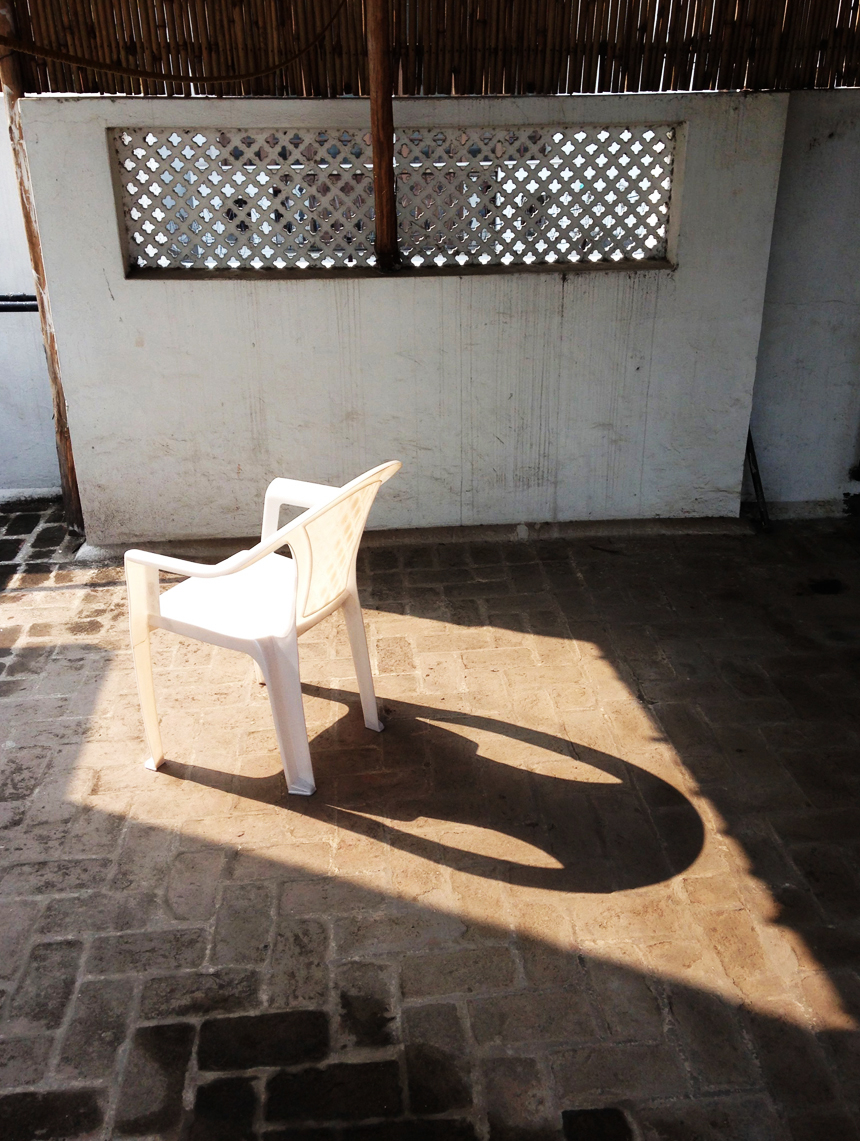
When it’s warm enough I go up on to the roof terrace, to the place where the sun shines through between the buildings and there’s a patch of sunlight where I can sit  on my chair. The chair is in the same place it was two months ago and for a moment there’s a kind of presence about that empty chair… déjà vu; the ‘self’ that was there at that time is gone completely, no familiarity with it – yet I remember being here quite clearly. Now I’m sitting in the warm sunshine, recreating a ‘self’ that suits this time and place, for this duration, knowing that soon it’ll be gone too. Phenomena are as they are for a short time and disappear; it’s as if the appearance of everything has the quality of a pencil sketch, a pleasant unfinishedness.

I look at things, and they’re gone – it’s the time needed to process the thought. Objects are experienced not in present time but just as they’re slipping into the past; everything is always seen in hindsight. Conclusions arrived at after the event. Nothing remains. The day I die will be an ordinary day. The moment after I’m gone will be no different from any other. It’ll be like a pause in the middle of a sentence… the focus on the object slips away, the next moment will just be the next moment and things will go on as if nothing happened. The fragility of the world held for an instant then it’s gone, only the space where everything used to be and the silence left behind…

‘Usually when we hear the teaching on not-self, we think that it’s an answer to questions like these: “Do I have a self? What am I? Do I exist? Do I not exist?” However, the Buddha listed all of these as unskillful questions. Once, when he was asked point-blank, “Is there a self? Is there no self?” he refused to answer. He said that these questions would get in the way of finding true happiness. So obviously the teaching on not-self was not meant to answer these questions. To understand it, we have to find out which questions it was meant to answer.’ [Thanissaro Bhikkhu:Selves & Not-self: The Buddhist Teaching on Anatta’]

————————-

connectedness

DurakitPOSTCARD#46: Bangkok: Sitting in a taxi that’s stuck in traffic and I see these buildings through the window, take the photo thinking, wow! I can write a post about that. The floating staircases look like they were put in as an afterthought. Somebody came up with the idea and sketched it out on the back of a beer mat. Creativity. Things are linked in the mind – the symbol of a bridge, everything is connected. It all fits. Taxi still stuck and I’m searching around in the memory for something, through the staircases and corridors of no-words-to-describe-it, looking for a starting point. How to begin? A small insight comes along; it’s the karma of circumstances.

That’s why, who, where, what, which, when and how I came to be here in Bangkok, strange as it may seem, having started off in such a far-away place over the mountains, over the sea… the Northern part of the world, near to the Arctic region. Up there, the polarities of shady darkness and never-ending light inspire one thing above all: the desire to get on a plane to a sunny place in the Southern Seas and never come back. So that’s what I did.

When I came back I discovered thirty years had passed, the Rip Van Winkle effect – look in the mirror, hair gone white. Most of the people I knew are dead. It had been so long I’d forgotten the ‘me’ that used to be there. I gave some thought to the ‘me’ left behind in the sunny place in the Southern Seas, went back over to check on that but it wasn’t there either. All these hours and days over the years, looking out the windows of an airplane and the world coming in through these eyes but seeing it like it’s not ‘me’ personally that it’s happening to, more like it’s an extension of what’s out there.

There’s a connectedness. No ‘me’. The temporary self-construct that used to be ‘in here’, a tentative sort of half-existence, has gone. Gone is gone. No ‘self’, anatta, nobody at home. Elvis has left the building. I am a metaphor of ‘me’ looking out of the window of a moving vehicle going away to, or coming back from a place called ‘home’ in Bangkok at the present time but next week I’ll be in Delhi again and looking at ‘home’ from that location. I know that three weeks from now I’ll be in Chiang Mai in that place there called ‘home’, hang out for a while, contemplate the space I’m in, then after that, no plans…

Is there anything I can call a real home? (hold that thought)… there’s a memory of something being ‘home’ when I was a kid. I remember long nights and short days, aunties and grannies wearing comfortable wooly cardigans, porridge in a cracked bowl, coal and wood fires, a black-and-white sheepdog – and incidentally, the rural/urban thing about Asian cities, cows sitting on the pavement, goats nibbling and chickens pecking around, the sound of a cockerel in the distance; all this reminds me of the farmyard scene where I was brought up. There’s a familiarity about it

Fond memories, pictures in the gallery of the mind, and yes I’d like there to be a real home, but for a very long time now there’s been only a series of temporary homes – all good, I share my life with Jiab and we’ve gotten used to the way things are. In each place I have my favourite chair, books, and all the things I need. It works okay except sometimes I might spend a long time searching the bookshelves for a book I’m sure is there then realise it’s not in these bookshelves, it’s the other bookshelves, about 2000 miles away. So I have to let that one go, although I can see it there in the mind’s eye…

I feel dispersed, an okay sort of feeling. It suits me well to follow the Buddha’s Teachings: homelessness, non-attachment, no-self. Whether there is a ‘self’, yes/no, is best not thought about too much because saying ‘yes’ or ‘no’ to it is, in itself, identifying ‘self’’. Words identify things, language has a default mechanism that allows me to select what ‘I’ want it to be (also what I don’t want it to be) and the resulting attachment to all that I love and hate. I see it happening, stay mindful about where the exit is located, and open the heart/mind citta to the world as wide as possible.

————————

‘I place the word “Jesus” into my heart, and in a magical instant all those wordless, intangible sensations I have come to recognize as His Presence fill the room, as if that word was a seed dropped into the planter of my heart, which took root, and produced an entire orchard.’ [Excerpt from the post: Trending Towards Holiness]

–   G   R   A   T   I   T   U   D   E   –

passive voice

IMG_0083aBangkok: No taxis available at the airport, and all trains into town are seriously crowded. I am one of a very large number of individuals caught in the rush on a Friday evening. Somebody said later it’s because all the international schools start again on Monday. No other way, it’s decided for me, okay, I accept, I am subject to the system, the public transport system and I have no control over it. I am being ‘taken’, it’s about the process, rather than any particular person controlling the process. I could create a Controller in my imagination like the bosses, the management and blame it all on them/him/her/it, but it’s better to not do that…. There’s not a ‘self’ in the equation – the deed is done but there is no doer, using the Passive Voice language function to express the Buddhist Truth of no-self (anatta), and I came across an interesting post about this the other day [Link to: Just A Little Dust].

The ‘self’ is absent. Sounds are heard, food is tasted, the chill wind of September is felt upon the skin. And there’s nobody there that feels it, unless I consciously put together an identity composite, in which case I feel the chill (Active Voice). Language tells a story, creates a fiction that I can get lost in; only partially aware that it’s a constructed thing and most of the time I’m clinging to a concept of selfhood, an assumed identity. Thankfully, in the Passive Voice, there is no doer, things are done; the cognitive process is about ‘how it works’ rather than ‘what it is’.

The world is seen – I had an eye operation recently and what I didn’t expect was that it turned out to be an opportunity to contemplate this phenomenon of the experiencer. There’s the experience of visual stimuli entering the eye through a lens created by means of an industrial process and somehow the ‘me’ part of it is not there like it used to be. The lens inside my left eye is made of plastic, there’s a particular clarity in the colours, the quality of light and a fascination with the way plastic surfaces refract the light; plastic food wrapping, mineral water bottles, car windscreens. It’s all very new and quite interesting – maybe because I still have the ‘old vision’ in the untreated eye, something to compare it with.

I can see the world through the old eye as well as the new eye. It’s like the linguistic ‘voice’ can be both passive and active and I’ve understood it mostly in the active form; the process of selfing is grasped at as an entity and identified with – a controlling thing. In the West it’s a ‘belief’. My difficulty with anatta has been extricating myself from the Judeo-Christian conditioning that assumes the existence of an eternal soul. I notice Thais don’t have this problem. Even after 30 years in the East, I still struggle with my Western conditioning; an everlasting identity, the idea of it still lingers; a shadow of reality. A couple of hours and I’m at Morchit BTS near Chatuchak standing in the rain and D comes to get me in the car. The thought arises, the car is driven but there is no driver….

————————-

 ‘Where water, earth, fire, & wind have no footing; there the stars don’t shine, the sun isn’t visible. There the moon doesn’t appear. There darkness is not found. And when a sage, a brahman through sagacity, has realized [this] for himself, then from form & formless, from bliss & pain, he is freed.’ [Bāhiya Sutta]