lowlands

lowlands 1POSTCARD 136, Peebles, Scotland: We don’t usually wake up to the sound of birdsong at dawn, it’s too early – 4.30 am here in the room with curtains closed to keep out light that glimmers all through the night. Summer in the north means it’s nearly always day. Difficult to sleep, getting out of bed is not easy but I have to be up and ready to leave because this is the end of the retreat and the start of the long journey home.

A labyrinth of corridors and narrow staircase that leads down from the upper floors in this old mansion house converted to a Health Center. Nurses chattering together in their white coats come upstairs, pass me on the staircase going down (ghostly image of maids and housekeeping staff from a former life). I go down and down to the small chapel created in the old wine cellar at the lowest point beneath this great house. Find a place and sit in the silence. I feel humble, a Buddhist in a Christian sanctuary, examining the nature of human experience rather than its external creator – ‘a part of’, rather than ‘apart from’. The ‘hallowed’ Presence may have no name… identification creates an object in a world of subjectivity; a world of whispering Hymn books’ paper pages turning in these curious acoustics: ‘forgive us our trespasses and those who trespass against us.’ So many ‘s’ sounds the rhythm of the Prayer goes out of sync for a moment then its momentum builds up and falls into unity again. Trespasses and trespassing; acting out scenarios in the mind – letting-go and forgiveness.

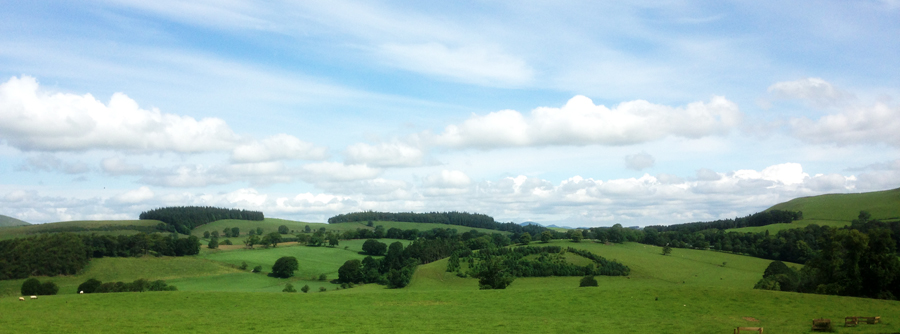
Say goodbye to nurses, therapists, doctors and friends I’ve known for four weeks and will probably never see again – we shared a small lifetime. Goodbye dark stained wood panels, chandeliers suspended in high ceilings; goodbye antique furniture and carpets over oak block herring-bone flooring. Bags in car and down the long drive into the rolling hills. Sun breaks through and the sky is blue as we descend through the landscape. These are the Lowlands.

“The mind is a kind of theatre where several perceptions successively make their appearance; pass, re-pass, glide away and mingle in an infinite variety of postures and situations.” [David Hume]

————————

Note: Dear fellow bloggers, I’ve been on retreat for more than a month, deep in the Scottish lowlands. One of the requirements was to stay away from social media, so I’ve been offline for all that time. Nice to be back, more posts to come…

clan

photo-9POSTCARD #135: Glasgow, Scotland: Battles lost and won and always the bagpipes have a part to play. There’s an extraordinary power about the instrument. I hear it as I’m walking down Buchanan Street, drawn towards the sound, and see the huge crowd surrounding the group outside an expensive shopping mall. Street musicians, I don’t know anything about the tartan kilt outfits they wear – the piper seems kinda clean-cut to me, respectable. Maybe he’s also a part-time piper in other bands, or one of the sons of these war-like characters beating out a furious rhythm on the drums. Somebody else going around collecting coins in an open box – there must be more than a hundred pounds in there ($150). I pour the contents of my pocket into the collection.

Jiab was here a long time ago while I was in Japan, she stopped to listen to a street musician playing the pipes and the piper happened to be standing next to an old red phone box with glass panels smashed out (those were the days before cell phones). So Jiab had a think about time zones between here and Japan, gathered all the change she had and called me up. I was in the office in Yokohama and somebody said there was a call for me. Picked up the phone and there was this skirl and blare of the pipes coming from the other side of the world. Then Thai laughter and the sound of coins being shoved into the phone slot – we couldn’t talk or anything, the sound was so loud. So after a while we ended the call. Jiab has a sense of humor.

Sound of the pipes fading into the background as I walk now through these streets back to my hotel… extraordinary that I have no home in Glasgow. I’m a tourist, even though I lived here for 5 years, and all that’s left is a strange familiarity – recognizing the streets, the buildings. Feels like I’m a member of a clan, vanquished, as if in a battle that took place in the time I was away – the Celtic sense of calamity. And today, after more than thirty years living in other people’s countries I discover I’m homeless. It feels like I don’t exist. I’m nobody, in a place where I used to be ‘somebody’. Mutuality in the illusion; clan, this is all we seem to have in the lifetime we share. In truth, it all merges into one; cycles of darkness and light, and seasons, a spinning planet around the sun, cycles of organic forms that reproduce, die and other’s take their place, continuously.

“… the moon, reflected in the water, shines brightly and within the spotless water seems to be, but the water-moon is empty, substanceless; there is no thing to grasp… ‘tis thus that all things are.” [Samadhiraja-sutra 2nd century CE]

————————-

Note: Dear friends tomorrow I’m going offline for a couple of weeks in order to enter a retreat and receive advice on my health situation. I’ll be back again in July and catch up with your posts and comments then. Thanks for reading….

there and then, here and now

IMG_2188POSTCARD #134: Elgin, Scotland: It’s a fleeting transitory thing, sometimes so clearly seen – as now on this bus following the coastal route and scribbling down words in my notebook (almost illegible writing due to the motion of the bus). I’m visiting Uncle P who is over 80 and lives in a care-home. The photo above was taken from the bus going through these small villages, and it was shortly after that I got off at Buckie.

Then it all comes back to me, the call of seabirds and smell of the sea. Huddled in my coat in the cold wind looking down at the same street surfaces; pavement cracks I recognize from the last time I was here, years and years ago? What is it? Just a feeling, awareness precedes thought, no words for this kind of thing. Incidental people pass by on the street. I think I know them from long ago, but it’s possible I never spoke to them at all, we were always like this, seeing each other in the town and only that gentle familiarity, glance, eyes meet, strange recognition… do I know you? It’s like I never left this timeless non-objective moment – there and then is here and now.

And they would say it makes no difference if I’ve been away in foreign lands, North India and Thailand, Chiang Mai, Bangkok and living my butterfly life. Coming back here is like stepping into the same instant of existence. It’s like it was yesterday, except people are older, aging, settling into a comfortable gravity. And a feeling of how everyone is near the end – I don’t know the young folks, of course. People I used to be friends with are inexplicably gone. It’s like the estuary leads out to the sea – water from the mountains flowing through so many different circumstances, on the way to joining the oceans of the world.

I get to see Uncle P and he looks well but almost all that he says is subtly incorrect, wrong dates, gives people all the wrong names and I agree with everything he says. When it’s time to go, he takes me to the exit, but we get lost, pause at the dining room and he’s puzzled why everything has been tidied away – I ask a staff lady in the kitchen who assures me that Uncle P had his lunch already. He forgets things; she tells me out of earshot – shows me the exit. Last I see of him, he’s going back down the corridor with the kitchen lady and telling her he’s looking for his wife. But she passed away a year ago.

On the bus to Elgin I have a little weep about Uncle P, and when the bus gets there, find an Internet café to write this.

‘Wandering through realms of consciousness like a refugee, thought looks for a home. Thought thinks that perhaps by clinging to this or to that, it can find a home. In this way, thought forms attachments with names and forms, with concepts such as “is” and “is not,” “self” and “other,” “me” and “mine,” and with emotions like envy, pride, and desire. It is the mission of thought to form these attachments in hopes of finding a home. Thought wants to own its own home.’ [Thought Is Homeless/The Endless Further/ 2012 July 16]

————————

awareness of awareness

wesak_lanterns‘Our awareness is like the air around us: we rarely notice it. It functions in all our waking moments and may even continue in sleep. Usually we are caught up in the content of our awareness, preoccupied with what we think, feel, and experience. Becoming aware of awareness itself is Receptive Awareness, very close to the idea of a witnessing consciousness. Resting in receptive awareness is an antidote to our efforts of building and defending a self: the assumption that there is “someone who is aware” falls away. Self-consciousness falls away; the distinctions between self and other, inside and outside, perceiver and perceived disappear. There is no one who is aware; there is only awareness and experience happening within awareness. We learn to hold our lives, our ideas, and ourselves lightly and rest in a spacious and compassionate sphere of awareness that knows, but is not attached.’ [Link to: Receptive Awareness]

POSTCARD #132: Delhi: Today, June 1st, 2015 is Visakha Puja – a special day in Thailand, Laos, Vietnam and Singapore. This day commemorates the birth, enlightenment (nirvāna), and death (Parinirvāna) of Buddha in the Theravada tradition. So you get all three on the same day. The events that take place on this day go all the way back to the time of the Buddha twenty-five centuries ago, monks chanting verses, there is a talk by a senior monk, listeners seated on the floor, and it fills me with awe to consider that it’s the same now as it was all those years ago; this moment here and now is actually that moment there and then. Everything about who I am, the clothes I wear, my appearance, identity, gender; all of that disappears for an instant in the huge span of time that appears to lie in between. There’s only awareness, I experience it physically, somewhere in the centre of the chest, spreading out to the shoulders. In Pali it’s called the citta, the heart.

Thought and mental activity are all located in the brain area; flashing like electricity voltage sparks, but awareness is in the centre of my being. Experientially I’m conscious that awareness is prior to thought and mental activity, awareness comes before everything. It’s there all the time, even when I’m asleep. I may assume that awareness is ‘me’, ‘self’. This ‘self’ says it’s ‘my’ awareness, ‘I’ am aware. But when this ‘self’ that I believe to be me starts to look for the ‘me’ that possesses awareness, it finds that it’s the other way round: awareness has to first start looking for the ‘me’ (and the ‘me’ can’t be found).

The question then arises, ‘who am I?’ I might say, well, I have an identity given to me by my parents, and a birth certificate, driving license, passport, ID card, and all this documentation is saying this is ‘me’. I have a personality; I’m like this, I’m like that. But it’s awareness that sees all this, the feelings, emotions, moods and I find the question: ‘who am I?’ is itself focusing attention, opening the mind, thoughts flicker and disappear, sparks fly, awareness sees all this. The identity, the personality is witnessed by awareness. Awareness was there before it all; before feelings, moods – emotions are objects of perception that awareness perceives. Awareness is what I am, it’s what all sentient beings are, it’s not personal, it’s everything. No beginning, no end, awareness has always been there. Awareness is spirit. Spirit is awareness

Most of the time I live with my small self, worn like a costume in a fancy-dress party, and function with other small selves doing the same thing. Same with everybody here today, at Vesakh time seated in meditation and focused on the Buddha’s teaching. But the Buddha wouldn’t have wanted us to say anything like, “I am a ‘Buddhist’”… beliefs appear in awareness, awareness is there before beliefs, before thought, before all that. There’s an awareness of a constructed ‘self’ – necessary for getting around. There’s this awareness and an awareness of the awareness itself.

————————

Photo source: http://asiaplacestosee.com/wesak-day-celebration/
Note: some parts of this post inspired by an Adyashanti talk in a post on the website: To Know Beauty/ Meditative Self Inquiry

beyond belief

IMG_4118POSTCARD #131: Delhi: I received this photo of a plane journey on my phone from M, my 11-year-old Thai niece. She was on a night flight from Bangkok to Chiang Mai. All our devices are connected so I get her photos, downloaded images, screenshots, kiddie’s apps and have to subscribe to an increased GB storage plan due to these thousands of ‘cute’ digital items, increasing daily. I read in Google somewhere that the number of mobile phones exceeds the population of the world, due to users that own multiple devices. Let’s say there are trillions of images all around the planet… whatever, there’s just this sense of vastness. Like the stars seen through M’s downloaded pic of the plane window. More than that; a quick look at Google tells me there are 200 billion galaxies out there, a Universe filled with a septillion: 1024 planets –on ‘the short scale’ (1,000,000,000,000,000,000,000,000) and 1042 on ‘the long scale’.

Changing from the Macro to the Micro, each star that can be seen from the plane window out there looks like a micro particle – wiki tells me that ‘point-particles’ are zero-dimensional. So it doesn’t take long to start thinking about transparency, lightness, non-being:

You are boundless space.
You are nothing that you appear to be.
You are the fathomless ocean, forever flowing.
The waves do not affect you.
Nothing affects you, for there’s no you.
[Robert Adams]

(reblogged from: Known is a drop, Unknown is an ocean

It’s just that everything I’ve been taught as a child is the received perception that’s passed down through generations of those with the same mind/body organism as I have. Most of us hold on to creationist belief systems, “God” – the ‘Big Bang’. But what caused the big bang? What came before that? A lot of people I know spend most of their time in contemplation, one way or another  – meditation or focused thought, and seeking a way of living that allows for this because it’s possibly the most important thing you can do with your life.

Advaita Vedanta talks about Brahman being the cause, and the world is the effect. Without the cause, the effect is no longer there. What that means is the ‘World” is real when seen with Brahman but it’s false when seen without Brahman. So basically Brahman is the original cause and those of us who see without Brahman are seeing the World as an illusion. Sounds like the sky is blue, the grass is green because the human sensory system creates it like that, and there’s no way to prove this is ‘real.’ That’s how it seems to be, in a manner of speaking – the sense there’s something missing… Brahman/Pure Consciousness/Reality? Not seeking, just considering the question. I like what cabrogal says: ‘Pure consciousness has no object’ – this has become like a kind of koan for me.

The Buddha didn’t agree with the external, eternal creationist idea:

“As far as the suns and moons extend their courses and the regions of the sky shine in splendor, there is a thousandfold world system. In each single one of these there are a thousand suns, moons, Meru Mountains, four times a thousand continents and oceans, a thousand heavens of all stages of the realm of sense pleasure, a thousand Brahma worlds. As far as a thousandfold world system reaches in other words, [the universe], the Great God is the highest being. But even the Great God is subject to coming-to-be and ceasing-to-be.” (Anguttara-Nikaya X 29)

It’s like saying these are all concepts and true reality is not a concept – words cannot reach that far. I received another picture from M, her painting of a beehive, done after she got off the flight and back in school again. It’s a natural hive in the forest. When Jiab asked what the bee outside the hive was doing there, she gave it some thought and said it was counting the stars – a created answer, sort of an on-the-spur-of-the-moment thing…

IMG_2162

————————–

Note: I Googled the title of this post after I’d set up the thing for publication and discovered in Amazon it’s the title of a book: ‘Beyond Belief’ by Elaine Pagels about the “secret” Gospel of Thomas. The idea that the Jesus Teachings were changed by Churchianity. Jesus was saying he was the son of God but we are all the sons and daughters of God, no difference. We can all be enlightened. I was wondering if anybody had read this book and should I order it from Amazon?

endeavour

h22_17283563POSTCARD #129: Delhi: I’ve had this photo in my files for a long time. All kinds of stuff come to mind, studying it, but if you look closely, there’s an orderlieness about it. These people are not fighting with each other to get on the roof of the train. This is Dhaka, Bangladesh, the massive exit from the city for Eid celebrations (end of fasting during the month of Ramadan). At the lower left you can see a hand extended to help someone climb on a window ledge. Others on the lower right are calmly waiting to see what’s going to happen because it looks like they can’t all get on this train. Maybe they’re waiting for the next one to arrive. Another thing that’s obvious for those on the roof is the fearlessness, the strength, the belief in each other, a kinship; the closeness of the group that you find everywhere in Asia, also I’ve noticed it in Thailand. These folk are from the ‘old world’. In the ‘new world’ (the West) the closeness is not so obvious. Could be we have been more war-like, the hunter-gatherers in ancient times, but within each clan there would still have been this unity, this bonding in the face of adversity. I feel it’s possible to recognize something of this affinity with each other.

I’m thinking of what it must be like to be one of these individuals with a place on the roof of the train, doing this trip annually; quite used to the sheer vastness of it all. Perhaps taking some comfort from the fact that there could be hundreds of human beings there at that very moment – also aware that the totality of this annual migration in Bangladesh is in the millions, certainly. Holding on to each other up there on the roof on the rough and bumpy ride. A journey maybe a day and part of a night, for some of them, and jumping off the train in groups, then probably another long journey to get home.

It reminds me of another event long ago, South India maybe 30 years ago. I was stuck in this provincial Bus Stand (bus terminal) because of a mix-up in routing on the way from Pondicherry to Bangalore. So just sitting on the pavement like all the rest do and waiting for my bus to turn up. Terrific noise and people everywhere, food vendors, everything. Other buses careering past and clouds of dust, black exhaust fumes and dangerous speeds – overloaded with people on the roof so much, the vehicle was leaning precariously to one side. It was quite a thing to see.

Then I noticed this boy running to catch his bus, 12 or 13yrs maybe, he looked at me, maybe the first foreigner he’d ever seen. There I was just sitting with everybody else. He hesitated then carried on running with a quick look back at me. Then running flat out to get his bus, speeding away very quickly. There was a moment when it looked like he wasn’t going to make it, then a hand reached out from somebody on the bus and he got pulled near enough to grab the ladder at the back that leads up to the roof. A wild leap and with both feet safely on the bottom rung, and held by others’ arms so both hands were tightly holding on, his head swiveled back, black eyes staring at me. The bus racing further and further away. I held the gaze like that, thinking there’s no way I’d have the strength and endeavor to do that. It seemed like this, held by watching his golden face turned towards me until the bus went out of sight.

“Right now you are Consciousness, appearing as a character in your play.  Maybe you think you need confirmation.  Forget it.  Relax.  You already are That.” [Nathan Gill]

—————————-

Photo Source: Chez Chiara

something, anything, nothing

16x20_webOLD NOTEBOOKS: Geneva, Switzerland: (originally dated September 29, 2012) I get on the Airport bus crowded with people and all their baggage, but I’m not going to catch a plane, I have to teach a new English class in the airport building, and feeling a bit nervous about that. Staff entrance, visitors’ ID, then I’m led along corridors to an elevator and down two or three floors into a network of underground rooms. Door opens and I’m in this claustrophobic space. No windows of course, a large white board, the smell of whiteboard markers, harsh penetrating fluorescent tube lighting. Find the air vents, adjust the air flow by remote and I can breathe better.

Three large athletic men enter; customs officers and senior security people, I see from my notes; shake hands with everyone. There’s a relaxed informal locker-room awareness of each other; deference among them, recognition of something about one individual I guess must be the most senior. Anyway I’m the foreigner in the group, and I have to give an account of myself.

Introductions over and we get started with the class. Pretty soon, something comes up, one of them stands, as if to attention, asks me a question about the use of ‘anything’ rather than ‘something’. After he’s asked the question there’s a hesitation, as if he’s going to say something else, then I notice he’s just observing my body behavior, the professional investigator…

So we’re looking at each other like this, and after I realize he’s finished talking in fact, I’m giving an answer to his question while gradually realizing I’m having a kind of out-of-body experience. I can hear my voice saying the words; the echo in the concrete room, feel the moisture and movement of the mouth but everything else is somehow unfamiliar.

It seems to work ok, I manage to articulate properly and tell him that ‘anything’ is usually used either in a negative context: “I don’t have anything”, and it’s also used in the interrogative form; you might ask a person: “Do you have anything to declare?” Me saying this with a smile, thinking of the Customs Declaration, and hoping to get the intensity to lighten up a bit.

No reaction (maybe he didn’t understand). So I continue with the example: “If you thought that person did have something to declare you could say: “Do you have something to declare?” Still no reaction from this hypnotic look and I’m feeling really weird. He sits down and discusses with the other two in French and they seem to agree about this. I’m still kinda not ‘here’… maybe it’s the underground room, the intensity of the officer’s stare

Somebody else in the group asks a follow-up question and an interesting discussion follows on from this. I sit down with them and can feel myself get back to ‘normal’ – learn not to pay attention to ‘the look’. Class time, comes to an end, shake hands (everybody shakes hands in the French culture), and I’m up in the elevator out along the corridors to the exit and the fresh air.

Wait at the Airport bus stop, it comes, and we’re off into town. The bus is full of wide-eyed people just arrived from distant parts of the world, large suitcases blocking the passageway. How can I say that there is no self, because, if there is no self, who/what is it that realizes this? There’s this feeling that I’m not here – clearly in the public eye but vanished away, invisible. Bus speeds off to town with passengers all speaking loudly in different languages.

Are you an object being watched by another Presence? Or are you the Presence in whose view an idea of yourself is watched? [Mooji]

————————

Notes also from David Loy: Enlightenment in Buddhism and Advaita Vedanta: 
Are Nirvana and Moksha the Same?) Image source

always here, always now

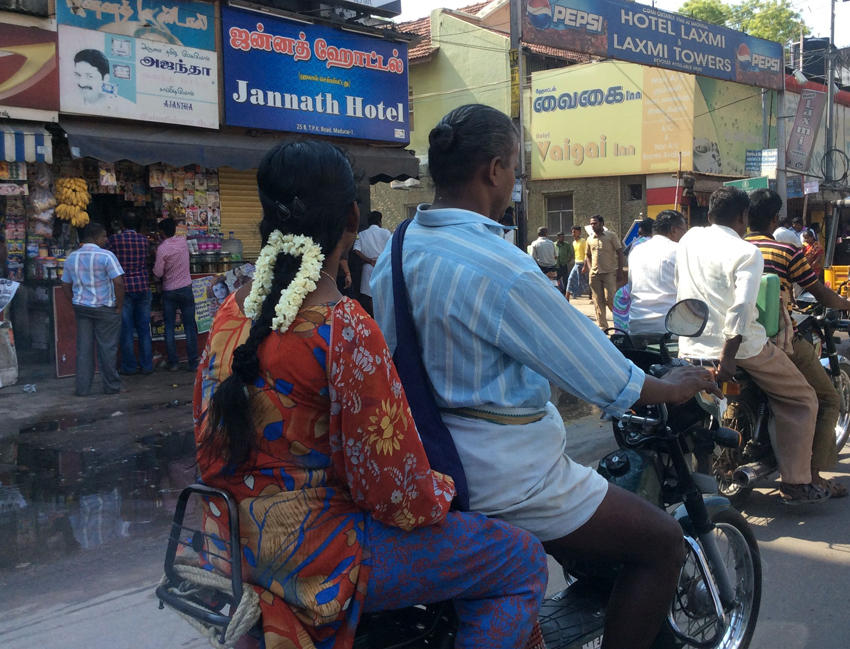
IMG_1216POSTCARD #127: Delhi: Jiab sent a photo from Madurai in South India, people go to work, life goes on. Meanwhile I’m hanging out my laundry on the roof terrace here in Delhi in an immense dryness of heat, knowing I’ll have to take them in an about one hour because if not they will become crisps, weather conditions being as they are and also the leaves of the bouganvillia plants and palms all around are soaking up the moisture in the air. I water the plants too of course but every day they’re dry in the morning. Somehow, everything survives.

It’s an ordinary day. And I was starting to write about that… then there was the small earthquake in Delhi, buildings shook for a few moments, nothing compared with the 2nd quake 7.4 Richter scale in Nepal. In fact I was there in Kathmandhu in the earthquake in the early 90s The thing I rememember about it was I was in a hotel on the 4th floor and suddenly the sky was full of birds, pigeons dashing around, hovering in the air… then the building started to move. The birds felt it first.

This is when blogging becomes a kind of mind-bogglingness. The aloneness of the solitary blogger in some time-zone in the world – an aloneness, maybe that’s what motivates this reaching out. ‘The internet is an extended sense organ’, bloggers in the world scattered around the planet, but really all contained in conscious awareness – we couldn’t be connected in any other way! I can’t see you, or hear you. I can’t touch you and will never ‘meet’ you in the normal sense of the word, I just know you’re there, or here inside me, or where we all are… curious how it’s the awareness of the connection that activates it.

‘There’s no other time than now, so how could we be elsewhere? We’ve always been “here and now” ―there’s nowhere else! Whether we think we are living in the past or in the future, we’ve always been squarely in the present moment. When we “stroll down memory lane” or “boldly go where no one has gone before”, we’re still exactly wherever we are, in the same time and place. Our memories of the past and plans for the future are nothing but present mental fabrications. Wherever we are, that is “here”. Wherever we were before, that was “here” then. Wherever we go later, that will also be “here” then. We can never return to yesterday, nor can we advance to tomorrow. Yesterday was now, only then. Tomorrow will be now, only then. It’s always now.There are no geographical or temporal alternatives. It’s HOW we live “here and now” that matters: avoiding harm, doing good, purifying the mind.’ [Nying Je Ling – Jonang Buddhism]

————————-

Update 13 May 2015 The Hindu Newspaper. Nepal again on edge as second quake kills 57. 7.3-magnitude earthquake strikes 68 km west of Namche Bazaar, close to Mount Everest. [Further update, the Himalyas dropped by three feet after the earthquake]Quake’s power a fifth of the 7.8-quake that struck Nepal on April25: US Geological Survey. 8 tremors hit Nepal in two hours, quake an aftershock of April 25 Quake: IMD.17 dead in India: 16 in Bihar, 1 in UP: MHA. More than 160 after shocks recorded since the first April 25 earthquake: Nepal Seismology Centre

—————————

Excerpts here from an earlier post: interconnectedness. Special thanks to Michael for: “The internet is an extended sense organ”

the construct

IMG_1192OLD NOTEBOOKS: East Anglia: [post written in New Delhi] A group arrives at the mall coffee shop sorts out the chairs, a few remarks, laughter; look at the menu the waitress comes over. Give their order, then there’s nothing left to say. Silence. Each one pulls out a mobile device, phone or iPad, stares at screens whose reflected glow illuminates the face of the user. Heads tucked in to examine the picture, body crouched over in fetal position; hypnotized, fascinated with the object, unlearned, never thinking of the question ‘WHY?”

Dominated by thoughts of, who am I? How do I relate to everybody else: you, he, she or it – we, you they? “Me’ as an individual doesn’t seem to be anything more than just a member of a particular socio-economic group. From this way of thinking, I can see (my) self situated favorably – or it could be unfavorably if I’m caught in being the victim; subject to the karma of former circumstances – product marketing gently nudging at the elbow. I need to be thinking about the next option – expectations, responsibilities, things I ought to be doing. Thoughts thinking thoughts, thinking more thoughts and thinking about things to the extent that it all becomes habitual – embedded in the self-construct I recognize as ‘me,’ subject to causes, conditions in the world, which is also a construct, I am some kind of imaginary character in a fictional landscape.

There is so much that we cannot know, limitations of the senses, including the cognitive sense. But everything arises due to thought, the duration between one thought and another is non existent – thought knows nothing of it because thought only knows an object; all objects appear only in thought – no object, no thought. STOP THINKING and there’s the enigma… the empty space where that thought used to be. Nothing there now, if it is just ‘nothing’, I’d need to have ‘something’ there to confirm it is nothing. I can’t find the ‘something’. So it’s not ‘anything’, it’s ‘not something’ – it’s a feeling of no-thingness. But then I’m thinking about it again… it’s an easing-away from that heaviness of thought, that which built the construct; buildings, welded metal, concrete, brick and iron embedded in stone. All of it can be demolished in a day. It all just fades away. ‘Melted into thin air… the baseless fabric of this vision… we are such stuff as dreams are made on…’

“After having thus successively taken each member of the community in its powerful grasp and fashioned him at will, the supreme power then extends its arm over the whole community. It covers the surface of society with a network of small-complicated rules, minute and uniform, through which the most original minds and the most energetic characters cannot penetrate, to rise above the crowd. The will of man is not shattered, but softened, bent, and guided; men are seldom forced by it to act, but they are constantly restrained from acting. Such a power does not destroy, but it prevents existence; it does not tyrannize, but it compresses, enervates, extinguishes, and stupefies a people, till each nation is reduced to nothing better than a flock of timid and industrious animals, of which the government is the shepherd.” [Alexis de Tocqueville, 1805-1859]

context

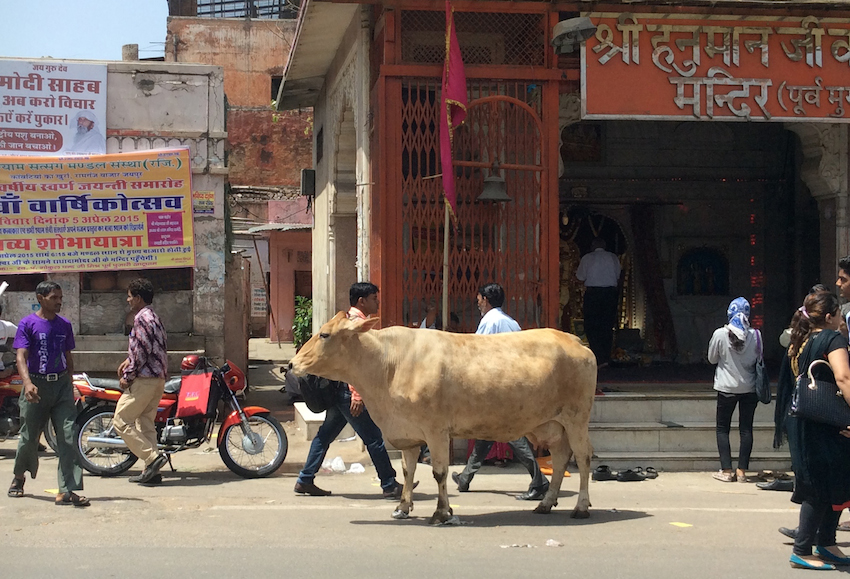
IMG_1071POSTCARD #126: Delhi: Jiab went to Jaipur and sent me this pic of a cow walking past the Hanuman Ji Temple. This lovely cow seems so unconcerned, passers-by too; harmony, things just moving along. All kinds of beings going on their way, dressed in this body given to us – not perfect maybe but this is not a perfect world – and I’m saying that because of waiting here in the hospital drinking bottles and bottles of water before I have the ultrasound scan of the abdomen. Anyway no urine pressure yet, the nurse says with a frown, and tells me to drink more water.

So I’m sitting on the hard chair in the corridor watching the strangest people go by. There’s an Imam dressed in white with long grey beard, ancient men in strange costumes I’ve never seen before – could it be Afghanistan? There’s an Arab lady dressed in black, head to toe with a slit for eyes to see the world through. All kinds of amazing beings… and I suppose I must look pretty strange to them too.

Then I receive the pic of the cow on my phone… wow! There’s something about India; this enlarged context, the all-inclusiveness. The first thing you notice is how it looks from the outside rather than what’s inside, the context is where the thoughts are situated, the content is what the thoughts are about. In India the diversity is tremendous; language, culture, behavioral protocol. People can’t easily share thoughts, that ordinary intimacy is not there in the way we know it in the West.

Anyway, I’m still having this problem, and think maybe if I walk around a bit that’ll help create urine pressure. I have to go to the pharmacy section to pay the bill for some medicine so I’ll do that. Ask how much it is, and it’s 294 Rupees, so I give the man a 500 note and he asks me if I have smaller change – this is always an issue in India – so I have a look and manage to dig out all the small notes I have to give him 300 rupees, I get my 6 rupees change and the man looks pleased, I paid the amount in full and the fact that I have no small change left, is not his concern – how could it be? What to do? Only the 500 note and the rest are thousand notes. I have only a few tens but this is not a good situation to be in, nobody has change for large notes.

Go to the canteen and buy a bottle of water for 15 rupees, I give him 20 rupees and he asks me if I have the 5 rupees… here we go again. So I can’t find the 6 rupees anywhere – where is it? Lost deep in my bag somewhere. Okay never mind about the 5 rupees, keep it. Mumbling and unhappy about all these hoarders of small change, go sit in my place and gulp down the bottle of water. Still no urine urge, have to drink more water, go back to the water guy and give him my last 20 rupees, assuming he still hasn’t got 5 rupees change. He gives me the bottle for 10 rupees in lieu of the extra 5 rupees I paid last time!

Suddenly my faith in the world is restored, and immediately I have this urgent need to go see the ultrasound nurse. She admits me and there’s that cold slithery thing moving around the lower abdomen. But it’s done, next stop is the toilet and all is well.

“The Dalai Lama once said that the things he found most surprising about Westerners was their self hatred […]. In Tibet, he said, only the village idiot feels self hatred.” [Thanissaro Bhikkhu]

—————————