necessity of mindfulness

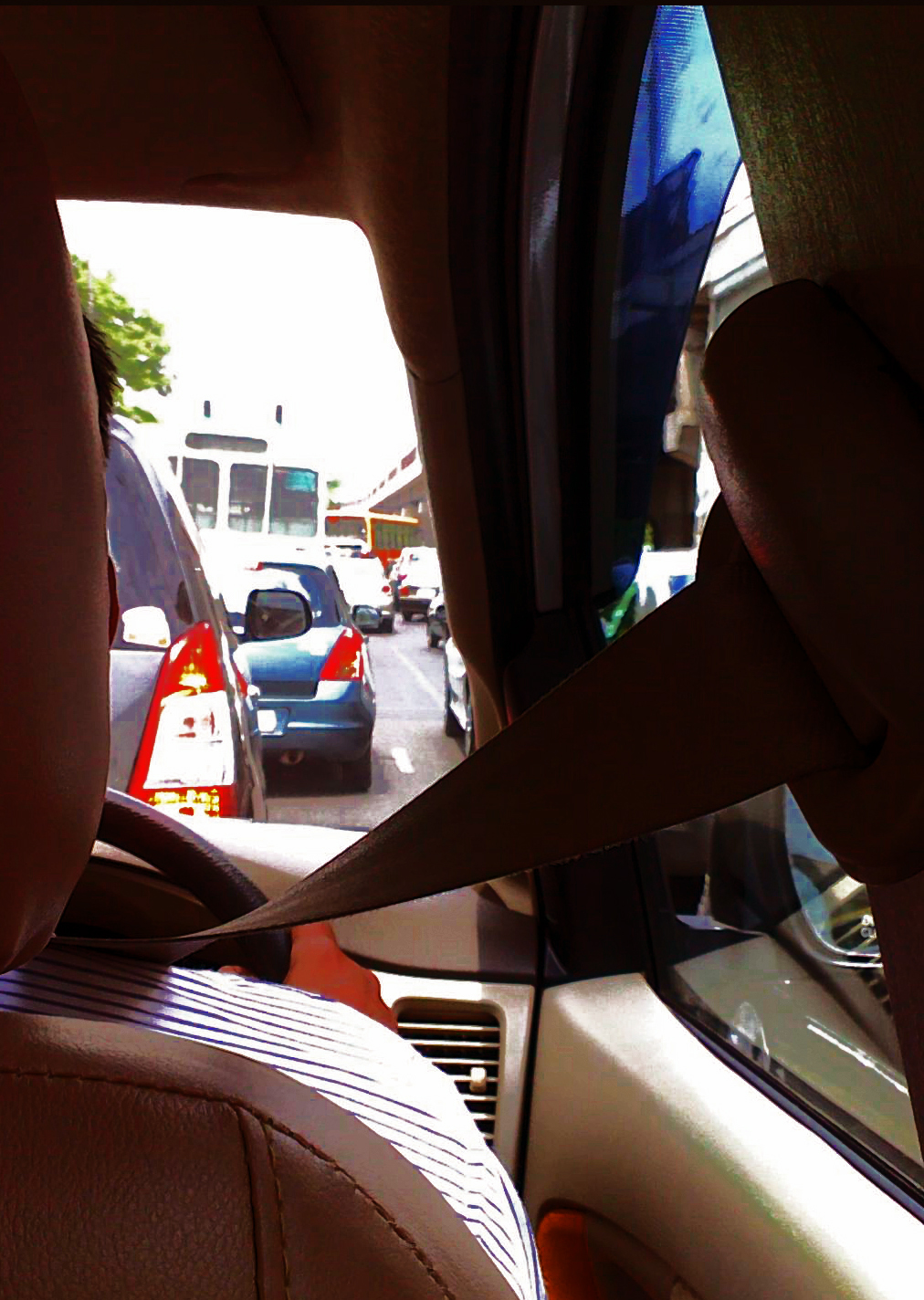
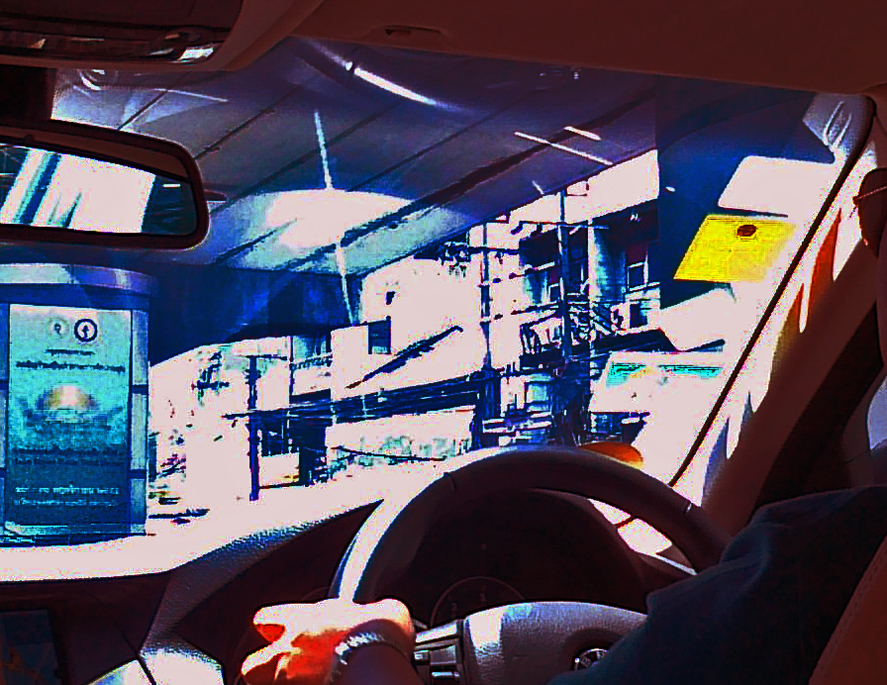
2012-03-31 12.35.44Bangkok: Getting into town from the airport is okay to start with, gliding along the elevated highway in a huge open landscape, and all the good-looking 21st Century buildings pointing up into the evening sky like some futuristic sci-fi heaven realm. Then, as we get near the exit, the traffic slowly starts to fuse together in a mass of end-to-end steel/chrome-plated metal units, creaking along like the glacier I visited a long time ago in Switzerland moving so slowly, the end of its 133 kilometer length is four hundred years older than its beginning. Struggling with the thought that I don’t want it to be like this, causes and conditions, the traffic is like nature, the ocean, the weather. Reminded of the Ajahn Chah image of leaves in the trees blowing in the wind in a rising and falling motion for as long as the winds last. And how it’s the moods of the mind blowing like the wind that cause the restless, uneasy feeling. In its original state, the mind is still and calm.

300620131923_crop

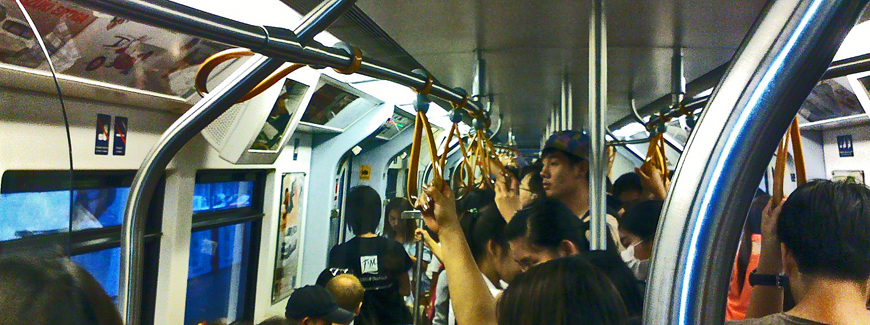
The next day I have to go to the eye hospital, blurred vision in the left eye, and procrastinating about that for a long time. Sometimes stumbling into things and I’m gently squeezing through the crowds at the skytrain entrance to get the ticket in the turnstile, remembering how it all works. There’s an alertness, awake and mindful, I am a foreigner living in someone else’s country. Getting off the train is complicated, it’s a place I’ve not been to before. Not finding the correct exit because the signs are unclear, I can read Thai but I choose to go with the North/South orientation of the map, knowing that if I face the way the train is travelling as I get off, in this case North, and as I go down the staircases and escalators to street level, I’m always orientated in that same Northerly direction and the traffic will be going North. All this because doing a U-turn can be a lengthy process here; somebody said the whole of Bangkok is one large, U-turn…. A pink and white cab is waiting and I tell the driver where I’d like to go – will he take me? He thinks for a bit (doing U-turns in his head), yes, ok. So we’re off.

At the hospital, it’s a long session. They put some drops in my eyes to enlarge the pupils so their equipment can see inside the eyeball. The doctor asks me if there’s anybody to take me home because the drops in the eyes will make things a bit indistinct for a few hours. Understatement. When I step outside the world is a blur, a smear, a sea of colour, yellow, green and pink taxis, red tail lights of vehicles in vivid splashes. No form or definition anywhere; I’ve lost my North/South orientation, having come in by a different door. Get on the first motorbike taxi that comes along and allow him to sort it out. We get up to a surprising speed going along what I believe to be the wrong side of the road, dodging oncoming traffic, weaving in and out of the other lane, wherever there’s a space. A great whoosh of hot wind, noise and get to the Skytrain station so fast it’s like we arrived before we set off. Give the guy a good tip and then it’s just a case of getting the North/South thing sorted out, following the crowds up the escalator, on to the train, and into the coolness of the AC carriage, with this wild wind blowing through the mind; papañca, proliferations arising from the single thought that I have an eye operation on August 9th. Necessity of mindfulness…
300620131924

————————-

‘To be mindful means to have metta towards the fear in your mind, or the anger, or the jealousy. Metta means not creating problems around existing conditions, allowing them to fade away, to cease. For example, when fear comes up in your mind, you can have metta for the fear — meaning that you don’t build up aversion to it, you can just accept its presence and allow it to cease. You can also minimise the fear by recognising that it is the same kind of fear that everyone has, that animals have. It’s not my fear, it’s not a person’s, it’s an impersonal fear.’ [“Mindfulness: The Path to Deathlessness: The Meditation Teaching of  Venerable Ajahn Sumedho.”]
forbearance

260620131912New Delhi: Moving through the streets to get on the highway to the airport; rough and bumpy, chunks of road surface missing. Demolition and construction, the urban environment is getting knocked down and rebuilt. We stop at an obstruction in the road caused by a large lorry unloading bricks, sand, cement and all I can see is the rear end of all these small vehicles standing together, jostling to get through… transportation of goods and services; bits of pipes and fittings, cables and plumbing items. Packages wrapped in plastic, held with bungee cords on the back of motorbikes; components, textiles, items boxed in packaging. A cycle rickshaw with a refrigerator on the back, and another one blocking the space with a large plywood panel tied on with rope at an awkward angle.

Drivers getting upset, the sound of horns, people walking around this blockage and through the traffic, carrying things on their heads, dragging children. Pavements are not for pedestrians, there are obstacles, tree roots, missing paving stones, sometimes no pavement at all; heaps of rubble, deep holes below where the drainage system is seen. The earth is beneath the streets, beneath the tarmac and the concrete and the clay, a substance created by erosion, geological conditions. The ‘developing world’ – no such thing as the ‘developed’ world. All of it is subject to change.

Up above, there’s a mass of overhead cables slung between high concrete posts, and a barefoot technician is up there on a bamboo ladder resting on the cables themselves, pushed out in a big stretch to accommodate the weight of him on the ladder. He’s threading another set of cables through, his partner below holding the ladder and traffic gets past them like the river flows around the stones in its path.

The infrastructure of the city is in the centre of my vision, not hidden. Everything that the environment is made of; all this is seen, the inside of it as well as the outside. Systems, processes, how things are done – evidence that the world itself is a constructed thing, put together, assembled, built. It has an unfinished look, bits of it are missing, removed, or not installed yet, or just left exposed; somebody took away the screws that hold the cover plate in place.

Things are unexpected, uncertain, everything is so much not what we think it is, there are no assumptions. The Western point of view that it ‘shouldn’t be’ like that – it ‘should be’ like this, is a concept imposed on a living organism, alive and moving. If I allow the organism to be as it is, I can disengage from the mind state where I think it’s something it’s not, and everything that’s currently bothering me about that disappears. I choose to be with the uncertainty of it, more and more; look at the dilemma of suffering without attaching to it; and challenge my tendency to see it in terms of a constructed self: anicca, dukkha, anatta – impermanence, suffering and no ‘self’.

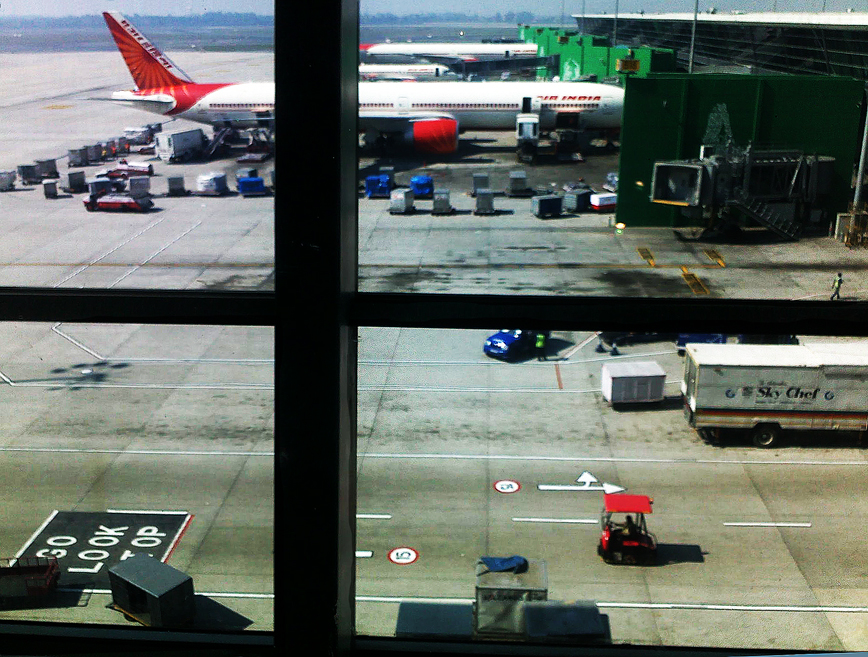
Dl_departuresArrive at the airport, check in, and through to Departures, happy to be in these ‘normal’ surroundings …the flight for Bangkok is now ready for boarding… I’m just a visitor, on my way to somewhere else. It’s difficult for me to have the infrastructure poking through into the way I choose to see things, because usually I have negativity and unpleasantness hidden away. Since childhood, my belief has been based on affirmative statements: the act of creation and the idea of a heaven… only pretty words. The truth is that ‘heaven’ is a reality beyond description – language doesn’t go that far. This kind of childlike ‘heaven’ is a fiction, not real in the sense that I am in the real world; the nuts-and-bolts of conscious experience, the present state of affairs. This here-and-now reality is fundamentally the same as it was 2,600 years ago, in the time of the Buddha, here in India.

What I’m trying to do now is to resolve the issue of fearful uncertainty by accepting the fact that there is an underlying sense of suffering (1. dukkha) in life and I need to contemplate this feeling with forbearance, rather than run away from it all the time. The direction this contemplation takes is simply to find out what it is I’m doing that’s causing the suffering (2. tanha), and stop doing that. It’s about letting go of whatever it is that’s causing it and I notice when that happens, the suffering stops (3. nirodha). This insight suggests there is a possibility I can stop the suffering completely and I follow the guidelines (4. magga) that show me how to do this consciously, in daily life. [The Four Noble Truths]

Time to go now, hand over the boarding pass to the Thai staff, she separates it along the perforation and hands me back the tab with my seat number. Goodbye India! I’ll be back in two months. Laptop bag on shoulder, and off down the passageway to the aircraft…

————————-

–  G  R  A  T  I  T  U  D  E  –
The subject matter and title of this post indirectly inspired by: Forbearance by Norman Fischer http://standinginanopenfield.wordpress.com/2013/05/19/forbearance-by-norman-fischer/ Also mentioned in that site, a comment by Dominic724: ‘Without forbearance it’s just a pile of pretty words’. The ‘pretty words’ comment triggered a memory of the Joni Mitchell song titled: ‘The Last Time I Saw Richard’ (1970) and ‘pretty lies’ (When you gonna realize they’re only pretty lies …). Lower picture image: Delhi Airport Departures

Kiki

kiki arrived

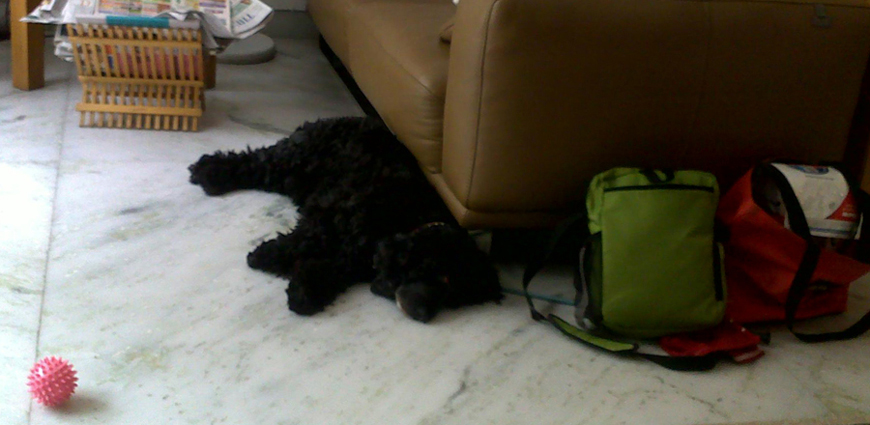
New Delhi: Kiki came to stay with us for a few days. Her owners went to Calcutta on business. Kiki is a black Cocker Spaniel, 10 years old in October this year and people say if you multiply a dog’s age by seven, you get the equivalent age in humans; so she’s like an oldish lady now. Kiki was born in Thailand, moved to Japan with her Japanese owner, then to Bangladesh, Vietnam, back to Japan and now she’s in India. A much-travelled small dog, Kiki has her own immigration documents, a kind of doggie passport. I first met Kiki in Bangladesh 4 years ago and it’s a bit sad to see she doesn’t remember me at all. But she’s older now, seen a lot, she’s slower and can’t be expected to remember everything. Kiki comes towards me with her little pink ball held in the mouth, drops it in a practiced way so that it rolls towards me. I pick it up and throw it and she runs to get it, but after about four throws she has to stop and have a rest.

We are given Kiki’s things in two small bags, food, blanket, toilet equipment, ball and her owners say bye-bye Kiki! and leave. Kiki spends a long time sitting at the patio door looking out, waiting to see if they’re coming back. But they’re not coming back; I try to engage with her, I try to speak with her in a kind of doggie-speak, cute high pitched baby chatter. But it’s not working very well because most of the time her owners speak to Kiki in Japanese. Kiki just looks at me, looks at Jiab, responds in a friendly way, but there’s a distance. Jiab and I are just the faces of this moment; she knows we are the carers. Kiki has had carers speaking to her in Thai, Bengali, Vietnamese and Japanese and, anyway, she’s limited because she’s a dog…. Now she’s just wondering which one of us, Jiab or me, is the one to whom she will be answerable; which one is the main provider of food and taker-out-for-walks? And it’s a new experience for us too, we don’t know much about looking after dogs. So I’m wondering how this’ll go, and thinking Kiki probably has that figured out already; the pros and cons of this situation, a naïve, abundant provider of tasty scraps from the table?

So we’re eyeballing each other like this, a certain curiosity and interest in the air and Kiki is totally black like a photographic negative, I can’t see any face, only a strip of pink tongue hanging out. I’d be staring at her intently looking for a face then I discover it, see the black eyes, black nose and aware, all of a sudden, that Kiki is looking back at me! An encounter. Quite a lot of licking; affectionate doggie wetness – I put her food in the dish and there’s great excitement but she doesn’t eat, just sits there looking at it. I’m thinking maybe she doesn’t like it… but then she turns around and looks at me, face to face, eye-contact, quite a meaningful moment. A recognition; is it about gratitude? I say something like, go on then Kiki… and she starts to eat, tremendous crunching noise, her bowl-shaped dish amplifies the sound, and the scrape and clatter of the dish sliding on the hard floor as it gets pushed along by a long black nose. Maybe the hesitation at the start was her saying: look, I’m sorry, this is going to be noisy, okay? Same thing with water, I’m sitting at the desk quietly and there’s this huge shlooshing, splooshing sound.

kikiphoto1The ‘face’ of Kiki got to be more and more of a significant element in our communication – no expression, quite plain, just a kind of awareness: non-verbal gazing at each other. At one point I say to her: where’s your ball? and she immediately starts running around looking for it. I realise then that her Japanese owners must say that in English. So I get down on the floor and we are both looking under the sofa and the chairs. In the middle of all this, we look at each other, I’m on my knees, at her level. I say to her: I don’t know where it is… hold that gentle look for a moment: I don’t know… consider the enigma of our shared existence. There’s something about this that gets my attention, she just looks. I come closer and look again at her dark face placed in a dark wooly body. There’s a little movement of the head. I look under the sofa she’s sitting next to and there is the ball! Difficult to reach because it’s behind the bar but I can just get it, flick it out and Kiki runs off across the room chasing it. She catches it and comes back to me, drops it and I have to throw it again….

————————-

the opportunity

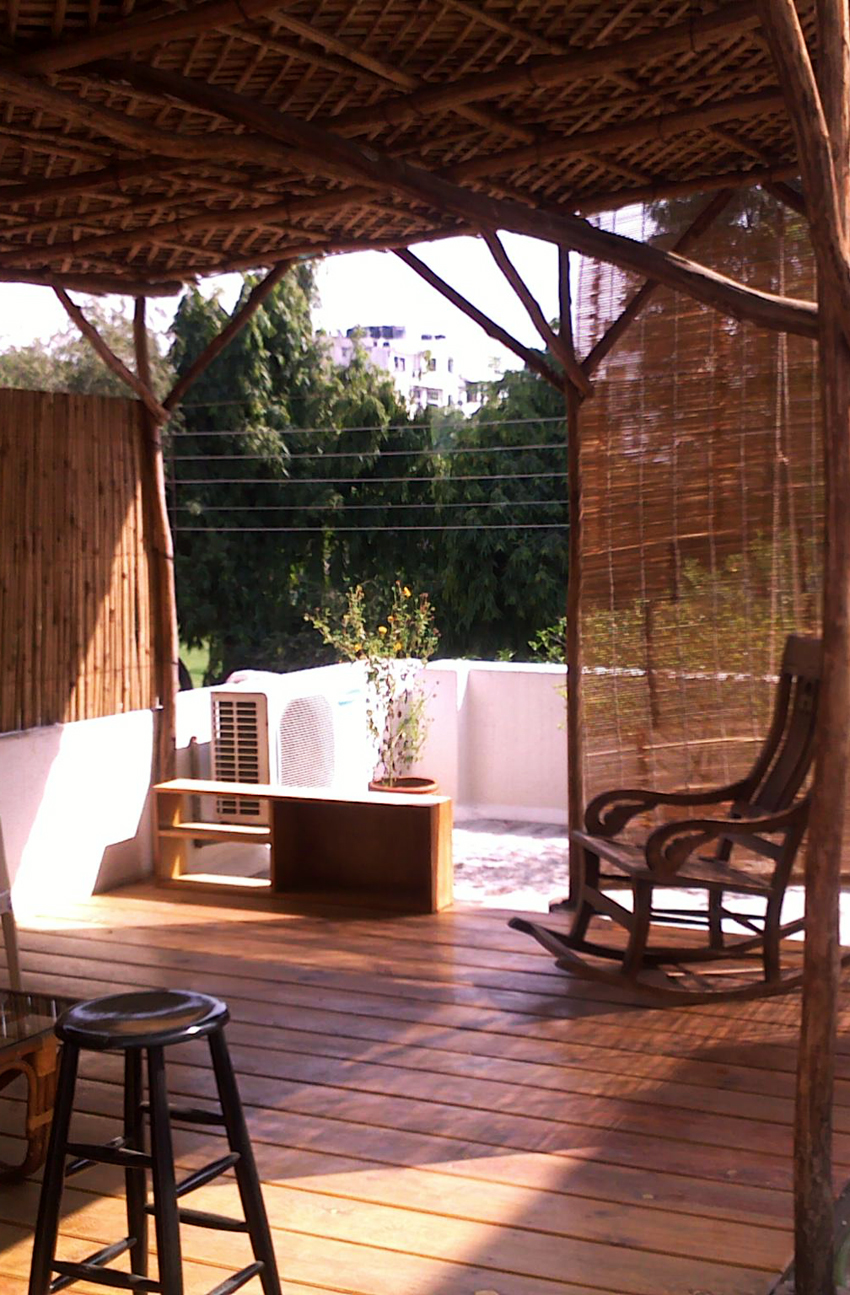
200620131896_2New Delhi: I leave the door open that leads to the roof terrace and come downstairs. Ksum is in the kitchen, cleaning up. She says: You no close door up? Pointing, so that I can understand her English; large black eyes look at me; blue sari, olive skin, Assamese Buddhist, originally, converted by Christian missionaries. Then she’s smiling in a kind of patient way when I start to explain I’d like to have the door open, to get fresh air? Looking at me like, does she have the energy to tell me this? Ked come in. You know Ked? …raises her voice because maybe I’m deaf or something, Ked come in, you open door. And I’m thinking… what’s Ked? And there’s that incredulous look. You no unerstan’ Ked?  Ked come in door, come down stair, into house steal food from all th’ trash‘n make a mess everywhere! And then I understand Ked is ‘Cat’… pronunciation is different. She sees the dawning of recognition on my face. Ahh… she says on my behalf, and nods her head with a sideways slant, goes back to her work; like I need to be told everything. I go upstairs to close the door then decide to step out on the roof terrace where the air is cool and nice.

Wow, Ksum having a bad day. But she’s right about Ked, cat; instinct and the window of opportunity – or door, in this case. There’s also monkey, of course, and rat, and all the other freeloaders and opportunists out there in the world of Wild Life, claws, wings, beak and teeth, quick and clever; skills evolved from when they were all dinosaurs. The ability to grasp, snatch, hold and eat. Human beings similarly motivated, driven by desire. Reacting to the sensory world – sights, sounds, smells, tastes, touch, mental objects, and grabbing at these with extraordinary speed. The habituality of it inherited from former lives… the reason I was reborn in this world is that I’m attached to everything I love and hate. We keep coming back. It’s the relentless search to feel good about everything, and avoid feeling bad about everything when the good feeling falls apart.

Carrot-and-stick; the good feeling is nice when it’s there and the bad feeling is nice when it’s not there. The good feeling makes it seem like everything in the world is allright, joyful, a sense of success; it’s rewarding. And the bad feeling is the opposite; a strange sense of failure, guilt, and fear – I’m bounced off the wall and wanting the good feeling again with renewed hunger. Chasing my tail. Stuck in the duality of exchanging the bad feeling for the good feeling – something thought to be deservedly earned, a reward for time spent in bad feeling. Stuck in a rut on the consumer treadmill without any belief in anything beyond that. Seemingly there’s no choice, earning just enough money to pay for what it takes to make me feel good for a short time, then I’m feeling bad again. All I really want is some peace and calm but it seems to be so hard to find.

210620131902Loving kindness and compassion for those in Suffering. The system creates the predicament. Most people think there’s no way out, even though the opportunity is there. It’s like the example of being locked up in a prison cell for years. Then, one day somebody comes into the cell and gives you the key to the door, so you can open it and you’re free. But instead of doing that, if you’re a ‘believer’, you put the key in a special place and pray to it every day, believing you’ll be able to endure all the hardships of your prison cell by worshipping the key. You don’t know what to do, doubt, uncertainty, fear, confusion. Other people, ‘non-believers’, disagree with your worshipping; they say, we don’t believe in religion or anything, so they decide the best thing to do is just get rid of the key and throw it out the window.

The key is not an end in itself. Just a key; meditation practice, mindfulness, just the intention to be mindful is enough. Back off from the automatic pull; the sense of something out there that I’m drawn towards… and the internal sense of ‘me’. There’s nothing there, only the Five Khandas (Five Aggregates): form, feeling, perception, mental formations and consciousness. ‘… stopping the mind, stopping the flow of thoughts that are proliferating, stopping the flow of moods that get drawn into either attraction or aversion. We return to a clear center, to awareness’ [Ajahn Pasanno, ‘On Becoming and Stopping’]. No holding on to anything, no holding on to the teachings even. Learning how to use the key. Maybe it’ll take a lifetime, but what else is there to do that’s as valuable as this? Allowing everything to arise and fall away. Cessation. No remainder. Nothing whatsover is to be clung to: sabbe dhamma nalam abhinivesaya.

200620131891‘We use the pleasant and unpleasant feelings to measure our success or failure. If we experience something pleasant, we think we’ve succeeded. If we experience an unpleasant feeling, we think we’ve failed. This comes from a place of becoming, what we have become through bhava tanha or vibhava tanha. We judge it in terms of the desire to maximize the pleasant and minimize the unpleasant.’ [Ajahn Pasanno, ‘On Becoming and Stopping’]

————————-

The story about the key comes from ‘Religious Conventions and Sila Practice’, Ajahn Sumedho, Cittaviveka 1992. Upper photo: the door to the roof terrace. Middle photo: sitting area on roof terrace. Lower photo: a plant called ‘Ladies Who Wake Up Late’ (flowers every day but late in the morning)

conflict & release

121120121567“Metta is non-discriminatory. It doesn’t mean liking one thing rather than another, it isn’t a question of singling out: “I love this person, I don’t love that one.” [Ajahn Sumedho, “Universal Loving Kindness” From Forest Sangha Newsletter, October 1997]

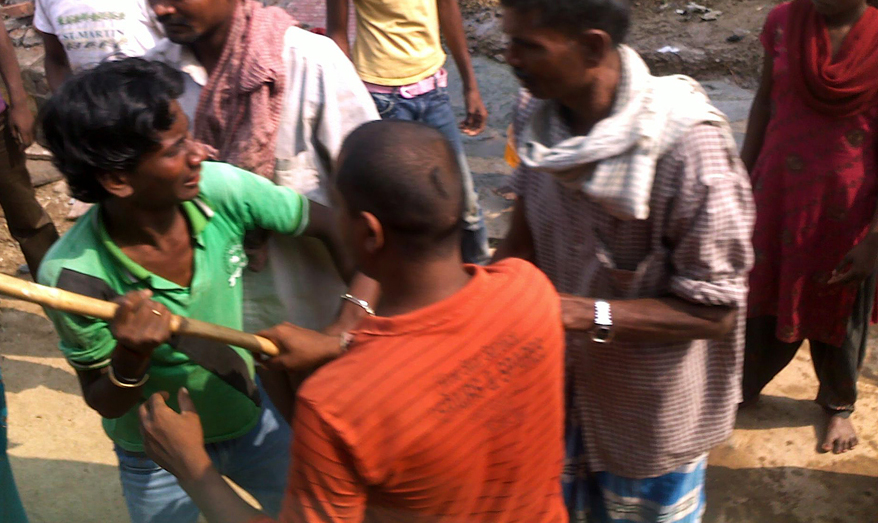
North India: The image here shows some kind of serious argument happening among a group of men, viewed from the window of a moving bus. I couldn’t actually see what was happening because other passengers were in the way, but I got the camera into a space near the window of the bus and took the picture, guesswork, thinking it’ll not come out clearly but it did – perfectly positioned in the centre of the frame. The man in the green shirt is trying to do something with that pole and the other guys are struggling with him violently. The bus pushed itself on through the crowd and the people made space for it. When we got up close, all I could see was the top of their heads and I took the photo without seeing where to point the camera…

The bus moved on and we were gone in a moment, accelerating along empty streets. I was amazed to see the photo after we’d moved away from the area. What to do with it? The tremendous intensity coming from the green-shirted man is scary – murderous feelings in the air. There’s another emotion too, he looks tearful, as if he might start to cry. It was an event I didn’t see, all I have is this picture of it. I could hear the explosions of angry voices, and the memory of it is still a bit scary, but it didn’t happen to me. If it hadn’t been for the camera lens, I’d not have seen it. As long as no effort is there to keep it going, conflict falls away. But we fuel the fires to keep the conflict going; our wars and war-mongering, allowing everyone the means to build up the tension, justified outrage, creating stories in the mind. We could just as easily allow it to fall away, but we’re drawn in, and it gets to a point when conflict is inevitable; this is always how it is.

Then Ajahn Vajiro was in town the other day and somebody asked him about what to do when you have to put up with some unreasonable, insensitive person giving you a hard time and you have to see this person on a daily basis. Ajahn spoke about the Brahma Viharas and later Suffering, the First Noble Truth and how the Buddha didn’t say he could eliminate suffering – he gave us the tools to escape the suffering. It led me to see that conflict is resolved if we can focus on the subjective nature of it, see our own anger, and see the anger the ‘bad guy’ has to cope with, and recognise it as exactly the same thing – what’s the difference?

The practice of meditation is the solution. Ajahn talked about getting to know the inner world; start from there, explore the universe from the inside. It’s not just about feelings of bliss and peace, that’s there too but it’s about the real world. Long term goals. Following this path, you get to know about suffering; you notice your own suffering, you have compassion and act towards others with compassion when you notice the suffering in your opponent. Apply wisdom – especially if your opponent is swinging a long pole, aimed at your head. See the angry person as someone who doesn’t understand his/her own suffering and recognise their difficulty – then get out of the way of the swinging pole!

It’s about the difference between ‘knowing’ and ignorance. Ignorance is the result of unskilful action. Non-ignorance (knowing) is about accepting limitations and doubt. It’s not a sure thing but it doesn’t have to be a serious drawback; having to cope with being not sure, uncertainty. Ajahn V described it as being at the edge of the known; doubt is nearly knowing what it is…. In a different context, uncertainty is what’s in the wrapped gift you’ve been given. You don’t know what’s inside until you open it….

————————-

“The metta – kindness – engendered in us encourages us to accept ourselves and others, and so to understand ourselves and others. Understanding implies wisdom. And this wisdom is that which allows us to find the way, to grow beyond, or let go of, that which limits and binds the heart. The kindness expressed to others allows them to accept themselves and others. This is an emotional, gut or heart acceptance that allows the acts of body, speech and mind that are a response to that which is perceived as `other’ to be kind; not motivated by not-liking, not motivated by aversion or fear. The effect is unlimited Metta is radiant and attractive, warming to those that are cold, cooling to those that are hot.” [Venerable Ajahn Vajiro – “Mature Emotions ” from the Forest Sangha Newsletter]

nothing cannot be anything

hand image3Delhi: There’s a needle in my arm. Strange how the body accepts this intrusive object and the antibiotic fluid coming through it that enters the blood stream. Veins have a plasticity like something synthetic we recognize from the world of manufactured polymer substances. But human tissue is better; you can make a hole in it and it repairs itself. You can cut it, stitch it up, remove parts of it and replace these with other parts that fit. The human body is a miracle. The pain of this needle, though, has a directness, increasing, then easing off, over and over, dukkha, there’s no getting away from it.

I don’t want it to be there, vibhava-tanha, I want to disconnect it from the plastic tube leading to the upside-down bottle suspended from the hook above my head. It feels unnatural; it shouldn’t be like this…. Lying here on the bed looking up and counting the drips that fall into the receptor that fills the tube; one drop every 4 seconds and that’s the rate of the fluid flowing down the tube into my pierced blood vessel. It’s a full bottle, and there are others I have to take after this one… treatment for an intestinal infection – nothing really extraordinary in a country like India, in the hot season, when all kinds of bacteria thrive. Caused by drinking water from a filtered system that didn’t filter. Organisms survive the filtering system; bugs everywhere in this intensity of 43°C.

I need to find a way of getting through this period of invalid status and prolonged boredom of a plain room with hospital fittings, plugs and sockets in the walls, hospital furniture and a TV screen I’m not interested in. Dissatisfaction with things; clicking the buttons that control the position of the hospital bed; down/up and up/down. Lying here with eyes closed, listening to the metal trash bin; it makes a satisfying percussive sound when the cleaner presses the pedal with his foot, lid springs open and strikes the wall next to it Clang! He releases the pedal and the lid closes: Flumpf an airtight trash bin with plastic bag liner. Crash! Flumpf! again and it’s joyful and funny.

I need some joy here, there are men in dark navy uniforms in the room; cleaners with large grey floor mops that look like they’re soaked in muddy water swabbing the tiles; smell of Dettol stings the eyes. Muddy grey mops and dark navy uniforms seem out of place in an environment of lemon yellow, soft pink walls; pastel shades and shiny chromium fittings. The muddy grey mops are a bit scary also, because I’m sensitive to things that appear dirty, having fallen into this sickness as a result of drinking water from a filter machine installed at home that allows dirty water to come through.

‘We’re not in Kansas anymore Toto…’ The doctor said always drink boiled water in the hot season, organisms are present in the water, filter or no filter. I feel some frustration with the company that sold me the water filter: ‘it shouldn’t be like this’but we don’t live in a world of ‘should’ and ‘shouldn’t – western theory applied in an Indian context. We expect it to work, and it doesn’t. Western systems are deductive and life is inductive. Organic growth has no beginning no end. How to understand that, what to do? Don’t make it into a structure. Let it be nothing.

So I can lie here on the bed with my eyes closed and the cleaners expect me to be like this because I’m a hospital patient. And in this curious public place, enter meditative contemplation, watching the breath, the rising and falling of the chest. Allow the thoughts that arise to fall away and be replaced by others that I allow to fall away and allow everything to fall away and cease, as far as possible – just the effort of trying to do this leads to a quietness in the mind; spaces of no thought. There’s some peace to be found in this activity. And from here consider nothingness, just nothing, no thought. It’s not an idea of nothingness, that’s a concept. Nothing cannot be  anything. Nothing cannot be located anywhere in time or space; no before, no after. If it is truly nothing, it can have no cause or effect. I can’t work towards some mind state in future time when I’ll see what ‘nothing’ really is, it has to be now, it’s always ‘now’. Nothing cuts through, penetrates, and dissolves everything. It’s just nothing.

————————-

‘One must have a mind of winter… (to behold) the nothing that is not there and the nothing that is.’ [ Wallace Stevens, The Snow Man]

Photo image: http://www.jeffzinn.com/wp-content/uploads/2011/12/poor.jpg

girl at the traffic lights

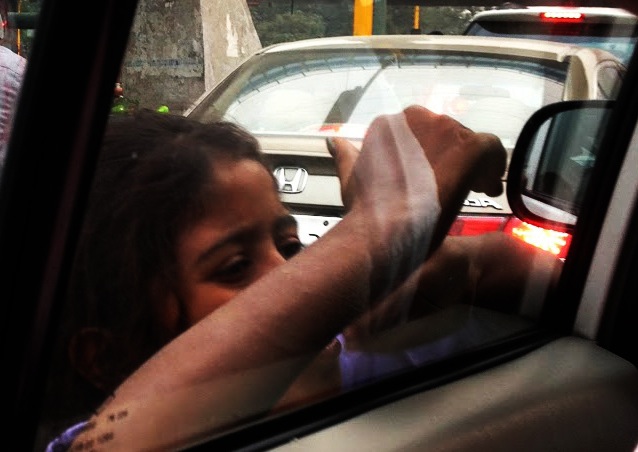
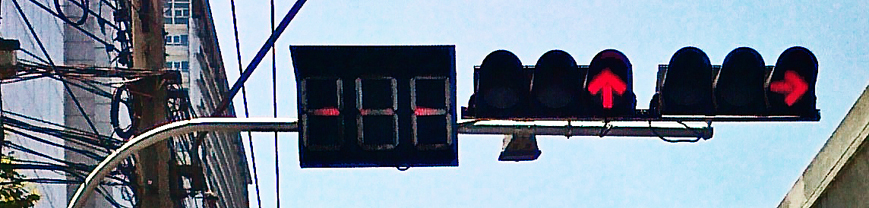
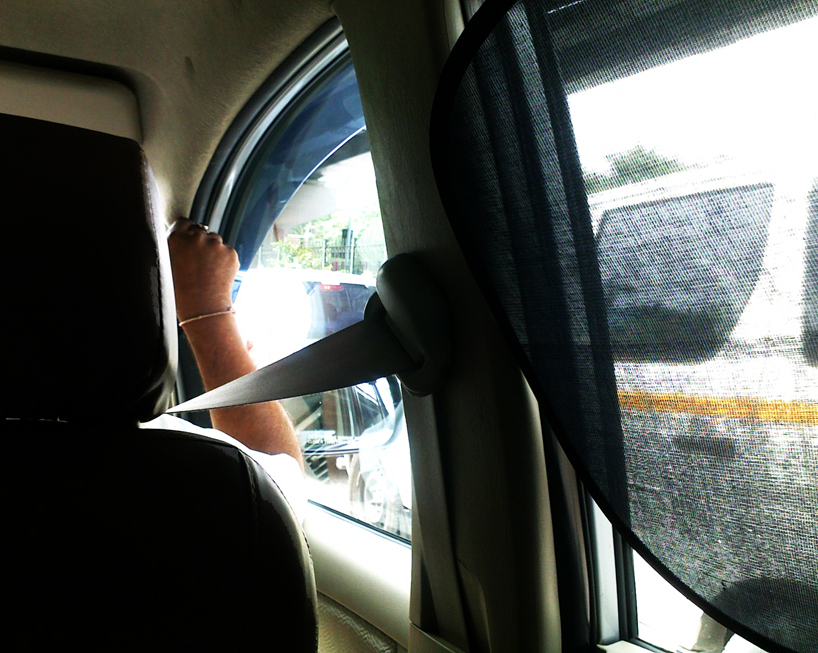
090420131781New Delhi: Sitting in the car, Shym driving, and I’m in the back seat looking out through tinted windows, incognito. Slow down and stop at the traffic lights. Street people and traders walking up and down between the vehicles, selling kiddy’s toys, books, and all kinds of stuff. Children with bunches of wilted  roses knocking on windows, and discussing with passengers in auto rickshaws. One of them presses her face against my window, hands and arms cupped around her head so she can see inside through the tinted glass film. A shadowy head and face spin around looking for where I’m situated in the dark interior. Finds me, then some kind of eye contact, and: tap-tap-tap-tap on the glass with a small coin…. tap-tap. Doing it just to see what’ll happen. Shym puts the car in gear and drives forward a little bit, trying to discourage her but she remains stuck to the glass like glue, walking sideways, legs slightly back out of the way of the turning wheels.

IMG_9171I slide down the window and give her a folded 10-rupee note. Hot street air enters the cool interior of the car like a blast from a huge hair dryer, and I see a dark girl about 9, with hair a light reddish-brown colour, dusty with the street atmosphere. The entrepreneur. How does it look to her? A foreigner gives her money, somebody with colourless eyes, pale, half invisible; like a creature that lives at the bottom of the sea, no sunlight. Her dark eyes hold my attention, intense, penetrating; there’s only ‘the look’. I slide up the window again. Giving her a few rupees is encouraging this kind of livelihood – that’s not really what I want to happen… but what to do? The lights change and we’re off, accelerating through the traffic, overtaking on the left, or the right, wherever there’s a space.

lights1

There’s a small smear on the glass where she was looking in. How does the world seem, seen through her eyes? Must be a no-choice situation; hardship at a level I can’t comprehend – we’re not watching the same movie. But it reminds me of something in the early times in Scotland. In those days I was pretty much caught between polarities. A rocky road. I went down South to England and I’d look at other people’s lives there; unbelievable to me, how their reality seemed to be so… bland? Where I was living you’d open the door of your house to go out and the wind would blow you back in. Extremes of climate, extraordinary confrontations; the rough and tumble. At that time, I didn’t know about the Buddhist perspective on suffering dukkha, all I had was the experience of it. The cloud of unknowing… life was held by random karma. Consciousness was a kind of unconsciousness. Awake but unclear, living in a dream… dum-di-dum. Subject to all the whims and fancies; tugs and pulls. Like/unlike – and for long periods, quite lost in samsaric realms. I thought I could just carry on like that, hoping to muddle on through…

Carefree, at times, and reckless, not happy, no sense of an applied mindfulness other than, okay, so… what’s going on here? Sometimes I was nearly right, other times terribly wrong. I’d weather the storm and somehow things stayed okay. The mistake was (although there are no mistakes) I’d be trying to get ‘it’ to do something or be something or become something (or not become something), without realizing that I didn’t have to do anything with it, or make a ‘thing’ out of it, or have it become anything. Just letting it be there in the background, or the foreground or seeing it in the middle distance, not focusing on it unduly – whatever. So the ‘it’ became not so important; less and less of an identity found in the ‘object’, more like a larger subjectivity. It’s the same for everyone but at the time I thought it was just happening to ‘me’.

AVN_TRAFFICDELI_282719eIt’s not about guarding that little self-construct called ‘me’. The Buddha’s Noble Truth of Suffering is about receiving the suffering as it is, conscious experience. Open wide and let it in so then there’ll not be a self for it to attach to. If I can allow the Suffering to enter, I’m not confused by it or perplexed by the fact that I don’t know why I don’t know what it is. I ‘know’ what it is: maintaining a ‘self’ that isn’t there. So I can let all of that go. It’s about relinquishment, giving it all away – a shared experience. A kind of generosity, like giving money to the girl at the traffic lights; she was there to enable my simple act of generosity (raison d’être for panhandlers). Who knows, maybe she has the wisdom I’ve been looking for all these years. I’ve been caught in delusion, a dull puzzleheadedness, caused by the influence of the painted consumer god, the psychiatric witch-doctors – is it so very different from her world? Failing to see that if my life is never nourished by anything greater than what I need and want, I become cynical and negative. There are some people like that; holding on to ‘self’ with such tenacity, they get old and bitter with disappointment. Offering something to somebody else makes me feel good, brings gladness into my life… ‘The Buddha-Dhamma spreads out from here to all sentient beings throughout the universe. Mettā, loving–kindness and goodwill is generated for the welfare and development of all beings everywhere: seen, unseen, born, not born yet, animals, devils and angels. The whole cosmology of possible sentient beings is included in the practice of mettā bhāvanā…’ [Ajahn Sumedho]

————————-

– G  R  A  T  I  T  U  D  E –
Ajahn Sucitto, for the use of the word: ‘puzzleheadedness’ also edenriley.com and thehindu.com

halfway through the hot season

roofsala2New Delhi: I wake up sometime deep in the afternoon. No need to look at the clock, the haze of light tells me it’s not yet 4pm, the time when it turns towards late afternoon and the cooler evening. So I continue lying there on the sofa, for a while, letting it sink in that I need to go upstairs to the roof terrace and get my laundry off the line – left for too long, the clothes get crisp and semi-baked. In a few minutes I’m upstairs, open the door at the top landing and step out into +40° centigrade, a blaze of mature, afternoon sunlight reflected off the concrete floor and walls. The air is a tangible thing, heavy like liquid, consistency of thick translucent soup. It has weight; there’s a sense of displacing the quantity of it that equals the mass of your body as you walk through – it squelches around the back and over your head and occupies the place where you were a moment ago. The presence of this extraordinary heat causes the mind to create reasons for it. Difficult to see clearly, most of the time I am involved with it (or I am it), depending on perceptions and understanding of the circumstances:

lnvestigating the mind… requires the use of the very thing we want to study. The mind functions as both the subject and object in this case. ln a conventional sense, this limits us to a superficial understanding, possibly coupled with a glimpse of some deeper aspects in the mind (or qualities of mind) that we recognize only through intuition. The superficiality is locked in by our descriptive language that attaches labels to the surface of things, preventing a meaningful exploration of either subject or object. Meditation is the entering into this process. It allows us to penetrate the barrier of chaotic language, taking us beyond rationality and placing the mind’s eye beyond the influence of the intellect.’ [Ajahn Sumano, ‘Meeting the Monkey Halfway’]

I go over to look at the tap where the monkeys come to drink and when they’ve finished, leave the water running and the tank goes dry. Then we have to start up the pump more often than usual. But no sign of any activity here, no puddles, no monkeying around. There’s a large basin full to the brim sitting below the tap. Jiab suggested we put it there, instead of the monkeys allowing the tap to run like that, and they can drink and fool around with the water – generosity. The neighbours would probably not approve of us providing facilities for the monkeys, even though we’re just allowing them to do what they do and be what they are – monkeys. For me it’s a novelty; they’re our near cousins, there’s a mutuality, we have some understanding of how we each see the world.

I was in a taxi one day, passing a garbage recycling area at the side of a road; workers sifting through the trash with long rakes and forks and the whole thing watched by a large troop of silent monkeys sitting in the branches of an overhanging tree. Suddenly this big monkey tumbled out of the tree, so fast I didn’t see how it was done, rolled across the ground and with very long outstretched arm, pointed fingers, grabbed an orange that nobody had noticed lying there in the trash. And in a moment was back up in the branches again, unpeeling it and guarding against covetous looks from other monkeys. I noticed the workers smiled and laughed at this amazing skill. Then the taxi moved on…

I get my laundry off the line quickly. Held in the fold of an arm, the clothes are hot and burning. Open the door, scald fingers on door handle, step into the stairwell, close the door behind me to stop the furnace heat from getting in. Down the stairs, drop the laundry in the basket and into the L-shaped room; two air-conditioners running, three ceiling fans, and my desk is in there, in the coolest corner of it. Smooth tiled floor where I walk barefoot and all curtains drawn closed to keep out the glare, except for one that offers a shaded view through the foliage of the large leafy tree outside in the garden and the various tints of transluscent green leaves through which sunlight filters. I see in the newspaper today the southwest monsoon arrived in Kerala, South India. Here in Delhi, we’re maybe only halfway through the hot season…

garden1

————————-

‘… the impact of the innumerable impressions crowding in upon man from the world of outer and inner multiplicity, papanca.’ [The Heart of Buddhist Meditation Nyanaponika (Thera)]

Note: The monkey and the orange story developed from a discussion with Lisa A. McCrohan

sustaining factors

monkey-tap-india_1626153iNew Delhi: Monkeys swing through the trees, jump down on to the roof terrace and turn on the tap to have a drink of water. I don’t mind; except that they don’t turn it off when they’re finished, just leave it running – water trickling down the drain from up above – that’s how I know they’ve been there. The neighbours have the same problem. I see somebody climbing up a ladder to the water tank up there at the highest point… what’s he doing? hmmm, replacing the tank lid; the monkeys have pulled it off to get in and drink, and have a little freshen up. Yes, well, it’s hot here, Jiab said around 45°C. Not worth it, being precise about temperatures above 40°, just waves of hotter air wafting around in slightly less hot air, something like being in a swimming pool of hot water. It’s so hot, I feel like a pancake on a hot plate. I don’t want to eat a pancake, I feel I am a pancake… cooked and kept warm. No problem, really, we have a room in the house with air-con, and I’m in there. All I need to consider are these long power cuts, but nothing more than 10 minutes. Longer than that is uncommon. But it did happen once [Link: Power Failure], what can you do? If it happens, it happens – the uncertainty element. Causes and conditions, no more than that. Phenomena are sustained only as long as their sustaining factors remain:

‘When this exists, that comes to be. With the arising of this, that arises. When this does not exist, that does not come to be. With the cessation of this, that ceases.’ Samyutta Nikaya 12.6

I can’t say I’m as detached as that when it comes to coping with stifling heat but knowing that this is how it is helps me to ease off and away from the proliferating stories in the head I don’t know are there because I’m seeing through them [Link to: The World is Made of Stories]. If there happen to be long periods with no air-con, it’s best to go outside, find a shady spot to sit and say hello to the neighbours, who’re all outside for exactly the same reason. Outside is better than in; the heat is trapped in these brick and concrete oven-like buildings. But, so far-so good, most of the time I’m sitting in this cool room.

It’s still early morning but I better get on and cook the food for the day because the kitchen will be like a furnace by noon. I open the door to go in there and enter an atmosphere that could be the planet Mars, images of volcanic slopes and bubbling lava… I have to boil water in the electric kettle, a curious old thing made of metal and if you forget to empty out any remaining water at night, when it has cooled down, tiny ants climb up the side and sit there enjoying the coolness of this small reservoir. Then, for some reason I find them drowned in the water the next morning. I think they must drift off in a dream state and fall in. I suggested to Jiab we just spoon out the ants, then boil the water but this is not well received: I do not want tea made with water that has been swam in by ants! So I’ve learned to empty out leftover water in a bucket to give to the plants.

Kettle boils, add the hot water to the steamer, put in the vegetables and switch on the gas. I can sympathize with the ants, there’s a ceiling fan spinning around, swooshing and splooshing the hot air in gusts and not doing much to lower the temperature. I have to switch it off, even so, when using the gas cooker because the gas flames get blown out and I’d asphyxiate in gas-flavored hot air (limp bizkit, chocolate starfish and the hot dog flavored water – no, no, not that, please…). Switch on the extractor fan, maybe that’ll help. The stove heats up the atmosphere by another 10 degrees and now it must be about 50°C. Strangely, it seems okay because there’s an object in awareness; the heat is coming from that; the gas stove. I don’t notice it’s hot, just standing waiting for the food to heat up, then it’s done and I can return to my cool room…

All there is is sitting in the coolness with this mindful alertness: the possibility that the power may go out any moment. There are more attention-grabbing existential phenomena but this’ll do me… listening for the monkeys and M’s little rhyme she taught me in Thailand comes to mind…

Five little monkeys jumping on the bed, one fell off and bumped his head. Mama called the doctor and the doctor said: “No more monkeys jumping on the bed.” Four little monkeys…

280520131847

————————-

Upper Photo: monkey-tap-India_16761531 GIRISH KUMAR : Message : Animals in News. Lower Photo: Cassia fistula, golden shower tree (the tree the monkeys use to access my roof).

loving-kindness to animals 2

cows2A village near Hat Yai:  Going to see the cows with M and we meet the first one. I ask M about pulling on the rope tied through it’s nose and if she thinks that would be painful? M tells me it’s like pulling your hand and she pulls me along by holding on to my finger: ‘Like this Toong-Ting’ – laughing, Toong-Ting as a reluctant cow… I can hear the voice of (her auntie) Pa K, who lives here, a down-to-earth farming person; and I guess M must have asked Pa K the same question and she’d shown her, as M shows me now. I’m also aware that M sees me a bit like a grown-up child, because I’m a foreigner and have such naïve views about things. For us Westerners, the simplicity of rural life is attractive, but we’re not able to see it in the long term, or accept the hard work that’s necessary to be able to live like that. Also having to accept basic truths like killing animals for food and all that… yes, well, I don’t discuss this with M. We just go on through all the wet ground towards the other cows in the distance.

There was another time I came here to visit the cows, and met the little cow with the bamboo bell around its neck: clacka-clacka sound when it’s eating grass – strange grass-eating rhythms. We stop and look at it, and it looks at us. Such a miniature creature, it looks like a calf, and comes towards me with cautious movements, swinging head in motion with the way it walks. It raises it’s head and points a snuffling, sniffing wet snout in my direction; bits of grass and green stained mouth. Large snorts. Then it extends a long tongue and sticks it in it’s nostril (how do they do that?), comes a bit closer and there’s quite a bit of sniffing of the air around me. This cute little cow is curious about me due to a certain familiar milky smell coming through the pores of my skin? It’s not smelling the others who are with me like this… Thais don’t drink much milk so I’m thinking, hmmm, here’s proof that the Western body releases a noticeable odour of milk. I know this little cow has never been near to a Western person before in its life. The recognition of this milky smell, a familiarity: I am an upright, standing-on-it’s-hind-legs member of the species – a cow person? A bit disturbing… I’m conscious, all of a sudden, that humans are carnivores and there’s this unpleasant conceit about being at the top of the food chain that’s bothering me right now.

Scan-130523-Cow1

Later, reflecting on this while eating a breakfast of grains, nuts, fruit and cow’s milk – jaws move in a slightly circular motion, down up, down, up, down, grind, grind, and swallow. I’m an animal too. I consume the environment, whether it’s other animals, fish, vegetables, eggs, milk and – we are the cow’s babies! I notice cutting up vegetables is a bit of a sacrifice too; every time I start to cook food there is the opportunity for this kind of contemplation. Vegetables and fruit may not have the obvious characteristics of sentient beings but we may eat their reproductive organs along with everything else and that’s kinda weird…

There’s a couple of lines of text somewhere in an essay by Tan Ajahn Buddhadassa, that I cannot find at the moment; it’s about consciousness of all the things we eat, bits of animals, poultry and fish and how all their ghosts will come back to haunt us in the end. Pretty scary, nowhere to run, everything we are: mental, physiological, flesh, blood, and bones is a composite of what we have eaten, internalized. And it extends back through the generations to the beginning of time. The cellular substance of what we are is a genetic composite of all kinds of animal fats and enzymes and there’s just no getting away from it.

Contemplating the eating of meat helps me to see the true extent of my delusion driven by a voracious appetite for all consumables. Things I feel drawn to consume surround me – non-food items; ideas, concepts, ‘mind’ hungers for mind object. Consciousness is clouded over by habitual ‘mind’. Remove habitual ‘mind’ and there may be something like a deluge of reality comes in and with it comes a satisfactory understanding of the mystery that people eat animals.

Scan-130523-cows3

When Acharn Mun was at the end of his life, weak and lying in a village in NE Thailand, a very large number of his followers began to assemble. He asked the bhikkhus to take him away from the village because the villagers would have to kill many animals to feed those people. They took him to a nearby town where there were market places and various kinds of prepared food could be easily obtained. Shortly after that Ajahn Mun passed away.

‘From the day of my ordination I have never thought of harming (animals), let alone killing them. I have always extended my loving-kindness to them, never neglecting to share with them all the fruits of my merit. It would be ironic if my death were to be the cause of their deaths (‘The Venerable Phra Acharn Mun Bhuridatta Thera, Meditation Master’, page 201 – 202).

————————-

Sections originally posted in loving-kindness to animals 1 and re-posted here.