passive voice

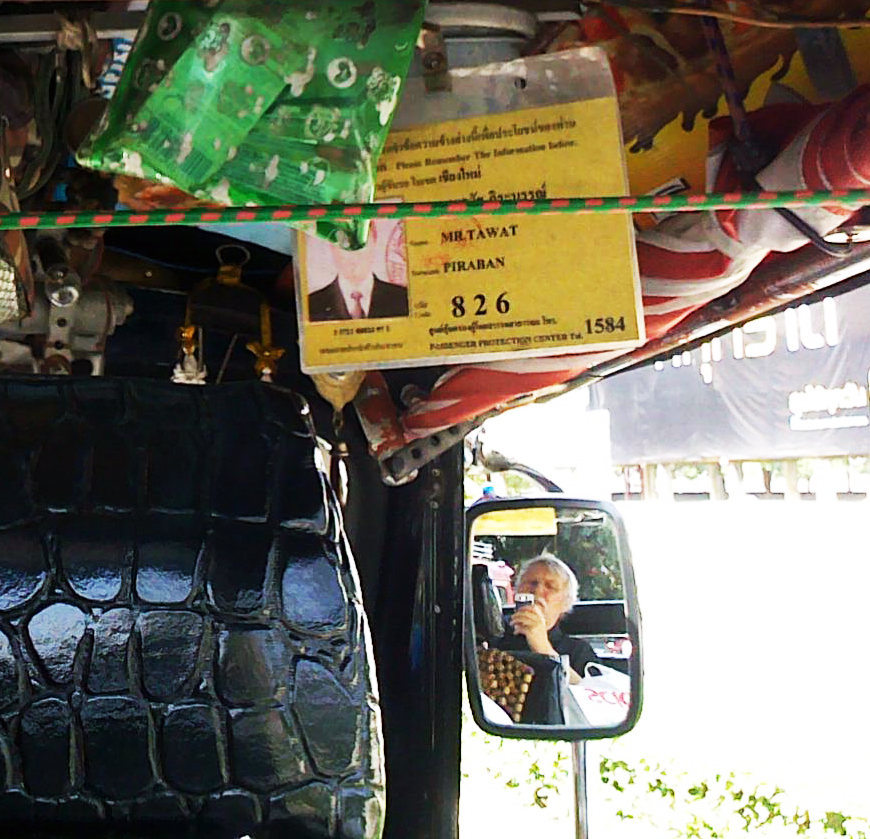
IMG_0083aBangkok: No taxis available at the airport, and all trains into town are seriously crowded. I am one of a very large number of individuals caught in the rush on a Friday evening. Somebody said later it’s because all the international schools start again on Monday. No other way, it’s decided for me, okay, I accept, I am subject to the system, the public transport system and I have no control over it. I am being ‘taken’, it’s about the process, rather than any particular person controlling the process. I could create a Controller in my imagination like the bosses, the management and blame it all on them/him/her/it, but it’s better to not do that…. There’s not a ‘self’ in the equation – the deed is done but there is no doer, using the Passive Voice language function to express the Buddhist Truth of no-self (anatta), and I came across an interesting post about this the other day [Link to: Just A Little Dust].

The ‘self’ is absent. Sounds are heard, food is tasted, the chill wind of September is felt upon the skin. And there’s nobody there that feels it, unless I consciously put together an identity composite, in which case I feel the chill (Active Voice). Language tells a story, creates a fiction that I can get lost in; only partially aware that it’s a constructed thing and most of the time I’m clinging to a concept of selfhood, an assumed identity. Thankfully, in the Passive Voice, there is no doer, things are done; the cognitive process is about ‘how it works’ rather than ‘what it is’.

The world is seen – I had an eye operation recently and what I didn’t expect was that it turned out to be an opportunity to contemplate this phenomenon of the experiencer. There’s the experience of visual stimuli entering the eye through a lens created by means of an industrial process and somehow the ‘me’ part of it is not there like it used to be. The lens inside my left eye is made of plastic, there’s a particular clarity in the colours, the quality of light and a fascination with the way plastic surfaces refract the light; plastic food wrapping, mineral water bottles, car windscreens. It’s all very new and quite interesting – maybe because I still have the ‘old vision’ in the untreated eye, something to compare it with.

I can see the world through the old eye as well as the new eye. It’s like the linguistic ‘voice’ can be both passive and active and I’ve understood it mostly in the active form; the process of selfing is grasped at as an entity and identified with – a controlling thing. In the West it’s a ‘belief’. My difficulty with anatta has been extricating myself from the Judeo-Christian conditioning that assumes the existence of an eternal soul. I notice Thais don’t have this problem. Even after 30 years in the East, I still struggle with my Western conditioning; an everlasting identity, the idea of it still lingers; a shadow of reality. A couple of hours and I’m at Morchit BTS near Chatuchak standing in the rain and D comes to get me in the car. The thought arises, the car is driven but there is no driver….

————————-

 ‘Where water, earth, fire, & wind have no footing; there the stars don’t shine, the sun isn’t visible. There the moon doesn’t appear. There darkness is not found. And when a sage, a brahman through sagacity, has realized [this] for himself, then from form & formless, from bliss & pain, he is freed.’ [Bāhiya Sutta]


the beholder

ploenchitBKK3

Bangkok: The world seems different, everything suddenly seen in clear three-dimensionality. Reflected light, rich, deep colours and a strange familiarity, objects in the environment become somehow known. I’ve seen these things so often before but now seeing them with an expanded awareness. It sounds visionary, you could say revelatory but it’s the result of eye surgery, rather than insight… nonetheless quite astonishing. I have this clarity in one eye only, vision in the other eye is like an old yellowed photo, dull and indistinct. The operation on that eye will be in October, back to the Rutnin Eye Hospital in Bangkok. The surgeon makes a hole in the eye and puts in a tool that uses ultrasound to emulsify the lens. The lens becomes liquid and is sucked away, then a plastic foldable lens is inserted in the place where the natural lens used to be. That’s it, done. Local anaesthetic is enough, or general if you feel claustrophobic about the covers over the face. After the op there are different kinds of eye-drops that go on for about three weeks and it feels a bit itchy but that’s all.

I’m amazed that it’s possible to do this; the plasticity of the human body, parts can be taken out, replaced; systems are deconstructed, reconstructed, subject to change. It all supports the idea of anatta: no abiding self. There’s an underlying flexibility about the mind/body organism namarupa. One example of this is that I have a very refined piece of plastic in my eye instead of a natural lens. And, looking at the world, I find an affinity with clear-wrap, cling-film, transparent plastic food packaging – the way the plastic surface refracts the light. In this strong sunlight in Thailand, I notice the reflections on chrome and glass – the clarity is sparkling and beautiful. Also these enhanced colours, reds mostly, and an overall bright clear blueness in the white areas. It has the quality of an iPad screen, retina display, high density pixels merge into one – an extraordinary brightness.

Faces of friends and family are seen as if for the first time. I notice small expressions now I didn’t know were there, maybe because everybody is looking at my new eye, intense Thai faces examine my new eye, and I’m looking back at them looking at me, seeing subtleties in their features that I’ve never seen before. It’s all quite new, a curious reality.

So, I’ll be going around for the next few weeks, looking at my surroundings and considering the phenomenon that I am experiencing this. Can it really be so? ‘Beauty is in the eye of the beholder’ (Margaret Wolfe Hungerford). The expression always seemed a bit mean and divisive to me, ‘I’ think it’s beautiful but ‘you’ might think it’s not; beauty becomes a matter of opinion… In Buddhism, the ‘beholder’ sees the world and identifies the self, ‘me’. If ‘I’ am inside the body, in ‘here’, I must be separate from everything else out ‘there’, isolated, alone, anxious – wrong view a fundamental error. The attachment to a perceived self and craving for it to become real, creates suffering. Language has a naming function, creating an apparent identity. Anything that is stated is always missing the point because of these characteristics of language. Better to think of it in terms of what it is not, rather than what it is: ‘… the remainderless fading & cessation, renunciation, relinquishment, release, & letting go of that very craving. (the noble truth of the cessation of dukkha)’ [SN 56.11 (dukkha nirodho ariya sacca)]

————————-

Photo image: Skyline at Ploenchit Bangkok.

layers

IMG_0041Bangkok: Falling out of the sky, jet-lagged and inert. A 12-hour flight from London; they gave me an upgrade to business class, nice. More space, better everything and a larger seat. Able to stretch out in the prone position, yes but also a huge selection of videos so I watched movies for 12 hours and no sleep. Now in a state of hypnosis here at the house, lying on the sofa in another time zone. Early morning in Bangkok and I’m watching the FOX channel. There’s only one English language channel on TV in this place so it simplifies things: NCIS, Bones, The Bridge and others. The stories merge into one all-inclusive narrative, a complex and improbable plot. Good-looking actors in expensive cosmetics play characters that migrate from other crime series into this one, the central story, all roads lead to one end, catching the bad guy, variations on a crime scene theme. The pace of it is intense, camera shots hold for about 3 seconds then change. Background audio has a percussive, mechanical sound then it’ll switch to something calm; a picture of domestic reality, beautiful interior, elegant lighting, lovely fabrics – I wish I had a room like that. Slow piano notes played meaningfully, like steps taken through the memory of something that happened once. I’m lulled into acceptance; the way it unfolds is the way it is. I become the story.

I could switch off the TV but there’s a reluctance; a pleasing attachment, something that appears more difficult to let go of than it is. Resisting the emptiness, the deep knowing there’s nothing there that triggers the reaction to fill the empty space with a self-construct, or an image, a movie celebrity, a child’s doll, the sphinx, the totem pole, dependency on a perceived creator. I mute the sound, allow the engagement with it, following the story as it transforms, watching the present moment until it changes – how did that happen? I didn’t notice it take place, only after it occurred. There’s the sense of something applied. Consciousness seems like an unconnected series of screenshots, a random sequence of events; things without substance appear and fade away. Rest in this fictional state… it’s just the way things are. Mindfulness is at the base of it all, in every way. Sleep shuts off the system; down through the layers, comfort, familiar surroundings. Crash out on the sofa in flickering TV light…

————————-

‘Like fish that cannot see the water they swim in, we do not notice the medium we dwell within. Unaware that our stories are stories, we experience them as the world.’ [David Loy, The World is Made of Stories]

nothing extraordinary

photo-1POSTCARD #02: London: There’s a crowd standing around the entrance to the Underground Station. It looks like an emergency, police cars pulled up on the pavement, and an area is cordoned off with white tape stretched across entry points to the station entrance. All traffic is redirected and pedestrians can’t get through either. A policeman gives me directions to the Underground station entrance on the other side; so reassuringly calm, I’m made to feel convinced there’s nothing unusual about this situation of flashing lights, bulletproof vests and loud crackling voices on the police audio system. Pay no attention if there’s a slight urgency in the air and the world seems like it’s falling apart, it’s all being taken care of…

Strange circumstances, we all think, realising what we are expected to do is adjust to it, stay within the familiarity of ‘self’ mode, conventional reality. Mesmerised by strategies to keep the population from mass hysteria. No, really, everything is perfectly allright sir… and I feel a hesitation; it wouldn’t be polite to ask the policeman what’s actually going on here, to take up any more of his time with awkward questions – no, and thank you, you’ve been so nice about this, thank you very much – very English. You hear the word ‘thank you’ constantly; THANKYOUs are everywhere, staying with how it appears to be; nothing extraordinary here, no, no… but I sense something catastrophic; a great yawning chasm opening up beneath my feet. Things are clearly not allright and there’s this sudden desire to be absent, distance myself from this location ASAP.

tube pic1Depending on a self that’s seemingly in ‘here’ creates the objective state – I am inside looking out through the eyes; seeing what’s going on out ‘there’ – a world separate from where ‘I am’. Duality. It’s an illusion, and part of this illusion is that the mind is maintaining the illusion. The policeman is maintaining the illusion, media, culture, everybody I meet reinforces the illusion because we’re all doing it. Even when I can see there’s no self to speak of – nobody at home – the mind is always telling itself there is a ‘self’ in here. And this is the situation; seeing past the ordinary self where there’s a ‘me’, a GPS locator: YOU ARE HERE. This is how it is that I arrive at the Underground entrance by way of the small backstreets, following the crowd. Then down two long escalators, deep under the ground, down and down to the depth of what feels like a ten storey building. At the very bottom of this is the tunnel and the track. Heavy old metal train careering in with a great whoosh of tunnel air, I get into the carriage and we’re off clattering through the blackness of the underground network, rattle-bang-clink, rattle-bang-clink, rattle-bang-clink….

————————-

‘… the distinction between an ever-changing experiential response to the environment, and the concept of a reified continuous self living in an objective world,’ [Gay Watson, ‘I, Mine and Views of the Self’]

Upper photo: Newcastle Rail Station, lower photo: London Underground train

girl at the traffic lights

090420131781New Delhi: Sitting in the car, Shym driving, and I’m in the back seat looking out through tinted windows, incognito. Slow down and stop at the traffic lights. Street people and traders walking up and down between the vehicles, selling kiddy’s toys, books, and all kinds of stuff. Children with bunches of wilted  roses knocking on windows, and discussing with passengers in auto rickshaws. One of them presses her face against my window, hands and arms cupped around her head so she can see inside through the tinted glass film. A shadowy head and face spin around looking for where I’m situated in the dark interior. Finds me, then some kind of eye contact, and: tap-tap-tap-tap on the glass with a small coin…. tap-tap. Doing it just to see what’ll happen. Shym puts the car in gear and drives forward a little bit, trying to discourage her but she remains stuck to the glass like glue, walking sideways, legs slightly back out of the way of the turning wheels.

IMG_9171I slide down the window and give her a folded 10-rupee note. Hot street air enters the cool interior of the car like a blast from a huge hair dryer, and I see a dark girl about 9, with hair a light reddish-brown colour, dusty with the street atmosphere. The entrepreneur. How does it look to her? A foreigner gives her money, somebody with colourless eyes, pale, half invisible; like a creature that lives at the bottom of the sea, no sunlight. Her dark eyes hold my attention, intense, penetrating; there’s only ‘the look’. I slide up the window again. Giving her a few rupees is encouraging this kind of livelihood – that’s not really what I want to happen… but what to do? The lights change and we’re off, accelerating through the traffic, overtaking on the left, or the right, wherever there’s a space.

lights1

There’s a small smear on the glass where she was looking in. How does the world seem, seen through her eyes? Must be a no-choice situation; hardship at a level I can’t comprehend – we’re not watching the same movie. But it reminds me of something in the early times in Scotland. In those days I was pretty much caught between polarities. A rocky road. I went down South to England and I’d look at other people’s lives there; unbelievable to me, how their reality seemed to be so… bland? Where I was living you’d open the door of your house to go out and the wind would blow you back in. Extremes of climate, extraordinary confrontations; the rough and tumble. At that time, I didn’t know about the Buddhist perspective on suffering dukkha, all I had was the experience of it. The cloud of unknowing… life was held by random karma. Consciousness was a kind of unconsciousness. Awake but unclear, living in a dream… dum-di-dum. Subject to all the whims and fancies; tugs and pulls. Like/unlike – and for long periods, quite lost in samsaric realms. I thought I could just carry on like that, hoping to muddle on through…

Carefree, at times, and reckless, not happy, no sense of an applied mindfulness other than, okay, so… what’s going on here? Sometimes I was nearly right, other times terribly wrong. I’d weather the storm and somehow things stayed okay. The mistake was (although there are no mistakes) I’d be trying to get ‘it’ to do something or be something or become something (or not become something), without realizing that I didn’t have to do anything with it, or make a ‘thing’ out of it, or have it become anything. Just letting it be there in the background, or the foreground or seeing it in the middle distance, not focusing on it unduly – whatever. So the ‘it’ became not so important; less and less of an identity found in the ‘object’, more like a larger subjectivity. It’s the same for everyone but at the time I thought it was just happening to ‘me’.

AVN_TRAFFICDELI_282719eIt’s not about guarding that little self-construct called ‘me’. The Buddha’s Noble Truth of Suffering is about receiving the suffering as it is, conscious experience. Open wide and let it in so then there’ll not be a self for it to attach to. If I can allow the Suffering to enter, I’m not confused by it or perplexed by the fact that I don’t know why I don’t know what it is. I ‘know’ what it is: maintaining a ‘self’ that isn’t there. So I can let all of that go. It’s about relinquishment, giving it all away – a shared experience. A kind of generosity, like giving money to the girl at the traffic lights; she was there to enable my simple act of generosity (raison d’être for panhandlers). Who knows, maybe she has the wisdom I’ve been looking for all these years. I’ve been caught in delusion, a dull puzzleheadedness, caused by the influence of the painted consumer god, the psychiatric witch-doctors – is it so very different from her world? Failing to see that if my life is never nourished by anything greater than what I need and want, I become cynical and negative. There are some people like that; holding on to ‘self’ with such tenacity, they get old and bitter with disappointment. Offering something to somebody else makes me feel good, brings gladness into my life… ‘The Buddha-Dhamma spreads out from here to all sentient beings throughout the universe. Mettā, loving–kindness and goodwill is generated for the welfare and development of all beings everywhere: seen, unseen, born, not born yet, animals, devils and angels. The whole cosmology of possible sentient beings is included in the practice of mettā bhāvanā…’ [Ajahn Sumedho]

————————-

– G  R  A  T  I  T  U  D  E –
Ajahn Sucitto, for the use of the word: ‘puzzleheadedness’ also edenriley.com and thehindu.com

remains of the dream

tuk18March

Chiang Mai: 05.00 hrs, phone alarm goes off, ascending ring tones of celestial music and the small window of digital light illuminates the dark room. Too bright, it’s difficut to see how to switch it off. OK, I got it…

Peace and quiet, it’s a Chiang Mai morning. Difficult to wake up because I just arrived from Delhi and there’s a time difference of 1½ hours – neither one thing nor the other and the remains of the dream scattered around. Fragments of a story and the urge to try to put the pieces together and recreate the dream. There’s this built-in curious ‘wanting’ tanha. Maybe I’ll find out what the story is about in the process of looking for the pieces that are lost?

Impossible. The predicament of the dream, the tendency to be wanting something… anything, it doesn’t matter; something to attain, obtain, procure, secure – a mood, a good feeling – the language of consumerism – wanting something, but I can never seem to narrow down the options sufficiently to actually get what I want, and all that’s left is the ‘wanting’ itself. Ungratified desire, just the wanting, hungry and dissatisfied, I feel like I want to get rid of the ‘wanting’ but wanting the ‘wanting’ to stop doesn’t make it stop. It only increases the level of ‘wanting’ and this is my suffering, dukkha….

Slowly moving up through the layers into a more wakeful consciousness, here. Difficult. All the pain meds for backache coming to an end now, very nearly pain-free for the first time in 10 days. Wonderful. So, I think I’m nearly able to pull the body into a meditational posture. Try it and see. Carefully adjusting the pillows and cushions on the bed to get myself sitting upright with folded legs. Aching knees because it’s been a while but it comes allright, settles down, and everything just falls into place again.

Mindfulness. The presence of the body, just quietly sitting here, and the mind slowly moving from sleep to wakefulness. The in-breath and the out-breath seem like incremental steps going higher and higher up a narrow winding stone staircase until it doesn’t go any higher and when I let go of that, the mind eases off into this state of peace. ‘… meditation is not an activity; it’s the cessation of an activity’ [Rupert Spira]. It’s about consciously not doing anything.

Peacefulness and fragments of the dream remain, pieces of a jigsaw puzzle. I’m drawn towards it, still, and inclined to try to put the pieces together again. The peaceful state becomes blissful, nice – if I merge with it, I’ll fall asleep and there’s a reluctance to do that. I’m holding on to it again, I see I’m trying to make it do what I want it to do, even though the blissful state is incidental, subject to change, annican, and I’ll never succeed with it.

It’s the ‘wanting’ thing again. I could ‘modify’ this and get it to be what I want? It would be nice if it were blissful all the time but I recognize something; the bliss can become irritation and sometimes it’s a hell realm and I have to get out of it quick… Heaven/hell, there’s no way of knowing which way it’s going to go, so I need to remove the function that tries to manipulate the pleasant state through greed and wanting.

This helps me to detach from it; let go of the bliss, bye bye… but it’s still there; just feels like it’s happening to someone else; generosity, share it with the world. Can’t find words to express. Leave it at that. I’m really a minimalist, anatta. No God, no ‘self’, no I, you, he, she, it, we, you, they – and the sentence often makes no sense because there’s no subject, no object. No problem, the feeling is too large, no words for it…

————————

“As far as the suns and moons extend their courses and the regions of the sky shine in splendour, there is a thousandfold world system. In each single one of these there are a thousand suns, moons, Meru Mountains, four times a thousand continents and oceans, a thousand heavens of all stages of the realm of sense pleasure, a thousand Brahma worlds. As far as a thousandfold world system reaches in other words [the universe], the Great God is the highest being. But even the Great God is subject to coming-to-be and ceasing-to-be.”[Anguttara-Nikaya X 29]

redefining the question

800px-Asoka_KaartNew Delhi: 04.00 hours. Awake at some time of darkness that’s neither night nor morning, getting some coffee and toast ready for Jiab going to the airport for the Gujarat flight at 06.00. Car comes, she gets in, bye… door-slam and she’s gone. Stars shining in the dark sky, then I come inside and look at a Google map of India with Gujarat there on the coast of the Arabian Sea – so that’s where it is… really not that far from Europe. Then take a look at the wiki map (shown above) of the Buddhist routes going out in all directions from North India in the time of Emperor Aśoka the Great, 273 BCE to 232 BCE. It looks like an explosion of consciousness that took place in North India, and spreading out from there; North, South, East, West, along the Old Silk Road directions. It goes West as far as the South-East Mediterranean countries; arriving there in pre-Christian times. Not impossible that the Buddha’s Dhamma had an influence on the Jesus Teachings. Maybe that’s why I had this strange recognition of it, déjà vu, when I first went to Wat Pah Nanchat. Studying Buddhism revealed fragments of an innate knowledge.

Text comes in, Jiab: ‘boarding soon’. It’s a two-hour flight, Delhi to Gujarat. Looking at the map again, I notice wiki uses the word, ‘proselytism’, but it can’t have been like that. There’s no doctrine of God-worship in Buddhism, ‘I believe (I believe) in God (there’s no real Teaching other than belief for me to study). In Buddhism (and Advaita Vedanta and the Tao), the separate ‘self’ is an illusion, ‘a cluster of memories, thoughts, habits and conditioning’, maintained due to this basic human tendency to hold on to stuff. It’s not about that, it’s not about our origin, our Creator or what we are made of, it’s about how the whole thing works. It’s a 2600 year-old teaching about learning how to see what our hang-ups are, and easing the burden. It’s not about living for our(selves): seeking, acquiring and hoarding, it’s about generosity, relinquishment and giving it all away*. It’s about mindfulness and the way things exist, rather than what exists. It’s about realities that fit into our world today, exactly as it was in ancient times. The Buddha anticipated modern physics: all matter is energy; beings exist as “bundles of energies” (five khandhas). It’s not about ‘self’, it’s no-self, anatta, it’s about consciousness, viññāna, and the big question: what is consciousness?

Central_Asian_Buddhist_MonksI go through to the bedroom to lie down for an hour or so; still not yet dawn. Watch the breath, conscious of the sound of the ceiling fan above me in the shadows, constant spinning cycle that somehow says something about the weight of the rotary blades. It looks like how it sounds: a spinning propeller of an old fashioned aircraft – consciousness of the visual image. Always there’s consciousness of something: consciousness of the smell of coffee and a crust of toast in the kitchen, the taste of it; consciousness of the soft bedding I’m lying in. There’s consciousness of thought and then there’s consciousness of no-thought – including my perception of it. Consciousness without an object, the still mind, unsupported consciousness – unconditioned? The non-dual perspective is that it’s like this anyway…. So it’s without an object in the sense that it is different from the basic functions of interacting with the world through sensory organs: eye, ear, nose, skin, mouth and mind; different from the state of being conscious of what’s going on in the body/mind organism, phassa, as a result of responses to the world outside. Not consciousness of… just consciousness itself – what is that? No answer… is this the kind of consciousness that’s needed to find the answer to the question or to redefine the question, maybe, or whatever… is it the true self?

If so, it’s not what I thought it was: ‘…this true self is also the fundamental source of all attachment to being and becoming… attachment to the allure of this primordial radiance of mind that causes living beings to wander indefinitely through the world of becoming and ceasing.’ [Luangta Maha Boowa]

If it’s not that, then it goes beyond words: ‘When all phenomena are done away with, all means of speaking are done away with as well.’ [Upasiva’s Questions (Sn 5.6)]

It all needs a larger context. Some time later, another text comes in, Jiab: ‘having breakfast in the hotel’. It’s 08.30 and she’s nearly 600 miles away….

‘Consciousness cannot be known by mind. The mind is an object. It doesn’t know anything. It is itself known by Consciousness.’ [Rupert Spira – Link to: Spiritual Artwork]

————————-

“If a monk abandons passion for the property of consciousness, then owing to the abandonment of passion, the support is cut off, and there is no base for consciousness. Consciousness, thus unestablished, not proliferating, not performing any function, is released. Owing to its release, it stands still. Owing to its stillness, it is contented. Owing to its contentment, it is not agitated. Not agitated, he (the monk) is totally unbound right within. He discerns that ‘Birth is ended, the holy life fulfilled, the task done. There is nothing further for this world.’ [Bija Sutta: Means of Propagation” (SN 22.54)]

*This post contains excerpts from: ‘Beyond The Dream, Tao Te Ching7: Selfless
Lower photo image: Central Asian monk teaching East Asian monk, 9th century fresco

hold on and let go

2013-04-01 15.24.34New Delhi: Arrived late morning on a flight from Thailand and Shym picks me up at the airport. It’s that feeling of bewilderment; having been scanned by X-ray machines, identified, processed, held in aircraft cabin pressure for 4 hours and transported. Now I’m here, nearly two thousand miles away from where I was, placed on the ground and having to reassemble the parts of who I am in this new context.

Where are we now? Eyes looking out, bright sunlight but not fiercely hot like Bangkok; more like a Mediterranean climate, feels okay. Heavy traffic, drivers with attention-seeking behaviour; the ‘BLOW HORN’ message on the back of trucks says everything. It’s a kind of open invitation to press your horn to say you’re here. Get out of the way! I am coming; it’s me! ‘Self’ is something real, something eternal, according to the Vedas and Upanishads – something that is. Completely different from the Thai Buddhist culture that I’m used to, which says that what we cling to as ‘self’ is really only impermanent phenomena subject to arising, changing, and passing away – nothing of substance.

India is not a Buddhist country, it used to be but the Teaching is more or less unknown today, and the only reason I make the comparison is that I’m often going between these two places, Thailand and India. It’s culture shock, really, happens every time. And now, stuck in this traffic jam, some drivers try to get relief by blowing their horn while we’re all at a standstill. I hear the sound and find I’m vibrating like a bell that has been struck… it’s the argumentative, provoking nature of it: I feel his anger. I forget about this when I’m away – an unavoidable reaction.

Mindfulness, focus on the breath, let it just be there – everything that arises ceases aniccan. In a moment the impact has gone, nothing special. I just need to be careful I’m not indirectly fanning the flames and causing it to blaze up again. I don’t want it to be like this but saying this doesn’t help because ‘not wanting’ (vibhavana) is as much a desire, as ‘wanting it’ is. If I continue to ‘hate’ it like this, I become even more attached to the anger of not-wanting it and cannot easily disengage from that. So, looking for the place that’s somewhere in the middle ground where I can find a temporary abiding.

It’s inevitable that North India looks confrontational when the Thai way is to keep your temper, whatever the situation; the chai yen concept (keep a cool heart). Thais very rarely show their anger. If there’s a problem, Thai people keep it inside… that particular intensity of unexpressed anger, like a pressure cooker that explodes suddenly – it can be dangerous. In 2001 a German motorcyclist, frustrated by the traffic situation, made an obscene gesture to a van driver and was shot dead. The van driver lost his cool. It’s what happens when you don’t manage to hold it anymore, the release is really explosive. In this kind of emotional holding, it can be pretty scary because everybody knows the consequence of a lifetime of intense holding; clinging with tenacity to the refusal to let go, and no safety valve. But not necessarily, Thai children learn about this Buddhist teaching at an early age, and in the right circumstances, most people see it for what it is and allow it to come to an end.

Then some hours later, I’m at the house, and somebody I don’t know is shouting in anger outside my front gate. I go to the window and a man is standing out there under the tree in the shade, talking on his phone in Hindi and waving his free arm. Shym told me the man was expecting to receive some money, seemingly, but didn’t get it and this was his reaction. The fury in his voice was like something Biblical, the wrath of God, I’m immediately intimidated, and the vibration of anger starts up again, it’s like a contagious disease. You just can’t pretend it’s not there – that compelling sense of ‘me.’ After a short while it’s gone, and I’m thankful there’s no ‘eternity’ in my mind: no heaven, no hell. There’s liberation from suffering: the way out, the Third Noble Truth, nirodha, and cessation, no holding. In the emptiness of the moment there is no self, only the stillness of the mind and everything comes to an end…

120420131785

one in five hundred

dreamstimefree_198297

Suvarnabhumi airport: 05.30 hours, enter the check-in hall, and I’m one in a great sea of people, all pushing trolleys with luggage… amazing; takes my breath away. It seems to be divided equally over two check-in areas: H on the left, and J on the right. Quick decision, go right – I’m at the end of the line, I’m the last… I’ll miss the plane! Everybody is stumbling along, dismayed: how could it be like this? The slow-shuffle, steadily moving down a very long, snake-like line, doubling back on itself, for five rows – looks like about 100 persons in each line, 500 people in front? The paranoia of individuals acting-out in wild queue-jumping behaviour arises (protecting my place in the line…) then that ceases. Relax, watch the breath, and observe reactions: a narrative of events in the mind. Seeing it happening as I’m going along; emotions rising and falling like sailing over these large waves on the sea. Stormy thoughts rise up and activate the red light: stop thinking! There’s the experience of intense contraction in the mind and immediately there’s the insight into letting go of it, drop that one now. Back to watching the breath again.

Lose track of time and later I check my watch and realize it has taken about an hour to reach the check-in desk where I have to show my passport and get the space on the plane I paid for. Then it’s done, I’m processed, got boarding pass, making my way through the multitudes, contemplating thoughts on an archetype of Asian migrations and, always, there are 500 people in front. At the toilets 500 people ahead of me, into immigration and the continuing capacity flow of 500 people is passing through. In the larger departure areas there’s an ocean of people as far as the eye can see, and at my gate, again 500. Flight is boarding and the capacity of the plane is around 500. Take off and all 500 of us mind/body units are airborne…

Airline staff serves the meal, feeding the five hundred – sounds biblical. Through the window, sky, clouds, and the surface of the planet. It makes me feel like a tiny speck of life, a microscopic cell. The body is allotted a space in a chair moulded to fit, takes up volume and weight. The body composed of the four elements: earth, water, fire and air, is something like a car battery, positive and negative poles, chemical reactions, and the mind is the energy that comes from that, the nama-rupa compound. Who ‘I’ am is not important, and the idea that it is ‘something’ (it is ‘me’) is a concept, a digital display that comes with the software. The whole thing is more like ‘process’, a connectedness on every level. Origin unknown, just believing in an external creator doesn’t seem to be it – the only reason that comes to mind is my own Christian conditioning as a child. I need to investigate this. The metaphor helps me to transcend my existing situation, figures of speech; other than that it’s all speculative conjecture. How can I see it in any other way? Anything else beyond this present conscious state must be so remote from what I presently know that none of the rules I’m familiar with apply. I’m in awe – I simply don’t know….

————————-

‘… radiant emptiness should not be mistaken for the pure emptiness of Nibbana. The two are as different as night and day. The radiant mind is the original mind of the cycle of constant becoming; but it is not the essence of mind which is fully pure and free from birth and death. Radiance is a very subtle, natural condition whose uniform brightness and clarity make it appear empty. This is your original nature beyond name and form. But it is not yet Nibbana. It is the very substance of mind that has been well-cleansed to the point where a mesmerizing and majestic quality of knowing is its outstanding feature. When the mind finally relinquishes all attachment to forms and concepts, the knowing essence assumes exceedingly refined qualities. It has let go of everything – except itself. It remains permeated by a fundamental delusion about its own true nature. Because of that, the radiant essence has turned into a subtle form of self without you realizing it. You end up believing that the subtle feelings of happiness and the shining radiance are the unconditioned essence of mind. Oblivious to your delusion, you accept this majestic mind as the finished product. You believe it to be Nibbana, the transcendent emptiness of pure mind.’ [Luangta Maha Boowa]

photo image, dreamstime: http://www.dreamstime.com/pier-free-stock-photography-imagefree198297

the who-I-am thing

BTS_Skytrain_over_Sala_Daeng_Intersection

Bangkok: Flying above street level and over the rooftops in the BTS Skytrain on elevated track, bright yellow seats, red holding straps and blue wall sections. Primary colours; diminutive, childlike and cute; it’s a toytown train. Brushed steel, shiny chrome and a smooth metallic click of wheel on rails, rushing through a landscape of blue sky over the city as far as the eye can see; billboards and upper storeys of town houses, moving past in the foreground, tall buildings of steel and glass standing like pillars in the background urban concrete environment. Here and there on the train, are TV monitors fixed at eye level with adverts running continuously so that we can enter into a world of consumer preferences: the Western model, East Asian style, adapted to fit Thai cultural attitudes to spending. Stories acted out by adults who look like children; cute ‘faces’, attractive personalities, ‘charm’. Products presented as if it were a game, makes it all seem acceptable; we don’t see the high-voltage sales strategy, cloaked in naïvity – a new society, a whole new generation of consumers – the corporate entity engaged in long term planning.

coke ad.ploenchitBKKI can get caught by it, drawn towards the TV screen, something I see in the advert triggers it, and the who-I-am thing arises: I LIKE THIS and it all gets to be really important, relevant, vivid and intense. I feel suddenly energised, compelled and, I WANT TO HAVE IT, ready to start discussing with sales staff at the retail point and proceed with the purchase; the plastic in my wallet, the samsara of advertising. For me, no worries, it will cease of its own accord if I can allow it to become nothing, and fortunately it’s all in a language I can switch off from so it fizzles out…

To become a person, I have to ‘believe’ in it – I have to consciously engage with it. To become me, I have to think ‘me’. The ‘me’ that I believe in depends on me thinking it. I am conditioned to be attached to my opinions, my emotionality, and the sense of self in all kinds of ways. I can manipulate the conditioned world so that, from this perspective of thinking, I see (my)self situated favourably – or it could be unfavourably if I’m caught in being the victim (but there is a way out). Everything arises due to causes and conditions, then thinking about it, excessively and often enough to have it embedded in the fabric of this self construct I recognise as ‘me,’ subject to its perceived whims and waywardness, as some kind of fictional character.

But there is a way out; an intelligent reflection on the human predicament; a proximity-to but distance-from situation: the Middle Way. The practice is about this simple truth: don’t mess with it, it won’t arise if I don’t think it into being. And I am my own boss, the nearest thing to God, as we know it, is viññāṇa, conscious awareness, self-sustaining; I don’t create it. There’s the body, sitting here in this yellow plastic seat, minding its own business, other than that, anatta, no personal essence or substance or core or soul given to me by the grace of (some external force); nothing added, nothing extra. The simplicity of this seems to immediately throw everything to do with ‘self’ into disarray; enough to cause it all to come tumbling down; a house of cards. And an artificial voice announcement gets my attention: Siam-interchange-station-doors-will-open-on-the-right-hand-side-of-the-train. I join the throng of passengers squeezing through the door and pouring out like liquid into the centre of the shopping mall heaven realm experience. There’s nothing wrong with personality, it’s the attachment to it that’s the problem…

————————-
Upper photo image: http://commons.wikimedia.org/wiki/File%3ABTS_Skytrain_over_Sala_Daeng_Intersection.jpg
Lower photo image: Coke ad Ploenchit, collection author