apperception & pain

A single day lived

with conscious intention and wisdom

is of greater value than a hundred years

lived devoid of discipline and manifest wisdom.

POSTCARD#341: The best offering we can make to the Buddha is to live wisely. We all know the consequences of living in accordance with preferences: we feel divided, not whole. When conditions conspire to be agreeable we lose ourselves in the happiness we have gained; when conditions become disagreeable we despair over what we have lost. Wisdom ‘sees’ both gain and loss – wisdom sustains the awareness which makes us free. [Ajahn Munindo Verse 111 from ‘A Dhammapada for Contemplation’ (2nd edition), Aruna Publications 2006.]

I aspire to this, the state of mindfulness at whatever point in time and space – awareness of actions, body and mind throughout the day. As it is, I’m burdened with pain – oddly similar, the awareness of pain at whatever point in time and space.

The following are diary entries at the end of last year when I was working with low doses of meds (Neurontin and Lyrica), in order to see the differences and the qualities of each, if possible. Also to try to adjust from two years on maximum consumption ‘when conditions conspired to be agreeable’ and existing in a pain-free vague haze every day. [the H: the headache]

  1. What to do about this ‘steel’ headache… like a wide steel spike pushed into the head at the crown and it’s unmoving, taking all the focus and attention.
  2. Hours go by, turning over and over in bed. Trying different positions and sometimes falling into a partial sleep.
  3. Then in the course of the day, various doses of medicine effectively reduce the pain; or is it the attention the H demands… and I experience a lightbulb moment. It’s apperception and pain… [apperception: the introspective or reflective apprehension by the mind of its own inner states.]
  4. The rest of the afternoon and evening pain-free, where’d it go? Wow, there’s no such thing as pain? Not exactly. Apperception and pain – a new way of seeing the world. At the same time I’m aware the H is not here right now because it’s ‘somewhere else’. Lyrica is good at hiding the headache; no indication of pain at all.
  5. A fear of the H is hovering around… then it comes back during the night and early morning. I took the dose at 5am and the drive to the city went okay, the H was sufficiently out of the picture to not be a problem. All the way through these early morning hours and various events that took place the H was out of view. Around 9.30am that metallic pressure behind the ear on both sides of the head as if a large hand grip on the back of the head, thumb on one side and fingers holding these pressure points.
  6. Still it feels like the metallic grip could squeeze harder anytime. After the Lyrica dose, there’s no change; the H could start with or without the Lyrica dose. I feel like I should take another dose to make sure the H doesn’t get a hold. But I don’t take an extra dose, time goes on and I ‘forget’ about it. The Lyrica cushioning settles in and makes everything comfortable.
  7. The H is not causing any difficulties this morning, which leads me to think there’s something about how associated circumstances have an effect and the H is perceived as this or that, according to these associations. It may sound overly simple but there’s something more to this I can’t quite see yet. It becomes obvious, the medicine has an effect on how the patient ‘feels about’ the pain. Now we are out of the city in the Nontaburi house, no traffic. Suddenly here, there’s a feeling of space, room to move. We normally live in a small apartment downtown. The pain is intense there, but not in the empty house where we are now.
 to be continued

mindfulness of pain, part 2

POSTCARD#338: Chiang Mai: Now three months since the event in November of last year, and the recovery from that blow to the centre of the chest, delivered like a heavyweight boxer’s punch – devastating. This is what it felt like. What happened was, around 9pm I was going through the crowds on Nimanheman Road with my Thai niece M, in the almost daylight brightness of studio lights suitable for taking selfies out on the street I suppose. Flashing illuminations distracted me and I stumbled on something in the darkness of a shadowy stretch of unsurfaced sidewalk, lost my balance and fell forward like a tree is felled in the forest. Broke a rib somehow, but the main thing was, I did something to the sternum, (the sternum is that vertical bone in the centre of the chest). This bone took the impact of the fall – I fell diagonally on a concrete step, hands held out to break the fall, but as the floor comes rushing up to meet me, it’s the step that takes the weight BANG!

I’m face-down on the step – small Asian hands reach out to help me get up. M leans forward and says in my ear, “Toong Ting, do you want me to call an ambulance?” I tell her I’m okay, (so practical, M is. She is 14 now and dyed her hair canary yellow, but that’s another story). Also thank you and smiling to all these kind people (note: real concern, anxious faces), more hands held out to help me get back to where I once belonged… the realm of all upright, upstanding, decent, and respectable persons.

What does this look like? Old guy with wispy white beard sinks down in the crowd, has a stroke or something? Falls on the rough un-surfaced sidewalk. No, no, I’m okay, just tripped, slipped, tumbled, stumbled, fumbled? I’ll be allright, thanks for your help, it’s okay – I’m getting some of their anxiety. Best stand up, no matter how inviting that unsurfaced sidewalk looks like a nice place to lie down and get comfortable. No, no, and I start moving around, to reassure everyone that this old guy escaped the clutches of gravity once again.

We made it back to the apartment without me feeling any pain, but next day the agony in the chest was something to behold. The breath-taking scale of it… just turning over in bed would throw me into a trauma of panic, difficult to find the way out of. Ordinary things, like getting up from the sitting position were so overwhelming I’d stay seated for most part of the day.

Meditation was/is a necessity, I had to develop skills fast for this 24 hour, no-choice pain situation. Almost always at night, when sleep would find me seeking a position or a place somewhere, somehow, something bearing the characteristics of rest, and following the pathways leading to a comfortable place to be in, to inhabit for a few hours and the easefulness of that, but not to dwindle there or linger too long, lest it becomes something impossible to extricate myself from – all these tugs and pulls that mindfulness uses to remind us where the Path leads.

Then as far as possible, a quiet investigation into the pain, and the reaction to it, again and again. Contemplation over the breath-taking scale of it; what to do? not much more than that, but by the end of January, I came out of it with a greater awareness of this part of the body… in the East it’s the Chit, the heart, the mind. The idea that identity was situated in the Brain didn’t make sense at all

What’s happening to me? Examining the X-ray of the broken rib I could see all the other broken ribs fused together any old way (this is how they mend themselves), bits sticking up where there shouldn’t be, and seen so clearly because they’re all on the same side of the body. Four broken ribs which occurred separately are all on the left side?

What kind of karma could this be; the ribs, the blow to the center of the chest, and the long surgical scar in the abdomen where a Thai surgeon removed two cancer tumors in the colon more than twenty years ago, and lastly, my Post Herpetic Neuralgia in the right occipital nerve, feels like a blow to the head, never gets better, a permanent headache. It’s all just so intrusive, so violent, how can this be? As far as personalities go, I’d say and others would agree, I’m not a violent person! Doesn’t make sense, karma like this is surely irredeemable!

Ajahn Vajiro was passing through town the other day so we met him at the airport and I asked him about these traumatic circumstances, and what to make of this strange karmic outcome? He shook his head saying, never mind about that, get back to the one who knows. In Thai it’s poo roo (poo: person, roo(v): to know.

Examples: poo ying: lady, poo chai: man.

You could say poo roo is the higher self, except that it’s a personification, which brings us back to the subject/object divide. What was meaningful for me was how Ajahn began articulate the blessings the Four Brahma-Viharas, while explaining the quality and meaning of the words:

1) Goodwill / Metta, Loving kindness.

2) Karuna / Compassion, is what goodwill feels when it encounters suffering: it wants the suffering to stop.

3) Mudita / Empathetic joy), what goodwill feels when it encounters happiness.

4) Upekkha / Equanimity)

The acoustics of Ajahn Vajiro’s words still remain in present time, everything about who I am, disappears for an instant and there’s only awareness. I experience this awareness physically, in the centre of the chest, spreading out to the shoulders. In Pali it’s citta, the heart. Felt exactly in the same place where the huge punch in the chest happened… curious and strange, best left alone, unsaid, unexamined, and questions unanswered do not create the subject/object divide. Thought and language are the apps, while awareness is the operating system. It comes before anything else, here in the centre of my being.

Awareness precedes thought. As soon as I think about it, the whole thing becomes duality, subject/object. This time, I’m inclined to take it further, and that awareness (object) is ‘me’ (subject), ‘self’. This ‘self’ says it’s ‘my’ awareness, ‘I’ am the subject of awareness. But when this ‘self’ that I believe to be ‘me’, starts to look for the ‘me’ that possesses awareness, it finds that it’s the other way round: awareness has to first start looking for the ‘me’ (and the ‘me’ can’t be found).

There are many ways that this metaphor can be constructed. Please let me know how it looks in the comment box.

T

death and divorce

POSTCARD#335: Bangkok: The sad truth about the West, is that divorce is about as common as marriage. Religion got deconstructed; the story came to pieces, no belief, no myth to feel directly connected with, except perhaps the myth of no-myth. We’re married to the economy, worship the consumer god, seek refuge, gratification, fulfilment and consolation in the purchase of goods and services. What’s left over after that, in terms of belief, we have to figure out any way we can.

It’s a world of our own choosing – for better or worse, wedded to the belief in a concept, no more. Here today, gone tomorrow… but it can take many years to wake up and see it for the illusion it is. Sadness, loss, but no one to blame, think forgiveness, wellness and the honesty of living in the world while waking up to it. Who am I? Who is the one who seems to inhabit this place? And a ‘self’ slips into view, flimsy, insubstantial ghostlike being. Life looking in through the eyes, input/output, and the experience of this room, inside-out, this space that contains the sensory apparatus I believe to be ‘me’ appearing in an agreed-upon reality.

Borderline cat burglar, a master of disguise, the skilled actor is one who’s had to lose his/her identity through necessity (hereinafter called The Party of the First Part), becomes an expert in taking on a ‘self’ that fits into context… a suitable arrangement. The ‘me’ I live with now, is not the ‘me’ I was then – more than 30 years since, a ‘self’, seen in the shadow of a dreamed-up past, the divorcé in mourning for a family lost in death and divorce. Mourning over that which was started but left unfinished, abandoned through forgetfulness.

One signature and all of it annulled, lineage discontinued. No time to say goodbye to my adoptive family who had all welcomed me, the in-law, into their hearts as a brother and son. I like to think they wished me well, in fact… I’m sure of it, but gone is gone, empty spaces in the fabric of my life. I am the one who went away and forgot to come back; since then, wandering through the overwhelm of many years in Asia, and the ruins of a life I lived once.

The absence of this person or that person, heard about years later, passed away a decade ago already mourned, forgotten even. My ex-mother-in-law gone from this world, her husband, Pops, gone too. How could I have let this happen? Remembering, there’s-no-one-to-blame, forgiveness asked-for and given. Forgiveness asked-for from those we thought to be blameworthy. Forgiveness to ourselves for bearing the burden of applied blame… forgiveness is our mantra throughout the day. Forgiveness, said in a whisper of unvoiced consonants, over and over.

Today I am willing to see past illusions to the truth. Today I am willing to become as a little child and be taught by the One Who knows. Today I step back and take my unhealed thoughts to the Light, that I might see them for the nothingness they are. I am willing to let my projections be undone. I am willing to remember Where I am always. Today I am willing to be happy, instead of right.

[Forgiveness Prayer: A Course In Miracles]


chattering green parrots

Old Notebooks: Bangkok: Delhi 2012: Flocks of chattering green parrots in the tall Eucalyptus tree opposite, disturbed by birds of prey circling around in the upper sky. I watch the whole scene from our place on the roof terrace. All kinds of flowering plants here; bougainvilleas and chrysanthemums. If you have ‘chrysanthemums’, why can’t you have ‘chrysanthedads?’ I ask Jiab, who is reading the Thai news with great scrutiny. But this doesn’t seem to be worthy of comment right now and after a period of silence, I get busy with shifting these heavy flowerpots of chrysanthemums into a beam of sunlight. Much huffing and puffing, when I’m finished with that and sitting on my chair, looking at what I’ve done, Jiab says to me: ‘… happy now?’ And the serial depressionist in me stirs, ‘Yes, I suppose I am.’

Since childhood really, that lingering sense that things are not right… not as I’d want them to be. But I’m happy enough, yes. Why? Because all these things that I think are not as good as they could be or should be (even worse); all these things are just there – then they’re not there, I’ve forgotten about them. ‘First there is a mountain, then there is no mountain then there is.’ That’s how it is; the dark cloud of unhappiness is not hanging over me today on the roof terrace with flowering plants in the sunshine. I can see there is dukkha (suffering) but that’s because I’m unknowingly holding it there. What’s needed is a conscious letting-go and then there’s no suffering – can it be as easy as that? Maybe it needs sustained effort, but that’s the idea of it. One can feel inspired, motivated knowing there is an end to it. And I suggest this possibility to Jiab, who now inclines towards me thinking maybe I seem to be making a more intelligent remark this time.

And we talk about that for a while. It’s always interesting for me to hear what she says because like most Thais she knows the Pali terms, having learned the chanting by heart in elementary school. Jiab is also fortunate because her father was a monk twice in his lifetime, each time for a couple of years. As a result, he was able to explain to his children that life is permeated with suffering caused by desire, and that suffering ceases when desire ceases. Sila, Samadhi, Panya (right conduct, meditation and wisdom) releases one from desire, suffering, and rebirth.

What it comes down to in the end, is everything that arises passes away and the Venerable Assaji statement: “Of things that proceed from a cause – their cause the Tathagata has told. And also their cessation — Thus teaches the Great Ascetic.” [Venerable Assaji answers the question of Śāriputra the Wanderer], and I’m amazed how how Śāriputra was totally blown away by that and people were getting enlightened on the spot as a result of the Venerable Assaji statement. In this context I’m thinking it means if you can see and are aware of the attachment to things you love and hate, that’s all there is to it; ignorance is gone and no matter how much it is held or the tenacity of the habit to hold on, suffering will pass away of its own accord: “Whatever is subject to origination is also subject to cessation.” With that, there’s a sudden burst of noise from the green parrots in the trees opposite, attention shifts and we go over take a look at what’s going on…


reflections on an earlier post

presence

Old Notebooks: Bangkok: Sravasti 2012: There’s a presence about these statues and Buddhist ruins, sunk deeper into the landscape than they were in ancient times. The seasons revolve around them; rainfall, heat, sand storms and the centuries come and go. People come to visit, pray, bow, apply gold-leaf, string garlands, light incense, show reverence and take pictures of their friends standing next to them. Showers of digital flashes light up the old walls like a fireworks display; ‘and here is the place where the Buddha was enlightened’, flash, click!

Thus, a piece of the outer world is taken; perhaps a small landscape showing the shrine, prayer flags strung across branches of a huge Bodhi tree and our friends standing below smiling for the camera. Everybody hurries to look at the picture just taken, but the image somehow, never quite hits the spot, so we reach into the outer world and ‘take’ another one… have a look, but it doesn’t quite hit the spot either.

Taking a picture is a reflex action, a capture; I want to ‘have’ a picture of it, even though there are thousands of images in this camera memory and we have to load them on to an external hard-drive to make room for more. They show us in different locations, in the passage of time… see how we are all getting older. But it’s meaningful to us, a metaphor we’re deeply familiar with, consciousness of outer object and inner sense base.

That’s how it seems to me. I see other beings walking around, some of them appear to know what’s going on, and others preoccupied with taking a photo of the event. Some believe it’s God’s world and contemplate experiential responses to outer stimuli, in the context of their conditioning. The idea that God also gave us the gift of insight to see for ourselves is not something they feel they need to take into consideration and just leave it at that. Others are looking here and there, browsing the options, hoping to stumble upon something soon, otherwise stuck in the samsara of Search Mode.

You could say it’s just a sense of history that’s present in any ancient site, or a building or museum. It’s possible to know how the people, who lived then, felt and understood the world; the things they looked at, and what they heard, smelt, tasted, touched and their mind responses; all of that is the same for me now, here in this place where the bodhisattva walked 2,600 years ago.

I’m connected with the outer world by consciousness, in the same way the people at that time were; the conscious experience of what is seen, is the same for me as it was for the bodhisattva – simply that. The environment I’m in may be different from how it was at that time, but the body/mind organism that receives the experience is universal. All beings are caught in this conscious experience. There’s no need to add anything else.

The sense of ‘now’ is the same today as it was then; the sounds I hear, the feeling of sunlight, the gentle wind blowing on my skin; an awareness of the ever-present sensory data, and the simple truth that there’s a likely possibility the Buddha was standing in the exact same place where I’m standing right now.

‘At Savatthi (Sravasti). Then the Venerable Kaccanagotta approached the Blessed One, paid homage to him… : “In what way, venerable sir, is there right view?”

“This world, Kaccana, for the most part depends upon a duality—upon the notion of existence and the notion of nonexistence. But for one who sees the origin of the world as it really is with correct wisdom, there is no notion of nonexistence in regard to the world. And for one who sees the cessation of the world as it really is with correct wisdom, there is no notion of existence in regard to the world.

“This world, Kaccana, is for the most part shackled by engagement, clinging, and adherence. But this one [with right view] does not become engaged and cling through that engagement and clinging, mental standpoint, adherence, underlying tendency; he does not take a stand about ‘my self.’ He has no perplexity or doubt that what arises is only suffering arising, what ceases is only suffering ceasing. His knowledge about this is independent of others. It is in this way, Kaccana, that there is right view.

“‘All exists’: Kaccana, this is one extreme. “All does not exist’: this is the second extreme. Without veering towards either of these extremes, the Tathagata teaches the Dhamma by the middle: ‘With ignorance as condition, volitional formations [come to be]; with volitional formations as condition, consciousness…. Such is the origin of this whole mass of suffering. But with the remainderless fading away and cessation of ignorance comes cessation of volitional formations; with the cessation of volitional formations, cessation of consciousness…. Such is the cessation of this whole mass of suffering.”’[SN 12.15(5)]


the eye ‘I’ metaphor

POSTCARD#329: Bangkok: Completed the cataract surgery in one eye, and waiting now for the second one, thus going around in a one-eyed condition. What I’m seeing through the right eye is a wonderful enhancement, a brightened-up version of everything… hard to believe. Close the right eye, look through the left and the world is a dull, indistinct, old, yellowed photograph. Just to confirm this, I close the left eye and look through the right again and it’s like the Nat Geo channel, as clear as the iPhone X 458 pixels per inch; the techno-device metaphor used to describe physical reality.

The world is an analogy, a figure of speech, a conceptual metaphor. In my case the lens in one eye is a tiny piece of sophisticated plastic – in the same way, someone might have an artificial leg, or a dental crown. No difference, except that you walk around with an artificial leg, you chew with a dental crown but I’m seeing the world through this artificial lens. The artificial lens is a functioning part of the cognitive process.

Light passes through the lens, images appear, mind considers all this, based on received experience of similar images and selects a file, saying, ‘what you see is like this’. It resembles something that’s familiar, so I re-cognize it, and that’s what it becomes – whether it is really what I think it is, or not. The metaphor pushes the whole thing over the edge; one thing becomes another. There’s that thing out there and ‘me’ in here, looking at it; ‘I’ am on the receiving end, therefore conscious experience ‘is’ individual identity: ‘I think, therefore I am. “cogito ergo sum”

The assumption is that the ‘self’ is a fixed reality and everything coming through the senses is real; sight, sound, smell, taste, touch, cognition – and it’s all coming to (((me))). I like it, I want it, I want more of it, or I hate it, I don’t want it. This is how it is, I get all the joy but also the pain, the good and the bad, love and hate, heaven and hell – thus I have to spend a major part of my life (maybe many lifetimes) having to cope with these polarizations that I accidentally created, thinking I was doing the right thing.

Buddhists say this is not it. Thoughts can exist in the absence of a guiding “self” – obvious to anyone engaged in the practice of Buddhist meditation: cogito ergo non sum! What can I do about it? How to be free of it, to not be a slave to it? In some circumstances, taking an indirect approach means simply the intention to be mindful is enough, sufficient to disengage from the automatic reaction. Not caught up in the experience of it, one step removed, just knowing that this is how it is; that’s all. Knowing it takes the place of not knowing it. Step by step, experiencing how to do it… words cannot go any further.

“Emphasis is laid on the principle that this (same) thought-complex is an aggregate or combination of such factors, and nothing more… there is no permanent entity or self which acquires the states”. [From a footnote in the English translation of the Dhamma Sangani, by Caroline Rhys Davids, 1900] Explained further in the Atthasalini, a 5th century commentary by Buddhaghosa: “… here there are only states: no permanent being, no soul is known. These are mere states without essence, without a guiding principle… there is nothing else whatever, neither a being, nor an individuality, nor a man, nor a person.”


Reflections on an earlier post

that which is seen

POSTCARD#325: Bangkok: After the operation on the right eye, and the world seems different, everything suddenly seen in clear three-dimensionality. Reflected light, rich, deep colors and a strange familiarity of objects, things become somehow known. I’ve seen these things so often before but now seeing them with an expanded awareness. It sounds visionary, you could say revelatory but it’s the result of eye surgery, rather than insight… nonetheless quite astonishing. I have this clarity in one eye only; vision in the other eye is like an old yellowed photo, dull and indistinct.

The operation on that eye will be in October, back to the Rutnin Eye Hospital in Bangkok. The surgeon makes a hole in the eye and puts in a tool that uses ultrasound to emulsify the lens. The lens becomes liquid and is sucked away, then a plastic foldable lens is inserted in the place where the natural lens used to be. That’s it, done. Local anesthetic is enough, or general if you feel claustrophobic about the covers over the face as the procedure is going on. After the op there are different kinds of eye-drops that go on for about three weeks and it feels a bit itchy but that’s all.

I’m amazed that it’s possible to do this; the plasticity of the human body, parts can be taken out, replaced; systems are deconstructed, reconstructed, subject to change. It all supports the idea of anatta: no abiding self. There’s an underlying flexibility about the mind/body organism (namarupa). One example of this is that I have a very refined piece of plastic in my eye instead of a natural lens. And, looking through this at the world, I find there’s an affinity with clear-wrap, cling-film, transparent plastic food packaging – the way the plastic surface refracts the light. In this strong sunlight in Thailand, I notice the reflections on chrome and glass – the clarity is sparkling and beautiful. Also these enhanced colors, reds mostly, and an overall bright clear blueness in the white areas. All this has the quality of an iPad screen, retina display; high-density pixels merge into one – an extraordinary brightness.

At home, curious Thai faces examine my new eye, and I’m looking back at them looking at me, seeing subtleties in their features that I’ve never seen before. It’s all quite new, an extended reality. So, I’ll be going around for the next few weeks, looking at my surroundings and considering the phenomenon that I am experiencing this and the mystery of that which is seen.

‘… the remainderless fading & cessation, renunciation, relinquishment, release, & letting go of that very craving. (the noble truth of the cessation of dukkha)’ [SN 56.11 (dukkha nirodho ariya sacca)]


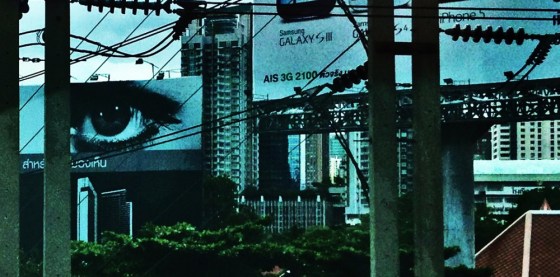
Photo image: Skyline at Ploenchit Bangkok. Reflections on an earlier post The Beholder

a twinkling diamond light

POSTCARD#321: Bangkok: Remembering North India, Bodh Gaya: 04.00 hours: This is where the Buddha’s enlightenment took place. I’m in a hotel not far from where it happened, the window is open, sitting on a cushion and comfortably watching the breath. There’s a sense of being near the epicentre, ground zero – the sparkling, twinkling diamond light. From here, it spread through everyone who were able to listen, then, in the course of time, reaching out to all parts of the East. Hundreds of thousands of visitors from Tibet, China, Japan, Korea, South East Asia and other places eventually came here to see for themselves, the places where the Buddha walked.

Something I’d really like to do before running to catch the last bus, is to visit all the Buddhist countries in the world. I’ve been to Bodh Gaya, Śrāvastī, and the other sites in North India, where that sparkling diamond light can be seen. All those centuries ago, the presence of the Buddha, – although typically, we have to line up with hundreds of other visitors and shuffle through these neatly restored monuments with a fence all around and guards at the gate to keep out the beggars.

Better just to find a place in the grass comfortably situated in the shade of these huge Pipal trees. How much of this is as it was, 2,600 years ago? I’m seated on the earth, with the others in my group. I am distinctly aware that the Buddha walked near to here when it was called Jeta’s Grove – Thus Have I Heard. The wind gently moves across my face, becomes tangled in the hair on my head. The sensation of the breath gently touching the inner nasal passages, and the consciousness that arises with that feeling – look around, the same blue sky, brown earth, green foliage, even though the objects I see may not be the same as they were then, the process of seeing is the same, received in the ever-present conscious experience – a manifestation of consciousness experiencing itself in that twinkling diamond light.

“Where there is the mind, where there are mental phenomena, mind-consciousness, things to be cognized by mind-consciousness, there a being exists or the description of a being. Where there is no mind, no mental phenomena, no mind-consciousness, there a being does not exist nor any description of a being.” [SN 1.65]


Reflections on an earlier post titled Now As It Was Then

the look of eyes (1)

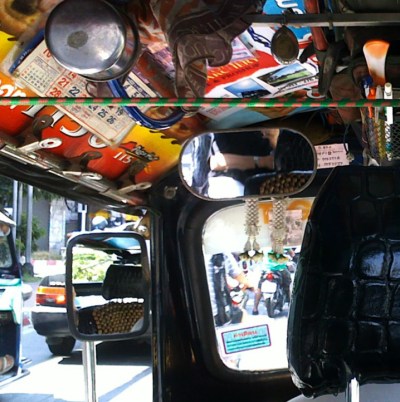
POSTCARD#319: Chiang Mai: Moving through the main road traffic in a tuktuk, going at an unforgivable speed, just amazed by the noise of it. Lying back on the seat in the slouched position, holding on to everything, and the body kind of adhered to the seat. We make a fast turn into a soi (narrow road), lurch to the right in this flimsy three wheeled vehicle, lightweight structure with a wide seat, shiny chrome poles support a canvas hood overhead and nothing to separate outside from inside.

We’re now in a residential area, careering down a narrow path; the engine noise is louder here. Pedestrians turn and look as the tuktuk approaches and step back out of the way. There’s just enough time to see the person’s head turning in my direction, I glance and have eye contact, wish them well in my mind, and I’m gone. Turn another corner and somebody else looks up from what they’re doing. It happens again and again, an old woman, a child, and a man just sitting on the wall. He hears the sound of the approaching tuktuk, head rises, shoulders turn and face comes round to where I am, looks at me sitting in the back seat, I smile and he does too. We’re in a moment, a shavingth of time and it’s gone. Again and again it all takes place in a couple of seconds – not unusual, quite ordinary… a fragment of a shared moment.

Heads move in my direction: who is that in the tuktuk? The human reaction eyes and ears; vision and hearing, and mouth is there to speak or call out if necessary. All these sensory receptors are positioned together in or about the face and the flat plane of it moves round like a small parabolic TV satellite dish reaching out for a signal, ready to respond. Sometimes it’s too fast and the thinking process doesn’t engage. I see the beginning of recognition, mind takes over and ‘self’ locks in, then released and the tuktuk is gone in that same instant. A brief glimpse; an excerpt from a sentence; a few words that don’t have a context.

Each person I see is ready to respond, smile, say hello when we have eye contact. It’s my responsibility to smile and wave because the place where I am at, is moving too fast and they see first I’m not anybody they know, white face, pale eyes, kind of invisible. Sorry, have to rush, bye! It’s a brief encounter then zoom round the corner and there’s somebody else. Face turns, eyes look and mind engages gear… she looks at me sees the prepared smile, smiles in recognition of my polite intrusion in her space and that is somehow hugely reassuring for me. The face turns away, and ‘I’ am not here, I never was here really, it just seemed like that for a moment; the look of eyes, and our shared world, the air takes the volume of a space where there’s always enough room for it, and the water in the lake is for fish to find somewhere to swim around in….


Photo: Chiang Mai Tuktuk

mindful attention

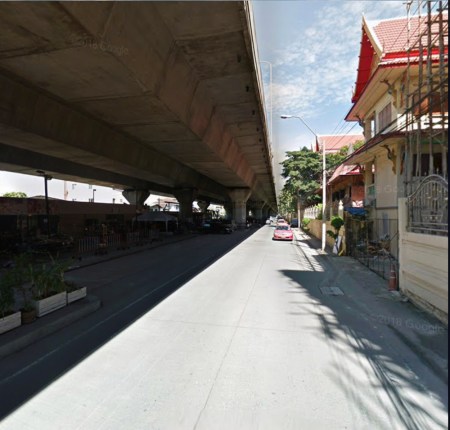
POSTCARD#317: Bangkok: I’ve been here long enough to remember what some districts looked like without the huge shadow of the elevated highway and overhead Skytrain. Congestion underneath; traffic jams, and not much room. Small markets, street food, but the population were okay with it – maybe forced out because a massive concrete pillar had to be situated right in the middle of where they used to be. But mostly they found another location, moved back a bit, shared the space among themselves giving way to the changing infrastructure.

The photo above shows the North/South Highway at Nontaburi that meets the city network of raised highways. On the right stands the Buddhist Wat Bua Kwan temple – buildings coloured red and cream. I don’t know if they lost a bit of land in the intrusion of the highway, they probably did. One thing the monks and laypeople who lived there lost, was the relative silence of how things used to be before the highway came. The noise level now must be incredible.

Then the road was finished and we’d pass by above the temple often, seeing only the exotic peak of the roof at first. After some time the roof was taken down and scaffolding appeared instead, then an upper floor was built. When the floor was completed, an enormous Buddha statue was placed in the centre facing East and the sunrise over the rooftops below. Then the walls and roof were built up around it.

It sounds like all this happened very quickly but it took special artisans 5 to 6 years, working  slowly and carefully, and allowing time for blessings and ceremonies to take place. Each part of the upper floor and walls were done in the same way and the special curved roof was completed with the whole extent of mindful observances.

Now it’s finished and we pass the building on the left side (lower photo) as we go into town (Thailand drives on the left). Coming back at night the whole thing is lit up and… it just blows me away.

Also the sense of the monks there, and in meditation morning and evening, otherwise occupied with household tasks, teaching in that beautiful place – but surrounded by this colossal sound of traffic 24/7. It says something about patient endurance, the way one can tolerate external things mindfully and allowing internal narrative to be in balance. The monks living there are sending a clear sign to car drivers and passengers passing by that it is possible to calmly persevere with mindful attention, sometimes in difficult circumstances. Remembering too that all things arise and pass away.


Ajahn Chah was in London, staying at the Hampstead Vihara. The monks were troubled by the noise that was coming from the pub across the road. Ajahn Chah told them that the cause of suffering was their sending attention out to trouble the sound. Sound itself is just so. Suffering only arises when we ‘go out’ and add something extra. Seeing our part in creating problems, a shift in the way we view struggles takes place. Instead of blaming, we simply ‘see’ what we are doing, in the moment. Let’s not get into a fight with hatred; exercising careful restraint and with Ajahn Chah’s reflection, we let it ‘fall away’

Initially we see this only after we have reacted and created suffering. With practice we catch it sooner. One day, we will catch ourselves just as we are about to create the problem. (Ajahn Munindo)