windows

BKKtaxi2POSTCARD#55: Bangkok: Coming in from the airport in a taxi with my Thai niece. I call her M, nine years old (soon be 10) and playing Minecraft on my iPhone all day. Glass window opens into another reality, digital trees, cubed terrain, oceans and snowscapes in a gravity reduced space. ‘Look, Look, Toong-Ting’, she says. Since she was an infant, M has called me Toong-Ting; holding on to her baby talk of the past and now it’s somehow cool to call me that. I lean over to see what’s going on in her window: building an ice palace with Lapis and Gold entranceway while playing the ‘Let it Go’ soundtrack from the movie, ‘Frozen’. I listen, ask questions, sing along and we exchange views – limited because English is a second language. When there’s nothing left to talk about, she returns to the Minecraft world and I hover in space waiting for the next question to arrive.

I am the support system, resource person, back-up plan. We came by plane from Chiang Mai this morning and the day has passed us by like this; M absorbed in her Minecraft software and the outside world seen from a sequence of moving vehicles we’re in, time and space transforms around the moment. Clouds in high altitude sky of 30,000 feet, mountains of buildings in the urban landscape and M emerges from the dream from time to time to pull me into the depths of the inner world she’s in – let’s see what she’s doing there… we dialogue about it, laugh, and she disappears further into subterranean caves, while I swim up to the surface again. There’s only a short time for me to look at the page I’m reading… sometimes only a few seconds before the next request arrives: “Look Toong-Ting, look, look…” I take a deep breath and dive into the water again. In the intervals between these visits to M’s world, I’m having to be mindful and speed-read my text like pieces clipped from a larger flow of words; one piece jumps out more than anything else:

A man is searching for God but gets frustrated in his effort, throws a stone into the water and a fish sticks its head out, says: ‘You think you’ve got problems? I’ve been swimming in this river my whole life looking for water, dying of thirst and cannot find any water to drink.’ The man says, ‘But the river is filled with water, there’s not a spot in the river where there is no water. Just open your eyes and you’ll see.’ And the fish says, ‘same with you; you’re surrounded by God. God is all around you and within you. Yet you say you can’t find God…’ [Sant Rajinder Singh: “The Love of God Is All Around Us”] (Click here for the original source: Holy Notion/ God and the Self)

Our taxi arrives at the house, get inside and M runs around discovering the familiarity of the last time we were here. Later in the day we’re in a corner of the room where she has her playthings scattered around. Everything lying in disarray after a particularly large creative frenzy of cutting out and the sticking of things with glue, scotch tape, adhesive coloured paper and bits of old Christmas decorations, recycled. And when every additional use these items might be put to is thoroughly exhausted, M moves to Minecraft videos on my laptop: “Look Toong-Ting, look…” she says.

I position myself so I can see the screen, participate when I’m needed, and otherwise pleasantly distracted by the surroundings; the world suddenly thrust into a clear, enhanced three-dimensional presence. Objects become somehow… known? All our bags and things just lying where they got dropped, extensions and extrapolations of the environment of rooms, the furniture, the plants and trees outside. A momentary happiness, bien-être, no words for it…

‘… the Truth and the way leading to it are often indicated by what they are not rather than what they are… in the Upanishads, ‘neti… neti’, meaning ‘not this… not this’, the reality of appearances is rejected. In Christian theological language, referring to what things are not is called the ‘apophatic method’, also known as the via negativa.’[Ajahn Pasanno & Ajahn Amaro: The Island – An Anthology of the Buddha’s Teaching on Nibbana]

————————-

passing through 1

tuktukChmai4POSTCARD#54: Chiang Mai: Situated at the top of a column of words (at the time of writing), light and easy, a feeling of no-thingness, the world is here but no serious attachment to anything. Emptiness of space in the place where “I” have not yet arrived and the sensory mechanisms that give the world meaning for me are still offline. Look at the altitude app, it says 1043 ft. above sea level, add 180 feet for the height of a 7 floor building and my location is identified. I am standing with my bag here on the top floor of said building, waiting for the elevator down… everything goes down from here. Doors open, step in with my bag on its little wheels, doors close, and down we go. It’s a small elevator space with large mirror. Is this good or bad; the witchcraft of mirrors. Study my reflection, hmmm… look into my eyes and see my eyes looking back out at me – slightly scary, stop doing that. Elevator stops at the 3rd floor, doors open, nobody there… a volume of 3rd floor air enters, doors close. We go down again, floor numbers on the indicator decrease as we descend further. Look at my reflection like a friend standing next to me. Examine the teeth in a large wide grin; watch myself holding this grimace, weird guy. Try to be normal; this is how I’m seen in public. Elevator reaches the ground level.

The people in the lobby are engaged in a conversational event that started before I got here and there’s a pause in the dialogue as I step into their space. Eyes look… do we know you? Smile, show teeth, no cause for alarm folks, just passing through. Walk out the main door and lift my bag down the steps. Street restaurants, the smell of exotic cooking, noise and clatter, a child cries, bicycles creak, rubber wheels on hot tarmac, a motorbike fills the place with sound. I have the feeling that I’m now situated at the top of a column of bones, ligaments, tissue, fluidity, and looking out of two holes in the skull that bond together into a single screen monitor – just the edges seen and the side of the nose. If I focus on something in the environment, through sight, sound, smell, taste, touch, there’s a curious ‘entering’ takes place… the outside world invades totally, no boundaries, and my whole head disappears* (funny how it does that) and there’s only the world, with me in it, headless. Everything switches back to normal view, when I want it to, and back to watching my feet appear and disappear on the ground below, one at a time: left, right, left, right. My bag following behind, rumbling along on its little wheels, slippers flip-flop on soles of feet…

Looking for a passing tuk-tuk or some means of public transportation that’ll take me to the airport. Reality check: am I at peace with myself? Is there an easefulness or am I busy thinking about things? How am I feeling? Allow the software to do its job; the facility of reflecting on how all this is going so far. Outer noise and heat find a way through the senses and have an effect on the mind/body organism in its ambling walk down the road – that stumbling gait, typical of lanky Western folk. Pleased to know how it feels and I can be aware of the sensation without making it into something I love or hate. Letting the events of the mind go unheld; give it all away, the great generosity of relinquishment. Be kind to myself, the ongoing practice of learning how to live my life. Tuk-tuk arrives, get in, wind in my face….

‘Human beings have a reflective quality that steps back from experience and says: “I don’t like this. It shouldn’t be this way. Stop it!” The aim of the spiritual path is to fully understand that the main problem of life is not that the government is unfair, that one isn’t getting enough money, that there is hunger, violence, pain or sickness, not even that one isn’t loved – but the feeling in the reflective mind of being bound down by these circumstances. Once we have clearly understood the mind, we can experience patience, equanimity, and release – even in predicaments that can be difficult or unpleasant.’ [Ajahn Sucitto, ‘Making Peace With Despair’, from the volume: ‘Peace and Kindness’]

————————-

*Reference to: ‘On Having No Head’ by Douglas Harding
–  G  R  A  T  I  T  U  D  E  –

a patch of sunlight

IMG_0540POSTCARD#50: Delhi: It’s cold here, fingertips touch the keys tentatively, unwilling to make contact. Feeling chilled all the time and can’t seem to get comfortable with this February weather. I just arrived from Thailand, my bag, still unpacked, contains the blue sky and sunshine of white shorts, sunglasses, T-shirts and rubber slippers. Wow it was hot there; I’m reluctant to let go of that nice feeling.

It’s like the world extends only as far as the immediate surroundings of where I’m currently situated and it takes a little time to reassemble things if I move 2000 miles to somewhere else. There’s the tendency to hold on to nice things and I’m particularly reluctant to let go of it this time because the visit to Delhi is only for a couple of weeks, then I go back to Thailand again. So I’m in transit, not really ‘here’, and that’s why I’m making the excuse that it’s not necessary to unpack my bag.

My bag is an extension of ‘me’, it’s my identity, part of the self-construct I’ve created, the same as everyone else’s sense of ‘self’. I feel a fondness for my bag, a familiarity and a connection with that small volume of folded clothing, flattened garments, papers, books and various computer cables, that’ll be zipped up tight, X-rayed and pushed back into its space in the aircraft baggage section along with all the other bags, and away we go back to the sunshine. But that hasn’t happened yet, and I’m stuck here in the cold for a number of days.

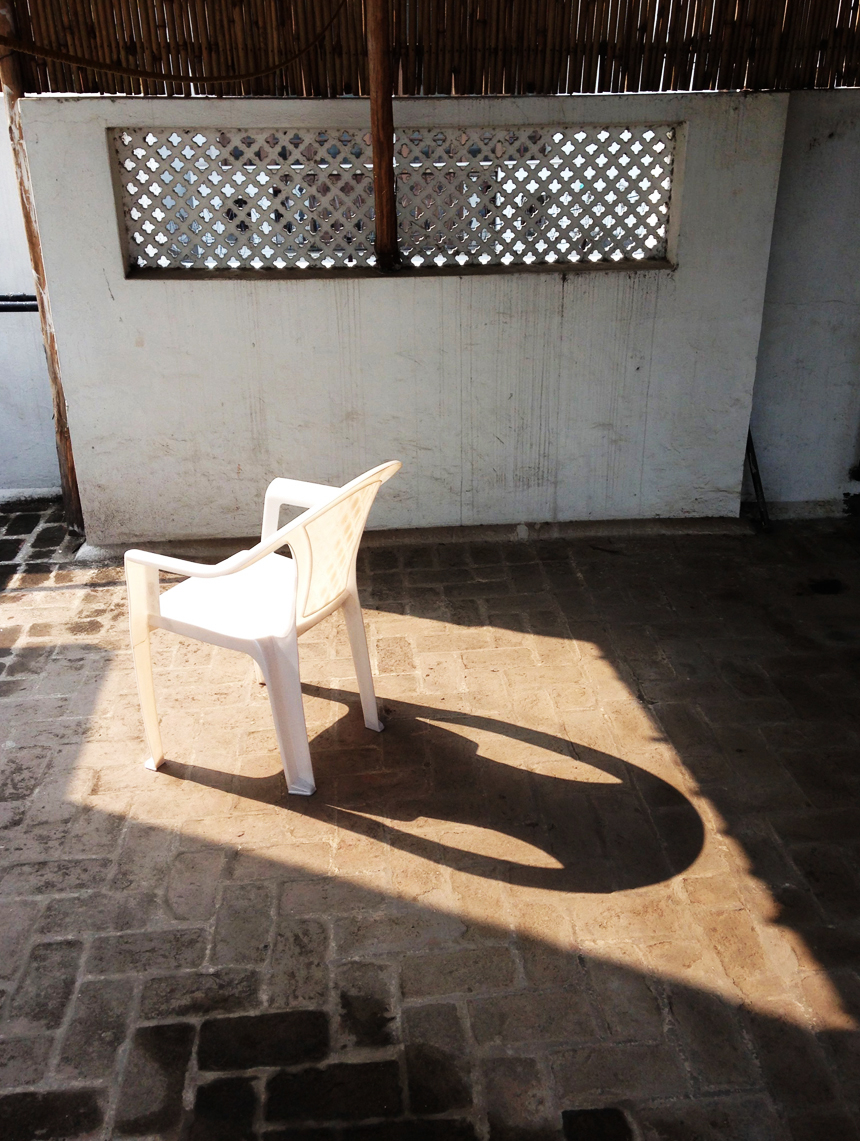
When it’s warm enough I go up on to the roof terrace, to the place where the sun shines through between the buildings and there’s a patch of sunlight where I can sit  on my chair. The chair is in the same place it was two months ago and for a moment there’s a kind of presence about that empty chair… déjà vu; the ‘self’ that was there at that time is gone completely, no familiarity with it – yet I remember being here quite clearly. Now I’m sitting in the warm sunshine, recreating a ‘self’ that suits this time and place, for this duration, knowing that soon it’ll be gone too. Phenomena are as they are for a short time and disappear; it’s as if the appearance of everything has the quality of a pencil sketch, a pleasant unfinishedness.

I look at things, and they’re gone – it’s the time needed to process the thought. Objects are experienced not in present time but just as they’re slipping into the past; everything is always seen in hindsight. Conclusions arrived at after the event. Nothing remains. The day I die will be an ordinary day. The moment after I’m gone will be no different from any other. It’ll be like a pause in the middle of a sentence… the focus on the object slips away, the next moment will just be the next moment and things will go on as if nothing happened. The fragility of the world held for an instant then it’s gone, only the space where everything used to be and the silence left behind…

‘Usually when we hear the teaching on not-self, we think that it’s an answer to questions like these: “Do I have a self? What am I? Do I exist? Do I not exist?” However, the Buddha listed all of these as unskillful questions. Once, when he was asked point-blank, “Is there a self? Is there no self?” he refused to answer. He said that these questions would get in the way of finding true happiness. So obviously the teaching on not-self was not meant to answer these questions. To understand it, we have to find out which questions it was meant to answer.’ [Thanissaro Bhikkhu:Selves & Not-self: The Buddhist Teaching on Anatta’]

————————-

valentine palindrome: 14/02/2014

IMG_0532bPOSTCARD#48: Bangkok Airport: Man wearing a bright red shirt leans backwards with hands behind his head just as I take the photo and it looks like a heart shape. Sitting in a coffee shop at Concourse B waiting for the 8.40 pm flight to New Delhi, decided to take the photo of the interesting curved shaped roof structure and didn’t see the heart-shape till I arrived in Delhi. A happy coincidence… and Valentines Day is special this year because of the palindromic sequence of date, month and year: 14/02/2014. Coming into Delhi from the airport, in the midst of pretty fierce traffic, I thought how nice to have this kind of numerical valentine and a day of love in a city that’s normally bristling with displays of proud male plumage and all things unloved. Then, looking through the image gallery in my camera phone, I discovered the photo – a gift, there in all the noisy traffic, a reminder to see beyond the tightly controlled mind state experienced in the driver’s seat.

The contemplation on loving-kindness, metta, begins with a focus on myself, my own well-being, and using that as a point of reference, I can extend it to others: “Just as I wish to be happy and free from suffering, so may all beings be happy and free from suffering!” Then I extend the thought of loving-kindness to a person for whom I have love and respect; and to those who are close to me. Extending then to those who are indifferent and to those disliked. It’s about the necessity of cultivating feelings of kind consideration to others; a conscious act of generosity rather than abiding with the unconscious default holding and keeping things to myself.

Arrived at the house, good to be back after two months away. Unpacked and found the Buddha’s Words on loving-kindness: the Karaniya Metta Sutta.

This is what should be done
By one who is skilled in goodness,
And who knows the path of peace:
Let them be able and upright,
Straightforward and gentle in speech,
Humble and not conceited,
Contented and easily satisfied,
Unburdened with duties and frugal in their ways.
Peaceful and calm and wise and skillful,
Not proud or demanding in nature.
Let them not do the slightest thing
That the wise would later reprove.
Wishing: In gladness and in safety,
May all beings be at ease.
 Whatever living beings there may be;
Whether they are weak or strong, omitting none,
The great or the mighty, medium, short or small,
The seen and the unseen,
Those living near and far away,
Those born and to-be-born
May all beings be at ease!
Let none deceive another,
Or despise any being in any state.
Let none through anger or ill-will
Wish harm upon another.
Even as a mother protects with her life
Her child, her only child,
So with a boundless heart
Should one cherish all living beings;
Radiating kindness over the entire world:
Spreading upwards to the skies,
And downwards to the depths;
Outwards and unbounded,
Freed from hatred and ill-will.
Whether standing or walking, seated or lying down
Free from drowsiness,
One should sustain this recollection.
This is said to be the sublime abiding.
By not holding to fixed views,
The pure-hearted one, having clarity of vision,
Being freed from all sense desires,
Is not born again into this world.

[Karaniya Metta Sutta: The Buddha’s Words on Loving-Kindness (Sn 1.8), translated from the Pali by The Amaravati Sangha]

————————-

[See also the Buddhist teaching on The Four Sublime States: Contemplations on Love, metta, Compassion, karuna, Sympathetic Joy, mudita, and Equanimity, upekkha, by Nyanaponika Thera]


leaving

IMG_0500POSTCARD#44: Chiang Mai: Time to close this chapter of the story. I’m leaving soon for New Delhi, transit in Bangkok for some days. The flight departs at 16.20 and before that there are things to do in the apartment: a basket of laundry to iron; ironing table set up and I’m standing there. Pointed end of the iron smoothens its way among the creases, sailing through mountains and valleys of fragrant laundered cloth, leaving a warm, flat plain of patterned textile in its wake. Place the heavy iron on its metal stand and there’s that pleasing little sound: clink-clink… then pick it up again to do another part of the garment. Doing the front, the back, the shoulders, the collar – place it on its stand again: clink-clink. Ironing is such a peaceful thing, the hot smoothness of it, all these landscapes of wrinkled cotton eased away.

Pictures unfold in the mind, a memory appears, the story begins. It’s wintertime, I’m in Kamakura, Japan, snow everywhere and the colourless luminosity of reflected light inside the dark interior of my cute little house (everything is small in Japan) high up on the slope of a hill, in the precincts of Zuisenji temple. The ironing table set up by the window; just enough room if I move carefully, laundry basket placed at hand and on the corner of a small table, a pile of folded ironed things. The brightness of reflected light outside illuminates what I’m doing. A time of sleepy afternoon days, the clink-clink sound of the iron at intervals intrudes gently into this comfortable silence.

There’s a small slooshing sound of someone walking through the snow – look out the window; a blinding whiteness, a photographic negative. Black tracks of footsteps on the path leading to the steps to the temple. It’s a lady walking with great care, taking smaller steps than Japanese ladies usually take. She is dressed in a long dark maroon coat and indigo coloured costume down to the ankles, feet in wooden geta slippers secured by a small V-shaped thong passing between the first and second toe over tabi, white stockings specially stitched for the purpose, and the entire foot encased in transparent galoshes with pretty floral designs. Holding her hand is a little girl about 8 years old, and it just happens that as I’m looking at the girl and her small white face, alert eyes, she turns to look at me… a faint smile, a moment of intelligent understanding; she sees me, a gaijin, framed in my window at eye level with the street: a foreigner lives there, in a house the same as ours… or maybe there are no words for it, just some kind of recognition, an enigma suddenly cleared away and knowing this.

How did life turn out for her? I feel sad that we only had the shared experience for that instant. Maybe it’s the remembering of events like these, returning many years later; a moment recalled, a thing that was puzzling for a long time suddenly understood, somehow – beyond words. These small moments of understanding, overlapping each other and it could be the more I’m aware of it, the more conscious experience includes the possibility of revelation. And this is the reason why there’s always a fascination with the remembered moment; an event or an accumulation of events that make sense… somehow. Language doesn’t stretch that far; the whole thing just carries meaning.

Ironing along the seams, the waistband, how good these garments look, just as they are, stitched art objects – clink-clink goes the iron. Pictures unfolding in the mind, a memory of an event is a story with a beginning, a middle, an end – although I might arrive in the middle and have to work it out from that entry point; searching for the ending of it so that I have some idea of what the beginning could have been – then re-order it so the story starts as it should (“… once upon a time….”). Language insists on a structure, I have to ‘story’ it (verb: to story), think about how to get it to work; what happened after that? Create a sequence of events. Listening to a story I’m telling myself as if it were being told to me by someone else.

Getting this place cleared up and ready now so that it can enfold itself quietly in hibernation while I’m away living in another world. Soon it’ll be time to jump into the taxi and off…

‘We are forever telling stories about ourselves. In telling these self-stories to others we may, for most purposes, be said to be performing straightforward narrative actions. In saying that we also tell them to ourselves, however, we are enclosing one story within another. This is the story that there is a self to tell something to, a someone else serving as an audience who is oneself or one’s self…. On this view the self is a telling.’ [Roy Schafer]

————————-

appearances

IMG_0488POSTCARD#43: Chiang Mai: It’s been a long extended morning, awake before dawn. My day began at 3 am – not a day, a night… correction, not ‘a’ night, just ‘night’, no defining characteristics. Night, as in: ‘the state of night.’ Night as an abstract noun, the darkness that envelops all beings in sleep, including a few birds, head-under-wing, perched on small branches in the treetops, level with my apartment on the third floor. All the lights are on here, dishes make noise, kettle boiling; cups rattle but there’s no coffee, and I can’t go out to get some because everything is closed… a long time to wait before the little supermarket round the corner is open. I sit near the window and look at the birds breathing,  their small chest movements sometimes visible.

A couple of hours reading friends’ blogs in the UK and the East coast of the US. And by the time it’s daylight, and Chiang Mai is awake, I feel like going back to bed. But instead, I’m walking along the road blinking in the sunshine. The air is warm like a soft blanket; no heaviness of winter clothing or hard shoes.  T-shirt, shorts and rubber slippers, everything light and easy. Noise and clatter, traffic, smells of food cooking. Everywhere you look it’s like a children’s picture book, blue sky and golden people who smile all the time. The world has been photo shopped, vivid, maximum-pixels. Everything appears as if lit from within, bananas are almost luminous; papaya fruit is a magic-marker orange. Too bright for me, I feel like an owl in the daylight, a nocturnal shadow… let me hide in the shade of my sunglasses; deep, cool, blue-green, cloaked in my dark, quiet space.

After the eye operation I’ve been disturbed by bright light. The doctor says the surface of the cornea is exposed, I have “the eyes of a twenty-year-old’ (wow). It’ll take a couple of years to adjust to the world. The sunlight in Thailand is bright like a television studio and I might have felt less sensitive about light, maybe, if I’d been living in the North of Scotland, where I’m from, and been the pale, indistinct, colourless being that I really am, with the pigmentation of a plant growing in the darkness – long and extended tendrils seeking out tiny sources of sunshine and taking on the glow of colour only when the growing tip finds its way through a crack and into a glimmer of light.

So I’m making my way along the small pavement, looking out for traffic hazards in this busy place and staying alert because of the rough paving underfoot I could stumble on – all kinds of obstructions and sometimes no pavement at all. A small temporary restaurant has arrived that wasn’t here yesterday, the owner just drives up in a pickup truck, sets up his stuff on the pavement, tiny tables unfolded and stools to sit on. It blocks the way, pedestrians cannot get past, have to step down on the road and walk out in the traffic, then back up on the pavement again. Can’t help feeling they ‘shouldn’t’ be allowed to do that… I notice though, that nobody here seems unduly affected by the inconvenience. Thais don’t impose their ‘preferences’ on a world that is for the most part neutral. It’s a Western thing to try to customize it according to what it ‘should’ be like, and engage with all the feelings conjured up by a ‘self’ that makes ‘my’ world into something good, bad or whatever.

Suffering a bit and thinking about this turmoil of having to adjust my expectations of the world according to how things appear to be and why bother with all that because things never turn out exactly as I want them to be – but the best is yet to come, really, because when I get to the little supermarket, the whole place has been demolished! It is totally not there. Doors taken out and nothing remains of the place that I recognize, just this very large, dark, dusty hole in the building. Some kind of major renovation. Hmmm looks like I’ll not get the coffee I came here for… but on the way back I see the temporary shop erected on the pavement is selling coffee. So I sit down and have one there.

‘For life in the present there is no death. Death is not an event in life. It is not a fact in the world. Our life is endless, in just the same way that our field of vision has no boundaries.’ [Wittgenstein]

————————-

light-headedness

IMG_0460POSTCARD#42: Chiang Mai: Don’t know why or how it can be like this, but there’s a sense of joyfulness, today – floating free. An easeful vertigo that’s comfortably not lost its balance. I’ve been looking at the building under construction next door, and seeing it expanding upwards daily. It’s like something sculptural. The floors and wall surfaces that will hold the enclosed space we recognize as rooms and corridors are not complete, just the shape of the space within which things exists, a 3 dimensional photographic negative in the mind’s eye. The builders do everything in negative form.

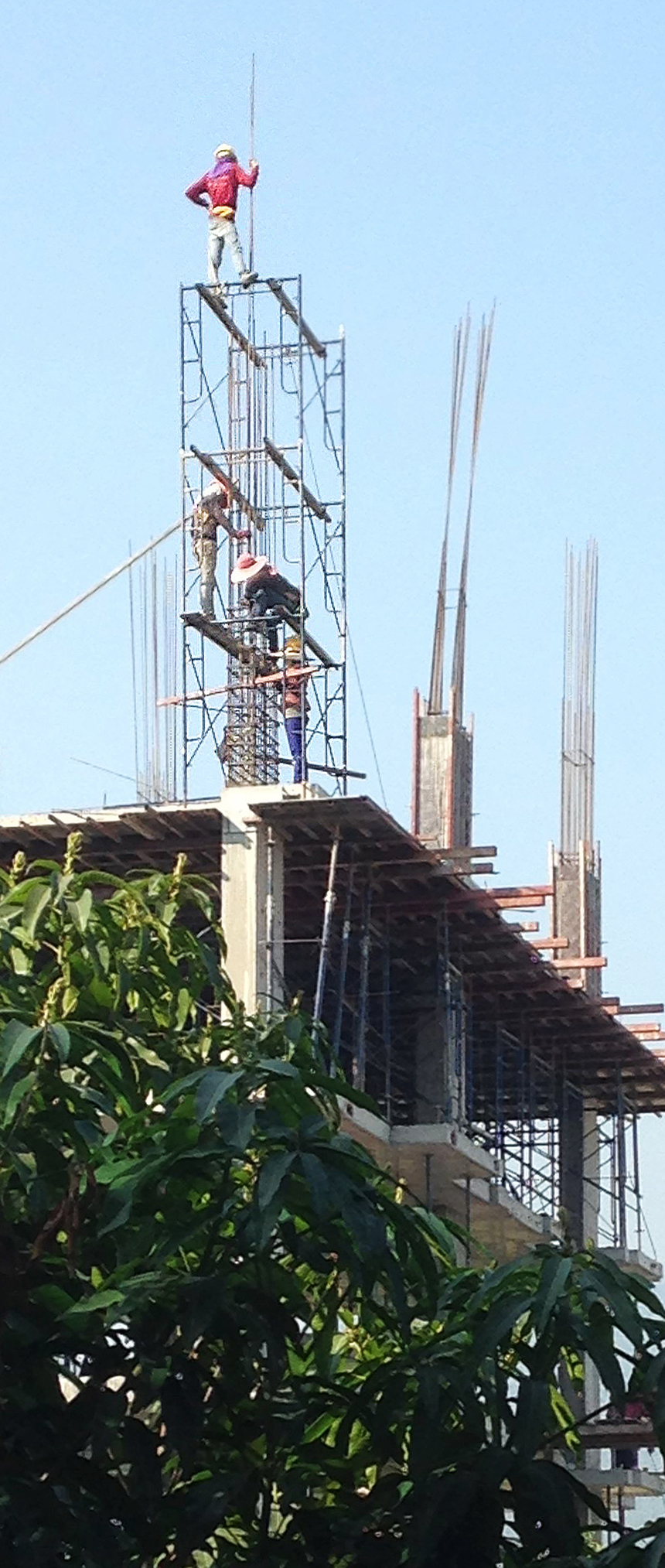
They’ve done one new floor since I last wrote about it [structures]. Bricks and mortar with foundations deep in the earth. So fast, almost like everything is made out of paper, no gravity, no heaviness, and we’re in the realm of birds and flying. The guy in the red shirt seems to be the one who always goes up first; climbing into the sky. I don’t know what his life can be like, maybe bonded to his job, burdened with hardships, and struggling with the contractor over pay… but how could he not feel good today, standing up there in the cool morning and looking out, blue sky as far as the eye can see.

These builders are the heroes of the story, men and women in their wide brimmed straw hats, faces covered with cloth to protect the skin from the sun and regulation hard-hats squeezed down over the straw crown. The big bankers and investors might open bottles of champagne when it’s finished, but they’re nothing compared with these ordinary folk on the scaffolding who climb up into the sky on their flimsy structures and boards and the building follows on up behind them. It’s as if there was a hook in the sky they attach their ropes to and from there, can haul the building up, suspended.

IMG_0462BBuildings are the mountains of the city and the created world. These builders are rural/urban migrants; they’re from the villages and the mountains themselves; mountain climbers who build the mountains they climb. And seen from where I am, on the third floor, this mountain/building next to me appears above the tree line and looks strangely separate from the ground below – I can’t see the foundation, there’s sky above and (I assume) sky below. It’s a floating building.

A strange illusion, I’ve seen it in Switzerland, on walks around Dhammapala Buddhist Monastery. When you’re high up there on a steep incline, with trees near enough so you can see the forest floor below, the mountain above the treetops looks like it has disconnected itself from the earth, drifted away from its moorings; a gravity-free mass of rocky earth and vegetation floating in the sky. Thinking of the floating Hallelujah Mountains in the Avatar movie; based on the Huang Shan mountains in China.

There’s a light-headedness about this because, today, I’m somehow free from attachment to things in the mind. Considering the possibility that one reason human beings tend to be in a state of ‘holding’ a lot of the time, is that we’re all earth-bound creatures; attached by gravity to a spinning planet and the default mindset is this holding-on thing – can be difficult to feel comfortable about letting go. But today I feel released from that pressure; climbing the mountains in the mind. This freedom has always has been like this. I just didn’t notice.

‘The Buddha taught that clinging was the ninth link in the chain of Dependent Origination. In that chain, craving led to clinging, and clinging to “becoming” (bhava), i.e., to continued stuckness in cyclical existence. There are two places where the chain of dependent origination can be broken: at the point where a pleasant feeling turns to craving, and at the point where craving leads to clinging.  We can break the link of craving through awareness of its dangers and insight into where it will lead us.  We can break the link of clinging by simply letting go.’ [Seth Zuihō Segall]

————————-

evenness of 2014

IMG_0382POSTCARD #38: A village near Hat Yai: Here in a house surrounded by trees above window height on the ground floor and in the daytime everything is seen in a translucent green light. It’s an old rubber plantation, with some palms and huge banana trees. Now it’s night and I’m pretty well seeing double having been staring at words all day. Struggling a bit to stay awake to see the coming of New Year – thinking the number 14 is somehow nicer than 13 and also the number 2014 has a pleasant evenness about it? But maybe I’ll go to sleep, it doesn’t seem right to be awake when all the small creatures in the forest are either asleep or being strangely nocturnal and kinda scary in their stealth. I feel a bit obvious here with all the lights on in the house.

IMG_0380Cannot see well, the spellchecker rejects all the Thai and Pali words and onomatopoeias and my spelling innovations; and when it doesn’t know a word I’ve been clicking the ‘Add’ option so much it’ll render the spellchecker obsolete eventually. It’s getting difficult too because small insects attracted by luminosity of screen are walking around in my vision seemingly dotting the letter ‘i’ and crossing the ‘t’ or making an ending to a word that isn’t there. Cannot understand how they get through the mosquito mesh on the windows. I notice that the larger insects stop flying around when you put the lights out because they bump into things, it takes them a few moments to stop where they are, anywhere’ll do and just immediately go to sleep.  I’ll do that too, have to call it a day and shall set this Post so it’ll go out at midnight, and it’ll be the New Year then, Thai time: +7hrs GMT. So, all that remains is for me to say thank you friends and fellow bloggers for visiting me here in the year 2013, and best wishes for 2014. Metta, Loving Kindness, may your year be one of Mindfulness and Letting Go

– HAPPY NEW YEAR TO ONE AND ALL –

IMG_0367

generosity is letting go

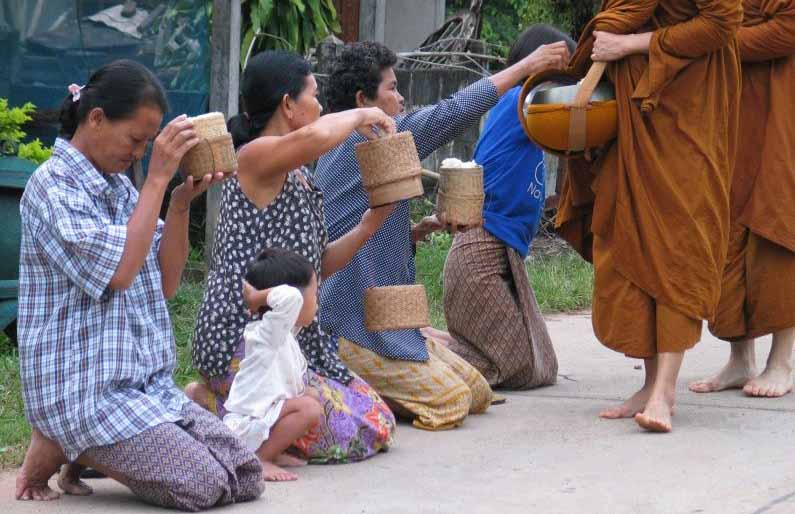
Pindabat 5POSTCARD #31: In Buddhist countries, babies are taught when they are about six months old to put food into the monk’s alms-bowl. The whole family applauds as the sticky rice drops from that little hand into the monk’s bowl. The kid gets the idea early on: when stuff leaves your hand, you get this happy feeling. It feels good to give.

Everything the Buddhist monk receives is a gift, an offering; the monk is a mendicant, and lives entirely on the generosity of others: ‘Our bodies are fueled by the food that is offered to us. In fact, scientists say that all the cells of the body are replaced every seven years, so any (monk) who has been ordained for that long has a body that is completely donated. If it were not for the accumulated kindnesses, efforts, and good will of countless hundreds and thousands of people, this body would not be able to sustain itself. Kindness is the actual physical fabric of what we think of as ‘me.” [Ajahn Amaro, ‘Generosity in the Land of the Individualist’]

Generosity is cultivating an inward disposition to give, a glad willingness to share what we have with others. Give it away, we have more than enough. Ease the discomfort of being driven to fulfill that urge to ‘have’, to ‘possess’, a hunger created by always wanting more. All of it is gone when you’re generous. Brainstorm the word ‘generosity’ and you come up with loving-kindness, compassion, empathy, well-being, freedom. You find gratitude, grace, honour, motivation, encouragement. Generosity is everything. It’s nature is to share, recycle, circulate; it can only be given, never taken.

Generosity, is a mental, emotional letting go; releasing the tenacity of holding on to things; all that baggage we burden ourselves with is removed in one single act of generosity. Generosity means not holding to the self-concept, the separateness applied to things that are really ‘in context’. Seeing it all as process, ever-changing; a connectedness with the outer world. Generosity leads to wisdom – the truth is without bias. The cultivation of generosity directly debilitates greed and hate, and facilitates the kind of mind that allows for the eradication of delusion.

‘There was a seeker and a wise man. The wise man had a most incredible jewel and the seeker was absolutely amazed by the jewel. He asks the wise man if he would give him the jewel. And the wise man gives it to him. The seeker is very excited and afraid that the old wise man is going to change his mind, so he hastily says goodbye and goes off. A short while after that he comes back, approaches the wise man with great humility and respect, lays the jewel down in front of him on the ground and says he’d like to make a trade. He’d like to exchange this jewel. And the wise man asks him what he wants to exchange it for. The seeker says he would like to exchange the jewel for knowledge of how to gain the sort of mind that could give up a jewel like that without a second thought.’ [This story appears in Khanti – Patient Endurance]

————————-

Sources include: Dana: The Practice of Giving
Excerpts from an earlier post: More Than Enough
Upper image is from the Wat Pahnanachat collection

the attributes of self

110520131818POSTCARD #18: Bangkok/Chiang Mai flight: They paint a face on the nose of the aircraft, the ‘cute’ concept – a Thai version of Japanese kawaii かわいい . It looks like a bird because the shape of it is beak-like but it’s recognizably a human face wearing sunglasses. Personifications, masks, fictional characters with human attributes respond in a childlike way to a world full of fear and joy. Goldilocks and the three bears finding the Buddhist Middle Way by trial-and-error: the first try is too hot; the second try, too cold; the third try is just right. Why not? This is a non-serious, one-hour flight; no sooner have we departed than we arrive. Smiling doll-like stewardesses in yellow costumes have just enough time to come up the aisle with a light snack in a paper bag for everyone, back down again to clear everything away and we’re descending into Chiang Mai.

Slightly bumpy, due to weather conditions, the vibration causes the luggage compartments to shake and creak for a moment. Sounds like something nautical; the rattle of rope harness striking the mast of a sailing ship… searching for something it resembles – something to account for this phenomenon of flying above the clouds at an incredible speed. Maybe I’m seeing the journey from Bangkok to Chiang Mai as if we were driving over something solid, bumps caused by an uneven road surface; a highway in the sky, an imagined bridge that spans the distance, 373 miles from there to here – a huge curved span in the sky. Logical mind attempts to create an explanation for it, based on what’s known, a figure of speech, something to help me ease back from contracting around the uneasiness, the unknown… that edgy feeling. Without the metaphor, all I’m aware of is tremendous velocity and a sense of vulnerability. The immediacy of the moment sweeps away all thought-constructs like the ground is gone from beneath my feet. Mindfulness of breathing, deeply in and all the way out…

Further into the descent I become a little deaf, it feels like being underwater, and no amount of swallowing or blowing of air into sinus cavities seems to clear it. Near to landing there’s the sound of the hydraulics, out go the flaps, down go the wheels and the earth rises up to meet us; 300 people contained in a structure the size of a building colliding with the surface of the Earth at 200 mph. A great yawning abyss of existential anxiety; I need something to hold on to – but there isn’t anything that’ll prepare me for such a colossal event; the roller-coaster experience. Aircraft wheels take the weight, first one then the other and the deep lurch, sink-down/bounce-back – for a moment it feels like we’re going to go out of control and disaster… then it’s okay.

There’s something about it being in a public context, we’re all in this together, and the sense of a letting-go of something tightly held: woooooo! The small ‘self’ is seen and relinquished; there’s nobody there… just this unattached feeling that couldn’t happen in any other circumstance. The Buddhist cessation – no words for it, consciousness doesn’t normally reach that far. No person, no identity. Before the Greeks created the Buddha image we know and accept today, there were only symbols, a riderless horse, the empty seat… footprints left behind in the place where he was.

 ‘… that dimension where there is neither earth nor water, nor fire nor wind, nor dimension of the infinitude of space, nor dimension of the infinitude of consciousness, nor dimension of nothingness, nor dimension of neither perception nor non-perception, nor this world, nor the next world, nor sun, nor moon. And there, I say, there is neither coming, nor going, nor stasis, nor passing away, nor arising: without stance, without foundation, without support [mental object]. This, just this, is the end of stress.’ [Ud 8.1]

————————-